
Geography Now
Published 23 Nov 2016Seriously though. Do those squats bro.
(more…)
June 16, 2023
Geography Now! Finland
Comments Off on Geography Now! Finland
QotD: Sailing ships in the real world versus sailing ships in Rings of Power
There are a bazillion ways to rig a ship (a lot of them with really fun names), but all sails function in one of two basic ways. First it’s worth noting every ship operates in both a “true wind” (the direction the wind is actually blowing) and an apparent wind, which is the combination of the true wind with the direction the ship is sailing and its speed; the apparent wind is what matters for sail dynamics because that’s the wind that the sails experience. If a ship is sailing at 8 knots and the wind is moving at 12 knots, but the ship and the wind are moving in the same direction, the apparent wind the ship experiences is just 4 knots. On the other hand, if the wind speeds remain the same but we have the same ship moving perpendicular to the wind, the apparent wind is going to actually be 14.4 knots and come from a direction between the ship’s heading and the wind’s source.
Square sails, which are rigged perpendicular to the direction of the ship work by having the wind strike the sail and pile up into it, which creates a high pressure zone behind the sail (because all of the air, blocked by the sail, is “stacking up” there) and a low pressure zone in front of the sail, which pushes the ship forward, technically a function of aerodynamic drag. The upside is that square sails can produce a lot of power, which is handy for big, heavy ships, especially in areas with predictable and favorable winds (such as the Atlantic trade winds). The downsides are two: on the one hand, top speed is limited because the faster the ship goes, the lower the apparent wind on the sails, which in turn reduces how much they can push the ship. On the other hand, square sails only work if the ship is moving in more-or-less the same direction as the wind is, within about 60 degrees or so (so the ship has a c. 120 degree range of movement relative to the wind). Moreover, for square sails to work, the air hitting them from behind needs to be substantially confined by their shape; this is why square sails are made to billow outward into an arcing shape as the wind hits them, instead of being held taught and fully flat against the mast.
Triangular or lateen or fore-and-aft sails work on a different principle. They are arranged parallel to the direction of the ship (that is, fore-and-aft of the mast, thus the term) and want to also be close to parallel to the wind (both square and triangular sails can, in some configurations, be moved around the mast to a degree to get an ideal direction to the wind). The way they work is that the wind hits the sail on its edge and the air current splits around the sail, but not evenly; the sail is turned so that the back side takes more wind, causing the sail to billow out, creating a wing-like shape when viewed from above. That in turn acts exactly like a wing, creating a high pressure zone behind the sail and a low pressure zone in front of the sail and thus generating aerodynamic lift as the wind passes over the surface (rather than pressing up behind it) the same way that an airplane’s wings keep it in the air. The clever part about this is that the lift generated doesn’t have to be in the same direction the wind is going, so a ship using these kinds of sails can move up to within around 45 degree of the wind (sailing “close hauled” – a ship rigged like this thus has a much larger 270 degree range of motion relative to the wind). Also – as noted above – depending on the ship’s “point of sail” (direction of movement relative to the wind), accelerating may not decrease the wind’s apparent speed (because you may not be sailing directly away from it), and so triangular sails often function better in light winds, sailing into the wind, and at very high speeds (but they provide less power for large, heavy ships sailing with the wind). And again, there is a lot of complexity in terms of the different functions of these types of sails, but we’re really just trying to make a fairly simple point here so everyone please forgive the simplification.
And that’s it: all sails work on one of those two principles (at any given time); the point in discussing this is to note that we’re dealing not with aesthetics here but with objects that need to interact in fairly fundamental ways with aerodynamics and so have shapes that are dictated by that function (and also, sails are cool). You can combine those two principles in a lot of exciting ways to create different “rigs” with different sailing qualities, but you those principles are your options – you cannot create some other kind of sail which works on different principles. Indeed, most of the more complex sailplans of larger ships use a combination of square and lateen sails, but each sail in the plan must be using one of these two principles; there are no other options.
And those of you looking back at what these ships [in Rings of Power] look like may have already guessed the problem here. These are clearly square-rigged ships; the sails are all perpendicular to the ship’s direction and the sail shape is symmetrical over the keel (that is, same shape on the port and starboard) and are unable to be angled in any event. But every single sail has a gigantic hole in the center because of the split mast. So the air you want to build up behind the sail is instead flowing through the hole between the masts. The sails even angle slightly, curling backwards at their outer edges channeling the air towards the gaps. But that air flowing through the gaps is going to lessen (not remove, but substantially lesson) the pressure differential over the sail which will cut the drag the sails generate which will make the ship much slower.
What is worse is that between the two masts and between the foremast and the bowsprit, the ships mount additional secondary sails. Now in a rig-plan that made any sense, these would be triangular sails in both shape and principle (e.g. gaff-rigged sails incorporated into a square-rig sailing pattern common for full rigged ships as well as staysails between the masts or between the foremast and the bowsprit, also common for full rigged ships), but the designers here have only managed one of those two things. The sails are triangular in shape, but are positioned perpendicular to the wind direction and then symmetrically matched. That means they both do nothing with the wind moving through that center channel we’ve created, but also their triangular shape is entirely useless because they’re functioning on drag instead of lift.
It’s not that this sail plan wouldn’t work: the big sails would create at least some aerodynamic drag which would push the ship forward. But this is a sail plan which would work much more poorly than a far more basic plan with just a single central mast mounting a single very large square sail. You could even keep the exotic junk-style sail supports (they’re called battens; everything on sailing ships has a funny name) if you wanted and just make the ships junk-rigged! Or, if you want a lot of fancy sails which aren’t in square shapes, you could go with a multi-masted dhow or xebec sail plan which would give you lots of overlapping triangular sails and also fit the Mediterranean/Roman vibe you were going for.
Moreover, while these sails aren’t square shaped, this is a pure “square sail” ship rig, which for ocean-going ships ostensibly used by great mariners is awful. Square sails only work well when running before the wind: they “tack” (zig-zagging from one close-hauled point of sail to another to climb up the wind) really poorly; some pure square-rigged ships cannot tack at all without the assistance of rowers. That’s is part of the reason why “full rigged” square-sailed age of sail ships nevertheless had triangular sails in gaff-rigging or as stay-sails or what have you, to enable the ship to tack effectively (the fancy term for this is how “weatherly” a ship is: how able it is to sail close to the wind; weatherlyness also depends on hull shape and a host of other factors). With a pure square-sail setup, these ships can only go in the direction of the wind, which is going to make it impossible to use them effectively as ocean-going ships because the prevailing winds on the ocean are very consistent: they will almost always be blowing the same way, which means these ships can sail out, but then can’t sail back. In short these ocean-going mariners have ships which cannot go on the oceans.
And of course this has been a theme of these posts but please, showrunners: when you are doing the visual design for a fantasy-historical society, you are not going to outsmart centuries of professional shipwrights with a brainstorming meeting and some concept art. So instead of trying to show that the Númenóreans are great mariners (“the sea is always right!”), which is the point of giving their super-cool ships so much screentime and is an essential thing to establish about their society, by making up a ship design that is going to end up invariably being much worse than historical designs, just go adopt a historical design that was successful. For my part, I’d have probably contrasted traditional Elven ships with a single sail-type (probably square) on a single mast with the advanced Númenóreans using lots of lateen sails.
That said, the fact that the Númenórean ships are terrible is fine because frankly, I wouldn’t want to sail to this battle either.
Bret Devereaux, “Collections: The Nitpicks of Power, Part III: That Númenórean Charge”, A Collection of Unmitigated Pedantry, 2023-02-03.
Comments Off on QotD: Sailing ships in the real world versus sailing ships in Rings of Power
June 15, 2023
Ketman, in theory and practice
I first encountered the idea of Ketman in an article by Severian on his old Rotten Chestnuts site (no longer online, alas). He was talking about it in the context of university:
I got into the higher ed biz fully intending to practice what Milosz calls “aesthetic ketman“. [“paying lip service to official ideology while secretly subverting it”] I loved my subject, but my subject was recondite enough, I figured, that I could keep the SJW bullshit to a bare minimum. I don’t remember what they called “intersectionality” back then, but whatever it was, I’d just make a few brief nods to it, then get on with my work in relative peace. Throw a few quotes from Foucault, Judith Butler, Gayatri Spivak, and the like in my dissertation intro, and that was that.
The problem, though, is that the sour pleasure of ketman is addictive, and like any addiction, you need to keep upping the dose to feel the same effect.
In The Critic, Colette Colfer discusses “gender ketman” today:

Ketman is a game of acting. It involves outwardly performing in compliance with a dominant belief system whilst inwardly rejecting it. Ketman is a form of self-protection, particularly when living under strict religious or totalitarian rule. Today, the game of Ketman is played as a way of hiding real opinions about gender ideology.
I first came across the concept of Ketman in Csezlaw Miłosz’s powerful 1953 book The Captive Mind, about life in Poland under Nazi right-wing and Stalinist left-wing totalitarian control. Miłosz dedicates one full chapter to Ketman. To play Ketman is to wear a mask, to simulate the behaviour that is required to fit in with the masses, to avoid the consequences of speaking up against a dominant ideology.
When the UK trade union for academics and lecturers, the University and College Union, released a video last month of their 2023 congress, it showed a crowded room of people loudly chanting in unison “trans rights are human rights”. They were holding up identical cerise-pink signs with words in all-caps, “TRANS RIGHTS ARE HUMAN RIGHTS”. I wondered, as I watched the clip, how many in that room were practising Ketman.
Miłosz came across the idea of Ketman in a book by Count Joseph-Arthur Gobineau (1816–82), entitled Religions and Philosophies in Central Asia. Gobineau served as a French diplomat in Persia during the mid-19th century, and he reckoned that the masses in Persia were practising Ketman. Gobineau also wrote about the “Allah lexicon” that included expressions such as inshallah and mashallah and insisted that scarcely one out of twenty Persians believed what they were saying.
Although Miłosz considered Gobineau a “rather dangerous writer”, he recognised Gobineau’s description of Ketman in the behaviour of people in Poland under Stalinist rule. The person practising Ketman must keep silent about their true convictions and must sometimes engage in trickery to deceive their adversaries. This can mean participating in rituals, waving banners, saying words or phrases to deceive others, and writing books filled with ideas the authors themselves don’t believe.
Miłosz said there were many different varieties of Ketman. Versions outlined in The Captive Mind include Metaphysical Ketman, which involved pretending to have no religious beliefs; and Ethical Ketman, which resulted from inwardly opposing the ethics of the “New Faith” of Stalinist communism, such as informing on neighbours.
However, practicing Ketman comes at a cost:
Miłosz points out that when a person plays Ketman for an extended period of time, they end up unable to distinguish their real self from the self they simulate. It’s almost like they begin to believe the lie. This level of association with the role being played gives some relief however, as the person no longer has to worry about dropping their guard when in conversation with others.
Severian, as you’d expect, has a more direct way of explaining it:
But more importantly, there’s the pleasure of ketman. So long as I make a few radical noises, I can get you sheep to believe anything I say. I used to tell people I studied transgendered potato farmers in the Kenyan uplands. I told this obnoxious girl from the Gender Studies department my dissertation was on resistance strategies of Eskimos in the Waffen-SS. I cited Alan Sokal’s hoax paper on the social construction of gravity in every seminar taught by a radical feminist, and no one ever called me on it. Anyone who thinks I’m kidding obviously hasn’t been on campus in the last 20 years or so. It was fucking hilarious …
… for a time. And then it got sad, then nauseating, because I eventually realized I was no different from the fools who swallowed my bullshit. It doesn’t matter if you’re being exquisitely ironic when you tell a room full of freshmen that “gender is a social construction”. They can’t recognize irony anyway, and even if they could, parroting the phrase “gender is a social construction” is still required to pass the class. More importantly, what if they did recognize it? I’m up there thinking I’m a shitlord, speaking truth to power to anyone smart enough to figure it out, but all they see is another fat, middle-aged sellout parroting nonsense. If I were serious about my shitlordery, they think, then I’d quit. But I don’t quit, which must mean my so-called “principles” are worth … what? We’ve already established you’re a whore, madam; now we’re just haggling over the price.
Comments Off on Ketman, in theory and practice
See Inside King Tiger | Tank Chats Reloaded
The Tank Museum
Published 10 Mar 2023In this video, Chris Copson gives us a glimpse inside one of the most formidable German tanks of World War II – the King Tiger.
(more…)
Comments Off on See Inside King Tiger | Tank Chats Reloaded
June 14, 2023
Michael Wittmann: The Fascination with the Panzer Ace of Villers-Bocage
OTD Military History
Published 13 Jun 2023American historian, Carlo D’Este seemed to have an intense admiration for Michael Wittmann, the SS Panzer ace best known for his actions at Villers-Bocage in Normandy on June 13 1944. This video shows why this problematic and even misplaced.
(more…)
Battle Of The Rivers (1944)
British Pathé
Published 13 Apr 2014Title reads: “Battle of the Rivers”.
Allied Forces invasion of France.
Various shots of mechanised units of the British and Canadian army preparing for assault on the Rivers Odon and Orne. Infantry mount the Sherman tanks and they head along the dusty road. Various shots of Sherman flail tanks passing camera (not flailing). Road bank collapses and one tank rolls onto its side
Various shots of Lancaster bombers over industrial area of Vaucelles. Aerial shots of bombs dropping from planes. Night shot of coloured markers cascading down to light up target area. More aerial shots, including L/S of Lancaster bomber crashing in flames.
Various shots of heavy artillery in action in the fields. Various shots of Royal Engineers putting Bailey Bridge across the Caen Canal. L/S of tanks crossing the bridge. Various shots of badly damaged industrial area near Caen. L/S of Canadian tanks on the move over open countryside and tracks. We see a soldier extinguishing flames where a tank’s grass camouflage has caught fire. The tanks cross a railway line.
Various shots of Winston Churchill being greeted by American officers as he arrives by plane in the Cherbourg area. He then tours the peninsula, looking at structures that were supposed to be V2 sites. M/S of Churchill climbing into spotter plane (“flying jeep”), piloted by Air Vice Marshal Broadhurst. Various shots of Churchill driving around Caen in an open-topped car, with him are Field Marshal Bernard Montgomery (Monty) and General Dempsey. Various shots of Churchill posing with a group of soldiers, he then spends some time chatting to them.
(more…)
Comments Off on Battle Of The Rivers (1944)
June 13, 2023
After the Great War, the British army failed to plan for future conflicts
Robert Lyman outlines why Britain in general and the British army in particular were so materially and intellectually unready for the war that broke out in 1939:
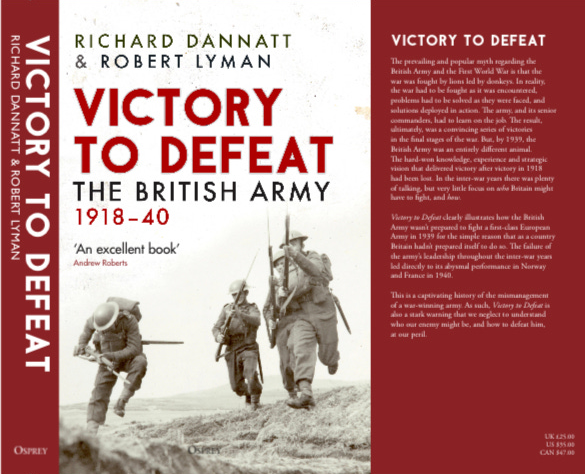
… the British Army was catastrophically unprepared for war in 1939. But it wasn’t just the Army that was unprepared. Despite a last-minute rush to re-arm, so too was the whole country. In Britain a deep-seated passivity had set in following the end the Great War. This belied the reality that in Europe the ending of the war in fact opened the door to unheralded political chaos and instability that was in time to overcome the forces of stability and would lead directly to yet another devastating war. In the years immediately following the arrival of peace in 1918 Britain hoped it could close the door on any future European or continent commitment and return to the halcyon days when its only security commitments were the defence of its widely flung Empire.
The weakness at the heart of British planning for war was a direct reflection of Britain’s strategic, political, societal and economic situation during the inter-war period. Britain – both the British public and the country’s various governments – simply wasn’t mentally prepared to go to war again so soon after the trauma of the Great War. As a result, it made no proper preparation for another full-on industrial war against a peer opponent on the continent. This was fundamentally a failure of political and military imagination; the inability to think through what a potential war might look like and to prepare for this possibility accordingly.
We have identified five primary causes of the decline of British military effectiveness in 1939. In the first place there was no clear strategic plan for the Army. Strategies are determined by having a clear understanding of who a future enemy might be. Following the end of the Great War, until the late 1930s no one seemed bothered to define this essential point of direction. There was a remarkably inadequate grand strategic conversation (i.e., at a national, governmental level) about the purpose, structure, and nature of the Army. There was plenty of talking, but very little of it focused on realistic determination as to who it might have to fight, and how. This was a problem, because it meant that Britain was unable to determine the precise structure its armed forces needed to be, and its cost. Was the focus of the army to be the continent, or the Empire, or both? No one knew. As a result, the last known plan reasserted itself – Imperial defence, à la 1914. This meant that the army wasn’t structured or equipped to fight a specified enemy in a defined set of circumstances. Instead, the British Army and its cousin, the Indian Army, was expected to be a generic jack-of-all-trades, without the structure, doctrine, training, or equipment to fight the type of war it had become the master of in 1918. While there was some doctrine, and considerable doctrinal debate, little was anchored in a clear definition of what future war was expected to look like. There was no operational design for the British Army derived directly from an analysis of the threat it faced. If it had done, the BEF would have been thoroughly prepared for the German Blitzkrieg in France and the Low Countries in 1940 or the similar Japanese Kirimoni Sakusen in 1941 and 1942. The British Army wasn’t prepared to fight a first-class European Army in 1939 for the simple reason that Britain hadn’t prepared itself to do so. Likewise, when it came to fighting the Japanese in 1941 and 1942 in Malaya and Burma, the British found that not only had it failed to prepare adequately for a potential Japanese invasion of its vulnerable Far Eastern colonies, but that it had no idea as to how to fight the Imperial Japanese Army. There were two connected failures here. The first was one of strategic preparedness, the blame for which was both governmental and strategic. The second was of training, doctrine and military preparedness by the British Army in Europe and Asia to fight. When they emerged out of their assault boats at Kota Bahru on the morning of 8 December 1942 the Japanese could as well have come from Mars, given how little the British knew about them and their warfighting methods.
Second, as a country, Britain was unprepared both politically and culturally for another war so soon after the last. In 1919 the country seemed to want to look backward to embrace the days of peace that had preceded the cataclysm of war, to drape itself with Edwardian comfort. It was tired and disillusioned, and felt no victor’s triumph. The country looked to itself, and to its Empire, eschewing the complications of commitments on continental Europe that had recently resulted in the loss of so much blood. The losses sustained in the Great War resulted in the overwhelming national sentiment that war must never again be undertaken as a form of politics. Clausewitz was dead. Part of this sentiment evidenced itself in the rise of pacifism. In the army, a pervasive belief existed that the Great War was an aberration, and nothing like it would again afflict western civilisation. Any lessons from the war were therefore irrelevant to the future structures or doctrine of the British Army, for whom the defence of the Empire was the crucial issue. But whether it liked it or not, the world was changing fast, in ways that Britain struggled to comprehend and from which it could not ultimately escape. The Russian Revolution, the rise of fascist dictators in Europe, isolationism in the USA (except for a new American assertiveness in Asia) and the increasing militancy of Japan, began changing the global landscape in ways that were hard to understand for a country seemingly once in total charge of the certainties of statecraft. Now it struggled to find its way in a new world of tension, turmoil and rapid change.
Third, no one in the British Army thought to capture the reasons for operational success in 1918. The dramatic reduction in troops numbers at the end of the Great War meant that those best able to convert the learning from 1918 into doctrine left for civilian life, taking their knowledge and experience with them. It was never recovered. There was therefore no template in the years afterward on which to build a successful military doctrine based on the successful warfighting experience that had culminated in the victories of 1918.
Fourth, political naivety led to a dramatic economic stringency being applied, including the underlying Treasury assumption in the early 1920’s of the ‘Ten Year Rule’, an assumption that kept rolling over, year after year. This meant that there wasn’t enough money to do what was necessary to protect British interests from impending harm. The Army butter was thinly spread on the imperial bread, with the result that insufficient investment was made in the core of the army’s warfighting capability. This stringency was exacerbated by the impact of the Great Depression at the end of the 1920s into the early years of the next decade.
QotD: The purge of the Socialist Revolutionaries
As Solzhenitsyn explained it, in the early days of the Bolshevik revolution, these SRs were part of a coalition government with the Bolsheviks. As such, they had to be given a certain amount of jobs in the ministries, including the justice ministry. They actually believed that stuff about The Workers, so they weren’t ready to send people to Siberia for twenty, thirty, forty years like Lenin demanded. They broke with Lenin (over other issues as well, obviously), the Bolsheviks crushed them, and once the Bolsheviks had power over all the ministries, there’s your gulag archipelago. Same as it ever was.
The Nazis had their “Left SR’s”, too. These were the Strasserites, led by brothers Otto and Gregor, the guys who put the “Socialist” in “National Socialism”. The Night of the Long Knives was a purge against both “left” and “right” — though Röhm and his butt boys get all the press, one of the Strasser brothers got his, too. That’s German efficiency for you!
And then there was the original Terror, in France, and even before that we had ours, too — the Whiskey Rebellion and Shays’ Rebellion aren’t usually taught as ideological (they’re usually not taught at all, of course), but they were. We’ve had two revolutions (before this week), in fact, and in both cases you had those pesky “we really believe this shit!” types causing all kinds of problems for the revolutionary government — see, for example, those state governors who made Jeff’s life hell in Richmond, objecting to the nationalization of their state militias on the grounds that the Confederacy is actually, you know, a confederacy, and that drafts and war production boards and taxes in kind and all the rest are exactly the kind of tyranny you’d expect from Abe’s gang in Washington …
Severian, “Speaking of Purges…”, Rotten Chestnuts, 2021-01-08.
Comments Off on QotD: The purge of the Socialist Revolutionaries
June 12, 2023
QotD: Cities in the pre-modern era
I find myself interested in pre-modern economies and militaries in roughly equal measure (in part because both are such crucial elements of state or societal success or failure). One of the reasons is that they are so interconnected: how military force is raised, supplied, maintained and projected is deeply dependent on how the underlying economy (which supplies the men, food, weapons and money) is structured and organized. And military institution and activities often play an important role in shaping economic structures in turn. So even if you are just here for the clashing of swords, remember: every sword must be forged, and every swordsman must be fed.
(Additional aside: I am assuming a west-of-the-Indus set of cereals: grain, barley and millet chiefly. Specifically, I am not going to bring in rice cultivation – the irrigation demands and density of rice farming changes a lot (the same is also true, in the opposite direction, to agriculture based around sorghum or yams). Most (western) fantasy and historic dramas are not set in rice-planting regions (and many East Asian works seem to have a much better grasp on where rice fields go and need no correction), so I’m going to leave rice out for now. I’m honestly not qualified to speak on it anyway – it is too different from my own area of research focus, which is on a Mediterranean agricultural mix (wheat, barely, olives, grapes), and I haven’t had the chance to read up on it sufficiently).
Lonely Cities
There’s a certain look that castles and cities in either historical dramas or fantasy settings set in the ancient or medieval world seem to have: the great walls of the city or castle rise up, majestically, from a vast, empty sea of grassland. […] These “lonely cities” are everywhere in fantasy and historical drama. I think we all know something is off here: cities and other large population centers do not simply pop up in the middle of open fields of grass, generally speaking. So if this shouldn’t all be grassland, what should be here? Who should be here?
What is a City For?
I think we need to start by thinking about why pre-modern towns and cities exist and what their economic role is. I’ll keep this relatively brief for now, because this is a topic I’m sure we’ll return to in the future. As modern people, we are used to the main roles cities play in the modern world, some of which are shared by pre-modern cities, and some of which are not. Modern cities are huge production centers, containing in them both the majority of the labor and the majority of the productive power of a society; this is very much not true of pre-modern cities – most people and most production still takes place in the countryside, because most people are farmers and most production is agricultural. Production happens in pre-modern cities, but it comes nowhere close to dominating the economy.
The role of infrastructure is also different. We are also used to cities as the center-point lynch-pins of infrastructure networks – roads, rail, sea routes, fiber-optic cable, etc. That isn’t false when applied to pre-modern cities, but it is much less true, if just because modern infrastructure is so much more powerful than its pre-modern precursors. Modern infrastructure is also a lot more exclusive: a man with a cart might visit a village where the road does not go, but a train or a truck cannot. The Phoenician traders of the early iron age could pull their trade ships up on the beach in places where there was no port; do not try this with a modern container ship. Infrastructure is largely a result of cities, not their original purpose or cause.
So what are the core functions of a pre-modern city? I see five key functions:
- Administrative Center. This is probably the oldest purpose cities have served: as a focal point for political and religious authorities. With limited communications technology, it makes sense to keep that leadership in one place, creating a hub of people who control a disproportionate amount of resources, which leads to
- Defensive/Military Center. Once you have all of those important people and resources (read: stockpiled food) in one place, it makes sense to focus defenses on that point. It also makes sense to keep – or form up – the army where most of the resources and leaders are. People, in turn, tend to want to live close to the defenses, which leads to
- Market Center. Putting a lot of people and resources in one place makes the city a natural point for trade – the more buyers and sellers in one place, the more likely you are to find the buyer or seller you want. As a market, the city experiences “network” effects: each person living there makes the city more attractive for others. Still, it is important to note: the town is a market hub for the countryside, where most people still live. Which only now leads to
- Production Center. But not big industrial production like modern cities. Instead it is the small, niche production – the sort of things you only buy once-in-a-while or only the rich buy – that get focused into cities. Blacksmiths making tools, producers of fine-ware and goods for export, that sort of thing. These products and producers need big markets or deep pockets to make end meet. The majority of the core needs of most people (things like food, shelter and clothes) are still produced by the peasants, for the peasants, where they live, in the country. Still, you want to produce goods made for sale rather than personal use near the market, and maybe sell them abroad, which leads to
- Infrastructure Center. With so much goods and communications moving to and from the city, it starts making sense for the state to build dedicated transit infrastructure (roads, ports, artificial harbors). This infrastructure almost always begins as administrative/military infrastructure, but still gets used to economic ends. Nevertheless, this comes relatively late – things like the Persian Royal Road (6th/5th century BC) and the earliest Roman roads (late 4th century BC) come late in most urban development.
Of course, all of these functions depend, in part, on the city as a concentration of people. but what I want to stress – before we move on to our main topic – is that in all of these functions the pre-modern city effectively serves the countryside, because that is still where most people are and where most production (and the most important production – food) is. The administration in the city is administering the countryside – usually by gathering and redistributing surplus agricultural production (from the countryside!). The defenses in the city are meant to defend the production of the countryside and the people of the countryside (when they flee to it). The people using the market – at least until the city grows very large – are mostly coming in from the country (this is why most medieval and ancient markets are only open on certain days – for the Romans, this was the “ninth day”, the Nundinae – customers have to transit into town, so you want everyone there on the same day).
(An aside: I have framed this as the city serving the economic needs of the countryside, but it is equally valid to see the city as the exploiter of the countryside. The narrative above can easily be read as one in which the religious, political and military elite use their power to violently extract surplus agricultural production, which in turn gives rise to a city that is essentially a parasite (this is Max Weber’s model for a “consumer city”) that contributes little but siphons off the production of the countryside. The study of ancient and medieval cities is still very much embroiled in a debate between those who see cities as filling a valuable economic function and those who see them as fundamentally exploitative and rent-seeking; I fall among the former, but the latter do have some very valid points about how harshly and exploitatively cities (and city elites) could treat their hinterlands.)
Consequently, the place and role of almost every kind of population center (city, town or castle-town) is dictated by how it relates to the countryside around it (the city’s hinterland; the Greeks called this the city’s khora (χώρα)).
Bret Devereaux, “Collections: The Lonely City, Part I: The Ideal City”, A Collection of Unmitigated Pedantry, 2019-07-12.
Comments Off on QotD: Cities in the pre-modern era
June 11, 2023
Rewriting the well-worn story of how the steam engine was invented
In the latest Age of Invention newsletter, Anton Howes pushes back against the story we’ve been telling for over 200 years about how the steam engine came to be:
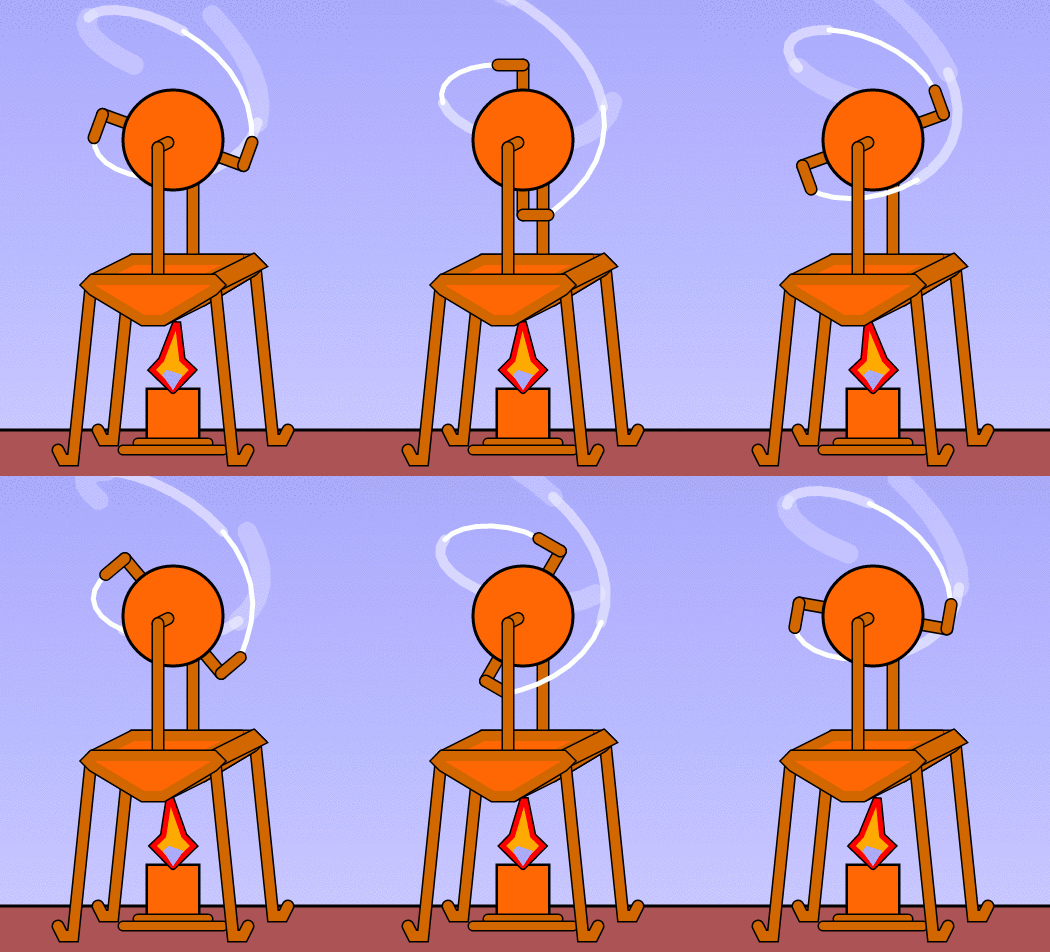
3D animation of an aeolipile or Hero’s engine.
Animation by Michael Frey via Wikimedia Commons.
The standard pre-history of the steam engine goes a little like this:
- There were a few basic steam-using devices designed by the ancients, like Hero of Alexandria’s spinning aeolipile, which are often regarded as essentially toys.
- Fast forward to the 1640s and Evangelista Torricelli, one of Galileo’s disciples, demonstrates that vacuums are possible and the atmosphere has a weight.
- The city leader of Magdeburg, Otto von Guericke, c.1650 creates vacuums using a mechanical air pump, and is soon using atmospheric pressure to lift extraordinary weights. This sets off a spate of experimentation by the likes of Robert Boyle, Robert Hooke, Christiaan Huygens, and Denis Papin, to create vacuums under pistons.
- As a result of the new science of vacuums, by the 1690s and 1700s the mysterious Thomas Savery and especially the Devon-based ironmonger Thomas Newcomen are able to develop the first commercially practical engines using atmospheric pressure. Steam engine development continued from there.
This is the narrative that had become set in the 1820s, if not earlier, and has been repeated with many of the same names and dates by book after book after book ever since. It’s a narrative that I have even repeated myself.
But, as I only recently discovered, atmospheric pressure and vacuums were actually being exploited long before Torricelli was even born, by people who believed that vacuums were impossible and had no concept of atmospheric pressure. Devices very much like Savery’s, which exploited both the pushing force of expanding hot steam and the sucking effect of condensing it with cold — what we now know to be caused by atmospheric pressure — were being developed far earlier.
I began to give a more accurate account of the development of the atmospheric engine in a detailed three-part series on why the steam engine wasn’t invented earlier (see parts I, II, III, which give more detail and the references). But I haven’t put it all together in one easily digestible place, and since writing I’ve continued to discover even more. So here’s a rough sketch summarising what really happened, based on everything I’ve found so far […]
The development of the atmospheric engine was thus significantly longer and more complicated than the traditional narrative suggests. Far from being an invention that appeared from out of the blue, unlocked by the latest scientific advancements, it started to take shape from decades and centuries of experiments and marginal improvements from a whole host of inventors, active in many different countries. It’s a pattern that I’ve seen again and again and again: if an invention appears to be from out of the blue, chances are that you just haven’t seen the full story. Progress does not come in leaps. It is the product of dozens or even hundreds of accumulated, marginal steps.
Comments Off on Rewriting the well-worn story of how the steam engine was invented
The Invasion of Normandy begins! – WW2 – Week 250 – June 10, 1944
World War Two
Published 10 Jun 2023The Allies’ gigantic amphibious invasion of France begins and by the end of the week they’ve carved out a decent-sized beachhead. Meanwhile in Italy the Allied advance takes Rome. The Soviets are launching new attacks of their own — now against the Finns, and the Japanese at Kohima … have just plain had enough.
(more…)
Comments Off on The Invasion of Normandy begins! – WW2 – Week 250 – June 10, 1944
Ask Ian: Why So Few Reproduction Historic Guns?
Forgotten Weapons
Published 22 Feb 2023From Paul on Patreon:
“I’ve always thought there were a lot of older guns that deserve to be reproduced, many of which could be really simple to manufacture. PSA is planning the release of their StG44 repro which is exciting. But why don’t we see this sort of thing more often. I suppose not everyone in the firearms community is going to want this sort of thing, but I think there are a lot of guns that would sell well enough to justify their reproduction.”Fundamentally, we don’t see more reproduction firearms because they are actually a lot harder and more expensive to make than people would think, and the market for them is smaller than people would think. Re-engineering old firearms for new production is a really substantial project, and the original data required rarely exists. The guns must be cheap enough and reliable enough to attract modern buyers, which will often require compromises on authenticity — which immediately reduces the already-small pool of potential buyers.
(more…)
Comments Off on Ask Ian: Why So Few Reproduction Historic Guns?
June 10, 2023
Do you also dream of apocalypse?
John Psmith certainly does, as he explains before plunging into a review of a book on Chinese warfare between 300 and 900 AD:
I have a secret confession to make. Late at night, when Mrs. Psmith and the Psmithlets are all tucked away in their beds, I like to stay up in my study and fantasize about … the end of the world. But not just any end of the world, because most apocalypses are very boring. For example: “AI unleashes killer nanobots that turn everybody into paperclips.” Yawn. How dull. Where’s the drama in that? No, like all disordered fantasies, mine are fun, and ever-so-conveniently constructed to push the bounds of plausibility while still being technically possible. I’m mostly fantasizing about apocalypses where almost everybody dies, but where one dashing and well-prepared man with pluck and determination and a giant pile of book reviews can restore an island of order and civilization. Hey come on, it could happen!
Most apocalypses would be awful — we would all die instantly, or else we would all die slowly and painfully, but somewhere perfectly balanced in the middle are the apocalypses that would be very exciting, and those are the emotional driver that lead me to engage in a mild degree of prepping. Now like all potential addicts, I have some hard and fast rules, clear lines that prevent me from spending all my family’s savings on refurbishing an old missile silo. My main rule is that any prepping I do has to have a dual use in some less exciting but more likely scenario.
So I store a lot of water in my basement because, look the US government tells me it could be useful in the event of a regional or local disaster. We have emergency bags pre-packed that include a list of rendezvous locations a day’s walk from our house because, hey, there are all kinds of reasons we might need that, okay? I own this tool so I can shut off my gas in the event of an earthquake and totally not because it looks handy for bludgeoning feral packs of marauders, so stop judging me. I have precious metals buried in the ground in a secret location because, uhhh … it’s good to have a tail-risk hedge in your portfolio, all right? What’s that? Why is there ammo in there too? Look, a good portfolio should be anti-fragile …
I think all of this is why I like Chinese history so much, because it’s just way crazier, bloodier, and more apocalyptic than the history of most other places. In Western Europe civilization collapsed once (okay fine, twice (okay, fine, three times)), and we’re still ruminating over it and working through this unending cultural psychodrama like some civilization-scale therapy addict. Meanwhile, in China, civilization collapsing is like Tuesday. The history of China is an endless cycle of mini-apocalypses in which the entire political, economic and moral order gets razed to the ground and Mad Max conditions prevail for a few decades or centuries, until somebody gathers enough power in his hands to establish a new dynasty and all is peaceful and harmonious under heaven. A few hundred years later, that new regime grows tired and old, the Mandate of Heaven slips away, and the cycle repeats.

Comments Off on Do you also dream of apocalypse?
Feeding a Greek Hoplite – Ancient Rations
Tasting History with Max Miller
Published 6 Jun 2023
(more…)
Comments Off on Feeding a Greek Hoplite – Ancient Rations
George MacDonald Fraser – Quartered Safe Out Here
We Have Ways of Making You Talk
Published 16 Jan 2023Merry Christmas from “We Have Ways of Making You Talk”. Over the next 12 days Al and James are reading extracts from some of their favourite books about the Second World War. Today Al is reading from Quartered Safe Out Here, by George MacDonald Fraser.
(more…)
Comments Off on George MacDonald Fraser – Quartered Safe Out Here


