
Growing cotton … unlike sugar or rice, never required slavery. By 1870, freedmen and whites produced as much cotton as the South produced in the slave time of 1860. Cotton was not a slave crop in India or in southwest China, where it was grown in bulk anciently. And many whites in the South grew it, too, before the war and after. That slaves produced cotton does not imply that they were essential or causal in the production.
Economists have been thinking about such issues for half a century. You wouldn’t know it from the King Cottoners. They assert, for example, that a slave was “cheap labor”. Mistaken again. After all, slaves ate, and they didn’t produce until they grew up. Stanley Engerman and the late Nobel Prize winner Robert Fogel confirmed in 1974 what economic common sense would suggest: that productivity was incorporated into the market price of a slave. It’s how any capital market works. If you bought a slave, you faced the cost of alternative uses of the capital. No supernormal profits accrued from the purchase. Slave labor was not a free lunch. The wealth was not piled up.
The King Cotton school has been devastated recently in detail by two economic historians, Alan Olmstead of the University of California at Davis and Paul Rhode of the University of Michigan. They point out, for example, that the influential and leftish economist Thomas Piketty grossly exaggerated the share of slaves in U.S. wealth, yet Edward Baptist uses Piketty’s estimates to put slavery at the center of the country’s economic history. Olmstead and Rhode note, too, from their research on the cotton economy that the price of slaves increased from 1820 to 1860 not because of institutional change (more whippings) or the demand for cotton, but because of an astonishing rise in the productivity of the cotton plant, achieved by selective breeding. Ingenuity, not capital accumulation or exploitation, made cotton a little king.
Slavery was of course appalling, a plain theft of labor. The war to end it was righteous altogether — though had the South been coldly rational, the ending could have been achieved as in the British Empire in 1833 or Brazil in 1888 without 600,000 deaths. But prosperity did not depend on slavery. The United States and the United Kingdom and the rest would have become just as rich without the 250 years of unrequited toil. They have remained rich, observe, even after the peculiar institution was abolished, because their riches did not depend on its sinfulness.
Dierdre McCloskey, “Slavery Did Not Make America Rich: Ingenuity, not capital accumulation or exploitation, made cotton a little king”, Reason, 2017-07-19.
September 25, 2023
QotD: The economics of American slavery
September 24, 2023
Operation Market Garden Begins – WW2 – Week 265 – September 23, 1944
World War Two
Published 23 Sep 2023Monty’s Operation(s) Market Garden, to drop men deep in the German rear in the Netherlands and secure a series of bridges, begins this week, but has serious trouble. In Italy the Allies take Rimini and San Marino, but over in the south seas in Peleliu the Americans have serious problems with Japanese resistance. Finland and the USSR sign an armistice, and in Estonia the Soviets take Tallinn, and there are Soviet plans being made to enter Yugoslavia.
(more…)
Architect Breaks Down Why All American Diners Look Like That | Architectural Digest
Architectural Digest
Published 1 Jun 2023Today Michael Wyetzner of Michielli + Wyetzner Architects returns to Architectural Digest to explore the design evolution of American diners. A cornerstone of American dining culture, their distinctive style has been emulated around the world making them a popular salute to the USA. Michael provides an expert look into the history behind their design evolution from the 1920s through to the 1960s and explains why all diners came to look like that.
(more…)
QotD: The composition of the polis
So what is an oikos? Well that word is about as plastic as polis. Oikos can mean a house (as in a physical building), or it can mean a household (as in the family that dwells in that building) or it can mean all of the property of that household, and indeed Greek writers will use this word to mean all of these things, often in the same context (that is they shift freely between these linked meanings, not seeing them as fully distinct). Now as a “family” we should note that an oikos was rather more extensive than our sense of family (though rather less extensive than the Roman concept of a familia and a lot less extensive than a Roman gens; we’ll come to these in a later series): an oikos consisted of all of the people who lived together in a house, which generally meant the adult citizen male, his wife and dependents and also their enslaved workers. It that family had enslaved workers who did not live with them, they also generally counted as part of the oikos because they were understood as the property of it.
The creation of a polis meant merging all of these things together in a very literal way. In a physical sense the creation of a town core meant literally putting houses together, as a good part of the population might move to live in that town core (with their farms just outside the town in walking distance, remember: most of these poleis are very small). Indeed M.H. Hansen notes in the introductory article on synoikismos in the Inventory that the only “purely political synoecism” – that is, a synoikismos that did not involve actually moving people to form or merge with a new town center but merely politically united existing geographically distinct communities – occurs in myth in Theseus’ supposed creation of the Athenian poleis. That this sort of synoikismos never happens in the historical period (there’s an attempt in Ionia in 547/6 but it never gets off the ground) ought to suggest that it probably didn’t happen with Theseus either.
It is also in a sense the merging of families, as one of the key privileges of citizenship in a polis was the right to marry women of citizen status (that is, the daughters of citizens) and thus have citizen children. And it meant the new citizenry putting their fortunes – in a literal, physical sense of the wealth that enabled them to survive (think farms and farming) – together in common when it came to things like war.
This may all seem fairly straightforward, but I invite you to consider the different implications it has compared to the way we mostly conceive of the population of a country, which we tend to imagine as a collection of individuals; as we’ll see the Greeks did this a bit too, but it wasn’t the first thought they reached for. In the polis, it is the households that have standing, represented by their adult, free citizen male heads, not individuals. The polis protects the households from the world, not the members of the household from each other, with the most obvious and immediate legal implication being the fact that crimes against junior members of the household are often understood as property crimes against the head of the household and actions within the household are simply not the business of the state. Now we shouldn’t over-stretch this: the Greeks were capable of understanding non-free and non-male people as individuals at times, but the political structure of the polis is predicated on units of households.
Bret Devereaux, “Collections: How to Polis, 101: Component Parts”, A Collection of Unmitigated Pedantry, 2023-03-10.
September 23, 2023
More on the history field’s “reproducibility crisis”
In the most recent edition of the Age of Invention newsletter, Anton Howes follows up on his earlier post about the history field’s efforts to track down and debunk fake history:
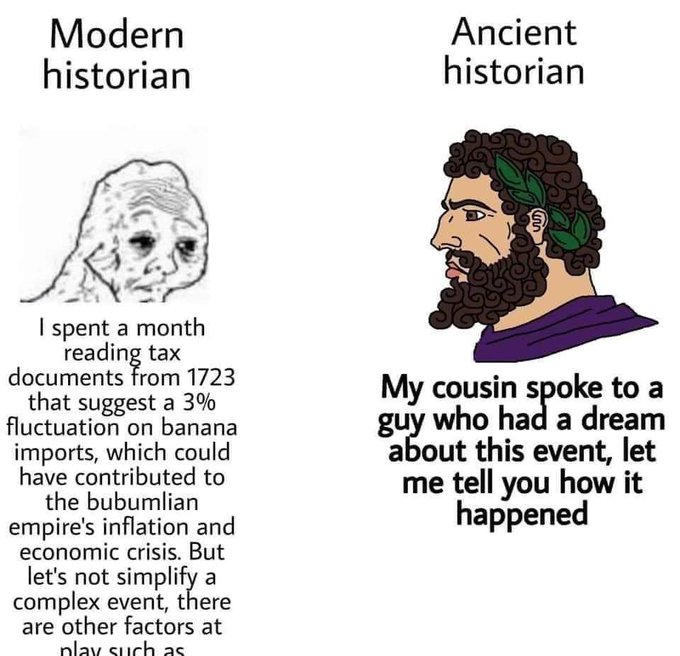
The concern I expressed in the piece is that the field of history doesn’t self-correct quickly enough. Historical myths and false facts can persist for decades, and even when busted they have a habit of surviving. The response from some historians was that they thought I was exaggerating the problem, at least when it came to scholarly history. I wrote that I had not heard of papers being retracted in history, but was informed of a few such cases, including even a peer-reviewed book being dropped by its publisher.
In 2001/2, University of North Carolina Press decided to stop publishing the 1999 book Designs against Charleston: The Trial Record of the Denmark Vesey Slave Conspiracy of 1822 when a paper was published showing hundreds of cases where its editor had either omitted or introduced words to the transcript of the trial. The critic also came to very different conclusions about the conspiracy. In this case, the editor did admit to “unrelenting carelessness“, but maintained that his interpretation of the evidence was still correct. Many other historians agreed, thinking the critique had gone too far and thrown “the baby out with the bath water“.
In another case, the 2000 book Arming America: The Origins of a National Gun Culture — not peer-reviewed, but which won an academic prize — had its prize revoked when found to contain major errors and potential fabrications. This is perhaps the most extreme case I’ve seen, in that the author ultimately resigned from his professorship at Emory University (that same author believes that if it had happened today, now that we’re more used to the dynamics of the internet, things would have gone differently).
It’s somewhat comforting to learn that retraction in history does occasionally happen. And although I complained that scholars today are rarely as delightfully acerbic as they had been in the 1960s and 70s in openly criticising one another, they can still be very forthright. Take James D. Perry in 2020 in the Journal of Strategy and Politics reviewing Nigel Hamilton’s acclaimed trilogy FDR at War. All three of Perry’s reviews are critical, but that of the second book especially forthright, including a test of the book’s reproducibility:
This work contains numerous examples of poor scholarship. Hamilton repeatedly misrepresents his sources. He fails to quote sources fully, leaving out words that entirely change the meaning of the quoted sentence. He quotes selectively, including sentences from his sources that support his case but ignoring other important sentences that contradict his case. He brackets his own conjectures between quotes from his sources, leaving the false impression that the source supports his conjectures. He invents conversations and emotional reactions for the historical figures in the book. Finally, he fails to provide any source at all for some of his major arguments
Blimey.
But I think there’s still a problem here of scale. It’s hard to tell if these cases are signs that history on the whole is successfully self-correcting quickly, or are stand-out exceptions. I was positively inundated with other messages — many from amateur historical investigators, but also a fair few academic historians — sharing their own examples of mistakes that had snuck past the careful scholars for decades, or of other zombies that refused to stay dead.
QotD: In which we discover why they’re called antimacassars
His accents mild took up the tale:
He said ‘I go my ways,
And when I find a mountain-rill,
I set it in a blaze;
And thence they make a stuff they call
Rowlands’ Macassar-Oil –
Yet twopence-halfpenny is all
They give me for my toil.’Better yet, in Don Juan Lord Byron managed to rhyme it:
In virtue, nothing earthly could surpass her
Save thine ‘incomparable oil’, Macassar!Mark Steyn, “Self-Knitting Antimacassars”, Steyn Online, 2019-08-02.
September 22, 2023
Is the Slovak Uprising Doomed to Fail? – War Against Humanity 115
World War Two
Published 21 Sep 2023Even as they battle an uprising in Slovakia, the Nazis see the opportunity to continue their racial realignment of Europe. The latest victims of this genocidal legacy are Anne Frank and her family, who arrive at Auschwitz. In Britain, the V-1 menace is defeated. But as London breathes a sigh of relief, the Nazis and their allies reduce Warsaw to rubble in a rampage of burning, looting, rape, and murder.
(more…)
MAS 49: A Universal Service Rifle
Forgotten Weapons
Published 20 May 2019As the MAS 44 saw combat service with French Marines in Indochina, some of its shortcomings began to reveal themselves. The rifle was reliable and durable, but it lacked some capabilities, most importantly rifle grenade launching and an optics mounting. After a test series of MAS 44A rifles, a new pattern was adopted as the MAS 49 and put into production in 1951.
A total of about 80,000 MAS 49 rifles were made, and they incorporated a scope mounting dovetail in the left side of the receiver and a grenade launching muzzle device and sight. In addition, the bayonet was left out, as it was no longer seen as necessary. Not all rifles were used with scopes or for launching grenades, but with the universal capability it was simple to adapt any rifle to whatever specialized role was required. Ultimately the MAS 49 would be replaced again in only a few year, by the MAS 49-56 iterative improvement — but that’s a subject for a future video.
(more…)
September 21, 2023
Iranian Railways, Red Cross Care Packages, and Tail Gunners – WW2 – OOTF 31
World War Two
Published 20 Sept 2023How did the Allies build and manage an enormous railway supplying the Soviet Union through Iran? How did the Red Cross deliver aid parcels through enemy territory to Allied POWs? And, how effective were the rear gunners in ground attack aircraft like the Stuka and Sturmovik? Find out in this episode of Out of the Foxholes.
(more…)
A new paper on the cancellation of the Avro Arrow in 1959
The National Post republished a Canadian Press article about a new research paper by Alan Barnes in the Canadian Military History journal:
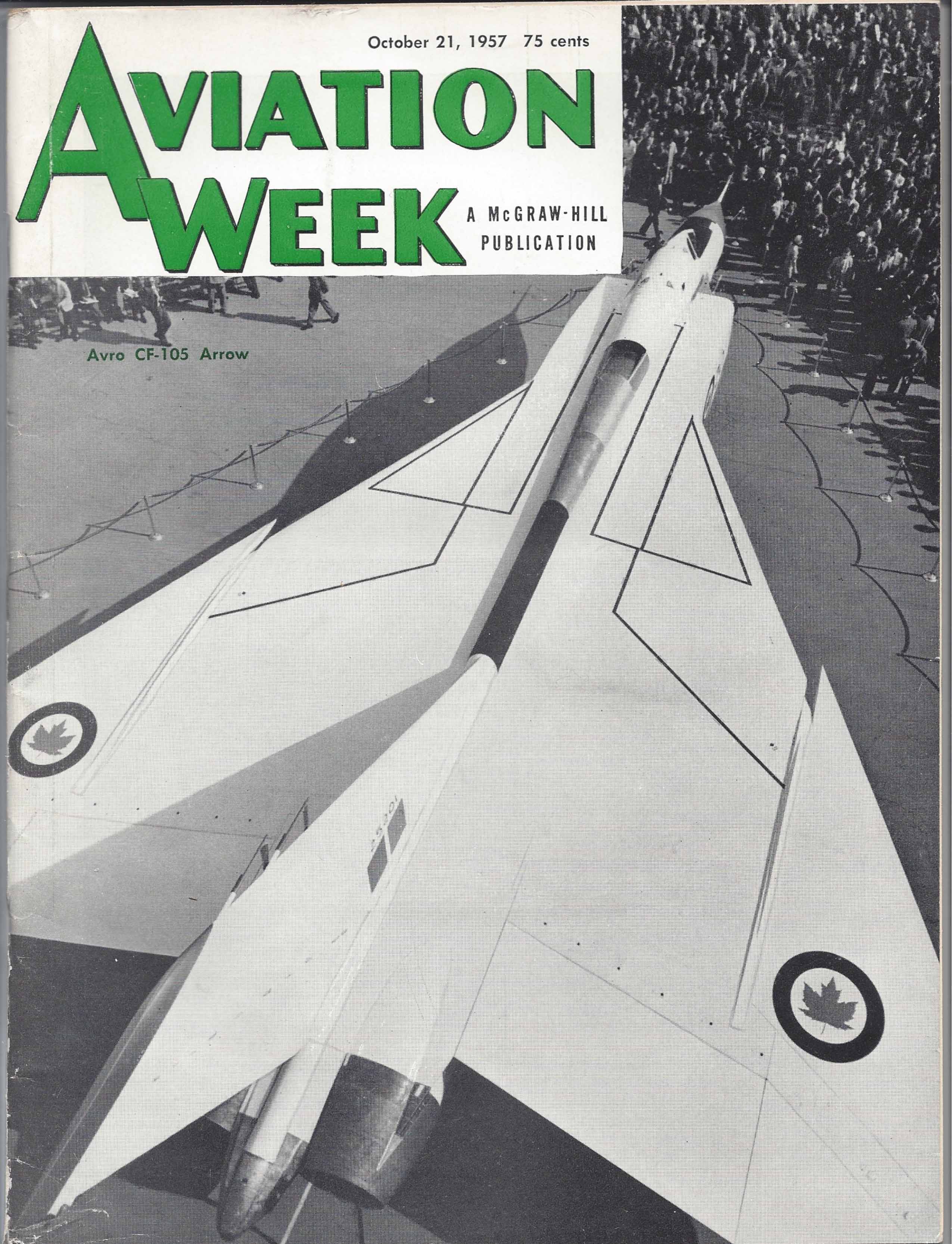
In the years after the Second World War, Canada developed its ability to prepare strategic intelligence assessments on defence and foreign policy, the paper notes. It would no longer have to rely entirely on assessments from the United States and Britain.
The analytic capability allowed Canada to fully participate in preparing the assessments on the Soviet threat to North America that would underpin joint Canada-U.S. planning for continental defence, Barnes notes.
“The CF-100 Canuck, a jet interceptor developed and manufactured in Canada, was just entering service, but there were already concerns that it might soon be outclassed by newer Soviet bombers operating at higher altitudes and faster speeds.”
In November 1952, the Royal Canadian Air Force called for an aircraft with a speed of Mach 2 and the ability to fly at 50,000 feet. “These demanding specifications contributed to the escalating costs and frequent delays in the CF-105 program.”
The Soviets would soon display a new long-range jet bomber, the Bison, at the 1954 May Day parade in Moscow. At an airshow the following year, a fly-past of 28 Bison seemed to indicate that the bomber had entered serial production, two years earlier than predicted, the paper says. In fact, only 18 prototype aircraft participated in the airshow, flying past several times to give the impression of larger numbers.
Even so, this display, along with the appearance of a new Soviet long-range turboprop bomber, the Tu-95 (dubbed the Bear), raised fears that the Soviet Union would soon outnumber the United States in intercontinental bombers, sparking a “Bomber Gap” controversy that figured prominently in American politics, the paper says.
[…]
A January 1958 assessment, “The Threat to North America, 1958-1967”, by Canada’s Joint Intelligence Committee, a co-ordinating body, ultimately had the greatest impact on decisions related to the Arrow, the paper says.
The assessment laid out clear judgments concerning the imminent transition from crewed bombers to ballistic missiles and described the limited size and capabilities of the Soviet bomber force, Barnes notes.
It observed that the Soviet ballistic missiles which were on the verge of being developed were likely to be markedly superior to the foreseeable defences, and concluded that missiles would progressively replace aircraft as the main threat to North America.
The assessment said this meant there would be little justification for the Soviet Union to increase the number of bombers, or to introduce new ones, after 1960.
“The (Joint Intelligence Committee)’s January 1958 assessment was correct in foreseeing Moscow’s shift from bombers to missiles over the subsequent decade,” Barnes writes.
He points out that following the Sputnik launch, Soviet leader Nikita Khrushchev came to see missiles as a panacea for a range of defence problems and as a cheaper alternative to conventional weapons. “With the Soviet bomber force now looking irrelevant and obsolete, it was relegated to a secondary position in Soviet military thinking.”
This is York
Jago Hazzard
Published 28 May 2023“Make all the railways come to York!”
(more…)
QotD: The Iliad as Bronze Age gangsta rap
What was cool though is I felt like I came away with a much better understanding of Socrates, Plato, and that whole milieu. Much like it’s easy to miss the radicalism of Christianity when you come from a culture steeped in it, it’s easy to miss the radicalism of Socrates if you don’t understand that this is the culture he was reacting against. Granted, the compilation of the Homeric epics took place centuries before the time of classical Athens, but my sense is that in important respects things hadn’t changed all that much. In our society, even people who aren’t professing Christians have been subliminally shaped by a vast set of Christian-inflected moral and epistemic and metaphysical assumptions. Well in the same way, in the Athens of Socrates and of the Academy, the “cultural dark matter” was the world of the Iliad: honor, glory, blinged out bronze armor, tearing hot teenagers from the arms of their lamenting parents, etc.
We have a tendency to think of the Greek philosophers as emblematic of their civilization, when in reality they were one of the most bizarre and unrepresentative things that happened in that society. But Numa Denis Fustel de Coulanges is here to tell us it wasn’t just the philosophers! So much of our mental picture of Ancient Greece and Rome is actually a snapshot of one fleeting moment in the histories of those places, arguably a very unrepresentative moment at which everything was in the process of collapsing. It’s like if [POP CULTURE ANALOGY I’M TOO TIRED TO THINK OF]. And actually once you think about it this way, everything makes way more sense. All those weird customs the Greeks and Romans had, all the lares and penates and herms and stuff, those are what these societies were about for hundreds and hundreds of years, and the popular image is just this weird encrustation, this final flowering at the end.
Jane and John Psmith, “JOINT REVIEW: The Ancient City, by Numa Denis Fustel de Coulanges”, Mr. and Mrs. Psmith’s Bookshelf, 2023-02-20.
September 20, 2023
Christian views on men and women
The most recent book review from Mr. and Mrs. Psmith discusses Brian Patrick Mitchell’s Origen’s Revenge: The Greek and Hebrew Roots of Christian Thinking on Male and Female:
The following is an email exchange between the Psmiths, edited slightly for clarity.
John: You know dear, we’ve been writing this book review Substack for eight months now, ever since that crazy New Year’s resolution of ours, but we still haven’t done “the gender one”. And I feel like we have a real competitive advantage at this, since both sides of the unbridgeable epistemic chasm between the sexes are represented here. So let’s settle some of the eternal questions: Can men and women be friends? Who got the worse deal out of the curse in the Garden of Eden? And what’s up with your abysmal grip strength anyway?
I was perplexed by these and other questions, but then I picked up this book on the theology of gender, and it all got a lot clearer. The author is Deacon Brian Patrick Mitchell, an Eastern Orthodox clergyman and retired military officer. In a previous life, Mitchell testified before the Presidential Commission on the Assignment of Women in the Armed Forces and then followed that up with a book called Women in the Military: Flirting with Disaster, so he’s been interested in the differences between men and women for a while.
People have been observing for centuries that Christianity can be a little bit schizophrenic on the subject of gender relations. From the earliest days of the Apostolic era, there are two strains in evidence within Christianity: one which shores up the gender divisions common to most agricultural societies, and another which radically transcends them. Oftentimes both strains are visible within a single person! Thus you have the Apostle Paul on the one hand saying in his letter to the Ephesians:
Wives, submit yourselves unto your own husbands, as unto the Lord. For the husband is the head of the wife, even as Christ is the head of the church: and he is the saviour of the body. Therefore as the church is subject unto Christ, so let the wives be to their own husbands in every thing. (Ephesians 5:22-24)
But then in Galatians:
There is neither Jew nor Greek, there is neither bond nor free, there is neither male nor female: for ye are all one in Christ Jesus. (Galatians 3:28)
For as long as Christianity has existed, there have been people emphasizing one of these tendencies as the “true” Christian message on gender while attempting to minimize the other. Sometimes these arguments are interesting and sometimes they bring out something important (I’m a fan of Sarah Ruden’s Paul Among the People on the one side, and of Toby Sumpter’s fiery homilies on the other), but I think in both cases they’re falling into the error of trying to simplify something that is actually complicated. There’s a certain kind of person who can’t handle inconsistency, and that kind of person is going to have trouble with Christianity, because to a finite being the products of an infinite mind will sometimes appear inconsistent. Does Christianity want women to be subject to men, or does it want men and women to transcend their natures? The answer is very clearly both.
Mitchell’s book is compelling because it doesn’t try to minimize or hide one of these tendencies, but acknowledges up front that they’re both there and both have to be struggled with. It then advances the novel (as far as I know) argument that these two tendencies with regard to gender relations actually reflect the two major ethnic and cultural influences on the early Church: Hebrew and Greek.
The ancient Hebrew attitudes towards male and female are apparent from the beginning of the Bible: God creates Eve from out of Adam’s rib, and she is called Woman because she was taken out from Man. Thus the woman is subordinated to the man, yet fundamentally made of the same stuff as him. God calls the division of humanity into men and women good, He blesses families and helps barren women conceive, He commands His people to be fruitful and to multiply, and He promises Abraham that his seed shall be numbered as the stars of heaven. The entire Old Testament is a story of families, sometimes dysfunctional families, but families nonetheless, as opposed to lone men roaming the earth as in the Iliad or Bronze Age Mindset. Male headship is assumed, but it’s also assumed that men are fundamentally incomplete without something that only women can give them: a home, a future, and the thing that makes both, children.
So in Mitchell’s telling, the Hebrew legacy is responsible for the more “trad” side of early Christianity. What about the Greeks? Well we already discussed in our joint review of Fustel de Coulanges’ The Ancient City how ancient Greek society was basically the world of gangster rap: honor, boasting, violence, women as trophies, women as a way of keeping score, women torn wailing from the arms of their parents or husbands and forced into marriage or concubinage or outright slavery. You will be shocked to learn that this culture did not hold a high opinion of women, procreation, or the marital union. Greek philosophy is a massively complicated and diverse beast, but there’s a strong tendency within it to associate women with physicality, nature, and brute matter, and to disdain all of these things in favor of rationality, spirit, and the intellect (all coded as male).
Our readers are probably thinking, “Hang on a minute, I thought the Hebrews were the patriarchal ones, do you mean to say that the hyper-masculine and hyper-misogynistic culture was the one that decided maleness and femaleness didn’t matter?” Well yes I do, and it’s pretty easy to see why if one hasn’t been totally brainwashed by modernity, but maybe it’ll be more convincing if a woman explains it to them.
Jane: Well, I think you gave a pretty accurate description of actually-existing ancient Greek culture, but we have to remember that the Church Fathers weren’t classicists poring through the corpus trying to accurately characterize the past. Rather, they were men of late antiquity, mostly educated in a “Great Books” canon heavy on the classical philosophy — and the worldview of philosophers is often quite different from the general norms and presuppositions of their society as a whole. (Not that modern — by which I mean post-1600 — classicists have always recognized this; E.R. Dodds’s The Greeks and the Irrational is considered a seminal work of classical scholarship precisely because it undercuts a long tradition of taking the philosophers as representative of their culture rather than in conflict with it.)1 So the direct influence on early Christians wasn’t the world Fustel de Coulanges describes (which covers roughly the Greek Dark Ages through the Archaic period), but the texts of the period that came after, as interpreted by an even later era. It’s a bit like looking at our contemporary small-l liberals, who draw heavily on a tradition that rose out of Enlightenment philosophy, which in turn was an outgrowth of and/or reaction to the medieval and early modern worlds: they’re not not connected to all that, but Boethius is not going to be the most helpful context for reading Rorty. You should probably look at Locke instead.
1. Bonus, and shorter, Dodds: “On Misunderstanding the Oedipus Rex“, which you probably do too.
Wire Guided Tank Killer | Swingfire | Anti-Tank Chats
The Tank Museum
Published 2 Jun 2023In this video, Chris Copson looks at the Swingfire, a Cold War period anti-tank guided weapons system. This powerful and hard-hitting missile was mounted on vehicles including Striker, Ferret, and FV 432. With a range of up to 4km, it had the significant advantage that it would outrange tank guns and could be fired remotely by the controller, enabling the launch vehicle to remain in cover.
(more…)
September 19, 2023
The end of the Western Roman Empire
Theophilus Chilton updates a review from several years ago with a few minor changes:
British archaeologist and historian Bryan Ward-Perkin’s excellent 2005 work The Fall of Rome and the End of Civilization is a text that is designed to be a corrective for the type of bad academic trends that seem to entrench themselves in even the most innocuous of subjects. In this case, Ward-Perkins, along with fellow Oxfordian Peter Heather in his book The Fall of the Roman Empire: A New History of Rome and the Barbarians, sets out to fix a glaring error which has come to dominate much of the scholarly study of the 4th and 5th centuries in the western Empire for the past few decades.
This error is the view that the western Empire did not actually “fall”. Instead, so say many latter-day historical revisionists, what happened between the Gothic victory at Adrianople in 378 AD and the abdication of Romulus Augustulus, the last western Emperor, in 476 was more of an accident, an unintended consequence of a few boisterous but well-meaning neighbors getting a bit out of hand. Challenged is the very notion that the Germanic tribes (who cannot be termed “barbarians” any longer) actually “invaded”. Certainly, these immigrants did not cause harm to the western Empire — for the western empire wasn’t actually “destroyed”, but merely “transitioned” seamlessly into the era we term the Middle Ages. Ward-Perkins cites one American scholar who goes so far as to term the resettlement of Germans onto land that formerly belonged to Italians, Hispanians, Britons, and Gallo-Romans as taking place “in a natural, organic, and generally eirenic manner”. Certainly, it is gauche among many modern academics in this field to maintain that violent barbarian invasions forcibly ended high civilization and reduced the living standards in these regions to those found a thousand years before during the Iron Age.
Ward-Perkins points out the “whys” of this historical revision. Much of it simply has to do with political correctness (which he names as such) — the notion that we cannot really say that one culture is “higher” or “better” than others. Hence, when the one replaces the other, we cannot speculate as to how this replacement made things worse for all involved. In a similar vein, many continental scholars appear to be uncomfortable with the implications that the story of mass barbarian migrations and subsequent destruction and decivilization has in the ongoing discussion about the European Union’s own immigration policy — a discussion in which many of these same academics fall on the left side of the aisle.
Yet, all of this revisionism is bosh and bunkum, as Ward-Perkins so thoroughly points out. He does this by bringing to the table a perspective that many other academics in this field of study don’t have — that of a field archaeologist who is used to digging in the dirt, finding artifacts, drawing logical conclusions from the empirical evidence, and then using that evidence to decide “what really happened”, rather than just literary sources and speculative theories. Indeed, as the author shows, across the period of the Germanic invasions, the standard of living all across Roman western Europe declined, in many cases quite precipitously, from what it had been in the 3rd century. The quality and number of manufactured goods declined. Evidence for the large-scale integrative trade network that bound the western Empire together and with the rest of the Roman world disappears. In its place we find that trade goods travelled much smaller distances to their buyers — evidence for the breakdown of the commercial world of the West. Indeed, the economic activity of the West disappeared to the point that the volume of trade in western Europe would not be matched again until the 17th century. Evidence for the decline of food production suggests that populations fell all across the region. Ward-Perkins’ discussion of the decline in the size of cattle is enlightening evidence that the degeneration of the region was not merely economic. Economic prosperity, the access of the common citizen to a high standard of living with a wide range of creature comforts, disappeared during this period.
The author, however, is not negligent in pointing out the literary and documentary evidence for the horrors of the barbarian invasions that so many contemporary scholars seem to ignore. Indeed, the picture painted by the sum total of these evidences is one of harrowing destruction caused by aggressive, ruthless invaders seeking to help themselves to more than just a piece of the Roman pie. Despite the recent scholarly reconsiderations, the Germans, instead of settling on the land given to them by various Emperors and becoming good Romans, ended up taking more and more until there was nothing left to take. As Ward-Perkins puts it,
Some of the recent literature on the Germanic settlements reads like an account of a tea party at the Roman vicarage. A shy newcomer to the village, who is a useful prospect for the cricket team, is invited in. There is a brief moment of awkwardness, while the host finds an empty chair and pours a fresh cup of tea; but the conversation, and village life, soon flow on. The accommodation that was reached between invaders and invaded in the fifth- and sixth- century West was very much more difficult, and more interesting, than this. The new arrival had not been invited, and he brought with him a large family; they ignored the bread and butter, and headed straight for the cake stand. Invader and invaded did eventually settle down together, and did adjust to each other’s ways — but the process of mutual accommodation was painful for the natives, was to take a very long time, and, as we shall see …left the vicarage in very poor shape. (pp. 82-83)
Professor Bret Devereaux discussed the long fifth century on his blog last year:
… it is not the case that the Roman Empire in the west was swept over by some destructive military tide. Instead the process here is one in which the parts of the western Roman Empire steadily fragment apart as central control weakens: the empire isn’t destroy[ed] from outside, but comes apart from within. While many of the key actors in that are the “barbarian” foederati generals and kings, many are Romans and indeed […] there were Romans on both sides of those fissures. Guy Halsall, in Barbarian Migrations and the Roman West (2007) makes this point, that the western Empire is taken apart by actors within the empire, who are largely committed to the empire, acting to enhance their own position within a system the end of which they could not imagine.
It is perhaps too much to suggest the Roman Empire merely drifted apart peacefully – there was quite a bit of violence here and actors in the old Roman “center” clearly recognized that something was coming apart and made violent efforts to put it back together (as Halsall notes, “The West did not drift hopelessly towards its inevitable fate. It went down kicking, gouging and screaming”) – but it tore apart from the inside rather than being violently overrun from the outside by wholly alien forces.


