
… it’s worth looking at the theoretical options the Japanese had to rein in the Kwantung Army … except they didn’t really have any.
The Lytton Commission was commissioned by the League of Nations to investigate the Mukden Incident, which was one of those false flags the Kwantung Army was fond of. They used it to seize Manchuria — technically a province of China — and set up a puppet government they called “Manchukuo” (under the Qing Emperor who was deposed in 1911 — who was 5 at the time — thus giving it a veneer of historical legitimacy). The Lytton Commission concluded that the Mukden Incident was indeed a false flag; that Japan was the aggressor; and that Manchukuo was a puppet state that should be dissolved, with Manchuria returning to Chinese sovereignty.
That’s bad, because if you’re Japan and you do any of that, you’ve now knuckled under to not just the West, but the worst hypocrites of them all (“Lytton” was Victor Bulwer-Lytton, the 2nd Earl of Lytton, formerly governor of Bengal and Viceroy of India, and oh, by the way, how exactly did Britain come to rule in India? The shit they pulled makes the Mukden Incident look like very small beer indeed). And it’s bad from the Chinese side, too, because now you’ve basically tied their hands in any peace negotiations — they can’t conclude any kind of honorable peace without getting Manchuria back, and as should be obvious from the above, you must pry Mantetsu from Japan’s cold, dead hands.
Still, Japan might’ve disciplined guys like Ishiwara … but how? You can’t cashier him; the Army would go insane. You can’t really transfer him — as much trouble as he’s causing in Manchuria, if you bring him home you might well have another February 26 Incident, and it might work this time. You certainly can’t execute him, because a) you’d have to take his entire faction with him, which would decimate your officer corps, and b) perhaps more importantly, the seizure of Manchuria was pretty popular. Mantetsu’s Media boys hadn’t been sitting on their hands during all of this, of course, and the Army’s Media people had been going nuts too.
In the end, the Japanese pretty much had no choice: They gave the League of Nations the finger. Which of course emboldened the KA even more, such that they cooked up an even faker and gayer false flag, the Marco Polo Bridge Incident, and WWII was on.
Severian, “Slipping the Leash”, Founding Questions, 2022-08-27.
August 19, 2026
QotD: The Kwantung Army was the tail wagging the Japanese Imperial dog
August 18, 2026
M15 Automatic Rifle (aka T44E5): Adopted But Not Produced
Forgotten Weapons
Published 23 Mar 2026When the US replaced the M1 Garand, the plan was to adopt both a select-fire infantry rifle and a heavy-barreled support weapon on the same platform. During development, both the T44 (later M14) and T48 (FAL) rifles had heavy-barreled versions. In the case of the M14, the final iteration of the heavy-barreled weapon was the T44E5, which was formally adopted as the M15. Before it could be actually put into production, though, it was cancelled as unnecessary.
In testing, first the Marine Corps and then the Infantry Board found that fitting a standard M14 with a detachable bipod gave the same performance as the M15 — and so why bother with an extra version of the gun? Of course, the equal performance was really quite poor compared to proper light machine guns, and once the M14 got into service this shortcoming was noticed. this led to the M14A1 aka M14E2 project, to essentially recreate the M15 with a pistol grip stock and front grip.
Thanks to the Springfield Armory National Historic Site for giving me access to this truly unique specimen from their reference collection to film for you! Don’t miss the chance to visit the museum there if you have a day free in Springfield, Massachusetts: https://www.nps.gov/spar/index.htm
(more…)
August 16, 2026
How Not to Be A Nazi – Death of Democracy 28 – Epilogue
World War Two
Published 15 Aug 2026Nazi Germany destroyed democracy in weeks, launched a war that killed tens of millions, and carried racial persecution to industrialized mass murder. But after 1945, Germans and Europeans faced another question: how could they prevent it from ever happening again?
In this final, independently viewable epilogue to Death of Democracy, Spartacus examines how West Germany transformed the lessons of dictatorship and war into the Grundgesetz — a constitutional system built around human dignity, enforceable rights, federalism, judicial independence, social stability, and a democracy empowered to defend itself.
We trace how the Federal Republic combined lessons from Weimar, the United States, Britain, Austria, France, and other democratic traditions; how Konrad Adenauer’s generation tied Germany to a new European order; and how the same determination to restrain power and prevent another continental war eventually shaped the European Union and the Lisbon Treaty.
Finally, we ask how well those democratic fortifications are holding in 2026 — and return one last time to the diarists, victims, witnesses, supporters, and resisters whose voices guided us through Germany’s descent into dictatorship.
From the comments:
@spartacus-olsson
12 hours agoThank you for joining me on this adventure. I hope it has been eye-opening. If you watched to the very end, you will know that I’m soon launching a World War 2 Trivia board game – I’ve been super punny and named it World War IIrivia (2rivia with Roman numerals).
After so many years of studying this and sharing it in the darkest possible way, I felt it was time to look at the whole affair in a way that’s fun, social, and still educational. So a couple of months ago I came up with something. It turned out to be one of those moments when the work seems like extra fun. Before I knew it, I was spending my sleepless nights on the idea, sketching rules in Word, writing questions into lists in Excel, designing the game in Photoshop, testing gameplay against myself, and redesigning. And then there it was — an actual game. It’s a game for both novices and experts, with some unexpected twists and turns. If you’re interested in this period of history and enjoy a night of board games, this is for you. Stay tuned for more updates about the launch.
Once again, many, many thanks to all of you for watching. Thank you to Iryna, Astrid, Anna, and Clara for your great work on the series. Thank you to the TimeGhost Army members for enabling me to do this. With that, as Mr. Murrow would put it:
Good Night and Good Luck,
Your Spartacus
The Ancient Greeks 04 – The Persian Invasion 2 – Logistics and Diplomacy
seangabb
Published 24 Mar 2026Greece: A Brief History, c.700 BC – 500 AD
How do you move an empire to war? This lecture examines the extraordinary logistical and diplomatic preparations behind Xerxes’ invasion of Greece. We explore how the Persian Empire assembled one of the largest armies in ancient history and the immense challenges of supplying and coordinating such a force.
At the same time, we examine the diplomatic pressure placed on the Greek states, including demands for submission and the divisions this created within the Greek world.
– The scale and organisation of the Persian army and navy
– Supply lines, engineering, and preparation
– The bridging (and scourging) of the Hellespont
– Persian diplomacy and the demand for “earth and water”
– Greek responses: submission, neutrality, and resistanceThis lecture shows that the invasion was not simply a military campaign, but a vast imperial operation combining force, intimidation, and political calculation.
QotD: The “Marian reforms” were not a thing
- Cohorts: Experimented with before Marius, especially in Spain. Marius uses cohorts, but there’s no evidence he systematized or standardized this or was particularly new or unusual in doing so. Probably the actual breakpoint here is the Social War.
- Poor Volunteers Instead of Conscripted Assidui: Marius does not represent a break in the normal function of the Roman dilectus but a continuation of the Roman tradition of taking volunteers or dipping into the capite censi in a crisis. The traditional Roman conscription system functions for decades after Marius and a full professional army doesn’t emerge until Augustus.
- Discharge bonuses or land as a regular feature of Roman service: Once again, this isn’t Marius but Imperator Caesar Augustus who does this. Rewarding soldiers with loot and using conquered lands to form colonies wasn’t new and Marius doesn’t standardize it, Augustus does.
- No More equites and velites: No reason in the source to suppose Marius does this and plenty of reasons to suppose he doesn’t. Both velites and equites seem to continue at least a little bit into the first century. Fully replacing these roles with auxilia is once again a job for our man, Imperator Caesar Augustus, divi filius, pater patriae, reformer of armies, gestae of res, and all the rest.
- State-Supplied Equipment: No evidence in the sources. This shift is happening but is not associated with Marius. In any event, the conformity of imperial pay records with Polybius’ system of deductions for the second century BC suggests no major, clean break in the system.
- A New Sort of Pilum: No evidence, probably didn’t exist, made up by Plutarch or his sources. Roman pilum design is shifting, but not in the ways Plutarch suggests. If a Marian pilum did exist, the idea didn’t stick.
- Aquila Standards: Eagle standards pre-date Marius and non-eagle standards post-date him, but this may be one thing he actually does do, amplifying the importance of the eagle as the primary standard of the legion.
- The sarcina and furca and making Roman soldiers carry things: By no means new to Marius. This is a topos of Roman commanders before and after Marius. There is no reason to suppose he was unusual in this regard.
So the Marian reforms … were not a thing. Functionally none of what is described as happening in them was new or unique to Marius. Indeed, the most substantial reforms are either things that were already changing (and which Marius seems to have had little role in) or things which had not yet changed but which would, under Augustus. Indeed, one of the problems with the assumption of a Marian reform is that it takes a whole lot of changes which were more likely a package of reforms under Augustus and pulls them forward in time to Marius, doing some damage to our understanding of both figures.
But Augustus makes much more sense as the figure doing many of those organizational changes. For one we have sources actually telling us he did them, from the standardization of military service (Dio 54.25.6), the creation of retirement bonuses and the aerarium militare to fund them (Dio 54.25.6 again, but also Res Gestae 17), and the radical expansion and formalization of the auxilia as part of the Roman army (Tac. Ann. 4.5). The one thing missing is citizenship-for-service, which we can see emerging under Tiberius, the next emperor immediately after Augustus. And it makes sense because Augustus is, by necessity, doing a bunch of other things with the legions too. He’s instituting a whole new command structure, with dedicated legionary commanders (the legatus legionis) serving under his own provincial commanders (legati Augusti) with imperial procuratores handling the former role of the quaestors. Also, the legions get their citizen cavalry (though a quite small detachment of it) back too.
So instead of thinking, “Marian reforms” – which were, I must stress, not a thing – you ought to be thinking about a period of tactical, organizational and institutional change beginning in the second century, accelerating in the first century and then finally being instituted as a comprehensive set of reforms and formalization by Augustus, not by Marius, which codified a lot of change that had already happened over that long period. A long process with a punctuation mark at the end rather than a singular moment of reform associated with a singular Roman general.
Alright. Now one of you go and fix the Wikipedia entry.
Bret Devereaux, “Collections: The Marian Reforms Weren’t a Thing”, A Collection of Unmitigated Pedantry, 2023-06-30.
August 15, 2026
“Forestalling collapse is simple: all we need do is reinstate meritocracy within institutions”
John Carter discusses the ever-more-concerning collapse in basic competence in western societies, which left unchecked will absolutely lead to civilizational collapse due to the vastly complex interconnection of so many systems that we all depend on day and night:
Helen Andrews recently wrote an essay for Compact Magazine, titled The Racial Crossroads, which has been making waves for daring to use the verboten descriptor “race communism” for the acrimonious racial spoils system that has replaced meritocracy throughout the dying West. It’s very good. You should read it.
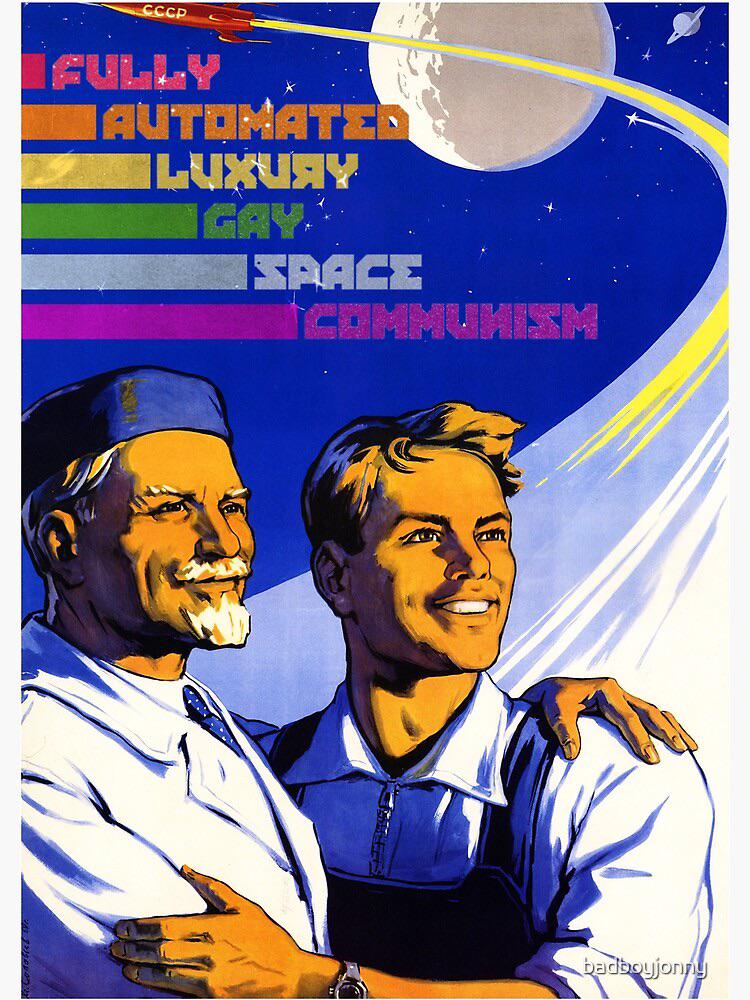
Personally, I prefer the more descriptive “gay race communism”. The progress pride flag is inseparable from the clenched Marxist fist of Black Lives Matter in regime iconography. Moreover, gay race communism is a deliberate subversion of the left’s own “fully automated luxury gay space communism” meme.
There are zero communists who actually look like this, gay or otherwise.
To be fair, Andrews introduces the concept as “gay race communism”, and even directly acknowledges its coinage by Twitter anon Drukpa Kunley. It wasn’t that long ago that conservative popularizers laundered ideas emerging from the anonosphere without attribution, as a means of hiding their origin and making themselves look more original, and Helen deserves credit for not doing this. Also to be fair, given the focus of Andrews’ piece, adding the “gay” to “race communism” could be seen as an unnecessarily inflammatory complication. It isn’t, but we’ll get to that in due time.
Andrews spends the first half of her essay detailing how the regulatory framework built by the Civil Rights Act created the cultural conditions for the rise of wokeness, affirmative action, and DEI initiatives. The official explanation given for anti-discrimination laws was that they were well-intended correctives to the legacy of slavery and Jim Crow. Affirmative action was to be an explicitly temporary measure to give American blacks a helping hand, with the understanding that – after a decade or at most a generation of assistance – they would no longer need a thumb on the scale. Once racism was defeated, we could all live in utopian colour-blind race-neutral Star Trek liberalism, judging one another by the content of our individual characters and no more concerned by the phenotypic differences of ancestral population groups than we are by sartorial quirks. Kumbayah and such. This isn’t an original argument: the same points have been made by Christopher Caldwell in his 2021 book The Age of Entitlement, and of course most directly by Richard Hanania in his 2023 book The Origins of Woke (whom Andrews doesn’t mention, possibly because everyone hates Hanania now).
The central point of Andrews’ essay is the following:
The old racial bargain is breaking down, due to a combination of changing demographics and a dawning realization that racial outcomes are not going to converge any time soon. One possible path forward is to throw out the old racial bargain and establish a new one based on equality under the law. The other possible path is to accept permanent racial favoritism at every level of society.
As Andrews sees it, the first problem with the Civil Rights regime is that it reifies the abstraction of equality into a legal presumption that there are no salient biological differences between human population groups. This simply isn’t true, but the assumption that it is true leads to the necessary conclusion that all differences in outcome between groups must be a consequence of discrimination based on irrational prejudice, rather than a natural result of inborn distinctions of cognitive capacity or behavioural profile. Biological differences are real and significant, but the make-believe that they are socially constructed and unimportant incentivizes a perpetual inquisition that dismantles society as it persecutes innocent people for ever more tenuous spectres of racism implicitly haunting the privileged depths of their incorrigbly white ids. This places institutions in an impossible quandary, since the only way to avoid being dragged into court in discrimination lawsuits is to preemptively discriminate in favour of protected groups, which is to say, against unprotected groups. Human resources departments have formed as a direct response to the legal sword of Damocles poised over every institution’s neck: their function isn’t actually to hire the best people, or to hire anyone at all, but rather to ensure that the employer won’t get sued for hiring people from the wrong groups, or not hiring the people from the right groups, or for allowing people from the right groups to get offended by things said by people from the wrong groups. A doctrine predicated on denial of reality must go to war with reality to preserve itself, and as the war on noticing grinds on the battlefront presses into ever more intimate corners of people’s lives, their public speech, their private speech, their silent thoughts, their very emotions.
Your emotions are illegal, chud.
The second problem Andrews identifies is demographic mission creep. When race communism first got rolling in the 50s and 60s, the focus was quite specifically on African-Americans, who had an arguable claim to restitution on the basis of their long period of bondage on the cotton plantations.1 White Americans largely agreed with that, and were trying to do the decent thing, to make up for the abuses and indignities suffered by the disadvantaged blacks.
The mass migration of the third world into the first upsets that balance. America is no longer a 90% white country with a small rump of Africans, but more like a 50% white country, with large and growing minorities from every benighted slum in the Global South … and every single one of those groups gets to classify itself as an oppressed racial minority from the Global Majority, and therefore help itself to the largess spilling forth from the cornucopia of white guilt. In the 70s and 80s affirmative action was largely no more than an annoyance for white Americans, but in the 2020s young American whites find themselves shoved aside in university admissions, in corporate hiring, in the availability of loans and grants for education, in the availability of venture capital, in promotions, and so on, with these opportunities being bestowed instead upon supposedly oppressed minorities who arrived five minutes ago and were never actually oppressed by white Americans.
[…]
Institutional collapse is a near certainty on this track. Our civilization is a staggeringly complex system of systems. Operating and maintaining those systems requires a high degree of competence. Competence has to be learned, but it can’t be learned by anyone. DEI pushes incapable people into key positions, while denying even the opportunity for training to the potentially capable. Eventually, the systems themselves begin to malfunction. Repair becomes impossible, because there’s no one who actually knows how to repair the systems: the ones working in the system are too stupid to understand it, while those who could have learned were locked out and therefore didn’t learn what they needed to know. One system breaks, causing a problem in another system, which leads to a problem in a third system, and soon cascading failures junk the entire machine. DEI – and by extension, Civil Rights – has precipitated a competence crisis, and Complex Systems Won’t Survive the Competence Crisis.
This complex systems collapse is already happening. Andrews uses the example of failures in airplane manufacturing, pilot training, and air traffic control that have made air travel that much more hazardous, and which seem to trace directly to DEI-motivated recruitment policies, although naturally it is difficult to verify this as the regime does everything it can to obscure such a connection. The general enshittification of the Internet is probably at least partly a result of less talented and less scrupulous Indians replacing white software engineers. Entertainment media has become ludicrously bad in direct proportion to the replacement of white male directors, showrunners, screenwriters, animators, artists, and programmers by women of pronouns. Academia is in the midst of a credibility collapse for exactly the same reason.
It is not hard to extrapolate this degenerative process out a generation or two. Instead of building cities on Mars, we will be bouncing over potholes on dirt roads. Tap water will have to be boiled, assuming water even comes from taps. Electricity will only be available a few days a week, and that in the good neighbourhoods. What did South Africans use for light before they had candles? Light bulbs. There are still liberals in South Africa, by the way.
Forestalling collapse is simple. All we need do is reinstate meritocracy within institutions.
Simple does not mean easy. Reinstating meritocracy is in fact ideologically impossible for the regime.
- The merits of that case can certainly be debated: white Americans have spilled rivers of their blood and mountains of treasure to end and make up for slavery, and when is enough enough?; the crime and dysfunction blacks have brought to American cities must surely be included against them in the accounting; the standard of living of the most low-down American hood rat is orders of magnitude better than that of his distant cousins in the shantytowns of Lagos, suggesting that if anything blacks should be grateful for free transport to the New World. Putting all of that aside, the fact remains that American blacks have a long history in America, and therefore have some claim to consideration.

Money isn’t an invention of the state
The invention of money has happened many, many times in many different societies. It’s an essential element to moving beyond subsistence and crude barter, because having a stable medium of exchange allows far more sophisticated economic activities. It addressed the real needs of people and it worked:

The state didn’t invent money. Carl Menger destroyed that myth in 1871 with his regression theorem, and statists have been seething ever since.
Picture yourself in a primitive barter economy. You’re a blacksmith who needs grain, but the farmer doesn’t want your horseshoes. He wants pottery. The potter wants leather goods. The leather worker wants meat. You face what economists call the double coincidence of wants problem: finding someone who both has what you want and wants what you have. Barter works for simple trades, but complex economic coordination becomes impossible.
Smart traders notice that certain goods get accepted more readily than others. Cattle, salt, shells, precious metals. These commodities share specific properties: durability, divisibility, portability, recognizability. Over generations, market participants gravitate toward the most marketable goods as media of exchange. No central authority decrees this. No committee meets to decide monetary policy. Individual actors pursuing their own interests spontaneously converge on the same solution.
Money emerges from voluntary exchange, not government decree. Every unit of money traces its value back through an unbroken chain of exchanges to its original commodity value. Gold became money because people valued it first as jewelry, ornamentation, and industrial uses. Its monetary premium built on top of that foundation. When governments later monopolized monetary systems, they parasitically appropriated this organic market institution.
You can observe this process today in Venezuela, Zimbabwe, Lebanon. When state currencies collapse, people don’t wait for permission to adopt alternatives. They trade cigarettes, rice, Bitcoin. Markets route around monetary failure because human cooperation demands a medium of exchange.
August 14, 2026
What Did the Builders of Stonehenge Eat?
Tasting History with Max Miller
Published 17 Feb 2026Roasted pork ribs with blackberries and honey with Stonehenge Nettle and Hazelnut Soup
City/Region: Britain
Time Period: 3000-1500 BCEAbout 2 miles from Stonehenge is Durrington Walls, the place that archaeologists believe was the living settlement for the people who built and used Stonehenge. Amongst the evidence of what was eaten, there are a lot of bones, about 90% of them being pig bones. Based on scientific analysis of the pig teeth found there, they were probably fattened on something sweet, which would have probably been honey or berries, so I’m using both to prepare these pork ribs.
This is a simple preparation, but these ribs are so good. The honey is the dominant flavor and the blackberry does come through. The other 10% of bones found at Durrington Walls were mostly cattle, so you could use beef ribs instead if you’d like, you’ll just have to cook them longer.
(more…)
QotD: Postmodernism’s origins
Leading the way were the French intellectuals, who in the 1960s and 70s questioned the deepest of those assumptions, beginning with truth itself. Was there really such a thing as “objective truth”, or was it simply an invention of the powerful, something declared rather than discovered? Was “progress” a description of reality or just the story told by whoever won? These are serious questions from which they could make fair observations. They were right to point out that institutions serve their own interests, and grand narratives play a defining role in our understanding and interpretation of the world. The trouble is that the same intellectuals didn’t try to place the answers intelligibly within the larger story of our lives. Postmodernism made interrogating power the overriding intellectual move and the answer to its own question.
Postmodernism doesn’t lend itself to a simple explanation, which is appropriate, as we shall see. However, dig beneath the deliberately impenetrable jargon, and the core claims are as follows. There is no objective truth, only competing narratives. What we think of as “knowledge” is just something the powerful tell us is the case. Language doesn’t describe reality but constructs it. Science, reason, and universal liberalism are inventions of Western minds, specifically male ones, while the Enlightenment idea of the individual with supposed natural rights is just another concept made up by those most likely to benefit from it.
There’s an obvious paradox at the outset. In what sense is it true to say there’s no such thing as objective truth? The question is meaningless because the premise is nonsensical. As Roger Scruton put it, “A writer who says that there are no truths, or that all truth is ‘merely relative’, is asking you not to believe him. So don’t.”
Despite the obvious contradiction, it’s an idea that has been pushed aggressively by campus authoritarians for decades. No narrative deserves authority, they say, while demanding intellectual obedience to a narrative of their own.
Frederick Alexander, “Postmodernism: The Idea That Ate Itself”, The Gadfly, 2026-04-03.
August 13, 2026
German democracy from the POV of “Our Democracy Enjoyers”
If you’ve been wondering about the state of democracy in Germany, your first move should be to check the latest update from eugyppius:

“Bundesrat of Germany” by photosteve101 is licensed under CC BY 2.0 
 .
.
In civics class, parties appear as little more than informal election-winning cooperatives. Now and again “the sovereign” – that is to say, “the people” – may grant one or various parties a limited right to govern, but the state is held to be in some sense public property. Politicians and their parties are at best its temporary custodians.1
Our Democracy Enjoyers particularly deplore state systems in which parties have captured the state – a special political form we might call the “party state”. Germany became a party state after 1933, when the NSDAP seized the entire state apparatus and outlawed all competitors. Contemporary states owned and operated by single parties include China, Cuba and North Korea. Our Democracy Enjoyers hate all single-party states because they are not democratic.
Party states need not however be single-party states. While the Socialist Unity Party (SED) effectively owned the DDR, they tolerated an array of subservient bloc parties from the very beginning. None of these parties ever had any chance of governing; they functioned only as extensions or alternative faces of the SED itself. These parties included gutted, early opposition parties like the CDU (Ost) and the Liberal Democratic Party (LDPD), but also SED concoctions like the Democratic Farmers’ Party (DBD) and the cynically post-Nazi National Democratic Party (NDPD). The SED cultivated these parties both as a democratic figleaf and also to integrate “non-proletarian” (particularly Christian) elements within the communist system. The precedent of the DDR shows that the party state can assume various innovative forms and that multiple parties may be useful for political, propaganda or other purposes.
My thesis of the Federal Republic is that it is also a party state. The only difference between the DDR and the BRD is that, in the BRD, several different parties share ownership of the state among themselves.
The three anecdotes at the head of this piece reveal this party ownership in incidental but telling ways. They show, for example, how a substantial portion of the police consider their oath of office to preclude loyalty to a democratically elected opposition party. Should the voters go rogue and install any such party at the state level, a prominent police union functionary openly hopes for insurrection and federal intervention. Periodically voiced ambitions and campaigns to cleanse the civil service of AfD elements come from a similar place. The ownership parties cannot countenance opposition creep into the bureaucracy, because they correctly regard the bureaucracy as their property.
The hysteria surrounding a thwarted SPD nomination to the Federal Constitutional Court reveals that the parties that own the BRD extend their proprietary interests not only to the executive and legislative branches, but also to the allegedly independent judiciary. The ruling parties have divided the prerogative to nominate judicial candidates informally among themselves. This prerogative is so jealously guarded that a leading Union politician cited a single thwarted SPD nomination to make the case for mass censorship and regulation of “alternative” media.
And while it is a minor incident that hardly matters, the dispute over the Otto-Wels-Saal shows that the proprietary feelings of the state parties extend to physical architecture, even specific rooms and buildings, which the parties of the party state regard not as public property but as their very own chambers – to name, possess and use as they see fit.
While progressive liberal political systems are all oligarchies, and this because of the Iron Law of Oligarchy, they are not all party states – far from it. The party state is a clunky and outmoded political system that historically arose out of accident or necessity, generally following a revolution perpetrated by a single party or political movement in a moment of particular ascendance. The Federal Republic was founded as a party state in 1949, mainly to foreclose the possibility that subversive National Socialist or communist elements might return to influence via democratic processes. This is the basic meaning of German “defensive democracy”, which denotes an array of legal or constitutional tools for the parties that own the state to fend off or criminalise competitors.
- Now, we know this is mostly nonsense. “The people” are an abstraction and as such they cannot grant anybody anything. All political systems ultimately redound to the control of more or less stable oligarchies. “Democracy” describes little more than a set of procedures via which the these oligarchies (or their representatives) assume power and enact their will.
The Ancient Greeks 04 – The Persian Invasion 1 – Xerxes Decides
seangabb
Published 23 Mar 2026Greece: A Brief History, c.700 BC – 500 AD
What drove the greatest invasion force of the ancient world to march against Greece?
In this lecture, we move from the aftermath of the Battle of Marathon to the momentous decision of King Xerxes of Persia to launch a full-scale invasion of mainland Greece in 480 BC. We examine the political, strategic, and psychological factors behind the Persian decision, including the legacy of Darius, the revolt in Egypt, and the internal debates within the Persian court.
Drawing on Herodotus and other ancient sources, this video explores:
– The consequences of Marathon for both Persia and Greece
– Xerxes’ consolidation of power
– The famous debate at the Persian court
– The role of honour, revenge, and imperial ideologyThis is the essential starting point for understanding how a regional conflict escalated into one of the defining wars of the ancient world.
Part of a full lecture series on the Persian Wars.
QotD: Marx was right about “class consciousness”
Marx called religion “the opiate of the masses” for a reason — by dulling their pain, it prevented them from realizing their true class position, thus achieving class consciousness, thus sparking The Revolution. What religion really does, of course, is satisfy a deep yearning in the human soul. There is more to life than shit, shoes, and bread. Karl Marx didn’t want to hear that, because his religious yearning was satisfied by his substitute god, Dialectical Materialism, and the half-assed (but very real) ceremonial it produced. Again, there’s a reason every Leftwinger practically from the French Revolution looked like [this]
I don’t know how you say “fake and gay” in Russian, but every single thing in that photograph is fake and gay. A pose. An affectation. And as with their look, so with their behavior. Leftwingers are, and always have been, famously boorish. They have no idea how longshoremen actually act, but they sure think they know, and so that’s how they act — like the worst caricature of a crude, illiterate, drunken longshoreman.
(I don’t know any longshoremen either, but I do know some folks who make a living from the sweat of their brows, and they’d turn Lenin’s head around for him if he came to their neighborhood and started acting like that. The Laboring Masses might indeed be “rude mechanicals” in Shakespeare’s sense — meaning, without too much formal education — but they’re surely not rude in the behavioral sense, because in their world, running your mouth gets you punched in it).
Dressing and acting like that is, quite literally, a religious ceremony for them … and ceremonial can only take place in a designated space, a liminal space that the community respects. A priest can indeed hold a mass on a street corner, but only if the passersby have enough residual respect for the institution of religion not to beat and rob the worshipers while their backs are turned.
The intelligentsia never understood that consciously. They sure as hell understood it unconsciously, though, which is why they immediately self-segregated — getting “sent down to the countryside, to reconnect with the laboring masses” was one of the worst punishments Mao’s boys could dish out to one of their mandarins, and again, there’s a reason for that. The upshot is, the intelligentsia, the Apparat, the Cloud People, whatever you want to call them, are the only ones who developed “class consciousness” in the Marxist-Leninist revolutionary sense …
… and their class consciousness is entirely oppositional. They are not us. That’s their sole criterion for virtue. Whatever we like, they dislike. Whatever we do, they must not do; and whatever we eschew, they must embrace.
Severian, “On Losing the Cold War”, Founding Questions, 2022-07-02.
August 12, 2026
The Korean War Week 112 – The Chinese Take Siberia – August 11, 1952
The Korean War by Indy Neidell
Published 11 Aug 2026There’s heavy fighting in the field this week for a position the US Marines call Siberia. Behind the scenes there’s worry, though, as the US Army is more and more facing a manpower crisis. They are, however, training ever more South Korean troops to one day hopefully bring all their own troops home from the Korean peninsula, and leave it defended by the locals.
“Hitler’s socialism wasn’t just an internal economic policy – it was the cause of the war”
On the social media site formerly known as Twitter, Krzysztof Szczawinski explains why socialism — of the left (the Soviet Union) and the right (Nazi Germany) — was the economic driver that pushed Europe into war in 1939. German socialism (in one state) could only continue to grow by annexing resources and manufacturing capabilities from neighbouring states, and by August 1939 it was Poland’s turn:
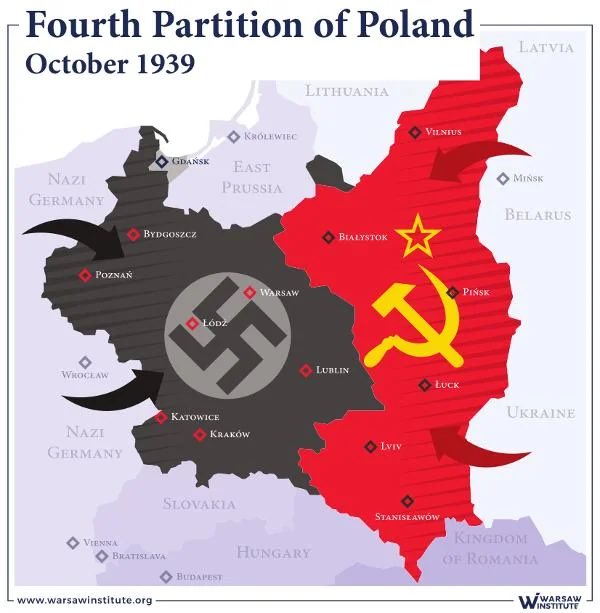
Socialism was at the origin of the war. Not as a coincidence. As a necessity. The socialist economic model generates contradictions it cannot resolve internally – the calculation problem, the misallocation, the stagnation, the mounting failure. War is the exit. It provides the external enemy that explains the internal failure. It justifies the total mobilization the system always wanted. It consumes the surplus population the economy cannot employ. It redirects the resentment outward.
Does this remind you of anything?
The evidence is not subtle. The NSDAP program of 1920 reads like a standard socialist manifesto. The economic reality confirmed it – price controls, industrial planning, state allocation of raw materials, entrepreneurs reduced to government functionaries. Private property in name only. Mises called it Zwangswirtschaft – coercive economy. Hayek dedicated a chapter of The Road to Serfdom to the socialist roots of Nazism. Both writing from observation, not retrospect.
After 1945 the Soviet victors imposed their version and attached the capitalist label to every rival. Western textbooks followed. The lie became the curriculum.
The real divide has never been left versus right. It is collective control versus individual freedom. Once you place National Socialism correctly within the family of collectivisms, the political spectrum becomes legible – and the war becomes explicable.
When the system fails — and it always fails — it needs an enemy. The bigger the failure, the bigger the enemy required.
Imagine being Poland. Squeezed between two socialist systems, both searching for their enemy.
We were it.
US Army M68 Close Combat Optic aka Aimpoint CompM Series
Forgotten Weapons
Published 16 Mar 2026When Aimpoint entered the competition for a US Army standard-issue combat optic in the 1990s, they really didn’t expect to win. The other finalists were Trijicon and Meprolite, and it seems like a safe bet that the American firm — Trijicon — would get the contract. However, it ended up going to Aimpoint’s CompM on both price and technical capability. This meant an order for 100,000 of the optics, requiring Aimpoint to massively scale up. It also led to a series of improvements to the design, which became the CompM2, CompM3, and CompM4.
Today, we are looking at the history of this evolution. How the Aimpoint 3000 became the Comp[etition], how the Comp was ruggedized to the CompM[ilitary], and how the Swedish Army Aimpoint CS led to the current CompM4.
(more…)


