
There’s a story that the Bush administration came into office in 2001 itching to get rid of Saddam Hussein and looking around for a pretext. Near as I can tell, this is totally false — actually, the entire US government had been looking for a pretext since at least a decade earlier than that. It all goes back to 1990 and the Iraqi invasion of Kuwait. Prior to that, Iraq was an American ally and proxy that helped contain the revolutionary regime in Iran. That relationship gave Saddam a long leash and meant he could get away with a tremendous amount. But the leash was not as long as Saddam thought, and he badly overstepped his limits when a diplomatic fight with Kuwait over the terms of some war loans escalated into a military confrontation. Improvisational decision-making was not out of character for Saddam, who had a tendency to do things like go alone into one of his many palaces and emerge wild-eyed the next day declaring that he had a prophetic dream which would henceforth guide state policy. But this time he got into some real trouble.
The Americans kicked Iraq out of Kuwait quickly and easily, and then … hesitated about what to do next. Nobody wanted to keep Saddam around (remarkably, when you have outlived your usefulness, people suddenly start to notice all of your human rights abuses), but nobody wanted to march into Baghdad and topple him either. There was some wishful thinking that the Kuwait defeat would cause Saddam’s regime to collapse, but most US foreign policy thinkers just shrugged their shoulders and figured better Saddam than chaos and a Vietnam-style quagmire. One especially perceptive official put it this way to a PBS journalist:
I felt there was a real danger here that you could get bogged down in a long drawn out conflict … and then you’ve got to worry about what comes after. And then you have to accept the responsibility for what happens in Iraq, accept more responsibility for what happens in the region. It would have been an all-US operation, I don’t think any of our allies would have been with us, maybe Britain, but nobody else. And you’re going to take a lot more American casualties if you’re gonna go much around in Iraq for weeks on end trying to run Saddam Hussein to ground and capture Baghdad and so forth and I don’t think it would have been worth it.
That official’s name was Dick Cheney.
So Saddam was left in place, and throughout the ’90s American policymakers seethed about it. There was no official policy that said we were going to overthrow him, but prominent politicians like Al Gore were out there writing op-eds saying that Saddam must be toppled and his government dismantled. This produced what Mazarr calls “destructive ambiguity” — everybody knew that everybody else knew that the real policy was to get rid of the guy, but since this was an unofficial position it went through none of the usual policymaking channels and was never formally debated. It also left a lot of room for freelancing.
For example, CIA clandestine operative Bob Baer (whose memoir is a terrifically fun read, by the way) began organizing a coup in 1995, not because he was directly ordered to do so but because he thought it was what his supervisors wanted. Even the strategy of the coup points towards this ambiguity — rather than straightforwardly overthrowing the government, it aimed to spark a rebellion that would gain some momentum but not enough to win, so that when Saddam moved to crush it the US would be pulled in and forced to act.1 Think for a moment about what an odd plan this is, and how it only makes sense if you believe the US secretly wants to invade while officially pretending not to.
The leader of this rebellion was supposed to be Ahmed Chalabi, one of the more fascinating characters in this story. Chalabi was a dapper, cosmopolitan, and erudite bank manager who got exiled from Iraq for gross financial corruption. He promptly reinvented himself as a freedom fighter, rented beautiful houses stocked with fine art in several major cities, and set about ingratiating himself with Western elites. He also began organizing his fellow emigrés and exiles into an effective political lobbying force. Unsurprisingly given his educated and aristocratic manner, he was extremely good at the lobbying part, and soon placed a special focus on the United States, wining and dining congressmen and writing op-eds for major newspapers. Soon he managed to convince the CIA that there were thousands of resistance fighters back in Iraq ready to follow him into battle.
He was good at convincing, but they also wanted to be convinced. Chalabi and his fellow emigrés were charming, cultured, westernized intellectuals who at least pretended to be pro-democracy. It was oh-so-tempting to believe that everybody in Iraq was like that, when in fact they were completely unrepresentative. As a rule of thumb, when a country has a revolution or a civil war or other social breakdown, the ones who make it out are the ones bright enough to see it coming and rich or well-connected enough to escape. Whether it’s the Russian Revolution, the Lebanese Civil War, or whatever you call what’s happening in South Africa, the people who leave are not a random subset — they’re the creme-de-la-creme. Unfortunately the US government somehow couldn’t figure this out in the case of Iraq. They met the emigrés, and were impressed by them, and decided that Iraq really was a civilized and cosmopolitan place under the surface, when in fact the society that created the emigrés had been destroyed decades earlier.
The emigrés represent one pole of the Baptists-and-bootleggers coalition that emerged in the ’90s to advocate for the overthrow of Saddam’s regime. The other is exemplified by Paul Wolfowitz, a soft-spoken academic who bounced between senior government positions and jobs at think tanks. Wolfowitz was a humanitarian in the most sincere sense. Much of his extended family had been killed in the Holocaust. The plight of oppressed peoples was not an abstraction for him, and he dedicated his life and career to the proposition that the United States should use all available means to end tyranny and oppression wherever they existed.
Wolfowitz is commonly described as a fanatical neoconservative, and he is, but I think it’s important to demystify that term. Too often it gets used as a catchall for “people we don’t like”, but at least when it comes to foreign policy the neoconservatives fit squarely within the American mainstream. With the notable exception of Donald Trump, every American president of the past few decades has had essentially the same foreign policy, driven by essentially the same core ideas: (1) Americans are the good guys, (2) it’s the job of the good guys to right wrongs wherever they are happening, (3) freedom and democracy are the non-negotiable inheritance of everybody on planet earth. These ideas drive the neoconservatives, yes, but they also drive Samantha Power and Susan Rice, not to mention Hillary Clinton and Barack Obama.
If you are an American, it may not be apparent to you how weird these ideas seem to the rest of the world. If I were to characterize how previous empires — and America’s current rivals — think about the world, it would be more like: (1) every country has core interests and peripheral interests, (2) you should not interfere in another country’s core interests if you can help it, (3) different peoples and cultures are adapted to different forms of government, and this diversity makes life spicy and interesting. Perhaps most shocking to Americans: most countries do not self-identify as “the good guys”, instead they think of themselves as a people with a history and a set of territorial claims.2
Mazarr describes this peculiar American quality as “the missionary impulse”, and notes that while it comes from a well-intentioned place, it “can produce a theological and absolutist conception of America’s responsibility as well as a romantic conviction that America can renovate other societies at will”. Or, to put it in blunter words, it makes us do insane things like invade and occupy a culturally alien country on the other side of the world, and stand there in blinkered incomprehension when people don’t like it. Perhaps the most damning thing about this missionary impulse is the way it provides a self-excusing justification for recklessness: since America is definitionally the good guys, all the horrible consequences of America’s dumb decisions must be somebody else’s fault, and anyway we meant well so you can’t really blame us.3 It’s like a speeding driver who hits and kills pedestrians over and over again, and when confronted gets huffy and points out he’s on his way to feed people at a soup kitchen.
Why is our national character like this? It’s one of those eternal questions. Maybe it’s because we were settled by various strains of fanatical Protestants, or because our ethnos was born during the Enlightenment, or some other “genetic” factor. Alternatively, it could be something about our historical development, or perhaps the large oceans that have always insulated us from most of the negative consequences of our decisions. Or maybe it’s just inevitable that whoever the current world empire is will feel this way, a consequence of our “unipolar moment”.4 Whatever the cause, it’s been a frequent source of misunderstanding between American and foreign diplomats, and few more so than Iraq’s.
The inability of the Iraqi regime, and of Saddam Hussein in particular, to “get” America or its motivations is a recurring bit of comic relief in Mazarr’s book, and one of the first big episodes of it occurs here in the mid ‘90s. This was the time when the Iraqis completely shut down their WMD programs and destroyed every trace of them. But even while halting their nuclear, chemical and biological weapons projects, they continued to loudly insist that they were operational. This appears to have been done out of fear that they would lose prestige if they admitted to backing down. Saddam also really wanted the Iranians to think that he still had chemical weapons out of fear that they’d invade if he didn’t, and he figured that US intelligence would obviously figure out that the programs had been stopped, so they didn’t have to come out and say it themselves.
I remember when I was a kid watching Dr. Strangelove, and laughing at the part where the Soviets built a doomsday device without telling anybody, completely defeating the purpose of having a doomsday device. Then I got older, and learned that no actually, in real life the Soviets built a doomsday device, and then didn’t tell anybody, because they apparently assumed that its psychological effect would be more powerful if America found out about it from its spies (naturally, we didn’t find out until after the Cold War was over). Saddam’s mistake was a weird inverse of this, destroying all his doomsday weapons and then just assuming we’d figure it out. I guess the moral of the story is that in real life, these too-clever-by-half schemes where you double-bluff your opponent are rarely worth it.5
Anyway, Saddam destroyed all of his WMD, and then kicked out the UN inspectors so as to maintain the charade that he still had them. At the same time that all of this was happening, the sanctions regime that the US had imposed was clearly falling apart. European and Asian businessmen were swarming all over Baghdad, trying to get things in place for when foreign investment inevitably flooded back into the country. All of this contributed to an ambient sense that something had to be done; the attempt to kick the can down the road was failing. By the late ’90s, the Clintons had already convinced themselves that a rematch with Saddam was inevitable, but they didn’t have time to act on it before their term was up and a new sheriff rolled into town.
John Psmith, “REVIEW: Leap of Faith, by Michael J. Mazarr”, Mr. and Mrs. Psmith’s Bookshelf, 2025-06-30.
- Yes, this was exactly Strelkov’s strategy in the Ukrainian civil war. And for similar reasons — the Russian government as an official body was dithering and indecisive, but a large faction within it wanted to act.
- My north star here is, as always, my former coworker from Bulgaria.
- Graham Greene did an exquisite job skewering this attitude in his novel The Quiet American. One character says of the titular American: “I never knew a man who had better motives for all the trouble he caused”.
- Did the Romans feel this way? Did the Chinese? I don’t actually know, but I think there’s something distinctive about the American imperial attitude. It really does come down to our belief that we’re bombing you for your own good (or overthrowing your government for your own good, or whatever). My sense is that past hegemons have been a bit more honest.
- Then again, Gaddafi did what Saddam arguably should have done, and look what that got him. I guess the real lesson is just not to make too much trouble until your nukes really work.
August 11, 2026
QotD: The long lead-up to the invasion of Iraq
August 10, 2026
Was Canada’s Victoria-class submarine deal a massive procurement failure?
Dominion Defence Review
Published 8 Aug 2026Plagued by chronic low availability while also being expensive to maintain, the purchase of used British submarines seems to be a good reminder that a low sticker price isn’t everything …
Gresham’s Law and the Thirty Years’ War
For one of the most destructive wars in European history (until the 20th century), most people know little or nothing about the Thirty Years’ War (which was a name applied later to a series of overlapping and interlocking conflicts that caused nearly 10 million deaths between 1618 and 1648). One of the many causes wasn’t so much religious or military, it was financial:
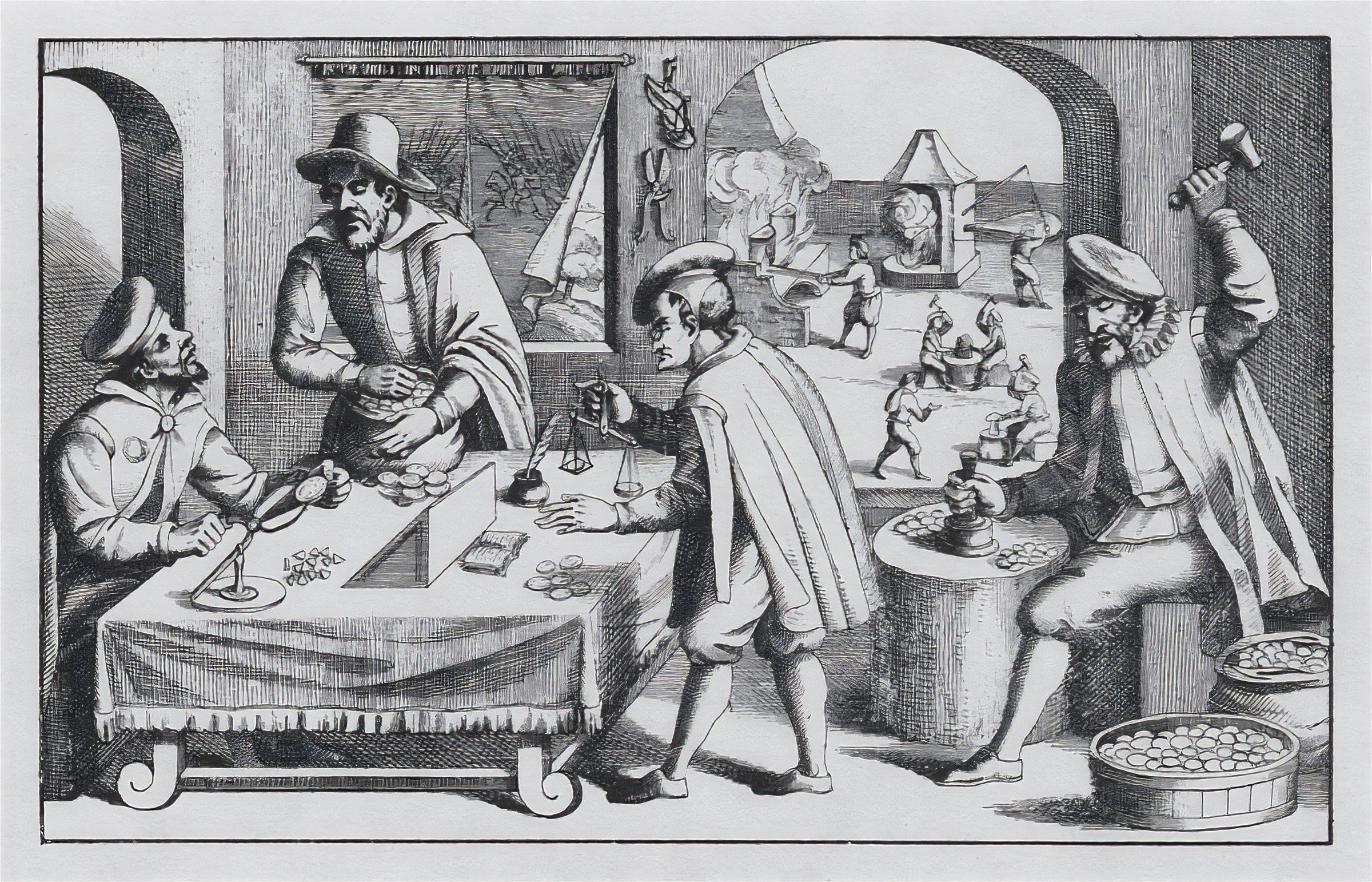
“Clipping coins in a Kipper mint”
Wikimedia Commons.
The Kipper und Wipperzeit of 1621 to 1623 [Wiki] was a direct consequence of princes and mints doing exactly what governments always do when they need money and cannot borrow it: they debased the currency.
The Thirty Years’ War started in 1618, and the Holy Roman Empire’s princes immediately faced a problem. War is expensive. Silver is finite. So the mints across the Empire began clipping, sweating, and debasing the small subsidiary coins that ordinary people used for daily transactions, flooding markets with copper-heavy pfennigs and kreutzers while hoarding the full-weight silver.
If you want to understand Gresham’s Law in its most brutal form, watch this play out. Bad money drives out good. People saved the honest silver and spent the garbage. Prices in nominal terms exploded. Contemporary accounts from Frankfurt and Augsburg document grain prices doubling and tripling between 1619 and 1623.
The real villain is the territorial mint system, which gave dozens of competing princes the legal power to set coin standards within their own borders. That fragmented monetary sovereignty created a race to the bottom. Each prince had every incentive to debase slightly more than his neighbor, because the first mover extracted real purchasing power before the market caught on.
This is currency debasement as taxation without legislation. The people who held wages and savings in subsidiary coin absorbed the loss. The princes who controlled the mints captured the seigniorage gain. No vote, no debate, no accountability.
Sound money advocates have been clear about the mechanism: when you hand governments monopoly power over coinage, they spend it. Every single time. The Kipper und Wipperzeit killed trade, wiped out savings across central Europe, and contributed to social instability that fed the war it financed. The policy destroyed the instrument it relied on.
Debasement never solves a fiscal crisis; it transfers it onto the population.
The Strangest Hammer Ever Patented (1924)
Rex Krueger
Published 1 Apr 2026This video includes a short clip that appears to be widely reposted on Instagram. I was unable to determine the original creator after reasonable searching. If you are the original creator, please contact me for attribution.
(more…)
QotD: Cleopatra’s relationship with Egypt and her Egyptian subjects
The factors usually pointed at to demonstrate Cleopatra’s attachment to Egypt are that she learned the language, engaged with Egyptian religion and represented herself in Egyptian fashion in royal artwork and commemoration meant for consumption in Egypt. And that’s true, she did those things! But the context often missing from using that as a clear indicator of Cleopatra’s cultural “Egyptianness” is that, apart from learning the language, those were common things for Ptolemaic rulers to do, despite the fact that the dynasty maintained a pronounced ethnic hierarchy in Egypt and aren’t generally regarded as being particularly attached to its people or culture. Nevertheless, there’s not nothing here in the sense that Cleopatra showed – or at least wanted to show – more than the normal Ptolemaic attachment to Egypt as a place and the Egyptians as people, which is to say almost any at all.
Let’s start with languages, because I think this fact can be presented in a somewhat distorted way. The language of the Ptolemaic court was Greek, initially Macedonian Greek (the Macedonians had a pronounced accent), though Plutarch notes that some of the later Ptolemies had lost their Macedonian accent (Plut. Ant. 27.3-4). Cleopatra, by contrast, was the first of the Ptolemies to bother to learn Egyptian (which should tell you something about the character of Ptolemaic rule; imagine if King Charles was the first English king since George I and kings from the House of Hanover to bother to learn English). The problem with this fact is that it is incomplete, presenting Cleopatra as a Greek-speaker who learned the language of her people out of sincere devotion, but that’s not what Plutarch says. Plutarch says:
She could turn [her voice] easily to whichever language she wished and she conversed with few barbarians entirely through an interpreter, and she gave her decisions herself to most of them, including Ethiopians, Troglodytes, Hebrews, Arabians, Syrians, Medes and Parthians. She is said to have learned the languages of many others also, although the kings before her did not undertake to learn the Egyptian language, even though some of them had abandoned the Macedonian dialect.1
So let’s unpack that. This isn’t a native speaker of Greek who learned just the language of her subjects, but a spectacularly skilled linguist who learned a lot of different languages, quite regardless of if she ruled the people in question. Running through the list, she evidently learned Ethiopian, the language of the people on her southern border, the speech of the Troglodytae, the people who lived on the coast of the Red Sea (a hinterland of her kingdom). The “language of the Hebrews” here is probably Aramaic rather than Hebrew (which would also cover much of Syria), while the language of the Medes and Parthians might mean both Old Persian and the Parthian language. To which we must add Egyptian, implied by that last sentence; it also seems fairly clear Cleopatra knew at least some Latin.2 This is part of why I find arguments that use Cleopatra’s knowledge of Egyptian as strong proof either for her Egyptian ancestry or deep attachment to Egypt less than fully compelling; she was surely not Parthian and did not have a deep attachment to Parthia, but she learned their language too. Again, there’s not nothing here, but it’s not a slam dunk either.
What of Cleopatra’s role in Egyptian religion? The recent Netflix miniseries makes quite a fuss about how Cleopatra’s first action as queen – that we know of, because this is simply the first moment she is visible in the sources to us at all – is to partake in a religious festival installing a new sacred bull in a shrine at Hermonthis, close to Thebes in Upper Egypt and how this was indicative of a deep love of Egyptian religion. And it may well have been, but it’s also worth noting that Ptolemaic rulers had been taking part in Egyptian religion for a long time. Most of the massive temple complex at Philae, for instance – even farther from Alexandria than Hermonthis, I might add – was built in the Ptolemaic period, with major expansions by Ptolemy II and III. Even more relevantly to our subject, this was a [devotion] to Isis; Cleopatra was not the first Ptolemy by any means to claim that goddess for the dynasty.3
Nor had this even been a new practice for the Ptolemies. Alexander was presumably crowned pharaoh in Memphis in the traditional manner, visited the oracle of Amun at Siwa and dedicated a major set of construction works in the temple of Amun at Thebes. The Ptolemies followed this model. Ptolemy II went to Mendes to personally conduct the ritual of the process of the Ram of Mendes and then extended the temple, he presided over the inauguration of a temple at Pithom, and so on.4 And on it went with Ptolemy III and on down the line (indeed, becoming a bit more pronounced as we move into the later Ptolemies, beginning with Ptolemy V Epiphanes, potentially as a result of the increasing weakness of the Ptolemaic dynasty both internally and abroad). Ptolemaic kings were regularly in and out of Memphis, the religious capital of Egypt, building new Egyptian temples, attending Egyptian religious rituals and so on. The reason is that the job of Pharaoh was as much (if not more) a religious job as it was a political one and it was a job that only the Pharaoh could conduct. And the idea that a Ptolemaic pharaoh with a legitimacy problem might consecrate some temples to help fix that wasn’t new either; Ptolemy VIII Physcon is out doing that thing in the mid-second century. Consequently, involvement in Egyptian religion was a requirement of the position, quite apart from the question of how much the holder of that position cared.
Cleopatra, like any Ptolemaic ruler, engaged in this sort of building, though it seems striking how much of her building program was composed of Hellenistic structures in Alexandria, even as Duanne Roller admits, “the queen was not a major builder”.5 She restored the gymnasium of Alexandria, made major repairs to the Lighthouse, built a new precinct in honor of Julius Caesar called the Kaisareion, and apparently built a monumental tomb for herself, also in Alexandria. Examples of her building outside of Alexandria are fairly thin: the completion of a temple at Dendera begun by Ptolemy XII, extensions to the temple at Hermonthis (where she visited early in her reign), never entirely finished and a temple to Isis in Ptolemais Hermiou in Upper Egypt. Cleopatra could hardly be accounted the great renovator of Egyptian religion or religious sites.
Likewise the assertion that Cleopatra represented herself in Egyptian artwork in Egyptian style and dress; that too was true of all of the Ptolemaic rulers from the very beginning. Indeed, Cleopatra’s self-representation as Isis was very much not new, but in fact the normal way Ptolemaic queens were represented (to match Ptolemaic kings being represented as Osiris). Here, for instance, is Ptolemy II Philadelphos (r. 284-246) with his queen Arsinoe II represented in Egyptian style on a relief now in the British Museum.
Like all Ptolemaic rulers before her, Cleopatra presented herself in an Egyptian form, conforming to Egyptian style, in Egyptian contexts. And, like all of the Ptolemaic rulers before her, she presented herself in a Hellenistic form in Alexandria and on her coinage. While you will see people point to various busts and frescos as being images of Cleopatra, it is only her coins where we can say for certain that an effort was made to capture her likeness (her Egyptian portraiture, though labeled, follows Egyptian stylistics, not her actual likeness); we have no idea if, for instance, later Roman artists had any information about what she actually looked like or if the busts we suppose to be of her actually are. Be wary also of Greek and Roman frescos showing fair-skinned women reported to be Cleopatra; almost all women in Greek and Roman fresco are shown as fair-skinned; it’s a standard artistic convention. Coins, of course, record no skin color and neither do our sources for Cleopatra; anyone who thinks they can tell you what color her skin was is unduly certain.6
Now this isn’t to say Cleopatra is doing nothing new. She does seem to have been somewhat more involved in Egyptian religion than her predecessors, though the exact degree to which this is true is hard to see because we don’t have anything like a full accounting of their actions; if it is a difference it is a different in quantity, not kind. Certainly her building program wasn’t anywhere close to the scale of the early Ptolemies, but perhaps she took more direct personal involvement. Once again, the unknowns here are formidable. Dorothy J. Thompson in the the Cambridge Ancient History7 takes this, along with Cleopatra switching her regnal name from “philopator” (“loves-father”) to “philopatris” (“loves-homeland”8) to be indicative of a clear effort by Cleopatra to be, “indeed queen of Egypt”, particularly in the context of dynastic struggles with her brothers: outflanking them by getting the favor of the people.
The problem with this narrative is the timing: Cleopatra makes that switch in titles in 36/5 BC, which is to say in year 16 of her 21 year reign, eight or nine years after her last serious competition for the throne, her youngest brother, had died. Instead, Bingen9 argues that the homeland Cleopatra is professing love for is the greater Macedonian empire – the empire of Alexander – which she may have seemed in 36 on the verge of reclaiming.10 Antonius was just about to give her (through her children) sweeping portions of Roman Syria, Cilicia, Cyrenaica and Armenia; he would also give them titles to Medea and Parthia, which he didn’t control (though perhaps in 36 he hoped to) but would represent collectively the whole of the old Seleucid Empire near its height. Bingen notes the other change to Cleopatra’s titulature at this point was rather than just being “the goddess who loves her father” she becomes “the young goddess who loves her father and her country”; the added νεωτέρα (“young”) perhaps being intended as a link to Cleopatra Thea, Seleucid queen-consort of Syria from 150 to 126 BC and Cleopatra’s own great-grand-aunt. Cleopatra, after all, was about to achieve the long Ptolemaic dream of controlling all of Syria.
Strikingly the sources do not tell us that Cleopatra was seen as any more distinctively Egyptian than her father or that she had some groundswell of popular support in Egypt. Indeed, Cassius Dio implies the opposite (Cass. Dio 42.34-6) that the Egyptians favored Ptolemy XIII in the succession dispute and it was only the force of Caesar’s arms that turned the issue to Cleopatra. Of course we have to be somewhat skeptical of this account too: Dio is marinating in a literary tradition that is very hostile to Cleopatra and also makes no effort to distinguish between the Alexandrians and the rest of Egypt, two very distinct groups. In any case it is clear that Cleopatra achieved no groundswell of support in Egypt in those early years: she had to raise her army in Syria and in the event it wasn’t the stronger force as she and Caesar spent the winter of 48/7 besieged in Alexandria by Ptolemy XIII’s then larger army (Caesar had not brought his full field army), until the arrival of an army out of Roman Syria led by a collection of Caesar’s allies tipped the balance. Julius Caesar was never a particularly cautious commander, so if he looked at whatever force Cleopatra still had and said, “we need to wait for reinforcements”, it could not, at that point, have been very substantial. Afterwards, Caesar would leave four legions in Egypt to secure Cleopatra’s rule, which seems not to indicate her great popularity or any great faith in her ability to hold the kingdom. After 44, she’s able to rule without direct support, but of course after 44, she and her children are the only dynastic options left, her brothers and sisters all being dead (some at her hand). Finally, when Octavian comes for her, there is no major effort by anyone to stop him militarily. If Cleopatra had the love of the Egyptian people at that point, we sure don’t see it.
In my view then, it seems like an argument can be made that Cleopatra had a fairly modest propaganda effort towards presenting herself as more in touch with Egyptian religion, but the extent and quality was at most only a modest improvement over the previous Ptolemies and apart from keeping her on the throne (with Roman backing), it doesn’t seem to have achieved much.
Bret Devereaux, “Collections: On the Reign of Cleopatra”, A Collection of Unmitigated Pedantry, 2023-05-26.
- Trans. from Jones (2006).
- On this, see Roller (2010), 48-9.
- On this sanctuary and its inscriptions, see J. Bingen (2007), 31-43.
- On this, see Hölbl (2001), 77-90.
- op. cit. 108.
- Though, contra Netflix, we can say something about her hair. I was rather confused when one of their talking heads posited that he liked to imagine Cleopatra with hair like his – his hair was very tightly curly and indeed that is how the Netflix documentary opted to do Cleopatra’s hair. We can see her hair on her coins and it is wavy, pulled together into a bun in Hellenistic style with short draping curls (loose, not tight) and a Hellenistic diadem. I think it is pretty fair to suppose this is how Cleopatra actually wore her hair – or at least, how she wanted people to think she wore her hair.
- The second edition of the Cambridge Ancient History; in this case CAH2 IX, 320-1.
- Literally “loves her fatherland”. To save myself some audio pain in the future, I often hear “philopator” pronounced with the emphasis on the second syllable (phi-LOPE-a-tor), but the accent is on the alpha, phi-lo-PA-tor, because that o is an omega, a long-vowel, so the accent can fall no further back.
- op. cit., 58-62 and 76-79.
- Bingen argues that in an Egyptian context, it would have been clear that Cleopatra’s patris was, in fact, Makedon – the most prestigious and useful possible patris to have in Ptolemaic Egypt.
August 9, 2026
How To Launch the Apocalypse – Death of Democracy 27 – Q3 1939
World War Two and Spartacus Olsson
Published 8 Aug 2026This is Step 27 in the Death of Democracy: LAUNCH A WORLD WAR — the moment when the collapse of democracy, diplomacy, and collective security culminated in an attack that would engulf the world.
In July and August 1939, Adolf Hitler turned the destruction of German democracy into the instrument for launching a European war.
While Nazi Germany armed Danzig, mobilized reservists, prepared its U-boats, introduced civilian rationing, and manufactured stories of Polish aggression, Britain, France, Poland, the United States, and the Soviet Union made a final series of increasingly desperate attempts to prevent catastrophe.
At the center of the crisis was the failed effort to construct an Anglo-French-Soviet alliance against Nazi aggression. Negotiations foundered on delay, mutual suspicion, the Baltic states, and the Soviet demand for military passage through Poland. Stalin then chose an agreement with Hitler: the Molotov–Ribbentrop Pact and its secret protocol divided Eastern Europe into German and Soviet spheres of influence and prepared the way for the destruction of Poland.
Inside Germany, there was little repetition of the supposed national enthusiasm of August 1914. Nazi leaders and Wehrmacht commanders ranged from confidence and opportunism to anxiety and fatalism, while many ordinary Germans feared that Hitler had finally pushed Europe beyond the point of no return. Yet propaganda, repression, and six years of dictatorship had stripped the population of any effective means of preventing the war.
The next episode will conclude the series with an epilogue examining what the destruction of the Weimar Republic teaches us about defending democracy today.
The drift toward socialism in the west
I’m reminded of that line from Kipling: “And the burnt Fool’s bandaged finger goes wabbling back to the Fire”, as most western countries have had plenty of opportunities to observe socialism in the wild, yet there’s always the chorus that it “wasn’t real socialism” and this time it’ll be great:

Socialism survives because it flatters the most powerful human instinct you have: the desire to believe that good intentions produce good outcomes.
The engine is pure motivated reasoning: not ignorance, not stupidity.
Venezuela collapsed from one of Latin America’s wealthiest economies into a country where citizens lost an average of 11 kilograms of body weight in 2017 because food disappeared. The Soviet Union murdered tens of millions in gulags and deliberately starved Ukraine in 1932-33. Cuba turned a middle-income Caribbean nation into a prison island. West and East Germany, North and South Korea. The pattern repeats, and yet the ideology never takes the blame.
Here’s why. Socialism’s defenders always move the goalposts. When the USSR fell, they said it wasn’t “real” socialism. When Venezuela imploded under Chavez and Maduro’s nationalizations, they blamed American sanctions. There is always an excuse, and that excuse always points away from the central planning mechanism itself.
Ludwig von Mises nailed this in 1920 in his essay on economic calculation. Without prices set by voluntary exchange, planners cannot allocate resources rationally. You get shortages and surpluses simultaneously, not because bureaucrats are evil, but because they are operating blind. The information simply does not exist in a form they can use.
Mises’s argument is uncomfortable in a specific way: it says the system cannot work regardless of who runs it. You cannot fix central planning by finding better central planners.
The real villain is the intellectual class, professors and politicians who build careers selling the promise of top-down coordination. They capture universities, media institutions, and government agencies, and they teach each new generation that the solution to failed socialism is more socialism.
Socialism survives because the people promoting it face zero personal cost when it fails. The Venezuelan peasant starves. The tenured professor in Boston gets a book deal.
That gap between who sells the idea and who pays for it is what keeps the whole rotten project alive.
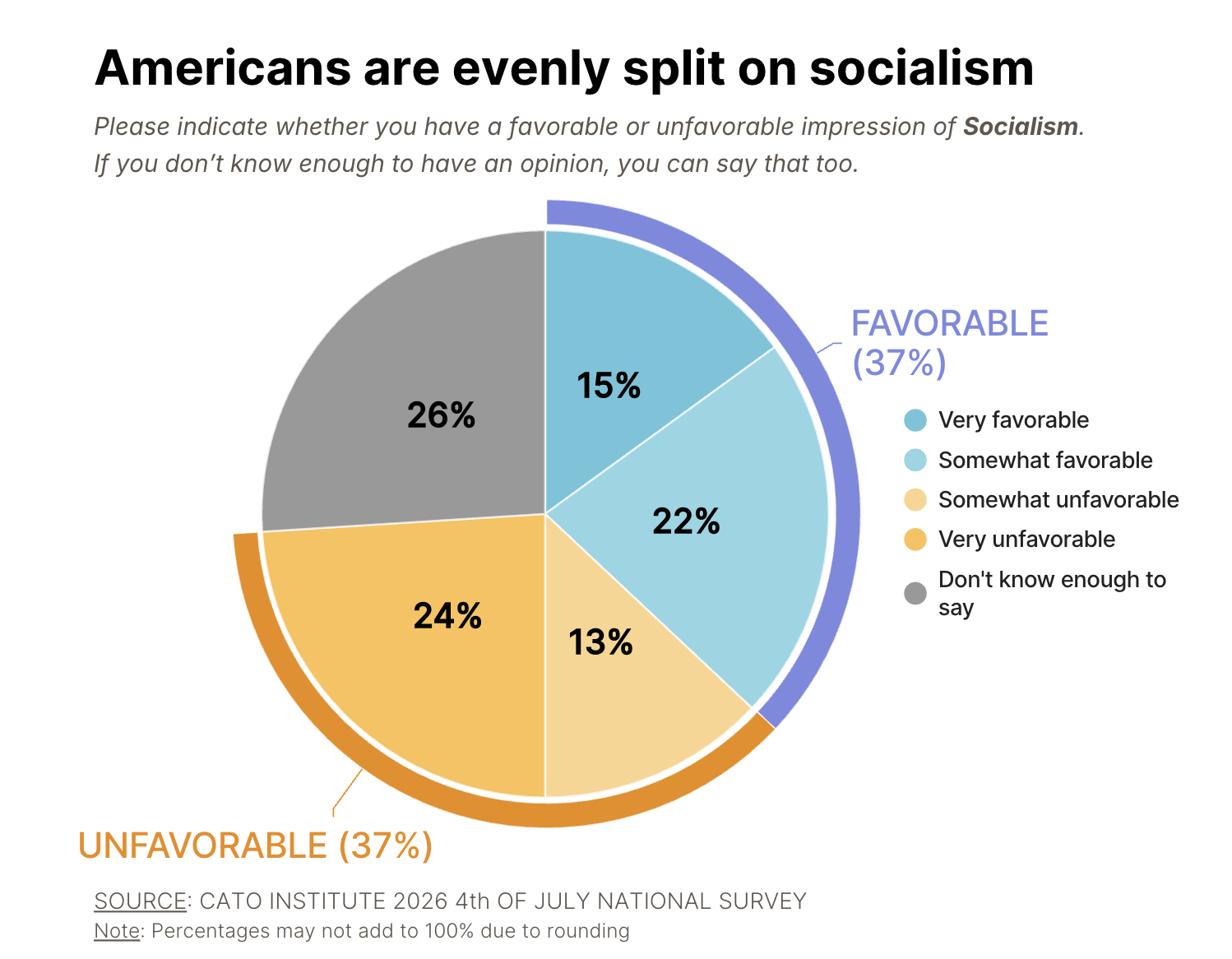
Celina notes that a recent Cato Instutute report shows uncomfortably strong support for both socialism and communism in the youngest groups:
This summer, America celebrated the 250th anniversary of its founding. At the same time, the Cato Institute, a libertarian think tank whose entire institutional purpose is the defence of free markets, commissioned a survey with Morning Consult of 2,253 American adults. The survey included the usual questions: pride in country, knowledge of what the anniversary commemorated, and belief in the American Dream.
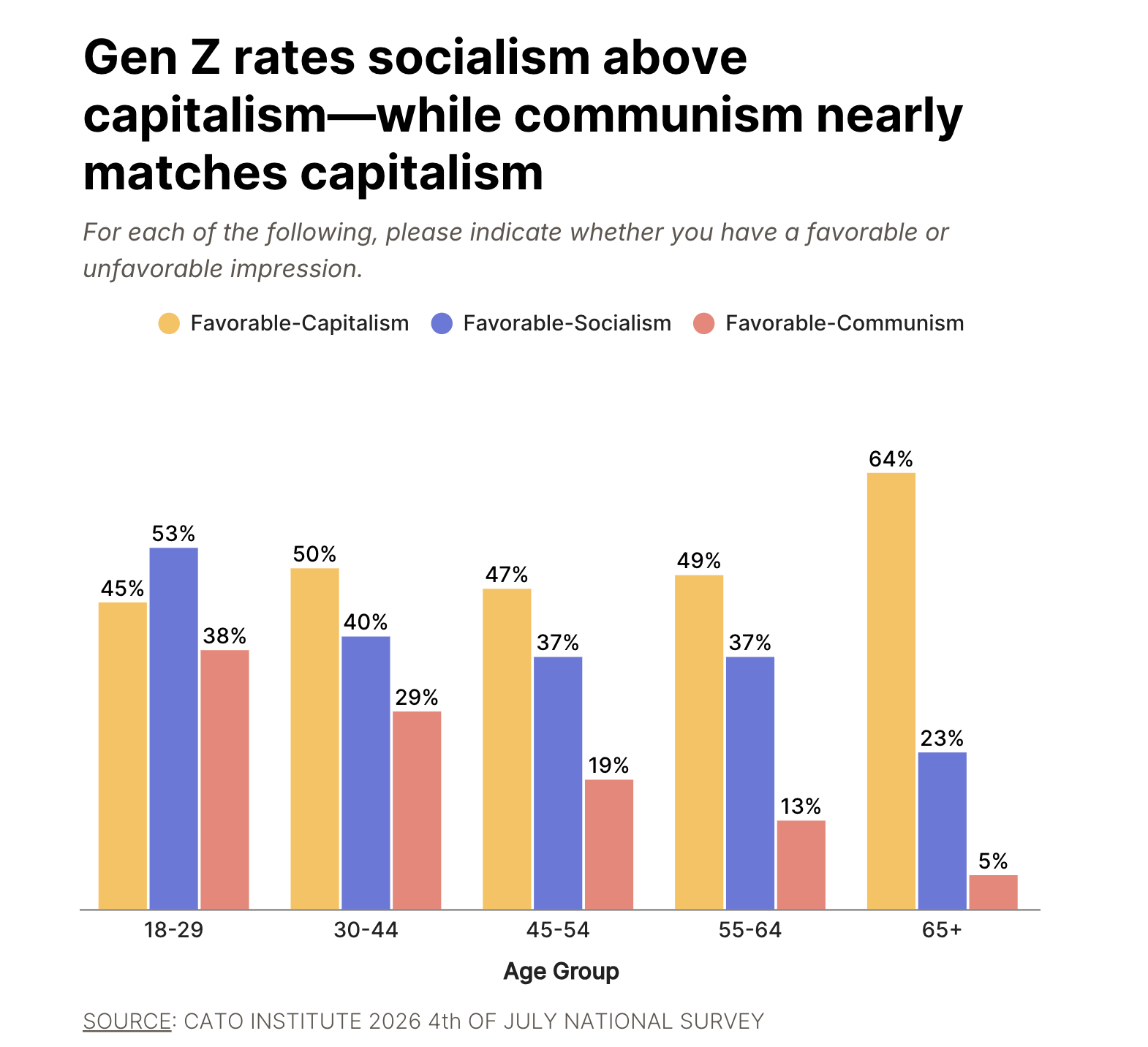
Besides the typical civic questions, the Cato questionnaire also asked Americans their feelings on communism, socialism and capitalism. The responses were quite explosive; the survey’s authors reported that: 21 percent of Americans said they held a favourable view of communism.1
Not socialism but communism. The word itself, which to the older Western mind is attached to the gulag and the Stasi and the Cultural Revolution, the one that American politics spent literally seven decades treating as roughly synonymous with treason.
Among Americans aged 18 to 29, the figure was 38 percent. In that cohort, favourable views of communism (38 percent) ran only seven points behind favourable views of capitalism (45 percent), and the generation was the only age group in which favourable views of communism actually edged out unfavourable ones, 38 to 36. Socialism, meanwhile, outpolled capitalism among the young outright: 53 percent favourable against capitalism’s 45. Also, the generational gradient was almost perfectly linear. Favourability toward communism fell from 38 percent among Gen Z to 29 percent among younger millennials, 19 percent among the middle-aged, 13 percent among those approaching retirement, and just 5 percent among seniors, the Americans old enough to remember duck-and-cover drills, Brezhnev, and the Berlin Wall as a piece of functioning infrastructure.
The 2026 Cato survey was not a fluke, which would be plainly obvious to people with even a slight interest in American politics. We also know this was not a fluke because the year before, in March of 2025, a Cato/YouGov survey of 2,000 adults found 34 percent of under-30s favourable toward communism and 62 percent favourable toward socialism. Cato’s senior editor Michael Chapman recorded roughly 52 million Americans aged 18 to 29, reporting a 34 percent favourability figure implying something on the order of eighteen million young people willing to say a kind word about an ideology that the Black Book of Communism credits with approximately 100 million deaths.
If you know a bit about the history of communism in America, you can understand why these numbers landed the way they did. American attitudes toward communism for most of the twentieth century were not just slightly negative; they were extremely so. Anti-communism was one of the few genuinely bipartisan commitments in American life, embraced by Cold War liberals and conservatives alike. Congress quite literally passed the Communist Control Act of 1954, effectively outlawing the Communist Party. Having any public sympathy for communism was politically and professionally fatal, as evidenced by the loyalty oaths, blacklists, and the House of Un-American Activities Committee (HUAC). When Gallup asked Americans in 1949 what “socialism” meant to them, the largest share answered on the lines of “government ownership of the means of production”, and they wanted no part of it. Communism, the harder and more explicit term, was too unthinkable during that time to even be asked in the poll.2
https://www.cato.org/blog/new-poll-nearly-half-americans-dont-know-what-americas-250th-celebrating
https://news.gallup.com/vault/240749/gallup-vault-americans-views-socialism-1949-1965.aspx

Clearing Bannerman’s Castle: A Century of Explosive Ordnance
Forgotten Weapons
Published 11 Mar 2026The Bannerman family decided to sell Bannerman’s Island to the state of New York in the 1950s, but the sale required that they first clear all the ordnance off it. That was no simple task, and the military was not interested in the job. Instead, the family found Val Forgett Jr, a demolitions expert who happened to be looking for seed money to start a business making reproduction black powder revolvers. His offer to do the cleanup work was accepted, and he spent a summer doing the job and put the proceeds into the first Navy Arms reproduction 1851 Colt Navy revolvers.
This video includes the talk given by Forgett to the Armor and Arms Club of New York in the 1990s explaining the process of clearing out the ordnance from the island …
(more…)
August 8, 2026
The Ancient Greeks 03 – Enter the Persians 7 – Marathon, The First Shock
seangabb
Published 16 Feb 2026Greece: A Brief History, c.700 BC – 500 AD
The Persian army lands at Marathon. Athens must decide whether to wait or fight. We examine Miltiades’ strategy, the Athenian command structure, hoplite tactics, and Herodotus’ restrained account of the battle.
We also analyse the later legend of the Marathon runner and the political consequences of the victory. Marathon did not end the Persian threat — but it changed Greek confidence forever.
This is not the end of the war. It is the end of its beginning.
August 7, 2026
Blood Dawn by Hans van de Ven
On his Substack, Dr. Robert Lyman reviews a new book on the Second World War in Asia by Hans van de Ven:
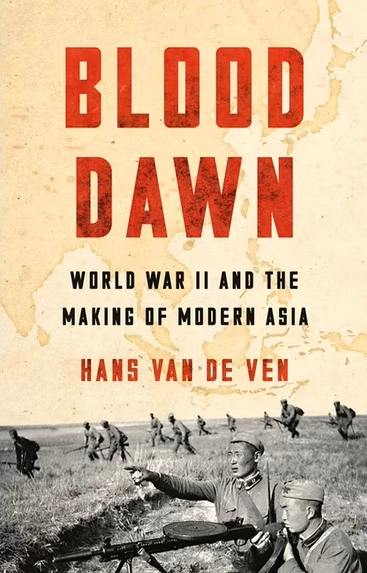
I really wanted to enjoy this book. The enthusiastic endorsements from Rana Mitter, Antony Beevor and Richard Overy raised my expectations considerably. Yet by page eight of Blood Dawn I felt as uncomfortable as the proverbial curate confronted with a rotten egg.
The author aims to provide a narrative that “contributes to a gradual shift in our understanding of the significance of World War II”. This is admirable. A more Asian-centred interpretation of the conflict is certainly needed, as the war is still too often viewed through a Eurocentric or North Atlantic lens. Historians such as Rana Mitter, Jonathan Fennell and Richard Overy have already helped redress this imbalance. It is unquestionably true that the conflict began with Japanese aggression in China as early as 1931 and that the war both began and ended in Asia.
The problem is that the book insists that the central dynamic of modern Asian history is a nationalist struggle to escape imperialism and colonialism. While both undeniably shaped Asia, it is a considerable stretch to explain the region’s political development primarily through resistance to empire. The author correctly notes that many Asian political movements saw the war as an opportunity to cast off colonial rule, but he greatly overstates their role in determining the war’s outcome.
Consequently, the analysis neglects the broader dynamics of power – local, regional and imperial – that shaped Asia before, during and after the war. The author assumes that modern Asia is the product of “Asian peoples’ continuing struggle to overcome the legacies of empire”. That seems reductive. A more convincing interpretation would describe modern Asia to be the result of a power-based confrontation among declining powers such as Britain, France and the Netherlands, a rising Japan, a developing China, and the emerging superpowers whose ideologies would shape postwar Asia: the United States and the Soviet Union. The war was principally caused by one rising empire, Japan, seeking to assert its dominance regionally and to replace existing empires.
As a result, some empires disappeared, others expanded, and many colonial territories gained independence as competing political elites seized opportunities created by wartime upheaval. Where those struggles could not be resolved peacefully, civil war followed. One may call this nationalism or self-determination, but it was power politics nonetheless.
In the postwar period, Asians were often less concerned with abolishing imperial legacies than with creating new centres of power controlled by local elites. Since 1945, Asia has been shaped by competing powers, some imperial in nature, such as China, the Soviet Union/Russia and the United States, and others nationalist and local.
A similar lack of nuance appears in the treatment of imperialism. British imperialism is lumped together with that of France and the Netherlands, with little appreciation for their differences. British involvement in 19th-century China is presented primarily as the cause of China’s problems rather than as part of a broader interaction with a declining and dysfunctional Qing polity. Imperialism was certainly influential, but so were domestic developments, including China’s internal sclerosis and Japan’s response to modernity, which produced its own imperial ambitions in China, Korea, Manchuria and the Pacific.
The author’s ideological predispositions are impossible to miss, and the book frequently descends into crude Anglophobia. We are told, for instance, that “British elites, who liked (and like) to think of themselves as natural and gifted rulers, found a new outlet for their yearning to govern India”. Such statements are simplistic, if not puerile. Similarly, discussing the collapse of the American-British-Dutch-Australia Command (ABDACOM) in 1942, the author remarks that “the Dutch were abandoned to their fate. Retreat is an underappreciated military skill, and the British were practiced masters of it, as they had shown at Dunkirk”. This is the sort of cheap point-scoring that would weaken an undergraduate essay, yet here it appears in a supposedly serious work of history.
The treatment of India is particularly problematic. The narrative focuses heavily on the Indian National Congress and consequently overlooks the diversity and complexity of the independence movement. There is little recognition that what Congress often described as British obstruction was, in part, a debate within Britain (especially the Conservative Party) about the form an independent India should take. The same debate also took place within Indian circles considering the subject.
During the 1920s and 1930s, the central political question in India was often not whether independence would occur but what form it would take and, crucially, who would benefit from it. The Quit India movement of 1942 followed the Cripps Mission, which had already offered India Dominion status after the war. Congress sought immediate separation, but many of its leaders privately supported the Allied war effort, believing correctly that victory would hasten independence. One could even argue that Congress’s greatest unintended achievement was not independence but the partition and communal violence that accompanied it. The book fails to engage adequately with these complexities.
The History of Gumbo in New Orleans
Tasting History with Max Miller
Published 10 Feb 2026Shrimp and crab gumbo with beef and ham hock served with rice
City/Region: New Orleans
Time Period: 1885New Orleans is one of my favorite food cities. Gumbo, a rich, thick soup or stew (depending on who you’re talking to), is an embodiment of the many cultures that have lived there. Ingredients and techniques from Native Americans, Africans, French, Spanish, and Acadian roots, just to name a few, have a place in gumbo.
While this is a relatively simple dish, it is absolutely packed with flavor. I was blown away by how a handful of ingredients, cooked down over time, came together to make such a delicious dish. Go to New Orleans and try one of the many versions of gumbo, and in the meantime, make this historical version that is so, so good.
Gombo With Crabs, or Shrimp
To a pound of beef add half a pound knuckle of ham; chop up both in inch pieces and fry them brown in two tablespoons of boiling lard; add to them four large crabs cut up, or a pound of peeled shrimps, or both if desired; cut into this four dozen small okra pods, one large onion, a little red pepper, and salt to taste. Let all simmer on a slow fire for about twenty minutes; then fill up with warm water, enough to cover the contents two inches deep. Let this boil for two hours. If it becomes too thick, add as much water as required. If preferred, a chicken can be used instead of beef.
— La Cuisine Creole compiled by Lafcadio Hearn, 1885
August 6, 2026
B-29 Superfortress – A $3.7bn Trial By Fire
HardThrasher
Published 5 Aug 2026The Boeing B-29 Superfortress was the most advanced bomber of World War Two — but also one of the most troubled and expensive aircraft ever built, and was plagued with flaws.
Developed at extraordinary speed, the B-29 could fly higher, faster and further than earlier heavy bombers while carrying a formidable bomb load.
It introduced pressurised crew compartments, remote-controlled gun turrets, advanced fire-control systems and enormous Wright R-3350 engines. But it couldn’t hit a barn door with its guns, had urine in the brakelines and engines which kept exploding due to all the flammable metal in them.
This video explores how the B-29 was designed, why it cost more than the Atomic Bomb to develop and how the United States overcame these challenges to get it into the war.
And yes, this is purely an excuse for me to make videos about the bomber war in the Pacific, so yar booh sucks 😊
00:00 Introduction
01:47 MOAR, MOAR, MOAR
05:48 Origin Story
12:52 Built It And They Will Come
17:57 The Battle of Kansas
19:12 Root Causes – The Key Problems
23:59 So Wright It’s Wrong
32:39 ConclusionsSources
1. Pace, S., Boeing B-29 Superfortress, Crowood Press, 2003 p.53
2. Werrell, K.P., Blankets of Fire, US Bombers over Japan during World War II, Smithsonian Institution Press, 1996, p.82
3. Werrell, K.P., p.68
4. [Deleted Section]
5. Pace, S., p.23
6. Sixteenth Census of the United States, 1940–1940, NAID: 16660414
7. Werrell, K.P., p.75
8. Le May & Yenne, Superfortress – The Boeing B-29 and American Airpower in World War II, Westholme Publishing 2007 (original published 1988 by McGraw) p.78
9. Le May & Yenne, p.78
10. Werrell, K.P., p.80
11. Le May & Yenne, p.80
12. Werrell, K.P., p.67
13. Werrell, K.P., p.67
14. Werrell, K.P., p.80
QotD: John Nicholson, a Muslim saint who really hated India
[…]
[The First Anglo-Afghan War (1838-1842)] began with the British efforts to replace Afghan Emir Dost Muhammad with a more pliant leader, which in a pattern seen from the days of Alexander onward, involved an invasion, an attempt at a pacification, followed by a grim and growing awareness that the place is full of some of the most brutal and fractious people on Earth and is simply ungovernable, which terminates in a costly retreat, the country itself returning to its customary barbarism, efforts to change it having had all the effect of flinging an encyclopedia into a chimp enclosure. For the British, this meant early success, then an overwinter occupation in which their position deteriorated, then a mass uprising, whereupon they negotiated with the locals for a peaceful exit upon surrendering their arms. The retreating British were of course betrayed and massacred. One man made it out.
Nicholson, serving as an adjutant officer with a native regiment, had earlier been taken prisoner, and endured horrific conditions as such. He watched as his Hindu soldiers refused — to a man — to convert to Islam, and were executed one after the other. After having been released, he discovered that his younger brother Alexander had been murdered and mutilated by the Afghans while retreating with the rest of the army. The entire effort had been a great traumatic waste.
One might expect that Nicholson would hate the Afghans and perhaps revise upward his estimation of the brave Indian soldiers who had served under him. But while he did indeed revile the Pashtun tribesmen (“the most vicious and bloodthirsty race in existence”) he actually seems to have disliked them slightly less than the Hindus, perhaps on the grounds that no one that eager to kill Indians can be all bad. Indeed, he seems to have learned there some harsh lessons concerning what it would take to actually accomplish anything in the subcontinent, doctrines he would apply fastidiously and thoroughly. In many ways, he went a bit more native than he would have cared to admit.
After the war, Nicholson was promoted and given a series of administrative jobs, where he became well-acquainted with the chaotic political situation in the Punjab region. Mostly under the control of the Sikh Empire, the area had long been contested ground between that new faith and Islamic invasions from the Mughals to the southeast and the Afghans through the Khyber Pass to the west, not to mention restive Hindu Rajputs and Marathas to the south. The unstable (then and now) region of Kashmir lay to the north, and the whole of the region was plagued by innumerable bandits and warlords. The BEIC ruled through direct administration, client kings, and various alliances, the latter two of which its political officers (“politicals”) had to interact with on a regular basis. It was very much a situation out of George R. R. Martin’s fever dreams, constant betrayals, perversions of every kind, and even a Ramsey Bolton-esque Sikh despot who flayed men alive for amusement.
Nicholson was in charge of the Bannu area, where he rapidly made a name for himself as a local administrator. The whole of the Bannu was infested with bandits of all kinds, from jihadis to Hindu cultists to normal brigands, and the people lived in constant fear of their depredations. Nicholson had no real interest in bettering lives, but he had even less interest in allowing any Indian, anywhere, to challenge his authority. So he set about fixing the problem as only he could.
Nicholson arrested and executed scores of bandits, rapidly processing them through his very efficient court system. The idea of impartially dispensing justice without respect to person or affiliation was quite new to the area, but Nicholson made sure the locals adjusted quickly, tolerating not even the slightest hint of disrespect from anyone, no matter who he was. When a local Muslim leader casually spit on the ground in front of him, Nicholson made him kneel and lick it up. Anyone who failed to display prompt obedience to his commands he had flogged immediately, and was the bane of servants, who were often the causal recipients of hurled cups and dishes. He was a very hands-on leader, not the least hesitant to get them dirty in a quite literal sense. At one point, when his local police were unwilling to pursue a dangerous gang leader, Nicholson rode alone to the man’s village, approached him on the street, and killed him with his sword after the suspect failed to submit to arrest. Nicholson kept his severed head on his desk pour encourager les autres.
Interestingly, such draconian brutality seems to have actually made Nicholson popular. He was harsh, unyielding, and wholly indifferent to their culture, but that very indifference made him unassailable to anything but his sense of duty. He was unbribable, as the people of India had absolutely nothing he wanted, and his complete contempt for their social norms meant that Hindu, Muslim, or Sikh, Brahmin or outcast, Aryan or Dravidian, all got the exact same treatment, prompt and thorough. His mad fearlessness meant that he was similarly immune to threats. Criminals, whoever they were, received savage punishment, but the law-abiding were left in peace; Nicholson had no desire to “improve” them or their society like his contemporary Macaulay. In a real sense, for the first time, the diverse people of the area were free, under Nicholson’s rule, to live as they wished without the violent misery that had previously characterized the region. It was a multicultural success story, festooned with the occasional decapitated head.
This being India, the people expressed their feelings towards him in particular ways. A body of wild Pashtun raiders, admiring Nicholson’s capacity for ruthless violence and his grim charisma, attached themselves to him as a personal guard, fedaykin to his Muad’Dib, serving without pay and loyal only to him. In a theologically fecund area with a strong tradition of syncretism and cults of personality, Nicholson naturally became the object of worship for a group of fanatical devotees. He in turn naturally despised this, having his worshipers flogged as public nuisances, but this only served to increase their devotion to their inscrutable, violent deity. In some parts of India, the Cult of Nikal Seyn survived as a Shia devotional movement, with Nicholson cast as a Muslim saint bringing justice to a war torn land. The last member died in 2004.
Librarian of Celaeno, “The Man Who Hated India”, The Library of Celaeno, 2026-05-04.
August 5, 2026
The Korean War Week 111 – Will Stalin’s Nightmare Come True? – August 4, 1952
The Korean War by Indy Neidell
Published 4 Aug 2026The UN conducts a massive bombing raid on the North Korean capital Pyongyang this week, and in the field, the bloody fight for Old Baldy continues. Behind the scenes, though, Presidential Candidate Dwight Eisenhower’s foreign policy guy John Foster Dulles is advocating for massive retaliation — in Korea and beyond — against all Communist states, to do more than simply “contain” them.
I, Claudius (MCMLXXVI). Show Me The Way To Go Rome
Stam Fine
Published 3 Apr 2026Stam Fine Reviews looks at the landmark 1976 classic BBC series I, Claudius based on the books by Robert Graves. I, Claudius is a sprawling epic looking at four emperors, Augustus, Tiberius, Caligula, and Claudius. Claudius had a limp, stammered and facial tics but was a survivor when everyone else around him was murdered.
I, Claudius is an influential series, even in places you don’t expect it (The Sopranos, Dynasty, Succession).
Note: The Romans didn’t use the letter ‘U’ at the time unless you upgraded your subscription to Roman+. I do not presently subscribe to Roman+.
Stars Derek Jacobi, Sian Phillips, Brian Blessed, George Baker, Patrick Stewart, Ian Ogilvy, Simon MacCorkindale, Margaret Tyzack, Patrica Quinn, John Hurt, and many more.
0:00 Introduction
0:33 Veni, vidi, Google Translate usus sum.
1:15 Technical Difficulties.
1:34 I, Claudius Take Two.
4:09 Augustus and Livia
5:50 Claudius
8:05 Tiberius
10:55 Caligula
13:14 Emperor Claudius
16:00 From Book to BBC2
19:11 Cast
21:24 LegacyI, Claudius
I, Clavdivs
I Claudius


