
In the 1300s the Black Death swept through England and killed somewhere between a third and half of the entire population. Entire villages emptied. Labour shortages reshaped the economy. And the survivors started moving. Massive waves of migration poured into London and the southeast from every corner of the country, bringing with them dozens of regional dialects that had never been in the same room before.
And somewhere in that collision of accents and dialects, something shifted. Literally. The vowels started moving.
Between roughly 1400 and 1700 every single long vowel in the English language changed how it was pronounced. It’s called the Great Vowel Shift. Before it happened, English vowels worked the way vowels work in Italian or Spanish. The letters did what they looked like they should do. “Bite” was pronounced “beet”. “House” was pronounced “hoos”. “Name” was pronounced “nahm”. “Knight” was pronounced “k-nicht” with a guttural sound at the end like you were clearing your throat. English was phonetic. The spelling matched the sounds. It made SENSE.
And then it didn’t.
All the long vowels began migrating upward in the mouth. The tongue positions shifted higher and higher over the course of about 300 years. And the vowels that were already at the top had nowhere left to go so they broke apart into two sounds. “Ee” became “eye”. “Oo” became “ow”. A 300-year linguistic pileup that nobody voted on and nobody agreed to. It just happened. And it happened during the worst possible window of time.
William Caxton brought the printing press to England in 1476. One of the most important technological developments in the history of communication. And it arrived RIGHT IN THE MIDDLE of the Great Vowel Shift.
Caxton started standardizing English spelling based on how words sounded at that exact moment. Printers needed consistency. They needed to pick a spelling and commit. So they did. But the sounds kept changing after the spelling was already locked in. The vowels were still moving. The consonants were still dropping. And the printed page couldn’t keep up.
We had ONE CHANCE to get English spelling right and we fumbled it at the worst possible moment.
This is why English spelling is a disaster. It’s not random. It’s not lazy. It’s a snapshot of a language mid-transformation that got frozen in place by a new technology and was never corrected. Every word you have ever misspelled, every silent letter that made you feel stupid, every time you stared at “knight” and thought why is there a K in this. You used to pronounce that K. You used to pronounce that GH. Those sounds died 500 years ago and the letters are still standing there like gravestones. English spelling is full of ghosts.
That’s why “food” and “good” and “blood” are spelled almost identically but sound completely different. In Chaucer’s time around the 1390s they all rhymed. In Shakespeare’s time around the 1600s they still rhymed but with a different vowel. And then sometime after that they each went their own separate way and the spelling just stood there watching like it had given up entirely.
And HERE IS THE THING. Other languages went through similar vowel shifts. German had nearly identical changes happen to its long vowels around the same period. And German just updated its spelling. They adjusted the orthography to match the new pronunciation. Like reasonable people. English looked at the same problem and said no. We’re going to keep the old spelling. Everyone will simply have to deal with it. Every person who has ever stared at “though” and “through” and “thorough” and “thought” and wondered why four words that look almost identical are all pronounced differently? Collateral damage. Five hundred years of collateral damage and we just accepted it.
Ok so that’s the vowels. That’s the background. Now we get to the accents and this is where I lost my mind.
The single biggest difference between standard American English and standard British English today is something called rhoticity. This is a real linguistics term even though it sounds completely made up. Rhotic speakers pronounce the R sound in words like “hard” and “car”. Non-rhotic speakers drop it. “Hard” becomes “hahd”. “Car” becomes “cah”. That one feature is doing like 80 percent of the work when your brain hears someone speak and categorizes them as British or American.
Here’s what nobody told you.
In 1776 everybody was rhotic. Americans AND the British. Both sides of the Atlantic pronounced their Rs. The fancy non-rhotic accent that we now think of as THE British accent, the one you hear in your head when someone says “British accent”, the one every villain in every movie has? That accent did not exist yet. It developed in the late 18th and early 19th centuries when the upper classes in southern England started dropping their Rs as a prestige marker. A fashion statement. And then it spread downward through society and outward through the Empire.
The accent we associate with the British Empire is actually newer than the American Revolution.
I need to say that again because it didn’t land the first time I heard it either.
The accent that we think of as “British” is newer than the country that broke away from Britain. Americans didn’t lose the British accent. The British lost the British accent. Americans are the ones who kept it.
Emma, “The Plague That Broke English (And Why the Founding Fathers Didn’t Sound British)”, Past Life, Present Cleavage, 2026-04-03.
August 5, 2026
QotD: “This is why English spelling is a disaster”
August 4, 2026
China attacked the sparrows, Britain will attack the cows
People make mistakes based on insufficient information, mistaken causes, biases, and many other distorted ways of reasoning. Governments do the same thing, but when governments screw up it’s a problem for everyone:
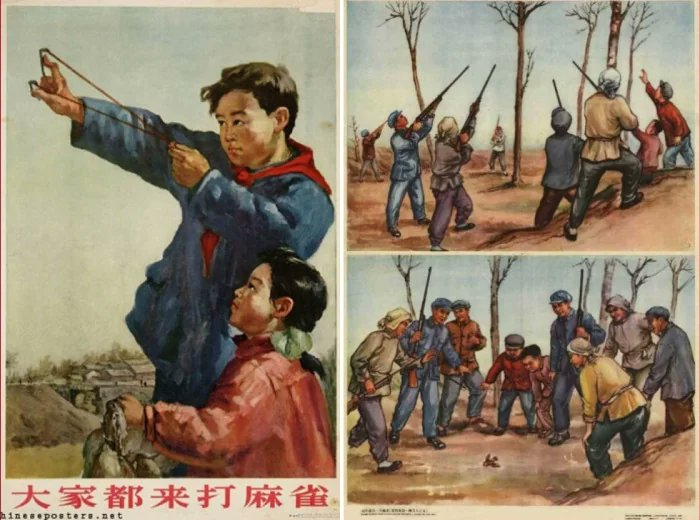
In 1958 the Chinese state worked out that sparrows were eating the grain, and organised six hundred million people to kill every one of them.
It did not take bullets. Villages, schools and factory units turned out with pots, pans, drums and gongs and made continuous noise so that no bird could land anywhere. Nests were pulled down, eggs smashed, chicks killed. The sparrows flew until their hearts gave out and dropped into the streets, where children collected them and the totals were reported upward as achievements. The toll ran into the hundreds of millions.
The arithmetic was sound as far as it went. A sparrow eats grain. Fewer sparrows, more grain, more people fed. Nobody in the room was wrong about what the bird took.
They were wrong about what it did.
Sparrows eat insects, in enormous quantity, and most of all in the breeding season when the chicks need protein. Take them out of a farmed landscape and the locusts and grain borers they had been holding down are handed the whole country. Which is what happened. Crop losses to insects rose sharply, and by 1960 the ornithologist Tso-hsin Cheng had made the case well enough that Mao ordered sparrows struck from the list and replaced with bed bugs.
Far too late, and never the whole cause. The famine of 1959 to 1961 was principally a policy famine, driven by collectivisation, grain requisition and the diversion of farm labour to backyard steel furnaces, and the dead are counted in tens of millions.
But the sparrow campaign is the purest thing in the episode, because it is the reasoning stripped to bone. A committee looked at a living system, isolated the one animal it could measure as a cost, and calculated the gain from removing it without ever asking what that animal was holding up.
Now look at what is being proposed for grassland.
The ruminant is measured the same way, on one ledger line, the methane it emits and the land it stands on. What is left off the ledger is everything it does. The grazing that keeps grassland grassland instead of scrub. The dung that feeds the beetles that feed the birds. The hoof that breaks the surface so seed can take. The mouth that removes the standing dead matter which otherwise cures into wildfire fuel. The manure that returns phosphorus and nitrogen to the soil so nobody has to mine it and ship it in.
Grasslands and grazing animals co-evolved over tens of millions of years. Remove the animal and you do not get the same field minus some methane. You get a different system, and it will not be the one on the spreadsheet.
The men who ordered the sparrows killed were not stupid, and they were not cruel. They had a number, and the number was correct, and they were praised for acting on it decisively. It took two years for the second half of the equation to arrive, and by then nobody could put the birds back.
We are eighteen months into the herd reduction schemes.
The grass has not sent its invoice yet.
Update, 6 August: Welcome, Instapundit readers! Have a look around at some of my other posts you may find of interest. I send out a daily summary of posts here through my Substack – https://substack.com/@nicholasrusson that you can subscribe to if you’d like to be informed of new posts in the future.
Madsen Model 1945: A Rather Unusual SMG
Forgotten Weapons
Published 9 Mar 2026At the end of World War Two, the Danish Madsen company wanted to replace its production of licensed Suomi submachine guns with a design of its own. The result was the Model 1945, a quite unusual design with a pistol-like slide. The nearest similarities would be the Polish PM-63 and the German VG1-5. The Madsen design also used an unusual hammer firing system. It was chambered for 9mm Parabellum, feeding from Suomi box magazines (not drums). Both a fixed wooden stock version (seen here) and a folding stock version were made, but only a few sales came through (apparently to Mexico and El Salvador).
Danish M1941 Madsen video: • Danish M1941 Suomi SMG
Madsen M1950 video: • Madsen M50: From the Korean War to Star Trek
(more…)
QotD: Limits to tactical flexibility in Roman Republican armies
And therein lies the rub: just as the commander doesn’t have a multitude of points where he can intervene in the battle but rather a limited set of key decision points, so too he does not have an infinite set of potential orders he (or his subordinates) might give at any given moment. Instead, the commander (or his subordinates) has a McDonald’s menu worth of options he can employ. He can order anything on the menu and expect the unit to respond accordingly but he cannot order anything not on the menu, nor can he order an altered version of a menu item (no Big Mac without cheese; Sir, this is not a Wendy’s).
Now generals could and did use drilling in the early stages of the campaign to add one or two “menu items” to their drill so as to be prepared for this or that problem. Indeed the general preparing some sort of surprise of this sort and then deploying it against an enemy is a standard topos of effective ancient generalship (although in many cases we may doubt the purported gimmick was actually used (e.g. Dionysius 20.1.6, Dio 10.5)). But that is the thing: such extra “menu items” have to be prepared in advance and often well in advance of the battle. Caesar, for instance, anticipating war elephants drills his troops in anti-war-elephant tactics before the Battle of Thapsus (46 BC, Caes. Bel. Afr. 84). Alexander’s phalanx seems to have been drilled to respond to scythed chariots as well (Arr. Anab. 3.13.5-6).
That said the bulk of the menu was likely to remain constant. After all these “menu items”, while they have simple names are often actually fairly complex to do and train when you are dealing with units of dozens or hundreds. Turning back to our example of Company, Right Wheel! we can get a sense of the complexity of training that maneuver by the way they did it. The “right guide” (the man on the extreme right) adopts a set pace (nine inch steps) while the “left guide” moves at the normal regulated speed (note this requires training your soldiers not only to step in time but to step at standard lengths) and every soldier in the middle regulates his motion by maintaining elbow contact with the man to his side. That’s a good method to get the result, but it isn’t an obvious or simple method: the fellow training the company to do this needs to already know how to do this.
Now in the modern period with mass printing, you could print drill manuals that had all of the commands and instructions on how to do them, but in the pre-modern period that kind of mass printing isn’t an option (and our military texts almost never go into this kind of granular detail) so your officers have to learn to train the behavior by observing it and participating in it themselves. Which means in turn a great deal of your “package” is set before the army is even mustered at the beginning of the campaign season because you are relying on a package of culturally embedded knowledge about how armies ought to function. And if your culture doesn’t have that tradition, inventing it from scratch is going to be hard and take time; and by “time” I mean “decades”. Effective drill for volley fire (the “countermarch”), for instance, answered a need that had existed for most of the 16th century, but the embryonic ideas for it only started emerging in the 1570s, the actionable plan on how to do it in 1594 and it was only then finally deployed in a major battle in 1600 at Nieuwpoort.
However, the time available for that kind of training is limited. Remember that drill works by repeating the same set of actions over and over again until they become almost instinctive. That takes a lot of time and repetition! That both means it is going to be difficult to find space for new “menu items” (especially with green troops that still need to learn the basics) but also that synchronized discipline itself is expensive. Our ancient sources stress how Roman levels of synchronized discipline required diligent and continuous drilling to create and maintain.
Doing that in turn would demand keeping the soldiers in question under arms for training for long periods when they were not fighting. In the Middle Republic this seems to have been accomplished through rolling recruitment: Rome was essentially always at war and always raising armies so there were always a goodly number of veterans to train and “break in” the truly green new recruits in any given draft (though again – and I owe this notion to Michael Taylor – there are some signs that the less intense conflict of the mid-second-century leads to some dulling of the Roman edge). As we transition through the Late Republic into the Early Empire, that is replaced by the slow professionalization of the Roman army, culminating in the force of long-service professionals created by Augustus. Being mobilized in peacetime, professional soldiers could be drilled extensively (assuming their cultural values are going to let them drill you; also be wary here of assuming standing forces of “military settlers” are professional in this way).
But all of that is extraordinarily expensive. Keeping those soldiers under arms, after all, means that they need to be fed, clothed and paid. Even in a system like the Middle Roman Republic where soldiers provided their own kit out of their own wealth (because Roman soldiers in the Middle Republic were recruited from the modestly well-to-do smallholding class), by drafting those men you have removed them from that economic activity. The expense of doing this would have been in most cases enormous and of course those are resources that could be deployed to any number of other uses, including simply raising a larger army of less disciplined, well trained troops. For, say, a Greek polis given the choice between having 450 men under arms all year round and excellently trained or having 5,000 hoplites under arms only in the one month where there is a battle to fight the clear answer is the latter. A lot of things need to line up before producing armies with high levels of synchronized discipline makes sense: the state needs a lot of resources, year-round security challenges and a tactical system which is effective and demands this kind of investment. So while developing synchronized discipline offered an army a degree of greater control and flexibility, it was prohibitively expensive.
Bret Devereaux, “Collections: Total Generalship: Commanding Pre-Modern Armies, Part IIIa”, A Collection of Unmitigated Pedantry, 2022-06-17.
August 3, 2026
Invasion of Iraq, 2003
Real Time History
Published 6 Mar 2026In March 2003, a US-led coalition invades Iraq. US President George W. Bush claims he must disarm Iraqi dictator Saddam Hussein of weapons of mass destruction and depose a brutal regime supporting global terror. But after a lightning capture of Baghdad and other Iraqi cities in the south, the war is far from over.
(more…)
QotD: The Hellenistic Age
When I was a child first getting interested in ancient history, the books I read followed a smooth narrative process. The story of the Greeks began with Athenian democracy and the victories at Marathon, Salamis, and Plataea that saved Western civilization from Persian conquest. Then there was the Athenian maritime empire, and its tremendous cultural achievements: the Parthenon, Socratic philosophy, the plays of Sophocles, Euripides, and Aristophanes. There was the Peloponnesian War and Thucydides’s chronicling of it. And then, in a tremendous climax, there were the awesome conquests of Alexander the Great, who destroyed the most powerful empire on Earth and conquered the known world by the age of 33, only to die young and have his empire swiftly broken up after his death.
… And then the story would promptly lurch 700 miles to the northwest and start over. Greeks? What Greeks? Now I was reading about the rise of a different city, Rome, and the achievements of its great republic. Instead of the Assembly and the ostracism, there was the Senate and the consuls. I would read about the Samnite Wars, the Punic Wars, the Gallic Wars, and finally the great civil wars that transformed Rome from a republic into the empire that men still think about a few times a week. In this story, the Greeks appear again, but only as enemies for Rome first to easily defeat, then be culturally influenced by. This fusion of Greek and Roman culture leads to European Christianity, the Renaissance, the cultural canon — in a word, the West itself.
Kid me didn’t think too much about it at the time. But as I grew, I and many others finally had a thought intrude: Wait a minute, what the heck was going on in Alexander’s old empire before the Romans got there?
And if you’re like me, asking that question is how you wind up reading Alexander to Actium.
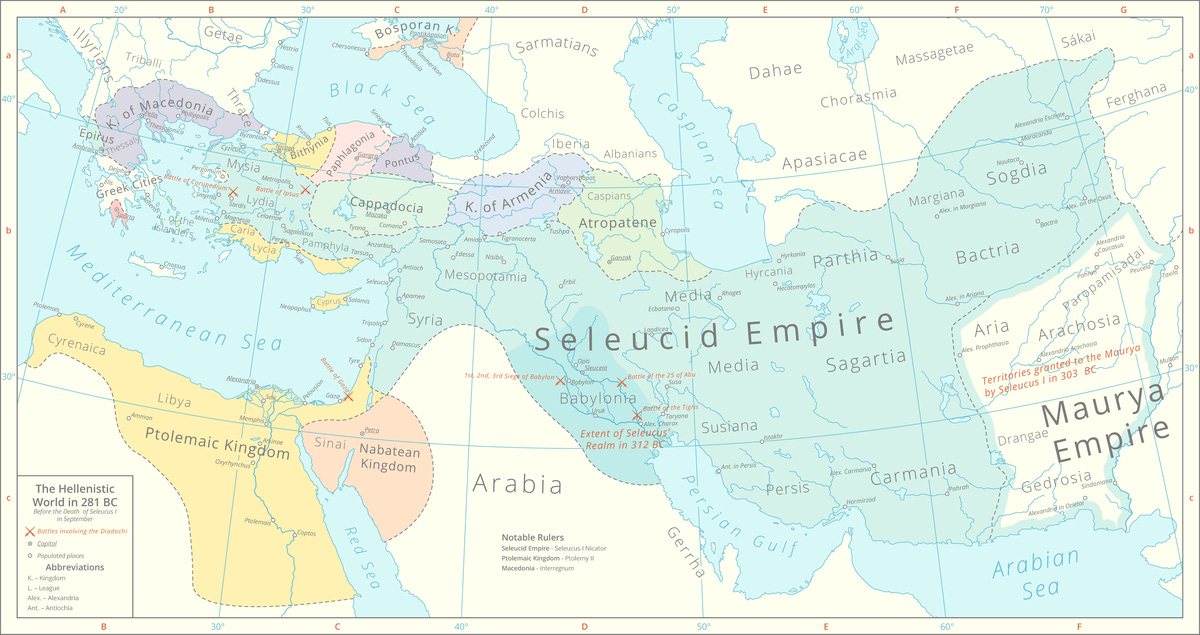
Alexander to Actium is classicist Peter Green’s gargantuan tome covering the period historians now call the Hellenistic era, the 293-year span following the death of Alexander the Great during which his vast but short-lived empire was divided up and ruled by ethnically Macedonian and Greek elites who left the stamp of Hellenic culture all across the eastern Mediterranean. The era begins with Alexander’s generals (the Diadochi, “Successors”) waging an epic forty years of war as funeral games for their dead master before finally settling into a more stable system with three great kingdoms centered on Macedon, Egypt, and Syria (plus lesser monarchies like Pergamon and Bactria). These kingdoms battled one another and Rome for another quarter-millennium, gradually losing land and power before they were extinguished, one by one. The last Hellenistic kingdom, Ptolemaic Egypt, made it until 30 B.C., when the legendary Cleopatra1 committed suicide and her realm became the personal possession of Octavian, the future Caesar Augustus. Long after their destruction, the Hellenistic legacy lingers most in religion: the Christian New Testament was written not in the Hebrew or Aramaic of Judea or the Latin of the Roman Empire, but in the koine Greek that had become the lingua franca of the educated eastern Mediterranean.
The ebb and flow of this 300-year historical epic is one that really deserves a trashy big-budget TV adaptation or three. The sordid acts of the Successors and their successors are so spectacular they could easily be made into a hybrid of HBO’s Rome and a popular show about dragons that shall remain nameless. I’m a little shocked one hasn’t been made already. To give just a small set of anecdotes from Green’s work:
- After an attempted army revolt following Alexander’s death, the general Perdiccas holds a “purification” ceremony for the army, which consists of rebel leaders being publicly trampled to death by elephants.
- Antigonus One-Eye, the man who came closest to reuniting Alexander’s empire, was very tall, very wide, very old, and had a very good nickname. Huge in size and huge in ambition, he dies fighting in battle at over 80 years old at Ipsus, a battle featuring 25,000 cavalry, 120 scythed chariots, and almost 600 elephants.
- Olympias, Alexander the Great’s mother, is so vindictive that when Philip II dies, she has a rival wife and her infant daughter roasted to death on a charcoal brazier even though they pose zero dynastic threat. When her own end comes during Macedon’s multiple civil wars, the soldiers of Cassander refuse to kill Alexander’s mother – so she is instead stoned to death by the families of those she had killed during past purges.
- Seleucus I, founder of the Syria-based Seleucid Empire, is happily married to his second wife Stratonice when he notices his son, Antiochus, is deeply enamored with her. No worry: Seleucus simply divorces Stratonice and has her marry Antiochus. This is actually a happy ending and works out for everyone, surprisingly.
- Lysimachus, king of Thrace, is happily married to his third wife, Arsinoe, when she tricks him into having his son by a first marriage executed so her own son can succeed. This sparks a war that kills Lysimachus and destroys his kingdom, somewhat botching the whole succession thing. But no worries: Arsinoe escapes to Egypt and makes out just fine by marrying its pharaoh – her brother.
- Cassander, king of Macedon, gets so irate at clever jabs from the wily Athenian politician Demades that he finally snaps and personally chops both Demades and his son to pieces while screaming insults at them.
- For about a decade during the various successor wars, Athens is ruled by a literal philosopher-king, the thirty-something Macedonian puppet Demetrius of Phaleron. One of his agenda items is building a gigantic mechanical snail to crawl through the streets of Athens leaving a realistic trail of slime behind; this is apparently some artful way of shaming the Athenians for being sluggish in standing up for Greek freedom.
- After Demetrius the Philosopher King is overthrown (by a different Demetrius, long story) the new tyrant takes advantage of divine honors granted to him to house his hoes in apartments at the back of the Parthenon. He tries to seduce a teenaged boy who instead commits suicide by jumping into a tub of boiling-hot water, and another time waives a fine against a prominent Athenian citizen in return for taking his son as a catamite. When you are legally a god, they let you do it.
- Aratus is a quite successful Greek general with the unfortunate problem of getting uncontrollable diarrhea before every battle.
- Escaped slave and rebel Drimakos defies authorities on Chios so successfully they simply reach a treaty with him: As long as he doesn’t steal too much and only accepts new slaves into his army who were severely abused by their masters (while sending the rest back), they’ll leave him alone. Drimakos lives to a ripe old age, then has his boy lover kill him and take his head in to claim a reward. Later, Drimakos’s spirit would supposedly appear to Chians in their dreams to warn of plots by their slaves.
- To show off their power, the Ptolemies commission a grand procession through Alexandria whose centerpiece is “a gaudily painted gold phallus, almost two hundred feet long … and tied up, like some exotic Christmas present, with gold ribbons and bows”. Green reasonably wonders how this mighty phallus was able to negotiate corners.
- The later Ptolemies could win some kind of ghastly award for their spectacular decadence. Ptolemy VIII Physcon (“the Obese”), who resembles a 2nd century BC Baron Harkonnen, seizes power after the death of his brother (also named Ptolemy) by marrying Cleopatra, who is also their sister. He then has her son, his nephew (also named Ptolemy), murdered during the wedding feast, then proceeds to seduce and marry his pubescent niece (also named Cleopatra). A decade later, riots forced Physcon and his niece-wife into exile, and his sister-wife proclaims her son by Physcon (another Ptolemy) as pharaoh, but the heir is apparently in Cyrene at the time, allowing Physcon to capture his unsuspecting son and send his dismembered corpse to the sister-wife as a birthday present. Meanwhile, the sister-wife’s daughter by her first brother (named Cleopatra, of course) gets married off to a Seleucid king and uses her sons as a series of puppets. The first puppet, Seleucus V, proves troublesome, so his mother murders him by using him for archery practice. The second puppet, Antiochus VIII, is more canny, and when his mother tries to murder him with a cup of poisoned wine, he notices something is up and forces her to drink the fatal cup herself. Antiochus VIII then fights a long civil war against his half-brother and cousin Antiochus IX, who is not a puppet but instead has the private hobby of playing with literal giant puppets. Got all that?
If learning the above is your idea of fun, then Alexander to Actium is a rich feast, enlivened throughout with Green’s flare for delicious details and legends that are possibly fanciful but too remarkable to leave out.
Blake Neff, “GUEST REVIEW: Alexander to Actium, by Peter Green”, Mr. and Mrs. Psmith’s Bookshelf, 2025-10-20.
- The Seventh, it turns out.
August 2, 2026
How to Make Aggression Sound Like Defense – Death of Democracy 26 – Q2 1939
World War Two
Published 1 Aug 2026By the spring of 1939, Hitler’s Germany is no longer merely threatening war, it is preparing to launch one while insisting that every act of aggression is really self-defense.
In this episode of “Death of Democracy”, we look at Germany in the second quarter of 1939: the launch of the battleship Tirpitz, the secret planning for Fall Weiss — the invasion of Poland — Hitler’s 50th-birthday military spectacle, the renunciation of the German-Polish Non-Aggression Pact and the Anglo-German Naval Agreement, the Pact of Steel with Mussolini’s Italy, and the diplomatic moves designed to isolate Poland before the coming attack.
But behind the military display, Nazi Germany’s economy is still on a knife’s edge. Rearmament, shortages, debt, plunder, and autarky have pushed the regime toward a brutal logic: conquest is no longer just ideology; it has become the regime’s chosen answer to the crisis it created.
Meanwhile, persecution inside the Reich continues to escalate. Jewish tenants are stripped of protection, the refugee ship St. Louis leaves Hamburg in a desperate search for sanctuary, and Ravensbrück opens as a concentration camp for women. As Germany exports terror into annexed Austria and Bohemia-Moravia, Britain and France finally begin to wake from appeasement — but dangerously late.
This is how aggression is made to sound like defense.
Never Forget.
The Ancient Greeks 03 – Enter the Persians 6 – Eretria Falls, Athens Stands Alone
seangabb
Published 16 Feb 2026Greece: A Brief History, c.700 BC – 500 AD
In 490 BC the Persian fleet advances island by island across the Aegean. Eretria is besieged, betrayed, and deported. We examine Persian punitive strategy, internal Greek division, and the calculated destruction of Eretria as an example to others.
Athens now faces invasion. Pheidippides runs to Sparta. The Spartans refuse immediate aid due to religious obligation. Only Plataea stands with Athens.
This is the moment before Marathon.
QotD: Churchill’s views on India
On the other hand, Churchill repeatedly voiced his admiration for the gallantry of Indian troops, noting in his war memoirs: “The unsurpassed bravery of Indian soldiers and officers, both Moslem and Hindu, shine for ever in the annals of war. Upwards of two and a half million Indians volunteered to serve in the forces … The response of the Indian peoples, no less than the conduct of their soldiers, makes a glorious final page in the story of our Indian Empire.”
Despite his fears about Indian independence, Churchill’s views noticeably mellowed over the years. On 5 February 1942, Churchill proposed in cabinet to visit India to make its Congress leaders an offer of postwar independence, in return for their supporting the war effort. But instead the war cabinet sent its senior Labour minister, Sir Stafford Cripps, known for his friendship with Congress leaders. When the Cripps mission failed to meet their demand for immediate independence, Congress launched the Quit India movement of civil disobedience against the Raj and resolved to offer only passive resistance to the Japanese invasion.
On being informed of this in September 1942, an apoplectic Churchill exclaimed to Amery: “I hate Indians. They are a beastly people with a beastly religion.” He was referring to Hinduism, rather than Islam, given loyal support for the war effort from the Muslim League. Churchill saw Gandhi’s decision to launch the Quit India movement in the middle of the war as a stab in the back when Britain most needed and deserved loyal support.
He also (like many Indian liberals and socialists) saw Gandhi’s political fasts as a form of emotional blackmail. And he was appalled, as were many Congressmen, by extreme nationalists such as the Bengali leader Subhas Chandra Bose joining hands with Hitler and the Japanese, a fact not calculated to endear Bengalis in general to Churchill.
Churchill’s abusive comments about Gandhi, Indians and Bengalis need to be seen in that context. They also need to be seen in the context of his penchant for making outrageous comments that he didn’t really mean in order to shock or tease.
Zareer Masani, “Churchill and the genocide myth”, The Critic, 2020-12-06.
August 1, 2026
Eugene Stoner’s Future Assault Rifle Concept (F.A.R.C.)
Forgotten Weapons
Published 6 Mar 2026After developing the AR-15 with Armalite, Eugene Stoner worked for a number of different companies. In 1972 he co-founded Ares Inc, where he and his partners worked on a wide variety of weapons platforms. Their work included rapid-fire cannons and full-fledged artillery as well as small arms. The first of those small arms was the Future Assault Rifle Concept — FARC. This was a gas piston, rotating bolt 5.56mm rifle design with a number of interested elements. The FARC-1 was a concept on paper only, leading to production of a few FARC-2 and FARC-3 prototypes. The project was cancelled in the wake of the end of the Vietnam War as funding for such things was much less readily available.
(more…)
July 31, 2026
Nobody “designed” capitalism
One of Karl Marx’s cleverer notions was to come up with a label for the economic system that had slowly emerged from the feudal period in Europe. It wasn’t ever the result of some overarching plan or campaign, it was just the easiest way for producers and consumers to connect without coercion or force. It had no real name until its declared enemy named it:
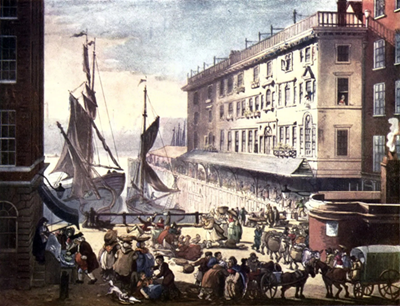
Capitalism did not begin in a boardroom. Voluntary exchange, repeated across generations, built the fairs, the credit networks, the double-entry books that Luca Pacioli codified in 1494. Nobody planned this. That’s the whole point.
The story you learned in school runs backwards. You were taught that greedy factory owners exploited children until noble legislators rescued them in 1833. What actually happened: the Industrial Revolution dragged English living standards up so fast that population doubled between 1750 and 1850 because people stopped dying. Wages rose. Life expectancy rose. The factory that horrifies the modern reader was an upgrade from a life of starving on a tenant farm at the mercy of the harvest. Children worked because their families were poor, and the factory made those families less poor. The reformers arrived after the market had already done the heavy lifting, then took credit for the sunrise.
Real capitalism needs sound money, and here is where the tragedy sharpens. Between 1815 and 1914, under a classical gold standard, prices in Britain fell gently while output exploded. You could save a coin and expect it to buy more later. That world died in stages: 1914, when governments suspended gold to print [money for] war; 1933, when Roosevelt confiscated citizens’ gold at $20.67 an ounce then revalued it to $35; 1971, when Nixon closed the window entirely and handed us the pure fiat regime you live under now.
What followed was corporatism wearing capitalism’s coat. When the Federal Reserve can conjure trillions and hand them to the banks and firms closest to the spigot, you no longer have a market allocating capital. You have a cartel allocating privilege. The 2008 bailouts were a monetary system doing exactly what a monetary system built on the printing press does.
When someone blames “unfettered capitalism” for the mess around you, ask them to point to the fetters.
The answer is to let go. Less regulation, no central bank, less tax, less government. Not more!
A few days ago, Severian point out:
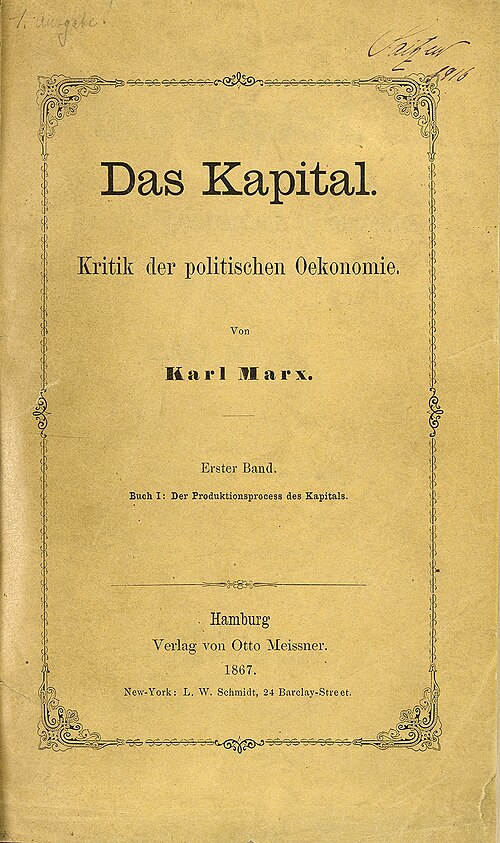
Title page of Das Kapital in the first German edition of Volume 1.
Wikimedia Commons.
At its broadest, “system” means something like “the appearance of rule-governed behavior”, and so yeah, “capitalism” is a “system” in that sense. The “law” of Supply and Demand is a “rule”, if you like, and we can start piling on the ACK-shullies from there. But it’s not particularly useful trying to analyze why and how it happens; the only thing we need to proceed is to acknowledge that it does.
“It” being “reification“, which you’ll recall means “treating an abstraction as if it were a real object”. Synonyms (per Wiki) include “concretism, hypostatization, or the fallacy of misplaced concreteness”, and while I personally dig “hypostatization” — it’s got that groovy Gnostic ring to it — “reification” is easier to type; plus it was very successfully repurposed by Marx and we might need that later, so “reification” it is. Calling “the natural human tendency to exchange stuff for other stuff, each party pursuing what he perceives to be his own advantage” Capitalism is a reification. It’s useful rhetorical shorthand …
… but it carries with it a tendency to mistake the map for the territory, you dig? Instead of confining yourself to “the natural human tendency to exchange stuff for other stuff, each party pursuing what he perceives to be his own advantage”, you inevitably start talking about the “rules” or “laws” of Capitalism. And from there, it’s just a short leap to our course title: the morality of Capitalism.
Because that’s what rules are for, no? To keep things fair — or equal, if you prefer. If we want to find out who’s better at tennis, let’s say, we set up a bunch of rules, to eliminate from the outcome every “inequality” but skill (and dumb luck). Both players have to agree on the scoring. Tennis, therefore, really is a system, strictly speaking. It really is a game, in the mathematical and linguistic senses.
Tennis is not a reification. When we talk about tennis, we are talking about the rules of the game, or the outcome of an individual match. That’s it.
But watch what happens when we start talking about the “rules” of Capitalism. The very word “rule” (or “law”) unavoidably contains the notion of fairness. The rule determining “out of bounds” in tennis is explicitly designed to make the game fair, because that’s what game rules are for — to make the players equal in every respect but skill. You couldn’t know who is the better tennis player if the rules were arbitrary; “out of bounds” has to be clearly defined, and universally applicable.
If you start talking about the “rules” of Capitalism, then, you might not think about “fairness”, but you can’t help but feel it.
Which the contrast with Communism makes worse. Because of course “Capitalism” and “Communism” are “dialectically constructed”. I don’t like throwing Marxist jargon around, but it’s useful in this case. Because Communism is a system, or a game, or whatever word you prefer. Communism does have rules, and they are explicitly designed — like the rules of all games — to ensure equality.
(And they do, comrades, they really do. As P.J. O’Rourke pointed out back when he was funny, Communism is as fair as it gets. We’re all equally broke, starving, and dead, but goddamn it, we’re equal).
I’m sure I don’t have to tell this crowd what a bad idea it is to let your enemies define things for you, but that’s what “Capitalism” does. Karl Marx his own self invented that term. Pick your famous “Capitalist” thinker — Adam Smith, David Ricardo, whoever. They didn’t call themselves “Capitalists”; they called themselves political economists. They weren’t devising rules for a game; they were describing phenomena they observed. It was only after Marx slapped the “Capitalism” tag on the natural human tendency to exchange stuff for other stuff, each party pursuing what he perceives to be his own advantage, that we started seeing “Capitalists”.
Cooking Kangaroo on the World War 2 Australian Home Front
Tasting History with Max Miller
Published 3 Feb 2026Slices of braised kangaroo with carrots, onions, parsley, and gravy
City/Region: Australia
Time Period: 1943Rationing began in Australia in 1942, and meat was one of the foods that had the biggest difference in pre-ration and rationed amounts in the Australian diet. Out in the country, you could hunt to supplement your meat ration, which often meant wallaby and kangaroo, which had fallen out of popularity in the early 20th century, and to be honest, I can see why.
This recipe, from an Australian wartime ration cookbook, is actually for spiced beef, and if you don’t have kangaroo in the back of your freezer or are hunting to supplement your wartime ration, I’d use the beef. The texture of the kangaroo wasn’t bad, but the flavor was not my favorite. I usually like gamey meats, but this was too gamey even for me with an earthy taste that I wasn’t a fan of.
Spiced Beef
Method: Mix sugar, mustard, vinegar and salt together and rub over meat with the back of a wooden spoon. Place meat in a dish with bay leaves, cloves and peppercorns — leave for 12 hours. Turn occasionally. Place meat with juices, herbs, etc., sliced carrots, onion and parsley in a saucepan. Just cover with water and simmer for 2 — 3 hours. Serve hot with liquid thickened as gravy or cold with liquid thickened and served as cold sauce. If the oven is in use, cook the meat in a casserole — 2 1/2 — 3 hours in a slow oven (325°F).
— Planning Meat Ration Meals by the Commonwealth Rationing Commission and the Commonwealth Department of Health, 1943
QotD: Cuisine on campaign
Supposing, for a moment, a bit of imagination on the part of quartermasters and cooks, and a semi-intelligent rationing authority, a war might be conducted with a bit of style. There could be rivalry between regimental kitchens, or between the galleys in Her Majesty’s fleet. Food could be made a powerful inducement in the recruitment drives.
There are some little sparks like this, in history. In the Crimean War, Florence Nightingale, that extraordinary lantern-bearing angel, procured the voluntary help of Alexis Soyer, the leading London hotel chef of the day, to advise her on the organization of field hospital kitchens. These quickly became the place to eat — almost worth getting wounded. M. Soyer applied his very broad mind to analyzing the limitations of field cookery, then turning each limitation into a strength. (I recommend his Culinary Campaign in the Crimea, 1857.)
Morale is not a small thing in the conduct of war. A hot meal served in defiance of logistics in the cold wet of a hideous trench, comes to remind us of victory, in the very face of the enemy.
David Warren, “Non-idlers”, Essays in Idleness, 2020-11-11.
July 29, 2026
The American Deep State’s biggest experimental laboratory
On Substack, John Carter links to the latest of kulak’s fascinating-and-unsettling Anarchonomicon posts with this introduction:

Kulak’s thesis here is that English Canada generally, and Toronto specifically, is ground zero for a lot of the more insane gay race communism trends because America has been using Canada as a testing ground for psychological operations since the 1950s.
That sounds kind of nuts but he makes a plausible case. Since Canada is technically a foreign country, intelligence agencies don’t face the same limitations they do at home. Since Canada is almost culturally identical to the US, what works in Canada will generally work domestically (and all the GAE psyops are ultimately aimed at America’s domestic tax cattle).
Kulak also brings the receipts here, showing how things like MeToo and GamerGate seem to have been prefigured by similar movements in Canada a couple years before.
One thing he misses is land acknowledgements, which began spreading in Canada in 2013 or so, and have since started appearing at American and Australian universities. I don’t know for sure that they started in Canada, all I can say is that it was Canada where I first noticed them, and where they have become ubiquitous.
Multiculturalism is another Canadian export, developed here in the 60s and rapidly introduced all over the Western world. The prime ministers who introduced it were American puppets, and the ideology itself has a very broadly American “nation of immigrants” feel to it.
Anyhow, you motherfuckers, two can play this game.
On the land acknowledgements, the first time I encountered it was at my son’s university graduation ceremony, but his university had a big First Nations specialization so it didn’t seem too outlandish at the time. Since then, of course, pretty much every event in urban Canada seems to feature a land acknowledgement and they don’t appear to be optional any more.
Anyway, on to kulak’s post on “The Battle for the Mind of North America”:
The Land of Mind-Rape and Honey
Canada is/was a nice enough place to visit or grow up … several large nice cities surrounded by tons and tons of quaint and cute functional “Mainstreet USA” style quirky little towns.
The “Rape” refers to Rapeseed, the primary ingredient in Canola Oil, the unhealthy seed-oil. (they named it “Canada Oil” because “Rape Oil” might make people hesitate)
But when you scratch at the surface there’s something profoundly deeply wrong with Canada. You can feel it. You can see it when you look out your window or when you turn on your television. You can feel it when you go to work … when you go to church … when you pay your taxes.
and the Canadians are quite pleased to tell you just what that thing is:
America.
Funnily though, when you ask what Americans have done to them or what is wrong with America, they’ll tell you things about moral degeneracy and perfidy of Americans … no different than what the American elite and the US Government expresses about its own populace.
For reference: Canada is a vassal of the US.
It has been since the 1960s when the British lost the Suez Crisis and the American Deep State backed “Multiculturalism”, an end to “God Save the Queen”, legalized sodomy, ended prayer in public schools, demilitarized Canadian education (which til the 60s included rifle practice, marching, and survival training) … and oh ya a new flag.
The Canadian flag, adopted in 1964 … which the very year should be a “red flag”. Is in fact, an American flag. It is the symbol of America’s diplomatic and espionage victories over the British Empire and its final conquest of Canada.
Canada’s entire culture, defined by being British, Imperial, warlike, frontier militiamen (Indeed Canada’s 1950s culture in many ways resembled Washington’s and Jefferson’s colonial American culture more than America did) … was ripped out in the course of a decade … quite intentionally and by design.
Indeed Canada was the testing ground for the Global American Empire’s psychological cultural program.
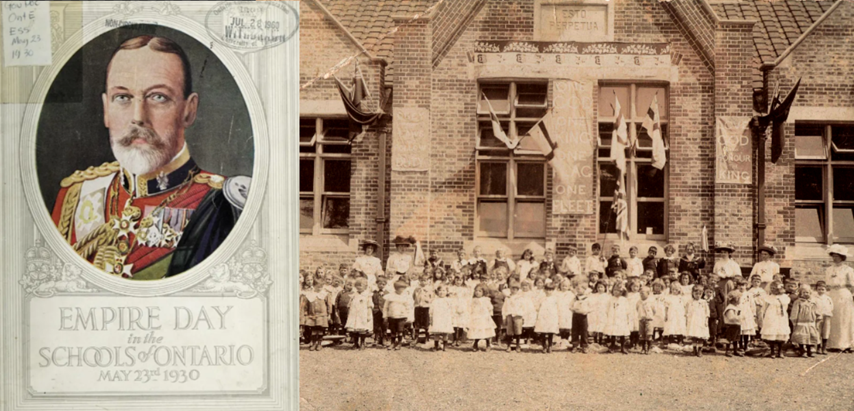
To get a feel for just HOW aggressively Canadian culture was purposefully ripped apart … I encourage you to flip through the various programs for “Empire day in the Schools of Ontario” up on archive to see English Canada’s actual natural culture. (I will be writing about this in more detail in another piece.)
And Please Note: The British did nothing comparable … the “Narnia” age of Canada coexisted with The Fabians, George Bernard Shaw, and the basically open communist treason of the actual British Aristocracy.
The mottoes on the posters: “Obey/ the Law/ Follow/ Duty”, “One God/ One King/ One Flag/ One Fleet”, “Love God and Honour the King”
This was immediately ripped out by State Department’s assets like Pearson and Trudeau in the 60s and 70s in favour of “Multiculturalism”.
How does the one Canada: Royalist, Militaristic, Patriotic as Can Be, defined by the three institutions of Church, Militia Armoury, and the old-style High School ruthlessly enforcing standards … More akin to Cadia from 40k than a 21st century country … How did it transform into the modern Canada within living memory?
How do you destroy the entire culture of a country and replace it with an entirely new culture in front of its population’s very eyes … without resistance and without protest?
Well that’s the problem that was solved here.
Canada was the testing ground for all of the American Government’s cultural occupational weapons it would go on to use on Europe and on its own people.
Terms like “melting pot”, “racism”, “tolerance”, “the open society” … These of course has all been coined by American Jewish and Communist activists (“Racism” specifically is a Trotskyist doctrinal term of art propagated by Trotsky’s personal pamphlets, and you should call any “Conservative” who ever uses the term a Communist traitor).
However it was in Canada that top down US foreign policy institutions first applied the current model to a country which they had conquered without a war.
Indeed when one looks into “Denazification” in Germany or the US occupations of France, Italy, or Japan you find little to no overlap between the language, structure, and even values of the “Democratic”, “antifascist”, and “Peaceful” occupational ideology and modern Globohomo.
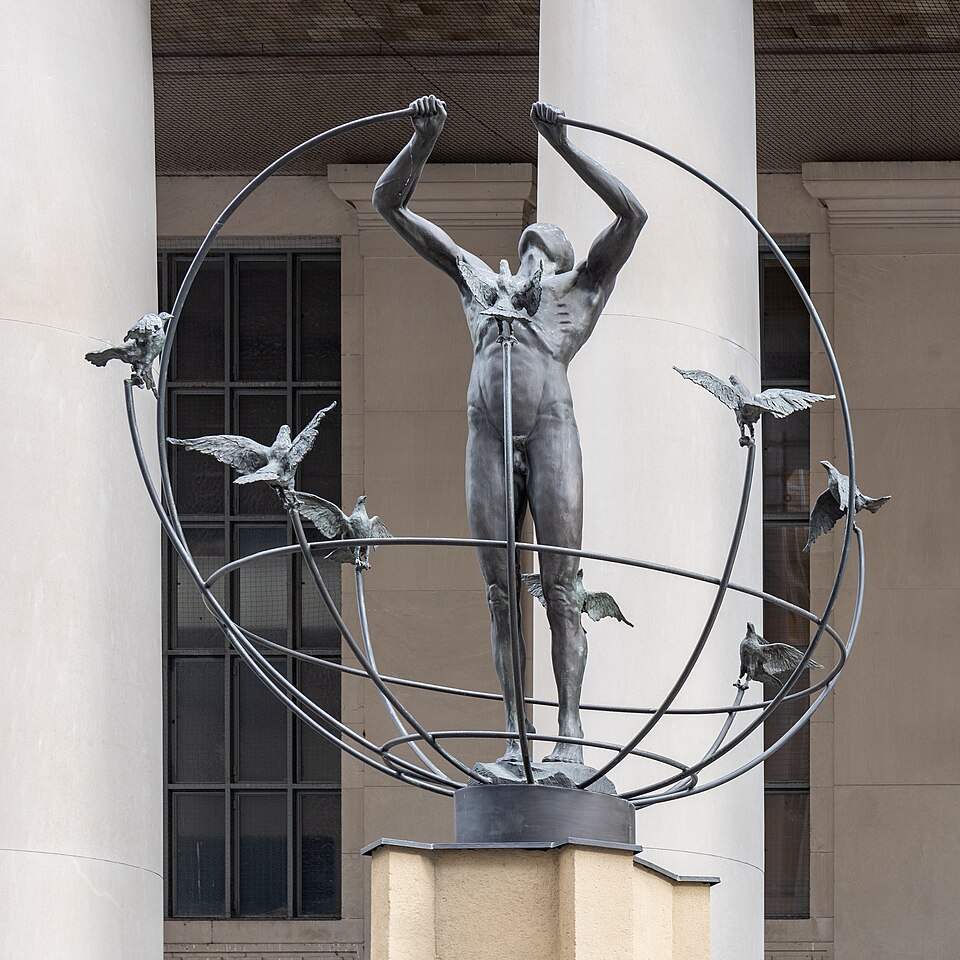
“Monument to Multiculturalism”. Toronto. Erected 1985. (The “Monument” can be interpreted two ways … the man and doves working together to build a unified world … or the man is unwittingly cooperating in his own caging and enslavement)
Whereas in Canada the US occupational ideology EXACTLY resembles modern globohomo. From the outset.
Pierre Trudeau’s first major political moment was the 1967 decriminalization of homosexuality.


The Korean War Week 110 – The Democratic Candidate – July 28, 1952
The Korean War by Indy Neidell
Published 28 Jul 2026In Chicago, the Democratic Party chooses Adlai Stevenson as their candidate for the Presidential election to be held November 4th; he’ll square off against Dwight Eisenhower, the Republican candidate. Also, in the US, the steelworkers strike comes to an end. In Korea, torrential rains prevent action on the ground this week, though the UN continues its summer aerial bombing campaign of the north in the skies.


