
World War Two
Published 7 Dec 2024July 1930 sees the Weimar Republic facing unprecedented turmoil. From Brüning’s budget crisis and the Reichstag‘s dissolution to Nazi and Communist clashes with state governments, Germany braces for a pivotal election in September. This episode unpacks the month’s chaos, political maneuvers, and the rising tensions tearing the Republic apart.
(more…)
December 8, 2024
President Hindenburg dissolves the Reichstag – Rise of Hitler 07, July 1930
Comments Off on President Hindenburg dissolves the Reichstag – Rise of Hitler 07, July 1930
December 7, 2024
Rediscovering the legacy of “Silent Cal”
Jacob M. Farley recently discovered the history of Calvin Coolidge’s presidency and the economic policies he pursued to such good effect in the 1920s (although Herbert Hoover’s energetic turn as Commerce Secretary for Harding and Coolidge strongly indicated that the benign laissez faire approach would be changed once Coolidge left the Oval Office):

Calvin Coolidge, Governor of Massachusetts, 1919.
Photo by Notman Studio, Boston, restored by Adam Cuerden via Wikimedia Commons.
In the pantheon of American presidents, Calvin Coolidge, or “Silent Cal”, often plays the role of the overlooked extra in the corner of history’s grand narrative. I can attest to this, as my first real exposure to him occurred recently during a visit to a museum whilst travelling in the US. Having spent some time since then reading up on everything Cal-related, I’ve become increasingly convinced that there’s a compelling case to be made that Coolidge’s approach to governance, particularly his economic policies, should be dusted off and revisited, not just for historical curiosity but as a lodestar for free marketeers far and wide.
Before I go any further, let’s set the scene of Coolidge’s era. The 1920s is often remembered for jazz, flappers, and the stock market’s dizzying heights. But beneath the cultural tumult, Coolidge was busy orchestrating what can quite fairly be called a symphony of minimalistic governance. His philosophy was profoundly simple: government should do less, not more.
Whilst this may seem extraordinarily mundane to you, consider that this wasn’t simply cheap talk on the campaign trail designed to get a nod of approval from over-50s. His ideas weren’t born out of laziness or disinterest but from a profound belief in the efficacy of the market’s invisible hand over the visible, often clumsy, hand of government intervention.
Coolidge’s administration slashed taxes like a bootlegger cuts whiskey – to make the good times flow more freely, notably through the Revenue Acts of 1924 and 1926. This wasn’t just about giving the rich a break; it was about stimulating economic activity by leaving more money in the pockets of Americans. By leaving more money in the pockets of Americans, he was essentially saying, “Here’s your allowance, now go make some noise at the stock market”.
The result? A crescendo of consumer spending, industrial growth, and a stock market that seemed to reach for the stars.
Coolidge believed in setting the rules of the game and then letting the players play. This isn’t to say there was no regulation, but rather, it was about not over-regulating, about allowing businesses to innovate, expand, and yes, even fail, without the government always having its finger on the scale. Imagine if the conductor only pointed out the tempo and let the musicians interpret it – that was Coolidge’s regulatory approach.
Under Coolidge, the U.S. economy boomed. Unemployment dipped to levels we can only dream of today, and real GDP growth was robust. If the economy were a piece of music, it was hitting all the right notes. But here’s where the narrative often shifts to a sombre tone – the Great Depression. While Coolidge left office before the market crashed, the seeds of economic disaster were arguably sown in the very success of the 1920s, exacerbated by policies that followed his term, particularly those of the Federal Reserve.
This is where the story of Coolidge’s economic policy gets nuanced. The Federal Reserve, relatively new on the scene, played its own tune by the late 1920s. Its policies, intended to stabilise the economy, are often critiqued for contributing to the eventual bust. Coolidge’s hands-off approach might have been a wise nod to market self-correction, but the Fed’s actions, flooding the number of dollars in circulation to stimulate the market’s trajectory in a way they deemed desirable, led to an artificially manufactured drunkenness, leading to a nasty hangover – The Great Depression.
After Coolidge, the economy didn’t just crash; it was like the Charleston dancer tripped over its own feet.
There had been a brief, nasty recession following the end of the First World War, but Harding and Coolidge responded not by muscular government action but by letting the market sort things out. Hoover, as Coolidge’s successor, was not cut from that cloth. Hoover was a believer in the progressive big-government approach to just about everything and his attempts to respond after the 1929 crash absolutely made things much, much worse. Later historians have chosen to forget Hoover’s actual policies and pretend that he followed Coolidge’s lead (most historians over the next couple of generations were pro-Roosevelt, so portraying Hoover as a conservative non-interventionist allowed them to contrast that with Roosevelt’s even more centralizing, interventionist policies).
Comments Off on Rediscovering the legacy of “Silent Cal”
The FBI’s future – fix it or abolish it? Decisions, decisions …
At Racket News, Matt Taibbi provides some background information on FBI failures leading up to the 9/11 terrorist attacks:

On August 13, 2001, 33-year-old French citizen Zacarias Moussaoui paid $6,800 in $100 bills to train on a 747 simulator at the Pan-Am International Flight Academy in Eagan, Minnesota. A retired Northwest Airlines pilot named Clarence “Clancy” Prevost thought Moussaoui’s behavior was odd for someone with no pilot’s license and told his bosses as much. When they said Moussaoui had paid and they didn’t care, Prevost said, “We’ll care when there’s a hijacking and the lawsuits come in”.
The company went to the FBI and on August 16, in what should have been one of the biggest arrests in the history of federal law enforcement, Moussaoui was picked up on an immigration violation. Agents on the case wanted permission to search Moussaoui’s belongings, with one asking superiors as many as 70 times for help in obtaining a warrant. The situation grew more urgent when the French Intelligence Service sent information that Moussaoui was connected to Islamic radicals with ties both to Osama bin Laden and the Chechen warlord Khattab, and that even within this crowd, Moussaoui was nicknamed “the dangerous one”.
Coleen Rowley, the Chief Division Counsel for the Minneapolis Field Office, absorbed agents’ concerns quickly and was aggressive in asking superiors to seek a Foreign Intelligence Surveillance Act (FISA) warrant to investigate further. One of the goals was a look at Moussaoui’s computer, as agents believed he’d signaled he had “something to hide” in there. But unlike the former Northwest pilot Prevost, whose superiors trusted his judgment and escalated his concerns, Rowley and the Minneapolis field office were denied by senior lawyers at FBI Headquarters. The Bureau was sitting on the means to stop 9/11 when the planes hit the towers.
This story is actually worse than described, as Rowley made clear in what became a famous letter she wrote to then-Director Robert Mueller the following May. “Even after the attacks had begun,” she wrote, “the [Supervisory Special Agent] in question was still attempting to block the search of Moussaoui’s computer, characterizing the World Trade Center attacks as a mere coincidence with Misseapolis’ prior suspicions about Moussaoui.”
While the Bureau blamed 9/11 on a lack of investigatory authority, the actions of the Minnesota office showed otherwise. Rowley’s decision to confront Mueller with a laundry list of unnecessary bureaucratic failures made her perhaps the FBI’s most famous whistleblower. Her letter excoriated the Bureau’s Washington officeholders for failing to appreciate agents in the field, and for implicitly immunizing themselves against culpability.
Comments Off on The FBI’s future – fix it or abolish it? Decisions, decisions …
December 6, 2024
Hegseth is clearly unfit to be Secretary of Defense because LOOK! A SQUIRREL!
I don’t recall having heard Pete Hegseth’s name before Trump nominated him to be the next Secretary of Defense, but Chris Bray clearly thinks the accusations are purely partisan:
Pete Hegseth is being Kavanaughed. And the only people dumb enough to fall for it are Republican senators.
I was willing to hear arguments that Hegseth wasn’t the best choice for Secretary of Defense. In his 40s, he’s on his third marriage, and while the rape allegation from his visit to a conservative conference in Monterey is clearly false, I was wide open to the argument that his actions demonstrated poor judgment. I was prepared to hear an argument. Like many combat veterans, Hegseth had some post-war chaos in his life. Discussion was merited.
But the more these arguments have been made, the dumber they’ve become. We’ve seen this play, and we know the third act: more heat, less light, the descent into completely irrational ranting.
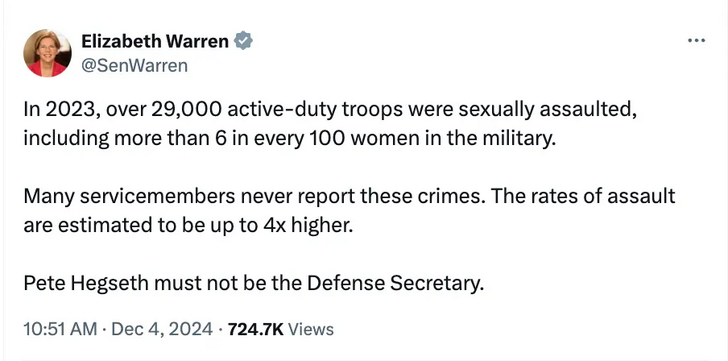
Let’s pretend to take this number at face value, for the sake of argument, though Warren is egregiously misrepresenting the estimate about unreported assaults. Let’s just look at the structure of the claim: In 2023, while Lloyd Austin was the Secretary of Defense, 29,000 troops were sexually assaulted. Therefore, Pete Hegseth must never become the Secretary of Defense.
This is the kind of argument people make when they’re piling on, in an atmosphere of hysteria. It has no logic or order to it, and it does the opposite of the thing it’s intended to do: It depicts current leadership as failures, while arguing against a course correction. Bob punched me in the face, which proves that John is very bad. This is currently the logical structure of half the “news”.
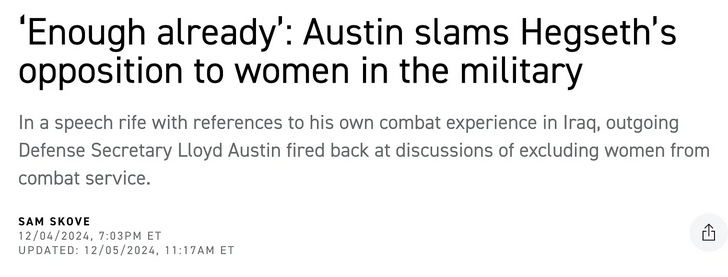
In another Martha-do-you-hear-yourself moment, Lloyd Austin himself recently attacked Hegseth for arguing that women shouldn’t serve in the combat arms:
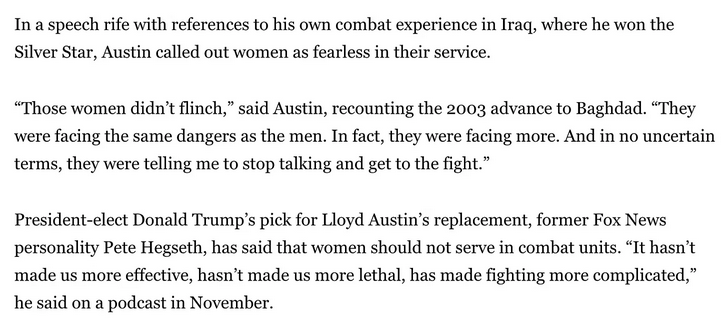
But read this carefully, and look for the own-goal:
Women serving in combat are facing more danger than men, Austin said.
Therefore, women should serve in combat. Explain the logic, Lloyd. Amazingly, the journalist who reported Austin’s comments missed the implications, mindlessly typing up the claim that women in combat are in more danger than men, then — next paragraph! — framing that statement as a rebuke to someone who warned that the service of women in combat “made fighting more complicated.” We’re not discussing; we’re ritually lining up behind our teams.
Comments Off on Hegseth is clearly unfit to be Secretary of Defense because LOOK! A SQUIRREL!
QotD: Herbert Hoover in the Harding and Coolidge years
[Herbert] Hoover wants to be president. It fits his self-image as a benevolent engineer-king destined to save the populace from the vagaries of politics. The people want Hoover to be president; he’s a super-double-war-hero during a time when most other leaders have embarrassed themselves. Even politicians are up for Hoover being president; Woodrow Wilson has just died, leaving both Democrats and Republicans leaderless. The situation seems perfect.
Hoover bungles it. He plays hard-to-get by pretending he doesn’t want the Presidency, but potential supporters interpret this as him just literally not wanting the Presidency. He refuses to identify as either a Democrat or Republican, intending to make a gesture of above-the-fray non-partisanship, but this prevents either party from rallying around him. Also, he might be the worst public speaker in the history of politics.
Warren D. Harding, a nondescript Senator from Ohio, wins the Republican nomination and the Presidency. Hoover follows his usual strategy of playing hard-to-get by proclaiming he doesn’t want any Cabinet positions. This time it works, but not well: Harding offers him Secretary of Commerce, widely considered a powerless “dud” position. Hoover accepts.
Harding is famous for promising “return to normalcy”, in particular a winding down of the massive expansion of government that marked WWI and the Wilson Administration. Hoover had a better idea – use the newly-muscular government to centralize and rationalize American In his first few years in Commerce – hitherto a meaningless portfolio for people who wanted to say vaguely pro-prosperity things and then go off and play golf – Hoover instituted/invented housing standards, traffic safety standards, industrial standards, zoning standards, standardized electrical sockets, standardized screws, standardized bricks, standardized boards, and standardized hundreds of other things. He founded the FAA to standardize air traffic, and the FCC to standardize communications. In order to learn how his standards were affecting the economy, he founded the NBER to standardize government statistics.
But that isn’t enough! He mediates a conflict between states over water rights to the Colorado River, even though that would normally be a Department of the Interior job. He solves railroad strikes, over the protests of the Department of Labor. “Much to the annoyance of the State Department, Hoover fielded his own foreign service.” He proposes to transfer 16 agencies from other Cabinet departments to the Department of Commerce, and when other Secretaries shot him down, he does all their jobs anyway. The press dub him “Secretary of Commerce and Undersecretary Of Everything Else”.
Hoover’s greatest political test comes when the market crashes in the Panic of 1921. The federal government has previously ignored these financial panics. Pre-Wilson, it was small and limited to its constitutional duties – plus nobody knows how to solve a financial panic anyway. Hoover jumps into action, calling a conference of top economists and moving forward large spending projects. More important, he is one of the first government officials to realize that financial panics have a psychological aspect, so he immediately puts out lots of press releases saying that economists agree everything is fine and the panic is definitely over. He takes the opportunity to write letters saying that Herbert Hoover has solved the financial panic and is a great guy, then sign President Harding’s name to them. Whether or not Hoover deserves credit, the panic is short and mild, and his reputation grows.
While everyone else obsesses over his recession-busting, Hoover’s own pet project is saving the Soviet Union. Several years of civil war, communism, and crop failure have produced mass famine. Most of the world refuses to help, angry that the USSR is refusing to pay Czarist Russia’s debts and also pretty peeved over the whole Communism thing. Hoover finds $20 million to spend on food aid for Russia, over everyone else’s objection […]
So passed the early 1920s. Warren Harding died of a stroke, and was succeeded by Vice-President “Silent Cal” Coolidge, a man famous for having no opinions and never talking. Coolidge won re-election easily in 1924. Hoover continued shepherding the economy (average incomes will rise 30% over his eight years in Commerce), but also works on promoting Hooverism, his political philosophy. It has grown from just “benevolent engineers oversee everything” to something kind of like a precursor modern neoliberalism:
Hoover’s plan amounted to a complete refit of America’s single gigantic plant, and a radical shift in Washington’s economic priorities. Newsmen were fascinated by is talk of a “third alternative” between “the unrestrained capitalism of Adam Smith” and the new strain of socialism rooting in Europe. Laissez-faire was finished, Hoover declared, pointing to antitrust laws and the growth of public utilities as evidence. Socialism, on the other hand, was a dead end, providing no stimulus to individual initiative, the engine of progress. The new Commerce Department was seeking what one reporter summarized as a balance between fairly intelligent business and intelligently fair government. If that were achieved, said Hoover, “we should have given a priceless gift to the twentieth century.”
Scott Alexander, “Book Review: Hoover”, Slate Star Codex, 2020-03-17.
Comments Off on QotD: Herbert Hoover in the Harding and Coolidge years
December 5, 2024
Ontario’s housing market squeezed by the 35.6% combined tax rate on new builds
The housing situation in Toronto and the rest of the province has been very tight for years. Lots of would-be buyers chasing the proportionally smaller number of new houses being built. This drives prices higher, but no matter how much of the final price is the builder’s profit margin, the government gets nearly four times as much on every new house sale:

The National Post previously reported that at least a third of a new home’s sticker price in Ontario was comprised of taxes, but an updated report, courtesy of the Canadian Centre for Economic Analysis (CANCEA), now puts the figure at 35.6 per cent.
(It gets even better when it comes to affordable housing — but more on that later.)
The Increasing Tax Burden on New Ontario Homes: 2024, which was commissioned by the Residential Construction Council of Ontario and released by CANCEA on Tuesday, is eye-opening for reasons beyond the fact that a compendium of largely superfluous taxes and production levies has reached 35.1 per cent of the final purchase price of a new home in the city of Toronto. It’s 35.5 per cent in the outlying 905 region, and 34.5 per cent in Ottawa.
The report needed only 16 pages to elucidate how bureaucratic machinations aren’t just gouging prospective homebuyers, but homeowners, too — especially the estimated 1.2 million whose mortgages, according to the Canada Mortgage and Housing Corporation, are due for renewal in 2025.
Read closely enough, CANCEA’s report makes a strong argument that, effectively, Canadians work for the government rather the other way around.
For example, CANCEA’s report demonstrates that 70 per cent of aforesaid taxes on new homes “consist of direct fees on the home, such as DC (development charges) and other fees”.
“For homes priced at $450,000,” which aligns with median income, “… the tax burden rises sharply to 45.2 per cent,” says the report, which also notes that economics often force developers to build smaller units that are insufficient for families.
Comments Off on Ontario’s housing market squeezed by the 35.6% combined tax rate on new builds
We must always trust the experts, say the experts and their journalistic fart-catchers
Glenn Reynolds (aka the “Instapundit”) welcomes Nate Silver to the expert-doubting party:

Well. I was writing about this stuff long before Nate got hip. Back in 2017, just as Donald Trump began his first term, I wrote “The Suicide of Expertise”, by way of responding to Tom Nichols’ book, The Death of Expertise. Nichols’ thesis was that the experts were expert, but that ignorant, superstitious Americans rejected their advice out of insecurity and an unwillingness to be proven wrong. My response was that the experts’ actual track record wasn’t looking so good:
Well, it’s certainly true that the “experts” don’t have the kind of authority that they possessed in the decade or two following World War II. Back then, the experts had given us vaccines, antibiotics, jet airplanes, nuclear power and space flight. The idea that they might really know best seemed pretty plausible.
But it also seems pretty plausible that Americans might look back on the last 50 years and say, “What have experts done for us lately?” Not only have the experts failed to deliver on the moon bases and flying cars they promised back in the day, but their track record in general is looking a lot spottier than it was in, say, 1965.
It was the experts — characterized in terms of their self-image by David Halberstam in The Best and the Brightest — who brought us the twin debacles of the Vietnam War, which we lost, and the War On Poverty, where we spent trillions and certainly didn’t win. In both cases, confident assertions by highly credentialed authorities foundered upon reality, at a dramatic cost in blood and treasure. Mostly other people’s blood and treasure.
And these are not isolated failures. The history of government nutritional advice from the 1960s to the present is an appalling one: The advice of “experts” was frequently wrong, and sometimes bought-and-paid-for by special interests, but always delivered with an air of unchallengeable certainty …
On Syria, experts in Barack Obama’s administration produced a policy that led to countless deaths, millions of refugees flooding Europe, a new haven for Islamic terrorists, and the upending of established power relations in the mideast. In Libya, the experts urged a war, waged without the approval of Congress, to topple strongman Moammar Gadhafi, only to see — again — countless deaths, huge numbers of refugees and another haven for Islamist terror.
It was experts who brought us the housing bubble and the subprime crisis. It was experts who botched the Obamacare rollout. And, of course, the experts didn’t see Brexit coming, and seem to have responded mostly with injured pride and assaults on the intelligence of the electorate, rather than with constructive solutions.
And this was long before the experts’ ne plus ultra of failure, the bungled, dishonest, and downright self-serving response to the Covid pandemic. The pandemic stemmed from experts’ arrogance, in the form of illegal “gain of function” research funded by the U.S. and laundered through Chinese labs, was met with ass-covering “wet market” lies to try to conceal that origin, and then with public health measures, such as lockdowns and social distancing and masking rules, that were backed by no actual science at all, and that were cheerfully flouted by those propounding them whenever it suited their purposes. The final nail in the experts’ authority-coffin, though, was when, after all the lockdown hysteria, they approved massive public marches by Black Lives Matter because, we were told, racism was a public health problem.
Well, so are STDs, but they weren’t encouraging anyone to march against gonorrhea.
Rather they were (ab)using their position to promote the leftist cause du jour. Everyone saw through it, and their stock collapsed.
So. Welcome to the party, pal. Nate’s noticing just how far things have gone downhill.
Comments Off on We must always trust the experts, say the experts and their journalistic fart-catchers
December 3, 2024
“Granting more sovereign rights to others surprisingly means that these groups will pursue their own interests. Who could have seen this coming?”
In his weekend round-up, Niccolo Soldo pokes a bit of fun at Justin Trudeau’s federal government for apparently being surprised that First Nations are looking to deal directly with China for their natural resources, rather than through the feds:

Canada continues to be unintentionally hilarious, all thanks to Prime Minister Justin Trudeau and his government.
The Great White North was forever a boring place politically, but the arrival of Trudeau Jr. on the scene shook things up. One of the first things that he and his government committed themselves to was to work to improve the country’s relations with its Native tribes, both politically and especially economically. The Trudeau government invented a genocide narrative based around residential schools.1 Canada too wanted a dark aspect to its own history, so that it could share in the self-flagellation that has coloured the recent history of its neighbour to its immediate south.
Maybe the intention here was to show these Native communities that Canada really, really did care and that by doing this, everything bad that had happened would be forgiven and forgotten? I dunno … what I do know is that Native bands are now seeking to directly do business with China, whereby they would sell natural resources under their control to Beijing:
Canada’s indigenous communities are seeking deals with China that could give Beijing access to the country’s natural resources, despite warnings from Canadian security services over doing business with Xi Jinping’s government.
This week the Canada China Business Council indigenous trade mission is in Beijing to discuss potential energy and other business deals in a trip that could put Canada’s national “reconciliation” with its First Nation communities at odds with its national security priorities.
Karen Ogen, the trade mission’s co-chair and chief executive of the First Nations Liquefied Natural Gas Alliance, said her goal on the trip, which starts on Wednesday, was to sell LNG for the benefit of the Wet’suwet’en communities in Canada’s western province of British Columbia.
“We’ve been oppressed and repressed by our own government,” she said. “I know the history with China is not good but we have an understanding of what we need and what they need.”
Canada purposely degraded its own national sovereignty in parts of its own country in the name of “reconciliation”. Granting more sovereign rights to others surprisingly means that these groups will pursue their own interests. Who could have seen this coming?
Clever Chinese:
China has spotted an opportunity in the sometimes fraught relations between Canada’s national and provincial governments and indigenous groups.
In 2021, shortly after Canada imposed sanctions on Beijing over the treatment of its Uyghur population, Chinese officials began to object to the “systemic violations of Indigenous people’s rights by the US, Canada and Australia” at the UN’s Human Rights Council.
“The PRC tries to undermine trust between Indigenous communities and Canada’s government by advancing a narrative that the PRC understands and empathises with the struggles of Indigenous communities stemming from colonialism and racism,” said a spokesperson for Canada’s security intelligence service.
A 2023 CSIS report accused China’s government of employing “grey zone, deceptive and clandestine means” to influence Canadian policymaking, including Indigenous communities.
“China knows how sensitive Indigenous reconciliation is to the Trudeau government,” said Phil Gurski, a former CSIS intelligence analyst.
A lot of these First Nations (Native bands) reside in the west of the country. Coincidentally, Canada’s third-largest city, Vancouver (located in Canada’s west), is roughly one-third Chinese in composition.
First Nations will continue to pursue these deals with the Chinese:
But CSIS remains concerned over Beijing’s possible access to resource-rich areas or geopolitically important waterways and regions such as the Arctic through First Nations groups.
“It not only undermines the government but is a way to potentially embarrass them on Canada’s past,” said Gurski.
But Matt Vickers, from Sechelt Nations land in Canada’s western province of British Columbia, who first visited China in the 1990s and is part of the CCBC delegation heading to Beijing this week, rejected the concerns of the security services.
“China now understands that for any major project to receive approval in Canada, you need First Nation consent, and not only consent but the First Nations require a majority equity play in those projects,” he said.
The CCBC is a bipartisan organisation consisting of Canada’s biggest companies, including Power Corp, which is the main sponsor of the Indigenous event.
This week’s trip marks the third time a group of Indigenous officials has travelled with the council to China in an effort to identify export markets, sources of capital and potential tourism projects.
“These missions have been developed in the spirit of reconciliation and collaboration, to help delegates better understand how China’s economy and economic development influences its desire for imports and investment opportunities,” said Sarah Kutulakos, executive director of the CCBC.
It gets even funnier:
Deteriorating relations between Ottawa and Beijing meant this year’s CCBC meeting would likely be “sombre”, said former Canadian ambassador to China Guy Saint-Jacques.
First Nations leaders should have “very limited expectations” from the trip. “I don’t expect big business coming out of it,” he said.
But Ogen, of the First Nations LNG Alliance, said she would put the controversy surrounding the trip to Beijing aside. “I … look at the global energy sector, China’s need for our gas, and how I can make the best deal for my people,” she said.
Trudeau scored an own-goal.
1. From wiki (because I am lazy): “The Canadian Indian residential school system was a network of boarding schools for Indigenous peoples. The network was funded by the Canadian government’s Department of Indian Affairs and administered by various Christian churches. The school system was created to isolate Indigenous children from the influence of their own culture and religion in order to assimilate them into the dominant Euro-Canadian culture.”

Comments Off on “Granting more sovereign rights to others surprisingly means that these groups will pursue their own interests. Who could have seen this coming?”
December 1, 2024
“Fellow Canadians, forget your dire financial plight … it’s only a ‘vibecession'”
Tristin Hopper imagines what Chrystia Freeland might be confiding to her diary after she blithely assured struggling Canadians that no, really, everything’s just fine and dandy and you’re being deceived by “bad vibes”:
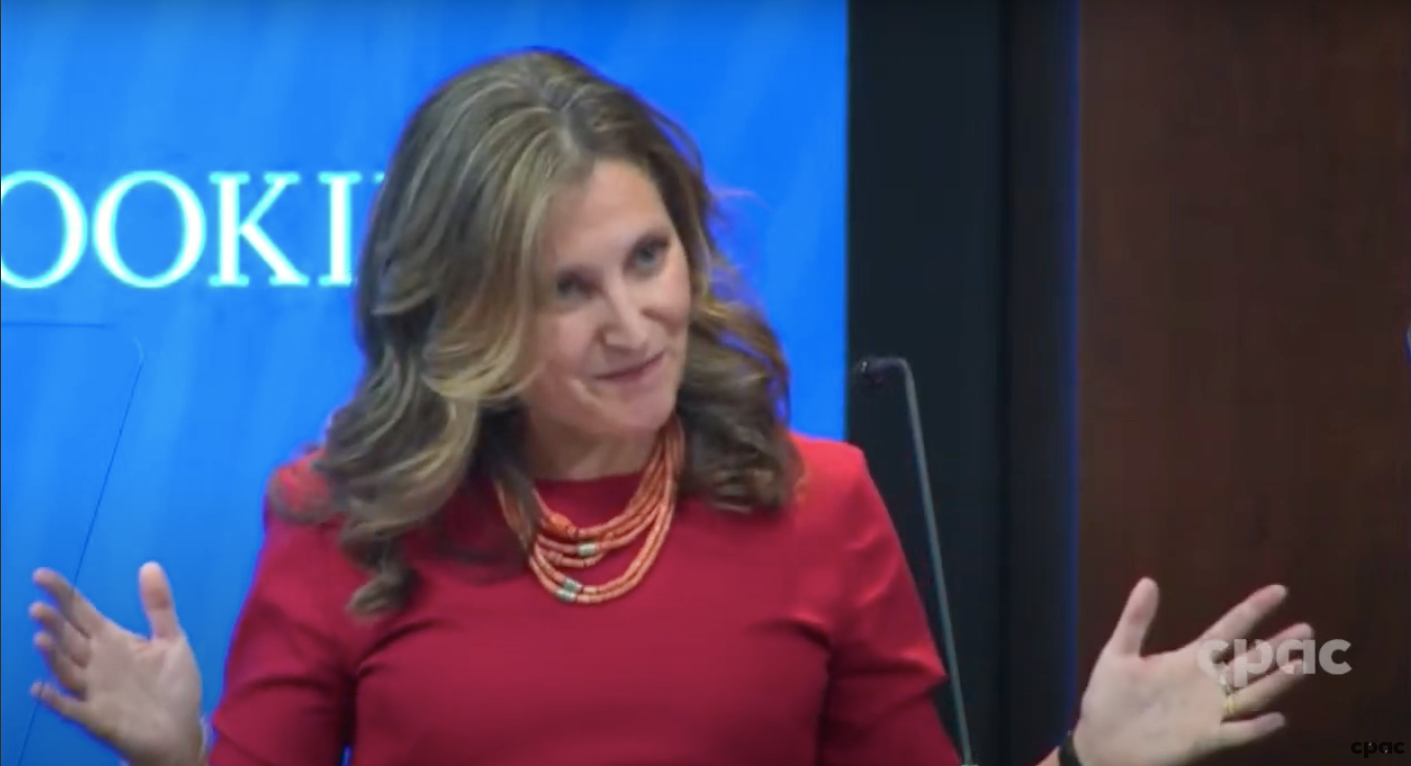
Screencap from a CPAC video of Chrystia Freeland speaking.
Monday
As a former journalist, I am fully aware of the awesome power of the press to distort and pervert reality. Here we all are in 2024 Canada. There is food. There is shelter. There is breathable air. The vast majority of us will go through the rest of the fiscal year without being stabbed on public transit.
And yet, to hear the misinformation and disinformation trafficked by the media, you would think we live in some kind of violent, economically depressed hellscape.
Well, this kind of mendacity has consequences: A nationwide hysteria of bad feelings and negative energy. A fanatical devotion to bad vibes in the face of all evidence to the contrary. I don’t purport to know how to cure such irrational malaise, but I will be very surprised if $250 each and some tax-free liquor and Christmas shopping doesn’t do it.
Tuesday
Donald Trump’s threat of 25 per cent tariffs is easily the most serious challenge I have faced as Canadian finance minister. The United States is our largest trading partner, and the suspension of free trade across our shared border would invite economic ruin the likes of which we’ve never seen.
Worse, Trump is immune to our usual strategies. We suggested sending his tariff threat to committee, or having it reviewed by a Crown inquiry, but neither offer was accepted. Rather, they want us to stem the tide of illegal migrants using Canada as a base to enter the United States. They are under the impression — let’s call it “bad vibes” — that this is a problem.
But let nobody say that the integrity of our trade flows are not my department’s top priority. As such, we are immediately introducing a one-time bursary of between $150 and $240 paid to any resident of Canada who can prove they have not attempted illegal entry of the United States within the past 12 months.
Comments Off on “Fellow Canadians, forget your dire financial plight … it’s only a ‘vibecession'”
QotD: Recording and codifying the land that William conquered
[…]
In brief, Scott argues that the process of making a society “legible” to government officials obscures social reality, to the point where the government’s maps and charts and graphs take on a life of their own. It’s recursive, such that those well-intentioned schemes end up first measuring, then manipulating, the wrong thing in the wrong way, to the point that the social “problem” the process was supposed to address drops out entirely — all you have, at the end, is powerpoint girls critiquing spreadsheet boys because their spreadsheets don’t have enough animation, and vice versa.
Scott doesn’t use the Domesday Book as an example (IIRC from a graduate school class 20-odd years ago, anyway), but it’s one we’re probably all familiar with. The first thing William the Conqueror needed to know is: what, exactly, have I conquered? So he sent out the high-medieval version of spreadsheet boys to take a comprehensive survey of the kingdom. Turns out the Duke of Earl’s demense runs from this creek to that rock. He has five underlings, and their domains run from etc.
The point of all this, of course, was so that Billy C. could call the Duke of Earl on the carpet, point to the spreadsheet, and say “You owe me a cow, three chickens, and two months in the saddle as back taxes.” It worked great, except when — as, it seems, is inevitable — the high-medieval equivalent of the spreadsheet boys did the high-medieval version of “ctrl-c”; just copying and pasting the information over. Eventually the tax situation got way out of whack, as it did for most every pre-modern government running a similar system — one of the reasons declining Chinese dynasties had such fiscal problems, for instance, is that the tax surveys only got updated every two centuries or so, such that a major provincial lord was still only paying 20 silver pieces in taxes, when he should’ve been paying 20,000 (and his peasants were all paying 20 when all they could afford was 2).
In other words: unless the spreadsheet boys periodically go out and check that the numbers on their spreadsheets actually correspond in some systematic, more-or-less representative way to some underlying social reality, government policy is being set by make-believe.
Severian, “The Finger is Not the Moon”, Rotten Chestnuts, 2021-09-14.
Comments Off on QotD: Recording and codifying the land that William conquered
November 30, 2024
It’s not just your imagination, the Canadian government is much bigger and much less efficient now
At The Audit, David Clinton shows that the Canadian federal government has gone through significant growth in staff at the same time as just about everything it does is now being done slower and less effectively1 than it was ten or twenty years ago:

Change is normal. The world around us isn’t sitting still and that’s got to have an impact on what’s needed by Canada and Canadians. So we can expect a government’s size and shape to evolve over time, but we’d certainly prefer that the changes were rational.
So let’s take a few minutes to understand how the size, cost, shape, and mandates of our government have been changing over the past few years.
Public service employment
Governments provide a set of services that don’t change dramatically from year to year. Sure, as the population grows they’ll need to process more passport applications and oversee the movement of greater numbers of international travellers across our borders. But task complexity shouldn’t increase faster than the population itself.
Therefore you would expect that the public service should grow in proportion to the overall population. Well, that’s not really true. Due mostly to digital automation, Canada’s private sector labour productivity rose steadily between around 1990 and 2014 and has maintained its peak level ever since. So in fact, since we can now do more with fewer people, you’d really expect public sector employment not to keep pace with rising population levels.
However, the actual proportion of federal employees to Canada’s total population has been growing noticeably over the past six years. Because of the scale I chose for its y-axis, the graph below does exaggerate the changes a bit, but you can see how the federal workforce grew from around 0.72% of the total population in 2017 to 0.9% in 2023. That means about one out of every 59 employed Canadians now works for the federal government.
Which means that – worker-for-worker – Canada’s public service is significantly less productive than it was ten years ago. And the growth in absolute numbers from 257,034 workers in 2015 to 357,247 in 2023 can be accurately characterized as bloat. Unforgivable bloat.
Departmental employment
Since 2011, by my count (and based on Treasury Board data), 11 new federal departments or agencies have come into existence and 18 have been shuffled off to wherever it is old bureaucracies go when they die. In some cases, the change represents nothing more than a technical realignment. The move from the Canadian Polar Commission to Polar Knowledge Canada is probably one such example.
I’m mildly curious to know how much such changes cost, even in terms of simple details like outsourcing designs for a new letterhead and getting IT to set up (and secure) a new website and email domain. I’m sure those don’t come for free.
It’s noteworthy that 11 of those 18 shutdowns took place in 2015 and 2016. That suggests they were the result of the incoming Liberal government’s policy implementations. Nevertheless, those changes don’t explain the scope of civil service employment growth since 2015.

1. I’m sure you’re all completely sick of me saying it, so I’ve relegated it to a footnote: the more the government tries to do, the less well it does everything.
Comments Off on It’s not just your imagination, the Canadian government is much bigger and much less efficient now
The mission of DOGE
One of Donald Trump’s more interesting announcements shortly after winning the federal election early in November was that he was going to give Elon Musk and Vivek Ramaswamy a formal position to do to the US government’s vast array of bureaucratic organizations what Javier Milei did to Argentina’s bloated national government. Here, scraped from the social media platform formerly known as Twitter, is Devon Eriksen‘s thoughts on how to go about pruning back the “fourth branch” of government:

Since the framers of the Constitution created a federal government with three branches, not four, there are no Constitutional checks on the emergent fourth branch.
Currently, the fourth branch is in many ways the most powerful, and certainly the most destructive, arm of the government.
– It has the privilege of targeting individual citizens on its own initiative, which is forbidden to the three other branches.
– It can interfere their lives in any way it wishes by making a “ruling”.
– The only recourse against a “ruling” is to take the bureaucracy in question to court.
– But the process is the punishment, because this takes months if not years and costs tens if not hundreds of thousands of dollars.
– Until recently, courts have deferred to bureaucrats as a matter of legal precedent. Now they merely do so as a matter of practice.
– But should the bureaucracy lose anyway, the only punishment the court inflicts is that they are told they have to stop doing that specific thing.
– Any fines or legal costs imposed on them punish the taxpayer, not the agent or even the agency.
– And the next, closely related, thing the bureaucracy thinks of to do is once again fair game, until the courts are once again brought in, at further cost, to tell it to stop.
All of this creates a Red Queen Effect.
Citizens must establish their own organizations, and raise donations to engage in constant lawfare, just to retain the rights they haven’t lost yet. And they must win every time to maintain the status quo.
Bureaucrats, on the other hand, can fight endless legal battles using money taken from their victims by the IRS, at no cost to themselves. Any victory they claim, they may keep permanently, while any loss may be refought endlessly simply by a slight variance of the attack.
Obviously, if this system is not changed, all power will accrue to the bureaucracy over time. They will constitute a totalitarian authority over every aspect of the life of every citizen.
This is why the name “DOGE” (Department of Government Efficiency) is a serious mistake.
Look, Elon, I like a joke as much as the next guy, and I do think irreverence is a load-bearing component of checking the bureaucracy, because a false aura of gravitas is one of their defenses against public outrage.
But words mean things.
When you create a check on the bureaucracy and call it the department of government efficiency, you focus the attention, and the correction, on the fact that the bureaucracy is stomping on people’s lives and businesses inefficiently, not on the fact that they are doing so at all.
But the name isn’t my decision. The power of the vote isn’t that granular. I can only elect an administration, not protect it from tactical errors by weighing in on individual policy decisions.
Unless someone with direct power happens to read this.
So, regardless of the name, here’s how an organization might be set up to effectively check federal bureaucracies.
1. DOGE must be responsive, not merely proactive.
Being proactive sounds better in the abstract, but it is much easier for a federal agency to gin up some numbers to fight a periodic overall audit, than it is to fight an investigation of a specific case.
2. DOGE must have direct oversight.
If it must take agencies to court, it is merely a proxy for the citizens whose money is being wasted, and whose rights are being trampled.
Imagine the level of inefficiency, waste, and delay, if your process for addressing bureaucratic abuse simply results in one part of the federal government pursuing an expensive court case against another.
Instead, DOGE must have the power to simply make a ruling, via its own investigation hearing process, which is binding on federal agencies.
Any appeals to the court system must be allowed to trigger their own DOGE investigation (for wasting taxpayer fighting a ruling).
3. DOGE must have the power to punish the agent, not just the agency.
“You have to stop that now” is not a deterrent. Neither is fining the agency, because such fines are paid by the American taxpayer.
DOGE must follow Saul Alinsky’s 11th rule: target individuals, not institutions.
Why?
Because agencies are agencies. They consist of agents.
An agent is someone who acts on behalf of a principal — someone whose interests the agent is supposed to represent.
When the agent is incentivized so that his interests diverge from those of the principal, he will be increasingly likely to act in his own interest, not the principal’s.
This is the Principal-Agent Problem.
An agency is a construct, a theoretical entity. What Vonnegut would call a “granfalloon”.
Agencies do not act, they do not make decisions, they do not have incentives they respond to. Any appearance to the contrary is an emergent property created by the aggregate action of agents.
Every decision, whether we admit it or not, has a name attached to it, not a department. It is that person who responds to incentives.
Agents will favor their own incentives over those of their principal (the American people) unless a counter incentive is present for that specific person.
For this reason, DOGE should, must, have the power to discipline individual employees of the federal agencies it oversees.
This doesn’t just mean insignificant letters of reprimand in a file. It means fines against personal assets, firing, or even filing criminal charges. No qualified immunity.
Yes, you read that right. DOGE must be able to fire other agencies’ staff. I recommend that anyone fired by DOGE be permanently illegible for any federal government job, excluding only elected positions.
4. DOGE investigations must be triggerable by citizen complaints.
This is self-explanatory. It gives DOGE the practical capability to redress individual injustices, and it crowdsources your discovery problem.
Establish a hotline.
5. DOGE must have sufficient power to protect and reward whistleblowers, and punish those who retaliate against them.
6. Bureaucrats must be held responsible for outcomes, not just for following procedure.
Often, procedure is the problem. The precedent must be established, and clearly enforced, that because agents have agency, agents are responsible for using their discretion to ensure efficient, just, and sane outcomes, not just for doing whatever departmental policy allows.
7. DOGE must have an adversarial relationship with the bureaucracies is oversees.
This eliminates the phenomenon of “we investigated ourselves and found no wrongdoing”.
Following the previous recommendation is almost sure to make this happen.
The point is not for DOGE to address every instance of waste or wrongdoing, it is to make bureaucrats act responsibly because they fear an investigation.
In essence, I am imagining DOGE (or some superior name that better reflects the mission) as an entity with a license to treat bureaucrats the way bureaucrats currently treat citizens.
Comments Off on The mission of DOGE
QotD: Unrealized promises of a “Great Society”
Amity Shlaes, Great Society: A New History, 2020.
Comments Off on QotD: Unrealized promises of a “Great Society”
November 29, 2024
Dr. Jay Bhattacharya nominated as Director of the US National Institutes of Health
From the point of view of the establishment, the barbarians are well and truly inside the gates, as President-elect Donald Trump has nominated Stanford epidemiologist Dr. Jay Bhattacharya as the next director of the National Institutes of Health:

Dr. Jay Bhattacharya, Donald Trump’s nominee as Director of the National Health Institutes.
Photo by Taleed Brown, 2020, via Wikimedia Commons.
Four years ago, Jay Bhattacharya was ostracized by his colleagues at Stanford and censored on social media platforms thanks to a campaign against him by the public-health establishment. The director of the National Institutes of Health, Francis Collins, sent an email to another NIH official, Anthony Fauci, urging a “quick and devastating published takedown” of Bhattacharya and his fellow “fringe epidemiologists”.
Bhattacharya is far from the fringe today. Donald Trump nominated him this week for Collins’s old job, director of the NIH. Assuming the Senate confirms him, it will be a major victory for science and academic freedom — and a serious threat to the universities that suppressed scientific debate and promoted disastrous policies during the pandemic, causing public trust in science to plummet. Academic researchers and administrators have mostly refused to acknowledge their mistakes, much less make amends, but Bhattacharya promised yesterday to “reform American scientific institutions so that they are worthy of trust again”.
As NIH director, he would wield a potent tool to induce reform: money. Stanford and more than a dozen other universities each get more than $500 million annually in grants from the NIH, the world’s largest funder of biomedical research. The NIH grants support not only researchers but also their universities’ bureaucracies, which collect a hefty surcharge to cover supposed overhead costs. The federal largesse has helped finance the administrative bloat at universities, including the expansion of diversity, equity, and inclusion bureaucracies under the Biden administration, which took into account a university’s commitment to DEI principles when deciding whether to award grants from the NIH and other agencies.
Those priorities are about to change. Trump has vowed to rescind immediately Biden’s executive order directing federal agencies to promote DEI. During his first term, Trump threatened to issue an executive order barring universities from receiving federal funds if they suppressed free speech. He didn’t issue that order, but whether or not he does so in his next term, the NIH director will already have the power to consider a university’s commitment to academic freedom in deciding whether or not to award funds.
“For science to thrive and progress, we must be open-minded and allow vigorous and passionate debate,” says Martin Kulldorff, a former professor of medicine at Harvard. “Why should taxpayers subsidize universities that don’t allow that?” Kulldorff, an eminent epidemiologist, lost his job at Harvard after he became an early and outspoken critic of pandemic policies. In 2020, he joined with Bhattacharya and Sunetra Gupta, an epidemiologist at Oxford, to write the Great Barrington Declaration, a critique of lockdowns that was signed by tens of thousands of scientists and physicians.
Bhattacharya, who has a Ph.D. in economics as well as an M.D. from Stanford, hung on to his job as professor of health policy at the latter’s medical school, but his views were taboo on campus. After he and colleagues did a field study at the start of the pandemic showing that the Covid fatality rate was much lower than the doomsday number used to justify lockdowns, they were vilified by academics and journalists, and Stanford subjected them to a two-month inquiry by an outside legal firm. (They were vindicated by the inquiry and also by subsequent research confirming their findings.)
Comments Off on Dr. Jay Bhattacharya nominated as Director of the US National Institutes of Health
Trump is a deals guy … and Canadian politicians need to negotiate with him on that basis
In what has turned out to be his final column for TVO, Matt Gurney says that Canadian views on Trump need to evolve if we hope to preserve the overall amicable relationship between the two countries. Trump made his career on making deals … but not many of our political leaders seem to have clued in that this means we need to approach all our post-Biden American affairs with that in mind:
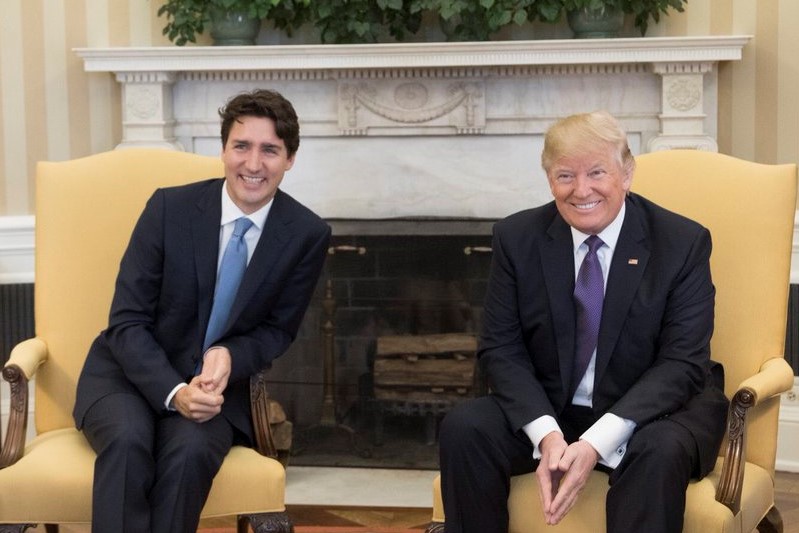
Justin Trudeau meets with President Donald Trump at the White House, 13 February, 2017.
Photo from the Office of the President of the United States via Wikimedia Commons.
Ever since the re-election of Donald Trump earlier this month, the most interesting question in Canadian politics has been “Who gets it?” That’s the main thing I’ve been looking for, and I think some of our leaders get it — or are starting to, at least.
Doug Ford doesn’t get it. Or didn’t, anyway, up until Tuesday afternoon.
On Monday night, president-elect Trump announced via a post on his Truth Social app that, as one of his first acts upon retaking the Oval Office in January, he would levy a 25 per cent tariff against all goods coming in from Canada and Mexico until those two countries fix the problems Trump says exist along the border. That’s a careful bit of phrasing on my part, so let me explain: I don’t disagree that there are issues for the United States along both borders. I don’t necessarily accept that the issues are the same on both borders or that Trump has accurately characterized the overall situation. But, in any case, Canada now has less than two months to figure out what it can do, assuming it can do anything, to satisfy the president-elect’s demands.
It’s very possible that we can do enough. Trump is a negotiator and a dealmaker, and we have to see his social-media post through that lens. He is establishing a strong opening position, and we’ll negotiate him down from there. That’s the good news, such as it is. The bad news, though, is that there’s no reason to assume Trump is going to do this only once. After we meet his demands on the border, he could demand that Canada take on more of the burden of the military defence of North America and the Western alliance. After we’ve drafted a bunch of people and launched a fleet of new warships and sent a heavily armed stabilization force to Haiti, he could come after us for our dairy subsidies. Once we give way on that, it’ll be getting tough on white-collar crime or telecom access or airline access. And so on and so on and so on. It’ll be one damned thing after another.
The broad contours of this were clear to me by about 1:30 in the morning on the day after (or night of, if you prefer) the U.S. election. As I keep saying, the party is over. Some of Trump’s demands will be basically utterly bogus, and others may be arguably unreasonable, but some of them are absolutely going to be fair, and Canada has, to my enormous frustration, left itself very, very vulnerable to his brand of pressure. We have utterly failed as a country to adapt to a changing world order by getting this country onto a more serious footing on any number of fronts, especially trade and defence. We were warned by friendlier U.S. administrations, including by presidents Barack Obama and Joe Biden. We didn’t listen. That was idiotic, and I can only hope not suicidal on our parts. Trump is going to get his way.
Comments Off on Trump is a deals guy … and Canadian politicians need to negotiate with him on that basis


