According to [Governor Harold] Stassen, “My best summary of Dulles is that he always knew he was absolutely right. Further, he knew that anyone who disagreed with him was, of logical necessity, always wrong. And finally, he could not understand how anyone could dare question the fact that he was always right.” It wasn’t just Stassen who had a problem with the priggish Dulles, though. As Supreme Court Justice William O. Douglas once said, “I’m not sure I want to go to heaven. I’m afraid I might meet John Foster Dulles there”. Some U.S. allies had misgivings about Dulles as well. Harold Wilson, a British member of Parliament and future prime minister, once mocked Dulles’s propensity to try to be everywhere all the time: “I heard they are inventing an airplane that can fly without Dulles! They hope soon to get it into production.” Winston Churchill himself once famously mocked Dulles via declension: “Dull, Duller, Dulles”.
Tevi Troy, Fight Club: Rivalries in the White House from Truman to Trump, 2020.
January 6, 2026
QotD: John Foster Dulles
January 5, 2026
International law is more like International “law”
On the social media site formerly known as Twitter, Konstantin Kisin points out that calling it “International Law” gives it a semi-mythic quality that it absolutely does not deserve:
All the bleating about “international law” shows just how completely deluded some of our elites have become.
International law was a pleasant fiction that lasted for a few decades. It was never real and now the world has reverted to its default setting: Great Power politics.
This is why, as a strong Ukraine supporter, I have never talked about international law or called Putin’s attack an “illegal invasion”.
Laws are based on submission to an overarching authority backed by force. There is no such international authority and even if you view the UN as one, it does not have the ability to use force against those who violate “international law” other than against small countries with weak militaries.
When the US attacked Iraq, the UN did nothing.
When Russia invaded Ukraine, the UN did nothing.
If China invades Taiwan tomorrow, the UN will do nothing.If you cannot enforce a law, it’s not a law.
I do not support Ukraine because naughty Vlad broke the rules. I support Ukraine because it’s not in OUR interest in the West to have Russia marauding its way through friendly countries on the borders of Europe. It’s in our interest for us to be as strong as possible and for our adversaries to be as weak as possible.
President Trump is a realist and a pragmatist. He sees through the fictions other “leaders” cling to.
A good leader advances the national interests of his country. If more Western leaders did this, our civilisation would be in a much better place.
I commented on another post that,
For a lot of people (Canadian Liberals and American Democrats in particular), the invocation “international law” has a mesmerizing effect on their ability to reason [insert usual disclaimer that if they could foresee the results of their enlightened beliefs, they wouldn’t be progressives]. They seem to have a quasi-religious belief in the UN as if it were some kind of God-given supergovernment that is always right and must always be obeyed. “World opinion” might as well be the hand of God to them, so any time the legacy media can portray the US (and Trump in particular) as going against “world opinion” they want to get out the sackcloth and ashes … or sack a city and turn it into ashes, whichever comes first.
vittorio analyzes the default position of most progressives on the social media site formerly known as Twitter:
most political issues nowadays can be explained by understanding that american leftists dont have positions, they have oppositions.
their entire belief system is defined by negation of whatever the right supports. this is why portland chants “free maduro” while actual venezuelans celebrate in the streets. they’re not pro-venezuelan or pro democracies, or pro tyrant, or pro maduro, they’re simply anti-american-right.
they’ve outsourced their worldview to institutional narratives for so long that genuine self-reflection would require questioning everything. for them it’s much easier to just oppose. the beliefs arent coherent because they were never meant to be coherent. they only need to signal tribal membership, and leftist membership is gained by opposing the right.
trump does X? the left screams and cries because they wanted Y
trump does Y? the left screams and cries and riots because even if they said they wanted Y, what they meant is that X was the way to go
trump cures cancer? they’ll argue that the cancer cells are alive have a right of free determination
trump saves lives? they’ll protest because somehow those lives didn’t matter and should have been ended
no coherent word model. no logic. pure opposition
at some point you just have to stop engaging with it as if it’s a real political position. it’s not. it’s aesthetic opposition wearing the costume of ideology
As Severian at Founding Questions often remarks, progressives’ core belief is The Great Inversion: “whatever is, is wrong”.
Bingo Bobbins makes the case that “International law is fake and gay”:
Was this operation necessary? Was Maduro really a “narcoterrorist”? I admit that I haven’t really been following all the drama with Venezuela recently, but my intuition is that Maduro was probably accepting bribes to look the other way with regards to drug trafficking, rather than being directly involved. And sure, he was a socialist dictator but there’s plenty of those around. The US doesn’t go and topple dictators unless there is a perceived US interest in doing so.
What Maduro was actually doing was cozying up to China. In fact, he had just finished a meeting with some Chinese ambassadors hours before Delta Force snatched him up by the scruff. This was actually a warning to China not to mess around in our hemisphere. The Trump administration is re-establishing the Monroe Doctrine, or, as he recently called in a press conference, “The Donroe Doctrine“. As far as I can see, this is completely in keeping with my preferred Vitalist Foreign Policy.
You can agree or disagree with this show of force, but please don’t whine to me about “International Law”. International Law is fake and gay. I certainly don’t care that the Trump administration “targeted a political leader”. This is the complaint being leveled by many leftists in regard to the operation. Really, this is just because leftists are anti-American third-worldists, and they are filled with butthurt because “their guy” lost. But, let’s examine this “rule” of not being allowed to target a countries rulers, because it’s particularly ridiculous.
If you have a problem with a specific country, who do you really have a problem with? You have a problem with that country’s leaders, since they are the ones making the decisions. Why wouldn’t you target the leaders? The only reason is that all the leaders from all the countries got together and agreed that they wouldn’t target each other. They would rather resolve their differences by throwing cannon fodder at each other, while keeping themselves off the table. And sure, I understand why that is great for them, but not why it would be great for me (or you).
Of course, the CIA has been ignoring this “international law” for decades, but they’ve been doing it in a very effeminate way, skulking about the world, funding Color Revolutions and clandestinely arming insurgent groups in order to subvert existing regimes. The Donroe Doctrine is much better. Imagine if the Trump administration had tried to handle Maduro the way the Obama administration tried to handle Assad. Fund a decades long civil war, accidentally establish a caliphate, fight a war against said caliphate, facilitate the deaths of tens of thousands of Christians, all to have an even worse dictator eventually rise to power.
Update, 6 January: Welcome, Instapundit readers! Please do have a look around at some of my other posts you may find of interest. I send out a daily summary of posts here through my Substack – https://substack.com/@nicholasrusson that you can subscribe to if you’d like to be informed of new posts in the future.
January 4, 2026
Venezuela in the news
Tim Worstall explains that despite the usual suspects’ claims that “it’s all about the oil!”, it actually isn’t very much about the oil at all:
Trump taking — kidnapping, arresting, to taste — Maduro and his wife simply isn’t about the oil business. Please note, this also isn’t about whether it’s a good idea or not although I’ll admit to thinking that it’s way damn cool — getting in and out of hostile territory without, so far as we know right now, a single American casualty at all? Damn cool in that military sense.
This is about the shrieking we’re getting from the usual suspects — this is all about the oil! See! Ms. Raisin is one I’ve seen online already, there are those quoting that Counterpunch article with the idiot Michael Hudson and so on.
My point is solely and only about access to that oil.
So, travel back 10 to 15 years.
Venezuela’s Orinoco Belt oil is very “heavy”. Technically it is about viscosity but think about it as “thick”. It’s more like treacle than it is like a free flowing liquid. There are also issues with sulphur but leave that alone here. It is, in the technical parlance, “cheap shit”. So bad that it has to be mixed with much lighter (and usually “sweeter”, which means less sulphur) crude oil from different oil fields so you can pump it through a pipeline or get it into a tanker.
Venezuela used to have — still could have — fields of that light and sweet oil but they ran those fields — during and after Chavez — so badly that production fell over. So, they used to actually import US crude oil to then mix with that heavy crude so they could export. They also price petrol — gasoline — so low that they cannot possibly run refineries to make their own gasoline. So, they would import the US crude, mix it, export the blend to the US and then buy back the gasoline from those US Gulf Coast refineries. This was ridiculous, of course, but you know socialists with prices and economies.
It also meant that those US Gulf Coast refineries were adapted to use that Venezuela mix. You can change the mix a refinery uses but it’s potentially costly. The more the mix changes the more the cost rises. But the important thing to note is that the only refineries within cheap shipping distance that could use the Venezuela crude efficiently were those US Gulf Coast ones. Sure, they’d be pissed if they lost access to their supplies but they could be altered to work with other crude mixes. The reliance was much more of Venezuela upon the refineries than the refineries upon Venezuela — at least, the cost of adaptation to a change was lower for the refineries.
OK, so that was the old situation.
Over this past decade and a bit the US — under both Trump and Biden — has been saying, well, you know, we don’t think much of the Venezuelan Government. We also know the only money they get is from crude oil sales, so, if we refused to take that for those Gulf Coast refineries then we could screw with Maduro. Which is what happened — sanctions on Venezuelan oil exports which, most obviously, apply to people shipping into the US and so obeying US law.
Other people who do not, or don’t have to, obey US law haven’t, wholly, been abiding by those sanctions. OK. Maybe that’s all a good idea and maybe it isn’t — not my point here at all.
We should also note that the oil fields in Venezuela actually owned/managed by Chevron, a US company, have still been allowed to ship to the US and elsewhere under US law.
One more little fact. The US is now — as a result of fracking — a net oil exporter. This is also something done under Trump I, the lifting of the ban on crude oil exports. It can still be true that maybe buying in some Venezuelan oil — or Mexican, Canadian, whatever — meets either geographic or blend desires. We’d like some really heavy sludge, for example, or maybe Canadian oil works for Wyoming (not real examples, just ideas). But in terms of total oil production and usage the US produces more than it uses now. So any decision to import is about those marginal issues of location and blend, not urgent necessity for simple crude oil. Fracking works, d’ye see?
On the other hand another bunch of the usual suspects are screaming about this as a violation of international law. ESR comments on the social media site formerly known as Twitter:
Since there’s a lot of screaming about the legality of black-bagging Nicolas Maduro going on, let’s talk about the game theory of international law.
Before I do that, though, I’m going to acknowledge that the Trump administration’s legal posture doesn’t even implicate international law significantly. Their theory is that Maduro stole an election, is not the legitimate head of state of Venezuela, and is a criminal drug-cartel leader; universal jurisdiction applies.
This is why a photograph of Maduro restrained by a soldier wearing a DEA patch was released.
I’m not here to state a position on whether that legal posture is valid; I want to instead outline a game theory of the “rules-based international order”, which people are complaining has been violated because the US black-bagged a head of state.
There are two different ways to establish a framework of governing law. Most people only understand one of them, which is the imposition of law by a ruler or coalition with force dominance. I’ll call this “unitary law”.
The other mechanism is mostly only understood by a handful of libertarians; it is law as a violence-minimizing equilibrium among a number of roughly equal agents playing an iterated Prisoner’s Dilemma game. In such settings, cooperation evolves naturally and doesn’t have to be handed down by a single ruler or coalition. I’ll call this “IPD law”.
“International law” is enforced by an uneasy combination of both mechanisms. This is more difficult to see than it should be because there’s also a lot of air and bullshit around “international law”, bullshit consisting mostly of wordcels trying to cast magic spells on people with guns.
The air and bullshit is why it’s common to say that international law is a mirage, or a fraud that only serves the interests of the strongest powers. This isn’t true: what is true is that if an international norm is not sustained by being a stable strategy in an IPD game, only force majeure by a dominant power or coalition can uphold it.
Here’s an example of a moral good that was established by unitary law of nations: the general abolition of chattel slavery, which happened because a dominant coalition of Western nations said “Fuck your sovereignty, we’re no longer tolerating this anywhere our militaries can reach.”
Here’s an example of a moral good that was accomplished by IPD law of nations: generally humane treatment of prisoners of war in armed conflicts. This didn’t develop because great powers unilaterally said “stop doing that”, it happened because even a great power at war with a minor one is exposed to effective tit-for-tat retaliation if it abuses POWs.
If you want to understand “international law”, you need to be able to disentangle three different things that claim to be international law: unitary law imposed by great powers, IPD law enforced by the threat of pain-inducing defections in an international tit-for-tat game, and wordcel bullshit.
The thing to bear in mind is just because there’s a lot of wordcel bullshit going around in “international law” doesn’t mean there isn’t a reality underneath.
British Prime Minister Keir Starmer rushes to distance himself from Trump’s action, for fear that someone might possibly mistake him for a vertebrate:
Leave it to the Babylon Bee to find the appropriate framing for a news story:
Update, 6 January: Welcome, Instapundit readers! Please do have a look around at some of my other posts you may find of interest. I send out a daily summary of posts here through my Substack – https://substack.com/@nicholasrusson that you can subscribe to if you’d like to be informed of new posts in the future.
“You will eat the bugs, peasant!”
On the social media site formerly known as Twitter, ESR reacts to yet another “bugs are yummy, peons, you are going to eat them” post:
Contemplating this picture, I had a realization about the people who want you to eat bugs.
The fact that the bugs are disgusting to you is the whole point. Enlisting you as the principal enforcer of your oppression is the program. Fucking with your head is the actual goal, not just a tactic.
It doesn’t matter whether or not Western prejudice against eating insects is irrational. In an alternate world where we routinely eat insects, the people who want you to eat the bugs would find some other kind of disgusting garbage and play to make you eat it.
Because this isn’t sustainability or any of that bullshit. The degradation is the point.
However, even the powers-that-be can’t magically create economic conditions in which insect factories earn profits:
In the renewable frenzy of the early 2020s Ÿnsect raised €600 million to “Reinvent the food chain” and pioneer alternative foods that “respect the planet’s boundaries”. Some $200 million of their funding came from hapless taxpayers somewhere. But in record time, seemingly before it began, it has already gone. Bankrupted. And not because people don’t want to eat mealworms (which they don’t) but because there wasn’t much market in making animal feed either. It turns out that farm owners didn’t want to spend 2 to 10 times as much on “sustainable” cattle fodder. So the company shifted focus to high end pet food, where besotted owners have money to spare, but that crashed too.
h/t Tom Nelson
How reality crushed Ÿnsect, the French startup that had raised over $600M for insect farming
By Anna Heim, TechCrunchThe company’s demise is hardly a surprise, as Ÿnsect had been embattled for months. Still, there is plenty to unpack about how a startup can go bankrupt despite raising over $600 million, including from Downey Jr.’s FootPrint Coalition, taxpayers, and many others.
Ultimately, Ÿnsect failed to fulfill its ambition to “revolutionize the food chain” with insect-based protein. But don’t be too quick to attribute its failure to the “ick” factor that many Westerners feel about bugs. Human food was never its core focus.
It’s only money …
And revenue was the problem. According to publicly available data, Ÿnsect’s revenue from its main entity peaked at €17.8 million in 2021 (approximately $21 million) — a figure reportedly inflated by internal transfers between subsidiaries. By 2023, the company had racked up a net loss of €79.7 million ($94 million).
The vainglorious heady days of climate communism meant some bureaucrats thought it made sense to spend $200 million dollars feeding bugs to cows to try to change rainfall in 2100 AD.
January 3, 2026
America’s secret UBI programs
On his Substack, Glenn Reynolds puts the Somali daycare scandal into its proper perspective: it’s not old-fashioned graft but something far bigger and far more destructive to the pillars of western society:
The explosive unveiling of the wildly extensive Somali-run daycare scams in Minnesota has drawn attention to a huge shadow economy, and not just in Minnesota. America, it turns out, is full of people, companies, and organizations that basically live off of fraud. We’re not talking old-fashioned waste, like $600 hammers or $1200 toilet seats. We’re talking about entities whose sole reason for existence consists of being a conduit for taxpayer money to flow directly to the people controlling them, with some of the proceeds being diverted to politicians and political organizations.
People are noticing.
This reverses an old joke told by my Nigerian relatives. A Nigerian visits his rich relative in the United States and is awed by the penthouse apartment, the limo, the private jet and so forth. “How did you make so much money?” he asks. The relative points out the window. “See that bridge? 15%. See that shopping mall? 15%. See that train station? 15%.”
The visitor, inspired, returns home to Nigeria and becomes fabulously wealthy. His rich cousin from America visits and says “How did you make so much money so fast?”
“You see that bridge over there?”
“Nope,” responds the confused relative. The Nigerian cousin points at himself and says “One hundred percent!”
Well, this joke has now been turned around. Leaving aside that we don’t really even build train stations, bridges, or even shopping malls in this country anymore, now it’s America where people are pocketing one hundred percent and not even trying to actually deliver any goods or services. That the people doing this are mostly Africans only adds to the irony.
But what happened?
Well, several things. At base, people defraud the government for the same reason that dogs lick themselves — because they can. One of the things you find in these programs is that there are virtually no controls to ensure that the recipients of the money are legitimate, that the money is spent as promised — in essence, that the bridges get built. (Or, in the case of California, the high speed rail lines.) That lack of controls, of course, is no accident. The systems are designed to promote fraud and to make it hard to catch or punish.
Second, the culture is weaker. In a high trust society, people get angry when there is fraud and move to punish and ostracize the perpetrators. In a low-trust society, people expect it.
Older generations of politicians used to engage more in what George Washington “Boss” Plunkitt called “honest graft”. He defined honest graft as legally exploiting insider knowledge and opportunities from one’s position for personal financial gain, while also benefiting the public or party. A classic example he gave was learning about upcoming public projects (like a new park or bridge) and buying nearby land cheaply before the plans became public, then selling it at a profit to the city. He famously summarized it as: “I seen my opportunities and I took ’em,” comparing it to savvy stock trading on Wall Street. In contrast, dishonest graft involved outright illegal acts, such as blackmail, embezzlement, or extortion (e.g., shaking down gamblers or saloon keepers).
God knows what he would have said about simply taking money for nothing. Would his reaction have been horror? Or admiration?
Britain’s government – a modern-day Ship of Fools
On his Substack, Dr. Robert Lyman takes a break from discussing events in India and Burma during the Second World War to consider the current British government:

The 1519 title page of Sebastian Brant‘s 1494 satirical book Ship of Fools
I began life as a medievalist and often find myself instinctively going back to old texts when contemplating today’s problems. I have been forced to think much in recent days about the incompetence of our current governing class in respect of their understanding of defence and its value. More especially, their failure to understand how to use the military instruments of defence to uphold our national interest. The Ship of Fools, which first appeared in Plato’s Republic but was resurrected in Europe in the late 1400s as a metaphor for desperately poor leadership, is the perfect allegory for me. It tells a simple story that resonates with thoughtful people in every age who look on in wonderment at the idiots governing them. The story is of a ship with a crew who talk (and drink) a lot, but with their cloth ears make all the wrong decisions. The result is chaos. In the 1480s the ship in question was the Church of Rome, but the allegory is easily transportable to Britain in the early days of 2026. What on earth is going on in defence in the UK as we enter 2026? I can only surmise that in the UK at least, we are in a ship governed by fools.
I was going to start this piece by complaining that our government simply doesn’t understand Clausewitz, but I thought that this might be a little too obtuse for most politicians. But one of Clausewitz’s points about the use of military power is pertinent to our age. When Napoleon invaded Russia in 1812 he did so not because he had an existential hatred of Slavs, or of the Tsar. Indeed, Napoleon and Tsar Alexander I had a remarkably friendly relationship. He did it because the practice of friendly diplomacy between the two leaders had failed. Napoleon had attempted to persuade the Tsar to refuse the British trading rights in Russia’s ports. Alexander I had demurred, so Napoleon considered that the only thing left to him in his tool kit of levers to persuade Alexander to change his mind, was force. So, he marched on Moscow. We know the story and its outcome well, so I won’t rehearse it now. Using this as an example, Clausewitz was simply saying that in the hurly burly of diplomacy, war is one of the tools available to a national leader to persuade an opponent to change course. Hence, we get the oft misquoted Clausewitzian maxim that “War is the continuation of policy with other means”.
Clausewitz was correct, of course. Yet we in Britain have forgotten this, if politicians over the past three decades have really understood it. Since 1990 I am not sure we’ve had any politicians who’ve truly understood it, despite the fine words we get from successive Secretaries of State about the first priority of government being to protect its citizens, etc. This, without action to demonstrate any understanding of how to achieve the protection of our citizens, is merely St Paul’s clanging cymbal. Put frankly, we no longer have an Army, Navy or Air Force able seriously to achieve any form of influence on the European stage — let alone deter an enemy or fight a serious war — and the state of the Continuous At Sea Deterrent (CASD) is abysmal I’m told, though you wouldn’t know this from the hollow rhetoric regularly emanating from No 10. We are deluding ourselves if we think we can exercise real influence in Europe or anywhere else for that matter if we don’t have the practical means to do so.
The truth is that the cupboard is bare.
How have we got to where we are? The primary reason over the years has been the saving of money for politicians who have simply not valued investment in the hard practice of defence, unless it is in a shipyard in their constituency. The end of the Iron Curtain in 1989/90 meant, to many people in the corridors of power, that we no longer needed to bear the burden of spending 5% of GDP on defence.
But a second problem is only becoming clear to me. I hope I am wrong, but I can only conclude that we now have a government that actively hates the idea of defence, and while it will never admit it, is determined to remove it as one of its levers or instruments of power. I came across this in a meeting recently. Why do we need defence, the argument seemed to go, when we should be encouraging the international community to regulate itself by means of adherence to international laws and norms of behaviour? Should not our effort as a country be in building up these international systems and structures of law and governance (many based on the United Nations as an idea and a regulator) and rely on these to reduce the potentiality for war? Surely, building up arms simply makes war more likely, not less?
Update, 4 January: Welcome, Instapundit readers! Please do have a look around at some of my other posts you may find of interest. I send out a daily summary of posts here through my Substack – https://substack.com/@nicholasrusson that you can subscribe to if you’d like to be informed of new posts in the future.
January 2, 2026
“You had to be unacceptably racist in 1993 to predict where South Africa would be in thirty years”
On the social media site formerly known as Twitter, Wesley Yang posted the comment in the headline. Will Tanner responded:
You did not, in fact. You just had to be paying attention
By 1993, South Africa was the only First World country left in Africa
America and the UN chased Belgium out of the Congo, and it collapsed into decades of civil war and famine
Mugabe destroyed Rhodesia after we aided the Soviets in helping him win. Angola and Mozambique became hells after Salazar died, the Carnation Revolution happened, and they were given up. Kenya and Sierre Leone all showed the hellish state of things that came with decolonization in the name of “democracy”
South Africa was the last man standing. It had a nuclear program. It had a space program. It had clean, reliable water and electricity. It had a thriving industrial sector. Crime was problematic, but not out of control
Now all of that was gone, for the same reason the Congo is a mess and Zimbabwe went from being the breadbasket of Africa to a famine-ridden mess: decolonization and equity
Anyone who paid attention could have predicted that. Maintaining First World life requires a First World mindset; that dies when handed over to race communists who are happy to backslide into the Stone Age if doing so means “equality” exists
And so South Africa went from First World to Third
And John Carter responded in turn:
When you stand back and look at this from ten thousand feet, a very dark pattern emerges.
In the aftermath of WWII, the newly established globalist institutions were used to give moral and financial support to decolonization movements, thereby chasing European countries out of what became the third world.
A governance structure that had successfully brought order, prosperity, and civilization to much of the planet was dismantled, leaving behind a chaotic mess of war and poverty.
Those same globalist organizations then embarked on a program of “foreign aid” that dramatically increased the size of that immiserated third world population (without actually improving conditions for them).
At the same time, their agents were busy at work within the governments of the former colonial powers, changing their immigration policies to allow immigration from more or less anywhere. Countries began adopting “multiculturalism” in the name of fighting “racism” … A newly developed postwar concept, which the media and education arms of the globalist project indoctrinated the youth to consider the worst of all possible sins.
Once the ideological and legal ground had been prepared in the former colonial powers, migration via legal and irregular pathways commenced, facilitated by — of course — the very same set of globalist NGOs that chased Europe out of the colonies.
Somehow, this new form of colonization is a good thing. Somehow, the European peoples enjoy none of the rights of “national self-determination” accorded to “indigenous” peoples which had been invoked to end colonialism.
As the populations of the third world were exploding thanks to the foreign aid being provided by globalist organizations, fertility in the first world fell off a cliff. The pill, abortion, feminism drawing women into universities and careers and therefore away from marriage and child-bearing, no-fault divorce destroying the family, and a gender war incited to new levels of bitter intensity every year which estranged the sexes, all served to reduce the white birth rate.
White fertility crashed just as the population bomb that had been set in the third world exploded, with the gates left open by carefully constructed legal frameworks that made immigration very easy and deportation very, very hard.
Update, 3 January: Welcome, Instapundit readers! Please do have a look around at some of my other posts you may find of interest. I send out a daily summary of posts here through my Substack – https://substack.com/@nicholasrusson that you can subscribe to if you’d like to be informed of new posts in the future.
January 1, 2026
Canadian government spending … with convenient “by recipient” lookups
It’s no secret that the Canadian federal government spends a lot of money every year. It’s public information, but it’s made available in a form that is very difficult to track across all the various ministries and other government bodies. On the social media site formerly known as Twitter, The Reclamare has posted a free consolidation website that gathers all these separate reports into a single database that you can query on a by-recipient basis. This means that you can see how much money a given company or organization received from all government sources in one convenient result.
The link is https://thereclamare.github.io/CDN_Govt_Spending/. I hope you find this useful!
The consuls and the start of a Roman year
Adrian Goldsworthy. Historian and Novelist
Published 1 Jan 2025For New Year’s day, we look at how the year started for the Romans, when from 153 BC onwards, the new consuls assumed office. There were rituals, sacrifices and ceremony, and then the start of the political year.
To round off, some thoughts on what is planned for the year to come on this channel.
Oh yes, and for chickens read geese!
December 31, 2025
Do you want tribalism? Because this is how you get tribalism
On the social media site formerly known as Twitter, InfantryDort asks the key questions about where our “elites” are taking us:
What’s the point? No, tell me, what’s the point?
What’s the point of laws if judges reinterpret them until they protect everyone except the people who obey them?
What’s the point of defending a nation if the same system refuses to defend your family from criminals it imported on purpose?
What’s the point of paying taxes if they fund fraud, reward deception, and subsidize parallel systems that never owed this place loyalty?
What’s the point of working, building, serving, if your labor is redistributed to those who broke the rules to get here?
What’s the point of accountability if paperwork matters more than reality, and intent matters less than optics?
I’ll tell you what the point is. The point is that any human with a brain is going to retreat to whatever group rewards his values and sacrifice. If it isn’t the nation, it becomes the tribe. And when it becomes the tribe, this American experiment is over.
A warrior can endure hardship, loss, and some long odds. What he cannot endure is betrayal by design.
When a nation stops enforcing its boundaries, its laws, and its obligations to its own people, it doesn’t just lose control, IT BURNS THE VERY WILL REQUIRED TO DEFEND IT.
I want something to defend that I believe in. We all do. I take the oath deadly serious. But one begins to wonder after awhile if that makes for a patriot or a sucker.
If a Soldier can follow it and die in defense of his country, but on the other side of the coin, there is a politician who can spit on it and get rich while importing and funding pirates … it really makes one wonder: What’s it all for?
@POTUS we know what problems you face. It’s not lost on us. But we are running out of time sir.
One of the things that makes these kinds of scam viable in western culture is that we are high-trust cultures with default assumptions that most people are not trying to exploit kindness and charity. This breaks down quickly once you introduce enough people from low-trust and tribal cultures:
The fraudulent spending of taxpayer dollars we are seeing uncovered nationally all rotates around the essential goodness of the American people.
Daycare for children? Of course — we don’t want our children or parents to suffer because Mom has to work.
Foodbanks? We don’t want anyone to starve. Our nation is better than that.
Homeless shelters? Homelessness is a scourge upon the American dream. We’re better than that.
Home elder care? The generations before us deserve dignity and respect. How could anyone oppose that?
Deep down we are a charitable and giving nation unlike most others. That sense of goodness and charity has been hijacked and exploited by foreign predators for their own material gain.
We need to wise up and toughen up, and understand that not every siren song of charity is on the level, particularly when our tax dollars are involved.
(Also, this reality gives an added layer of meaning to the concept of “suicidal empathy”.)
Ian at The Bugscuffle Gazette explains that importing the third world means that you need to expect your culture will start becoming more like the third world:
It says something1 about he state of Legacy Media when a 20-something kid with an iPhone can do a better imitation of 60 Minutes than 60 Minutes can.
No, Gentle Readers, I am not — in any way — surprised that Somalian immigrants in Minnesota are happily committing fraud — remember, do, that I grew up in Africa.
One of the things that endear Americans — and Western Europeans in general — to me is the sheer naiveté displayed by same. The ability of the average American to remain convinced that the entire World is just like them is rather cute.2
Folks, fraud and bribery is the norm in the Third World. In tribal cultures fraud and bribery are not only the norm, but are the rule.
If the average American reader takes nothing else from this essay, please understand that fraud and bribery are not crimes in the Third World; that fraud and bribery are not only not crimes in tribal society, but they are expected, required, and a perfectly acceptable part of every day tribal life.
And Somalia is not only Third World, but it is excessively tribal.
So, I’m not really mad at the Somalis. You can’t get mad at a gopher for digging up your yard. Gophers got to dig, and tribal cultures got to tribal.
That by no means signals that I don’t think the fraudsters should be excused. Hell, no. Public trials, and if found guilty — maximum sentences. Those lacking in U.S. citizenship, once the full prison sentence is completed, loaded onto a C-5 Galaxy and bodily pitched off of the ramp onto a random Somalian airport tarmac.3
What has stoked my ire is the fact that the Somalis used one of the most heavily-regulated industries to commit their fraud — that should have everyone up in arms.
Childcare is the responsibility of at least one Minnesota State agency — probably more — and will have mandated State-level inspections and audits.
Let me re-state that: Minnesota government employees would be legally-required and paid to walk their happy little arses into those businesses and use their Mk1 Mod 0 Eyeballs to look around at least once a year. If you were an inspector for whichever Minnesota agency(ies) regulates child care facilities, and you never filed a “Hey, something ain’t right” report, it’s time for a Come-To-Jesus Meeting in a brightly-lit room with humour-impaired law enforcement types.
If nothing else, the fact that one of these allegedly fraudulent pre-schools not only mis-spelled “Learning” as “Learing”, but mis-spelled the name of the street in the publicly-posted address should have been a red flag to someone.4
This sheer dollar amount of fraud, over this amount of time, and using this many separate corporate entities means that multiple people in the Minnesota State government knew something stunk to high heaven.
Minnesota government employees who knew of this fraud need to do the maximum allowed felony time.
- Not, you know, anything good.
- The ability of the average American leader — who is supposed to know better — to do the same is aggravating and dangerous.
- Bringing the aeroplane to a full stop during this process not absolutely required.
- Us cynical retired law enforcement types call this a “clue”.
December 30, 2025
Tariffs are an economic burden, even when you claim they’re paid by foreigners
At the Foundation for Economic Education, David Hebert responds to a recent pro-tariff puff piece from financial columnist, Matthew Lynn:
As Lynn acknowledges, “the tariffs are a tax”. Because they are a tax, they are going to be paid by someone in some form. You can’t have money flowing into the Treasury without someone paying that extra money in some way. Broadly speaking, we can divide the potential payors of American-imposed tariffs into three camps: American consumers, American importers, and foreigners.
One of the oft-cited effects of a tariff is to reduce the amount of imports coming into America. This makes sense and is in fact one of the numerous goals administration officials have pointed to. Insofar as American consumers and importers end up paying the tariff, they will buy less of the now-more-expensive foreign products. We’re already seeing this happen in the US, which Lynn alludes to throughout his article.
If foreigners pay the tariff, they’ll sell less of the now-tariffed goods to the US. This will, as President Trump and others have correctly identified, hurt their bottom line. To offset at least some of this, these countries will try to sell more of their products to their domestic consumers or consumers in countries other than the US. This is exactly what we have seen and what we are seeing, as other countries around the world are securing new trade deals with one another and deliberately excluding the United States from said deals.
So, Lynn is correct to point out that foreign corporations have incurred costs because of the Trump tariffs. However, despite his repeated implication to the contrary, this is not money that goes to the US Treasury. Volkswagen, for example, has raised the price of its 2026 models by up to 6.5 percent, largely due to tariffs, and has indicated that this is just the beginning. That’s more money coming out of American consumers’ pockets. At these higher prices, American consumers are purchasing fewer Volkswagens than last year. Volkswagen’s losses from the tariffs include an almost 30 percent decline in profits from auto sales. Importantly, sales that do not happen count toward the reduced profit that Volkswagen reported but generate no tariff revenue for the Treasury to collect. That Lynn, a financial commentator, does not understand this distinction is deeply troubling.
Who Really Pays the Tariff?
Lynn’s central argument rests on a fundamental confusion between what economists refer to as the “legal incidence” and the “economic incidence” of a tax. Legally, because tariffs are a tax on imports, it is the US importers who must write the check to Customs and Border Protection. But this says nothing about who actually pays the tariff.
For example, when landlords’ property taxes go up, who pays? The landlord will obviously write the check to the county assessor, but unless Lynn thinks that landlords are running charities, that cost gets passed on to tenants in the form of higher rent, less frequent maintenance, or fewer included benefits (utilities or access to designated parking, for example). The legal incidence falls on the landlord, but the economic incidence falls disproportionately on renters, i.e., young Americans already besieged by high housing costs.
Tariffs work the same way. US Customs and Border Protection bills the American importer directly, which is the legal incidence of the tariff. But the economic burden gets distributed among American consumers, American importers, and foreign exporters, depending on the particulars of the individual markets.
Lynn cites the Harvard Pricing Lab finding an approximately 20 percent “pass-through rate,” meaning that American consumers are only paying about one-fifth of the tariff costs. He treats this as a permanent feature of the tariff regime and as proof that foreigners are footing the bill. But the question isn’t who writes the check today, it’s who bears the cost over time. And here, the evidence directly contradicts Lynn’s fables.
As we have seen, pass-through rates are not static, but evolve over time as markets adjust. And every piece of evidence suggests that the pass-through rate has been and is continuing to rise rapidly. Goldman Sachs and the Council on Foreign Relations tracked the evolution over just this administration. Their findings are stunning: In June, US businesses absorbed about 64 percent of the tariff costs, American consumers about 22 percent, and foreign exporters about 14 percent in the form of reduced profits. Just four months later, American businesses absorbed just 27 percent, while American consumers absorbed 55 percent and exporters absorbed 18 percent. Projections for 2026 continue the trend with consumers absorbing 67 percent, exporters 25 percent, and importers just 8 percent.
The logic behind this is simple and has been echoed by President Trump and Scott Bessent themselves. In the initial months following Liberation Day, American importers could not quickly shift to alternative suppliers, giving them little leverage to demand price cuts from existing foreign vendors. Many American importers also believed (or hoped?) that the tariffs were simply a negotiating tool that would be bargained away. Having built up inventories before April, they were able to avoid raising consumer prices, with the belief that the “temporary pains would be worth the long term gains.”
That’s no longer the case. As the BLS notes in its latest import price index report, the price of imports has barely changed. This matters because US importers, not foreign sellers, are legally required to write the tariff check. American buyers pay the foreign company’s price, then pay the tariff on top of it. If foreigners were truly absorbing the tariffs, they’d have to lower their prices to compensate, and we would see a decrease in the import price index. We haven’t. The index is flat, which is evidence that the burden of the tariff is, as economists warned, being paid disproportionately by Americans in one form or another. As the Council on Foreign Relations analysis points out, by October, importers have “had time to seek alternative suppliers, giving them a bit more negotiating leverage.” More importantly, the “trade deals” that the administration has inked have made it clear that substantially higher tariffs are here to stay. All of this gives importers and retailers good reason to continue passing more of the costs along to consumers.
We are already seeing evidence of this happening. The Federal Reserve Bank of Boston’s survey of small and medium-sized businesses, for example, confirms this dynamic. Firms expecting tariffs to persist for a year or longer plan to pass through three times more of their cost increases to consumers than firms expecting short-lived tariffs. As of August, over 45 percent of affected businesses expected their costs to be impacted for longer than a year.
But how does all of this compare to the pass-through rate felt during the 2018–2019 tariffs? The Harvard Pricing Lab — the same data that Lynn cites — actually undermines his entire argument. After just six months, the 2025 tariff pass-through rate is indeed around 20 percent. But if we compare this to the 2018 tariffs, the difference is night and day. After Trump’s first-term tariffs, the pass-through rate stayed under 5 percent after a full year. This isn’t evidence that these tariffs are working. It’s evidence that these tariffs are hitting consumers harder and faster than the previous round.
“This is where Canada is now”
On the social media site formerly known as Twitter, L. Wayne Mathison handily sums up the state of the nation:
I’ve reached the point most people hit right before systems fail.
The point where facts stop working.
Charts don’t matter. Reports don’t matter. Evidence doesn’t matter. You can post receipts until your fingers cramp and political partisans will still clap, chant, and rationalize while the house fills with smoke. They are not misinformed. They are committed. And commitment beats reality every time.
That’s where Canada is now.
The Liberals and the NDP no longer govern with outcomes in mind. They govern with narratives. If the story sounds compassionate, the damage underneath is waved away as acceptable collateral. Housing explodes. Healthcare buckles. Food banks flood. Productivity sinks. And if you point to any of it, you’re told to be kinder, quieter, or more patient.
Patience is a luxury people without power can’t afford.
What scares me isn’t just the policies. It’s the psychology. We are watching a ruling class that confuses control with competence and optics with success. Every failure is met with more management, more spending, more moral language, and less accountability. When reality resists, they don’t change course. They tighten.
That’s where Mark Carney enters the picture, and why he should worry anyone paying attention.
Carney doesn’t speak like a democratic leader. He speaks like a risk officer explaining why losses are necessary. “Sacrifice.” “Stability.” “Confidence.” These are not solutions. They are words used when the model is failing but the managers refuse to admit it. In his world, the problem is never the plan. It’s public resistance to the plan.
That mindset is poison in a democracy.
The Liberals broke affordability and papered it over with subsidies. The NDP cheered and demanded more of the same. Now Carney offers to professionalize the decline. Smoother language. Tighter controls. Bigger levers. Less dissent. He doesn’t promise prosperity. He promises management.
Here’s the part people don’t want to hear.
You can’t fix a country by overruling its citizens.
You can’t tax, regulate, borrow, and moralize your way out of shortages.
You can’t feed kids, house families, or staff hospitals with press releases.And when governments start treating criticism as a threat rather than a warning, history tells us what comes next. Not reform. Hardening. Surveillance language. Emergency logic. Ever broader definitions of “harm”. Ever fewer off ramps.
This is how civilizations don’t collapse in a bang. They collapse in meetings.
I don’t expect to convince partisans anymore. That window is gone. This is a warning, not an argument.
If you are still cheering while food banks replace paycheques, while hospitals ration care, while housing becomes a privilege, while leaders talk about sacrifice without ever naming their own, understand this: they are not fiddling while Rome burns. They are insisting the fire is necessary.
And once that belief sets in, facts won’t save us. Only consequences will.
By then, our children are already in the smoke.
December 29, 2025
The war against white men didn’t start in 2015
Janice Fiamengo responds to Jacob Savage’s essay on the “lost generation” of young white men who have been subject to open and explicit discrimination in education, employment, and loudly denounced for noticing this:
Most people who have discussed Savage’s essay accept his time frame: that the exclusion of white men took place mainly over the past ten to fifteen years. But this is not true. It has been going on for much longer than that, as Nathan Glazer made clear in his comprehensive Affirmative Discrimination: Ethnic Inequality and Public Policy, first published in 1975 and updated in 1987. Government initiatives to provide jobs for women and racial minorities, particularly blacks, were rooted in the equal rights legislation of the 1960s, implemented later that decade and aggressively expanded in the 1970s and 1980s. The National Organization for Women under the leadership of Betty Friedan, for example, brought a lawsuit against the U.S. Equal Employment Opportunity Commission to force it to comply with federal legislation, and sued the country’s 1300 largest corporations for alleged sex discrimination.
Anyone wishing to read a detailed prehistory of what Savage has chronicled can also consult Martin Loney’s extensively documented The Pursuit of Division: Race, Gender, and Preferential Hiring in Canada (1998), which shows how what was called equity hiring in Canada spread across areas such as the police force, firefighting, the civil service, crown corporations, law, teaching, academia, and elsewhere, beginning in the 1980s. What Glazer’s and Loney’s research shows is that discrimination against white men in employment is far more deeply embedded than most people realize and has affected many more men than is currently recognized.
It is ridiculous to castigate Boomer white men, as it seems popular now to do, for allegedly implementing and benefiting from diversity policies. The last thing that should be encouraged is for younger white men to turn their anger on older white men. Many of these older men themselves faced active discrimination, psychological warfare, divorce-rape, and immiseration. Every organ of the culture told them it was time to change, get with it, stop being Archie Bunker, recognize the superior merits of the women and racial minorities their people had allegedly oppressed for so long. White women were by far the majority and most enthusiastic architects and proponents of equity hiring, bullied in turn by the black and brown women with whom they originally formed their alliance against white men (and all men, with a few exceptions).
Older white men may have secured (tenuous) positions of power, but they had no power in themselves as white men. Most of them knew they could find themselves disgraced, friendless, and jobless as the result of an unpopular decision or an unguarded statement. Accusations of sexual misconduct to take such men out of their positions were not confined to millennial males.
I was in the academic job market in 1997, and diversity hiring was already commonplace then. Everyone knew it was going on, and it was signaled both explicitly and implicitly in the advertisements that encouraged applications from women and visible minorities. My friend Steve Brule remembers when affirmative action was brought in at the large chemical company where he worked in 1984. At the beginning, it was said that these programs would be time-limited, lasting only for a short season. Instead, they lasted for well over 40 years and are still going strong.
It is foolish to imagine that such discrimination is now going to lie down and die. There have been a number of occasions over the last few years in which that was confidently predicted (remember Claudine Gay?) and did not occur. Already the diversity advocates, who are legion, are marshalling their counter-arguments and nit-picking the evidence, finding (or lying about) the ways in which what Savage described hasn’t really happened, recalibrating numbers, rationalizing and justifying them. Thousands of academics will spend years joining forces to discredit claims about discrimination, recasting them as a MAGA or Groyper lament and a dangerous attack on the legitimate (but still inadequate!) gains made by valiant women and long-oppressed racial minorities. Recently for The Washington Post, Megan McArdle, in an ostensibly critical article, is still playing with false justifications and outlandish untruths, saying the following about the rationale for equity hiring:
… One could say of course it’s unfair, but repairing the legacy of slavery and sexism is a hard problem, and sometimes hard problems have unfair solutions. It wasn’t fair to round up huge numbers of men born between 1914 and 1927 and send them off to fight the Nazis, but that was the only way to win.
One might argue that, but I haven’t seen anyone do so. No one seems brave enough to state baldly that we should penalize White men born in 1988 for hiring decisions that were made in 1985 by another White guy who was born in 1930. Instead what I’ve seen is a lot of deflection.
What bizarre nonsense, what spurious claims even if her point is that such logic is ugly. Discrimination in favor of white men has been illegal since 1964, and affirmative action/equity hiring was already fully in place by the mid-1980s when the “white guy who was born in 1930” was allegedly discriminating in his hiring practices. As McArdle inadvertently shows, we’ve been operating on the basis of deliberately-perpetrated false beliefs for years, beliefs that the intelligentsia adhered to and promulgated.
On the City Journal Substack, Renu Mukherjee argues that Supreme Court Chief Justice John Roberts is correct that “The best way to stop discrimination on the basis of race is stop discriminating on the basis of race”:
First, public opinion is clear: Americans of all racial and ethnic backgrounds have long opposed the use of racial and identity-based preferences. While this trend extends to employment, I’ve studied it extensively in the context of college admissions. The data underscore Americans’ strong support for colorblind meritocracy.
One year before the Supreme Court struck down the use of racial preferences in college admissions in Students for Fair Admissions v. Harvard, the Pew Research Center asked Americans whether an applicant’s race or ethnicity should be a factor in the college admissions process. 74 percent of respondents said that it should not, including 79 percent of whites, 59 percent of blacks, 68 percent of Hispanics, and 63 percent of Asian Americans. By way of comparison, 93 percent of Americans said that high-school grades should be a factor in college admissions, and 85 percent said the same about standardized test scores. Several surveys since then have produced similar results.
A May 2023 study that I co-authored with my Manhattan Institute colleague Michael Hartney reinforces this point. Through an original survey experiment on the 2022 Cooperative Election Study (CES), we asked Americans to play the role of an admissions officer and decide between two competing medical-school applicants. While the applicants’ accomplishments were randomly varied, the specific pair of applicants that respondents saw always consisted of an Asian American male and a black male.
Our objective was to determine whether, and when, Americans believe diversity should take precedence over merit in medical-school admissions. We found that even when respondents were informed that the medical school lacked diversity, the vast majority made their admissions decisions based on merit — in this case, college grades and MCAT scores — not race.
A few months prior to the publication of that paper, for a separate report, I reviewed hundreds of survey questions on affirmative action stored on the Roper Center for Public Opinion Research’s online database. I found that Americans are most likely to say that they oppose “affirmative action” when survey language explicitly describes the policy as providing “preferential treatment” or “preferences” for a given group. This suggests a deep American aversion to racial and gender-based favoritism — which is why Democrats, when pushing policies rooted in such ideology, tend to rely on euphemisms. Republicans should not do what even Democrats know doesn’t work.
Unfortunately, over the last few weeks, they have sounded like they might. Several prominent Republicans have taken to the social media platform X to argue that “Heritage Americans” — those who can trace their lineage to the Founding era — are inherently superior to more recent arrivals. In doing so, they suggest that the former are entitled to preferential treatment on the basis of ancestry. Here, the logic is that “all animals are equal, but some animals are more equal than others”.
Republican leaders, such as Vice President JD Vance, should reject such grievance-based politics. These ideas were unpopular when Democrats pushed them, and they will be unpopular when Republicans try them, too.
Will 2026 finally be the year Canada abandons food cartels?
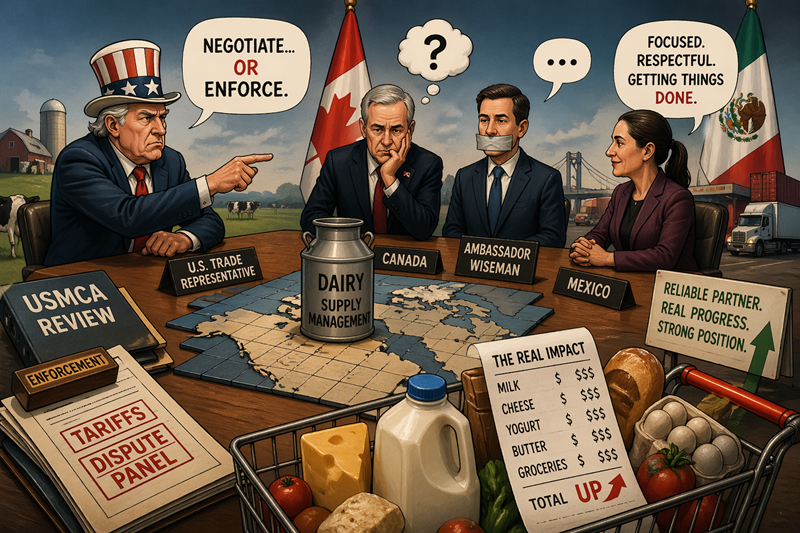
For reasons unknown, Canadian politicians both left and right have been willing to sacrifice almost anything in trade negotiations except the cosy protectionist scheme we call “supply management”, which enriches a tiny number of farmers in Ontario and Quebec by keeping grocery prices significantly higher than the free market price. On his Substack, The Food Professor predicts that Prime Minister Carney will be forced to give up this market-rigging, anti-consumer scheme in the coming year:
As we enter 2026, several forces are converging to reshape Canada’s food economy. Consumer empowerment — amplified by social media — continues to accelerate, while geopolitics, particularly tensions with our southern neighbour, are becoming increasingly disruptive. Together, these dynamics will push food policy issues that once lived in technical silos into the public spotlight.
At the top of that list sits CUSMA and supply management. Prime Minister Carney has signaled firmness on market access, backed by legislation that shields supply management from parliamentary debate. That protection, however, is unlikely to endure. Even if the United States has little genuine interest in exporting more dairy to Canada — and even if Canadian consumers show limited appetite for it — President Trump now understands, far better than during his first term, that supply management is a potent political wedge. The system protects roughly 9,400 dairy farmers who exert disproportionate influence over agricultural policy, while compensation payments continue to flow without any meaningful reduction in production or market share. For a growing number of Canadians, this arrangement increasingly resembles a closed loop rather than a public good. The irony is that global demand for dairy is rising and Canadian milk should be part of that growth story. Instead, the system prioritizes insulation over ambition — a missed opportunity at a time when competitiveness should matter most.
January 1 also marks the formal implementation of new front-of-package nutrition labels. Although these symbols have been appearing on shelves for some time, many consumers either overlook them or misunderstand their purpose. Their real impact has been largely invisible to the public: they have already reshaped how food companies formulate products, invest in research, and redesign portfolios. Whether the labels meaningfully change consumer behaviour remains debatable, but their influence on product development is no longer.
[…]
Finally, 2026 coincides with the United Nations’ International Year of Rangelands and Pastoralists — a timely moment to reset the debate around meat consumption and livestock production. Rangelands underpin global meat systems by converting grasslands — often unsuitable for crops — into high-quality protein. In a world where demand for animal protein continues to grow, portraying livestock as inherently incompatible with sustainability ignores nutritional, economic, and ecological realities. Well-managed grazing supports rural livelihoods, strengthens export economies, and can enhance biodiversity and soil health rather than undermine them. If policymakers are serious about food security, climate resilience, and affordability, 2026 should mark a shift away from apologizing for meat production and toward recognizing livestock as a strategic pillar of resilient food systems — not a sector to be regulated out of existence
December 28, 2025
It may seem petty to deny entry to EUrocrats, but it’s all they will understand
At first, I thought it was just another bout of Trump being deliberately petty over trivial stuff, but on reflection, it’s actually a neat way to bring home the message to the EU bureaucrats personally that they will be held responsible for their actions:
RE: Free Speech & Denying Visas to Euro Autocrats
The very most Orwellian mind game happening in the world today is the way authoritarian globalists are attempting to redefine the concept of “free speech”.
In America, “free speech” has long meant that we are free to say or write virtually anything without fear of government intervention or suppression. It is this ability to express whatever we want that makes it “free”.
The authoritarian globalists, however, have stood this on its head. They have decided that in order for their citizens to be “free”, they must be free of ever hearing or reading any speech that might offend someone or sow doubt as to government policies. To these fascists, “free speech” means GOVERNMENT MODERATED speech which somehow — through its moderation — sets people “free” from ever hearing conflicting views. As I said — straight out of Orwell.
Europe is, of course, the hotbed of this fascist redefinition of what free speech means, but we in America have only narrowly escaped this plague by electing Trump. Remember, Biden and his team were reliant on institutionally stamping out so-called “disinformation” as a means of control over the populace. We must be ever vigilant here in the USA that such thuggish government criminality never again be allowed to prosper.
I think it is very important that every citizen of the USA and the world understand the depths of depravity these people will sink to in order to control ordinary people. This is about mind control, and nothing else.
Ultimately, the value of true free speech is that it embraces the idea that we all have agency over ourselves; that we are free individuals who can and should hear conflicting views, and decide for ourselves what is true and just, and what is untrue and unjust. This is sovereignty over the self, and unfortunately Europe has never let go of the concept of serfdom, so self-sovereignty is a threat that must be stamped out.
The Trump Administration has been prescient, bold and effective in denying visas to the Eurotrash autocrats who would see free speech reduced to whatever speech unelected bureaucrats deem acceptable. I cannot commend Trump enough for the thoughtfulness and importance of that action.
In a world where almost all humans are linked by essentially the same communications platform, only one world leader is truly standing for free speech: Donald Trump. And I thank him for it. We all should — even the TDS sufferers.
For a relevant example, Dries Van Langenhove:
Update, 29 December: Welcome, Instapundit readers! Please do have a look around at some of my other posts you may find of interest. I send out a daily summary of posts here through my Substack – https://substack.com/@nicholasrusson that you can subscribe to if you’d like to be informed of new posts in the future.