On the social media site formerly known as Twitter, Martin Varsavsky illustrates the real situation in Argentina after Javier Milei was elected as opposed to the dystopian nightmare imagined by the western media:
After more than two years of Milei, the international press still does not understand what is happening in Argentina.
The narrative abroad is “shock therapy, social pain, fragile coalition”. That frame misses the actual mechanism. Argentina did not have a budget problem. It had a printing problem. From 2003 to 2023 the central bank financed deficit after deficit until the peso lost 99 percent of its value against the dollar. Annual inflation hit 211 percent in 2023. Half the country was poor. That was the floor.
What changed is not vibes. It is arithmetic. The fiscal deficit was eliminated for the first time in 16 years. Monthly inflation fell from 25 percent to low single digits. The central bank stopped printing to fund the Treasury. Country risk dropped from over 2,500 basis points to a fraction of that. Argentine sovereign debt, which used to trade like a default option, began behaving like normal emerging market paper.
Critics say poverty rose. It did, briefly, because removing price controls and subsidies revealed the real prices of energy, transport and food that the state had been hiding with debt. Once measured honestly, poverty has been falling fast. Real wages are recovering. Mortgages in pesos are reappearing, something that had not been possible in a generation.
This matters beyond Argentina. It is the clearest live experiment in whether a developed-style economy can be rebuilt by pulling the state out of places it never belonged. Spain, Italy and France should be paying attention. A country does not get poor because it lacks resources. It gets poor because its political class learned to live off printing money and calling it social policy.
Argentina spent 80 years proving that. It is now spending two years proving the opposite.
First off, “morality” doesn’t have jack shit to do with taxation. You pay what you legally owe. Nobody willingly pays the government more than they legally owe.
This has always been this way since America has had income taxes. There is endless court precedent. You pay what you legally owe. That’s it. If you pay less than you legally owe, then the government will fine or imprison you. If you pay more than you legal owe, the government will laugh and laugh, because you are an idiot, and you deserve to be poor.
Every single person who barks about how somebody else should be paying more? They themselves are paying the minimum they can get away with. As they should. As should you.
I remember when I was taking my first tax class back in college. This class was all accounting majors by this point. At the beginning of the semester the professor (who’d had a long career as a tax guy) gave us an imaginary family as our clients and had us do their taxes. One kid didn’t take advantage of all the obvious deductions for his clients. When the professor asked why, the kid said some mushy thing about how he didn’t think it was FAIR to keep that money from the government … Holy shit. The professor ripped this kid a new asshole. HOW DARE YOU!?! IT IS NOT THE GOVERNMENT’S MONEY! IT IS YOUR CLIENT’S MONEY. YOU OWE THEM YOUR BEST! IT IS YOUR SACRED DUTY TO SAVE THEIR MONEY! YOU DISGUST ME AND YOU SHOULD NEVER BE A CPA!
That class was one of my favorites.
Basically, you pay what you owe, no more, and anyone who claims otherwise is full of shit.
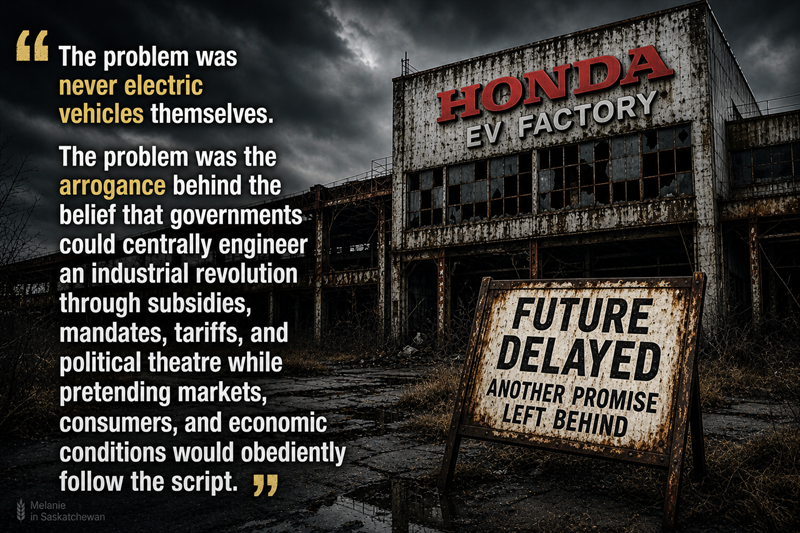
As part of their mindless fanboyism for anything remotely related to “Net Zero”, the federal government and the Ontario provincial government have been serving up subsidies for electric vehicles and hastening the “inevitable transition” away from internal combustion vehicles. Through legislation and regulation, they’ve been doing everything they can to close down the traditional car and truck manufacturing sector and replace them with zero emission vehicles. The various governments have handed out subsidies amounting to billions, and yet one after another after another the much ballyhoo’d EV factories, battery plants, and other futuristic projects fall by the wayside, leaving very little in exchange for those billions:
There was a time, not very long ago, when Liberal politicians treated EV battery announcements like moon landings.
Hard hats. Safety glasses. Giant ceremonial cheques. Breathless speeches about “the future”. Every battery plant was “historic”. Every subsidy package was “transformational”. Every corporate press conference looked like a motivational seminar for people who think buzzwords are infrastructure.
All we were missing was a fog machine and Bono.
Meanwhile ordinary Canadians were standing in grocery aisles doing mental math over bacon prices, delaying dental work, and wondering whether they could survive another winter utility bill without sacrificing whatever scraps remained of their savings.
But while Canadians were trying to keep their heads above water, Ottawa was busy launching one of the most expensive industrial subsidy experiments in modern Canadian history.
AI-generated image from Melanie in Saskatchewan
The Honda EV project in Ontario was supposed to be one of the crown jewels of this brave new green economy. Politicians lined up in hard hats and safety glasses like a traveling theatre troupe performing The Future Is Here. Canadians were assured this was proof the country was becoming an EV superpower.
Turns out it may have been more of a very expensive PowerPoint presentation with taxpayer financing attached.
[…]
In March 2020, Prime Minister Justin Trudeau appointed Mark Carney as an informal economic adviser during the COVID recovery period. Over the following years, Carney increasingly promoted “green transition” investment frameworks, climate-linked financial systems, ESG-focused economic planning, and massive public-private investment partnerships tied to decarbonization strategies.
Which is important context now, because the EV subsidy era did not emerge out of thin air. It grew out of a broader worldview that treated government-directed green investment as both economic policy and moral mission. The assumption underneath all of this was breathtakingly simple:
“If government wants it badly enough, reality will cooperate.”
That is usually where things begin going sideways.
Canadians were told the EV transition was inevitable. Questions about affordability, charging infrastructure, winter range, electrical grid capacity, or consumer demand were often brushed aside like annoying little details raised by peasants who simply lacked sufficient enlightenment.
Then came the subsidy gold rush.
[…]
Corporations are not charities. They are not loyal patriots. They are not emotionally attached to government slogans.
They follow incentives. They chase profitability. They change direction when conditions change.
That is exactly what Honda did.
Meanwhile Canadians are left holding the bill for another “historic transformation” that produced:
endless announcements
glossy photo ops
consultant buzzwords
government self-congratulation
escalating subsidy exposure
and corporate renegotiations every time market conditions shifted
while producing no completed Honda EV manufacturing hub and no fleet of Canadian-built EVs rolling proudly off Ontario assembly lines.
What remains instead is a stalled megaproject, a confused tariff policy, a government spinning contradictory narratives depending on the week, and taxpayers once again discovering they were voluntold into becoming venture capitalists for political vanity projects.
Apparently this is what “economic leadership” looks like now.
Hard hats. Press releases. Fifty-plus billion dollars in EV-related exposure. And a factory plan slowly evaporating into the mist while Chinese EVs roll through the front gate anyway.
Comments Off on Great success! Honda “postpones” their Ontario EV project
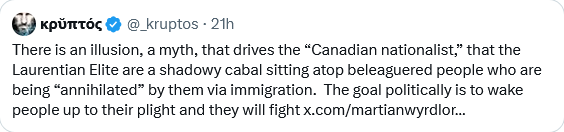
Canada before Confederation was largely run by the Family Compact, an informal oligarchy of wealthy and influential families who had a virtual monopoly on social advancement, political appointments, and the justice system. As kids we were all told in school that this all withered away and now we live in a wonderfully meritocratic society (that’s also a genocidal racist, sexist, homophobic, transphobic dystopia, but those are later lessons after the land acknowledgements). They didn’t fade away, of course, and the behind-the-scenes power brokers are still there, still wielding informal but widespread control over the government and the economy. We just call them the Laurentian Elite, so that’s totally different than the bad old Family Compact, eh?
The Laurentians very effectively keep themselves out of the public eye. Most Canadians don’t even know this class exists. So, they are in that sense a shadowy cabal.
Of course Canadians want prosperity and whatever. Everyone does. Of course they think this is the purpose of the government. Of course the government’s messaging is largely around economics.
The government’s actual activities, however, are immensely economically destructive. This is because of their religious fanaticism. Canadians believe in “peace, order, and good government”. The Laurentians believe in multiculturalism, mass immigration, gender woo, and climate change. They just lie about these things being good for the economy. It’s now obvious that they are very bad for the economy, and yet, they continue, so.
The gimmigration restrictions are a joke. The government is continuing to hand out PRs and passports like Halloween candy, and turd worlders are continuing to grab them like the black kids who think the whole basket is all just for them. It is allowing TFWs to flood the asylum system, which it uses as a back door to keep them in the country. The numbers they publish are a bullshit accounting game, but even if they’re to be believed, letting in hundreds of thousands of new PRs every year isn’t a reduction from anything but the truly insane spike in 2022-24.
The housing market is fucked, yes, but I’m skeptical this is because immigration has been “reduced”. It’s more likely that a decade of zero economic growth, rapid inflation, even more rapid asset inflation, shit jobs, and high taxes means that no one can afford the overpriced housing, so no one buys it. The shoebox condos they threw up all over Toronto are a contributing factor: no one wants to spend $500,000 on a 500 square foot condo, so no one does. Investors can’t afford to sell for less, so they sit on them. Developers look at tens of thousands of units of unsold inventory, and refuse to start new projects. Whole system is seized up because of many years of malinvestment, not because the government has meaningfully reduced the invasion.
You say that Canadians will go back to Laurentian rule once the excesses are curbed. That presumes Laurentian rule slackened for even a moment, and that the Laurentians have any intention of curbing their excesses. Neither of these are true. They are doubling down on everything. Destroying Canada — as one element in the destruction of Western civilization — is a religious imperative for them. Nor was their power ever threatened, because it is propped up by brainwashed parasitic client groups — boomers, women, immigrants — that now comprise the bulk of the country.
The “pivot” was about two weeks of campaign rhetoric, during which a fast-talking globalist banker gave the boomers a reach-around about “British and French heritage”, which dazzled the affection-starved senile coots because it was the first time they’d heard something nice about themselves in a generation. Since then there’s been no rollback in DEI. No rollback in gender woo. No rollback in net zero. No rollback in Internet censorship. To the contrary, it has been full steam ahead on every single one of their hateful programs.
No revolution? You’re probably right, although the Freedom Convoy suggests that there are possibilities. Nevertheless the most likely scenario is that Canada devolves into Argentina Del Norte, its bones picked by vultures posing as patriots, kept in power by the most mind-raped boomers on planet Earth.
I do not think this is a good thing, obviously. I love my country very much. I suppose the reason for my vehemence on this matter is that I do not see any future for Canada with the Laurentians remaining in charge. We cannot work with them. They aren’t going to change. They aren’t going to slow down. They need to be removed, prosecuted for high treason, their assets seized, their oligopolies nationalized, and many of them sent to the gallows. Absent this, Canada is doomed.
Comments Off on Pay no attention to the Laurentian Elite behind the curtain!
On his Substack, Christopher Snowden explains how “public health” is just another of the many, many anti-capitalist branches of progressive belief:
Some people don’t really want to solve problems. They want to change the world for other reasons. That was the argument I made in Not Invented Here last year, a multi-author IEA publication that essentially elaborated on this meme …
One example is obesity, which we are told can only be tackled by fundamentally changing the food environment, banning advertising, taxing more products and demonising “Big Food”. None of this has ever actually worked anywhere. We do, however, now have GLP-1 drugs that work wonders for many people.
Plenty of “public health” academics are notably resistant to “fat jabs” because what they really want is to fundamentally change the food environment, ban advertising, tax more products and demonise “Big Food”.
Take this article from three self-described “public health scholars” in JAMA Health Forum, for example. They object to obesity being framed as a “a disease requiring individual treatment” because, they say, it undermines public support for government action. They even complain that “medical societies consistently argue that we do need to both prevent and treat obesity” because treatment — i.e. losing weight — is something that individuals can do for themselves. Moreover, studies have shown that when the public hear about people losing weight on their own initiative, they are less likely to support population-wide policies such as food taxation.
Broadcasting a “we need to do both” message, it turns out, is a counterproductive communications strategy for addressing the obesity epidemic. Studies message-testing obesity narratives find that public support for government action is highest when obesity is framed as the result of food industry manipulation and addresses toxic food environments.
The authors don’t seem particularly interested in whether this narrative is true. The main thing is that it can “build support for addressing upstream drivers of the obesity epidemic”. They conclude that medical professionals should stop talking about GLP-1 drugs in public and bang on about “BiG fOoD” instead.
While we acknowledge that public and media discourse often expect clinicians to comment on treatment efficacy and emergent therapies, in an ideal world, the medical community would move discussions about GLP-1 drugs targeting causes of individual cases in-house, while using its credibility and authority publicly to amplify much needed political discussions about the root causes of increasing obesity incidence.
This messaging should include concrete policy proposals targeting unhealthy food environments shifting the debate toward the structural causes of the obesity epidemic, such as World Health Organization–recommended sugar taxes and other policies that would effectively reverse the rise in ultraprocessed food production, marketing, and consumption and, importantly, the corporate power that has so far prevented governments from enacting these policies.
You can see why they are worried about fat jabs. The drugs work by giving people artificial willpower and prove that if obese people simply eat less food they will stop being obese. It has nothing to do with advertising, price, availability or “corporate power”.
From the perspective of the authors, these drugs are a threat, but what exactly is their perspective? The first author, Luc Hagenaars, has written a lot about sugar taxes which he compiled for his PhD thesis. He also worked at the Dutch Ministry of Health in the early 2020s when the Netherlands was undergoing its anti-liberal counter-revolution. Last year, he wrote an article titled “The Ozempic Era Could Shift Blame for Obesity From Individuals to Commercial Food Systems” which made exactly the opposite argument to the one he is making here.
Update, 8 May: Welcome, Instapundit readers! Have a look around at some of my other posts you may find of interest. I send out a daily summary of posts here through my Substack – https://substack.com/@nicholasrusson that you can subscribe to if you’d like to be informed of new posts in the future.
I’ve heard many people praise Seattle as a great place to live with lots of amenities and a fantastic setting. Like a lot of places with those kinds of attractions, it also has a political scene that leans strongly to the left, as Mayor Katie Wilson recently highlighted:
Seattle’s socialist Mayor Katie Wilson has a message for prosperous people leaving Washington over the state’s soaring tax burden. “Bye!” she says with a laugh, to cheers from a largely progressive audience. Entrepreneurs and investors will certainly take that comment into account as they consider where to live and do business. We can be sure of that fact because recent research further supports the commonsense idea that people often leave high-tax states in search of lower tax bills.
Goodbye, Wealthy People!
Wilson’s comments came during an April 16 discussion about “The New Progressives” as part of Seattle University’s Conversations series. Wilson and King County Executive Girmay Zahilay fielded a series of questions by host Joni Balter and graduate student Ari Winter.
Asked about major companies leaving or threatening to leave over Seattle’s and Washington’s escalating tax burden, Zahilay acknowledged that “everything is a tradeoff” and “of course I think taxes can make companies make decisions about staying or leaving”. You wouldn’t necessarily want to live under his policies, but he sounds like he understands that his decisions may drive people out and impose costs on the community.
Wilson, a self-described “socialist“, was presented with a follow-up question by Winter. She was asked, “do you still think progressive taxes are an easy and promising solution?”
Wilson responded that it was “very, very exciting to see the billionaire tax pass the legislature” and described her history of advocating for higher taxes. She then cut to the heart of her response.
“I think the claims that millionaires are going to leave our state are, like, super overblown. And if, you know, the ones that leave, like, bye!” she said with a wave and a snicker. The audience at the university event joined in with whoops and applause.
Wilson may want to practice her goodbyes. Fisher Investments moved from Washington to Texas to escape a new capital gains tax. Starbucks is building a corporate hub in Tennessee and moving jobs there, largely over tax concerns. Billionaire Jeff Bezos fled the state for Florida, also motivated by taxes.
“Jeff Bezos sold about $15 billion in stocks before the new law took effect, potentially saving over $1 billion in taxes”, the Washington Policy Center’s Chris Corry noted. “Moving his primary residency to Florida would ensure that any future stock sales would not be subject to the excise tax.”
In The Critic, John Wills explains that public housing organizations, like any organization with perverse incentives, will never solve the problem of providing enough housing for those who cannot afford it:
Homes Fit for Heroes – Dagenham “These are typical examples of the housing on the Becontree Estate. Initially 25000 homes were built by the London County Council between 1921 and 1934. These homes fit for the heroes of WW1 had all mod cons gas, water and electricity with inside toilets and bathrooms. A further 2000 homes were built before WW2. The Becontree estate was the biggest council estate in the world.” Image and description from geograph.uk. Photo by Glyn Baker – CC BY SA 2.0
There is a moment, familiar to anyone who has spent serious time inside a housing association, when the institutional logic becomes impossible to ignore.
Perhaps you are sitting in a meeting, reviewing the organisation’s performance: voids are down, rent arrears are within tolerance, development pipeline is healthy and the regulator is satisfied. By every measure the sector uses to evaluate itself, things are going well.
Outside the window, however, the waiting list has not reduced. The families in temporary accommodation are the same families (or families very much like them), who were there five years ago. In short, the problem the organisation was created to solve is precisely as large as it was when the meeting began.
Despite these demonstrable facts, nobody in the meeting thinks this is strange. Nobody considers the organisation a failure. The metrics are, after all, fine.
I spent a decade working at a senior level in housing associations. I left as I became disillusioned with a model that has evolved to measure everything except the thing that matters.
The founding logic was sound enough: postwar Britain faced a housing crisis that was specific, urgent and — crucially — finite. Tens of thousands of homes had been destroyed or damaged, men had died in enormous numbers, and a baby boom was placing acute pressure on stock that was already inadequate before the war started. Social Housing was therefore a rational response to a bounded problem: build homes, house people and alleviate a crisis that would, in time and as a result of the initial centralised effort, resolve itself. You might also apply the same logic to slum clearance a decade later: deplorable housing stock needed replacing, and the state needed a mechanism to do it. The model remained defensible so long as everyone understood that success meant crossing a defined finish line.
However, nobody thought to define that finish line. The problem here is that once you remove the time horizon from an organisation tasked with solving a problem, the organisation’s survival becomes contingent on the problem’s persistence, not its resolution. This is not a conspiracy and it requires no bad actors, nor even a conscious decision to perpetuate matters. It is simply what institutions do when the incentives are wrong. As a thought-experiment, imagine that the eradication of smallpox had been incentivised not by the goal of total global elimination, but instead by vaccines administered, clinics built or healthcare workers employed. What would the probability be of us continuing to battle smallpox into the 21st Century? I cannot be certain, but suspect it would be considerably higher than nil.
The regulatory framework for social housing has compounded the error rather than correcting it. Regulators, quite reasonably, dislike hoarded capital. A registered social landlord (RSL) sitting on large reserves and doing nothing with them is, from a regulator’s perspective, a problem to be solved. The solution the sector has converged on is growth — more stock acquired, more homes built, larger balance sheets, bigger organisations and more services and people employed to deliver them. The key metric of a healthy RSL is therefore its size: which is to say, the scale of the problem it exists to address. (To test this proposition, ask someone in housing to describe their organisation. The chances are the first words out of their mouth will be the number of homes they manage). An organisation genuinely succeeding in its mission — one that is housing fewer people because fewer people in its area of operations need housing — under the current framework would look like a failure. It would be encouraged to merge with a larger, more “successful” neighbour, which is to say one that has accumulated more evidence of unresolved housing need.
Comments Off on Public housing perpetuates the poverty it was supposed to cure
World War Two and Spartacus Olsson
Published 2 May 2026
In Q2 1936, Adolf Hitler consolidated power after the Rhineland gamble, tightening the machinery of dictatorship while projecting strength abroad. As Hermann Göring took control of Germany’s economic lifelines and Heinrich Himmler centralized the police, the regime accelerated its transformation into a fully integrated police state.
Behind Olympic pageantry and propaganda triumphs like Max Schmeling’s victory, the Nazi system deepened repression. Courts enforced the Nuremberg Laws with chilling logic, reducing Jewish citizens to a state of “civil death”, while Joseph Goebbels expanded total control over media and public discourse.
At the same time, Germany’s economy bent further toward war, with dwindling foreign reserves and rising dependence on autarky. Yet domestically, resistance remained minimal as propaganda, fear, and perceived stability drove growing public support.
Globally, the quarter exposed the weakness of the League of Nations during Italy’s conquest of Abyssinia, saw Léon Blum’s rise in France, and witnessed the outbreak of the Arab Revolt in Palestine — signs of a world drifting toward instability.
This episode examines how dictatorship consolidates not just through terror, but through law, economics, and consent — and why, by mid-1936, meaningful resistance inside Germany had largely vanished.
Comments Off on How to Declare a Live Person Legally Dead – Death of Democracy 14 – Q2 1936
The German Chancellor’s future looks unhappy, and eugyppius notes that even the lapdog mainstream media outlets who praised him last year are now publishing calls for his ouster:
German Chancellor Friedrich Merz, 5 May 2025. Photo by Sandro Halank for Wikimedia Commons.
Merz has always been just some loser. He’s a third-rate talentless politician and in this much like his predecessor, Olaf Scholz. Both are mere caricatures, what happens when you mimeograph overmuch the last century’s tired political styles. These kinds of chancellors will continue to exist only so long as they can be sold to the geezers of the Federal Republic’s care homes by the amateurish marketing campaigns of a complicit state media as the incarnation of far-sighted competence and (more importantly) bourgeois respectability.
Early in 2025, Merz had the chance to seize a measure of power for himself and make facts. He could have forged a deal with Alternative für Deutschland on the most important questions, established a minority government and set about force-marching the obese German state through necessary reforms. It might’ve torn his party apart, he might’ve failed, there would’ve been a huge fight, but whatever happened nobody would ever forget Chancellor Merz. Instead, the Pigeon Chancellor let a lot of deranged Antifa street protesters and screeching women with parareligious concerns about atmospheric carbon dioxide concentrations dissuade him from the only reasonable path. Instead of making history, he chose to spend the first year of his chancellorship making the Social Democrats fat and happy at the expense of the nation. Most don’t even hate Merz, because hate like love has to be be earned. He inspires nothing more than mildly scornful indifference.
Everyone who was not a complete idiot knew that Merz’s mad coalition with the Social Democrats could never work. Yet the man has been lionised in the international press and even in centre-right domestic papers like the Frankfurter Allgemeine Zeitung as a serious reformer. These people told us Merz would rebuild the Bundeswehr, reduce insane social spending, impose fiscal discipline, solve the migroid problem and restore economic growth. Even if the leftoid half of the German establishment press didn’t embrace all these myths, they nevertheless worked hard to make Merz seem presentable, serious and viable. He was worth a shot, he would do his best, and after the crazy Scholz years Germany was back on solid footing.
Now, in the the space of about two weeks, the entire myth of Chancellor Merz has collapsed. Major papers that used to defend his government and praise his prospects are suddenly saying it’s over. They’re writing front-page editorials in the spirit of stuff I was posting here over a year ago. Merz appears at town-hall meetings where he gets asked how he’s made life better in Germany and before he can answer the audience just laughs at his stupid ass. His coalition partners say he’s doing a terrible job. Back-benchers from his own party are calling his political strategy a failure to his face and leaking it afterwards to the press so everyone knows what they said.
Still worse, people from the Chancellery are talking to the tabloids. They’re explaining that Merz’s government has been hanging by a thread since at least last December; that his party thinks he’s a pushover whom the SPD constantly manipulates; that often Merz just absorbs the opinions of whatever person he last talked to and so his handlers have to limit his contacts to keep him from going off-message in insane ways; that Merz is now almost totally isolated, having burned through most of his close confidants; and that nobody has any solutions or ideas and increasingly everybody doubts that the Chancellor has the talents to save himself.
At The Conservative Woman, Bepi Pezzulli outlines a few ways that the Spanish government is moving in quite different directions than their NATO allies and fellow EU members:
Torre del Oro (Tower of Gold) – Calle Almirante Lobo, Seville – Spanish flag” by ell brown is licensed under CC BY-SA 2.0 .
Spain’s Prime Minister Pedro Sánchez wants the privileges of alliance without the duties of one. Madrid remains in Nato, hosts critical American military infrastructure, and speaks the language of Atlantic solidarity – but only when convenient. On the central strategic questions of the age – Russia, Israel, and the wider Western posture in the Mediterranean – it increasingly behaves like a spoiler. What is troubling is that Spain is not merely posturing: it is rewriting its entire conception of statecraft, treating alliance as a shield, hostility as leverage, and strategic ambiguity as a governing doctrine.
When Washington needed alignment, Sánchez offered obstruction. When Israel faced existential war, Madrid offered moral lectures. When the West sought energy discipline against Moscow, Spain found room for Russian gas. All while preserving the old imperial obsession with Gibraltar and extracting advantages from London over the Rock.
Spain has discovered the pleasures of consequence-free hostility. That needs to end.
Anti-Americanism with diplomatic immunity
Sánchez has carefully cultivated the old European left’s anti-American reflexes: Nato when subsidised, moral neutrality when sacrifice is required. His government publicly resisted support for American military operations linked to Iran escalation and signalled clear reluctance to facilitate use of Spanish bases such as Rota and Morón for operations that might implicate Madrid politically. The message was unmistakable: American security guarantees are welcome but strategic co-operation is negotiable. The rhetoric matched the policy. “No to war” was not merely a slogan for domestic consumption. Sánchez is deliberately positioning Spain as the righteous dissenter against Washington’s harder strategic line.
At the same time, Spain maintained substantial imports of Russian gas well into the European sanctions era. While pipeline politics consumed Brussels, Madrid benefited from a convenient moral distinction: condemning Moscow loudly while continuing commercial accommodation where useful. The formal sanctions architecture left open some loopholes, and Spain was happy to live inside them.
An ally that profits from ambiguity while others bear the strategic burden is not an ally in the full sense. As US War Secretary Pete Hegseth noted, “An alliance cannot be ironclad if in reality or perception it is seen as one-sided”.
From criticism of Israel to open diplomatic hostility
On Israel, Sánchez has moved beyond criticism into active diplomatic confrontation. Recognition of Palestine was presented as humanitarian principle. In practice, it rewarded maximalism at the worst possible moment. Madrid helped transform October 7 from a terrorist massacre demanding strategic clarity into another European seminar on Israeli restraint. Spain became one of the loudest governmental amplifiers of the anti-Zionist campaign in Western Europe. Ministers normalised rhetoric that blurred the distinction between criticism of Israeli policy and systematic delegitimisation of the Jewish state itself. Arms restrictions followed. Then diplomatic actions. Symbolism became policy.
Gibraltar: Madrid’s imperial nostalgia
Spain’s sanctimony would be easier to tolerate if it were not paired with its own colonial fixation. For decades, Madrid has pursued sovereignty claims over Gibraltar with theological persistence. Brexit offered a fresh opening. With Brussels behind it, Spain extracted a remarkably favourable negotiating posture over the future relationship of the Rock with both the European Union and the United Kingdom. London, in the hands of the most Europhile government in recent history, conceded far more than many British voters imagined when they heard the word “sovereignty”. Spain never abandoned the long game. It simply learned to play it through institutions until a weaker opponent appeared. Madrid insists Gibraltar is unfinished history. Fair enough: is it not time then to conclude the same about Ceuta and Melilla?
The prime fact of human nature which the wise statesman must take into account is that men will exert themselves for their own benefit, or for that of their families, regarded as an extension of themselves, as they will exert themselves for no one else; and, in particular, men are not prepared to work for the state or for any other collectivity as they will work for themselves or for their families … If it is made impossible for him to advance himself or his family by his exertions, the average man will cease to exert himself. No motive comparable in its effects … has yet been known in the history of the human race … Because socialism expects the average man to exert himself for the state as he would for himself, … the socialist is doomed to disappointment when he comes to put his ideas into practice.
On his Substack, Brian Lilley points out another glaring inconsistency between Prime Minister Mark Carney’s rah-rah pro-Canadian rhetoric and his anti-Canadian actions:
This story should outrage everyone, regardless of political stripe.
But considering the positions taken by progressive Liberals in this country concerning Donald Trump, it should really outrage them. Sadly, like with Trudeau or whichever politician people seem to support these days, Carney’s backers won’t see the error of his ways.
When I was a young army cadet, the first person I would see checking into the James Street Armouries in Hamilton — now known as the John Weir Foote Armoury after a ceremony I was part of in 1990 — well, the first person I would see would be the Commissionaire. Back in the mid-80s these were mostly people who were veterans of the Korean War or our peacekeeping missions who were now charged with providing security at federal buildings.
Founded in 1925 to give meaningful employment to veterans of the First World War, the Corps of Commissionaires has been providing security services at federal buildings, and others, for just over 100 years. Since shortly after the Second World War, the Commissionaires have had a special relationship with the federal government when it comes to providing security.
Just recently, the Carney government — the Elbows Up and Canada Strong folks — ended the arrangement that gave the Commissionaires first right of refusal on security at federal department buildings. They ended the agreement with the not-for-profit organization that is still the biggest employer of veterans in the country at the behest of a global company scooping up security contracts from the Trump admin including ICE detention centres like Alligator Alcatraz.
You can love Trump or hate him but don’t tell me you are Elbows Up, that we are experiencing a rupture, that the old relationship is over, that being close to the Americans is dangerous and then do this.
I detailed it all in my latest column for the Toronto Sun including who was behind this, how it went down, and why it is outrageous.
The Canadian Corps of Commissionaires was eventually founded in 1925, specifically to employ Canadian veterans of the First World War. We were initially established in Montreal, then Toronto and Vancouver, to look after these men and women and provide them with transitional and permanent jobs, primarily in the security field. The Right Honourable John Buchan, Governor General of Canada, became the Corps’ first patron in 1937. Viceregal patronage has been an 81-year tradition since then.
In the early years, we mostly provided guarding services for government institutions. From 1925 to 1948, Commissionaires expanded throughout Canada.
In 1950, with the opening of the St. John’s, Newfoundland division, Commissionaires was operating services from coast to coast.
By 1982, Commissionaires exceeded 10,000 employees.
Comments Off on Carney elbows out Canadian veterans to support an American company
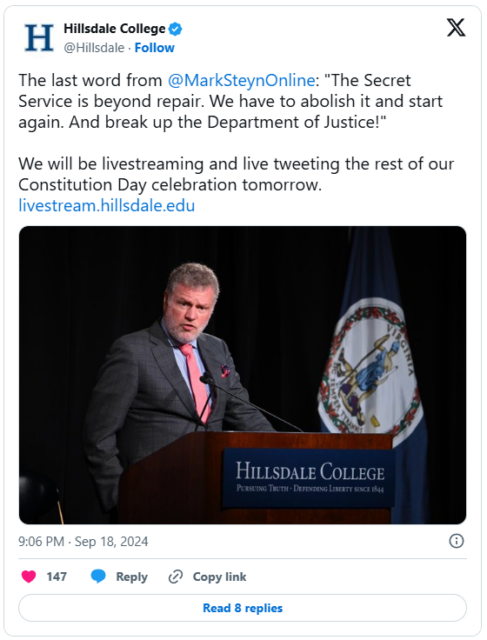
I haven’t been following the latest attempt to assassinate the President, but Mark Steyn apparently has been (even though he’s touring Ukraine at the moment):
By contrast Washington is ever more like Churchill’s riddle wrapped in a mystery inside an enigma. My conscience is clear. Almost two years ago, it was perfectly obvious to anyone who examined the facts on the ground in Butler, Pennsylvania that the United States Secret Service had an institutionalised level of incompetence and/or malevolence that was assisting those many persons anxious to kill Trump to do so. Even as mere incompetence, it is murderously so: Corey Comperatore is dead, and everyone in Butler and DC who enabled his death still has a job.
So immediately afterwards I stated the obvious:
Instead, the 47th President promoted the chap in charge in Butler that day to head of the entire Secret Service: one Sean Curran. And, on Saturday night, Mr Curran allowed the same thing that happened at Butler to happen all over again. On the incompetence front, look again at the would-be assassin breaching security with his brilliant cunning plan, requiring months of painstaking training and preparation and attention to detail, of simply running through the checkpoint:
The chaps at Kharkiv railway station are more alert than those guys. Yet setting aside the under-performance of the individual agents — close enough for government work, it seems — this ingenious manoeuvre became a critical issue mainly because, exactly as at Butler, the Secret Service had taken the decision to shrink the perimeter of the “secure zone”. In Islamabad the other day, the Pakistanis were hopeful that Vance and the Iranians would be jetting in for another round of face-to-face negotiations. So they took the precaution of ordering all the other guests out of the designated hotel: the Tehran delegation, in particular, is concerned that Netanyahu will off them while they’re in town by having Mr Moshe Wetwork check in to the junior suite on the fifth floor.
No such worries at the grisly Washington Hilton — even though half the country would be cheering on Mr Wetwork. On ABC TV, Jimmy Kimmel threw a Thursday-night “alternative” White House Correspondents Dinner at which he saluted the First Lady:
You have the glow of an expectant widow.
I have never knowingly watched Jimmy Kimmel or Jimmy Fallon or Jimmy Colbert, whichever is which. But I’m old enough to remember when Johnny Carson in 1981 told Nancy Reagan and indeed when Steve Allen in 1901 told Ida McKinley that they had the glow of expectant widows.
Oh, wait, no. Neither Johnny nor Steve did that. Because, back in 1981 and 1901, America still had sufficient of what the late Roger Scruton called the “pre-political we” to recognise that assassination fantasies are not helpful to a functioning polity.
Alas, the role that in other western nations has to be outsourced to Muslim rape gangs and low-IQ child-stabbers and sundry novelty demographics is in America performed by showbiz bigshots, NPR ladies d’un certain âge, and pajama boys with a quarter mil in college debt.
That, however, is a given. What ought not to be a given is that the Secret Service is on their side. At Butler, Mr Curran and his colleagues shrunk the perimeter so that it excluded an easily accessible roof with a clear line to Trump’s head. At the Washington Hilton, Mr Curran and his colleagues shrunk the perimeter to the event room and its immediate approach. In the usual tedious “manifesto”, the would-be killer nevertheless noted that the security was so “insanely” bad they must be “pranking” him:
What the hell is the Secret Service doing..?
Like, I expected security cameras at every bend, bugged hotel rooms, armed agents every 10 feet, metal detectors out the wazoo.
What I got (who knows, maybe they’re pranking me!) is nothing.
No damn security.
Not in transport.
Not in the hotel.
Not in the event.
Like, the one thing that I immediately noticed walking into the hotel is the sense of arrogance. I walk in with multiple weapons and not a single person there considers the possibility that I could be a threat.
The security at the event is all outside, focused on protestors and current arrivals, because apparently no one thought about what happens if someone checks in the day before.
Like, this level of incompetence is insane, and I very sincerely hope it’s corrected by the time this country gets actually competent leadership again.
Like, if I was an Iranian agent, instead of an American citizen, I could have brought a damn Ma Deuce in here and no one would have noticed shit.
Actually insane.
So, once he’d run through the security line, he was able to get into the same men’s room that the entire cabinet had to use. Had RFK or Pete Hegseth felt the urge before settling in for a night of long speeches, the headlines this weekend would have been very different. Half the presidential line of succession was in there. That’s what the geopolitical types call, if you remember, a “decapitation strategy”. Except you don’t need a bunker buster, just some California doofus willing to take a run at the checkpoint — and bingo, whoever the Secretary of the Interior is winds up like some z-list ayatollah.
On a lighter note, Daniel Jupp imagines what Trump-haters might be thinking in the wake of another progressive would-be assassin’s attempt:
MAINSTREAM media and politicians throughout the Western world who insist on calling Trump a fascist, a dictator, a threat to democracy, and literally Hitler, declared a three-hour moratorium on insulting him before they raced to try to escape any responsibility.
“Our thoughts and prayers go out to President Trump and his family while we write an article claiming the assassin is a Republican and it’s actually Trump’s fault”, announced the BBC. “Our viewers should be reassured that we ARE doctoring footage.”
“Violence has no place in politics when it fails”, Ed Davey, leader of Britain’s Liberal Democrats intoned.
Religious leaders condemned the rise of populism and white supremacy that fuels such attacks.
“We must have unity, Christian compassion even for those who don’t deserve it, and come together in kindness. He who lives by the sword dies by the sword at some point”, Pope Leo wisely reflected.
“Where is this violence coming from?” wailed the Associated Press. The news agency issued a statement reminding people that assassinations should be attempted only in settings where misses, ricochets and other deaths could not possibly include any of their journalists. “A Correspondents’ Dinner is simply not the place for this sort of thing.”
When I first got married, we had several friends in the Toronto arts community, and while I enjoyed their company, for the most part I heartily disliked their art. Everything seemed to be consciously designed to be unpleasant to look at: jagged, rusty metallic edges, weird proportions, bilious colour choices, and so on. I was assured more than once that this was what “art” was meant to be: if it didn’t evince a strong reaction, it wasn’t doing its job. On Substack, Celina discusses the claim that modern art was actually a psyop sponsored by, inter alia the CIA:
Abstract Expressionism is arguably the most famous American art movement of the 20th century.
There’s a 95% chance you’ve seen a painting by Jackson Pollock, Willem de Kooning, or Mark Rothko, even if you didn’t know their names.
And if you’ve spent any time online, you’ve probably heard the rumours:
They were funded by the CIA. It was all propaganda. It wasn’t even real art … just a psyop.
That sounds absurd.
Except … there is a large, large grain of truth behind it.
Jackson Pollock, Number 1A, 1948, The Museum of Modern Art, New York, NY, USA.
Manufacturing Consent
After the First World War, the journalist Walter Lippmann helped pioneer the view that the control of information and, more importantly, the control of public response, had become essential to the stability of modern democracy. This was especially true in moments when the state required certain reactions from the public, as it did during wartime. Lippmann, who famously popularised the phrase “the manufacture of consent“, argued that representative government could no longer function without the deliberate use of mass communication in the supposed service of the public good:
That the manufacture of consent is capable of great refinements, no one, I think, denies. The creation of consent is a very old act, which was supposed to have died out with the appearance of democracy, but it has not died out. It has, in fact, improved enormously in technique, because it is now based on analysis rather than on rule of thumb. And so, as a result of psychological research, coupled with the modern means of communication, the practice of democracy has turned a corner. A revolution is taking place, infinitely more significant than any shifting of economic power.1
Lippmann’s ideas about the “manufacture of consent” would not remain theoretical for long. After the Second World War, they were tested on an unprecedented scale by the American establishment.
Poets, philosophers, critics, and intellectuals became participants in it. They were recruited, funded, and mobilised to form the cultural front line of a struggle against the Soviet Union. But this was not a conventional war. There were no trenches, no battlefields, no declarations.
Instead, it was a war of ideas, fought in publishing houses, universities, art galleries, and across the airwaves. At the centre of this effort stood the Congress for Cultural Freedom.
And its story reveals just how far a democracy was willing to go in shaping what its citizens and the world would come to believe.
Lippmann, W. (1922). Public opinion. Harcourt, Brace and Company.
In the latest SHuSH newsletter, Kenneth Whyte looks at the importance of a South Korean government report to changing the structure of the South Korean economy and making the country far more visible culturally on the world stage:
South Korea, in the latter half of the twentieth century, was building its economy almost entirely by exporting manufactured goods, everything from home electronics to ships to automobiles. That changed, as the story goes, when the country’s Presidential Advisory Board on Science and Technology released a report on digital technology in May 1994. It noted that a single Hollywood film, Jurassic Park, with its computer-generated dinosaurs, generated the same amount of foreign sales as 1.5 million Hyundai cars. The darling of Korean industry, Hyundai was exporting 640,000 cars a year in 1994. So one film was worth more than two years of heavy industrial production requiring enormous plant, equipment, capital investment.
The report stunned Koreans — “literally sent shock waves across the country”, writes Doobo Shim, a Seoul-based professor of media and communication. At the time, culture and entertainment were viewed as ephemeral and unlikely to contribute to Korea’s core mission of “improving the material conditions of the people”. The country decided it needed to change its game in order to thrive in the twenty-first century economy.
It wasn’t a straight line from the Presidential Advisory Report to Parasite, Squid Game, BTS, Blackpink, and Han Kang’s Nobel prize, but it’s straighter than you might think. Seoul is now a top-five world cultural center, and arguably top two if we’re talking pop culture and anything that appeals to under-thirties. How it happened tells us a great deal about Canada’s relative failure to develop home-grown cultural and entertainment industries.
The Presidential Advisory Board report alone did not alter Korea’s strategy. The country was starting from way behind. First came democratic reforms and media deregulation. That birthed new commercial TV channels and a variety of independent publications. Now with an independent (from government) domestic media sector, Korea tried to protect it by limiting the amount of foreign cultural product in its market. That didn’t work. In 1993, 90 of the top 100 video rentals in the country were from Hollywood; only five were domestic. Sound familiar, Canada?
Protection wasn’t going to work, anyway. Another factor at play was the Uruguay Round, an international accord negotiated between 1986-1994 that decisively liberalized the global economy, forcing all 123 signatory countries to open their markets for a vast range of goods and services, including communications services and entertainment product. It was clear to Korea that efforts to protect heritage and culture by shutting out the world had no future. It needed to upgrade its efforts in the cultural sphere if it wanted to avoid being swamped by content from multinational companies, and not just American ones. Satellite television services out of Japan and Hong Kong were already making inroads in Korea.
Another thing: Korea had noticed that Japan, its nearest rival in the home electronics sector, was making investments in content. Sony had bought Columbia pictures and CBS records. It was the nineties, the age of synergy, or vertical integration. Companies making devices — video players, portable music players — also wanted to own what played on them. Korean firms such as Samsung and Daewoo, makers of TVs and VCRs, felt a need to be vertically integrated, too.
So the Presidential Advisory Report landed on fertile ground. Korean businesses felt an imperative to pay attention to content. The Korean government felt itself under siege from foreign cultural and entertainment product. “Gone are the days”, said one expert interviewed in the newspaper Dong-A Ilbo, “when the government could appeal to the people to watch only Korean programs out of patriotism”.
All that notwithstanding, the report mostly resonated because it presented culture as an opportunity. It asked Koreans to recognize the potential of arts and entertainment to improve the material conditions of the people. Instead of resisting the emerging global marketplace, the power of multinational corporations and platforms, and the free movement of talent, it needed to master this new system, compete commercially, and take Korean culture to the world.



 .
.