
Tasting History with Max Miller
Published 4 Nov 2025Custard-like pie with vanilla and nutmeg
City/Region: Fulton, Missouri
Time Period: 1908While water pies have made the rounds on the internet as a Depression-era food, they were around long before the 1930s. In the decades leading up to the Great Depression, there was a series of smaller depressions, so there was plenty of opportunity for people to feel the need to make water pie.
This is surprisingly good with a texture like the filling of a pecan pie. Because the main ingredients are water and sugar, whatever flavorings you use are really important. The nutmeg and vanilla I use here are delicious, but the sky’s the limit. You could use citrus, flower waters, other spices, or basically anything that sounds good to you. Be sure to let the pie cool completely in order for it to set up to its soft custard-like texture.
Water Pie.
One cup sugar, two tablespoons of flour mixed well with the sugar, then add one-half cup of hot water, lump of butter and flavoring, cook until it becomes thick, then pour into your prepared paste and bake slowly.
— Mrs. Hollis Crews, Fulton Weekly Gazette, March 6, 1908Plain Paste
1 1/2 cups flour
1/4 cup lard
1/4 cup butter
1/2 teaspoon salt
Cold water
Wash butter, pat, and form in circular piece. Add salt to flour, and work in lard with tips of fingers or case knife. Moisten to dough with cold water; ice water is not an essential, but is desirable in summer. Toss on board dredged sparingly with flour, pat, and roll out; fold in butter as for puff paste, pat, and roll out. Fold so as to make three layers, turn half-way round, pat, and roll out; repeat. The pastry may be used at once; if not, fold in cheese cloth, put in covered tin, and keep in cold place, but never in direct contact with ice. Plain paste requires a moderate oven. This is superior paste and quickly made.
— The Boston Cooking School Cook Book by Fannie Farmer, 1896
April 28, 2026
“Depression Era” Water Pie
April 27, 2026
QotD: The false economy of reducing plastic packaging for food products
One morning in 1996, I sat with a class of fifth-graders in Manhattan as they gazed mournfully at a photo of a supermarket package of red apples. It was part of a slide presentation by the director of environmental education for the Environmental Action Coalition, the guest lecturer at that day’s science class.
“Look at the plastic, the Styrofoam or cardboard underneath,” she told the class. “Do you need this much wrapping when you buy things?”
“Noooo,” the fifth-graders replied.
It was all so obvious to them, the fifth-graders as well as their lecturer. She was barely out of college, but she thought that she knew more about selling produce than supermarket executives and packaging engineers who had spent their careers studying this question. She was sure that plastic wrap and Styrofoam were wasteful and harmful to the environment because she had never seriously considered the alternative or wondered why those products were introduced.
To merchants and shoppers in the late 1920s, there was nothing wasteful about the revolutionary packaging material introduced by DuPont. Cellophane seemed miraculous because it was not only moisture-proof but also transparent. “EYE IT before you BUY IT,” DuPont advertised, and shoppers welcomed this new feature enabling them to judge the quality of produce and meat before they paid up. Cellophane kept things fresh much longer, an advantage advertised to everyone from homemakers to soldiers. During World War II, a DuPont ad showed a German soldier looking on enviously as American prisoners of war opened packages of cigarettes from home that were wrapped in cellophane: “The prisoners who have better cigarettes than their guards.”
Soviet citizens in the 1980s were similarly envious of Westerners’ new plastic grocery bags, which sold for $5 apiece on the black market in Moscow. The bags were coveted partly as a status symbol (a hard-to-get imported product) and partly because they were so light and compact. In a shortage-plagued economy, Muscovites never knew when a scarce item would suddenly become available in a nearby store, so they wanted to have an empty bag with them, just in case.
American merchants and shoppers switched from paper to plastic packaging because it reduced waste. Plastic was cheaper because it required fewer resources to manufacture. It required less energy to transport because it was lighter. Plastic took up less space in landfills than paper, and it further reduced the volume of household trash because it preserved food longer. The typical household in Mexico City, for example, generated more garbage than an American household because it bought fewer packaged products and ended up discarding more food that had spoiled.
But activists eager to find some reason to oppose disposable products have ignored these advantages. They blame America’s throwaway society for polluting the oceans with plastic, though virtually all that pollution comes from either fishing vessels or from developing countries with primitive waste-management systems — mostly the Asian countries that were importing plastic recyclables from America. Instead of castigating American consumers, environmentalists should blame themselves for creating the recycling programs that sent plastic to countries where it was allowed to leak into rivers. The best way to protect marine life is to throw used plastic into the trash, not the recycling bin, so that it goes straight to a well-lined local landfill instead of ending up in the ocean.
And instead of campaigning to ban plastic grocery bags, green activists should be promoting their environmental advantages. Banning them results in higher carbon emissions because the substitutes are thicker and heavier, requiring more materials and energy to manufacture and transport, and these paper bags and tote bags typically aren’t reused often enough to offset their initial carbon footprint. Greens may feel virtuous lugging groceries home in a paper or tote bag, but the shoppers choosing plastic are actually doing more to combat global warming and reduce consumption of natural resources.
John Tierney, “Let’s Hold On to the Throwaway Society”, City Journal, 2020-09-13.
April 25, 2026
“… as the review of USMCA approaches. Dairy is once again at the center of the storm”
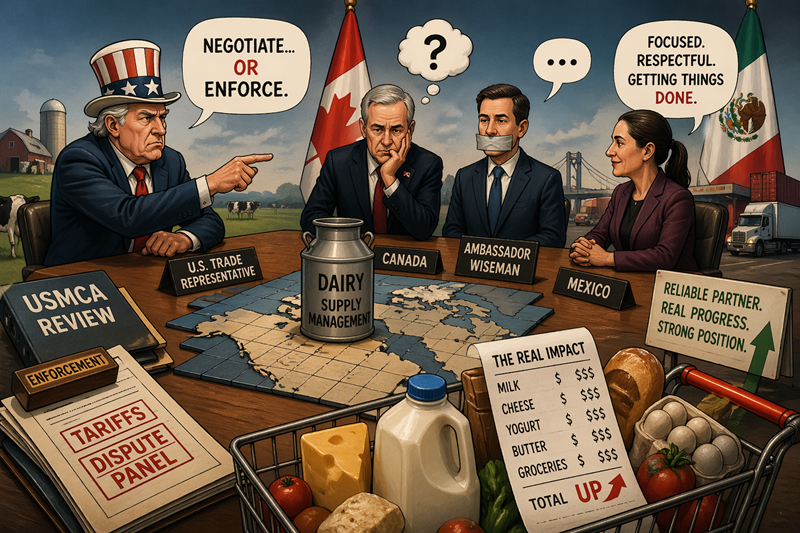
Dr. Sylvain Charlebois on the strong hints the US government has been dropping that Canada’s stance on our restrictive dairy cartel — euphemistically referred to as “supply management” — is going to be a key negotiating point in the upcoming USMCA trade negotiations:
The warning came quietly, but it was unmistakable. According to a Reuters report carried by The Western Producer, U.S. Trade Representative Jamieson Greer made it clear: Canada’s dairy dispute will be resolved one of two ways, through negotiation or through enforcement.
That is not diplomatic nuance. That is a choice.
And it comes at a delicate moment, as the review of USMCA approaches. Dairy is once again at the center of the storm. It always is. Canada’s supply management system, long defended domestically, continues to frustrate U.S. officials over limited market access. As reported by Reuters, tensions remain high around how Canada administers its tariff-rate quotas.
None of this is new. What is new is the tone.
Recent commentary out of the United States, including sharp criticisms aimed at Mark Carney, reflects a growing impatience. Some of it is political theatre. But some of it signals something more consequential, a willingness to move from negotiation to enforcement if progress stalls.
In food trade, that shift matters.
Canada’s agri-food economy is deeply integrated with the United States. This is not a casual trading relationship. It is structural. Supply chains cross the border multiple times before products reach consumers. Roughly three-quarters of Canadian agri-food exports still head south. You do not casually antagonize the market that anchors your value chain.
The critique coming from voices like Brian Switzer, however undiplomatic, boils down to a familiar expectation. Canada should act like a predictable partner. Not subordinate, but steady. When that perception erodes, the consequences are rarely immediate. They emerge later, in tighter border controls, procurement shifts, or dispute panels.
And eventually, in prices.
April 21, 2026
Ivan the Terrible – Feeding the Evil Russian Tsar
Tasting History with Max Miller
Published 14 Oct 2025Soft buns filled with cabbage, onion and dill
City/Region: Russia
Time Period: 16th CenturyIn Russian, Ivan the Terrible is Ivan Grozny, and the translation of “terrible” was meant more in the way of “fearsome” or “formidable” rather than “cruel” or “awful”, though Ivan ended up being all of those. What started off as a good reign with military victories, building Saint Basil’s Cathedral, and restricting the boyars‘ (aristocracy) power over the people descended into a reign of terror with a secret police, the massacre of a city, and even killing his eldest son in a fit of rage.
While Ivan truly was terrible, these piroshki are not. They are absolutely delicious. The bread is soft, and the filling is savory and slightly sweet with the dill really coming through. These were made with all different kinds of fillings, so feel free to try out other ingredients, like meat, fish, fruit, or other vegetables, or put in a hard boiled egg for a modern touch.
Small pies filled with mushrooms, poppy seeds, kasha, turnips, cabbage, or whatever else God sends.
When the servants bake bread, order them to set some of the dough aside, to be stuffed for piroshki.— The Domostroi, 16th Century
April 19, 2026
How to Tank the Economy for War – Death of Democracy 12 – Q4 1935
World War Two and Spartacus Olsson
Published 18 Apr 2026Nazi Germany in late 1935 was becoming more ruthless, more militarized, and more dangerous. In this episode, Spartacus Olsson reports from Berlin on the final months of 1935, when Hitler’s regime tightened its grip through food shortages, propaganda, rearmament, and the continued implementation of the Nuremberg Laws. As ordinary Germans faced rising prices, scarce meat and butter, and mounting pressure to sacrifice for the Reich, the Nazi state pushed its “guns before butter” economy even further. We examine the “fat gap”, Winter Relief, Eintopfsonntag, and the growing burden placed on German families while resources were diverted to war preparation.
At the same time, the First Supplementary Decree to the Reich Citizenship Law gave the regime a bureaucratic definition of who counted as a Jew, accelerating exclusion, dismissal, and persecution. Courts, police, and the Gestapo increasingly enforced the racist order, while Goebbels’ propaganda machine worked to normalize hardship, suppress criticism, and intensify antisemitism.
Against the backdrop of Mussolini’s invasion of Abyssinia and the paralysis of the League of Nations, Hitler found new room to maneuver internationally while consolidating dictatorship at home. This episode explores how the Third Reich turned scarcity into discipline, prejudice into law, and national pride into obedience — bringing Germany one step closer to catastrophe.
Never Forget.
April 14, 2026
Caligula – Feeding Rome’s Most Evil Emperor
Tasting History with Max Miller
Published 7 Oct 2025Skin-on marinated and roasted pork belly decorated with edible gold paint
City/Region: Rome
Time Period: 1st CenturyCaligula, the third Roman Emperor, is remembered as one of the most notorious and cruel of the lot. While he tortured and killed whomever he pleased, he also threw lavish banquets. Suetonius writes that Caligula’s reckless extravagance included “loaves and meats of gold”, and while it’s possible that he meant loaves and meats made of actual gold, I’m going with an edible interpretation.
The Roman flavors of garum, asafoetida, and other seasonings come through strongly, but aren’t overpowering. The meat is wonderfully crispy while being meltingly tender, and the sauce is a nice sweet counterpoint. The gilding is, of course, optional, but it does look rather impressive.
As always, feel free to change up the amounts of anything in the marinade and sauce to suit your tastes as Apicius doesn’t give us any amounts to go on; your version will be just as authentic as this one.
Offelas Ostienses
You slice the meat beneath the skin, so that the skin remains intact. Grind pepper, lovage, dill, cumin, silphium, and one bay laurel berry; moisten with liquamen (garum), pound. Pour over the meat pieces in a roasting pan. When they have marinated for two or three days, take them out, tie them crosswise and put them into an oven. When cooked, separate each piece, and grind pepper and lovage; moisten with liquamen, and add a little passum so that it is sweet. When it comes to a boil, thicken the sauce with starch, pour over the meat pieces and serve.
— De re coquinaria by Apicius, 1st century
April 10, 2026
A Brief History of GRAVY
Tweedy Misc
Published 2 Dec 2025For the next instalment of the series of classic British sauces we take a look at the history of gravy.
In this video I look into some of the earliest historical references to gravy, then some 18th Century recipes. I investigate whether gravy might be a derivative of a classic French sauce, and look in some detail into one important component of traditional gravy recipes: the roux, used for thickening.
I also investigate some products which have emerged since the 19th Century to help with the process of making gravy, from gravy salt and gravy browning, through Bisto’s original gravy powder of 1908, and their fully instant product in the form of “gravy granules”, launched in the 1970s.
Also, have you ever wondered why Bisto is called Bisto? We’ll get into that too.
0:00 Introduction
0:32 What is gravy?
1:27 Early history of gravy
2:01 18th Century gravy recipe
2:25 The importance of the roux
3:37 More 18th Century gravy recipes
4:07 Is gravy actually…. French?!?!
5:29 Gravy salt
6:47 Gravy browning
7:31 History of Bisto
9:19 Modern Bisto
10:25 Conclusion
April 7, 2026
The Myth of Mooncakes: Did they topple a Chinese Dynasty?
Tasting History with Max Miller
Published 30 Sept 2025Mooncakes made with flaky pastry and a seed and nut filling, decorated with a red stamp
City/Region: China
Time Period: 1792There are many different kinds of mooncakes made all over East Asia around this time of year for the Mid-Autumn Festival. Some are savory, some are sweet, and they can have chewy, crumbly, or flaky doughs.
The flaky dough that we’re making here can be made with either lard or melted butter. Lard would have been more traditional for 1792, and it makes a more flavorful pastry, but melted butter will make a smoother dough that’s easier to work with and comes out less crumbly and more flaky.
The filling is delicious and not too sweet, with a rich unctuousness from lard, nuts, and seeds.
Imperial Scholar Liu’s Mooncake
Use flying flour from Shandong to make a flaky pastry for the crust, with pine nuts, walnuts, and melon seeds ground into a fine powder for the filling. A little rock sugar and lard are added. When eaten, it does not taste overly sweet, but instead is fragrant, flaky yet tender, and rich; a truly unique experience.
— Suiyuan Shidan by Yuan Mei, 1792
April 5, 2026
“Easter remains one of the major annual high holy days of confectionery derangement”
At The Freeman, Nicole James remembers her early chocolate obsessions:

Roald Dahl’s chocolate river was the economic policy of my childhood. Dripping with glossy abundance, and available to any enterprising glutton with a low sense of self-preservation. I never looked at Augustus Gloop and thought, “There goes a cautionary tale about excess”. I thought, “There goes a boy with initiative”. I wanted the river. I wanted the factory. I wanted an Oompa Loompa or two, ideally unionized and living in a tasteful outbuilding, making me truffles on demand. I wanted a world in which everything was edible and slightly mad. While everyone else was apparently learning moral lessons, I was busy fantasizing about a life in which I could plunge both arms into a molten tributary of cacao and come up glistening, like some sort of deranged dessert otter.
Easter seemed to offer the nearest thing to this ideal. It was the one annual moment when adults, in a dramatic collapse of judgment, agreed that children should be handed industrial quantities of wrapped chocolate and told to go hard. Easter had tiny eggs hidden in pot plants and larger ones with enough packaging to survive atmospheric re-entry. It was capitalism in a bunny suit.
Then adulthood arrived, lugging excellent literary references. Along came Like Water for Chocolate, with its sexy sorrow and culinary melodrama, and suddenly chocolate was not just a childhood frenzy but a vehicle for yearning and seduction. It could communicate things one would never dream of saying aloud at a suburban dinner party. Chocolate had range.
And this is why the present state of it feels so personally offensive because what is happening to chocolate is a slow-motion mugging. Cocoa is being shaved out. Bars are shrinking. Prices are soaring. Palm oil and vegetable fats are barging into flavor. Chocolate flavor. Not real chocolate, but a cheap mockery of the original deity.
And yet Easter remains one of the major annual high holy days of confectionery derangement. According to Cargill, in the United States, people are expected to plough through around 73 million pounds of chocolate over the Easter season. Around 90 million chocolate bunnies are produced, with — fun fact — 78% being devoured from the ears first.
Easter spending in the US has in recent years hovered around the $23 billion mark, with candy doing much of the heavy lifting. Chocolate, marshmallow Peeps, baskets, flowers, brunches, the whole pastel circus. Christianity may supply the headline act, but the event itself has clearly been workshopped by a mall.
But beneath the cellophane gaiety lies an increasingly grubby truth. Cocoa prices have surged, largely because harvests in West Africa have been hammered. Ghana and Côte d’Ivoire, which together produce the bulk of the world’s cocoa, have been clobbered by poor weather, crop disease, supply chain fragility, deforestation, and the sort of labor abuses that make any cheerful Easter ad feel criminal. The global appetite for chocolate remains immense, but the cacao tree itself is having a nervous collapse.
Update, 19 April: To the surprise of many who’ve latched on to the “woe, woe, mankind bad” chorus, there are now reports of a bumper crop of cocoa and the market prices are dropping:
It all seemed to kick off in March 2024 with the BBC’s chief climate headbanger Justin Rowlatt noting that “climate change” was one of the reasons for chocolate Easter eggs getting more expensive. Experts are said to have claimed that “human-induced” climate change had made extreme heat “10 times more likely” in the main cocoa bean-growing areas of West Africa. The story has had excellent fearmongering legs with a couple of years of bad weather-related harvests sending the world price of cocoa soaring. As late as October last year, the New York Times was stating that higher cocoa prices pushed up by climate change had led to companies changing their chocolate confectionary concoctions. Alas, sadly missing in recent chocolate climate claptrap is that an improved recent harvest (no weather-adjusting humans thought to be involved) has led to a massive 75% slump in global cocoa prices from the peak reached in January last year.
Like coral, polar bears and Arctic ice, any narrative-disturbing news is ignored. The media barkers promoting the Net Zero fantasy simply move onto the next promising climate porn project that can be ramped up to Armageddon level. The Great Choccy Catastrophe is a classic of its kind, but it is just the latest in a long and increasingly tedious line of crying wolf climate tantrums.
[…]
They get a lot of weather in the tropics, particularly in countries like Ivory Coast which accounts for up to 45% of world cocoa bean production. Dry periods alternate with wetter conditions, and there is some short-term variability in decadal temperatures. But according to World Bank climate figures, the average temperature since 1900 has risen just 1°C, while rainfall totals have remained remarkably stable. The average annual total since 1900 is around 1,354 mm. This is nearly identical to the 1,283 mm recorded in 2023, and similar to the 1,239 mm that fell in the supposedly drought conditions in 2024. Neighbouring Ghana is the world’s second largest cocoa producer and its 125 year precipitation average is 1,236 mm. This is a little higher than the 2024 ‘drought’ total of 1,181 mm, and a tad lower than the 1,278 mm in 2023.
The tropics have provided good pickings for climate and Net Zero agitators. Temperatures and rainfall can vary widely over individual years and decades. For instance, Ghana had record low rainfall in 1983 of 851 mm compared with a record high of 1,775 mm in 1968. As we have repeatedly seen over the last few years, any departure from the norm becomes the basis for a politicised junk science prediction that the climate is in crisis.
How to Make Marbled Eggs for Easter – The Victorian Way
English Heritage
Published 23 Mar 2018If you’d like to try this recipe at home, make sure to be very careful when handling/blowing the eggs. In some countries chickens are not vaccinated against salmonella so we suggest giving the eggs a good wash in boiling water and take care not to get any raw egg in your mouth.
This recipe for Marbled Eggs would have been served as a sweet “entremets” — small dishes served before dessert. This particular version uses a sweetened cream filling with chocolate and vanilla, but you could use any flavour you like or experiment with different colour jellies.
(more…)
April 3, 2026
Hot Cross Buns – Mother Goose Would Love These
Food Wishes
Published 12 Apr 2017Pretty much all I know about hot cross buns, I learned from the nursery rhyme, but thanks to a recipe I found on Anson Mills, I was still able to make a fairly decent batch. Including real crosses, not to be confused with dinner rolls on which an icing cross has been piped.
In addition to its eye-catching appearance, the dough-based “cross” provides an interesting textual contrast, as it gets sort of chewy, and crispy edged.
Like I said in the video, any sweet dough will work with this easy technique, especially rich, and fragrant examples, like our Italian Easter Bread dough. Times may vary, but regardless of the dough, simply wait for the dough to double in size, and proceed.
If you want to get all your buns the same size, weigh your dough in grams before dividing, and then divide by 16. Then, weight each of your dough balls to that exact amount, and boom, your tray of buns will look like the ones you saw on that magazine cover. Or, just eyeball it and take your chances. Either way, I really hope you give this a try soon. Enjoy!
March 31, 2026
This Recipe Took 3 Years … Ninja Kikatsugan
Tasting History with Max Miller
Published 23 Sept 2025Very bitter, very sake-flavored balls that include ginseng, coix seeds, and licorice
City/Region: Japan
Time Period: 1676Much like cowboys, pirates, and knights, ninja have been fictionalized to be a far cry from the intelligence gathering and sabotage experts of history. The term “ninja” didn’t even become popular until the mid-20th century.
Even the historical text I’m using here, the Bansenshukai, has been called into question. Because it was written over the period of several centuries, often by people who weren’t even alive during the period when ninja, or shinobi, were active, who knows if it’s an accurate portrayal of their tools and methods.
If this recipe is accurate, I feel bad for the people who had to eat them. They’re really bitter with an overwhelming sake flavor that isn’t pleasant. Really, I wouldn’t recommend making these; they’re not worth the 3 year time investment, and hyōrōgan are a much tastier ninja survival food.
Kikatsugan
10 ryō Asiatic ginseng
20 ryō Buckweat flour
20 ryō Millet Flour
20 ryō Yam
1 ryō Liquorice
10 ryō Coix seed
20 ryō Rice flour
Grind this into a powder, soak it in three shō of sake for three years until it has dried. Afterward, roll it into balls the size of peach pits.
Eating three of these daily will keep you healthy even when you have nothing else to eat.
Eating three will prevent both mental and physical fatigue.— Bansenshukai, 1676
March 24, 2026
Baking the Original Apple Pie from Medieval England
Tasting History with Max Miller
Published 16 Sept 2025Hot water crust pie filled with mashed apples and pears with raisins, figs, and spices
City/Region: England
Time Period: c. 1390This is the first recorded recipe for apple pie, written in England around 1390 in The Forme of Cury. As many historical recipes are, this one is bare bones and leaves a lot of room for interpretation. The “good spices” in the recipe could mean basically any combination of spices you like. I think this is probably referring to a popular medieval spice mixture called poudre douce, whose exact contents varied from cook to cook. Popular spices included cinnamon, nutmeg, mace, black pepper, long pepper, cardamom, ginger, galangal, and cloves, so feel free to experiment and make up your own.
Whichever spices you use will affect how familiar or exotic the pie tastes, and I really enjoyed the version I made. It’s not too sweet with most of the sweetness coming from the fruit, and I found the spices to be really strong but really pleasant. Unlike modern apple pies, the filling is more of a compote texture, but it holds together nicely. It’s a perfect recipe to try for the fall.
For to make Tartys in Applis.
Tak gode Applys and gode Spycis and Figys and reysons and Perys and wan they are wel ybrayed coloured with Safron well and do yt in a cofyn and yt forth to bake wel.
— The Forme of Cury c. 1390
March 23, 2026
Reject multiculturalism as you would reject fake meat
Spaceman Spiff looks at the technocratic dream that we’d all give up on eating meat and instead switch to lab-grown, VC-funded, and Bill-Gates-approved fake meat. It failed utterly, of course, because despite all of the arguments the corporations and the astroturf activists could marshal, nobody wanted it. Vegetarians wouldn’t switch to eating something vaguely kinda-sorta meat-ish, and meat eaters were happy continuing their carnivorous habits. It had no real market, so it was a dud product.
Our technocratic elites have been pushing multiculturalism for even longer than they were pushing fake meat, but just as with fake meat, the more people encounter it, the less willing they are to accept it:

Multiculturalism is the belief many distinct cultures can live together and flourish rather than devolve into conflict.
This is false. It has never worked anywhere.
The world itself is multicultural. The solution that emerged to manage different groups was national borders. Each culture could segregate and live apart from others because they could not successfully live together.
As the failures of multiculturalism become impossible to hide, social engineers reach for ideas to make it work. The latest is civic nationalism. The fake meat of the social governance world.
For all human history we have relied upon the real thing, but now today’s social engineers believe they have discovered a superior recipe, one that avoids the hassle and expense of tradition.
Anyone can become someone like you as long as they conform to an arbitrary list of beliefs, behaviours, laws and customs. We can ignore ethnicity, heritage and history. We can manufacture instant populations with passports and certificates just as we can create synthetic meat by combining the ingredients ourselves.
Like fake meat it looks workable on paper. Not only that, it is presented as self-evidently reasonable. Why has nobody thought of this before? How convenient governments and corporations can import a new workforce and they magically become British, American or Chinese because they “share values” and observe laws.
America was the first to experiment, a necessity after the introduction of non-European immigration in the 1960s. Needless to say they didn’t need it before that.
The country found itself importing people with no historical connection to the American population through heritage or history. Far fewer of them married into the family than previous waves of immigrants from European nations. While importing the world America was becoming the world with its racial, ethnic and cultural tensions.
They convinced themselves they had always been a nation of immigrants and conveniently forgot how long it took even the Irish to assimilate into America despite their ostensible similarity to the founding stock.
Strenuous efforts to make this seem normal, despite its novelty, included the energetic emphasis on shared values or adopted customs since the newcomers were often strikingly different.
Civic nationalism seems to be based on the same faulty reasoning as synthetic meat. We can circumvent the traditional approach using innovation. Why live through centuries of strife for a nation to emerge when you can just hand out certificates and make everyone instantly like you because they claim to respect the law and promise to adopt new customs?
Initially this can seem to work. If a small number of skilled immigrants come they are typically absorbed. Most cultures can do this if the numbers are modest and especially if the newcomers intermarry, or their children do.
Even more so, in traditional societies, including our own until recently, the pressure to adapt was almost universal; no translators, no welfare, no slack whatsoever.
Large numbers of immigrants over short time scales retard the process of assimilation, and generous welfare programmes can derail it completely.
America is also big unlike European nations, so it has taken a while for the full effects to be felt.
Despite the endless hype, people reveal their preferences in their behaviour. They can move. Pro-immigrationists have complained about white flight for decades, one very obvious example of the failure of civic nationalism.
Image from Spaceman Spiff
Just like those inconveniently full supermarket shelves with their synthetic products no one will buy, people run from diversity when they can.
Civic nationalists, like climate zealots, resort to repeating their tired lines about their great intent, how amazing it is all meant to be if people would just get into the spirit of things.
But it is all fantasy. Literal fictions that exist only inside the heads of those who imagine utopia. Real life has its own ideas.

Update: Added missing URL.
Update the second, 24 March: Welcome, Instapundit readers! Have a look around at some of my other posts you may find of interest. I send out a daily summary of posts here through my Substack – https://substack.com/@nicholasrusson that you can subscribe to if you’d like to be informed of new posts in the future.
The REAL History of Worcestershire Sauce (and a few others …)
Tweedy Misc
Published 20 Nov 2025A look into the history of Worcestershire Sauce, and some other related sauces and condiments originating in the 18th and 19th centuries.
In doing so I try to understand whether Lea and Perrins created something brand new in their Worcestershire Sauce of the 1830s, or whether it was more an evolution of other similar styles of sauce which already existed at that time like Harvey’s Sauce, and Reading Sauce … and in turn do both of those owe something to an even earlier condiment — Quin’s Sauce …?
I also debunk an oft retold (particularly here in YouTube) story about Baron Sandys returning from a post as the Governor of Bengal being the inspiration for Lea and Perrins’ Worcestershire Sauce — it’s almost certainly not true.
0:00 Introduction
0:55 What is Worcestershire Sauce?
1:22 Ingredients and Recipes
3:01 History of Worcestershire Sauce
6:33 Food in Georgian England
7:51 Hare Soup!
8:22 Harvey’s Sauce
11:00 Reading Sauce
13:21 Quin’s Sauce
14:49 Yorkshire Relish
16:04 Henderson’s Relish
17:02 Conclusion
He also posted an addendum to this video.


