
Coffee comes in five descending stages: Coffee, Java, Jamoke, Joe, and Carbon Remover. This stuff was no better than grade four.
Robert A. Heinlein, Glory Road, 1963.
March 23, 2026
QotD: Grading coffee
Comments Off on QotD: Grading coffee
March 17, 2026
Corned Beef and Cabbage Recipe | St. Patrick’s Meal | Food Wishes
Food Wishes
Published 13 Mar 2009Get the full story! Visit http://foodwishes.com to get the ingredients, and watch over 200 free video recipes. Leave me a comment there. If you have questions, ask on the website. Thanks!!
Full recipe here – https://www.allrecipes.com/Recipe/236601/Chef-Johns-Corned-Beef-and-Cabbage/
Comments Off on Corned Beef and Cabbage Recipe | St. Patrick’s Meal | Food Wishes
QotD: The noble hamburger
Today, I want to share some real talk on the lesser lights of the burger family. Basically, hot dogs and Sloppy Joes are the Billy Carter and Mary Trump of burger-esque entrees. They are lesser relatives who should be at best ignored if not outright scorned.
Hot dogs are bad. They taste bad, they look bad – keep that icky cylinder away from me! – they are made of the best-left-forgotten bits and pieces of animals like snouts, hooves, and Ted Lieus. Perhaps their popularity is that they are easy to cook – throw them in water and you have both a soggy sausage and a gross broth. The kind of people who eat hot dogs by choice probably think like that.
Here’s the short version: Never speak of hot dogs to me.
And Sloppy Joes – what are they? What is that goop? It’s not chili, it’s not anything except ground beef with some sauce and I guess you can put mustard on it. A hamburger, which is food fit for an American, can also wield ketchup and mayo. But a Sloppy Joe? It’s just … nothing. I don’t know why they exist but they should stop doing so.
Kurt Schlichter, “Support Your Local Sheriff and Camouflaged Federal Officers”, Townhall.com, 2020-07-21.
Comments Off on QotD: The noble hamburger
March 13, 2026
What did ordinary Tudors do for work? Inside the 16th-century daily grind
HistoryExtra
Published 4 Nov 2025From sunrise in the fields to the heat of the brew house, Ruth Goodman reveals the untold story of how the Tudors really worked.
Forget silk-clad courtiers – most people in the 16th-century toiled from dawn to dusk just to keep food on the table. Men ploughed, hedged, and hauled in the fields while women brewed ale, milked cows, churned butter, and raised children – often all at once. Every Tudor household was a finely balanced machine of survival.
In this episode of her new series on Tudor Life, historian Ruth Goodman explains how every pair of hands mattered. It wasn’t as simple as “men’s work” and “women’s work”. You’ll hear how the two worlds were completely intertwined. And what about those who were unable to work? This video sheds light on an innovative 16th-century welfare scheme that made all the difference.
Filmed on location at Plas Mawr – an Elizabethan townhouse in Conwy, North Wales, now in the care of Cadw – this series with Ruth looks beyond the royals who often dominate the headlines, and considers the everyday routines of those living in England and Wales in the Tudor era.
00:54 How did Tudors earn money?
03:20 Where did men work?
08:15 What if you were unable to work?
Comments Off on What did ordinary Tudors do for work? Inside the 16th-century daily grind
March 10, 2026
Austria’s Inbred Emperor who Demanded Dumplings – Marillenknödel
Tasting History with Max Miller
Published 9 Sept 2025Apricots wrapped in a soft dough with a crunchy exterior and sprinkled with powdered sugar
City/Region: Austria
Time Period: 1858Ferdinand I of Austria was emperor in name only. Incredibly inbred, Ferdinand had various disabilities and ailments that affected his ability to rule, though it’s said that he spoke five languages and was very witty. As the empire was run by others, not much is written about Ferdinand’s rule, but one thing that he did do as emperor was to demand dumplings at every meal.
And I can see why; they’re absolutely delicious. The apricots are sweet and juicy, the dough is soft, and the crunchy exterior of breadcrumbs, butter, sugar, and cinnamon is wonderful.
Apricot and Plum Dumplings With quark dough.
You mix 4 deciliters flour and 20 decagrams quark with 3 yolks to make a soft dough. Roll out fairly thick, cut into large pieces, enough to wrap a plum [or apricot], then seal them well … Boil the dumplings in salted water. Lift them out carefully with a spoon so they don’t stick to the bottom, then transfer with a slotted spoon into hot butter in a dish. Let them brown on one side. In the butter, you can first brown some sugar and breadcrumbs…coat with sugar, cinnamon, and brown breadcrumbs.
— Die Süddeutsche Küche by Katharina Prato, 1858
Comments Off on Austria’s Inbred Emperor who Demanded Dumplings – Marillenknödel
March 5, 2026
QotD: Chinese cooking
What is it like? Well, Dunlop barely manages to cover this in a 400-page book, so I hesitate even to try, but let me hit a few of the high points. First, diversity. China is a continent masquerading as a country, both in population and in geographic extent, so its cuisine is comparably diverse. Most cooking traditions have one or two basic starches, China has four or five.1 China extends through every imaginable biome, from rainforest to tundra, desert to marshlands, and much of the genius of Chinese food lies in combining the delicious bounties offered up by this kaleidoscope in interesting or unexpected ways.
One way to think of Chinese eating is that much of it is a sort of “internal” fusion cuisine. Because China was ruled from very early on by a centralized bureaucracy with a fanaticism for river transport, the process of culinary remixing has been going on for much longer than it has in most places. The Roman Empire could have been like this, but the shores of the Mediterranean all have pretty similar climates, so there were fewer ingredients to start the process with. Already very early in Chinese history, before the 7th century, we hear of the imperial city being supplied with:
oranges and pomelos from the warm South, […] the summer garlic of southern Shanxi, the deer tongues of northern Gansu, the Venus clams of the Shandong coast, the “sugar crabs” of the Yangtze River, the sea horses of Chaozhou in Guangdong, the white carp marinated in wine lees from northern Anhui, the dried flesh of a “white flower snake” [a kind of pit viper] from southern Hubei, melon pickled in rice mash from southern Shanxi and eastern Hubei, dried ginger from Zhejiang, loquats and cherries from southern Shanxi, persimmons from central Henan, and “thorny limes” from the Yangtze Valley.
If we think of chefs as artists, the Chinese ones have since ancient times had the advantage of an outrageously diverse set of paints. But these ingredients aren’t combined willy-nilly, without respect for their time or place of origin. The Chinese practically invented the concept of terroir, and their organicist conception of the universe in which everything is connected to everything else implied strict rules about which foods were to be eaten when, both for maximum deliciousness and to ensure cosmic harmony.
In the first month of spring, [the emperor] was to eat wheat and mutton; in summer, pulses and fowl; in autumn, hemp seeds and dog meat; in winter, millet and suckling pig. An emperor’s failure to observe the laws of the seasons would not only cause disease, but provoke crop failure and other disasters.
The obsessions with freshness and seasonality come to their culmination in the one area where Chinese cuisine stands head and shoulders above all others: green vegetables. In the West, “eating your greens” is a punishment, or at best a chore, and it’s easy to see why. In much of the world vegetables are bred for yield and transportability, kept in refrigerators for weeks, and then boiled until no trace of flavor remains. Dunlop and I have one thing in common: when we’re not in China, of all the delights of Chinese cooking it’s the green vegetables that we miss the most.
When I bring American friends to a real Chinese restaurant, sometimes they’re shocked that the vegetable dishes cost the same amount as the main courses. Why does a side dish cost so much? But no Chinese person would ever think of a vegetable course as a “side” dish, they’re part of the main attraction, and more often than not they’re the stars of the show. In the West, you can now get decent baak choy, but this is just one of the dozens and dozens of leafy greens that the Chinese regularly consume, many of them practically impossible to find outside Asia.
My own favorite is the sublime choy sum. I remember once getting off a transoceanic flight, starving and exhausted, and being offered a bowl of it over plain white rice. The greens had been scalded for a few seconds with boiling water, then tossed around a pan for no more than a minute — just long enough that the leaves were so tender they seemed to dissolve in your mouth, but the stems still held snap and crunch. The seasoning was subtle — maybe a few cloves of garlic, some salt, a splash of wine or vinegar. Just the right amount to bring out the deep, earthy flavors of the vegetable, to somehow make them brighter and more forward, but not to overpower them.2 It was one of the most delicious things I’ve ever eaten. I think I’ll still remember it when I am old.
Did you notice that in the previous paragraph I spent almost as much time describing the texture of the food as its flavor? That’s no coincidence. Of course the Chinese care about flavor, everybody does (except the British, ha ha), but relative to many other culinary traditions the Chinese put a disproportionate emphasis on the texture of their food as well. I’ll once again draw on a bastardized version of the Whorf hypothesis: English is a big language with a lot of borrowings, so we have a correspondingly large number of words for food textures. Imagine explaining to a foreigner the difference between “crunchy” and “crisp”, or between “soft” and “mushy”. That is already more semiotic resolution than most languages have when it comes to the mouthfeel of their food, but Chinese takes it to a whole ‘nother level.
John Psmith, “REVIEW: Invitation to a Banquet by Fuchsia Dunlop”, Mr. and Mrs. Psmith’s Bookshelf, 2024-02-05.
- One of them, potatoes, has a particularly fraught history. Potatoes started seriously spreading in China right around the time of the mass famines that accompanied the collapse of the Ming dynasty. Accordingly, they got a reputation of being food for poor people. They’ve never really managed to overcome this association, and are generally shunned by the Chinese, especially in high-end cuisine, despite several government campaigns to encourage people to eat them since they’re nutritious and easy to grow in arid conditions.
- There’s a pattern in Chinese gastronomy where extremely intense, over-the-top flavors are a bit low-status, and flavors so pure and subtle they verge on bland are what the snooty people go for. This is true across regions (the in-your-face food of Sichuan is less valued than the cuisine of the Cantonese South, or the cooking traditions of Zhejiang in the East), but it’s also true within regions (in Sichuan, the food of Chongqing is much spicier than the food of Chengdu, and correspondingly lower status).
Comments Off on QotD: Chinese cooking
March 3, 2026
The Deadly Job of a Victorian Baker
Tasting History with Max Miller
Published 2 Sept 2025Large, gingery loaf of bread
City/Region: England
Time Period: 1857In order to make expensive wheat flour go further, Victorian bakers added things to it of varying edibility. While potato, corn, and pea flour were used, so was ground up plaster of paris, chalk dust, and a powder called alum. Alum made the flour very white, but is also toxic in large quantities.
This loaf, made only with wholesome, edible ingredients, would have been on the fancier side of a bakery’s offerings with the addition of lots and lots of powdered ginger. This bread really surprised me, as it tastes like a normal loaf of bread at first, but then the heat and the flavor of the ginger comes through afterwards.
Ginger Loaf, or Rolls.
Mix intimately two ounces of good powdered ginger, — called in the shops prepared ginger, — and a little salt, with two pounds of flour, and make it into a firm but perfectly light dough with German or brewer’s yeast, [and 1 pint milk] in the usual manner; [to rise one hour or until quite light: to be kneaded down and left again to rise until light]. Bake it either in one loaf, or divide it into six or eight small ones.
The proportion of ginger can be much increased if desired; but the bread should not then be habitually eaten for a long continuance, as the excess of any stimulating condiment is often in many ways injurious.
— The English Bread-Book by Eliza Acton, 1857
Comments Off on The Deadly Job of a Victorian Baker
March 2, 2026
Remember this when they tell you grocery prices are high because of greedy corporations
On the social media site formerly known as Twitter, L. Wayne Mathison explains why the headline profits of grocery stores bear almost no relation to the far smaller actual profits in the grocery retail market:

“Leader IGA” by daryl_mitchell is licensed under CC BY-SA 2.0 

 .
.
The 32% Illusion: A Grocer’s View from Behind the Till
I used to own the IGA in Hamiota. Small town. Thin margins. Real bills. So when I hear that Loblaw Companies Limited is raking in “31–32% profit”, I don’t get angry. I get tired.
Here’s the move. Take a gross margin number. Call it profit. Add a dash of politics. Serve hot.
Gross margin is revenue minus cost of goods sold. That’s it. It doesn’t include payroll, hydro, insurance, property tax, refrigeration repairs at 2 a.m., shrink, theft, advertising, transport, interest, or the banker breathing down your neck. Net profit is what’s left after all of that. In grocery, that number floats around 2 to 3 percent in a good year. Some years less. Some years negative.
When I ran my store, payroll alone could swallow most of the gross margin. Then add freight. Then add utilities. Manitoba winters are not kind to freezers. Then add spoilage. Bananas do not care about your ideology. They rot on schedule.
People think grocers “set prices”. That’s half true at best. Suppliers raise costs. Fuel goes up. Wages rise. Carbon costs ripple through trucking and farming. You pass it on or you close. It’s arithmetic, not greed.
Now here’s the uncomfortable part. Food inflation hurts. It hurts seniors. It hurts young families. It hurts the clerk stocking shelves. But blaming a 30% “profit margin” is a shortcut. It feels good. It’s wrong.
Big chains make money on scale, pharmacy, cosmetics, financial services. Those categories carry higher margins than milk and bread. That lifts the consolidated gross margin number. It does not mean grocery aisles are printing cash.
We should argue about competition. We should argue about supply management. We should argue about taxes embedded at every step of the chain. Good. Let’s do that. But at least use the right numbers.
I spent years watching pennies. Grocers survive on volume and efficiency. A few cents per dollar is the game. Always has been.
If you want lower food prices, focus on input costs, transport, energy, regulation, and competition. Start there.
And before sharing the next viral graphic, ask one question: gross or net?
That single distinction separates outrage from reality.
Comments Off on Remember this when they tell you grocery prices are high because of greedy corporations
February 24, 2026
What did Prisoners eat at Folsom in 1925? – Lamb Curry & Beans
Tasting History with Max Miller
Published 26 Aug 2025Lamb curry with onions and carrots served with white bread and plain pinto beans
City/Region: Folsom, California
Time Period: 1916-1933Folsom Prison is infamous, but the food doesn’t sound like it was all that bad, though there was plenty of watery gruel made from the water salt pork had been soaked in, and if you were in solitary confinement, you got a diet of bread and water with beans every third day. Meals weren’t all terrible, though. A 1925 menu show foods like Hamburger Steak with Brown Gravy, Split Pea Soup, and Lamb Curry & Rice, which is what we’re making here.
In the 1920s, a lot of the cooks were using military manuals, so that is where the base of this recipe comes from, along with a list of ingredients from a commissary report from 1933.
It’s actually quite good, though I would add as much as double the amount of curry powder as was specified in the historical recipe. The beans are a little plain, but that’s to be expected.
382. Beef, curry (for 60 men).
Ingredients used:
20 pounds beef.
1 1/2 ounces curry powder.
Cut the beef into 1-inch cubes and place in a bake pan; cover with beef stock or water; season with salt, pepper, and curry powder. When nearly done, thicken slightly with a flour batter. Serve hot.— Manual for Army Cooks, 1916
LAMB CURRIE and RICE
1160 pounds Mutton
830 ” Rice
300 ” Onions
400 ” Carrots
1 bottle Curry
— Commissary report from Folsom Prison, February 1, 1933
Comments Off on What did Prisoners eat at Folsom in 1925? – Lamb Curry & Beans
February 17, 2026
Eating in Japan During World War 2
Tasting History with Max Miller
Published 19 Aug 2025Fried sweet potato paste on top of roasted seaweed with a soy glaze and brown rice
City/Region: Japan
Time Period: December 1942Contrary to the government’s promises, the availability of food declined in Japan as World War 2 went on. Journal entries from 1945 highlight just how bad things had gotten. People were unable to get ahold of staples like rice, soy sauce, miso, and fuel for cooking fires, and many were scavenging for anything to eat.
This recipe comes from a few years earlier when things were tight, but not quite so dire. While it doesn’t exactly taste like grilled eel, it is quite good. There’s a nice crispiness to it (more so before the glazing and grilling), and the glaze is delicious. It kind of reminds me of the breading that you might get on some katsu.
Kabayaki of Sweet Potato
Ingredients for 5 servings
100 monme sweet potatoes
2 tablespoons wheat flour
1 teaspoon salt
15 sheets of roasted seaweed
Grate the sweet potatoes with a grater and grind. Mix in the flour and salt. Spread the mixture onto the roasted nori to a thickness of about 1/2 cm. Fry them in oil until golden brown. Separately, make a soy sauce glaze in the ratio of 3 parts soy sauce to 2 parts sugar. Dip in the glaze and grill them. Repeat this twice, brushing with sauce each time. On the third, use only the sauce without grilling.— Fujin no Tomo (The Woman’s Friend), December 1942
Comments Off on Eating in Japan During World War 2
February 15, 2026
QotD: The love of long-distance train travel
Of course, the accursed cell phone and the even more accursed smartphone have penetrated the seclusion. And alas, there are no more dining cars, a delight now almost completely abolished by spiteful managements, and available mainly on ridiculous super-luxury trains such as the pastiche Orient Express. Yet no restaurant meal I have ever had, including the pressed duck at the old Tour D’Argent in Paris (before it became a museum where you could eat the exhibits), has surpassed the breakfasts, lunches, teas, and dinners I have eaten in trains.
I think of the wonderful bacon and eggs, accompanied by soda bread, on the cross-border Belfast-to-Dublin flyer in Ireland; the vast plates of pork and dumplings accompanied by Pilsener beer on the somnolent Zapadny Express from Nuremberg to Prague; the fresh pancakes and maple syrup at breakfast on the California Limited, with antelopes fleeing from the train somewhere between Dodge City and Albuquerque; the first sip of tea from the samovar, served in a glass in an ornate silver holder, on the Red Star night sleeper from Moscow to Leningrad; the first glass of wine on a sunny September evening as the Rome Express, an hour out of Paris, clattered southward past the faintly minatory cathedral tower at Sens. Then there were the toasted teacakes near Grantham on the southbound Flying Scotsman, and the superb galley-cooked steak on the upper deck of the Chicago-bound Capitol Limited, as it climbed westward through the evening into the forests beyond Harper’s Ferry and up the Potomac valley.
Peter Hitchens, “Why I Love Trains”, First Things, 2020-07-16.
Comments Off on QotD: The love of long-distance train travel
February 11, 2026
The “True” History of Key Lime Pie: Florida or New York?
Tasting History with Max Miller
Published 12 Aug 2025Key lime pie in a graham cracker crust with meringue, garnished with lime zest and lime peel
City/Region: Key West, Florida
Time Period: April 14, 1933Yet another example of a dish with multiple origin stories, the key lime pie was perhaps invented in Key West in 1875 by Aunt Sally, the possible cook or family member of William Joseph Curry, Florida’s first millionaire, when she observed Cuban sponge collectors making a cream of lime juice, condensed milk, and egg yolk. Or maybe it was a spin on Borden’s (the makers of Eagle brand condensed milk) Magic Lemon Pie, created in New York City in 1931.
Either way, this recipe from 1933, one of the first using a graham cracker crust, is delicious. The filling is smooth, but firms up well, and the lime flavor really stands out without being too tart.
Tropical Lime Pie
Mix thoroughly:
1 can condensed milk,
1/4 cup evaporated milk,
3 egg yellows,
1-3 lime juice, strained.
Butter 9-inch pie tin heavily. Sprinkle graham cracker crumbs about one-fourth inch thick for crust, pressing crumbs well up on sides of pan. Pour in uncooked custard and cover with meringue, using three egg whites and three scant tablespoons of sugar. Brown in moderate oven and allow to set for one hour before serving. Serves six.— Mrs. Mabel McClanahan, Key West Florida, in The Miami Herald, April 14, 1933
Comments Off on The “True” History of Key Lime Pie: Florida or New York?
February 7, 2026
Food hang-ups by generation
Around the early to mid-80s, I started to notice trends in the kind of health information being pushed by the mainstream media. One of the big topics of the day was the dangers of … eggs. Eggs were so dangerous that “experts” were warning adults to avoid eating more than one or two per week. Three was the absolute limit and you were dicing with death if you went over that “healthy” limit. Then, a few years later, eggs were “the perfect food” and we weren’t eating enough of these formerly abominated death pills. A few years after that, OMG! Apples, people, apples! Danger, danger, danger! That was around the time I stopped putting any credence into health reporting in the media. However, as Lisa De Pasquale points out, food issues have been an ongoing struggle for each succeeding generation:
In the ’80s, the ultimate healthy Boomer breakfast was a bran muffin. There were also various cereals like Grape-Nuts and Raisin Bran. There definitely wasn’t room for their parents’ bacon and eggs unless you had a death wish. Boomers settled on eggs as the devil’s snack when the American Heart Association warned in the 1960s that people shouldn’t consume more than three eggs per week. Like social distancing six feet from others during COVID and eight 8oz glasses of water per day, the recommendation wasn’t based on science, but on being a simple number Americans could remember.
Thanks, but this Gen Xer will stick to getting my 8,675,309 steps per year as my guiding fitness principle.
[…]
The Millennial Food Pyramid
Level One: Genetically Modified Organism and Nonorganic Foods — Use Sparingly
While Gen X was at ground zero in doubting Big Food’s pyramid, our Millennial colleagues and kids really continued the battle. Like luxury logos, they seek out the organic and non-GMO labels. It’s a virtue signal of both their values and what they can afford. Erewhon smoothies, anyone?
Level Two: Various Overpriced Coffee Drinks — Two to Three Servings
Gen Xers link coffee to work and responsibility; caffeine is a tool to get through the morning. Millennials view coffee drinks as self-care. It’s about treating themselves to dessert any time of day — a major win for marketing executives.
Level Three: Charcuterie Boards, Wine, Hard Seltzers, Craft Beers — Three to Five Servings
Millennials love to entertain. Nothing shows sophistication and “adulting” in your 30s and early 40s like a charcuterie board. Lunchables upgraded! They came of drinking age at the same time as small-batch beers, American boutique wineries, and hard seltzers.
Level Four: Instagram-Worthy Food — Six to Eleven Servings
Camera phones leveled up the entertainment value of food consumption. Like organic labels, what Millennials eat signals their open-mindedness. As they get older, they straddle the line of wanting to be in on the trends (avocado toast and açai bowls) and the dive you haven’t heard of with authentic phở.
The Generation Z and Generation Alpha Food Pyramid
Level One: Real Meat, Dairy, and Peanuts — Use Sparingly
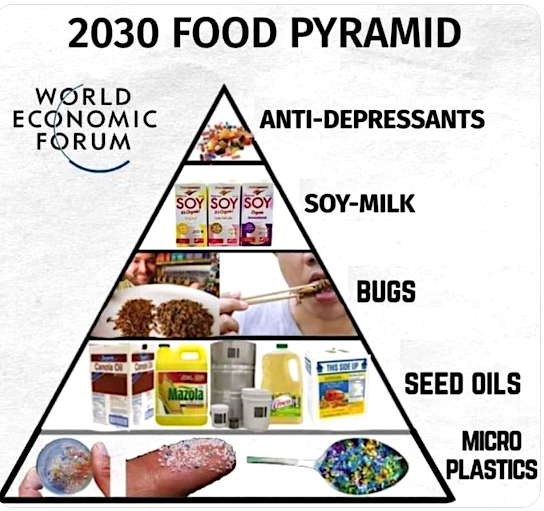
The Gen X and Millennial generations dabbled in veggie burgers, but Gen Z and Gen Alpha went whole lab-created hog into plant-based meats and milks, to the point that meat and milk no longer have a meaning until a company gets sued for using the words. To be fair, they are also embracing biohacking trends and ditching seed oils. Due to the growing prevalence of allergies, peanuts are a universal no-no food in public spaces.
Level Two: TikTok Recipes — Two to Three Servings
The term “recipe” is used loosely. I’ve come across a TikTok video for making a cream sauce from a block of cream cheese, water, and dried pasta. There is a positive aspect of trying these TikTok recipes, though: it prepares them for trying new things and for failure when a recipe doesn’t come out right.
Level Three: Food Delivery Service Meals — Three to Five Servings
Postmates, Uber Eats, Grubhub, and DoorDash are staples at mealtime. Following their surge during the COVID era as restaurants struggled to stay in business, accounts linked to their parents’ bank accounts became as common as sharing a cell phone plan.
Level Four: Gamer Food and Drinks — Six to Eleven Servings
Living next to a park has taught me one thing about Gen Z and Gen Alpha — they’re all inside. I mostly see neighborhood kids on Halloween, and every year, I recognize fewer and fewer costumes because they’re dressed as video game characters. Their snacks are manufactured for their attention span: quick hits of spicy, sour, or sweet while on pause. The gamer culture and H Mart remove barriers as Japanese snacks dominate.
So, where does this leave Gen X? We’re not immune to the powers of Big Food. In fact, recent research shows that ultra-processed food addiction began with us thanks to the explosion and availability of ultra palatable foods with added refined carbs and fats. StudyFinds reported researchers from the University of Michigan said, “Individuals who are now older adults were in developmentally sensitive stages during the 1970s and 1980s, precisely when tobacco-owned food manufacturers were shaping the market with addictive ultra-processed foods”.
February 3, 2026
The Killer Pigs of the Middle Ages
Tasting History with Max Miller
Published 5 Aug 2025Sliced roasted pork loin with jus
City/Region: England
Time Period: 1390Pigs were an important source of food in the Middle Ages. They didn’t take up a lot of space, had lots of babies, and ate pretty much anything, so despite their smell and bouts of violence (sometimes ending in murder), they were commonly found throughout Europe.
This English recipe, which uses black pepper, coriander seed, caraway seed, and wine, all expensive ingredients that had to come from far away, wouldn’t have been for the common folk. Today, these ingredients are readily found at the grocery store, and this is a delicious roast that is perfect for those just getting into medieval cooking. As with a lot of historical recipes, there are no quantities given, so feel free to adjust the amounts of any of the spices to suit your taste.
Cormarye.
Take Coriander, Caraway small ground, Powder of Pepper and garlic ground in red wine, muddle all this together and salt it, take loins of Pork raw and flay off the skin, and prick it well with a knife and lay it in the sauce, roast thereof what thou wilt, & keep that that falleth therefrom in the roasting and seeth it in a little pot with fair broth, & serve it forth with the roast anon.
— The Forme of Cury, 1390
Comments Off on The Killer Pigs of the Middle Ages
January 27, 2026
Did People in the Middle Ages Drink Water?
Tasting History with Max Miller
Published 1 Aug 2025A brew of barley, licorice, figs, and sugar
City/Region: France
Time Period: 1393The myth persists that everyone was drunk in the Middle Ages because no one drank water, only alcohol. While many people preferred to drink ale, wine, or mead, people drank water all the time. Having a source of fresh, clean water was the basis of the location of many cities and towns.
Clean water isn’t just an issue of the past, either. Today, 1 in 10 people don’t have access to clean water. For the month of August, I’m joining thousands of creators across the internet to form Team Water with the goal of raising $40 million to supply 2 million people with clean water which will flow for decades. You can support Team Water by donating at teamwater.org, or by watching and sharing the episode for this recipe. I’ll be donating all of the ad revenue from this video to Team Water!
This sweet tisane is an herbal tea made with barley, licorice root, figs, and sugar. I really enjoyed it, even though the flavor of the licorice and figs didn’t come through. It kind of reminds me of the milk after you’ve eaten a bowl of Raisin Bran, which I like.
Sweet tisane.
Take some water and boil it, then for each septier of water add one generous bowl of barley — it does not matter if it is all hulled — and two parisis’ worth of licorice; item, also figs. Boil until the barley bursts, then strain through two or three pieces of linen, and put plenty of rock sugar in each goblet. The barley that remains can be fed to poultry to fatten them.
— Le Ménagier de Paris, 1393
Comments Off on Did People in the Middle Ages Drink Water?


