
Tasting History with Max Miller
Published 29 Jul 2025Mastic stew with black rice, spices, and lamb, garnished with cilantro
City/Region: Mongol Empire | China
Time Period: 1330The grandson of Genghis Khan, Kublai Khan doubled the size of the largest land empire the world had ever known by conquering China. We actually know quite a bit about the foods that fueled his empire-expanding efforts. Shortly after his death, Yinshàn zhèngyào, or The Proper and Necessary Things for the Emperor’s Food and Drink, was written, and its recipes include ingredients from across Kublai Khan’s vast empire.
The mastic in this stew is a resin from the mastic tree in the Mediterranean, and it has a bitterness along with cedar or pine notes. I really like it in sweet things, but there is no sugar in this dish. The stew is aromatic and smells of cardamom and cinnamon, but they don’t come through in the flavor. The bitterness of the mastic and the lamb dominate the dish, but Kublai Khan was eating this dish to invigorate his chi, so maybe the flavor didn’t matter as much.
I used black rice, or forbidden rice, so named because supposedly it was only eaten by the emperor and his court for much of Chinese history, and it makes the stew a deep purple. You can use long grain white or brown rice, which will make for a lighter colored dish.
Nourishes, warms the middle and grants chi. Leg of mutton, five tsaoko cardamoms, 2 ch’ien cinnamon, one half sheng chickpeas, mash and remove the skins. Boil the ingredients together to make a soup, strain it. Cut up the meat and set aside. Add 2 ho of cooked chickpeas, 1 sheng of aromatic rice, 1 ch’ien of mastic. Mix well with a little salt. Add chopped meat and cilantro.
— Yinshàn zhèngyào by Hu Sihui, 1330
January 20, 2026
Feeding the Great Mongol Khan
January 13, 2026
The History of SPAM
Tasting History with Max Miller
Published 22 Jul 2025Sliced SPAM layered with cream cheese filling, sliced and served with potato salad and tomatoes
City/Region: United States of America
Time Period: 1951SPAM. The iconic canned meat product. Beloved by some, reviled by others, SPAM was buoyed by a very successful marketing blitz by the Hormel company starting in the 1930s. There were radio and magazine ads, The Hormel Girls (a singing group), and recipes.
I’m not the biggest fan of SPAM, and this recipe turned out way too salty for me. If you want to make the historical recipe, go ahead and follow it, but I would personally opt for the reduced sodium SPAM and cut out the salt in the cream cheese mixture. If you like SPAM, definitely try this out! It’s super flavorful, but it’s just not to my taste.
Tender, pure-pork SPAM joins with a zesty cream cheese mixture for memorable eating. Serve for supper or lunch — or as a noteworthy appetizer.
SPAM ‘n’ Cheese Ribbon Loaf
Cut in 8 slices……1 whole SPAM
Mix together……1 (3-oz.) package cream cheese (softened with a little milk)
1 tsp. lemon juice
1 tsp. grated onion
1 tbsp. minced parsley
1/4 tsp. salt
Spread between……slices of SPAM
Chill……4 hours (or longer; overnight if desired). Slice and serve. Good with deviled eggs or potato salad.Economical all-meat buy! No bone, no waste. SPAM is all meat … juicy pork shoulder and mild, tender ham, with Hormel’s unequalled seasonings.
— Hormel advertisement, 1951
January 8, 2026
QotD: Canned food and the early days of the Raj
Consider the history of canned food. It has obvious military applications — Napoleon famously quipped that an army marches on its stomach, and as canning was largely invented in France, he made some effort to issue food to his troops (as opposed to local procurement and / or “living off the land”). He didn’t quite get there, but the resultant revolution in logistics was as important to the conduct of war, in its way, as just about anything else. If you don’t know how armies are provisioned, you’re likely to miss something when you talk about wars.
You might even miss something culturally. For instance, there’s an entire sub-subdiscipline called “Food and Foodways”, and it’s not as silly as it sounds. Canned food was an important part of British cultural life in the Raj, for instance. File it under “Women Ruin Everything” — once it got safe enough for ladies to have a reasonable chance of surviving East of Suez, the awesome freewheeling decadence of the “White Mughals” period was replaced by dour, dowdy Victorian bullshit. Every summer the “fishing fleet” pulled into Calcutta harbor, disembarking scads of ugly British girls with a Bible in one hand and a can of spotted dick in the other, determined to snag the highest-ranking ICS man they could and, in the process, turn India into another boring suburb of Edinburgh. Anglo-Indian cookbooks are full of recipes for horrid British glop straight out of cans, and if you routinely got really, really sick from eating spoiled stuff, well, hard cheese, old chap! Heaven forbid you eat the delicious, nutritious, climate-optimized cuisine that was literally right there …
If you want to argue that the Indian Army fought so many border wars just to get away from sour, hectoring memsahibs and their godawful tinned slop, I’m not going to stop you.
Anyway, the point is, IF you are conversant enough with the relevant technical stuff, it occurs to me that you can get a snapshot of embedded cultural assumptions by looking at a period’s characteristic or representative technology.
Severian, “Assumption Artifacts”, Founding Questions, 2024-04-30.
January 6, 2026
Typhoid Mary’s Deadly Ice Cream
Tasting History with Max Miller
Published 15 Jul 2025Fresh peach ice cream frozen in a mold garnished with sliced peaches and peach puree
City/Region: United States of America
Time Period: 1877Mary Mallon, born in 1869, was a cook for wealthy families, but she’s better known for being the first person found to be an asymptomatic carrier of typhoid fever. While most food was cooked to a temperature that kills the typhoid-causing bacteria, the families that employed Mary loved her peach ice cream.
While ice cream that has eggs in it is cooked, and there’s no way to know what kind Mary made, I opted for a recipe from the time for American style ice cream that has no eggs and isn’t cooked. Whichever ice cream base Mary used, she put cut up fresh peaches into it, which certainly could have carried the bacteria.
Gruesome inspiration for this recipe aside, the ice cream is really good. There’s a ton of fresh peach flavor, and you can make it as sweet or not as you like. The slices of peach inside the ice cream were very cold and kind of froze my mouth, so you could try cutting them up into smaller pieces to avoid the brain freeze I got.
Peach Ice-Cream
Mix a quart of cream with a cupful of sugar and four tablespoons of sherry. Add four cupfuls of peaches mashed fine and sweetened to taste, and freeze.
— Everyday Desserts by Olive Green (Myrtle Reed), 1911
January 4, 2026
“You will eat the bugs, peasant!”
On the social media site formerly known as Twitter, ESR reacts to yet another “bugs are yummy, peons, you are going to eat them” post:
Contemplating this picture, I had a realization about the people who want you to eat bugs.
The fact that the bugs are disgusting to you is the whole point. Enlisting you as the principal enforcer of your oppression is the program. Fucking with your head is the actual goal, not just a tactic.
It doesn’t matter whether or not Western prejudice against eating insects is irrational. In an alternate world where we routinely eat insects, the people who want you to eat the bugs would find some other kind of disgusting garbage and play to make you eat it.
Because this isn’t sustainability or any of that bullshit. The degradation is the point.
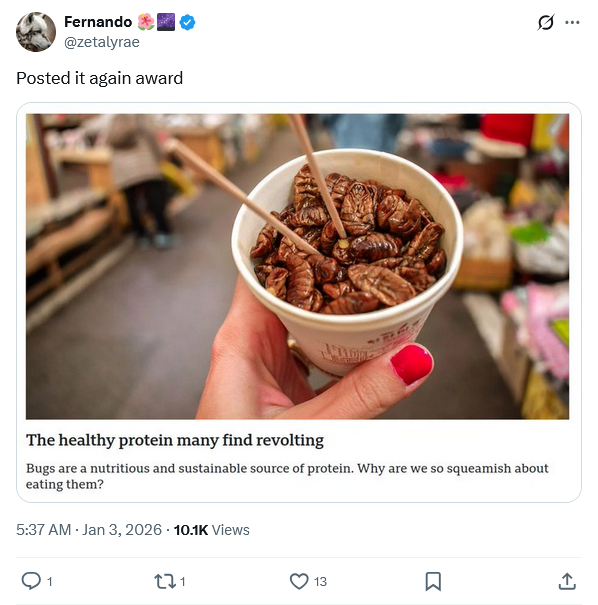
However, even the powers-that-be can’t magically create economic conditions in which insect factories earn profits:

In the renewable frenzy of the early 2020s Ÿnsect raised €600 million to “Reinvent the food chain” and pioneer alternative foods that “respect the planet’s boundaries”. Some $200 million of their funding came from hapless taxpayers somewhere. But in record time, seemingly before it began, it has already gone. Bankrupted. And not because people don’t want to eat mealworms (which they don’t) but because there wasn’t much market in making animal feed either. It turns out that farm owners didn’t want to spend 2 to 10 times as much on “sustainable” cattle fodder. So the company shifted focus to high end pet food, where besotted owners have money to spare, but that crashed too.
h/t Tom Nelson
How reality crushed Ÿnsect, the French startup that had raised over $600M for insect farming
By Anna Heim, TechCrunchThe company’s demise is hardly a surprise, as Ÿnsect had been embattled for months. Still, there is plenty to unpack about how a startup can go bankrupt despite raising over $600 million, including from Downey Jr.’s FootPrint Coalition, taxpayers, and many others.
Ultimately, Ÿnsect failed to fulfill its ambition to “revolutionize the food chain” with insect-based protein. But don’t be too quick to attribute its failure to the “ick” factor that many Westerners feel about bugs. Human food was never its core focus.
It’s only money …
And revenue was the problem. According to publicly available data, Ÿnsect’s revenue from its main entity peaked at €17.8 million in 2021 (approximately $21 million) — a figure reportedly inflated by internal transfers between subsidiaries. By 2023, the company had racked up a net loss of €79.7 million ($94 million).
The vainglorious heady days of climate communism meant some bureaucrats thought it made sense to spend $200 million dollars feeding bugs to cows to try to change rainfall in 2100 AD.
January 1, 2026
New Year’s Good Luck “Pasta Fazool” (Pasta e Fagioli) – Food Wishes
Food Wishes
Published 31 Dec 2019Scientists will tell you that there’s no way eating pork, beans, and/or greens at the beginning of a new year can bring you good luck and great fortune; but our lab-coated, left-brained friends are missing one very important fact: People who think they’re lucky, are lucky.
For a fully formatted, printable, written recipe, follow this link: https://www.allrecipes.com/recipe/277…
You can also find more of Chef John’s content on Allrecipes: http://allrecipes.com/recipes/16791/e…
December 29, 2025
Will 2026 finally be the year Canada abandons food cartels?
For reasons unknown, Canadian politicians both left and right have been willing to sacrifice almost anything in trade negotiations except the cosy protectionist scheme we call “supply management”, which enriches a tiny number of farmers in Ontario and Quebec by keeping grocery prices significantly higher than the free market price. On his Substack, The Food Professor predicts that Prime Minister Carney will be forced to give up this market-rigging, anti-consumer scheme in the coming year:

Image from Agri-Food Analytics Lab, Dalhousie University
As we enter 2026, several forces are converging to reshape Canada’s food economy. Consumer empowerment — amplified by social media — continues to accelerate, while geopolitics, particularly tensions with our southern neighbour, are becoming increasingly disruptive. Together, these dynamics will push food policy issues that once lived in technical silos into the public spotlight.
At the top of that list sits CUSMA and supply management. Prime Minister Carney has signaled firmness on market access, backed by legislation that shields supply management from parliamentary debate. That protection, however, is unlikely to endure. Even if the United States has little genuine interest in exporting more dairy to Canada — and even if Canadian consumers show limited appetite for it — President Trump now understands, far better than during his first term, that supply management is a potent political wedge. The system protects roughly 9,400 dairy farmers who exert disproportionate influence over agricultural policy, while compensation payments continue to flow without any meaningful reduction in production or market share. For a growing number of Canadians, this arrangement increasingly resembles a closed loop rather than a public good. The irony is that global demand for dairy is rising and Canadian milk should be part of that growth story. Instead, the system prioritizes insulation over ambition — a missed opportunity at a time when competitiveness should matter most.
January 1 also marks the formal implementation of new front-of-package nutrition labels. Although these symbols have been appearing on shelves for some time, many consumers either overlook them or misunderstand their purpose. Their real impact has been largely invisible to the public: they have already reshaped how food companies formulate products, invest in research, and redesign portfolios. Whether the labels meaningfully change consumer behaviour remains debatable, but their influence on product development is no longer.
[…]
Finally, 2026 coincides with the United Nations’ International Year of Rangelands and Pastoralists — a timely moment to reset the debate around meat consumption and livestock production. Rangelands underpin global meat systems by converting grasslands — often unsuitable for crops — into high-quality protein. In a world where demand for animal protein continues to grow, portraying livestock as inherently incompatible with sustainability ignores nutritional, economic, and ecological realities. Well-managed grazing supports rural livelihoods, strengthens export economies, and can enhance biodiversity and soil health rather than undermine them. If policymakers are serious about food security, climate resilience, and affordability, 2026 should mark a shift away from apologizing for meat production and toward recognizing livestock as a strategic pillar of resilient food systems — not a sector to be regulated out of existence
What Are Sugar Plums? How to make real Victorian sugar plums
Tasting History with Max Miller
Published 10 Dec 2024Purple, green, yellow, red, blue, and white hard candies with cherry centers
City/Region: United States of America
Time Period: 1865Sugar plums go hand-in-hand with Christmas, but what exactly are they? There are recipes out there for a confection made of dried fruit and nuts that’s rolled into balls, but true Victorian sugar plums were a kind of candy made up of layers of hardened sugar syrup and gum arabic surrounding a fruit or nut core. They were pretty much the same thing as Jordan almonds.
You won’t find many recipes for them in Victorian-era cookbooks because no one really made them at home. The specialized equipment and labor involved meant that most people bought them from a confectioner, and I can see why.
Making these was a three-day endeavor for me, and I had to get a panning machine attachment for my stand mixer, and gum arabic, which I surprisingly didn’t already have in my pantry. They’re a nice sweet treat, but really more trouble than they’re worth to make at home.
Cherry Sugar-Plums. Set preserved cherries on a sieve in the stove. When they are partly dry, mix them with pounded sugar, and rub them over a sieve; dry them again, and proceed as with barberry sugar-plums.
Barberry Sugar-Plums. Take perfectly ripe barberries, stem them, dry them in a stove, and add the gum and sugar in the swinging basin. To accomplish this, after being heated in the stove, give them a coating of one part sugar, and one part gum arabic; and, when thoroughly moistened, powder with sifted sugar. Dry the coating in a stove; add a second on the next day, so as to completely cover the fruit; then thicken, and finish like the verdun sugar-plums. The fruit must be coated away from the fire. They are colored like the rose sugar-plums, and pearled like the lemon.
— The Art of Confectionery, 1865
December 26, 2025
QotD: In defence of fruitcake
To start, fruitcake has two important things going for it:
- Fruit.
- Cake.
As we all know, fruit is healthy. We are constantly being badgered by dietary experts to eat more fruit. What better source of fruit is there than fruitcake? Besides every other source, I mean.
I do think it’s important here to dispel an enduring myth that the fruit in today’s modern fruitcakes is infused with colossal amounts of sugar.
That is a lie.
It is glacéed with colossal amounts of sugar, which is an entirely different process that involves speaking French.
Okay, I am willing to admit that the fruit you typically find in fruit cake these days, assuming you find any, has been … glacéed with so much sugar it resembles Gummies more than fruit, but that’s not what’s important. What’s important is that it has the word “fruit” in it, so when your doctor asks you if you’ve been eating fruit you can give him an answer that won’t necessarily require a visit to confessional both and a half dozen Our Fathers.
[…]
Fruitcake has a long history, dating back as far as the Egyptians and has played a role in shaping our lives to this very day. Roman legions used an early form of fruitcake called satura to fuel their expansion. Did they rely on kale salads and quinoa? No, otherwise we’d all be speaking German by now. Or something.
Fruitcake is versatile as well, appropriate for both breakfast and dessert, bookending your busy day. Plus, how many desserts can you wrap up and give as an actual gift as opposed to just something you bring to a dinner party? Let’s just say you aren’t going to drop banana pudding in a FedEx box.
And yes, all jokes aside, it really can be used as a doorstop. You can’t say that about peach flambé, if only for the safety hazard.
“One of our writers was crazy enough to pen this defense of fruitcake, God bless him”, Not the Bee, 2022-12-19.
December 25, 2025
QotD: Christmas dinner
It is a simple recipe for happiness. First the meal, then the antidote, then another meal. The ancient Romans were the great masters of this technique. However, having just looked up the word vomitorium in the Latin dictionary, I find that after all it does not mean a place where you went to be sick after dinner. So perhaps this was not a normal feature of every Roman home, as is commonly believed.
Implied in the above-mentioned advertisement is the notion that a good meal means a meal at which you overeat yourself. In principle I agree. I only add in passing that when we gorge ourselves this Christmas, if we do get the chance to gorge ourselves, it is worth giving a thought to the thousand million human beings, or thereabouts, who will be doing no such thing. For in the long run our Christmas dinners would be safer if we could make sure that everyone else had a Christmas dinner as well. But I will come back to that presently.
The only reasonable motive for not overeating at Christmas would be that somebody else needs the food more than you do. A deliberately austere Christmas would be an absurdity. The whole point of Christmas is that it is a debauch — as it was probably long before the birth of Christ was arbitrarily fixed at that date. Children know this very well. From their point of view Christmas is not a day of temperate enjoyment, but of fierce pleasures which they are quite willing to pay for with a certain amount of pain. The awakening at about 4 a.m. to inspect your stockings; the quarrels over toys all through the morning, and the exciting whiffs of mincemeat and sage-and-onions escaping from the kitchen door; the battle with enormous platefuls of turkey, and the pulling of the wishbone; the darkening of the windows and the entry of the flaming plum pudding; the hurry to make sure that everyone has a piece on his plate while the brandy is still alight; the momentary panic when it is rumoured that Baby has swallowed the threepenny bit; the stupor all through the afternoon; the Christmas cake with almond icing an inch thick; the peevishness next morning and the castor oil on December 27th — it is an up-and-down business, by no means all pleasant, but well worth while for the sake of its more dramatic moments.
Teetotallers and vegetarians are always scandalized by this attitude. As they see it, the only rational objective is to avoid pain and to stay alive as long as possible. If you refrain from drinking alcohol, or eating meat, or whatever it is, you may expect to live an extra five years, while if you overeat or overdrink you will pay for it in acute physical pain on the following day. Surely it follows that all excesses, even a one-a-year outbreak such as Christmas, should be avoided as a matter of course?
Actually it doesn’t follow at all. One may decide, with full knowledge of what one is doing, that an occasional good time is worth the damage it inflicts on one’s liver. For health is not the only thing that matters: friendship, hospitality, and the heightened spirits and change of outlook that one gets by eating and drinking in good company are also valuable. I doubt whether, on balance, even outright drunkenness does harm, provided it is infrequent — twice a year, say. The whole experience, including the repentance afterwards, makes a sort of break in one’s mental routine, comparable to a week-end in a foreign country, which is probably beneficial.
George Orwell, “In praise of Christmas”, Tribune, 1946-12-20.
December 24, 2025
QotD: Moderation for the inveterate port fan at Christmas
A nice spätburgunder, the delightful German word for pinot noir, would be a good alternative. Or perhaps an English red. They’re not easy to find or cheap but I can thoroughly recommend the 2020 pinot noirs from Gusbourne in Kent and Danbury Ridge in Essex.
With the turkey, keep the pork accessories to a minimum. Don’t sneak into the kitchen to polish off the pigs in blankets. Instead have lots of vegetables, but do not have seconds, no matter how tempting that might be. As for Christmas pudding, avoid, avoid, avoid. Maybe a crumb for appearances’ sake. But you must resist the sweet wine. I’m a sucker for a nice monbazillac but I’ve decided you don’t need port and sweet wine, and I’m going for the port. Eyes on the prize and all that.
The strategy is to reach the port and stilton course having consumed no more than the equivalent of one bottle of wine. Ideally less. If you’ve had two, that’s too much. Go for a walk.
Assuming you’ve reached this stage soberish and with a stomach that’s not rebelling, that doesn’t mean that you can suddenly channel your inner Georgian squire when the decanter comes round. Don’t be like John Mytton, one time MP for Shrewsbury, who arrived at Cambridge University with 2,000 bottles of port: unsurprisingly he didn’t graduate. He was notorious for drunken antics such as setting fire to his nightshirt in a bid to cure hiccups and once rode a bear into a dinner party for a jape. We’ve all had that urge after too much port.
It might seem heretical, but you don’t need to finish off the decanter at the table. A vintage port should be good for four or five days, whereas tawny lasts for weeks, so you can keep coming back to it. If there are only a few port fans in the family, it’s worth opening a bottle on Christmas Eve and having a glass or two. Then if you do decide to polish it off while outlining your plan for getting the British economy back on track, there won’t be quite so much in the bottle. Oh, and tiny glasses, please. Think Russell Crowe and Paul Bettany in Master and Commander.
When lunch is over, say no to coffee and find somewhere to have a nap until it’s time for a cup of tea. Try to avoid eating or drinking alcohol again for the rest of the day. But who am I kidding, I’ll probably open a bottle of Beaujolais to go with my turkey sandwich. And maybe a little port and Stilton. But nothing after nine o’clock. That is very important.
And so to bed for a good night’s sleep and awake rested, if not quite refreshed, and without an angry wife glaring at me. That’s the plan anyway.
Henry Jeffreys, “How to drink port without the storm”, The Critic, 2022-12-09.
December 23, 2025
Christmas Cookies – You Suck at Cooking (episode 120)
You Suck At Cooking
Published 23 Dec 2020This sugar cookie recipe is super easy, just like things that aren’t difficult. They also have something in common with Christmas cookies: you can find them both on planet earth, which is the fifth largest planet in our solar system.
1/2 pound softened butter
1 cup of sugar
cream them together with your gyrowangucopterlatorThen add:
1 jangled egg
3 tablespoons milk
1 teaspoon of vanilla extract
then rejangle with your handheld copterwanglerIn another bowl sift together:
3 cups all purpose flour
¾ teaspoon baking powder
1 teaspoon saltthen dump the baking snow onto your butter cloud and recopterize with your dough typhoon but feel free to fold it together with your spatulator first to avoid a dust storm
At this point you should have dough but if you doughn’t then add another tablespoon of milk until you have dough (and if you have goo try adding some more wheat dust)
lay the dough down to sleep on plastic wrap (one folded sheet) then throw it in the
temperature reducer for an hour or twothen remove it from the heat remover and if it’s really cold let it warm up a bit, otherwise start
pressing and rolling it out until it’s 1/4 inch thick unless you’re not making cookiesthen just do your thing, you know, making shapes and whatnot and bake them for 12 minutes on 350
If you want to make icing take 1 cup of powdered sugar and add a couple teaspoons of corn syrup and a couple teaspoons of water … you can add more corn syrup and less water or just keep adding corn syrup, it’s really up to you. I did one where all I added was maple syrup and that was interesting although you can barely taste the maple over the powdered sugar, but what I learned from this is holy cow does corn syrup ever taste good. As an adult I’ve been in this mentality that corn syrup is the worst and why would you ever eat that and I tasted it for the first time in years and it was like eating caramel for the first time. I think I chugged that stuff when I was a kid and wanted candy because it’s liquid candy. Anyway, what I’m saying is I recommend corn syrup. Even though it comes from corn, which is not recommended.
December 22, 2025
QotD: Wine and vegetarianism
Jay McInerney, Bacchus & Me: Adventures in the Wine Cellar.
December 20, 2025
Christmas During the Great Depression
Tasting History with Max Miller
Published 17 Dec 2024Gelatinous Christmas pudding with chocolate, nuts, dried fruit, and whipped cream
City/Region: United States of America
Time Period: 1931During the Great Depression, making Christmas festive was more important than ever. Homemade gifts, cards, and decorations defined the season when money was tight for everyone. Many people who lived through the Great Depression recalled that no matter what, Christmas dinner was special.
This recipe from 1931 comes from a radio program hosted by the fictional character Aunt Sammy, who was supposedly the wife of Uncle Sam. I’m not quite sure how this Christmas pudding was much less expensive than a traditional boiled pudding, but it’s an interesting change nonetheless. I like the flavors of the chocolate and fruit coming through, though I do wish the texture was a little smoother.
There are twelve ingredients. Quite a lot to write down but I’ll go slowly.
2 tablespoons of granulated gelatin
1 cup of cold water
1 pint of milk
1 cup of sugar
1 and 1/2 squares of chocolate
1 cup of seeded raisins
3/4 of a cup of dates
1/2 cup of nuts
1/2 cup of currants, and
3 egg whitesThat’s a long list. I’ll go over it again while you check. (Repeat)
To make this pudding, first soften the gelatin in the cold water for ten minutes. While the gelatin is soaking, melt the chocolate with part of the sugar. When it is melted, add a little of the milk, just enough to make a smooth paste. Put the rest of the milk in the upper part of the double boiler. When the milk is hot, add to it the melted chocolate. Then the sugar and salt. And, finally, the soaked gelatin. Stir the mixture. Then remove it from the fire. Set it away to grow cold. When it begins to thicken, add the vanilla, the fruit, and the chopped nut meats. Then fold in the beaten egg whites.
Now turn the mixture into a wet pudding mold decorated with whole nut meats and raisins. Set the mold in the refrigerator or other cold place, to chill. When the pudding is cold and firm, and it is time for serving at dinner, turn it out on a pudding plate or platter. Garnish it with sprigs of holly. A wreath of holly springs around the edge and one stuck in the top makes it look like a real Christmas pudding.
Serve the pudding with whipped cream, sweetened and flavored with vanilla, or with a currant jelly sauce.
— Aunt Sammy, December 1931
December 15, 2025
How to Eat Like an Ancient Stoic
Tasting History with Max Miller
Published 8 Jul 2025Lentil soup with leeks, coriander seeds, and herbs
City/Region: Greece | Rome
Time Period: 3rd Century B.C.E. | 1st CenturyThe ancient stoics were all about being happy with what you’ve got. If one could learn to take pleasure in eating simple foods like lentil soup and barley bread (usually eaten by the poorest members of society), then they would have more happiness than if they constantly craved luxurious food. Granted, most of these philosophers were wealthy, so they didn’t actually have to live like the very poor.
The ancient Greek stoic philosopher Zeno of Citium was known for carrying around lentil soup in a clay pot, and that was probably just lentils boiled in water. This recipe, adapted from ancient Rome’s Apicius from a few centuries later, is a little fancier, but still rather simple and uses ingredients that would have been available to Zeno. Despite its simplicity, it’s surprisingly delicious with a hint of sweetness, oniony leek, and the cooling effect of the mint.
Boil the lentils; when skimmed, put in leeks and green cilantro. Pound coriander-seed, pennyroyal, silphium, mint, and rue, moisten with vinegar, add honey, blend with garum, vinegar, and defrutum. Pour over the lentils, add oil, serve.
— Apicius, de re coquinaria, 1st Century


