
World War Two
Published 24 May 2025Indy and Sparty handle your questions on the German intervention in North Africa. Why did Rommel make such an impact so quickly? What was the war like for the local populations? How deeply involved was Rommel in the persecution of North African Jews?
(more…)
May 25, 2025
Rommel’s Dark Secrets in North Africa – WW2 Fireside Chat
Comments Off on Rommel’s Dark Secrets in North Africa – WW2 Fireside Chat
When NATO “stopped being an effective military alliance” and instead “became a kind of social club”
In UnHerd, Edward Luttwak says that Europe (however you might prefer to define it) needs a new Great Power:

All through European history, the intervals of peace, during which reconstruction and progress overcame the ravages of war, were secured by a temporary equilibrium between the Great Powers of the day.
It is obvious that there was no such equilibrium on 23 February 2022, when Russian columns started rolling towards Kyiv, and Russian President Vladimir Putin had just described Ukraine not merely as Russian, but as the homeland of the very first Russian state: Kievan Rus’.
[…]
But when the moment came, and Russian tanks rolled into Ukraine, there was no cohesive and determined power ready to respond quickly and effectively. Nato had done just that several times during the Cold War, by promptly reinforcing threatened allies with thousands of air-lifted troops from the so-called “Allied Command Europe Mobile Force”.
That, however, was the old, pre-enlargement Nato, which was still a veritable military alliance of countries capable of defending themselves, and help weaker allies in trouble, and whose chronically weak Mediterranean member states, with the most resplendent uniforms and least combat strength, had no Russian troops on their borders.
But once very deserving yet utterly indefensible countries such as Estonia were included in Nato — along with Poland, which mustered just 42,000 combat soldiers out of its population of 33 million a mere three months before Putin’s full-scale invasion began — it stopped being an effective military alliance.
Instead, it became a kind of social club. The Nato calendar is full of meetings at the “Supreme Allied Headquarters” in Mons in Belgium, where all manner of military and related issues are addressed often very professionally and quite freely — except that nobody is allowed to mention, however politely, even the most glaring military shortcomings of fellow allies, which undermine important war plans.
The highpoint of the Nato calendar is the splendid summits with all flags flying, in which the arrival of new countries is greatly celebrated, regardless of their ability to actually defend themselves. Both heads of state and heads of government are invited to those gatherings on the premise that there is strength in numbers, with no concerns about the inherent difficulty of reaching any agreements in such a vast crowd.
In the last summit, held in Washington DC in July 2024, Biden’s confusion of President Zelensky with Putin added a touch of humour to otherwise gloomy proceedings: nobody in attendance offered any suggestions on how to end the war in Ukraine.
What proves that Nato is no longer a genuine military alliance was that nothing was done in the last pre-war days before Putin’s invasion finally began. The satellite intelligence that revealed Russian forces on the move also showed that they were already in assault formations. But even then, five days remained to fly fighter-bomber squadrons to forward bases.
Yet even inaction would have been better than what actually happened. Instead of ordering the rapid deployment of tactical airpower to bases in Germany, Italy and the United Kingdom, the Biden administration instead evacuated US diplomats from Kyiv, starting a panic that induced the evacuation of some 20 other diplomatic missions.
Comments Off on When NATO “stopped being an effective military alliance” and instead “became a kind of social club”
BD-44: The New Semiauto Sturmgewehr from D-K Productions
Forgotten Weapons
Published 13 Jan 2025D-K Productions is a collaboration between the German company Sport System Dittrich (SSD) and an American partner. SSD has been making reproductions of German World War Two small arms for something like 20 years — including Sturmgewehrs. Their guns are really good recreations of the 1940s originals, but there have long been issues importing them into the US. This was solved at last by forming a US company and doing the receiver manufacturing here in the States. While the company has plans to offer a whole bunch of different models, the one currently available is the BD-44, a copy of the standard production model of MP-44/StG-44.
I was really impressed by the use of not-finish-machined forgings for parts like the stacking rod and gas block, correctly duplicating the original German production. The stampings look good, and the handling matches the original guns (don’t expect it to be AR-level ergonomic!). The gut “feel” of the gun is an excellent match for an original MP-44. The 8×33 chambering and use of original magazines (alongside new-production magazines made by D-K) is the correct choice, of course.
I did not like the mismatch between the magazine well and magazine stops, and I did have a couple malfunctions in the two magazines I ran through it so far. Note that the gun I have at the range is my second one; the first one (which is what you see on the table) had consistent feed problems and D-K replaced it when I sent it back to them.
Whether the gun is worth the steep asking price is a personal decision, naturally. Hopefully this video gives you the information necessary to make your decision if you were considering getting one!
(more…)
Comments Off on BD-44: The New Semiauto Sturmgewehr from D-K Productions
May 24, 2025
German democracy trembles as the extremely extreme extreme right AfD aren’t going to be banned
eugyppius updates us on the continued shaky state of German democracy, as the scary extremely extreme right Alternative für Deutschland (AfD) party seems to have somehow escaped being banned from participation in politics due to some ridiculous “lack of substantive evidence” excuse:
Last week, a supersecret assessment of Alternative für Deutschland by the Federal Office for the Protection of the Constitution (BfV) leaked to the press. This document was supposed to prove, in excruciating detail, why the AfD are so evil and so fascist and so Nazi and so Hitler, and in this way make a preliminary case for banning the party. In fact its contents turned out to be such an arrant joke that it sapped all remaining momentum within the German political class to prohibit the AfD. I suspect even the “right-wing extremist” classification of the AfD is now in jeopardy and may well be thrown out by the courts, that is how bad this much-heralded supersecret assessment turned out to be.
It took a few days for the full impact of the report’s idiocy to really sink in. That’s how it is with really stupid things – the incredulity they inspire must first dissipate. Finally, though, on Tuesday of this week, Interior Minister Alexander Dobrindt announced that the dubious evidence marshaled by the BfV was “not sufficient” to support ban proceedings. Dobrindt also said that the whole debate had become “counterproductive” and that it was time to begin finding ways to “end social polarisation”, whatever that means. Hours later, it emerged that Chancellor Friedrich Merz had ordered the entire CDU leadership never to say another word about banning the AfD. If everyone will just shut up, Merz believes his party can “avoid further debate” and avoid “giving voters the impression that the CDU is aiming to eliminate a rival party” – which is of course exactly what the CDU were hoping to do until the BfV fucked everything up with their retarded 1,108-page collection of dyspeptic Facebook-grade political takes.
There’s still a few scattered calls for ban proceedings coming from the left, but their heart isn’t in it and they don’t matter anyway. Without Union votes, no ban application will ever get to the Federal Constitutional Court in Karlsruhe. Raed Saleh, an extremely obnoxious politician who heads the SPD faction in the Berlin House of Representatives, whined to the press this morning about how “appalling and disgraceful” it is that outlawing the opposition is no longer on the table and that his party is now being asked to “engage in political debate” with the AfD instead. Federal Justice Minister Stefanie Hubig, also of the SPD, likewise fervently hopes that the AfD might still be banned and she thinks the Interior Ministry should spend more time “evaluating” that BfV dumpster-fire assessment. Since Hubig is Justice Minister and not Interior Minister it doesn’t really matter what she thinks the Interior Ministry should be doing. I don’t understand why so many are citing Hubig’s remarks like they mean anything.
The implosion of this ban-the-AfD arc seems like kind of a big deal to me. Since 2021, the party have been “under suspicion” of right-wing extremism, but despite four years of snooping the BfV have been able to come up with nothing that is not some combination of legally irrelevant, harmless, banal, uninteresting, stupid and a complete waste of government resources. At some point, you have to put the question: If the AfD are so evil and so Nazi and so fascist and so Hitler, why can’t anybody, anywhere, adduce any evidence of their evil Nazi Hitler fascism?
Comments Off on German democracy trembles as the extremely extreme extreme right AfD aren’t going to be banned
History of Britain, II: Stonehenge; The Druids, Vates, and Celtic Religion
Thersites the Historian
Published 15 Jan 2025In this episode, I briefly examine the presence of prehistorical megaliths on the British Isles and talk about the religion of the Celts, which was ascendant at the time that Britain entered entered the historical record.
Comments Off on History of Britain, II: Stonehenge; The Druids, Vates, and Celtic Religion
QotD: Comparing living standards and technology between the Roman period and medieval western Europe
The first crucial question here is exactly when in the Middle Ages one means. There is a tendency to essentialize the European Middle Ages, often suggesting that the entire period reflected a regression from antiquity, but the medieval period is very long, stretching about a thousand years (c. 500 to c. 1500 AD). There is also the question of where one means; the trajectory of the eastern Mediterranean is much different than the western Mediterranean. I am going to assume we really mean western Europe.
While I am convinced that the evidence suggests there was a drop in living standards and some loss of technology in the immediate aftermath of the collapse of the Roman Empire in the West, most of that drop was fairly short-lived. But exactly when development in medieval Europe meets and then exceeds the same for antiquity (typically we’re comparing the second century height of the Roman Empire) also depends on exactly what kind of measure is being used.
If the question, for instance, is agricultural productivity on a per capita basis (the most important component of per capita economic production), medieval Europe probably moves ahead of the Roman Empire fairly quickly with the introduction of better types of plow and widespread use of watermills for grinding grain. My understanding is that by c. 1000 AD, watermills show up fairly frequently in things like monastic charters, suggesting they were reasonably widespread (the Romans used watermills too, though their spread was uneven) and by that point, plow technology had also moved forward, mostly through the development of plow types better suited to Europe’s climate. So as best we can tell, the farmer of c. 1000 AD had better tools than his Roman predecessors and probably had such for some time.
If the question is technology and engineering, once again what you see depends on where you look. Some technologies don’t appear to have regressed much, if at all, ironworking being one example where it seems like little to nothing was lost. On the other hand, in western Europe, the retreat in architecture is really marked and it is hard to say when you would judge the new innovations (like flying buttresses) to have equaled some of the lost ones (like concrete); certainly the great 12th/13th century Cathedrals (e.g. Notre Dame, the Duomo di Sienna and I suppose the lesser Duomo di Firenze, if we must include it) seem to me to have matched or exceeded all but perhaps the biggest Roman architectural projects. Though we have to pause here because in many cases the issue was less architectural know-how (though that was a factor) as state capacity: the smaller and more fragmented states of the European Middle Ages didn’t have the resources the Roman Empire did.
If one instead looks for urbanization and population as the measure of development, the Middle Ages looks rather worse. First and Second century Rome is probably unmatched in Europe until the very late 1700s, early 1800s, when first London (c. 1800) and Paris (c. 1835) reach a million. So one looking for matches for the large cities and magnificent municipal infrastructure of the Romans will have rather a long wait. Overall population is much more favorable as a measurement to the Middle Ages. France probably exceeds its highest Roman population (c. 9m) by or shortly after 1000AD, Italy (c. 7.5m) by probably 1200; Spain is the odd one out, with Roman Hispania (est. 7.5m) probably only matched in the early modern period. So for most of the Middle Ages you are looking at a larger population, but also a more rural one. That’s not necessarily bad though; pre-modern cities were hazardous places due to sanitation and disease; such cities had a markedly higher mortality, for instance. On the flip-side, fewer, smaller cities means less economic specialization.
So one’s answer often depends very much on what one values most. For my own part, I’d say by 1000 or 1100 we can very safely say the “recovery” phase of the Middle Ages is clearly over (and I think you could make an argument for setting this point substantially earlier but not meaningfully later), though even this is somewhat deceptive because it implies that no new technological ground was being broken before then, which is not true. But the popular conception that the whole of the Middle Ages reflects a retreat from the standards of antiquity is to be discarded.
Bret Devereaux, “Referenda ad Senatum: August 6, 2021: Feelings at the Fall of the Republic, Ancient and Medieval Living Standards, and Zombies!”, A Collection of Unmitigated Pedantry, 2021-08-06.
Comments Off on QotD: Comparing living standards and technology between the Roman period and medieval western Europe
May 23, 2025
Did Germany Just Choose a King? – Rise of Hitler 17, May 1931
World War Two
Published 22 May 2025May 1931: 150,000 Stahlhelm men parade through Breslau before Crown Prince Wilhelm and other imperial relics, reviving monarchist hopes. Hitler hails his SA and calls for eastern expansion. But it’s economic collapse that dominates — Austria’s top bank nears default, threatening Germany’s own system. As Berlin pushes for a reparations pause and clings to its customs union with Vienna, France stands firm. And in Oldenburg, the Nazis take their first Landtag.
(more…)
Comments Off on Did Germany Just Choose a King? – Rise of Hitler 17, May 1931
Bill Bailey – The Doctor Who theme re-imagined as Belgian jazz
Royal Ballet and Opera
Published 29 Jul 2021Comedian Bill Bailey re-imagines the Doctor Who theme as Jacques Brel-esque Belgian jazz. Taken from his DVD Bill Bailey’s Remarkable Guide to the Orchestra.
Comments Off on Bill Bailey – The Doctor Who theme re-imagined as Belgian jazz
May 22, 2025
Lucy Connolly, political prisoner
I’m no firebrand on social media — I’d probably have a lot more followers if I were — but I can easily imagine a situation like the one that got Lucy Connolly sent off to the British gulags for an ill-judged social media post:
In what has become an emblematic case of the UK’s betrayal of free speech, Lucy Connolly has now lost her appeal for early release. This mother and childminder had posted an offensive tweet in the direct aftermath of the Southport murders, in which a psychopath brutally attacked children with a knife at a yoga class. She had believed the false claim that the perpetrator was an asylum seeker, and written online that she had no objection to people burning down hotels where immigrants were residing.
The tweet was taken as evidence that Connolly had intended to “stir up racial hatred” and incite violence during the febrile climate of the summer riots. It had been deleted within hours, no violence occurred as a result, and yet she was sentenced to 31 months in prison. Given that the severity of Connolly’s sentence was doubtless related to unofficial government pressure on the judiciary, many have made the case that Connolly is a political prisoner.
For all our shared revulsion at the tweet, we must remember that we are still talking here about words, not actions. It was completely right that Philip Prescott, a man who attacked a mosque as part of a mob during the riots, was sentenced to 28 months in jail. But Connolly has received an even longer sentence having committed no acts of violence at all. Many rapists and paedophiles have been treated far more leniently. I know of no sound argument that could possibility justify this state of affairs. It is the very definition of two-tier justice.
Let’s get the caveats out of the way. Nobody is defending what Connolly wrote. It was unpleasant, rash, misjudged, and much else besides. Here is the post in full.
Grim stuff. But it by no means fulfils any serious definition of incitement to violence. For one thing, she is not calling on hotels to be torched, but is rather making clear that she would not care if that occurred. This distinction is key, but has been overlooked. Moreover, Connolly has zero influence or clout. It is not as though anyone reading this could have taken it as an instruction or order and acted accordingly. Those wishing to appreciate the full context of why Connolly behaved as rashly as she did should read this excellent piece by Allison Pearson for The Telegraph.
It should go without saying that in a free society some people are going to say ghastly things. That’s the price we pay for liberty. The judge in this case made a statement in his ruling that has been widely interpreted as political: “It is a strength of our society that it is both diverse and inclusive. There is always a very small minority of people who will seek an excuse to use violence and disorder causing injury, damage, loss and fear to wholly innocent members of the public and sentences for those who incite racial hatred and disharmony in our society are intended to both punish and deter.”

Comments Off on Lucy Connolly, political prisoner
Landstad 1900: A True Semiautomatic Revolver
Forgotten Weapons
Published 3 Jul 2024The Landstad Model 1900 is a magazine-fed, semiautomatic revolver designed by Norwegian Halvard Folkestad Landstad, who lived in Kristiana (now called Oslo). He designed the gun on his own dime, and presented it to military trials in 1901, which it failed miserably. The gun has a six-round detachable box magazine of 7.5mm Nagant cartridges, a two-chamber cylinder, and a simple blowback action. Its firing cycle is to chamber a round from the magazine into the bottom cylinder chamber by manually cycling the action. The trigger is a long double-action type which rotates the cylinder 180 degrees so the cartridge is in line with the barrel and releases the striker to fire the round. Upon firing, the bolt cycles open, extracting and ejecting the empty case, rechecking the striker, and chambering a new round from the magazine into the bottom of the cylinder.
The purpose of this overly complex system was to provide a semiauto action which did not ever leave a live cartridge under the striker, in the name of safety. Only one example was made, and its bolt broke after just 5 or 6 rounds fired. It was repaired almost immediately, but the Norwegian military had was not interested in further development, and nothing more came of the program. A few years later in 1908 Norway would institute a more serious semiauto pistol trials program which led to adoption of the Kongsberg 1914 (a slightly modified Colt 1911).
Thanks to Jan for allowing me to disassemble and film this one-of-a-kind piece for you!
(more…)
Comments Off on Landstad 1900: A True Semiautomatic Revolver
May 21, 2025
The Korean War Week 48 – Cut Off. Outnumbered. Doomed – May 20, 1951
The Korean War by Indy Neidell
Published 20 May 2025The Chinese Spring Offensive reignites, and it does so with a vengeance, kicking straight into high gear, and also totally surprising the UN forces by hitting them heavily much further east than they had ever expected — in the high Taebacks. Units find themselves, cut off, sandwiched, or broken … although a redeployment means that already by the end of the week, a UN counterattack is in the cards.
Chapters
00:00 Intro
00:50 Recap
01:28 The Offensive Begins
07:39 Van Fleet Reorganizes
11:03 ROK 3rd Corps Breaks
12:55 A Counteroffensive
14:13 The Joint Chiefs Speak
16:31 Summary
16:46 Conclusion
(more…)
Comments Off on The Korean War Week 48 – Cut Off. Outnumbered. Doomed – May 20, 1951
The Butt Report – Nadir of the RAF – The Bomber War Episode 3
HardThrasher
Published 15 Dec 2023As the powers that be on YT have decided that this video is Evil and naughty they’ve removed the ads — which, like, is great from your point of view but a bit shite from mine. So if you wanted to it’d be awesome if you’d consider either hitting the Super Thanks button or consider becoming a super cool kid and joining my Pateron.
If you’d like to email me send a message to lordhardthrasher@gmail.com
In this episode, the Butt Report, what happened next and the arrival of Bomber Harris. Despite this being more than 50 minutes, I’ve skipped some detail e.g. The Singleton Report which basically said “eh – bit difficult this bombing thing” nor Tizard’s rubbishing of Cherwell’s Memorandum, nor really the detail of the Cherwell Memorandum. You’ll live. However if you want more on the subject then I recommend the Official History of Bomber Command to get more into the civil service fire fights.
(more…)
Comments Off on The Butt Report – Nadir of the RAF – The Bomber War Episode 3
May 20, 2025
The Death of Marat
Daniel Jupp uses the famous Jacques-Louis David painting of the 1793 assassination of French revolutionary leader Jean-Paul Marat by Charlotte Corday to illuminate the twisted dealings of the various radical factions within the larger revolutionary movement:
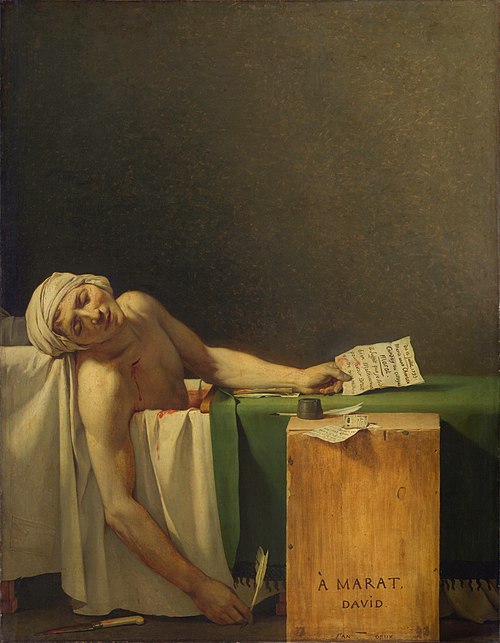
La Mort de Marat (The Death of Marat) by Jacques-Louis David (1748-1825)
From the Royal Museums of Fine Arts of Belgium via Wikimedia Commons.
One of the most famous and celebrated works of art in European history is a painting about a political assassination. That painting is The Death of Marat (La Mort de Marat in French) by Jacques-Louis David. It was painted in 1793. David was already one of the most respected French artists of the 18th century, a leader of French Neoclassical art. He was also himself a political figure, a prominent member of the Montagnard faction (itself a subset of the Jacobins) and a member of the revolutionary Committee of General Security.
It’s an overtly political painting in every way, created by a man who was as much a French Revolutionary politician as he was an established and esteemed artist. It’s about a shocking political event, and it was crafted as an exercise in propaganda. […] The painting shows us Marat in his bath, immediately after being assassinated by Charlotte Corday on the July 13, 1793. It is a beautifully composed image of political martyrdom. Marat’s posture, for anyone with the slightest awareness of Western art traditions, immediately shows where the sympathies of the artist lie (and also, where the sympathies of the artist lie).
Marat’s pose is, of course, a deliberate mirroring of the pose of Christ in hundreds if not thousands of Western art traditional depictions of the Crucifixion. The pale, slim but muscular figure, marked by the assassin’s blade but in a manner that might be compared to the puncture wound inflicted by the Spear of Longinus or to the stigmata nail wounds of crucifixion on Christ himself, has that peculiar serenity in death that other artists place in depictions of Jesus. The blood is present as proof of supreme sacrifice, but artistically minimised, prevented from distracting from the clean, shining, almost marble-like flesh of the deceased, who is already a kind of heroic statue in repose, fixed for the admiration of the ages. The dead man has a gentle, compassionate smile on his lips, as if interrupted in the process of forgiving his murderer. The angle, the gentleness, the delicacy of it all suggests Christ-like self sacrifice, as if Marat has chosen his death knowingly, given his life willingly.
Here is the martyr of the Revolution. A new Christ, as good as the old one … if not better.
[…]
It’s at this point that we should mention the central dishonesties here. Christian self sacrifice and martyrdom is a very different thing to one politically radical extremist being murdered by another. Marat was, in reality, about as far away from this movingly gentle depiction of him as one could imagine. As one of the most radical and zealous figures of the Revolution, Marat was a lesson for the ages in the exact opposite way to the one that David depicts. He wasn’t a gentle figure of self sacrifice. He wasn’t a Lamb bringing Peace in the manner of Christ. He wasn’t an innocent. He was a brutal, grasping, rapacious sadist. He was one of the leaders of the storming of the Bastille, and that too has symbolic and practical importance – the terrible monarchical regime had hardly anyone in its most hated prison, whereas the Revolutionary “liberators” soon stuffed it full of their political enemies.
Even at a point where many murders were already being committed, Marat was noted as an unusually brutal proponent of Revolutionary excess. His assassin was from a rival, supplanted Jacobin faction, the Girondists. The Girondists too had supported the earliest uses of violence, riot and uprising within France, and were a “war party” who wanted to export the Revolution abroad and topple monarchical dynasties across Europe. These two factions did not really differ on whether you should murder your political enemies or not, but the Girondists were at times embarrassed by Montagnard violence when it was at its most indiscriminate. The Girondists tended to be the most intellectualised of the Revolutionaries. They were the writers of pamphlets and doctrines of great length and increasingly mind-numbing tediousness. Marat, although also a street-level gutter pamphleteer, was much more of a bloody handed man of action, more akin to a modern terrorist. But the two were aligned in the creation of the bloodshed, even if the Girondins wanted it to be more focused and controlled and ultimately directed outside France:
Temperament largely accounts for the dividing line between the parties. The Girondins were doctrinaires and theorists rather than men of action. They initially encouraged armed petitions, but then were dismayed when this led to the émeute (riot) of 20 June 1792. Jean-Marie Roland was typical of their spirit, turning the Ministry of the Exterior into a publishing office for tracts on civic virtues while riotous mobs were burning the châteaux unchecked in the provinces.
The split between the two factions came to a head as a fall out from the September Massacres of 1792. Marat, a leader of the peasant sans-culottes mobs, was personally engaged in the orgy of bloodshed. Girondist leaders were alarmed, already sensing that previously aligned Revolutionaries or widespread mob violence could turn on them. Typically, the Girondists took defensive measures that were mainly concentrated on written statements, declarations or on bureaucratic ministries, whereas the Montagnards gradually took control of revolutionary militias and the people who were prepared to actually decide, at the point of a sword or via the barrel of a musket, who got killed and when. Neither side could be described as moderates, but one side were more ruthlessly pragmatic, which is why it was the Girondists who ended up being put on the execution lists of the Terror.
At the time that Corday assassinated Marat, Girondists had already been ousted from positions of power and arrested. Marat, along with Danton and Robespierre, was one of their three most prominent denouncers and enemies. Corday stated that she had “killed one man so that 100,000 could be saved”. It’s clear that she had hoped her action would save her arrested Girondin allies and personal friends, but it had the opposite effect and sealed their subsequent trial and executions.
Comments Off on The Death of Marat
The Battle of Aquino
Canadian Tank Museum
Published 13 Jan 2025You may know about AQUINO Tank Weekend at our Museum, but what was the Battle of Aquino? When did it take place? What happened to the Ontario Regiment RCAC during that action?
Enjoy this short documentary with our Curator Sam Richardson as he gives you a detailed look at the situation in May 1944 during the Italian campaign of the Second World War. Learn more about the soldiers that took part, the battle that took place and why it remains important to our Regiment and our Museum.
(more…)
Comments Off on The Battle of Aquino
QotD: The autohagiography of the NHS
I grew up, for example, in the inculcated belief that the National Health Service was, according to the slogan of the time, “the envy of the world”. Millions of people believed this, and indeed it was an assertion heard for many years whenever the subject of health care came up. The slogan was last wheeled out in any force in 2008 for the 60th anniversary of its founding.
Oddly enough, it never occurred to the people who repeated the slogan to examine the basis of the claim. Who, exactly, were the people doing the envying — not just one or two of them, but en masse? It is no doubt true that immigrants from very poor countries were pleased enough to receive care under the NHS, comparing it with what they would have received at home. But is it really much of an achievement for a developed country to have health care better than that offered in Somalia or Bangladesh?
A war of anecdotes, while always gratifying to the human mind, is not the way to decide important questions such as the superiority or inferiority of a system of health care.
It never occurred to those who repeated the “envy” slogan to look to comparable countries across the Channel or North Sea to see whether, in fact, those countries had anything to envy. In fact, between 1948 and 1975, even Spain under Franco performed better in the matter of improving the health of the population than did Britain. In most respects, in fact, Britain lagged or limped behind other countries, always in the rear and struggling to catch up.
What eventually struck me, then, was the willingness of so many people to repeat and believe a slogan without any compulsion whatever to do so, and without the slightest inclination to examine its truth — indeed without any awareness of the need for such an examination. There was no oppressive force to prevent or deter them from intellectual inquiry, but they preferred the comfort the slogan offered to the effort and possible discomfort of finding the truth. The NHS, or rather the idea of the NHS, played the role of teddy bear to a population with many anxieties.
True enough, many individuals may have experienced deficiencies in the service — long waiting times, offhand or disagreeable interactions with the bureaucracy, etc. But like Russian peasants of old who believed that the Tsar knew nothing of the oppression which they suffered, and would have put an end to it if he had known, the British continued to believe that the National Health Service had been born with original virtue and that the defects they experienced were exceptions. Repeated scandals of gross neglect or sub-standard treatment were shrugged off in the same way. And in a certain dog-in-the-manger way, the British were inclined to believe that if the NHS was unpleasant to negotiate, at least (being more or less a monopoly) it was equally unpleasant for everyone. Fairness and justice were equated with equal misery. Anyway, being ill is always unpleasant, so what did anyone expect?
Theodore Dalrymple, “Worshipping the NHS”, New English Review, 2020-05-07.
Comments Off on QotD: The autohagiography of the NHS


