
What is the use of pointing out that a World State is desirable? What matters is that not one of the five great military powers would think of submitting to such a thing. All sensible men for decades past have been substantially in agreement with what Mr. Wells says; but the sensible men have no power and, in too many cases, no disposition to sacrifice themselves. Hitler is a criminal lunatic, and Hitler has an army of millions of men, aeroplanes in thousands, tanks in tens of thousands. For his sake a great nation has been willing to overwork itself for six years and then to fight for two years more, whereas for the common-sense, essentially hedonistic world-view which Mr. Wells puts forward, hardly a human creature is willing to shed a pint of blood. Before you can even talk of world reconstruction, or even of peace, you have got to eliminate Hitler, which means bringing into being a dynamic not necessarily the same as that of the Nazis, but probably quite as unacceptable to ‘enlightened’ and hedonistic people. What has kept England on its feet during the past year? In part, no doubt, some vague idea about a better future, but chiefly the atavistic emotion of patriotism, the ingrained feeling of the English-speaking peoples that they are superior to foreigners. For the last twenty years the main object of English left-wing intellectuals has been to break this feeling down, and if they had succeeded, we might be watching the S.S. men patrolling the London streets at this moment. Similarly, why are the Russians fighting like tigers against the German invasion? In part, perhaps, for some half-remembered ideal of Utopian Socialism, but chiefly in defence of Holy Russia (the ‘sacred soil of the Fatherland’, etc. etc.), which Stalin has revived in an only slightly altered from. The energy that actually shapes the world springs from emotions — racial pride, leader-worship, religious belief, love of war — which liberal intellectuals mechanically write off as anachronisms, and which they have usually destroyed so completely in themselves as to have lost all power of action.
[. . .]
Mr. Wells, like Dickens, belongs to the non-military middle class. The thunder of guns, the jingle of spurs, the catch in the throat when the old flag goes by, leave him manifestly cold. He has an invincible hatred of the fighting, hunting, swashbuckling side of life, symbolised in all his early books by a violent propaganda against horses. The principal villain of his Outline of History is the military adventurer, Napoleon. If one looks through nearly any book that he has written in the last forty years one finds the same idea constantly recurring: the supposed antithesis between the man of science who is working towards a planned World State and the reactionary who is trying to restore a disorderly past. In novels, Utopias, essays, films, pamphlets, the antithesis crops up, always more or less the same. On the one side science, order, progress, internationalism, aeroplanes, steel, concrete, hygiene: on the other side war, nationalism, religion, monarchy, peasants, Greek professors, poets, horses. History as he sees it is a series of victories won by the scientific man over the romantic man. Now, he is probably right in assuming that a ‘reasonable,’ planned form of society, with scientists rather than witch-doctors in control, will prevail sooner or later, but that is a different matter from assuming that it is just round the corner. There survives somewhere or other an interesting controversy which took place between Wells and Churchill at the time of the Russian Revolution. Wells accuses Churchill of not really believing his own propaganda about the Bolsheviks being monsters dripping with blood, etc., but of merely fearing that they were going to introduce an era of common sense and scientific control, in which flag-wavers like Churchill himself would have no place. Churchill’s estimate of the Bolsheviks, however, was nearer the mark than Wells’s. The early Bolsheviks may have been angels or demons, according as one chooses to regard them, but at any rate they were not sensible men. They were not introducing a Wellsian Utopia but a Rule of the Saints, which like the English Rule of the Saints, was a military despotism enlivened by witchcraft trials. The same misconception reappears in an inverted form in Wells’s attitude to the Nazis. Hitler is all the war-lords and witch-doctors in history rolled into one. Therefore, argues Wells, he is an absurdity, a ghost from the past, a creature doomed to disappear almost immediately. But unfortunately the equation of science with common sense does not really hold good. The aeroplane, which was looked forward to as a civilising influence but in practice has hardly been used except for dropping bombs, is the symbol of that fact. Modern Germany is far more scientific than England, and far more barbarous. Much of what Wells has imagined and worked for is physically there in Nazi Germany. The order, the planning, the State encouragement of science, the steel, the concrete, the aeroplanes, are all there, but all in the service of ideas appropriate to the Stone Age. Science is fighting on the side of superstition. But obviously it is impossible for Wells to accept this. It would contradict the world-view on which his own works are based. The war-lords and the witch-doctors must fail, the common-sense World State, as seen by a nineteenth-century Liberal whose heart does not leap at the sound of bugles, must triumph. Treachery and defeatism apart, Hitler cannot be a danger. That he should finally win would be an impossible reversal of history, like a Jacobite restoration.
George Orwell, “Wells, Hitler and the World State”, Horizon, 1941.
June 29, 2013
QotD: Orwell on nationalism and the world state
June 28, 2013
Turkish PM throws treason accusation against BBC journalist
I guess the BBC is doing a fair job of agitating the powers-that-be, at least in Turkey:
Selin Gerit, a London-based presenter for BBC’s Turkish service, was until last week relatively unknown in her home country. However, that changed when Recep Tayyip Erdoğan told parliament she was guilty of treason over her coverage of the anti-government protests sweeping the nation.
The prime minister’s condemnation has triggered concerns among fellow journalists, who believe Erdoğan — who accuses the media of fanning the demonstrations — is attempting to stifle dissent.
The campaign against Girit was launched last weekend when the mayor of Ankara, Melih Gökçek, posted a series of angry tweets. The BBC criticised what it called government intimidation. The corporation’s comments triggered Erdoğan to claim in parliament the following day that Girit was “part of a conspiracy against her own country”.
Turkish journalists see the focus on Girit as a warning to them all — an example to cow the rest of them into submission. Serdar Korucu, editor of a major domestic news outlet, said: “The prime minister is telling us, ‘Be careful what you say and do, or you can easily be next’.”
The mainstream media have ignored much of the unrest, with CNNTürk airing a documentary on penguins while the central square in Istanbul became the scene of street protests unprecedented in Erdoğan’s 10-year rule. The public was outraged, and protests were staged outside local news outlets.
Many journalists, however, were not surprised. Fatma Demirelli, managing editor of Today’s Zaman, the English-language daily, said self-censorship had long become the norm in newsrooms. “Journalists now have a sort of split brain: on the one hand you see what the news is, but on the other you immediately try to gauge how to report it without stepping on anyone’s foot,” she said. “Self-censorship has become an automatic reflex.”
June 27, 2013
Bulgarian protests now into second week
In the Guardian, John O’Brennan brings us up to date on the much less reported-on protests in Bulgaria:
Bulgarians are protesting against far-reaching and systematic corruption and the “capture” of the state by rent-seeking oligarchic networks. Oresharski was appointed by the BSP to head a so-called “expert” government, after a general election in April produced a tight outcome. The technocratic government came about because the leading figures within the two largest political parties, the BSP and the centre-right Gerb (Citizens for European Development of Bulgaria) were widely discredited. And although the prime minister has now withdrawn the appointment of Peevski, for protesters the episode suggested that even respected figures like Oresharski are incapable of shaking off the shadowy world of oligarchic power in Bulgaria.
In Bulgaria it is often impossible to know where organised crime ends and legitimate business begins. The nexus between the two is characterised by complex bureaucratic structures, opaque corporate accounting and a maze of offshore accounts. In Varna, Bulgaria’s third largest city, the protests have taken direct aim at TIM, a business conglomerate allied to Gerb and long the real power in the region. Some estimates suggest that it controls up to 70% of Varna’s economy, including most of the tourist infrastructure. When protesters in Varna yell “M-A-F-I-A” they are automatically collapsing business into politics and implicating local municipal officials as the agents of this powerful oligarchic network.
Varna perfectly illustrates why the current protests are largely non-party-political and anti-politics in tone: the definitive division in today’s Bulgaria is no longer between right and left, but between the citizens and the mafia. This is a world where the guilty don’t just go unpunished; they ascend to the highest citadels of power.
Although corruption and the abuse of power are the central themes of this protest, economic hardship also plays a role. New data from the EU demonstrates that Bulgarians have the lowest standard of living in the European Union, at around 50% of the EU average. Even Croatia, which will accede to the EU on 1 July, is significantly more prosperous than Bulgaria.
June 26, 2013
Mark Steyn on the rise of UKIP
It’s the attack of the swivel-eyed loons:
It’s all but impossible to launch a new political party under America’s electoral arrangements, and extremely easy to do so under Continental proportional representation. The Westminster first-past-the-post system puts the task somewhere in between: tough, but not entirely the realm of fantasy. The Labour party came into being at the dawn of the 20th century, and formed its first government in 1924. The United Kingdom Independence party was born in 1993 and now, a mere two decades later, is on the brink of … well, okay, not forming its first government, but it did do eerily well in May’s local elections. The Liberals were reduced to their all-time lowest share of the vote, the Tories to their lowest since 1982, and for the first time ever, none of the three “mainstream” parties cracked 30 percent: Labour had a good night with 29, the Conservatives came second at 25, and nipping at their heels was the United Kingdom Independence party with 23 percent.
They achieved this impressive result against not three opponents but also a fourth — a media that have almost universally derided the party as a sinkhole of nutters and cranks. UKIP’s leader, the boundlessly affable Nigel Farage, went to P. G. Wodehouse’s old high school, Dulwich College, and to a sneering metropolitan press, Farage’s party is a déclassé Wodehousean touring company mired in an elysian England that never was, populated only by golf-club duffers, halfwit toffs, rustic simpletons, and hail-fellow-well-met bores from the snug of the village pub. When I shared a platform with him in Toronto a few months back, Mr. Farage explained his party’s rise by citing not Wodehouse but another Dulwich old boy, the late British comic Bob Monkhouse: “They all laughed when I said I’d become a comedian. Well, they’re not laughing now.”
The British media spent 20 years laughing at UKIP. But they’re not laughing now — not when one in four electors takes them seriously enough to vote for them. So, having dismissed him as a joke, Fleet Street now warns that Farage uses his famous sense of humor as a sly cover for his dark totalitarian agenda — the same well-trod path to power used by other famous quipsters and gag-merchants such as Adolf Hitler, whose Nuremberg open-mike nights were legendary. “Nigel Farage is easy to laugh at … that means he’s dangerous,” declared the Independent. The Mirror warned of an “unfulfilled capacity for evil.” “Stop laughing,” ordered Jemma Wayne in the British edition of the Huffington Post. “Farage would lead us back to the dark ages.” The more the “mainstream” shriek about how mad, bad, and dangerous UKIP is, the more they sound like the ones who’ve come unhinged.
June 25, 2013
Portugal’s experience with drug decriminalization
The Cato Institute sent out a Twitter update, reminding everyone about the 2009 White Paper by Glenn Greenwald on how the Portuguese drug experiment played out after 2001:
On July 1, 2001, a nationwide law in Portugal took effect that decriminalized all drugs, including cocaine and heroin. Under the new legal framework, all drugs were “decriminalized,” not “legalized.” Thus, drug possession for personal use and drug usage itself are still legally prohibited, but violations of those prohibitions are deemed to be exclusively administrative violations and are removed completely from the criminal realm. Drug trafficking continues to be prosecuted as a criminal offense.
While other states in the European Union have developed various forms of de facto decriminalization — whereby substances perceived to be less serious (such as cannabis) rarely lead to criminal prosecution — Portugal remains the only EU member state with a law explicitly declaring drugs to be “decriminalized.” Because more than seven years have now elapsed since enactment of Portugal’s decriminalization system, there are ample data enabling its effects to be assessed.
Notably, decriminalization has become increasingly popular in Portugal since 2001. Except for some far-right politicians, very few domestic political factions are agitating for a repeal of the 2001 law. And while there is a widespread perception that bureaucratic changes need to be made to Portugal’s decriminalization framework to make it more efficient and effective, there is no real debate about whether drugs should once again be criminalized. More significantly, none of the nightmare scenarios touted by preenactment decriminalization opponents — from rampant increases in drug usage among the young to the transformation of Lisbon into a haven for “drug tourists” — has occurred.
The political consensus in favor of decriminalization is unsurprising in light of the relevant empirical data. Those data indicate that decriminalization has had no adverse effect on drug usage rates in Portugal, which, in numerous categories, are now among the lowest in the EU, particularly when compared with states with stringent criminalization regimes. Although postdecriminalization usage rates have remained roughly the same or even decreased slightly when compared with other EU states, drug-related pathologies — such as sexually transmitted diseases and deaths due to drug usage — have decreased dramatically. Drug policy experts attribute those positive trends to the enhanced ability of the Portuguese government to offer treatment programs to its citizens — enhancements made possible, for numerous reasons, by decriminalization.
June 24, 2013
Finally, a semi-rational explanation for the slow adoption of deodorant in Britain
Richard Smith talks about the British Medical Association’s “official” stance on heterosexual and homosexual “indulgences” from the 1950s on, and also explains why British use of deodorant always lagged the rest of the western world:
I was once responsible for Family Doctor Publications, which were a series of booklets owned by the BMA, had titles like You and Your Bowels, and sold in huge numbers in the 1950s because they were almost the only information on health available to the public. I was much amused that in the 50s the BMA agreed that the booklets could include advertising for cigarettes and alcohol, but under no circumstances could they advertise contraceptives. And at about the same time thousands of copies of one booklet had to be pulped because it seemed to accept the possibility of sex before marriage. Now I’ve learnt more about the prudishness and “severe, restrictive morality” of the BMA.
[. . .]
The BMA was also happy to ignore science and evidence when it launched into explanations of what at the time was perceived as “an epidemic of homosexuality.” “Many men see in homosexual practices as a way of satisfying their sexual desires without running the risks of sequelae of heterosexual intercourse. They believe, for example, that there is no danger of contracting venereal disease in homosexual activity. Other men adopt homosexual practices as a substitute for extramarital heterosexual intercourse because there is no fear of causing pregnancy or emotional complications as in the life of a woman.” The idea that “women” equals “emotional complications” was a very 50s idea.
It was unsurprising, thought the BMA, that the public would be hostile to homosexuals because of the propensity of its practitioners in “positions of authority to give preferential treatment to homosexuals or to require homosexual subjection as an expedient for promotion. The existence of practising homosexuals in the Church, Parliament, Civil Service, Armed Forces, Press, radio, stage and other institutions constitutes a special problem.” Medicine is conspicuously absent from that list. God (heterosexual, of course, even though capable of insemination without intercourse) forbid that the BMA would have homosexuals in its membership.
The BMA found sexual acts between men “repulsive” and that “homosexuals congregating blatantly in public houses, streets, and restaurants are an outrage to public decency. Effeminate men wearing make-up and using scent are objectionable to everybody.” Born in 1952 I was infused with this kind of thinking and didn’t use a deodorant until I was 45 for fear of what people might think. My father, born in 1922, didn’t like me to buy half a pint rather than a pint of beer in case I be thought homosexual.
Having made its position clear, the BMA concluded that “if degenerate sodomists” persist then “it would be in the public interest to deal with them in the same way as mentally deranged offenders.” In other words, commit them to state lunatic asylums.
Irish bank bailouts based on lies and deception
In the (Irish) Independent, Paul Williams explains what the bankers did to force the Irish government to bail them out:
TAPE RECORDINGS from inside doomed Anglo Irish Bank reveal for the first time how the bank’s top executives lied to the Government about the true extent of losses at the institution.
The astonishing tapes show senior manager John Bowe, who had been involved in negotiations with the Central Bank, laughing and joking as he tells another senior manager, Peter Fitzgerald, how Anglo was luring the State into giving it billions of euro.
Mr Fitzgerald had not been involved in the negotiations with the Central Bank and has confirmed he was unaware of any strategy or intention to mislead the authorities. Mr Bowe, in a statement last night, categorically denied that he had misled the Central Bank.
The audio recordings are from the bank’s own internal telephone system and date from the heart of the financial crisis that brought the State to its knees in September 2008.
Anglo itself was within days of complete meltdown — and in the years ahead would eat up €30bn of taxpayer money. Mr Bowe speaks about how the State had been asked for €7bn to bail out Anglo — but Anglo’s negotiators knew all along this was not enough to save the bank.
The plan was that once the State began the flow of money, it would be unable to stop.
June 23, 2013
Two remarkable press releases on the Snowden case
First, here’s the official Hong Kong government’s statement:
Mr Edward Snowden left Hong Kong today (June 23) on his own accord for a third country through a lawful and normal channel.
The US Government earlier on made a request to the HKSAR Government for the issue of a provisional warrant of arrest against Mr Snowden. Since the documents provided by the US Government did not fully comply with the legal requirements under Hong Kong law, the HKSAR Government has requested the US Government to provide additional information so that the Department of Justice could consider whether the US Government’s request can meet the relevant legal conditions. As the HKSAR Government has yet to have sufficient information to process the request for provisional warrant of arrest, there is no legal basis to restrict Mr Snowden from leaving Hong Kong.
The HKSAR Government has already informed the US Government of Mr Snowden’s departure.
Meanwhile, the HKSAR Government has formally written to the US Government requesting clarification on earlier reports about the hacking of computer systems in Hong Kong by US government agencies. The HKSAR Government will continue to follow up on the matter so as to protect the legal rights of the people of Hong Kong.
And here’s a statement from Wikileaks:
Mr Edward Snowden, the American whistleblower who exposed evidence of a global surveillance regime conducted by US and UK intelligence agencies, has left Hong Kong legally. He is bound for a democratic nation via a safe route for the purposes of asylum, and is being escorted by diplomats and legal advisors from WikiLeaks.
Mr Snowden requested that WikiLeaks use its legal expertise and experience to secure his safety. Once Mr Snowden arrives at his final destination his request will be formally processed.
Former Spanish Judge Mr Baltasar Garzon, legal director of Wikileaks and lawyer for Julian Assange has made the following statement:
“The WikiLeaks legal team and I are interested in preserving Mr Snowden’s rights and protecting him as a person. What is being done to Mr Snowden and to Mr Julian Assange — for making or facilitating disclosures in the public interest — is an assault against the people”.
To the vast amusement of many commentators, the reported route out of Hong Kong leads to Russia, with other stopping points including Cuba and Venezuela. It’s like a free press/civil liberties tour of the planet!
June 22, 2013
Generating electricity from “biomass” – bad economics and bad for the environment
Matt Ridley explains why replacing natural gas (or even coal) electrical generation with biomass is an absurd “solution”:
Under the Government’s plan, biomass power stations will soon be burning much more wood than the country can possibly produce. There is a comforting myth out there that biomass imports are mainly waste that would otherwise decompose: peanut husks, olive pips, bark trimmings and the like. Actually, the bulk of the imports are already and will continue to be of wood pellets.
It is instructive to trace these back to their origin. Reporters for The Wall Street Journal recently found that the two pelleting plants established in the southern US specifically to supply Drax are not just taking waste or logs from thinned forest, but also taking logs from cleared forest, including swamp woodlands in North Carolina cleared by “shovel-logging” with giant bulldozers (running on diesel). Local environmentalists are up in arms.
The logs are taken to the pelleting plants where they are dried, chopped and pelleted, in an industrial process that emits lots of carbon dioxide and pollutants. They are then trucked (more diesel) to ports, loaded on ships (diesel again), offloaded at the Humber on to (yet more diesel) trains, 40 of which arrive at Drax each day.
[. . .]
Over 20 or 40 years, study after study shows that wood burning is far worse than gas, and worse even than coal, in terms of its greenhouse gas emissions. The effect on forest soil, especially if it is peaty, only exacerbates the disparity. The peat dries out and oxidises.
Yet the Government persists in regarding biomass burning as zero-carbon and therefore deserving of subsidy. It does so by the Orwellian feat of defining sustainability as a 60 per cent reduction in emissions from fossil fuels. As Calor Gas puts it: “This is a logical somersault too far, conveniently — for the sake of cherry-picking the technology — equating 40 per cent to 0 per cent.” (Calor Gas supplies rural gas and is understandably miffed at being punitively treated while a higher- carbon rival industry is subsidised. […]) Moreover, unlike gas or coal, you are pinching nature’s lunch when you cut down trees. Unfelled, the trees would feed beetles, woodpeckers, fungi and all sorts of other wildlife when they died, let alone when they lived. Nothing eats coal.
So, compared with gas, the biomass dash is bad for the climate, bad for energy security and dependence on imports, bad for human health, bad for wildlife and very bad for the economy. Apart from that, what’s not to like?
June 20, 2013
The world map of modern slavery
In The Atlantic, Olga Khazan talks about the countries that appear on this US State Department map of human trafficking:
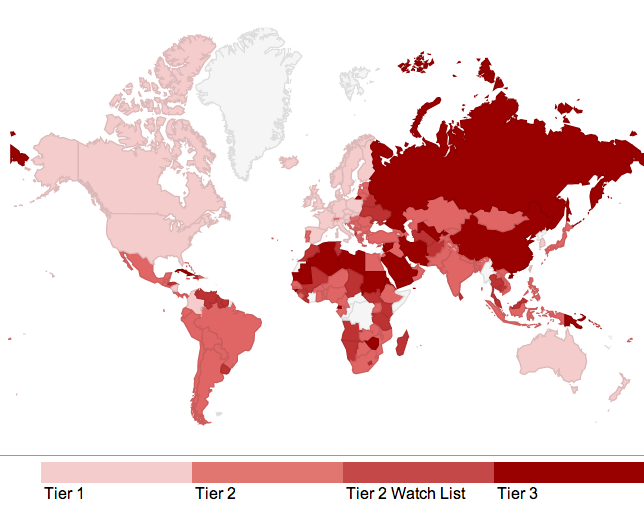
China, Russia, and Uzbekistan have been named among the worst offenders when it comes to human trafficking, according to a State Department report released Wednesday, joining Iran, North Korea, Cuba, Sudan, and Zimbabwe on the bottom “tier” of the U.S. human trafficking rank.
Their lower designation means the U.S. may sanction those countries with measures like cancelling non-humanitarian and military assistance, ending exchange visits for government officials, and voting against any IMF or World Bank loans.
China, Russia, and Uzbekistan had previously been on the “Tier 2 Watch List,” a middling designation for countries that show little progress in making strides in preventing forced labor. Because they had been on the “Watch List” for four years, the State Department was obligated to either promote or downgrade them.
In China, the one-child policy and a cultural preference for male children perpetuates the trafficking of brides and prostitutes.
“During the year, Chinese sex trafficking victims were reported on all of the inhabited continents,” the report found. “Traffickers recruited girls and young women, often from rural areas of China, using a combination of fraudulent job offers, imposition of large travel fees, and threats of physical or financial harm, to obtain and maintain their service in prostitution.”
However, the State Department also singled out the country’s epidemic of forced labor, in which both internal and external migrants are conscripted to work in coal mines or factories without pay, as well as its continued use of re-education hard labor camps for political dissidents.
However, it’s also worth keeping in mind that there are two common definitions of human trafficking in use, one of which is an outrage to common decency while the other is an attempt to conflate sex work with slavery:
1) The transport of unwilling people (usually women, but of course can at times be either men or children) into forced prostitution. This is of course illegal everywhere: it’s repeated rape just as a very start. It is also vile and we should indeed be doing everything possible to stamp it out.
2) The illegal movement of willing people across borders to enter the sex trade. Strange as it may seem there really are people who desire to be prostitutes. People would, other things being equal, similarly like to be in a country where they get a lot of money for their trade rather than very little. Given these two we wouldn’t be surprised if people from poorer countries, who wish to be in the sex trade, will move from those poorer countries to richer countries. And such is the system of immigration laws that many of them will be unable to do this legally: just as with so many who wish to enter other trades and professions in the rich world. You can make your own mind up about the morality of this but it is obviously entirely different from definition 1).
The UK debate over online porn
Willard Foxton says that the real problem is that the two “sides” of the argument are not even talking the same language:
Claire Perry, the Prime Minister’s “special adviser on preventing the sexualisation and commercialisation of childhood”, has three demands which she claims will save the world from the horrors of porn. First, that internet service providers and other internet companies block child pornography at its source; second, that any sort of simulated rape pornography is banned; and third, that pornography is banned from public WiFi.
On the face of it, these all seem like reasonable demands. I mean, if you oppose them, you must be some kind of filth peddler or mad porn obsessive, right? Or you might just be a person who understands how the internet works, and therein lies the problem. Let’s tackle Perry’s demands one by one and explain, patiently, why she is wrong.
Firstly, her request that internet service providers block images of child abuse “at their source”. It sounds perfectly reasonable, doesn’t it? Indeed, it’s so reasonable that they already do, and indeed have been doing since 2007. It’s done through a system called Cleanfeed, which is a rare example of a British state-funded IT project that works like a charm. They way it works is, any time a website is reported as illegal to the police, it’s added to a list. Any sites on that list are inaccessible from British ISPs. It’s a very secure system, and very hard to work around – it works so well that we’ve exported it to Canada and Australia.
Perry also wants Google to “do more” to block child porn. As I’ve said before on these pages, Google (and other large search providers), already have enormous departments devoted to blocking it, with thousands of employees checking YouTube for offensive images. On top of that, very little of the material that so offends Perry is available though a simple Google search; most of the illegal stuff is hidden in Internet Relay Chat file servers or on the dark web, accessible only via anonymising browsers like Tor.
Update: At Techdirt, Tim Cushing addresses the common claim by grandstanding politicians that child pornography is easy to “stumble upon”:
How hard would it be to access child porn if you weren’t looking for it specifically? The Ministry of Truth puts your odds at 1 in 2.6 million searches. (MoT points out the odds will fluctuate depending on search terms used, but for the most part, it’s not the sort of thing someone unwittingly stumbles upon.)
All those demanding Google do more to block child porn fail to realize there’s not much more it can do. The UK already has an underlying blocking system filtering out illegal images at the ISP level, and Google itself runs its own blocker as well.
The above calculations should put the child porn “epidemic” in perspective. As far as the web that Google actively “controls,” it’s doing about as much as it can to keep child porn and internet users separated. There are millions of pages Google can’t or doesn’t index and those actively looking for this material will still be able to find it. Google (and most other “internet companies”) can’t really do more than they’re already doing already. But every time a child pornography-related, high profile crime hits the courtroom (either in the UK or the US), the politicians instantly begin pointing fingers at ISPs and search engines, claiming they’re not doing “enough” to clean up the internet, something that explicitly isn’t in their job description. And yet, they do more in an attempt to satiate the ignorant hunger of opportunistic legislators.
If Google is “the face of the internet” as so many finger pointers claim, than the “internet” it “patrols” is well over 99% free of illegal images, according to a respected watchdog group. But accepting that fact means appearing unwilling to “do something,” an unacceptable option for most politicians.
June 19, 2013
Examining Vermouth’s claim to being the “oldest wine in the world”
History Today linked to an article in their archives from 1975 from Pamela Vandyke Price discussing the ancient provenance of Vermouth:
When the great vermouth establishments refer to their product as ‘the oldest form of wine in the world’, they are not exaggerating. If we could travel in time, we might find many of the wines praised in antiquity to be harsh, sour and coarse to our palates, but the ‘aromatized wine’ that we know as vermouth would then have existed and, even if we drank it for medicinal or preventive reasons rather than for enjoyment, we could recognise it and relate it to the vermouths of today.
Vermouth can be, and often is, made wherever wine is made. The ancient Egyptians used both wine and beer, plus juniper, frankincense, celery, lotus leaves and honey, in the treatment of certain ailments; and it is by a method of infusion, maceration, distillation, or two or all three of these processes that, essentially, vermouth is made today. In Book IV of the Odyssey, Helen throws a drug given to her by an Egyptian lady into the bowl in which the wine is to be mixed and diluted before dinner; this ‘had the power of robbing grief and anger of their sting and banishing all painful memories’ — an efficacious aperitif, assuring good digestion. At the end of the third millennium B.C. what is perhaps the first written doctor’s prescription is recorded in cuneiform script on a tablet from the Sumerian city of Nippur — a physician notes that certain powders should be infused with a type of wine.
[. . .]
Other families in the drink business were quick to see the possibilities for vermouth, setting up in Turin, Marseilles and Sete (again in proximity to mountain herbs and a quantity of wine), and in Chambray. Many of them are still family concerns, even though they are great empires of the drink business. Martini & Rossi, who were founded about 1840, replaced a much older concern making vermouths and liqueurs at Pessione, near Turin (the head of that firm was the grandfather of Giovanni Angelli, founder of Fiat); the superb museum now established alongside the Pessione installations is a necessary detour for anyone interested in the history of wine from the earliest times.
The Cinzano family began in the drink business in the sixteenth century, and in 1757 the brothers Carlo Stefano and Giovanni Giacomo were invested as Master Distillers in Turin; today their business is gigantic, including, among other things, the Florio concern at Marsala, (itself including the former cantinas of Ingham and Woodhouse). Louis Noilly, in business at the beginning of the nineteenth century in Lyons, set up in the vermouth trade with his son-in-law, Claudius Prat and they enjoyed so much success that by 1843 they moved their headquarters to Marseilles. Madame Josephine Prat, who ran the business after the deaths of the two founders, was succeeded by her two children; and her granddaughter, Vicomtesse Vigier, who entered the firm before 1939, directed it until 1970 when she died, over a hundred years old.
It seems a little odd that, with so many modifications of wine-making and changes in the tastes of drinkers, aromatized wine should still be in demand. But, in fact, it is increasingly so. Whenever people order a straight vermouth they are ordering the oldest wine in the world.
June 18, 2013
“Call it Jihadi sushi”
The difficulty of choosing the right side in the Syrian civil war is that there may not be one:
At his awkward press conference with David Cameron on Sunday, Vladimir Putin made an astonishing claim — the Syrian rebels eat people. It happens to be true. Putin was presumably referring to Abu Sakkar, a rebel leader who videoed himself eating a combatant’s lung. Sakkar explained that he did it in revenge for footage he found on the dead man’s phone of the government soldier raping women. “I swear to God we will eat your hearts and your livers, you soldiers of Bashar the dog!” cried Sakkar. For some Islamists, dedicating such an act to God is not as sacrilegious as it sounds. Students at Al Ahzar University in Cairo — an educational institution once graced by Obama’s presence — have access to a textbook that teaches it’s okay to eat apostates so long as the meat is not cooked. Call it Jihadi sushi.
The story underlines how difficult it is to choose the side of good in Syria: Assad’s men are rapists, the rebels are cannibals. When deciding what to do, the West has to avoid two templates of disaster. We don’t want another Rwanda, when the West stood aside and tolerated a genocide and we don’t want another Iraq, when the West got involved and stayed involved almost for a decade.
What Britain, France and America have decided to do is something in-between. Ignore the hyperbole about intervention from some in the press: at this stage all the alliance is threatening is to give logistical support to the rebels through non-military aid and a no-fly zone. Of course, this could escalate. But no Western leader wants to put boots on the ground and the goal of the sabre-rattling is actually to prod Russia into dragging Assad to the negotiating table at the proposed conference in Geneva (by the way, Putin might deliver on that but it’s far less likely that we’ll get the rebels to play ball on our side). We are deliberately internationalising the conflict, turning it into a giant game of chicken between America and Russia in the hope that they will resolve the war on behalf of the Syrian combatants.
June 17, 2013
Top this – wine corks meet screw-tops
BBC News looks at the latest attempt to blend the tradition of the wine bottle’s cork closure with the convenience of the twist-off screw top:

The unveiling this week of a new style of cork raises the question of why the traditional kind continues to dominate much of the wine world.
The Helix is opened with just a twist of the hand. No corkscrew is necessary as the top of the bottle has a thread inside.
The glass bottle and cork combination for wine is thought to have started in the 17th Century. But newer materials exist today that some argue are better suited for sealing a bottle than cork.
Screw caps and plastic corks have been embraced by producers fed up with wine becoming “corked” — the unpleasant musty taste, likened to wet dog, which is caused by tainted cork.
Influential US wine critic Robert Parker reckons that during the mid 1990s 7-10% of the wine he tasted was corked. In 2004 he predicted that by 2015 screw caps would dominate the wine industry.
The screw cap — generic name “Stelvin” after its biggest brand — advanced spectacularly in “New World” wine nations. By 2011, 90% of New Zealand wine was sealed this way.
But in Europe and the US the cork remains king.
It’s a little puzzling to some. Wine has become democratic and modern. There are prices and drinking styles to suit everyone. So why hasn’t the closure method evolved?
Portugal, where most of the world’s corks are harvested, has fought back against the chemical compound trichloroanisole (TCA), one of the most common causes of tainted corks.
But the screw cap not only avoids the problem of tainted cork, it forms a tighter seal. Most critics say that this guarantees a better flavour for all but the more expensive wines (which may age better with more oxygen).
“We prefer seals that ensure the wine is not going to be faulty,” says Ewan Murray, spokesman for the Wine Society. “Wines that are ready to drink young are always going to be fresher under a screw cap.”
June 16, 2013
Latest installment of the corporate tax crusade
In Forbes, Tim Worstall explains why a company that has paid full corporate taxes on its income has no further legal or moral obligation to pay more:
Read that through again: they’re saying that the company has already paid full corporation tax on that money. And we don’t tax dividends going to people in foreign countries. Whatever the tax rate is there, we simply don’t tax them. Because of course that’s up to the country where the money goes to to tax: it’s not actually something that is taxable in the UK. For, obviously, they’ve already paid the full corporation tax due.
But it does actually get better. Those dividends, paid out of post tax (and do please note, post tax) profits wouldn’t be subject to further corporation tax in the UK either:
The general rule is that dividends paid by a UK company to another UK company out of post-tax profits are exempt from further taxation.
That the recipient corporation is in the British Virgin Islands thus makes not one whit or iota of difference to the amount of corporation tax payable. So this is all really a rather strange complaint. Perhaps the newspaper has just got caught up in the frenzied atmosphere over the subject.
[. . .]
As to why this story is being blown up allow me to offer some speculation. There’s a group of people who are quite vociferous in their demands that the corporate tax system must be radically changed. Richard Murphy (who just for complete disclosure, used to write here at Forbes) is one of the leading lights of that group. Various members of the loose knit group have been behind all sorts of claims about Vodafone, Boots, Starbucks, Google, Apple and a number of other companies. The problem with the claims is that none of them have really stuck. There’s been absolutely no finding of illegality anywhere.
The claim has thus moved onto, well, OK, so it’s not illegal: all of these companies are indeed obeying the law. But we still don’t think they’re paying enough tax. Therefore the law must be changed simply because we think they should be paying more tax. Which is, when you think about it, a fairly extreme claim. Companies should pay more tax because a group of 20 or so people demand that they should be doing so?


