Quotulatiousness

July 13, 2013

The state’s constant interest in what’s in your kid’s lunchbag

Filed under: Britain, Education, Health — Tags: , , — Nicholas @ 09:13

James Delingpole on the most recent “Nanny knows best” appointee hoping to dictate what the kids are going to eat for lunch:

“Mr Dimbleby”, it seems to me, is coming perilously close to suggesting that the decision as to what children eat at school should be a matter for the State rather than parents. Can he really believe this? Is there nothing about saying this sort of thing that makes him uneasy?

I mean sure, I agree with him on the principle that a good, well-prepared hot meal at lunchtime is probably more filling and nourishing than a packet-bread sandwich and a packet of crisps. Problem is, not all school canteens offer quite the same range and quality you might find in — oh, I don’t know, let’s pluck a random example from the air, shall we? — Bekynton.

Having put children through the state system myself I know whereof I speak. A new caterer arrived at my daughter’s primary school to much fanfare and for a while the food was great and most parents gratefully abandoned packed lunches (which, let me tell you, are a real hassle for a parent to prepare because they have to be done fresh in the morning when you’re already in a rush having breakfast and getting ready for the school run) and welcomed the new regime. But then standards began slipping to the point where my daughter (who, like a lot of children whose staple diet is gastro-porn TV programmes from the Great British Bake Off to Masterchef, genuinely cares about food) couldn’t eat the stuff any more. Again: is “Mr Dimbleby” seriously suggesting that schools should force children to go on eating in the canteen regardless of how disgusting they find the food?

You hear similar arguments from well-heeled progressive types on the school system generally. “If only public schools were abolished and all those pushy middle-class strivers were forced to put their children through the state system, standards would rise across the board.” Well, possibly. What would more likely happen is that all those scrubbed, diligent, nicely spoken, polite young poshos would be dragged down to the level of the lowest common denominator. And in any case it’s not an experiment which has any right being attempted anywhere in a Western notionally free-market economy. Why not? Because it’s illiberal bordering on the totalitarian, is why.

This is hardly a new topic … last year I said:

I remember what kind of crap my middle and high school cafeterias offered … and if I’d forgotten to bring a sandwich with me that day, going hungry always seemed like the better choice. The food on offer always seemed to manage the difficult stunt of being visually unappealing (sometimes being actually disgusting to look at), nutritionally inadequate, and either utterly flavourless (the better choice) or actively nasty. No wonder the best sellers in the cafeteria were the milk cartons (especially the chocolate milk), pop cans, potato chips, chocolate bars, and Vachon cakes (all of which were pre-packaged and relatively invulnerable to further processing).
July 12, 2013

Mapping the latest British defence “disgrace”

Filed under: Britain, Germany, Military — Tags: , , — Nicholas @ 14:06

Sir Humphrey on the mapping uproar:

Several UK newspapers reported this week the findings of the UK Parliaments Intelligence & Security Committee report that during OP ELLAMY, the UK had relied on Germany to provide mapping for the RAF to conduct its missions. This was apparently a disgraceful sign of a nation in decline and that we should all be jolly ashamed of ourselves.

The reality (as ever!) is a little different and one worth thinking about. Maps are something that we all take for granted in our daily lives, and they are an utterly indispensable part of modern military operations (even in the hands of a newly appointed young officer). We perhaps take for granted the information on them, without considering how it is obtained. In the UK the Ordnance Survey has over many hundreds of years done a phenomenal job of providing accurate information almost down to the last manhole cover about what lies where. At sea the Hydrographic Service has similarly spent many hundreds of years charting the oceans and waters of the planet — it is not an exaggeration to say that in some of the more remote parts of the globe, the only charts in use date back to the surveys done by Captain Cook or other explorers. As a national asset the Hydrographic Office in particular is absolutely priceless — very few nations run credible hydrographic programmes beyond the UK, US, Russia and China. The Royal Navy, with its extremely effective and very hard worked survey fleet has been able to become a global leader in providing accurate chart information to the world — indeed many countries are enormously reliant on the UK for providing charts for their warships.

But, to put a map or chart together is an enormously complicated piece of work which takes a lot of time and effort. No country on earth currently has the resources to provide a truly global and accurate mapping capability of all the nations and areas that it may need military mapping for. Its not just a case of putting down some generic top level mapping and hoping that’s enough — modern military operations require a lot of detail, and to be able to work effectively, mapping is needed at a very high level of detail. When it comes to targeting, knowing whether a particular target is located at grid reference 123456, or 12345678 can make a huge difference — precision weapons nowadays mean that the chances of hitting the intended spot are much higher than ever before. This means you can destroy a critical node or facility without necessarily doing much in the way of wider damage, which makes rebuilding efforts easier, and also reduces the risk of civilian casualties.

[. . .]

The irony is that amidst the anguish over using German maps, the article skims over the wider point that Defence Intelligence appears to be losing several hundred posts. It is not commonly realised that the DI is responsible for the provision of geographic information to the military, currently via the Defence Geographic Centre in Feltham (for more information see LINK HERE). This sort of service is crucial to help the MOD maintain an edge on operations — it isn’t just about having a good set of weapons, but the ability to know where you are, where you are going and how you can have the best possible military effect that matters. Ironically the papers that got the most irate about the news the UK was relying on the Germans were also the same papers that call the most loudly for ever more civil servants to be fired. The problem is that the people working at the DGC are exactly the sort of civil servants who are not pen pushers, who make a massive, near immeasurable difference to UK security, and who face considerable uncertainty in the future. We perhaps forget at our peril that just because someone doesn’t wear uniform, it doesn’t mean that they don’t play a major role in helping the defence of the UK.

July 11, 2013

Rupert “Emmanuel Goldstein” Murdoch

Filed under: Britain, Business, Liberty, Media — Tags: , , , , — Nicholas @ 07:57

James Delingpole on the quick march to government control over the British media:

I was listening to Radio 4 news yesterday as with salivating glee it reported the recall of Rupert Murdoch to the Culture Media and Sport Select Committee and I thought to myself, not for the first time: “Britain is losing the battle for press freedom.”

What worries me most is that so few of us seem capable of comprehending a) how we’re losing it and b) why it might be a problem. The default assumption behind the BBC’s reportage — and unfortunately, probably, an accurate one — is that most normal people think that Murdoch is the very type of low-down reptilian evil, that he is primarily responsible for dumbing down our culture and abasing standards within our media, and that every time he gets his comeuppance it’s a jolly good thing.

Needless to say, I disagree totally with this analysis — and not purely because I’d love it if he plucked me from obscurity and gave me an incredibly well paid job, writing, say, the James Delingpole Tells It Like It Is column in the Sun. No, I say it because I sincerely believe it. Tabloid media moguls like Murdoch do not create public taste: they reflect it. And if, like me, you believe in free markets and freedom of choice then we should applaud the farsightedness and tenacity with which he broke the print unions at Wapping, and the way he pioneered satellite viewing in Britain with Sky and the way in the US his Fox channel and his Wall Street Journal fight such a heroic and inspiring battle against the liberal consensus. Sure, I’ve no doubt he’s very good at drowning kittens — he’s a ruthless billionaire businessman, for heaven’s sake — but the benefits this buccaneer has brought to our world economically and socially far, far outweigh any he damage he might have done.

Yet you’d never guess this from his treatment in the media nor from the way he’s represented in public debate. Really, he’s like our very own Emmanuel Goldstein — the all-purpose hate-figure created by Big Brother in Nineteen Eighty-Four in order to channel the people’s discontent in the “correct” direction.

July 10, 2013

Operation Husky, 1943

Filed under: Britain, Cancon, History, Italy, Military, USA, WW2 — Tags: , — Nicholas @ 09:11

Was the invasion of Sicily by the allies in 1943 a strategic error?

Seventy years ago this week, U.S. and British Commonwealth troops began Operation Husky, the invasion of Sicily. Foreshadowing D-Day 1944, Gen. Dwight Eisenhower served as overall Allied commander. Like D-Day, Allied airborne soldiers led the Husky assault by parachuting (on the night of July 9, 1943) into olive groves and rock-strewn fields along the island’s southeastern shores. On July 10, seven divisions — three U.S., three British and the 1st Canadian Infantry Division — launched an amphibious attack on a 100-mile long front. Despite several successful Axis air attacks on ships and a brazen Italian tank attack on U.S. positions near Gela, by midnight July 10 all seven divisions were ashore.

Putting seven divisions ashore so swiftly was an extraordinary coup. Oh, grievous errors occurred as the buildup proceeded, the most notorious being the July 11 downing of 23 U.S. transports by Allied anti-aircraft fire. The planes were ferrying paratroop reinforcements. Yet in its initial phases Husky demonstrated that the Anglo-American team had learned a great deal since the Operation Torch landings in November 1942. Planning and coordination had improved. North African combat had honed the skills of American forces.

[. . .]

The Sicily campaign placed Allied troops less than 10 miles (the strait’s width) from mainland Italy.

The oh-so-close proximity of large Allied forces to Italy was enticing. And that enticement leads to the biggest historical question tagging Operation Husky: Was taking Sicily the best strategic choice, since it made an invasion of Italy inevitable? From south of Naples to the Po Valley, Italy’s rugged and rocky terrain is a defender’s delight and attacker’s sorrow.

Winston Churchill had sold Sicily as the next logical step. Sicily was the classical route to Rome from North Africa, and knocking fascist Italy out of the war would deal Adolf Hitler’s Axis a heavy political loss.

Sicily geographically dominates the central Mediterranean. Husky’s advocates noted that for three millennia the island served as the stepping stone of to-and-fro commerce and war between North Africa and Europe.

American military leaders were not convinced. The decisive route to Berlin goes through France — make the all-out effort there. Churchill also claimed Europe had a “soft underbelly.” Italian and Balkan terrain is not soft. Several senior U.S. planners thought Churchill was really trying to defend British imperial interests.

Axis-controlled Sicily had served as a big aircraft carrier for attacking Allied shipping. Under Allied control, those bases would extend air cover to northern Italy and Sardinia. U.S. planners agreed that Husky made operational sense if the goal was securing air bases. But can we stop there, at the strait? Sicily’s hard slog was costly. A strategic thrust up Italy’s mountainous spine will be as just slow and deadly.

And indeed it was.

How Avro salvaged a bad design to create the Lancaster bomber

Filed under: Britain, History, Technology, WW2 — Tags: , — Nicholas @ 00:01

In Samizdata, Brian Micklethwait goes back to his Airfix modelling days to rediscover his admiration for Avro’s Lancaster bomber. In the process, he discovers just how strange the evolution of that aircraft actually was:

In the late 1930s, believing that bombers would always get through and that they therefore had to have lots of bombers or lose the war, British Air Officialdom had two ideas about how to build a bomber. They accordingly announced two specifications, which different potential bomber-makers were invited to meet with their designs. They wanted a two engined bomber, like those that the Germans bombed Britain with in 1940 but better, or like the Wellington but better. And they wanted a much bigger four engined bomber, such as the Germans never got around to building, and like … well, like the Avro Lancaster.

So, the Lancaster was Avro’s answer to the second requirement? Actually, no. Or, not at first. Britain ended up with three four-engine heavy bombers, the Short Stirling, the Handley Page Halifax, and the Lancaster. But strangely, by far the worst of these three, the Short Stirling, was the only one of the three that was all along intended to be a four-engine bomber. Both the Halifax and the Lancaster started out as answers to the two-engine specification rather than the four-engine one.

[. . .]

In particular, all the work that Avro had done improving, as they had hoped, the fuselage of the Manchester, which had done nothing to improve the Manchester, suddenly came into its own in the new configuration. Ever since I built my Airfix Lancaster as a child, I have wondered about the oddity of that Lancaster fuselage. Simply, this fuselage seemed too small for the airplane as whole. And the wings seemed too big. Not ugly exactly, in fact not ugly at all, but nevertheless a bit like the arms of one of those misshapen body builders with excessive biceps. My Lancaster photo (above) even shows how the wings between the fuselage and the inner two engines go straight out rather than tapering, as if these wings were only widened late on in the design process. Now, all that makes sense. The Lancaster’s fuselage began life as the fuselage of a smaller airplane. No wonder it looked to me too small. It was too small. The Lancaster’s wings look stretched because they were stretched. It is only now, after half a century and more of gazing at the Lancaster, that one looks at the Manchester, and sees its fuselage as too big and its wings as too small.

The birth of the Lancaster illustrates a general point about making airplanes, which explains why successful airplanes often fly on for so long. Consider the airborne WW2 mega-hit, the DC-3 (aka the Dakota), and then later the big Boeings, the B-52 and the 747. The Lancaster didn’t last as long as those hardy perennials, because propeller driven heavy bombers were soon replaced by jet bombers (like the B-52) and by intercontinental ballistic missiles. But even the Lancaster flew on for many decades, in the only slightly altered form of its close cousin, the Avro Shackleton, which only went out of service in 1991!

July 9, 2013

Does Britain need a “big army”?

Filed under: Britain, Military — Tags: , — Nicholas @ 09:58

Sir Humphrey refutes the call for a bigger army in the United Kingdom:

Humphrey has a very personal view that when people call for the military to be changed, it usually involves change to try and make it reflect the military that they served in. For decades people have been complaining bitterly that the UK military doesn’t do what we want it to do, and that only deep change can possibly solve the problem. Meanwhile the British Armed Forces carry on deploying and succeeding on their missions, despite this lack of a ‘wonder weapon ORBAT’. It is very easy to look at an order of battle and decide that somehow the UK lacks a real army – indeed anything can be proved with statistics, and it’s easy to say that because the UK plans a relatively small force with only limited numbers of equipment relative to other powers, it somehow lacks a real army. The problem with such a simplistic argument is that it ignores several issues.

[. . .]

So, when we hear demands that the UK has to have a ‘real army’ the question must be ‘what does a real army look like’? We cling to a view that somehow because the British Army doesn’t possess thousands of tanks and legions of artillery batteries it somehow doesn’t have the same impact as other nations which possess much larger military forces. But to the authors mind there are two very different types of armed force out there – those which exist on paper, and those which have genuine capability to meet their missions. One only has to look across the world to see a plethora of nations who on paper possess large reserves of troops, weapons and equipment which theoretically place them at the top of whatever table one looks at. The problem is though that they are often poorly trained, funded and their equipment lacks support or maintenance – the ‘shiny toy in the shop window’ syndrome. When one reads accounts of large armies, it is often striking how they are in reality unable to deploy and effectively use more than a small fraction of their overall strength, or deploy at any distance. The author still shudders when he hears tales of various UN peacekeeping forces where nations with statistically large militaries deployed sizable contingents, only for them to arrive with next to no equipment, logistics or food, and then to have next to no effect on the job at hand. The other category of army is the one that is funded and equipped properly to do the job at hand. This is a much smaller category of nations, and the UK firmly falls into this category. It involves providing a force which may not be numerically large, but where the equipment – both first line and support, is of a good quality, and which works well together.

[. . .]

The reality for the British Army is that it is a force which does not have a likely opponent, nor an existential threat to defeat. It is all very well calling for it to grow, but at a time of very constrained budgets, and ever more expensive equipment, the question is where is the money to support this? The challenge for the UK in the next SDSR and beyond is perhaps to better justify why it warrants a regular British Army of 82,000 people at all – an island nation with no existential threats, and any likely deployments to be small in nature, perhaps the question is whether we need an Army that large in the first place? Given the Royal Navy and RAF are better suited for the type of expeditionary warfare that is so in vogue at present, does the Army warrant being the size it does? To the author at least the answer is a qualified ‘yes’. The current force provides sufficient personnel to be able to support coalition operations (for we are highly unlikely to deploy an armoured force in isolation), and to meet all likely outputs required of it. But, it is not just about numbers – the UK could do what the French does and pay smaller salaries, invest in front line equipment to the detriment of support equipment and put a numerically larger force in the field which struggles to support itself. This would not be sensible – rather the current structure means that the UK can afford some very useful ‘enabling capabilities’ which mean it seen as being an ally of value to other nations. Investing in ISTAR, in logistics and in other key but ‘unsexy’ assets makes the UK well placed to be able to maintain a force which other nations want to work with – one of the so-called benefits of soft power, as nations seek UK troops for training and support.

In conclusion then, Humphrey remains confused as to what exactly the benefit would be of the UK changing course and trying to fund a vastly larger army. The money doesn’t exist for such a course of action, and the infrastructure to support such a force no longer exists (even in BAOR days the majority of the Army wasn’t based in the UK, so we’d need to build it from scratch), and the costs associated with recruiting and equipping a large force are enormous. Given the lack of existential threats, and the reality that there is no real desire for sustained overseas operations for at least the next few years, it is hard to escape the view that the UK not only possesses a reasonably sized army proportionate to its current strategic position, but that by keeping it relatively small, it retains the funds to keep it well trained and well equipped, and in turn enabling it to punch above its weight as a partner of choice for other nations.

Replacing impartial courts with revolutionary tribunals

Filed under: Government, Greece, Law, Media, USA — Tags: , , , — Nicholas @ 08:57

Victor Davis Hanson talks about earlier experiments with tribunals:

In ancient Athens, popular courts of paid jurors helped institutionalize fairness. If a troublemaker like Socrates was thought to be a danger to the popular will, then he was put on trial for inane charges like “corrupting the youth” or “introducing new gods.”

Convicting gadflies would remind all Athenians of the dangers of questioning democratic majority sentiment. If Athenian families were angry that their sons had supposedly died unnecessarily in battle, then they might charge the generals with capital negligence — a warning to all commanders to watch their backs. As in the case of Socrates, a majority vote often led to conviction, and conviction to a death sentence, or at least ostracism or exile. The popular courts freelanced to ensure that “the people” would hold sway over the perceived powerful and elite.

For a couple of years in revolutionary France, a Tribunal Révolutionnaire tried royalists, clergy, the wealthy, and supposed counter-revolutionaries on trumped-up charges of crimes against the people. Their purpose was a more violent version of the Athenian idea that the courts should serve the public by targeting the prominent, influential, or wealthy.

We in the United States are in jeopardy of turning our own criminal-justice system into revolutionary tribunals — fanned by the popular media and public opinion and directed against so-called enemies of the people.

[. . .]

The American court system is insidiously focusing on social transformation rather than individual justice. If Neanderthal reactionaries in California twice voted to reiterate that marriage is between a man and a woman, then leave it to judges and courts to find them bigoted and politically incorrect. In the present revolutionary environment, the degree of the Obama administration’s enforcement of federal laws concerning gay marriage, or illegal immigration, or the new health-care law has hinged on politics and perceptions about social justice — and the courts increasingly predicate their own decision-making on these same considerations. The street can brand a court either an esteemed ally or a reactionary enemy of the people, and so the courts make the necessary adjustments.

Update: The New York Times editorial board expresses its concern about “the laws you can’t see”.

As Eric Lichtblau reported in The Times on Sunday, the Foreign Intelligence Surveillance Court has for years been developing what is effectively a secret and unchallenged body of law on core Fourth Amendment issues, producing lengthy classified rulings based on the arguments of the federal government — the only party allowed in the courtroom. In recent years, the court, originally established by Congress to approve wiretap orders, has extended its reach to consider requests related to nuclear proliferation, espionage and cyberattacks. Its rulings, some of which approach 100 pages, have established the court as a final arbiter in these matters.

But the court is as opaque as it is powerful. Every attempt to understand the court’s rulings devolves into a fog of hypothesis and speculation.

[. . .]

As outrageous as the blanket secrecy of the surveillance court is, we are equally troubled by the complete absence of any adversarial process, the heart of our legal system. The government in 2012 made 1,789 requests to conduct electronic surveillance; the court approved 1,788 (the government withdrew the other). It is possible that not a single one of these 1,788 requests violated established law, but the public will never know because no one was allowed to make a counterargument.

When judicial secrecy is coupled with a one-sided presentation of the issues, the result is a court whose reach is expanding far beyond its original mandate and without any substantive check. This is a perversion of the American justice system, and it is not necessary.

July 8, 2013

No matter who you vote for, the Ruling Party always gets in

Filed under: Britain, Politics — Tags: , , — Nicholas @ 00:01

Charles Stross has himself a theory on politics:

I’m nursing a pet theory. Which is that there are actually four main political parties in Westminster: the Conservatives, Labour, the Liberal Democrats, and the Ruling Party.

The Ruling Party is a meta-party; it has members in all of the three major parties, and probably the minority parties as well. It always wins every election, because whichever party wins (or participates in a coalition) is led in Parliament by members of the Ruling Party, who have more in common with each other than with the back bench dinosaurs who form the rump of their notional party. One does not rise to Front Bench rank in any of the major parties unless one is a paid-up Ruling Party member, who meets with the approval of the Ruling Party members one will have to work with. Outsiders are excluded or marginalized, as are followers of the ideology to which the nominal party adheres.

Your typical Ruling Party representative attended a private school, studied Politics, Philosophy and Economics at Oxford (or perhaps Economics or Political Science at the LSE). If they took the Eton/PPE route they almost certainly joined the Oxford debating society. Alternatively they might be a barrister (a type of lawyer specializing in advocacy before a judge, rather than in back-office work).

The Ruling Party doesn’t represent the general electorate, but a special electorate: the Alien Invaders and their symbiotes, the consultants and contractors and think-tank intellectuals who smooth the path to acquisition of government contracts or outsourcing arrangements — the government being the consumer of last resort in late phase consumer capitalism — arrangements which are supported and made profitable by government subsidies extracted from taxpayer revenue and long-term bonds. The Ruling Party is under no pressure to conform to the expectations of the general electorate because whoever the electors vote for, representatives of the Ruling Party will win; the only question is which representatives, which is why they are at such pains to triangulate on a common core of policies that don’t risk differentiating them in a manner which might render them repugnant to some of the electorate.

It would explain a lot, actually.

July 7, 2013

America’s Ministerium für Staatssicherheit

Filed under: Europe, Germany, Government, USA — Tags: , , , , — Nicholas @ 10:36

Rick Falkvinge looks at an interesting appropriate pairing: the former German Democratic Republic’s Ministerium für Staatssicherheit (Stasi) and the American NSA:

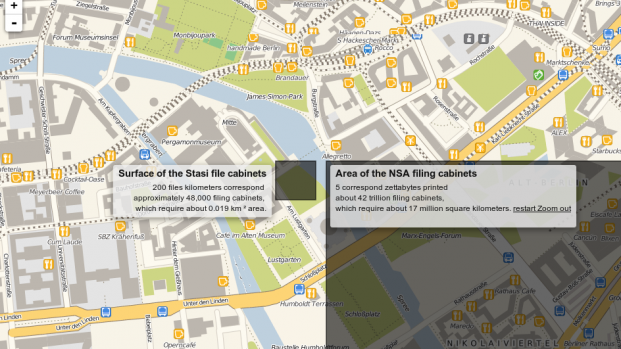
If you were to compare the evil, reprehensible Stasi to the NSA side by side in a visual comparison, who’s the worse surveillance hawk? The people over at OpenDataCity have put together a nice visual guide with astonishing results. We tend to think of Stasi-scale surveillance as the epitome of evil surveillance, and have completely lost track of what today’s governments are doing to their people.

When you go to this page (in German), you are presented with a nice map that compares the size of the Stasi archives — a large building in Berlin — with the corresponding NSA archives. It’s clear that the NSA’s archives — if used with Stasi technology, for an apples-to-apples comparison — would be quite a bit larger:

Comparison of the Stasi and NSA archives. The Stasi archives were a building in Berlin, the NSA archives seem to be more like a couple of entire blocks.

Comparison of the Stasi and NSA archives. The Stasi archives were a building in Berlin, the NSA archives seem to be more like a couple of entire blocks.

Keep reading … it’s like a “powers of ten” exercise.

July 6, 2013

Ireland’s oil and gas bonanza for the oil companies

Filed under: Europe, Government, Law — Tags: , , , , , — Nicholas @ 09:49

Ireland is thought to have substantial offshore reserves of oil and natural gas that are likely to be profitable with current technology, but due to a legislative change dating back to the 1980s, the Irish government may not get much benefit:

In a now legendary all-night sitting on September 29th, 2008 the Irish government agreed to guarantee all bank debts. O’Toole calls this the “most disastrous decision that was ever made by an Irish government”. At least two generations of taxpayers will pay off these debts. O’Toole makes an excellent job of charting the Irish path to disaster in his book Ship of Fools, in which he calls the accounts of Anglo Irish Bank the “most inventive work of Irish fiction since Ulysses”.

The oil off the Irish coast could be the way out of this misery. The oil could be the hope. If the former energy minister Ray Burke hadn’t rewritten the relevant laws as though the oil industry itself held the pen. And if Bertie Ahern hadn’t made an already bad deal for the Irish people even worse.

Burke was energy minister in 1987, when it was decided to change the provisions for oil and grass drilling licence allocation. Until then the state owned 50 per cent of all oil and gas found in Irish waters. In addition, companies had to pay royalties of between 8 and 16 per cent as well as 50 per cent tax. (1, see notes below)

The new rule gave companies 100 per cent of their find and abolished licence fees. In 1992 Bertie Ahern, then finance minister and later prime minister from 1998 to 2008, cut the tax for oil companies to 25 per cent — a provision that remains to this day. (2)

[. . .]

The reason this political inheritance is causing such animated discussion now is because of huge oil and gas reserves believed to surround the island. The company Providence estimates the volume of oil it discovered in the Barryroe field, south of Cork, at over 1.7 billion barrels, of which at least 270 million can be pumped. Further test drillings in Irish waters have been similarly promising.

At the moment a barrel of oil costs, depending on grade, between $90 and $100, meaning there could be oil worth many billions of euro in the Irish sea bed. (3) Even the oil companies concede that Ireland is surrounded by massive riches. But the Irish will probably gain none of this thanks to men like Ray Burke and Bertie Ahern.

Orwell’s rules of tea

Filed under: Britain, Food, History, Randomness — Tags: — Nicholas @ 09:02

When he wasn’t writing books for the ages, George Orwell sometimes turned his hand to less world-shaking tasks such as making a proper cup of tea:

First of all, one should use Indian or Ceylonese tea. [. . .]

Secondly, tea should be made in small quantities — that is, in a teapot. [. . .]

Thirdly, the pot should be warmed beforehand. [. . .]

Fourthly, the tea should be strong. [. . .]

Fifthly, the tea should be put straight into the pot. [. . .]

Sixthly, one should take the teapot to the kettle and not the other way about. [. . .]

Seventhly, after making the tea, one should stir it, or better, give the pot a good shake, afterwards allowing the leaves to settle.

Eighthly, one should drink out of a good breakfast cup — that is, the cylindrical type of cup, not the flat, shallow type. [. . .]

Ninthly, one should pour the cream off the milk before using it for tea. [. . .]

Tenthly, one should pour tea into the cup first. [. . .]

Lastly, tea — unless one is drinking it in the Russian style — should be drunk without sugar.

July 5, 2013

The secret army of monitors who fed Enigma signals to Bletchley Park

Filed under: Britain, Germany, History, Italy, Military, WW2 — Tags: — Nicholas @ 08:20

The BBC remembers the volunteer radio tinkerers who helped win the intelligence war in Europe:

One day, towards the start of World War II, a captain wearing the Royal Signals uniform knocked on a British teenager’s door.

The 16-year-old was called Bob King. When he went to greet the visitor, he had no idea that soon he would become one of Britain’s so-called “voluntary interceptors” — some 1,500 radio amateurs recruited to intercept secret codes broadcast by the Nazis and their allies during the war.

“The captain asked me if I would be willing to help out with some secret work for the government,” remembers Mr King, now 89. “He wouldn’t tell me any more than that.

“He knew that I could read Morse code – that was the essential thing.”

[. . .]

By mid-1941, the new base, Arkley View, was receiving about 10,000 message sheets a day from its recruits.

“I worked for five years scrutinising the logs that came in from the other amateurs — thousands of log sheets with the signals which we knew were wanted, and you could only know it from experience,” remembers Mr King.

“We knew it wasn’t Allied army air force, we knew it was German or Italian — various things gave that away, but it was disguised in such a form that it looked a bit like a radio amateur transmission.

“We knew it was highly important, everything was marked ‘top secret,’ but only many years later we discovered that it was German secret service we were listening to.

“Of course you didn’t ask questions in those days, otherwise you’d be in real trouble.”

Encoded messages were transmitted to Bletchley Park in Buckinghamshire, the UK’s former top-secret code-cracking centre.

Once decoded, the data was sent to the Allied Commanders and the UK Prime Minister, Winston Churchill.

July 2, 2013

Russia’s French amphibious ships

Filed under: Europe, France, Military, Russia — Tags: , — Nicholas @ 08:42

As reported a few months back, the Russian navy will be getting a pair of amphibious ships from France. The deal isn’t going quite as smoothly as the Russians had hoped:

Russia recently bought two French Mistral class amphibious ships. Russia has not bought foreign warships for a long time, but this purchase was largely because of an eagerness to acquire Western shipbuilding technology and construction skills. This has already paid off, although not exactly how the Russians had planned. This became evident when a Russian official recently announced that the first Mistral would be built entirely in France. It had earlier been decided to have Russian shipyards build some sections of the first Mistral. It was quickly discovered that the Russian shipyard was not capable of building to the French specifications or do it according to the French timetable. The Russians expected to learn some valuable lessons from the French and, while embarrassing, this was one very valuable lesson. Russian shipyard officials have had their faces rubbed in the embarrassment of not being able to compete the way using their current practices. Russian experts on Western production methods and techniques have long complained of the antiquated and inefficient methods still favored by Russian shipbuilders. Navy leaders have been complaining for decades about the poor quality of work coming out of Russian shipyards. The Mistral purchase was to put this to the test.

BPC "Bâtiment de Projection et de Commandement" Tonnerre. Photograph by  Yannick Le Bris

The Mistral class BPC “Bâtiment de Projection et de Commandement” Tonnerre. Photograph by Yannick Le Bris

One thing American marines and sailors notice about the Mistral is the wider and higher corridors. This came about because the ship designers surveyed marines and asked what ship design improvements they could use. It was noted that in older amphibious ships, the standard size (narrow) corridors were a problem when fully equipped troops were moving out. That, plus the smaller crew size, makes the Mistrals appear kind of empty but very roomy. That, plus larger living accommodations (made possible by the smaller ship’s crew and marine complement), make the Mistrals a lot more comfortable. The French ships can be rigged to accommodate up to 700 people for short periods, as when being used to evacuate civilians from a war zone.

After the first two, additional Mistrals for the French Navy are being built using more commercial techniques and are expected to cost closer to $500 million each. France has three Mistrals with several more on order. Russia says it plans to base some of its Mistrals in the Far East, where there is an ongoing dispute with Japan over Japanese islands Russia occupied after World War II and never gave back. The Mistrals will probably show up elsewhere, because the Russian fleet is again patrolling the high seas and showing up wherever its government needs some muscle.

The Russians will name their two Mistrals the Vladivostok (initially planned to be based in its namesake city) and the Sevastopol (to be based at Novorossiysk).

British high speed railway run

Filed under: Britain, Railways, Technology — Tags: , — Nicholas @ 08:22

As part of the 75th anniversary of Mallard’s record breaking 126mph run in 1938, sister loco 4464 Bittern was temporally permitted to exceed from 75mph to 90mph on the mainline. This was to be a rare look at steam running at higher speeds, following recent high speed test runs. On June 29th Bittern hauled a London-York special “The Ebor Streak” which ran along the A4’s native racing ground the East Coast Mainline.

4464 is first seen at Langford in Bedfordshire running like a greyhound at 90mph! Well…I think it was doing a little more than 90! After a high octane pursuit on the A1 carriageway, the next location is what better place to see an LNER A4 would be Doncaster. Ending on a high note, the A4 whistles and echoes past Doncaster Works where she, Mallard, Flying Scotsman and all other LNER locos were built.

With special thanks to Locomotive Services Limited, DBS and Network Rail for this miracle to happen.
I’m now in high hopes in getting the next two 90mph runs on July 19th and 27th.

These shots and much much more will be included in the forthcoming documentary: “BITTERN: The Need for Speed” as part of the “MALLARD 75” celebrations. Which will include at an depth look at the preparations and build up to the main events in June & July, along with interviews with the crews & officals at this historic event in railway preservation history. See http://www.ovpsteam.co.uk/48.html

H/T to Eric Kirkland for the link.

June 30, 2013

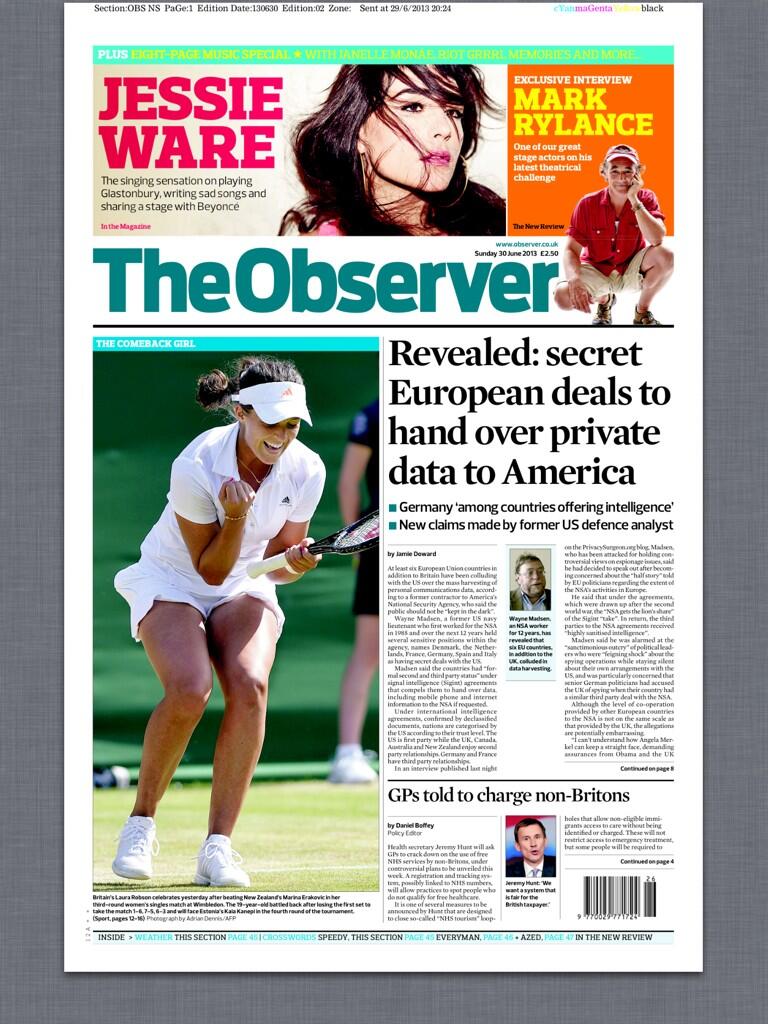
The Observer has an embarrassing day

Filed under: Britain, Media, USA — Tags: , , , — Nicholas @ 10:56

In his Forbes column, Tim Worstall gleefully recounts the steps in a publishing cock-up by The Observer:

It looks like The Guardian/Observer* has managed to get itself mightily stung over a revelation about PRISM and the NSA. Which is all very amusing given the paper’s part in the Glenn Greenwald/Edward Snowden revelations. But what turns it into an absolute joy is that, while the news originally came from someone with, hmm, rather “out there” views, the actual information itself seems to be roughly true. And yet they’ve still taken the piece down.

The story starts here, at a site called The Privacy Surgeon. The site does an interview with an ex-NSA guy called Wayne Madsen. In which he claims that there are various European and other countries that cooperate with the NSA in the collection and then dissemination of information picked up from the monitoring of communications.

[. . .]

So, The Guardian/Observer has published a piece using allegations made by someone we’d already be predisposed to think of as being less than entirely correct in his descriptions of the real world. And, as a result, they’ve taken the piece down:

    This article has been taken down pending an investigation.

So far so good, just as in any other walk of life you think you’ve made a mistake you try to correct it. Just as Mother always told you you should. The slightly unfortunate thing is that the Sunday papers in the UK print quite early on the Saturday evening. Thus we get this front page of the physical paper:

Observer front page 20130630

The paper is now running as its front page a story that it has already retracted online. This is something of an “Ooops!” moment and as such one to be treasured as an example of the fallibility of both human beings and organisations that contain them.

However, the story really gets even better than this.

« Newer PostsOlder Posts »

Powered by WordPress