Quotulatiousness

September 2, 2013

This month in moral panic watch – “rape porn”

Filed under: Britain, Government, Media — Tags: , , , , , — Nicholas @ 09:24

British PM David Cameron has decided that it’s the duty of his government to crack down on internet pornography. In particular, the British government will be attempting to stamp out violent pornography, aka “rape porn”. This may not be his best idea ever:

Lobby organisations like “End Violence Against Women” and sensationalist news rags like the Daily Mail repeatedly claim that watching violent pornography increases sexual abuse and rape by men.

However, the scientific evidence has stubbornly refused to play along with this view:

U.S. Commission on Obscenity and Pornography (1970) found no evidence of a causal link between pornography and rape

Pornography and rape: theory and practice? Evidence from crime data in four countries where pornography is easily available” (1991) B Kutchinsky

Examined what happened to the rape statistics in four countries (USA, Denmark, West Germany and Sweden) during periods where the availability of violent pornography went from extreme scarcity to relative abundance.

Quoting the report: “The results showed that in none of the countries did rape increase more than nonsexual violent crimes. This finding in itself would seem sufficient to discard the hypothesis that pornography causes rape

There’s also the problem that pornography is actually quite popular — with both male and female users — over 40% of all internet users view pornography voluntarily. In fact, large numbers of women admit to enjoying rape fantasies:

Whether the puritans or the feminists like it or not, it is a fact that many women enjoy rape fantasies as explained by this female journalist.

Erotic literature such as Fifty Shades of Grey featuring bondage, spanking, hair pulling, fisting and pinwheeling generated sales of over £10M in six months, to a predominantly female audience.

On a more scientific level, a 1988 study by Pelletier and Herold found that over half of their female respondents had fantasies of forced sex.

Nobody (quite rightly) suggests that women who expose themselves to this sort of “violent porn” literature, or who engage in sexual fantasies of rape are more likely to go out and put themselves into situations where they will be raped.

People clearly understand that there is a world of difference between enjoying rape as a sexual fantasy and the violent, painful reality of actual rape.

The same reasoning must logically apply to men who enjoy rape fantasy and rape porn. There is a world of difference between enjoying rape as a sexual fantasy and the violent reality of actual raping another human being.

To assert that women can enjoy rape fantasy, porn and violent BDSM literature without harm because they understand the difference between fantasy and reality, but men do not is nothing more than misandry.
August 31, 2013

The modern monarchy in Spain

Filed under: Europe — Tags: , , , — Nicholas @ 11:06

In an older post at the Guardian, Miguel-Anxo Murado looks at the place of the monarchy in Spanish society:

King Juan Carlos of Spain must be one of the most Shakespearian kings, ever. His grandfather was ousted from the throne like Richard II, and like Richard III, his brother was killed (though in Carlos’ case it was a tragic accident). Like Hamlet he had a difficult relationship with his father, and like Macbeth, he arrived at the crown by way of an evil creature (General Franco). It sounds inevitable that, like King Lear, in his old age he would be cursed with troublesome daughters. Now, one of them, Princess Cristina, has been summoned by a judge. She has to answer for allegations that, together with her husband the Duke of Palma, they misappropriated millions of euros in public funds. Some say this scandal, the latest in a long series of royal mishaps, threatens the very institution of monarchy in Spain. But is it so?

The rule of King Juan Carlos of Spain is a very interesting example of how the essence of monarchy is not history, but a story — and how tricky that is. The Spanish monarchy is a literary institution. It was born outside and above the law. Its legitimacy was based on symbols, metaphors and, first and foremost, on storytelling: a mostly imaginary tale of continuity and exceptionality. Modernity changed this a bit, but not by much. Like theatre, monarchy had begun like a religious cult and ended in a popular spectacle. That was all. In stable systems like the UK, this transition from statecraft to stagecraft could be done more or less effectively, but in Spain it was pushing the trick too far.

[…]

Like with all story-telling, there’s some truth in this fiction. Yes, the king did assist the transition to democracy, and he stood against the 1981 military coup. Yet the often overlooked fact here is that he had no alternative if he wanted to reign. It was true that he was not ostentatious, but he wasn’t austere either. It is true that he seems a likeable person, but not exemplary. He was a patron of the WWF, but he also loves hunting elephants. He needed not to be perfect, but now he has to, because that was the nature of the narrative his friends concocted.

New rule of thumb for military adventures

Filed under: Britain, France, Middle East, Military, USA — Tags: — Nicholas @ 10:16

James Joyner suggests a new rule of thumb needs to be used:

Could anyone have imagined a decade ago a scenario when the United States would go to war with France by our side and England on the sidelines?

I anticipate English muffins being renamed Freedom muffins any day now. And jokes about kippers eating surrender bulldogs or some such.

More seriously, perhaps recent experience has provided us a rule of thumb: if Washington can not persuade both London and Paris of the advisability of military action, perhaps said action is inadvisable?

August 30, 2013

A profitable way to deal with annoying calls

Filed under: Britain, Business — Tags: , — Nicholas @ 09:01

At the BBC News website, Joe Kent profiles today’s hero in the ongoing battle against annoying telephone solicitations:

A man targeted by marketing companies is making money from cold calls with his own higher-rate phone number.

In November 2011 Lee Beaumont paid £10 plus VAT to set up his personal 0871 line — so to call him now costs 10p, from which he receives 7p.

The Leeds businessman told BBC Radio 4’s You and Yours programme that the line had so far made £300.

Phone Pay Plus, which regulates premium numbers, said it strongly discouraged people from adopting the idea.

Mr Beaumont came up with the plan when he grew sick of calls offering to help him reclaim payment protection insurance (PPI), or install solar panels.

He said: “I don’t use my normal Leeds number for anyone but my friends and family.”

Once he had set up the 0871 line, every time a bank, gas or electricity supplier asked him for his details online, he submitted it as his contact number.

He added he was “very honest” and the companies did ask why he had a such a number.

He told the programme he replied: “Because I’m getting annoyed with PPI phone calls when I’m trying to watch Coronation Street so I’d rather make 10p a minute.”

He said almost all of the companies he dealt with were happy to use it and if they refused he asked them to email.

August 29, 2013

British parliament defeats government motion on Syria

Filed under: Britain, Middle East, Military — Tags: , , , — Nicholas @ 16:42

Twitter just lit up with the news that Prime Minister David Cameron’s motion to allow military action against Syria has been soundly defeated in parliament. The reported voting line was 272 in favour and 285 against. This was not a confidence motion — the government will not be forced to resign over this vote, but it’s a strong slap in the face to Clegg and Cameron.


The new Swiss model of prostitution

Filed under: Business, Europe, Law — Tags: , — Nicholas @ 08:25

I think it’s impossible to stamp out prostitution, so making it legal and (hopefully) safer for the sex workers is a good idea. Switzerland seems to agree, although they’re going about it in an odd way:

Zurich’s new drive-in brothels opened earlier this week and they already raised a few eyebrows.

Across Europe there does seem to be a growing trend for sex drive-ins, however, with a widespread belief that it gets prostitution off the streets and into a safer environment, with similar schemes in Germany, Italy, Belgium and the Netherlands.

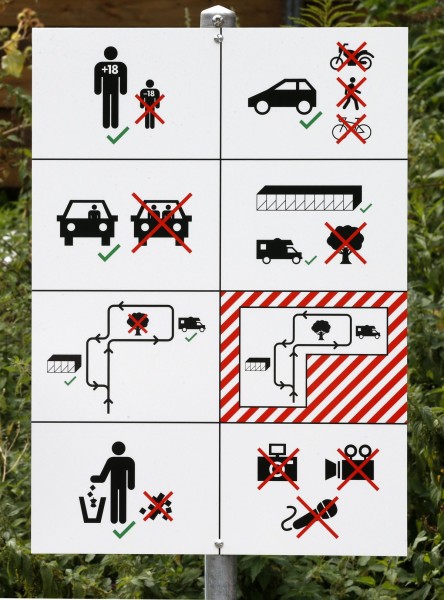
One of the most unusual aspects of the Zurich brothel — which are being referred to as “sex boxes” in Swiss media — are the signs being used at the facility, which cater both to Switzerland’s multilingual society (four official languages) and perhaps an odd sense of humor.

Rather than posting verbose signs in all four official languages (French, German, Italian, and Romansh), they’re using rather amusing “international” pictograms:

We’ve done our best to translate (going right to left then working down):

  • Swiss drive-in brothel signsNo one under the age of eighteen.
  • Only cars can use the facility — no motorbikes, people on foot, or bicycles.
  • Just one client at a time.
  • Use the facilities provided, not the outdoor space.
  • Again, do not use the outdoor space.
  • Do not go off facility grounds
  • Throw away your trash.
  • No photography, filming, or recording (or singing, perhaps).

August 26, 2013

Suddenly of greater interest to the media – where are the carriers now?

Filed under: Britain, France, Middle East, Military, USA — Tags: , , , , — Nicholas @ 08:39

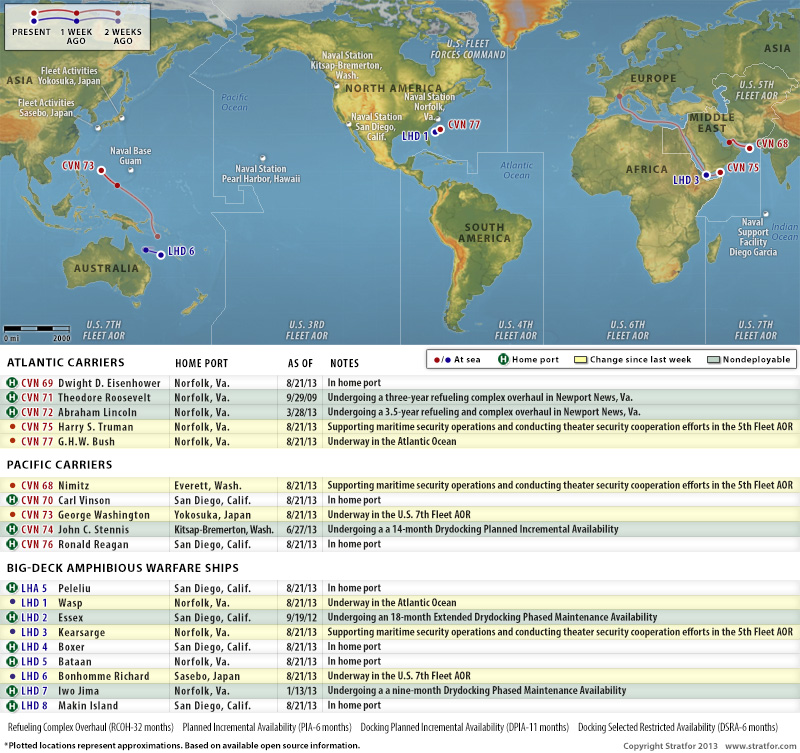
Zero Hedge pulled a quick summary of US, French, and British naval units in light of the rumours of some kind of attack on Syria:

  • A U.S. military source said on Friday the U.S. Navy was increasing its number of cruise missile-carrying destroyers in the Mediterranean to four from three by delaying the return to the United States of the Arleigh Burke class destroyer USS Mahan.
  • The aircraft carrier USS Harry S Truman, by far the most powerful warship in the region, left the Mediterranean last weekend, passing through the Suez Canal into the Red Sea.
  • Defence experts say the carrier could still strike Syria from south of Suez. As well as the strike aircraft carried by the Truman, several of her escort ships are also capable of firing Tomahawk land attack cruise missiles.
  • Since earlier this year, the United States has also had F-16 jets in Jordan, where they remained after a major military exercise this year at the request of the Jordanian government. It also has a major air base at Incirlik in Turkey that could easily house multiple aircraft as part of a wider military campaign.

Carrier locations - late August 2013

The French aircraft carrier Charles de Gaulle is still in or near Toulon, while the Royal Navy is said to have at least one Trafalgar or Astute class submarines in the Mediterranian. The RN no longer has in-service aircraft carriers, so any British air support would have to be from the RAF, possibly based in Cyprus (but subject to local government approval).

Update: This report says that the USS Ramage is also being retained in the Mediterranean along with the USS Mahan.

Update, 27 August: It was just mentioned (no link) that the Charles de Gaulle has been ordered to leave port, bound for the Eastern Mediterranean.

August 25, 2013

QotD: Persian and Greek views of abduction

Filed under: Books, Greece, History, Quotations — Tags: , , — Nicholas @ 00:01

Up to this point, there had been abductions only from each other, but after this the Hellenes were largely responsible for offenses. For they began to make war on Asia before their enemies made war on Europe. Now the Persians think that the abduction of women is certainly an act only unjust men would perform, and yet once they have been abducted, it is senseless to make a fuss over seeking vengeance. It is the way of sensible people to have no concern for abducted women; it is quite obvious that the women would not have been abducted if they had not been compliant.

Herodotus, “Book 1”, The Histories, c.450-420 BCE

August 23, 2013

Putin’s newfound fans in the American conservative movement

Filed under: Politics, Russia, USA — Tags: , , — Nicholas @ 09:22

In Reason, Cathy Young looks at the unlikely fandom for Russian President Vladimir Putin among American social conservatives:

Russian President Vladimir Putin, the career KGB officer who has presided over the rollback of his country’s post-Communist freedoms and revived Cold War-style anti-Americanism, is an unlikely hero for American conservatives. Yet the Kremlin strongman has lately found some fans on the right who see him as a defender of Christian values — most recently, in the imbroglio over Russia’s new legal ban on gay “propaganda.” It is a sad misjudgment that does a disservice to the causes of conservatism, freedom, and religion alike.

Spokesmen for several right-wing groups including the American Family Association have praised the Russian law, which prohibits any pro-gay speech or expression that could be accessible to minors. Veteran columnist Pat Buchanan has joined the Putin cheerleading squad. And, shockingly, the usually thoughtful author Rod Dreher, who blogs for The American Conservative, has added his own “1.5 Cheers for Putin.”

While condemning anti-gay violence and authoritarianism in Russia, Dreher praises Putin’s willingness to speak up for Christianity and laments that “post-Soviet Russia, for all its grievous flaws, is . . . more conscious of its Christian history and character than the United States.”

This is a truly grievous misunderstanding of the reality of religion and politics in 21st Century Russia. Russia today is outwardly far more religious than most of Western Europe, but it’s a religion of state more than church: Orthodox Christianity has taken Communism’s place as the new official ideology, with church membership an official badge of patriotism and loyalty.

QotD: Belgium as a sum of its many, many parts

Filed under: Europe, Government, Politics, Quotations — Tags: , , , — Nicholas @ 00:01

The outcome was byzantine in its complexity. Belgium was sub-divided into three “Regions”: Flanders, Wallonia and “Brussels-Capital”, each with its own elected parliament (in addition to the national parliament). Then there were the three formally instituted “Communities”: the Dutch-speaking, the French-speaking and the German-speaking (the latter representing the approximately 65,000 German speakers who live in eastern Wallonia near the German border). The communities, too, were assigned their own parliaments.

The regions and the linguistic communities don’t exactly correspond — there are German speakers in Wallonia and a number of French-speaking towns (or parts of towns) within Flanders. Special privileges, concessions, and protections were established for all of these, a continuing source of resentment on all sides. Two of the regions, Flanders and Wallonia, are effectively unilingual, even with the exceptions noted. Brussels was prounced officially bilingual, even though at least 85 percent of the population speaks French.

In addition to the regional and linguistic Communities, Belgium was also divided into ten provinces (five each in Flanders and Wallonia). These, too, were assigned administrative and governing functions. But in the course of the various constitutional revisions real authority came increasingly to lie either with the regions (in matters of urbanism, environment, the economy, public works, transport and external commerce) or the linguistic community (education, language, culture and some social services).

The outcome of all these changes was comically cumbersome. Linguistic correctness (and the constitution) now required, for example, that all national governments, whatever their political color, be “balanced” between Dutch- and French-speaking ministers, with the prime minister the only one who has to be bilingual (and who is therefore typically from Flanders). Linguistic equality on the Cour d’Arbitrage (Constitutional Court) was similarly mandated, with the presidency alternating annually across the language barrier. In Brussels, the four members of the executive of the capital region would henceforth sit together (and spake in the language of their choice) to decide matters of common concern; but for Flemish or Francophone “community” affairs they would sit separately, two by two.

As a consequence Belgium was no longer one, or even two, states but an uneven quilt of overlapping and duplicating authorities. To form a government was difficult: it required multi-party deals within and across regions, “symmetry” between national, regional, community, provincial, and local party coalitions, a working majority in both major language groups and linguistic parity at every political and administrative level. And when a government was formed it had little initiative: even foreign policy — in theory one of the last remaining responsibilities of the national government — was effectively in the hands of the regions, since for contemporary Belgium it mostly means foreign trade agreements and these are a regional prerogative.

Tony Judt, “The Old Europe — and the New”, Postwar: A History of Europe Since 1945, 2005.

August 22, 2013

Sixties TV – it was different if you were under 12

Filed under: Britain, Media — Tags: , , , , , — Nicholas @ 14:14

James Lileks looks at a few Gerry Anderson productions:

The Sixties - different under 12

Gerry Anderson! You’re going to get everything you need for crackerjack adolescent-satisfying sci-fi: spaceships, shuttlecrafts, computers, control rooms, crisp commanding officers, futuristic gadgets, and a big score. And none of it will work half as well as you hoped. The spaceships will look great, though. The computers will blink and there will be switches, but nothing makes Star Trek Sounds. The control rooms are clean but everyone is talking in a British accent for some reason, like they have their own NASA that’s just as big. The gadgets are okay. The score has a trademark echoey quality you found in soundtracks, particularly British ones, from the late 60s to the early 70s. It should be good! Why isn’t it great?

I’ve pondered that mystery for a long time. Sometimes you have a revelation — hey, the founding concept of “Space: 1999 was really stupid” — or you carp about the details, wondering why the UFO interceptors went hunting with one (1) missile that required a direct hit to be effective, instead of just blowing the hell out of the area. Then you realize it’s not great because it’s all the work of someone who made horribly grinning square-headed puppets, that’s why, and never stopping thinking he was making entertainment for 8 years olds.

[…]

The title theme is here, complete with oddly romantic piano interlude. It’s every Barry Grey piece that ever left me cold, right there. In general I just don’t feel Barry Grey’s music — except for the opening of the “Space 1999” theme before it goes full whacka-chicka, and of course that other theme. Here’s a guy who wrote miles and miles of scores for things like “Supercar,” for heaven’s sake, and he turns around and knocks off the tightest, sharpest theme of the 70s.

Still, Laurie Johnson was better.

August 21, 2013

The Guardian gets a taste of the medicine it prescribed for the tabloids

Filed under: Britain, Government, Liberty, Media — Tags: , , , , — Nicholas @ 08:25

In sp!ked, Brendan O’Neill talks about the amazing double standards of Britain’s “chattering classes”:

If there was a Nobel Prize for Double Standards, Britain’s chattering classes would win it every year. This year, following their expressions of spittle-flecked outrage over the detention of Glenn Greenwald’s partner David Miranda by anti-terrorism police at Heathrow airport, they’d have to be given a special Lifetime Achievement Award for Double Standards.

For the newspaper editors, politicians and concerned tweeters now getting het up about the state’s interference in journalistic activity, about what they call the state’s ‘war on journalism’, are the very same people – the very same – who over the past two years cheered the state harassment of tabloid journalists; watched approvingly as tabloid journalists were arrested; turned a blind eye when tabloid journalists’ effects were rifled through by the police; said nothing about the placing of tabloid journalists on limbo-like, profession-destroying bail for months on end; said ‘Well, what do you expect?’ when material garnered by tabloid journalists through illegal methods was confiscated; applauded when tabloid journalists were imprisoned for the apparently terrible crime of listening in on the conversations of our hereditary rulers.

For these cheerleaders of the state’s two-year war on redtop journalism now to gnash their teeth over the state’s poking of its nose into the affairs of the Guardian is extraordinary. It suggests that what they lack in moral consistency they more than make up for with brass neck.

Everything that is now being done to the Guardian has already been done to the tabloid press, a hundred times over, and often at the behest of the Guardian. For all the initial depictions of Mr Miranda as ‘just Glenn Greenwald’s partner’, in fact he was ferrying encrypted information from the NSA leaker Edward Snowden on flights paid for by the Guardian. That is, he was detained and questioned over journalistic material acquired through illegal means. That’s already happened to the tabloids. Over the past two years of post-phone hacking, post-News of the World harassment of tabloid hacks by the state, 104 people have been arrested, questioned, usually put on unjustly elongated bail, and sometimes imprisoned. These include many journalists but also office secretaries and other non-journalist types, like Mr Miranda, who stand accused of handling illegally acquired material. The 104’s crimes include ‘disclosure of confidential information’ – not that dissimilar to what Greenwald and Miranda have done in terms of getting hold of and publishing Snowden’s illegally leaked confidential material. Yet while the redtop writers rot in legal limbo, Mr Miranda becomes a chattering-class cause célèbre.

[…]

But, believe it or not, the double standards run even deeper than that. For today’s outraged defenders of Greenwald, Miranda and the Guardian from a state war on journalism were the architects of the state’s far larger, far more destructive war on tabloid journalism. From the Guardian itself to Labour MP Tom Watson to various influential members of the Twitterati, many of those now shocked to find officials harassing journalists for doing allegedly dodgy things were at the forefront of demanding that officialdom harass redtop hacks for doing dodgy things. If you unleash and cheer a war on journalism by the state, you really cannot be surprised when the warmongers eventually put you and your journalism in the crosshairs, too.

QotD: Empires

Filed under: Britain, Government, History, Quotations — Tags: — Nicholas @ 00:01

It’s odd the world still cares about European royals, whose primary contribution to history has been wars, repression and poverty for ordinary people so that a handful of twits could live in extreme excess, admiring themselves in the mirror. Not just the British ruling houses — the Hapsburgs, Romanovs, Hohenzollerns and other royal lines mainly brought misery to their subjects, and this was so even if Thomas Hobbes was right about corrupt aristocracy being preferable to bedlam. ALIQUATENUS MELIOR CHAOS should have been on every medieval royal family crest. That’s Latin for “We Are Somewhat Better Than Chaos,” at least according to the Google universal translator.

Perhaps anachronistic royalty draws crowds and media gushing because society adores celebrity, which the House of Windsor continues to possess. But through no effort of its own: The glamour, money and position of the Windsor crowd is inherited, not earned. Society’s admiration should go to those who attain their positions via merit.

Yet there is continuing enthusiasm for anachronistic monarchs of several nations: During the baby countdown outside Clarence House, crowds showed up in Brussels to cheer for new King Philippe, who may be the most irrelevant human being ever to don a purple sash. Fantasy may explain this. Mired in quiet desperation, people like to imagine being born into wealth and glory, treated as special and chosen. Fantasies about sports, sex or money help men and women get through their day, and getting through the day is important.

But let us not forget that kings, queens, princes, princesses, dukes, duchesses and the rest have had an almost entirely negative impact on the human family. Billions of people across the centuries would have lived better lives if the curse of royalty had not arisen. As for empire — whether British or in any other form, it is a hateful, destructive concept used by the few to bleed dry the many. Britons shouldn’t feel nostalgia for their lost empire, they should feel shame an empire once was held. Americans ought to join Indians, Pakistanis, Kenyans, Egyptians, Chinese, Afghans, Boers, Burmese and others in contempt for the memory of the British Empire.

Gregg Easterbrook, “Tuesday Morning Quarterback: NFL could set a better safety example”, ESPN, 2013-08-20

August 20, 2013

The odd pre-history of the Statue of Liberty

Filed under: Europe, France, History, Liberty, USA — Tags: , , — Nicholas @ 10:52

B.K. Marcus on what schoolchildren don’t learn about the famous New York city landmark:

Frédéric Auguste Bartholdi wanted wealth and world renown for building a celebrated colossus, and he was willing to shop the idea around — even to the era’s most illiberal customers.

His first pitch for a giant, torch-bearing statue was to the Ottoman viceroy of Egypt, which was, at the time, the single greatest commercial conduit for the international slave trade.

The statue that now stands in New York Harbor is officially called “Liberty Enlightening the World” (La Liberté éclairant le monde). The statue in Egypt was to be called “Egypt Enlightening the World” or, more awkwardly, “Progress Carrying the Light to Asia.”

Failing to close the deal in Egypt, Bartholdi repackaged it for America.

When this bit of backstory reached the American public, Bartholdi denied that one project had anything to do with the other, but the similarity in designs is unmistakable.

Egypt was a vassal state of an authoritarian empire and the gateway for the colossal African slave trade into Asia — whereas the fundraising for the Statue of Liberty proposed a monument not merely to liberty but to the recent abolition of American slavery. (Picture the broken chains at the Statue of Liberty’s feet.)

The original statue was to be an Egyptian woman — a fellah, or native peasant — draped in a burqa, one outstretched arm holding a torch to guide the ships on the great waterway over which she would stand.

Bartholdi had wanted to place his piece at the northern entrance to the Suez Canal in Port Said because the canal represented French greatness in general and engineering greatness more specifically. His statue was to be a synthesis of French art and French engineering, as well as a political symbol of the progress that France offered the East.

The canal was indeed a great engineering accomplishment and a giant step forward for world trade and greater wealth and comfort for everyone — including the toiling masses. But it was built on the back of slave labor, a 10-year corvée that forced Egyptian peasants to do the digging. Thousands died.

“You’ve had your debate. There’s no need to write any more.”

Filed under: Britain, Law, Liberty, Media — Tags: , , , , , — Nicholas @ 10:29

Things are getting surreal at the Guardian:

A little over two months ago I was contacted by a very senior government official claiming to represent the views of the prime minister. There followed two meetings in which he demanded the return or destruction of all the material we were working on. The tone was steely, if cordial, but there was an implicit threat that others within government and Whitehall favoured a far more draconian approach.

The mood toughened just over a month ago, when I received a phone call from the centre of government telling me: “You’ve had your fun. Now we want the stuff back.” There followed further meetings with shadowy Whitehall figures. The demand was the same: hand the Snowden material back or destroy it. I explained that we could not research and report on this subject if we complied with this request. The man from Whitehall looked mystified. “You’ve had your debate. There’s no need to write any more.”

During one of these meetings I asked directly whether the government would move to close down the Guardian‘s reporting through a legal route — by going to court to force the surrender of the material on which we were working. The official confirmed that, in the absence of handover or destruction, this was indeed the government’s intention. Prior restraint, near impossible in the US, was now explicitly and imminently on the table in the UK. But my experience over WikiLeaks — the thumb drive and the first amendment — had already prepared me for this moment. I explained to the man from Whitehall about the nature of international collaborations and the way in which, these days, media organisations could take advantage of the most permissive legal environments. Bluntly, we did not have to do our reporting from London. Already most of the NSA stories were being reported and edited out of New York. And had it occurred to him that Greenwald lived in Brazil?

The man was unmoved. And so one of the more bizarre moments in the Guardian‘s long history occurred — with two GCHQ security experts overseeing the destruction of hard drives in the Guardian‘s basement just to make sure there was nothing in the mangled bits of metal which could possibly be of any interest to passing Chinese agents. “We can call off the black helicopters,” joked one as we swept up the remains of a MacBook Pro.

Update: Charlie Beckett at the LSE’s Polis blog:

The narrative of increasing totalitarian persecution has a few flaws. Firstly, I think it was entirely reasonable for security forces to question someone linked to security breaches. I just think that doing it under terror laws was wrong, especially as Miranda is part of a journalism team.

I am still a little unsure of the Greenwald/Guardian narrative. I am puzzled by why the team chose to fly Miranda through London at all. I am also unclear as to why the Guardian let security officials smash up their hard-drives without making them go down a legal path.* [Someone with more profound doubts about the Guardian and Greenwald is former Tory MP Louise Mensch — good piece by her here]

But those are details. Overall, it’s clear that US and UK officials, long-tortured by WikiLeaks and Julian Assange, are now losing patience with whistle-blowers and their accomplices in the news media. Whatever the absolute truth of the NSA/PRISM revelations it is clear that the security service are pushing the boundaries on what they can do with new technologies to increase their information and surveillance. They are also seeking to reduce scrutiny by journalists, as they told Rusbridger:

    “You’ve had your debate. There’s no need to write any more.”

That in itself may be worrying but it’s hardly surprising. That is what they are there for. We would all be very cross if there was an act of terror missed because of inadequate data collection by spooks or if a press leak endangered our safety. But it’s also journalism’s job to hold these people to account and let the public know the scope of what they are up to. That’s what worries me about the Miranda incident.

« Newer PostsOlder Posts »

Powered by WordPress