
1/2 tumbler red wine
ScotchI have it on the authority of Colm Brogan that the Great Queen was “violently opposed to teetotalism, consenting to have one cleric promoted to a deanery only if he promised to stop advocating the pernicious heresy,” and that the above was her dinner-table drink, “a concoction that startled Gladstone” — as I can well believe.
The original recipe calls for claret, but anything better than the merely tolerable will be wasted. The quantity of Scotch is up to you, but I recommend stopping a good deal short of the top of the tumbler. Worth trying once.
Scholars will visualize, pouring in the whisky, the hand of John Brown, the Queen’s Highland servant, confidant and possibly more besides; and I for one, if I listen carefully can hear him muttering, “Och, Your Majesty, dinna mak’ yoursel’ unweel wi’ a’ yon parleyvoo moothwash — ha’e a wee dram o’ guid malt forbye.” Or words to that effect.
Kingsley Amis, Everyday Drinking: The Distilled Kingsley Amis, 2008.
August 20, 2013
QotD: Queen Victoria’s Tipple
August 19, 2013
The Dieppe Raid
The Laurier Centre for Military Strategic and Disarmament Studies has a two-part post on the Dieppe raid and the decision-making process that led up to the operation:
Professor Emeritus Terry Copp, director of the Laurier Centre for Military Strategic and Disarmament Studies presents “The Dieppe Raid: A Decision-Making Exercise – Part 1: Operation Rutter.” This lecture, which explores Operation Rutter – the precursor to Operation Jubilee (the Dieppe Raid) – is the first in a series of two videos which will make up this decision-making exercise. The next video (Part Two) focuses entirely on Operation Jubilee and can be found here.
This decision-making exercise is offered as part of the outreach activities of the Laurier Centre for Military Strategic and Disarmament Studies at Wilfrid Laurier University, Waterloo, Ontario, Canada. The exercise is based on the one we use to engage students in critical historical thinking at the strategic and operational level without the benefit of hindsight.
The main question we would like you to consider while watching these lectures is:
After being presented with the same information that decision-makers had in 1942, would you still launch the Dieppe Raid?
Additional information will pop up throughout the video through the “Annotations” feature, so please do not disable this option while viewing.
Glenn Greenwald’s partner detained by UK authorities
The British government sends a message:
The partner of the Guardian journalist who has written a series of stories revealing mass surveillance programmes by the US National Security Agency was held for almost nine hours on Sunday by UK authorities as he passed through London’s Heathrow airport on his way home to Rio de Janeiro.
David Miranda, who lives with Glenn Greenwald, was returning from a trip to Berlin when he was stopped by officers at 8.05am and informed that he was to be questioned under schedule 7 of the Terrorism Act 2000. The controversial law, which applies only at airports, ports and border areas, allows officers to stop, search, question and detain individuals.
The 28-year-old was held for nine hours, the maximum the law allows before officers must release or formally arrest the individual. According to official figures, most examinations under schedule 7 — over 97% — last less than an hour, and only one in 2,000 people detained are kept for more than six hours.
Miranda was released, but officials confiscated electronics equipment including his mobile phone, laptop, camera, memory sticks, DVDs and games consoles.
Since 5 June, Greenwald has written a series of stories revealing the NSA’s electronic surveillance programmes, detailed in thousands of files passed to him by whistleblower Edward Snowden. The Guardian has also published a number of stories about blanket electronic surveillance by Britain’s GCHQ, also based on documents from Snowden.
Update: The opposition Labour party calls for an investigation into this use of anti-terrorism legislation (but as Charles Stross point out … they passed the laws themselves).
Labour has called for an urgent investigation into the use of anti-terror powers to detain David Miranda, the partner of a Guardian journalist who interviewed US National Security Agency whistleblower Edward Snowden.
Yvette Cooper, the shadow home secretary, said ministers must find out whether anti-terror laws had been “misused”, after Miranda was held for nine hours by authorities at Heathrow airport under the Terrorism Act.
His detention has caused “considerable consternation” and the Home Office must explain how this can be justified as appropriate and proportionate, she said.
[…]
“The independent reviewer of terrorism legislation, David Anderson, has already warned of the importance of using schedule 7 of the Terrorism Act appropriately and proportionately. The purpose of schedule 7 is to determine whether or not someone is involved in or associated with terror activity. The Home Office and police need to explain rapidly how they can justify using that purpose under the terrorism legislation to detain David Miranda for nine hours. This has caused considerable consternation and swift answers are needed.
“The police and security agencies rightly work hard to protect national security and prevent terrorism. But public confidence in security powers depends on them being used proportionately within the law, and also on having independent checks and balances in place to prevent misuse.”
QotD: “The Genius of the Carpathians”
Romanian Communism in its last years sat uneasily athwart the intersection of brutality and parody. Portraits of the Party leader and his wife were everywhere; his praise was sung in dithyrambic terms that might have embarrassed even Stalin himself (though not perhaps North Korea’s Kim Il Sung, with whom the Romanian leader was sometimes compared). A short list of the epithets officially-approved by Ceauşescu for use in accounts of his achievements would include: The Architect; The Creed-shaper; The Wise Helmsman; The Tallest Mast; The Nimbus of Victory; The Visionary; The Titan; The Son of the Sun; A Danube of Thought; and The Genius of the Carpathians.
Tony Judt, “The End of the Old Order”, Postwar: A History of Europe Since 1945, 2005.
August 18, 2013
QotD: The unluckiest regiment in the British army
The history of the 24th Regiment (later the South Wales Borderers) is certainly one of the most interesting stories of any regiment in the British army. Throughout its long history, going back to 1689, it had been an exceptionally courageous regiment and also exceptionally unlucky. In 1694 it had taken part in the ill-fated descent on Brest. In the War of Jenkins’s Ear and the attack on Cartagena it lost more than half its number from disease in the West Indies. In 1756 it was forced to surrender to the French at Minorca. The entire regiment was captured in the American War. Forty-six per cent of the second battalion were casualties at the Battle of Talavera in the Peninsula War — more than any other British regiment engaged. In 1810 about 400 men, nearly half the regiment, were captured by the French while on troopships from South Africa bound for India.
Perhaps it is as well to outline here the story of this gallant but ill-starred regiment after the Battle of Chilianwala. The catastrophe which overtook it in the Zulu War will be described later. In World War I it was in the disastrous Gallipoli campaign, and on 3 December 1917 the second battalion marched out of the lines in France with only two officers, the doctor and seventy-three men. In World War II a battalion was captured by the Germans near Tobruk and, naturally, it was part of the unfortunate expedition to Norway in 1940 — even the ship carrying them struck a rock and sank.
Byron Farwell, Queen Victoria’s Little Wars, 1972
August 15, 2013
MI5 – more Maxwell Smart than 007
Britain’s counter-intelligence service, MI5, comes in for some unkind words on the BBC website from Adam Curtis:
The recent revelations by the whistleblower Edward Snowden were fascinating. But they — and all the reactions to them — had one enormous assumption at their heart.
That the spies know what they are doing.
It is a belief that has been central to much of the journalism about spying and spies over the past fifty years. That the anonymous figures in the intelligence world have a dark omniscience. That they know what’s going on in ways that we don’t.
It doesn’t matter whether you hate the spies and believe they are corroding democracy, or if you think they are the noble guardians of the state. In both cases the assumption is that the secret agents know more than we do.
But the strange fact is that often when you look into the history of spies what you discover is something very different.
It is not the story of men and women who have a better and deeper understanding of the world than we do. In fact in many cases it is the story of weirdos who have created a completely mad version of the world that they then impose on the rest of us.
I want to tell some stories about MI5 — and the very strange people who worked there. They are often funny, sometimes rather sad — but always very odd.
The stories also show how elites in Britain have used the aura of secret knowledge as a way of maintaining their power. But as their power waned the “secrets” became weirder and weirder.
They were helped in this by another group who also felt their power was waning — journalists. And together the journalists and spies concocted a strange, dark world of treachery and deceit which bore very little relationship to what was really going on. And still doesn’t.
And no retelling of MI5’s hits and misses is complete without the time they accused their own chief of being a Soviet spy:
The small group in MI5 now became convinced that their organisation was not just penetrated by the Russians, it was actually run by a Soviet agent. They knew they had to get the truth out somehow even if it meant breaking the law. So they found a friendly journalist called Chapman Pincher and told him the hidden truth.
Here is Chapman Pincher being interviewed on the Wogan programme about what then happened. Up to this point Pincher had been the Defence correspondent on the Daily Express. He was successful for getting “scoops” from “inside sources” — although the historian EP Thompson said that really Chapman Pincher was:
“A kind of official urinal in which ministers and intelligence and defence chiefs could stand patiently leaking.”
What the dissident MI5 agents now told Pincher was like super high-grade piss. Or, as he puts it in the Wogan interview, “it was like walking into an Aladdin’s Cave”. But what Pincher wrote was going to open the floodgates to a new kind of conspiracy journalism that still holds sway over large parts of the media imagination.
Have a look at him and decide yourself — high grade toilet or investigative journalist? Or maybe often they are the same thing?
August 13, 2013
It’s accurate to describe the Greek plight as a depression
Allister Heath says the catastrophic state of the Greek economy fully merits the descriptor “depression”:
Sorry, but the fact that Greece collapsed at an annual rate of 4.6 per cent in the second quarter, rather than a little bit faster, isn’t good news. It’s terrible, awful, horrible news. Greek output is down by 23 per cent since 2008 and unemployment is at around 28 per cent; no wonder, given the shrinking economy, that gross tax revenues are continuing to undershoot targets.
Hyperbolic economists sometime claim that the UK has undergone a depression, which is nonsense — but Greece’s woes cannot be described in any other way. Its depression has been catastrophic, one of the worst ever recorded for any country in the modern, industrialised era (apart from during or immediately after a war). Its dramatic collapse reminds us that stupid economic policies can destroy a nation; depressions have not been banished from modern civilisation.
It may be, of course, that the collapse is beginning to abate and that the economy may finally stabilise next year. I’ll believe it when I see it; unless Greece’s money supply starts growing again, and demand begins to increase, a recovery is impossible. But Greece is just a tiny part of the Eurozone, so achieving such an outcome is even harder than in a country like the UK, especially given that the Greek financial crisis hasn’t really gone away. There is no way that Athens will meet its bailout targets and its debt burden is utterly unsustainable.
August 11, 2013
Debunking the “Cameron’s gunboat diplomacy” meme
Sir Humphrey points out that the British media’s collective gasp about Royal Navy ships being sent to Gibraltar merely highlights what a slow news month it is:
It’s an amusing irony that the recent row in Gibraltar has suddenly given the Royal Navy more publicity about its forthcoming COUGAR deployment in one evening, than it may have got in several months of deployment. The news that the Response Force Task Group (RFTG) is deploying to the Med has been seen as a clear example of gunboat diplomacy by Fleet Street’s finest, many of whom seem terribly keen on starting a war in order to fill column inches during a slow news month…
Its perhaps worth noting that this deployment is extremely long standing — the sort of planning which goes into deploying a major Task Force will usually commence at around 12 months prior to the event, when the rough outline of a plan is put together on the objectives of the deployment, likely ports, aims and intended outcomes and so on. While maritime power is about flexibility, it’s often forgotten that most RN deployments these days are the end product of months of well co-ordinated planning and staffing to ensure that the UK gets the best possible value from its naval assets.
[…]
What we can perhaps draw from this is that firstly the RN has enjoyed an unexpected boon of coverage, tapping into the nation’s subliminal psyche which holds that sending a grey hull is a key means of solving a crisis, no matter what or where the crisis is. There is perhaps work for some analysts to understand why, almost alone among all major powers, the cries of ‘send a gunboat’ seem to resonate most strongly in the UK (albeit to a lesser extent the same applies with the ‘send a carrier’ debate in the US). While deployments of warships can be seen as a useful indicator of interest in situations, it appears to be held most strongly in the UK — there is, at times, a fervent belief that deploying vessels is akin to the legend of waving the ancient banner three times in order for Arthur and his knights to appear — it makes little practical sense, but is somehow strangely comforting to the people.
August 7, 2013
Gibraltar as this year’s “shark story” filler
Sir Humphrey thinks there’s rather less than meets the eye in the media’s coverage of the Spanish government’s recent series of escalations over Gibraltar:
Its August, the sun is shining, the politicians are on holiday and the media are desperately searching around for some kind of story to fill the news. Suddenly, the perfect story has emerged — those dreadful Spanish are doing all manner of dubious things to threaten Gibraltar and simultaneously the Falkland Islands. Is there reason for panic, or is it a case of just summer bluster in order to distract attention from other problems? The UK has always had a challenging relationship with the Spanish over Gibraltar — no matter how much the UK wishes to move the relationship forward (and in many areas it remains an extremely strong and positive relationship), this feels as if it is an issue which cannot easily be resolved.
The current situation owes much to the Spanish ratcheting up tensions after claims that Gibraltar was laying concrete blocks into local waters, in turn threatening traditional fishing grounds. It is hard to work out whether this is a genuine grievance, or merely a convenient pretext in order to gain some traction on putting pressure on the territory. Following a previous weekend where long traffic jams occurred with checks on all cars transiting the border, the Spanish are now reportedly considering imposing an entrance / exit tax of 50 Euros on anyone transiting their side of the border. While such taxes may be deeply unpleasant, they are perhaps not necessarily new (many countries impose similar entrance taxes around the world). The question is to what extent would this damage the local economy? It is worth considering that many Gibraltarians work in southern Spain, so any tax would probably make it difficult to get to work and damage the livelihood of many small businesses – perhaps appealing in a nation where youth unemployment is ever higher, but in the interim it could easily cause more long term economic damage to both the Spanish and Gibraltarian economies.
So what is the tie-in to the Falkland Islands? A media report on Spain selling Mirage fighter jets to Argentina:
It is not clear whether this is actually news, or whether it’s the case that the Tabloid press have been looking on Wikipedia and turned what is a one line entry on future Spanish Mirage jet prospects into an article designed to raise tensions. In reality this site has long made the point that the Argentine Armed Forces are in a parlous state, and that they are desperately short of spares, training and operational experience.
They’ve also taken various fleets of aircraft out of service in recent years, so its entirely reasonable to expect some form of replacement at some point. In the case of the Mirage jets, they entered service in 1975 and are extremely old and not necessarily front line fast jet material any longer. Acquisition of a small number of 1970s vintage jets which have been worked hard for nearly 40 years is not really going to change the balance of power in the South Atlantic. Indeed, its worth noting that right now (if you believe Wikipedia) the entire Argentine Mirage fleet is grounded anyway due to spares and safety issues. At best this acquisition may try and restore some limited capability. So, its fair to say that the Falkland Islands are hardly at risk of collapse — if the acquisition of a small number of ancient fighter aircraft materially changes the balance of power, then something has gone very badly wrong in UK defence planning circles.
August 6, 2013
Helping the Russians laugh … at us
Bruce Sterling on the Edward Snowden situation:
This is the kind of comedic situation that Russians find hilarious. I mean, sure it’s plenty bad and all that, PRISM, XKeyScore, show trials, surveillance, threats to what’s left of journalism, sure, I get all that, I’m properly concerned. None of that stops it from being hilarious.
Few geopolitical situations can ever give the Russians a full, free, rib-busting belly laugh. This one sure does.
If Snowden had gotten things his own way, he’d be writing earnest op-ed editorials in Hong Kong now, in English, while dining on Kung Pao Chicken. It’s some darkly modern act of crooked fate that has directed Edward Snowden to Moscow, arriving there as the NSA’s Solzhenitsyn, the up-tempo, digital version of a conscience-driven dissident defector.
But Snowden sure is a dissident defector, and boy is he ever. Americans don’t even know how to think about characters like Snowden — the American Great and the Good are blundering around on the public stage like blacked-out drunks, blithering self-contradictory rubbish. It’s all “gosh he’s such a liar” and “give us back our sinister felon,” all while trying to swat down the jets of South American presidents.
These thumb-fingered acts of totalitarian comedy are entirely familiar to anybody who has read Russian literature. The pigs in Orwell’s Animal Farm have more suavity than the US government is demonstrating now. Their credibility is below zero.
The Russians, by contrast, know all about dissidents like Snowden. The Russians have always had lots of Snowdens, heaps. They know that Snowden is one of these high-minded, conscience-stricken, act-on-principle characters who is a total pain in the ass.
Modern Russia is run entirely by spies. It’s class rule by the “siloviki,” it’s Putin’s “managed democracy.” That’s the end game for civil society when elections mean little or nothing, and intelligence services own the media, and also the oil. And that’s groovy, sure, it’s working out for them.
When you’re a professional spy hierarch, there are few things more annoying than these conscience-stricken Winston Smith characters, moodily scribbling in their notebooks, all about how there might be hope found in the proles somehow. They’re a drag.
[…]
Citizens and rights have nothing to do with elite, covert technologies! The targets of surveillance are oblivious dorks, they’re not even newbies! Even US Senators are decorative objects for the NSA. An American Senator knows as much about PRISM and XKeyScore as a troll-doll on the dashboard knows about internal combustion.
August 5, 2013
A morbid bit of railway history
I read about the London Necropolis Railway in The Fuller Memorandum by Charles Stross. I foolishly assumed he’d made it up for the purposes of the story. Not at all:
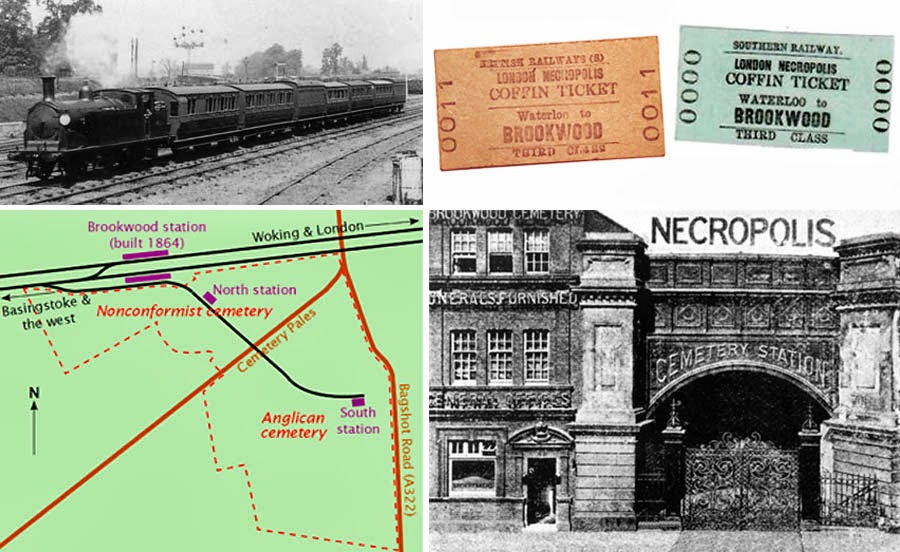
[Sir Richard] Broun was fascinated by the recently-emerged technology of steam trains. In 1848, Waterloo Station had only just been opened, and the railways themselves were still considered something of a novelty. Broun, along with his partner Richard Sprye, concocted a plan to ease the overcrowding issue with the help of this new invention. Buying up a 1,500 acre site outside Woking, they proposed the creation of a dedicated railway of the dead: a line (serviced by London & Southwest Rail) used for the sole purpose of transporting the deceased from London to ‘Brookwood Cemetery’ for burial.
[…]
The railway was inaugurated on 13th November 1854, with its own dedicated platform at Waterloo Station. A timetabled service would transport coffins down at night and mourners by day, delivering them to one of two stations: the Conformist station on Brookwood’s sunny side; or the non-conformist station on its dark north face. To prevent upsetting any delicate Victorian sensibilities, each ‘coffin train’ was divided into classes to separate the dead from their poorer neighbours. Even in death, it seemed, the idea of sharing a carriage with a pauper was anathema.
[…]
Until the 1940s it remained a weird London institution, a ghoulish Victorian hangover that resisted time, social change and falling demand. Ultimately, it took the Luftwaffe to close it down: during the heavy bombing raid of 16th April 1941 the Waterloo terminus was obliterated. The LNR had shipped its last cadaver.
H/T to Dave Slater for the link.
August 3, 2013
Energy efficiency does not equate to lower energy usage
Tim Harford talks about an obscure 19th century prognosticator and the implications of one of his predictions:
Despite Keynes’s admiration, Jevons might now be forgotten, save for one famous prediction and one intriguing argument. The famous prediction — that the UK’s economic prosperity was at risk because the country would run out of viable reserves of coal — was contained in The Coal Question (1865), a book that made Jevons a celebrated pundit at the age of 29. The coal industry did fall into decline. Production peaked exactly a century ago, when there were 1.1 million coal miners — four times as many as when Margaret Thatcher was elected in 1979. Whether this had much to do with the fall of the Empire is a fascinating question.
Jevons remains notable in some circles for an argument he made in The Coal Question, rebutting critics who claimed that a coal shortage was no problem because steam engines would become dramatically more efficient. Jevons replied: “It is wholly a confusion of ideas to suppose that the economical use of fuel is equivalent to a diminished consumption. The very contrary is the truth.” This idea became known as the Jevons paradox: that energy efficiency does not reduce energy consumption. When light was hugely expensive, a person might read by the fickle flame of a single candle; now it’s so cheap we flood our cities with it. Double glazing could mean lower heating bills but in practice it means warmer houses.
So was Jevons right? That’s a hotly contested topic. On a microeconomic level, he was not: a 50 per cent increase in the energy efficiency of a device will lead to increased use, but rarely to the doubling in usage that would be necessary for Jevons to be correct. Aha, reply Jevons’s defenders: even if a fuel-sipping car does not induce me to drive much further, I may still spend my cash savings on some other energy-guzzling device. True. But energy is a small enough part of the economy — about 6 to 10 per cent — that the actual cash savings available to spend elsewhere will usually be modest.
Sherlock Series 3 Teaser Trailer
More about this programme: http://www.bbc.co.uk/programmes/b018ttws Sherlock returns but will things ever be the same again?
August 2, 2013
The self-inflicted wounds of Britain’s post-war auto industry
Dominic Sandbrook contrasts the rise of the German auto industry from the literal rubble of the post-war world with the slow decline of Britain’s once-mighty car makers:
If you want to know why Angela Merkel calls the shots in Europe, Germany’s car factories are a pretty good place to start.
By contrast, Britain’s car industry is a shadow of its former self. We do still make almost one and a half million cars a year, which is good news for thousands of British engineers. But these days, we make them for other people.
The iconic Mini plant at Cowley, for example, is celebrating its centenary this year. It was founded in 1913 by the entrepreneur William Morris as the home for his legendary Morris Oxford.
Today it still makes thousands of cars — but it makes them for BMW.
It’s a similar story at Crewe, the home of another great British icon, Bentley – which actually belongs to Volkswagen.
Half a century ago, let alone when Morris was at his peak, this would have seemed unimaginable. But the sad truth is that Britain’s car firms only have themselves to blame.
Seventy years ago, at the end of World War II, Germany was on its knees. After the fall of Hitler’s empire, its car industry lay in ruins.
In August 1945 the British Army sent a major called Ivan Hirst to take control of the giant Volkswagen plant in Wolfsburg, which had been built under the Nazis to produce ‘people’s cars’ for the German masses.
Ignoring his sceptical superiors, Hirst could see the potential amid the shattered debris of the Wolfsburg factory.
Rebuilding Volkswagen, he thought, would be a step towards rehabilitating Germany as a prosperous, peaceful European ally. And of course he was right.
In the next few years, Hirst restarted production of a car we know today as the Beetle. And from then on, VW was flying.


