
Extra Credits
Published on 7 Jun 2018A small handful of Grecian city-states have come together to stand off against the invading Persians at Thermopylae. At this fateful mountain pass, Greece will discover its identity as a nation.
The Battle of Thermopylae is one of the most significant events in the ancient world — and also one of the least understood.
Brought to you by Total War: Arena! Use the code HOPLITE for extra goodies:
https://totalwararena.net/join/4064_EN1…
June 9, 2018
Thermopylae – The Hellenic Alliance – Extra History – #1
Comments Off on Thermopylae – The Hellenic Alliance – Extra History – #1
D-Day – IV: The Atlantic Wall – Extra History
Extra Credits
Published on 29 Jun 2017The Germans had established a secure barrier against the Allied invasion of France – or so they believed, until the D-Day landings in Normandy caught them by surprise and the Atlantic Wall quickly fell apart.
Comments Off on D-Day – IV: The Atlantic Wall – Extra History
June 8, 2018
The British political scene has all the horrific fascination of a slow-motion car crash
Colby Cosh says that anyone who claims to be shocked and appalled at the Ontario political mess need only glance across the pond to put things into proper perspective:
The one thing everyone seems to agree upon about Ontario’s provincial election is that it has been all kind of horrid, strange and exhausting; if there is another thing they agree upon, it is that Ontario politics will probably continue to be horrid, strange and exhausting for a while even when it’s over. I have one word for these people: Brexit. Try following U.K. politics for a while in the era of British secession from the European Union. You will scurry, shrieking, back to Queen’s Park soon enough.
The Brexit drama is a mesmerizing blend of jargon and impotence, frustration and confusion; it is a vivisection of democracy from which Britain cannot avert its gaze. In Ontario you still have distinguishable political parties: in Britain now, familiar entities have been altogether dissolved into underlying tendencies, shades and conspiracies. So-and-so is a “soft Brexiter.” How soft? Oh, not as soft as Mr. Whatnot, but distinctly softer than Miss How-Do-You-Do. Mysterious verbal puzzles — do you favour the “single market” or the “internal market”? — become theatres of struggle.
A bonus of Brexit-watching for us is that, over the past six months or so, you have often been able to get the brief neurochemical pop that Canadians all receive when Canada is mentioned abroad. The Canada-EU free-trade deal CETA, which you may remember being signed in October 2016 after some obscure trouble with Walloons, has turned out to be an important anchoring concept in the Brexit debate. CETA is the European Union’s most liberal and comprehensive trade deal with an offshore non-member — and that is just what Britain voted to become.
Advocates of a “hard” Brexit, with no judicial, bureaucratic or fiscal ties to the continent, began pointing to CETA as a readymade model for Britain-EU relations almost before the ink was dry. Problem: CETA broadly allows free movement of goods between Canada and Europe, but services are not included. Britain doesn’t make much physical stuff anymore, and it quit digging coal; it depends especially heavily on providing financial services to the world.
Comments Off on The British political scene has all the horrific fascination of a slow-motion car crash
The Battle of Belleau Wood Begins I THE GREAT WAR Week 202
The Great War
Published on 7 Jun 2018The German Army is still threatening Paris and the situation for the Allies looks dire. Reluctantly, General Pershing agrees to put some of the American troops into action at Belleau Wood and Château-Thierry.
Comments Off on The Battle of Belleau Wood Begins I THE GREAT WAR Week 202
The spiritual and aesthetic brutality of Brutalist architecture
In City Journal, Catesby Leigh looks at (and shudders at) some of the best-known examples of Brutalist architecture in the UK:
World War II left Britain in urgent need of rebuilding. The Blitz destroyed 200,000 homes and left another quarter-million uninhabitable. In the severely overcrowded urban slums, often blighted by industrial pollution, families lived without indoor plumbing, and they shared outdoor privies with neighbors. Others found shelter in temporary prefabricated homes produced by the aviation industry. In 1946, the government legislated the creation of new towns that, along with extensions of existing ones, would eventually be home to more than 2 million Britons. Aside from the new towns, a multitude of urban renewal and greenfield-development schemes emerged during the economically vigorous 1950s and 1960s. Housing “estates” erected by city and other local councils, mainly for lower-income residents, sprang up at a vertiginous rate, along with new office buildings, civic centers, shopping centers, parking garages, schools, hospitals, factories, and university buildings. Some 1.5 million prewar homes were demolished in the three decades following the war. Old urban centers were transformed: “Post-war Birmingham rebuilt itself in austere raw concrete, like Kuwait and Hanover and Manila,” Christopher Beanland enthuses in Concrete Concept: Brutalist Buildings Around the World. But by the late 1960s, it was obvious that most Englishmen weren’t keen on the idea of Birmingham looking like Kuwait and Hanover and Manila.
[…]
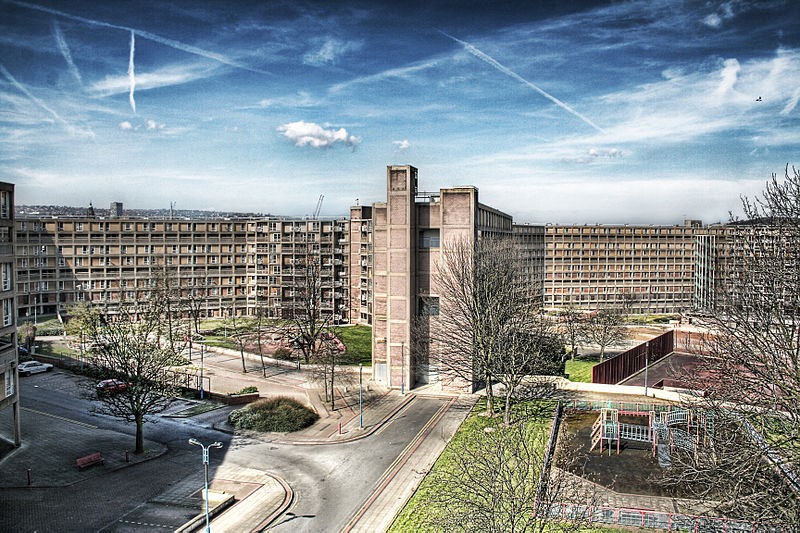
Park Hill, half-abandoned council housing estate, Sheffield, England
Photo via Wikimedia CommonsMany of the buildings that Harwood’s book covers make you wonder whether it is really about architecture at all. Consider Park Hill (1961), a huge council-housing estate containing nearly 1,000 duplexes and single-level flats that partially replaced a demolished slum overlooking downtown Sheffield — a crime-ridden precinct that, for all its problems, had housed a resilient community. Laid out as four long, interconnected slabs inflected so as to form an utterly antiurban, vermiculated footprint, Park Hill owed an enormous debt to the Unité d’habitation. At every third story, it featured elevated open-air “streets” or “decks” — the Corbusian fetish of the day — that ran indoors and out, connecting the slabs. As at the Unité, the imagery was nakedly industrial, with the apartments stashed in a “bottle-rack” grid of concrete that soon assumed a depressingly drab tincture and also proved prone to spalling. A ruthless rationalism likewise asserted itself in the level height maintained throughout the complex, which ranged from four to 13 stories, despite the irregular, sloping site. Park Hill was less a work of architecture than a huge, strange contraption inflicted on the urban skyline. Visual amenity, such as it was, came in the form of soft-hued brick within the concrete grid.
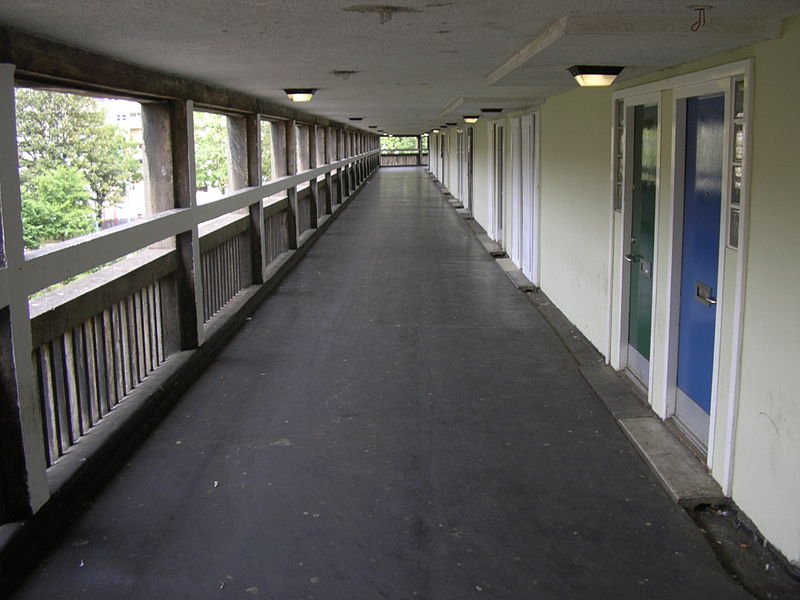
A typical deck in the Park Hill Flats, Sheffield.
Photo via Wikimedia Commons.As with many postwar housing projects, Park Hill offered practical amenities that residents had never before enjoyed: indoor plumbing, hot water, mechanical heating, even a sophisticated garbage-disposal system. Harwood mentions that, Britain’s many council-housing catastrophes notwithstanding, Park Hill “stood firm.” This is not true. By 1979, less than 20 years after its completion, Park Hill was an urban basket case — riddled with graffiti, terrorized by hooligans, afflicted with irruptions of black mold and the terrible stench resulting from waste-disposal blockages. Deserted decks and stairways provided criminals with multiple escape routes.
[…]
Local journalist Peter Tuffrey’s Sheffield Flats, Park Hill and Hyde Park: Hope, Eyesore, Heritage — whose title might seem to play ironically off Harwood’s but for the fact that the book appeared two years earlier — allows us to study a map and old photographs of the slum that Park Hill and Hyde Park supplanted. What we see are blocks, courts, and alleys teeming with row houses and low-rise tenements — streetscapes displaying a human scale, much solid construction, and considerable dereliction, all to be swept away by the desolation of the Corbusian superblocks.
Harwood doesn’t trouble herself with the Hulme Crescents (1972), another assemblage of concrete slabs on the vermiculated, “streets-in-the-sky” plan that rose from the blank slate of a demolished Manchester working-class district where 90,000 people once lived — “the human engine-room of the Industrial Revolution,” as Lynsey Hanley calls it in her largely autobiographical and often engrossing Estates: An Intimate History. The Crescents, designed to house more than 13,000, were conceived in emulation of Bath, the gorgeous Georgian city. Things didn’t work out that way.
“Almost immediately, the estate’s infrastructure began to suffer from the same problems that beset Park Hill and Broadwater Farm [a troubled north London estate]: leaky roof membranes, infestations of vermin and insects, uncontrollable damp, deserted walkways, and an endemic feeling of isolation,” Hanley notes. “The flats were so expensive to warm that many tenants never turned the central heating on, and communal areas were so difficult to maintain that the [city] council could not cope. When a small child died after falling off the top-floor ‘access deck’ of one of the Crescents in 1974, families decamped to the outskirts, belatedly following the rest of old Hulme.” The Crescents’ descent into chaos did make it possible for an anarchic punk scene to flourish in an upper-level hangout known as The Kitchen. The party ended with the estate’s demolition during the 1990s.
[…]
Still, the folly of concentrating lower-income populations in tall buildings eludes her, just as it eluded the Tory government that, in 1956, introduced hugely generous subsidies for the construction of high-rises, relative to row houses and semidetached houses. Not only are tall buildings much more expensive to build and maintain than houses; they were not even essential to achieving the residential densities that postwar planners sought. Tall buildings are highly artificial and complex structures housing temperamental machines, like elevators, that require a heightened degree of maintenance, often by highly paid technicians rather than handymen with toolboxes and stepladders, as Hanley observes. Tall buildings also require an elevated degree of social discipline, as well as security features like intercom systems, closed-circuit TV, and doormen or concierges. The tower blocks and high-rise slabs at the Barbican Estate, the carefully developed, elaborately landscaped, intensely picturesque Brutalist “bankers’ commune” in the City of London, have been very successful. The appropriate synecdoche for the Barbican’s low-end counterparts, however, might well be a broken-down elevator littered with trash, defaced by graffiti, and reeking of urine.
Comments Off on The spiritual and aesthetic brutality of Brutalist architecture
D Day – III: La Résistance – Extra History
Extra Credits
Published on 20 Jun 2017Although the French government surrendered to the German invasion, French people rose up and formed resistance groups to take their country back. Charles de Gaulle and his Free French took advantage of these independent movements to help organize actions that would greatly aid the Allied landings at Normandy.
Comments Off on D Day – III: La Résistance – Extra History
June 7, 2018
D-Day – II: The Secret War – Extra History
Extra Credits
Published on 13 Jun 2017The Germans expected the Allies to invade France to re-open the Western Front, but they did not know when or where the invasion would start – thanks largely to the operations of MI5, British intelligence services, who staged an elaborate deception called Operation Bodyguard designed to make the Germans think they would be invading Pas de Calais instead of their real target: Normandy.
Comments Off on D-Day – II: The Secret War – Extra History
June 6, 2018
D-Day: Canada at Juno Beach
Yesterday Today
Published on 3 Jun 2017D-Day: Canada at Juno Beach
6 June 1944
Of the nearly 150,000 Allied troops who landed or parachuted onto the Normandy coast, 14,000 were Canadians. They assaulted a beachfront code-named “Juno”.
The Royal Canadian Navy contributed 110 ships & 10,000 sailors in support of the landings while the RCAF had helped prepare the invasion by bombing targets inland. On D-Day & during the ensuing campaign, 15 RCAF fighter & fighter-bomber squadrons helped control the skies over Normandy and attacked enemy targets. On D-Day, Canadians suffered 1074 casualties, including 359 killed.
Comments Off on D-Day: Canada at Juno Beach
Travelling on British passenger trains
Other than preserved steam train passenger trips, the last time I took a train in Britain was during the “Winter of Discontent”, and it was a grim experience indeed. Recently, Malcolm Kenton purchased a First Class BritRail Pass and did some extensive travels on many of the passenger services (averaging over 250 miles per day over 12 days). He said he understands why the British complain about on-time arrivals, but compared to American passenger trains, he clearly felt he was in a railway wonderland:
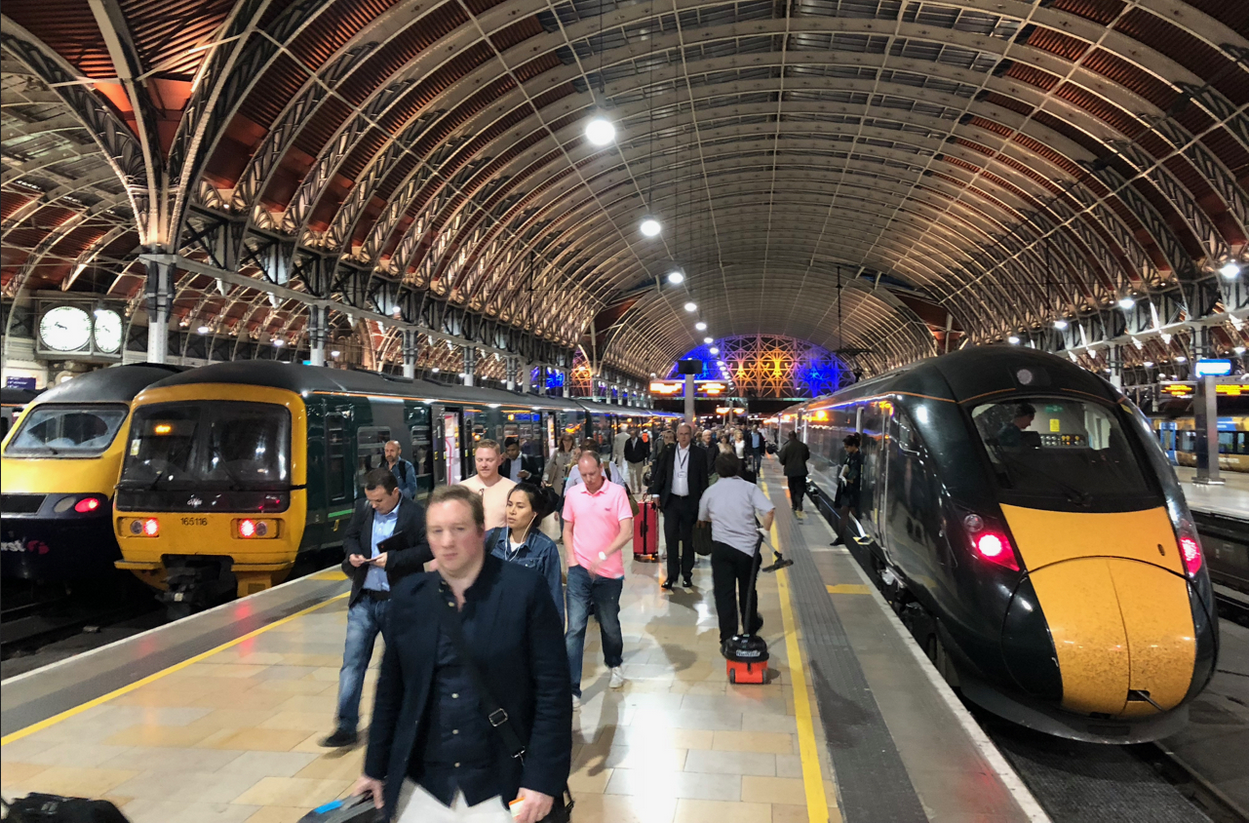
10:00 PM on a Tuesday, May 15, at London’s magnificent Paddington Station. At right, a Great Western Railway
Hitachi dual-mode train has just arrived from points southwest, with a Great Western DMU train across the platform.
Photo by Malcolm Kenton
The Brits have a habit of complaining about their trains. As I experienced, their on-time performance often falls short of Swiss standards (though is excellent by American standards), ticket prices are continually increasing, and service frequencies and span on some lines aren’t what they could be. But it’s hard for someone who’s used to a country where even major cities are served by just one train a day, if that, to knock a system that provides at least three daily frequencies to even the least densely populated lines. If this is what remains after the infamous early 1960s Beeching cuts, which saw the abandonment of many secondary lines, then what existed before must have been absolutely mind-boggling.
[…]
The regular National Rail trains I rode were about evenly split between electric and diesel power. Most of the lines emanating within a 100-mile radius of London are electrified — both the East Coast and West Coast mains boast catenary as far as Edinburgh and Glasgow from London, and several other lines have third-rail power, including the South Western trains between London Waterloo and Weymouth via Southampton, which I rode — the world’s longest continuous third rail-electrified railway at 136 miles, whose electrification was completed in 1988. By contrast, America’s longest electrified railroad is only 57 miles: Metro-North’s Harlem Line from Grand Central Terminal to Southeast, N.Y. Trips of up to 200 miles on electrified lines tend to be covered by Electric Multiple Unit trainsets, while electric locomotive-hauled sets cover longer runs.
Top speeds for expresses on the electrified mains range from 100 to 125 MPH, akin to Regionals on Amtrak’s Northeast Corridor. Older equipment is usually limited to 80 to 90 MPH. On less busy branch lines, speeds top out between 40 and 70 MPH depending on track condition. Some of these lines are dark territory and some still use semaphore signals and manually-operated switch towers (signal boxes in British parlance).
Catenary electrification is working its way westward on the Great Western main line towards Cornwall, but long-distance expresses on this line use either 1990s-built High-Speed Train trainsets powered by diesel locomotives on both ends or two-year-old Hitachi dual-mode (catenary electric and diesel) multiple unit trainsets. Most services on less busy lines, however, are provided by Diesel Multiple Unit trainsets of varying vintages and configurations, often of just one or two cars. ScotRail’s rural services, including the five-hour run Sam and I took from Glasgow to Mallaig, all use DMUs.
Of the ten different branded National Rail services I sampled, I was most impressed with Virgin Trains, Great Western and Chiltern Railways. I took Virgin’s expresses on both the East and West Coast main lines and both offered a comfortable First Class product with hot meals and alcohol included, similar to Acela First Class. Great Western’s First Class seats were the most comfortable and the color schemes and seat arrangements the most attractive, and the food service included sandwiches as well as snacks, coffee, tea, sodas and still or sparkling water. On most trains traveling for more than one hour, there is food and beverage service from a cart. In most cases, First Class passengers get one complimentary snack (such as pretzels, fruit, crisps (potato chips in British parlance), candies, cookies and pastries) and one drink each time the cart passes through the coach.
Comments Off on Travelling on British passenger trains
D-Day – I: The Great Crusade – Extra History
Extra Credits
Published on 6 Jun 2017D-Day: June 6, 1944, the day when Allied forces stormed the beaches of Normandy to retake France from the Germans. They hoped to take the Germans by surprise, and their decision to brave rough weather to make their landings certainly accomplished that, but despite these small advantages, the American forces at Utah and Omaha Beach had to overcome monumental challenges to establish a successful beachhead.
Comments Off on D-Day – I: The Great Crusade – Extra History
June 5, 2018
The Landings At ANZAC Cove And Suvla Bay 1915 I THE GREAT WAR On The Road
The Great War
Published on 4 Jun 2018With thanks to Mr. Ali Serim for making this episode possible.
Indy and our guide Can Balcioglu explore the northern landings sites of Gallipoli where the Australian and New Zealand Army Corps (ANZAC) landed in 1915.
Comments Off on The Landings At ANZAC Cove And Suvla Bay 1915 I THE GREAT WAR On The Road
June 3, 2018
Conrad von Hötzendorf – A Military Genius? I OUT OF THE TRENCHES
The Great War
Published on 2 Jun 2018Chair of Wisdom Time!
Comments Off on Conrad von Hötzendorf – A Military Genius? I OUT OF THE TRENCHES
Brand X – Nuclear Burn (1976)
aquarianrealm
Published on Nov 7, 2010AMG: Brand X were a British jazz-rock fusion outfit formed by Genesis drummer Phil Collins and Atomic Rooster guitarist John Goodsall as a side project from their regular groups. Their initial lineup also included keyboardist Robin Lumley and bassist Percy Jones (the Liverpool Scene, the Scaffold). Brand X’s debut album, Unorthodox Behaviour, was released in 1976; a live album, Livestock, and the studio effort Moroccan Roll followed in 1977. Collins left the group to concentrate on Genesis, and for 1978’s Masques, he was replaced by Al Di Meola drummer Chuck Burgi, as well as additional keyboardist Peter Robinson, who had played with Stanley Clarke. Three further albums — 1979’s Product, 1980’s Do They Hurt?, and 1982’s Is There Anything About? — followed before the group disbanded. In the mid-’90s, Lumley, Goodsall, and Jones reunited, issuing several live collections in the years to follow.
H/T to ESR for the link.
Comments Off on Brand X – Nuclear Burn (1976)
June 2, 2018
The Robinson Affair (that the British establishment would like to “disappear”)
If you haven’t been paying attention to the British media, you might not have heard about Tommy Robinson and his crusade to expose the “Asian grooming gangs” that have been left almost undisturbed by the British police, prosecutors and (until very recently indeed) the media:
The controversy around him continued. In March, Robinson was suspended from Twitter, where he had almost half a million followers. The social-media site (which merrily allows terrorist groups like Lashkar e-Taiba to keep accounts) decided that Robinson should be suspended for tweeting out a statistic about Muslim rape gangs that itself originated from the Muslim-run Quilliam foundation. And it is on this matter that the latest episode in the Robinson drama started — and has now drawn worldwide attention.
Ten years ago, when the EDL was founded, the U.K. was even less willing than it is now to confront the issue of what are euphemistically described as “Asian grooming gangs” (euphemistic because no Chinese or Koreans are involved and what is happening is not grooming but mass rape). At the time, only a couple of such cases had been recognized. Ten years on, every month brings news of another town in which gangs of men (almost always of Pakistani origin) have been found to have raped young, often underage, white girls. The facts of this reality — which, it cannot be denied, sounds like something from the fantasies of the most lurid racist — have now been confirmed multiple times by judges during sentencing and also by the most mainstream investigative journalists in the country.
But the whole subject is so ugly and uncomfortable that very few people care to linger over it. Robinson is an exception. For him — as he said in a 2011 interview with the BBC’s Jeremy Paxman — the “grooming gangs” issue isn’t something that afflicts some far-off towns but people in the working-class communities that he knows. And while there are journalists (notably the Times’ Andrew Norfolk) who have spent considerable time and energy bringing this appalling phenomenon to light, most of British society has turned away in a combination of embarrassment, disgust, and uncertainty about how to even talk about this. Anyone who thinks Britain is much further along with dealing with the taboo of “grooming gangs” should remember that only last year the Labour MP for Rotherham, Sarah Champion, had to leave the shadow cabinet because she accurately identified the phenomenon.
Which brings me to last Friday. That was when Robinson was filming outside Leeds Crown Court, where the latest grooming-gang case was going on. I have to be slightly careful here, because although National Review is based in the U.S., I am not, and there are reporting restrictions on the ongoing case. Anyhow, Robinson was outside the court and appeared (from the full livestream) to be filming the accused and accosting them with questions on their way in. He also appeared to exercise some caution, trying to ensure he was not on court property.
But clearly he did not exercise enough caution, a strange fact given that last year Robinson had been found guilty of “contempt of court” for filming outside another rape-gang trial, one involving four Muslim men at Canterbury Crown Court. On that occasion Robinson was given a three-month prison sentence [PDF], which was suspended for a period of 18 months. Which meant he would be free so long as he did not repeat the offense.
Although Robinson appeared to be careful at Leeds Crown Court last Friday, to dance along the line of exactly what he could or could not livestream outside an ongoing trial with a suspended sentence hanging over his head was extraordinarily unwise. What happened next went around the world: The police turned up in a van and swiftly arrested Robinson for “breach of the peace.” Within hours Robinson had been put before one Judge Geoffrey Marson, who in under five minutes tried, convicted, and sentenced Robinson to 13 months. He was immediately taken to prison.
From that moment it was not just Robinson but the U.K. that entered a minefield of legal problems. In addition to the usual reporting restrictions on the ongoing trial, a reporting ban was put on any mention of Robinson’s arrest, swift trial, and conviction, meaning that for days people in the blogosphere and the international media got free rein to claim that Tommy Robinson had been arrested for no reason, that his arrest was a demonstration of a totalitarian state cracking down on free speech, and even (and this one is remarkably clueless as well as careless) that the recent appointment to the position of home secretary of Sajid Javid — who was born to Muslim parents — is the direct cause of Robinson’s recent arrest.
Comments Off on The Robinson Affair (that the British establishment would like to “disappear”)


