
NMRNPortsmouth
Published on Aug 21, 2017An 18-month programme to re-support the world’s most famous warship HMS Victory sagging under her own weight is now underway.
June 2, 2018
A Safer Berth – HMS Victory
Comments Off on A Safer Berth – HMS Victory
June 1, 2018
50 Miles To Paris – Third Battle Of The Aisne I THE GREAT WAR Week 201
The Great War
Published on 31 May 2018The German spring offensive has lost some traction over the past few weeks but the Allies are still under pressure. With Operations Blücher and York, the Germans are getting within 50 miles of Paris again, just as they did in 1914.
Comments Off on 50 Miles To Paris – Third Battle Of The Aisne I THE GREAT WAR Week 201
May 31, 2018
Admiral David Beatty: “There seems to be something wrong with our bloody ships today”
One of the outcomes of the Battle of Jutland was that naval opinion finally crystalized over the notion of battle cruisers: the loss of three British battle cruisers during the battle (and near-loss of a fourth) proved to most that the design was flawed and that this class of ships should never have sailed into battle against real battleships. A recent post at Naval Gazing begs to differ on this judgement:
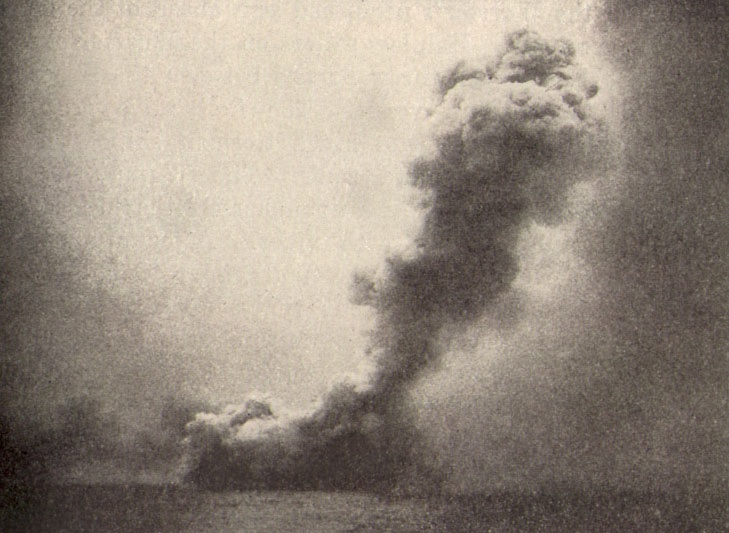
Explosion that sank HMS Queen Mary at the Battle of Jutland, 31 May 1916
Image via Wikimedia Commons.
David Beatty’s famous remark about the destruction of two of his ships by catastrophic magazine explosions during the Battle of Jutland sums up the traditional attitude towards one of the battle’s most famous aspects. Of the 3,326 men aboard the battlecruisers Indefatigable, Queen Mary, and Invincible, only 17 survived. It’s long been believed that the ships themselves were to blame, as they were built with only relatively light armor. Shells supposedly penetrated to the magazines and set them off. Recent research has revealed that this was not the case, and the ships were lost primarily due to defects in operation, not design.
The basic problem with the conventional theory is that no German shell penetrated deep enough into the surviving ships to have been able to set off a magazine if it had hit one. The magazines take up a minority of a battlecruiser’s deck, so if such hits were common, then at least a few of the surviving ships should have seen shells reach their machinery. Instead, German shells were found to detonate with 16-24′ of their first impact with the structure. At the 20° angle the shells were falling at at the time, this puts them no more than 8 feet below the upper deck upon detonation. The only case where shell fragments reached magazine was a hit on Barham at 1758 when fragments from a 12″ shell penetrated the deck over the 6″ magazine. Despite leaving a 12″x15″ hole in the 1″ deck, the fragments had no effect on the powder stored under it.
So is there a different potential cause, one that happened to a surviving ship? A survey of the damage to Beatty’s battlecrusiers reveals a promising candidate. A hit on a turret, such as the one suffered by HMS Lion, could cause a flash to propagate down into the magazine, which would then deflagrate in precisely the manner seen during the battle. A careful examination of Lion‘s damage shows that she came very close to suffering the same fate.
Turret explosions are hardly unknown aboard warships, either as a result of accident or enemy action, and a great deal of care goes into making sure that they don’t set off the magazines. Powder is stored in metal cans or tanks, and flashproof doors and other interlocks are used to make sure that fire does not reach the magazines. Unfortunately, the British had systematically undermined these protections in the search for rate of fire and ammunition capacity, and their magazine practices during the battle can only be described as suicidal.
After the Battle of Dogger Bank, Beatty decided that the reason he was unable to destroy the German battlecruisers was insufficient rate of fire. Not only would opening fire early and firing quickly lead to early hits, but it would also distract the German gunners. However, the British were not particularly confident in their long-range fire control, and began to stuff extra cordite into the handling rooms and other spaces that had been designed to provide flash protection. This was made much worse by a other changes intended to increase rate of fire. Normally, the cordite cases were kept sealed until just before the charges are sent to the gun, but the crews chose to open many of the cases early, take some cordite out of the cases before battle to make it easy to access, and even stored extra charges completely unprotected. In a final effort to make the turrets as dangerous as possible, the majority of the anti-flash safety doors were removed.
The only ship which strongly resisted this trend was Lion, and the efforts of her Gunner, Alexander Grant, deserve most of the credit. When Grant came aboard, he found the situation described above, and quickly reintroduced the traditional magazine safety regulations with the support of Lion‘s captain, Ernle Chatfield. He managed to train the magazine crews to the point where they could provide cordite to the guns faster than the guns could fire it, while observing full safety procedures.
Comments Off on Admiral David Beatty: “There seems to be something wrong with our bloody ships today”
The Battle of Jutland Explained
Ministry of Defence
Published on 25 May 201610,000 men. 250 ships. 12 hours. Two sides. The Battle of Jutland – 100 years ago.
Comments Off on The Battle of Jutland Explained
No5 MkI Enfield “Jungle Carbine”
Forgotten Weapons
Published on 18 Jan 2015http://www.forgottenweapons.com
The No.5 MkI Enfield, commonly called the “jungle carbine” is nearly the shortest-lived rifle in British military service. Introduced in 1944, they were declared obsolete in 1947 as the result of insoluble accuracy problems. The guns were originally developed from regular No4 Enfield rifles with the goal of producing a shorter and lighter variant for paratroops. This was done by shortening the barrel, adding a flash hider, and making lightening cuts in several places on the barrel and receiver (which were the cause of the problems that doomed the gun).
Not all No.5 rifles produced developed problems, and they were certainly handier than the regular Enfield rifles. They are noted for kicking harder, of course, and this is not really helped by the narrow rubber buttpad they came with (most of which are nice and hard today).
Theme music by Dylan Benson – http://dbproductioncompany.webs.com
Comments Off on No5 MkI Enfield “Jungle Carbine”
QotD: Difficulties in using self-reported data
Nick Cohen, over in the Guardian, is busy telling us all that we must drink less and that Scotland raising the minimum price of alcohol (hitting poor people’s cheap cider and bargain booze, but not directly affecting craft lagers, appellation d’origine contrôlée wines and artisan gin) is a Good Thing because the industry makes its profits by exploiting addicts who are drinking themselves to death en masse.
It is a truth universally unacknowledged that, like drugs cartels, the drink industry makes most of its money from addicts. It thrives on hooked customers, who put boosting the brewers’ profits before their and their families’ health and happiness. Sixty per cent of alcohol sales – worth £27bn a year in England – are to “increasing risk” drinkers taking more than 21 units of alcohol a week, in the case of men (about 10 pints or two bottles of wine), and “harmful” drinkers taking more than 50… Twenty one units (14 for women) does not sound much in my world of journalism, but it is a sign of people who cannot go a day without a shot of their drug, which is as good a definition of an addiction as any.
Now, there’s a question there about who decided what that “risk” was and how large it was. Cohen gets into the Salvation Army-style temperance-league apocalyptic warnings about the horrors of heavy drinking and warns that by the time you’re knocking back fifty units a week (for men, thirty-five for women) you’re undergoing “full degeneration”.
But is that based on any firm evidence? One interesting study, reassuring to the toper, can be found here, which among other things makes the gentle point that since we either under-report what we consume, or we pour away half of the booze we buy undrunk, planning policy on what we admit to consuming may not be accurate.
Jason Lynch, “How Much Is ‘Too Much’?”, Continental Telegraph, 2018-05-08.
Comments Off on QotD: Difficulties in using self-reported data
May 30, 2018
Eurocrats send Italy back to the polls, to get it right this time
What were the Italians thinking? Didn’t they realize that the election of Euroskeptics would just result in the powers-that-be sending them back to vote (and possibly to vote again) until they get the right answer? Brendan O’Neill calls it a putsch:
There has been a putsch in Italy. A bloodless putsch, with no guns or jackboots, but a putsch nonetheless. The president’s vetoing of the finance minister put forward by the populist parties that won a huge number of votes in the General Election in March represents a grave assault on the democratic will. It is a technocratic coup, an EU-influenced, big-business-pleasing attempt to isolate and weaken the popular anti-Brussels sentiment that has swept Italy. Indeed, it has brought about the collapse of the talks to form a new populist government and made it necessary to hold fresh elections. Let’s be honest about what has happened here: March’s democratic election has essentially been voided by technocrats who care more about Euro financiers than they do about the ordinary people of Italy.
Italy has been plunged into political crisis by establishment figures who are repulsed by the Euroscepticism spreading through the nation. In the election in March, the mainstream parties – the Democratic Party and Forza Italia – were decimated by voters. They suffered an historic blow at the ballot box, the Democratic Party getting 18.7 per cent of the vote, and Forza Italia an even sadder 14 per cent. Meanwhile, populist parties, in particular the Five Star Movement (M5S) and the League (formerly the Northern League), soared to the forefront of political life. M5S won 32.7 per cent of the vote, and the League won 17.4 per cent – a huge rise on the four per cent it got in the election in 2013.
[…]
The usurping of the popular will is best summed up in who has been promoted by Mattarella to replace Conte as the interim prime minister: Carlo Cottarelli, a former senior official in the International Monetary Fund who is referred to as ‘Mr Scissors’ for his insistence on cuts to public spending. So even though millions of Italians voted for populist parties that said they would reverse spending cuts and challenge Eurozone stability rules, now they find themselves ruled, for the time being, by a technocrat who takes an entirely different view. They have ended up with the opposite to what they voted for. This is the putsch; this is the technocratic coup; this is the thwarting of the democratic outlook by an establishment that thinks it knows better than ordinary people how their lives should be run.
This is how life in the Eurozone, and in the EU more broadly, works now. The people and the parties they vote for are written off by the expert class and technocrats and the forces of big business as irrational or prejudiced or dangerous, and the popular will is overriden in the name of maintaining the status quo. We saw this in the EU fury that greeted the French, Dutch and Irish revolts against the EU Constitution a decade ago; in the enforcement of spending cuts in Greece and Ireland that the people in those countries did not want; and we see it in the ongoing efforts by Brussels and its useful idiots in Britain to weaken or even kill off our mass vote for Brexit. Remainers, behold the truth of the institution you are fighting to defend: not the happy-clappy union of European peoples of your deluded dreams, but rather a vast oligarchical machine that laughs in the face of national sovereignty, views the democratic will as a pesky fly to be swatted away, and looks upon ordinary people as too pig-ignorant to make big political decisions. We need more rebellions against this elitist Euro-hatred for the views of ordinary people, and an all-out defence of the hard-won European principle of democracy.
Comments Off on Eurocrats send Italy back to the polls, to get it right this time
Decisive Weapons S02E04 – U-Boat Killer: The Anti-Submarine Warship
erana19
Published on 25 Jan 20161996-1997 BBC documentary series. Series 2, Episode 4.
Comments Off on Decisive Weapons S02E04 – U-Boat Killer: The Anti-Submarine Warship
May 29, 2018
The History of Non-Euclidian Geometry – Sacred Geometry – Extra History – #1
Extra Credits
Published on 26 May 2018Before we get into non-Euclidian geometry, we have to know: what even is geometry? What’s up with the Pythagorean math cult? Who was Euclid, for that matter? And what the heck is the 5th Postulate?
Comments Off on The History of Non-Euclidian Geometry – Sacred Geometry – Extra History – #1
ESR’s thumbnail sketch on the origins of the Indo-European language families
When you mash historical linguistics hard enough into paleogenetics, interesting things fall out:

The steppe extends roughly from the Dniepr to the Ural or 30° to 55° east longitude, and from the Black Sea and the Caucasus in the south to the temperate forest and taiga in the north, or 45° to 55° north latitude.
Via Wikipedia
What we can now say pretty much for sure: Proto-Indo-European was first spoken on the Pontic Steppes around 4000 BCE. That’s the grasslands north of the Black Sea and west of the Urals; today, it’s the Ukraine and parts of European Russia. The original PIE speakers (which we can now confidently identify with what archaeologists call the Yamnaya culture) were the first humans to domesticate horses.
And – well, basically, they were the first and most successful horse barbarians. They invaded Europe via the Danube Valley and contributed about half the genetic ancestry of modern Europeans – a bit more in the north, where they almost wiped out the indigenes; a bit less in the south where they mixed more with a population of farmers who had previously migrated in on foot from somewhere in Anatolia.
The broad outline isn’t a new idea. 400 years ago the very first speculations about a possible IE root language fingered the Scythians, Pontic-Steppe descendants in historical times of the original PIE speakers – with a similar horse-barbarian lifestyle. It was actually a remarkably good guess, considering. The first version of the “modern” steppe-origin hypothesis – warlike bronze-age PIE speakers domesticate the horse and overrun Europe at sword- and spear-point – goes back to 1926.
But since then various flavors of nationalist and nutty racial theorist have tried to relocate the PIE urheimat all over the map – usually in the nut’s home country. The Nazis wanted to believe it was somewhere in their Greater Germany, of course. There’s still a crew of fringe scientists trying to pin it to northern India, but the paleogenetic evidence craps all over that theory (as Cochran explains rather gleefully – he does enjoy calling bullshit on bullshit).
Then there have been the non-nutty proposals. There was a scientist named Colin Renfrew who for many years (quite respectably) pushed the theory that IE speakers walked into Europe from Anatolia along with farming technology, instead of riding in off the steppes brandishing weapons like some tribe in a Robert E. Howard novel.
Alas, Renfrew was wrong. It now looks like there was such a migration, but those people spoke a non-IE language (most likely something archaically Semitic) and got overrun by the PIE speakers riding in a few thousand years later. Cochran calls these people “EEF” (Eastern European Farmers) and they’re most of the non-IE half of modern European ancestry. Basque is the only living language that survives from EEF times; Otzi the Iceman was EEF, and you can still find people with genes a lot like his in the remotest hills of Sardinia.
Even David Anthony, good as he is about much else, seems rather embarrassed and denialist about the fire-and-sword stuff. Late in his book he spins a lot of hopeful guff about IE speakers expanding up the Danube peacefully by recruiting the locals into their culture.
Um, nope. The genetic evidence is merciless (though, to be fair, Anthony can’t have known this). There’s a particular pattern of Y-chromosome and mitochondrial DNA variation that you only get in descendant population C when it’s a mix produced because aggressor population A killed most or all of population B’s men and took their women. Modern Europeans (C) have that pattern, the maternal line stuff (B) is EEF, and the paternal-line stuff (A) is straight outta steppe-land; the Yamnaya invaders were not gentle.
How un-gentle were they? Well…this paragraph is me filling in from some sources that aren’t Anthony or Cochran, now. While Europeans still have EEF genes, almost nothing of EEF culture survived in later Europe beyond the plants they domesticated, the names of some rivers, and (possibly) a murky substratum in some European mythologies.
The PIE speakers themselves seem to have formed, genetically, when an earlier population called the Ancient Northern Eurasians did a fire-and-sword number (on foot, that time) on a group of early farmers from the Fertile Crescent. Cochrane sometimes calls the ANEs “Hyperboreans” or “Cimmerians”, which is pretty funny if you’ve read your Howard.
Comments Off on ESR’s thumbnail sketch on the origins of the Indo-European language families
Allied Defense During Spring Offensives 1918 I THE GREAT WAR Special
The Great War
Published on 28 May 2018MHV about Stormtrooper tactics: https://www.youtube.com/watch?v=BNqmA-if-4g
The French and British defenses during the German Spring Offensive 1918 were put to a real test when the Germans attacked. The carefully built defenses had to be abandoned and new lessons had to be learned.
Comments Off on Allied Defense During Spring Offensives 1918 I THE GREAT WAR Special
QotD: Gandhi on the Holocaust
I am aware that for many not privileged to have visited the former British Raj, the names Gujarat, Rajasthan, and Deccan are simply words. But other names, such as Germany, Poland, Czechoslovakia, somehow have a harder profile. The term “Jew,” also, has a reasonably hard profile, and I feel all Jews sitting emotionally at the movie Gandhi should be apprised of the advice that the Mahatma offered their coreligionists when faced with the Nazi peril: they should commit collective suicide. If only the Jews of Germany had the good sense to offer their throats willingly to the Nazi butchers’ knives and throw themselves into the sea from cliffs they would arouse world public opinion, Gandhi was convinced, and their moral triumph would be remembered for “ages to come.” If they would only pray for Hitler (as their throats were cut, presumably), they would leave a “rich heritage to mankind.” Although Gandhi had known Jews from his earliest days in South Africa — where his three staunchest white supporters were Jews, every one — he disapproved of how rarely they loved their enemies. And he never repented of his recommendation of collective suicide. Even after the war, when the full extent of the Holocaust was revealed, Gandhi told Louis Fischer, one of his biographers, that the Jews died anyway, didn’t they? They might as well have died significantly.
Richard Grenier, “The Gandhi Nobody Knows”, Commentary, 1983-03-01.
Comments Off on QotD: Gandhi on the Holocaust
May 28, 2018
Naval Operations In The Dardanelles Campaign 1915 I THE GREAT WAR On The Road
The Great War
Published on 25 May 2018In our first episode filmed on the former Gallipoli battlefields, Indy and our guide Can Balcioglu explore the naval campaign that preceded the landings at Gallipoli in early 1915.
Comments Off on Naval Operations In The Dardanelles Campaign 1915 I THE GREAT WAR On The Road
May 27, 2018
QotD: Epicurus on the ethics of pleasure
Epicurus begins with the question asked by Socrates at the end of the fifth century — what is the good life? His answer is that the good lies not in virtue or justice or wisdom — though these are not to be ignored — but in happiness.
“Pleasure” he writes, “is our first and kindred good. It is the starting point of every choice and every aversion, and to it we come back, inasmuch as we make feeling the rule by which to judge of every good thing.”
Now we have more than enough of Epicurus to know that he is not arguing for what are called the self-indulgent pleasures — of eating and drinking and sex and the like. Aristippus of Cyrene (c435-366 BC), we are told, had already argued for these. He also claimed that happiness was the highest good, but went on to claim that happiness lay in the pursuit of pleasure regardless of convention or the feelings of others or of the future.
This interpretation was attached to Epicurus in his own lifetime, and the attachment has been maintained down to the present — so that the words “Epicure” and “Epicurean” have the meaning of self-indulgent luxury.
What Epicurus plainly means by happiness is the absence of pain. We are driven to act by a feeling of discontent. We seek food because we are hungry. We seek warmth because we are cold. We seek medicine because we are sick. Once we have acted correctly and removed the cause of discontent, we are happy.
Turning to his own words, he says:
When we say… that pleasure is the end and aim, we do not mean the pleasures of the prodigal or the pleasures of sensuality, as we are understood to do by some through ignorance, prejudice or wilful misrepresentation. By pleasure we mean the absence of pain in the body and of trouble in the soul. It is not by an unbroken succession of drinking bouts and of revelry, not by sexual lust, nor the enjoyment of fish and other delicacies of a luxurious table, which produce a pleasant life; it is sober reasoning, searching out the grounds of every choice and avoidance, and banishing those beliefs through which the greatest tumults take possession of the soul. Of this the beginning and the greatest good is wisdom. Therefore wisdom is a more precious thing that even philosophy; from it springs all the other virtues, for it teaches that we cannot live pleasantly without living wisely, honourably and justly; nor live wisely, honourably and justly without living pleasantly.
In this scheme, therefore, happiness is to be defined as peace of mind, or ataraxia. This pursuit of happiness does involve bodily pleasure, but such pleasure is a means to the greater end of ataraxia. “No pleasure” he says, “is a bad thing in itself, but the things which produce certain pleasures entail disturbances many times greater than the pleasures themselves.”
His ethics of pleasure can be summarised as:
The pleasure which produces no pain is to be embraced. The pain which produces no pleasure is to be avoided. The pleasure is to be avoided which prevents a greater pleasure, or produces a greater pain. The pain is to be endured which averts a greater pain, or secures a greater pleasure.
And so the happy man for Epicurus is one who lives simply within his means, who seeks only those pleasures which contribute to his long term peace of mind.
And while hedonism is ultimately a doctrine of selfishness, what Epicurus had in mind was not a life spent in the pursuit of solitary happiness. He says: “Of the means which wisdom acquires to ensure happiness throughout the whole of life, by far the most important is friendship.”
It may be that we seek friendship for selfish reasons. But friendship is to be persistently sought and maintained throughout life. Epicurus himself had an immense capacity for friendship.
Sean Gabb, “Epicurus: Father of the Enlightenment”, speaking to the 6/20 Club in London, 2007-09-06.
Comments Off on QotD: Epicurus on the ethics of pleasure
May 26, 2018
Sir Humphrey debunks the notion of maintaining a “reserve fleet”
The US Navy keeps a lot of ships around after they’ve been retired from active service (sometimes for decades), and some in the UK are asking if the Royal Navy should do something like that with the soon-to-be-retired Type 23 frigates. Sir Humphrey explains in great detail why this shouldn’t happen:
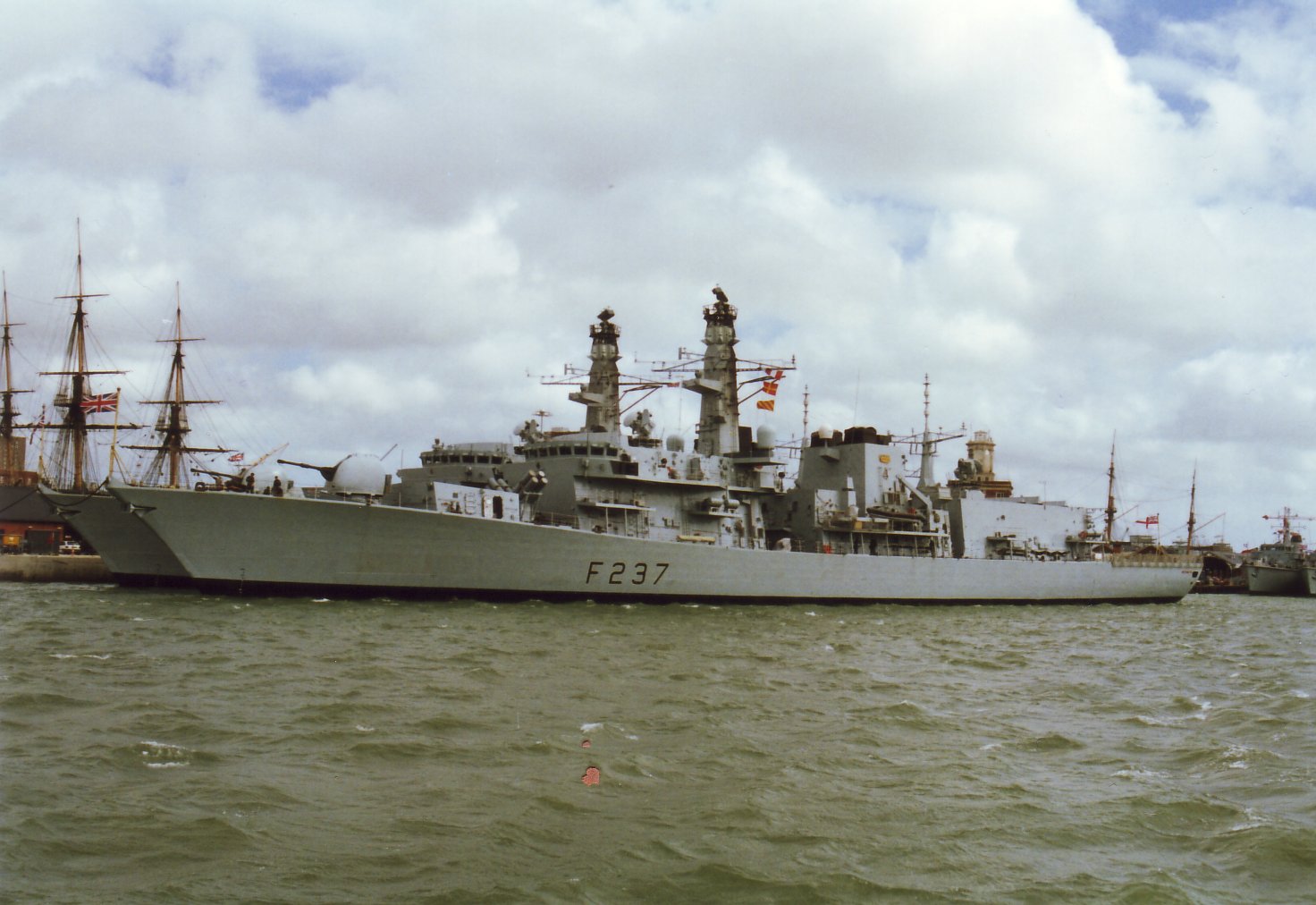
HMS Westminster (foreground) and HMS Iron Duke, Type 23 frigates of the Royal Navy, in the naval base of Portsmouth, August, 2000.
Image via Wikimedia Commons.
The subject of ‘Reserve Fleets’ is something that often comes up across the internet whenever naval forces are discussed. To many casual observers there is an innate draw to the idea of holding ships back as a contingency against a potential threat. No matter how appealing this idea seems on the surface though, there are a multitude of good reasons why keeping complex warships in reserve at the end of their life is usually a very bad idea.
In broad terms these reasons boil down to four key areas – Maintenance & Material and People & Training. Each of these areas poses a challenge which brought together makes it extremely difficult to consider keeping a ship credible once she has paid off.
Maintenance & Material
The Royal Navy has historically not maintained a large reserve fleet since the 1950s, when the combination of the loss of conscript manpower, the increasing complexity of warships adding to reactivation times and the reality that any global conflict would go nuclear quickly meant that reserve fleets were relatively worthless.After the late 1950s the RN maintained a ‘Standby Squadron’ that usually comprised several vessels that while not fully active, were kept in reasonable running order. For many years Chatham dockyard functioned as the home of the Squadron, which usually comprised ships drawn from classes still in service, that could be brought up to readiness quickly to replace other vessels at sea. This occurred during both the Cod War and the 1982 Falklands War.
It is not clear when the Standby Squadron was formally discontinued, but it played a key part in the RN force structure into the 1980s. For instance, the 1981 defence review foresaw a number of escorts (possibly 7-8 out of 50) being held in quasi-active status. The RN also maintained other ships in full reserve – such as during the lifetime of the Invincible class when usually one of the three was placed into reserve for a year or two ahead of deep refits.
The key distinction here is that this sort of set up required a heavy investment of resources and manpower to keep the ships maintained and fit for sea. A modern warship is never truly alone during her active life – there are always people onboard to maintain systems and keep watch over her. By contrast ships that decommission and pay off will progressively see less and less people onboard until one day they have been stripped down and become ‘dead ships’, and they will be left to rot until the scrappers take them.
To keep a ship in a salvageable condition, able to be made ready for sea requires a significant amount of maintenance and upkeep. This is something that is costly, requiring regular dockings, inspections and repairs, as well as the cost of keeping the ship preserved and vaguely usable. To put a ship into Reserve with the intention of using her again does not mean she can be forgotten about – quite the contrary, they require regular care and maintenance.
To put a ship into reserve at the end of her life and be certain of using her again would require an additional refit to rectify defects. It would also require regular inspections, support and attention throughout the period in reserve.
For a ship that is likely to be used again, it makes reasonable sense to do this as every pound spent on preventative maintenance is likely to save many more in reactivation costs. For a ship likely to pay off, this makes far less sense – you are spending a lot of money to park a ship and wait for it to be scrapped.
Comments Off on Sir Humphrey debunks the notion of maintaining a “reserve fleet”


