
World War Two
Published 17 May 2025Today, Indy and Sparty tackle some questions on the North African theatre. Why did the Italians think invading was a good idea in the first place? Was Allied treatment of Axis POWs a war crime? How did Italian and Allied tanks stack up?
(more…)
May 18, 2025
Why it Sucked to be an Italian Prisoner in North Africa – WW2 Fireside Chat
Comments Off on Why it Sucked to be an Italian Prisoner in North Africa – WW2 Fireside Chat
April 22, 2025
Young Rommel’s First Triumph: Battle of Caporetto 1917
The Great War
Published 13 Dec 2024In October 1917, German and Austro-Hungarian troops went over the top into the rain and fog to attack the Italian trenches opposite them. They would go on to break the trench deadlock on the Italian Front, and nearly destroy the Italian army in just two weeks. The Battle of Caporetto was Austria-Hungary’s greatest victory of WW1 – and where a young Erwin Rommel learned to fight like a Desert Fox.
(more…)
Comments Off on Young Rommel’s First Triumph: Battle of Caporetto 1917
April 13, 2025
History Hit Expert BLEW My MIND On Ancient Roman History
Metatron
Published 14 Dec 2024Link to the original video
• Historian Answers Google’s Most Popul…
Pompaia, on the River Sarnus — a river which both takes the cargoes inland and sends them out to sea — is the port-town of Nola, Nuceria, and Acherrae.
Strabone, Geografia, IV, 81 – Factors in the Establishment of Pompeii. Let’s begin by well what we know. How did it all start? Like many cities of the classical world, Pompeii also has its founding myth: according to Servius, the city was supposedly founded by none other than the demigod Hercules, and its name would have originated from “a Pompa Herculis”, meaning “from the triumph of Hercules”. However, the most recent archaeological discoveries confirm a foundation dating back to around the 8th century BC by the Oscan people, an Italic tribe, corroborating what Strabo reported in his Geography. The Oscans were part of the large linguistic family of Umbro-Sabellian or Osco-Umbrian peoples, distinct from the Latins, who probably arrived in Italy in the 12th century BC. While some Hellenists have proposed that the etymology of Pompeii should be sought in the Greek Πεμπo (Pempo), meaning “to send”, due to the thriving commercial activity, the original linguistic root is likely this Oscan word “pumpè“, from which comes the archaic name Pumpàiia. The Oscan “pumpè“, analogous to the Greek “penta” and Latin “quinque“, means “five”, and most likely refers to a proto-urban reality formed by the progressive fusion of five distinct residential centers, five small Oscan villages that were scattered on the southern slopes of mount Vesuvius, next to the course of the Sarno river.
2. Natural resources: Volcanic areas often provide access to valuable resources like obsidian, sulfur, and various minerals used in ancient crafts and trade.
3. Lack of geological understanding: Ancient people didn’t fully understand the mechanisms of volcanic eruptions or their potential for catastrophic destruction. The last major eruption of Vesuvius before 79 AD was likely prehistoric, so there was no living memory of its danger.
4. Infrequent eruptions: Many volcanoes, including Vesuvius, can remain dormant for long periods. This can create a false sense of security among nearby populations.
5. Strategic location: Pompeii was located in a prime spot for trade, with access to the sea and inland routes. The benefits of this location may have outweighed perceived risks.
6. Religious and cultural significance: Volcanoes were often seen as sacred in ancient cultures, associated with deities or supernatural forces. This could make living near them culturally desirable.
7. Limited mobility: Ancient societies were less mobile than modern ones. Once established, it was difficult to relocate entire cities, even if dangers became apparent.
8. Economic investments: As cities grew and prospered, the economic and social costs of abandoning them became increasingly high.
9. Adaptation and mitigation: Over time, societies living near volcanoes often developed strategies to cope with minor volcanic activity, like earthquakes or ash falls.
10. Lack of alternatives: In some regions, volcanic areas might have been among the best available locations for settlement, despite the risks.
It’s worth noting that while the destruction of Pompeii was catastrophic, the city had thrived for centuries before the eruption of 79 AD. From the perspective of the ancient inhabitants, the benefits of their location likely seemed to outweigh the potential for a disaster that might never occur in their lifetimes. This balance of risk and reward in choosing settlement locations is not unique to ancient times. Even today, many major cities are located in areas prone to natural disasters, demonstrating that humans often prioritize immediate benefits over long-term, uncertain risks
#pompeii #ancientrome #documentary
Comments Off on History Hit Expert BLEW My MIND On Ancient Roman History
April 11, 2025
Beretta 93R: The Best Machine Pistol?
Forgotten Weapons
Published 13 Dec 2024The Beretta 93R (“Raffica”) was developed in the 1970s by Beretta engineer Paolo Parola at the request of Italian military special forces. It took the basic Beretta 92 pistol design and added a well-thought-out burst mechanism under the right-side grip panel. It does not have a plain full-auto setting, but only semiauto and 3-round burst. To help keep the gun controllable, it has a heavier slide to reduce cyclic rate, a detachable shoulder stock, and a folding front grip to help control the muzzle. It uses extended 20-round magazines and is actually remarkably controllable (or so I am told; I have not had a chance to shoot one myself).
(more…)
Comments Off on Beretta 93R: The Best Machine Pistol?
March 31, 2025
Berettas With Bayonets: The Very Early Model 38A SMG
Forgotten Weapons
Published 29 Nov 2024The initial model of the Beretta 38A had a number of features that were dropped rather quickly once wartime production became a priority. Specifically, they included a lockout safety switch for just the rear full-auto trigger. This was in place primarily for police use, in which the guns were intended for semiautomatic use except on dire emergency (and the first batches of 38As in Italy went to the police and the Polizia dell’Africa Italiana). The first version of the 38A also included a bayonet lug to use a version of the folding bayonet also used on the Carcano rifles. This was a folding-blade bayonet, and the model for the 38A replaced the rifle muzzle ring with a special T-lug to attach to the muzzle brake of the SMG. These bayonets are extremely scarce today, as they were only used for a very limited time.
(more…)
Comments Off on Berettas With Bayonets: The Very Early Model 38A SMG
March 27, 2025
Uncovered: The CIA’s Secret War That Shook Stalin! – W2W 16 – 1947 Q3
TimeGhost History
Published 26 Mar 2025In 1947, the Cold War intensifies as the Truman and Zhdanov Doctrines divide the world into opposing camps. The CIA is born to counter communist threats, while Stalin’s Cominform tightens its grip across Eastern Europe. From Berlin’s streets crawling with double agents, to covert American election meddling in Italy, espionage becomes the frontline of this global showdown. Welcome to a new age of spies, secret doctrines, and ruthless intelligence wars.
(more…)
Comments Off on Uncovered: The CIA’s Secret War That Shook Stalin! – W2W 16 – 1947 Q3
March 24, 2025
How Greece Humiliated Mussolini’s Army – WW2 Fireside Chat
World War Two
Published 22 Mar 2025Today Indy and Sparty answer your questions about the Italian invasion of Greece, Hitler and Mussolini’s relationship and the different types of fascism!
(more…)
Comments Off on How Greece Humiliated Mussolini’s Army – WW2 Fireside Chat
March 10, 2025
Rome (2004): HBO’s Untold 5 Season Story
Little Wars TV
Published 6 Sept 2024HBO’s Rome is one of the greatest television shows ever made, but the premium network infamously cancelled Rome after just two seasons. It is a decision HBO executives later admitted was a mistake. In this video essay, we explore why HBO cancelled Rome and what the showrunners envisioned as the full, five-season story arc. Which characters were meant to survive? What historical storylines would have been explored? And what was the show’s final scene supposed to be at the end of five seasons?
We’ll unearth interviews with Bruno Heller and William J MacDonald, hear from actors like Kevin McKidd, and attempt to piece together a vision of Rome‘s full potential if HBO had not cancelled the show prematurely.
(more…)
Comments Off on Rome (2004): HBO’s Untold 5 Season Story
March 9, 2025
Italy’s Italian Fiasco
World War Two
Published 8 Mar 2025Today Sebastian puts Indy and Sparty in the hot seat for questions about the war in China and North Africa. Just what is the deal with the Italian Army anyway? How much fighting did the CCP do against the Japanese? And what’s the most overlooked event of the first year of war?
(more…)
Comments Off on Italy’s Italian Fiasco
February 16, 2025
Pope Fights: The Pornocracy – Yes it’s really called that
Overly Sarcastic Productions
Published 25 Oct 2024Guard your browsing histories, the Popes are at it again …
SOURCES & Further Reading:
Rome: A History in Seven Sackings by Matt Kneale
Absolute Monarchs: A History of the Papacy by John Julius Norwich
Antapodosis by Liutprand of Cremona
A. Burt Horsley, “Pontiffs, Palaces and Pornocracy — A Godless Age”, in Peter and the Popes (Provo, UT: Religious Studies Center, Brigham Young University, 1989), 65–78.
(more…)
Comments Off on Pope Fights: The Pornocracy – Yes it’s really called that
February 10, 2025
QotD: The Roman Republic versus the heirs of Alexander the Great
Last time, we finished our look at the third-century successes of the phalanx with the career of Pyrrhus of Epirus, concluding that even when handled very well with a very capable body of troops, Hellenistic armies struggled to achieve the kind of decisive victories they needed against the Romans to achieve strategic objectives. Instead, Pyrrhus was able to achieve a set of indecisive victories (and a draw), which was simply not anywhere close to enough in view of the tremendous strategic depth of Rome.
Well, I hope you got your fill of Hellenistic armies winning battles because it is all downhill from here (even when we’re fighting uphill). For the first half of the second century, from 200 to 168, the Romans achieve an astounding series of lopsided victories against both (Antigonid) Macedonian and Seleucid Hellenistic armies, while simultaneously reducing several other major players (Pergamon, Egypt) to client states. And unlike Pyrrhus, the Romans are in a position to “convert” on each victory, successfully achieving their strategic objectives. It was this string of victories, so shocking in the Greek world, that prompted Polybius to write his own history, covering the period from 264 to 146 to try to explain what the heck happened (much of that history is lost, but Polybius opens by suggesting that anyone paying attention to the First Punic War (264-241) ought to have seen this coming).
That said, this series of victories is complex. Of the five major engagements (The River Aous, Cynoscephalae, Thermopylae, Magnesia, and Pydna) Rome commandingly wins all of them, but each battle is strange in its own way. So we’re going to look at each battle and also take a chance to lay out a bit of the broader campaigns, asking at each stage why does Rome win here? Both in the tactical sense (why do they win the battle) and also in the strategic sense (why do they win the war).
We’re going to start with the war that brought Rome truly into the political battle royale of the Eastern Mediterranean, the Second Macedonian War (200-196). Rome was acting, in essence, as an interloper in long-running conflicts between the various successor dynasties of Alexander the Great as well as smaller Greek states caught in the middle of these larger brawling empires. Briefly, the major players are the Ptolemaic Dynasty, in Egypt (the richest state), the Seleucid Dynasty out of Syria and Mesopotamia (the largest state) and the Antigonid Kingdom in Macedonia (the smallest and weakest state, but punching above its weight with the best man-for-man army). The minor but significant players are the Attalid dynasty in Pergamon, a mid-sized Hellenistic power trapped between the ambitions of the big players, two broad alliances of Greek poleis in the Greek mainland the Aetolian and Achaean Leagues, and finally a few freewheeling poleis, notably Athens and Rhodes. The large states are trying to dominate the system, the small states trying to retain their independence and everyone is about to get rolled by the Romans.
Bret Devereaux, “Collections: Phalanx’s Twilight, Legion’s Triumph, Part IVa: Philip V”, A Collection of Unmitigated Pedantry, 2024-03-15.
Comments Off on QotD: The Roman Republic versus the heirs of Alexander the Great
January 24, 2025
Was WW1 Pointless? – War Goals Of Every Major Nation
The Great War
Published 13 Sept 2024The First World War is often seen as futile and pointless. Millions of men fought and died for years, but no one was satisfied with the outcome, which did not bring a lasting peace. But that is not how governments and many people saw the war as it was being fought. So what did the countries fighting actually want to achieve? In other words, what was the purpose of the First World War?
(more…)
Comments Off on Was WW1 Pointless? – War Goals Of Every Major Nation
November 28, 2024
QotD: The trace italienne in fortification design
Since the goal remains preventing an enemy from entering a place, be that a city or a fortress, the first step has to be to develop a wall that can’t simply be demolished by artillery in a good afternoon or two. The solution that is come upon ends up looking a lot like those Chinese rammed earth walls: earthworks are very good at absorbing the impact of cannon balls (which, remember, are at this point just that: stone and metal balls; they do not explode yet): small air pockets absorb some of the energy of impact and dirt doesn’t shatter, it just displaces (and not very far: again, no high explosive shells, so nothing to blow up the earthwork). Facing an earthwork mound with stonework lets the earth absorb the impacts while giving your wall a good, climb-resistant face.
So you have your form: a stonework or brick-faced wall that is backed up by essentially a thick earthen berm like the Roman agger. Now you want to make sure incoming cannon balls aren’t striking it dead on: you want to literally play the angles. Inclining the wall slightly makes its construction easier and the end result more stable (because earthworks tend not to stand straight up) and gives you an non-perpendicular angle of impact from cannon when they’re firing at very short range (and thus at very low trajectory), which is when they are most dangerous since that’s when they’ll have the most energy in impact. Ideally, you’ll want more angles than this, but we’ll get to that in a moment.
Because we now have a problem: escalade. Remember escalade?
Earthworks need to be wide at the base to support a meaningful amount of height, tall-and-thin isn’t an option. Which means that in building these cannon resistant walls, for a given amount of labor and resources and a given wall circuit, we’re going to end up with substantially lower walls. We can enhance their relative height with a ditch several out in front (and we will), but that doesn’t change the fact that our walls are lower and also that they now incline backwards slightly, which makes them easier to scale or get ladders on. But obviously we can’t achieved much if we’ve rendered our walls safe from bombardment only to have them taken by escalade. We need some way to stop people just climbing over the wall.
The solution here is firepower. Whereas a castle was designed under the assumption the enemy would reach the foot of the wall (and then have their escalade defeated), if our defenders can develop enough fire, both against approaching enemies and also against any enemy that reaches the wall, they can prohibit escalade. And good news: gunpowder has, by this point, delivered much more lethal anti-personnel weapons, in the form of lighter cannon but also in the form of muskets and arquebuses. At close range, those weapons were powerful enough to defeat any shield or armor a man could carry, meaning that enemies at close range trying to approach the wall, set up ladders and scale would be extremely vulnerable: in practice, if you could get enough muskets and small cannon firing at them, they wouldn’t even be able to make the attempt.
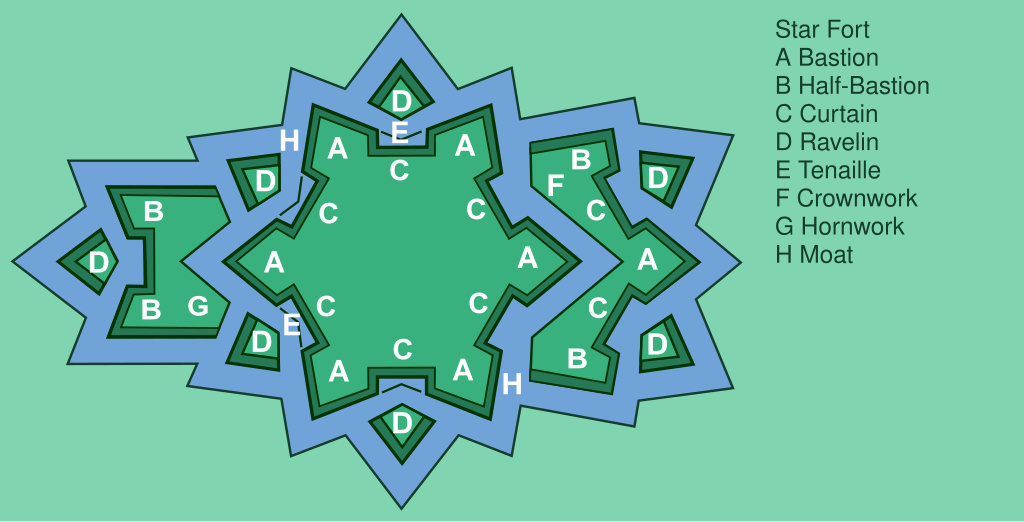
But the old projecting tower of the castle, you will recall, was designed to allow only a handful of defenders fire down any given section of wall; we still want that good enfilade fire effect, but we need a lot more space to get enough muskets up there to develop that fire. The solution: the bastion. A bastion was an often diamond or triangular-shaped projection from the wall of the fort, which provided a longer stretch of protected wall which could fire down the length of the curtain wall. It consists of two “flanks” which meet the curtain wall and are perpendicular to it, allowing fire along the wall; the “faces” (also two) then face outward, away from the fort to direct fire at distant besiegers. When places at the corners of forts, this setup tends to produce outward-spiked diamonds, while a bastion set along a flat face of curtain wall tends to resemble an irregular pentagon (“home plate”) shape [Wiki]. The added benefit for these angles? From the enemy siege lines, they present an oblique profile to enemy artillery, making the bastions quite hard to batter down with cannon, since shots will tend to ricochet off of the slanted line.
In the simplest trace italienne forts [Wiki], this is all you will need: four or five thick-and-low curtain walls to make the shape, plus a bastion at each corner (also thick-and-low, sometimes hollow, sometimes all at the height of the wall-walk), with a dry moat (read: big ditch) running the perimeter to slow down attackers, increase the effective height of the wall and shield the base of the curtain wall from artillery fire.
But why stay simple, there’s so much more we can do! First of all, our enemy, we assume, have cannon. Probably lots of cannon. And while our walls are now cannon resistant, they’re not cannon immune; pound on them long enough and there will be a breach. Of course collapsing a bastion is both hard (because it is angled) and doesn’t produce a breach, but the curtain walls both have to run perpendicular to the enemy’s firing position (because they have to enclose something) and if breached will allow access to the fort. We have to protect them! Of course one option is to protect them with fire, which is why our bastions have faces; note above how while the flanks of the bastions are designed for small arms, the faces are built with cannon in mind: this is for counter-battery fire against a besieger, to silence his cannon and protect the curtain wall. But our besieger wouldn’t be here if they didn’t think they could decisively outshoot our defensive guns.
But we can protect the curtain further, and further complicate the attack with outworks [Wiki], effectively little mini-bastions projecting off of the main wall which both provide advanced firing positions (which do not provide access to the fort and so which can be safely abandoned if necessary) and physically obstruct the curtain wall itself from enemy fire. The most basic of these was a ravelin (also called a “demi-lune”), which was essentially a “flying” bastion – a triangular earthwork set out from the walls. Ravelins are almost always hollow (that is, the walls only face away from the fort), so that if attackers were to seize a ravelin, they’d have no cover from fire coming from the main bastions and the curtain wall.
And now, unlike the Modern Major-General, you know what is meant by a ravelin … but are you still, in matters vegetable, animal and mineral, the very model of a modern Major-General?
But we can take this even further (can you tell I just love these damn forts?). A big part of our defense is developing fire from our bastions with our own cannon to force back enemy artillery. But our bastions are potentially vulnerable themselves; our ravelins cover their flanks, but the bastion faces could be battered down. We need some way to prevent the enemy from aiming effective fire at the base of our bastion. The solution? A crownwork. Essentially a super-ravelin, the crownwork contains a full bastion at its center (but lower than our main bastion, so we can fire over it), along with two half-bastions (called, wait for it, “demi-bastions”) to provide a ton of enfilade fire along the curtain wall, physically shielding our bastion from fire and giving us a forward fighting position we can use to protect our big guns up in the bastion. A smaller version of the crownwork, called a hornwork can also be used: this is just the two half-bastions with the full bastion removed, often used to shield ravelins (so you have a hornwork shielding a ravelin shielding the curtain wall shielding the fort). For good measure, we can connect these outworks to the main fort with removable little wooden bridges so we can easily move from the main fort out to the outworks, but if the enemy takes an outwork, we can quickly cut it off and – because the outworks are all made hollow – shoot down the attackers who cannot take cover within the hollow shape.
An ideal form of a bastion fortress to show each kind of common work and outwork.
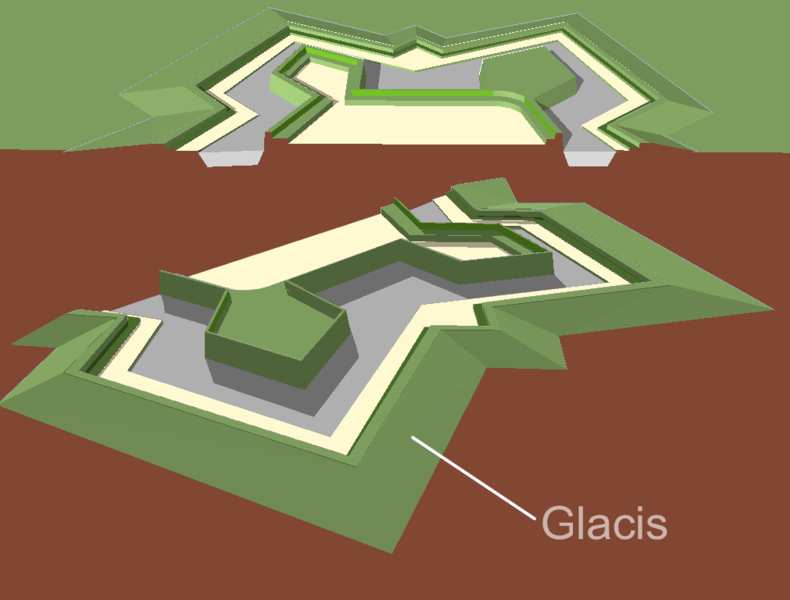
Drawing by Francis Lima via Wikimedia Commons.We can also do some work with the moat. By adding an earthwork directly in front of it, which arcs slightly uphill, called a glacis, we can both put the enemy at an angle where shots from our wall will run parallel to the ground, thus exposing the attackers further as they advance, and create a position for our own troops to come out of the fort and fire from further forward, by having them crouch in the moat behind the glacis. Indeed, having prepared, covered forward positions (which are designed to be entirely open to the fort) for firing from at defenders is extremely handy, so we could even put such firing positions – set up in these same, carefully mathematically calculated angle shapes, but much lower to the ground – out in front of the glacis; these get all sorts of names: a counterguard or couvreface if they’re a simple triangle-shape, a redan if they have something closer to a shallow bastion shape, and a flèche if they have a sharper, more pronounced face. Thus as an enemy advances, defending skirmishers can first fire from the redans and flèches, before falling back to fire from the glacis while the main garrison fires over their heads into the enemy from the bastions and outworks themselves.
A diagram showing a glacis supporting a pair of bastions, one hollow, one not.
Diagram by Arch via Wikimedia Commons.At the same time, a bastion fortress complex might connect multiple complete circuits. In some cases, an entire bastion fort might be placed within the first, merely elevated above it (the term for this is a “cavalier“) so that both could fire, one over the other. Alternately, when entire cities were enclosed in these fortification systems (and that was common along the fracture zones between the emerging European great powers), something as large as a city might require an extensive fortress system, with bastions and outworks running the whole perimeter of the city, sometimes with nearly complete bastion fortresses placed within the network as citadels.
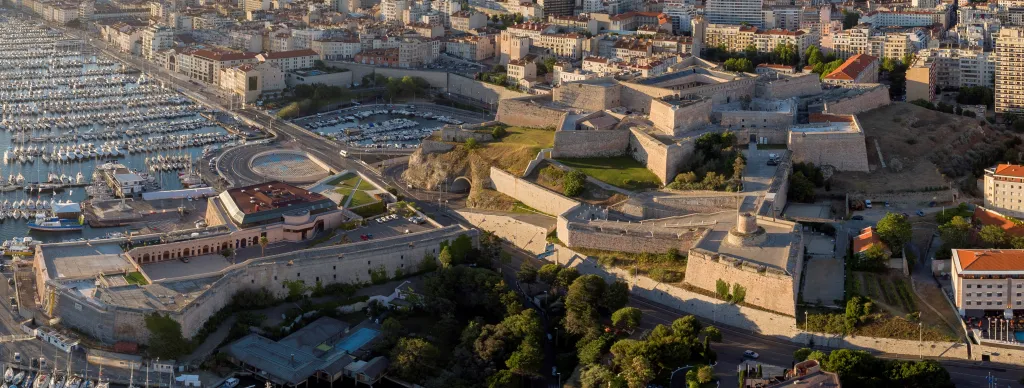
Fort Saint-Nicolas, which dominates the Old Port of Marseille. The fort forms part of a system with the low outwork you see here and also an older refitted castle, Fort Saint-Jean, on the other side of the harbor.
Photo via Wikimedia Commons.All of this geometry needed to be carefully laid out to ensure that all lines of approach were covered with as much fire as possible and that there were no blindspots along the wall. That in turn meant that the designers of these fortresses needed to be careful with their layout: the spacing, angles and lines all needed to be right, which required quite a lot of math and geometry to manage. Combined with the increasing importance of ballistics for calculating artillery trajectories, this led to an increasing emphasis on mathematics in the “science of warfare”, to the point that some military theorists began to argue (particularly as one pushes into the Enlightenment with its emphasis on the power of reason, logic and empirical investigation to answer all questions) that military affairs could be reduced to pure calculation, a “hard science” as it were, a point which Clausewitz (drink!) goes out of his way to dismiss (as does Ardant du Picq in Battle Studies, but at substantially greater length). But it isn’t hard to see how, in the heady centuries between 1500 and 1800 how the rapid way that science had revolutionized war and reduced activities once governed by tradition and habit to exercises in geometry, one might look forward and assume that trend would continue until the whole affair of war could be reduced to a set of theorems and postulates. It cannot be, of course – the problem is the human element (though the military training of those centuries worked hard to try to turn men into “mechanical soldiers” who could be expected to perform their role with the same neat mathmatical precision of a trace italienne ravelin). Nevertheless this tension – between the science of war and its art – was not new (it dates back at least as far as Hellenistic military manuals) nor is it yet settled.
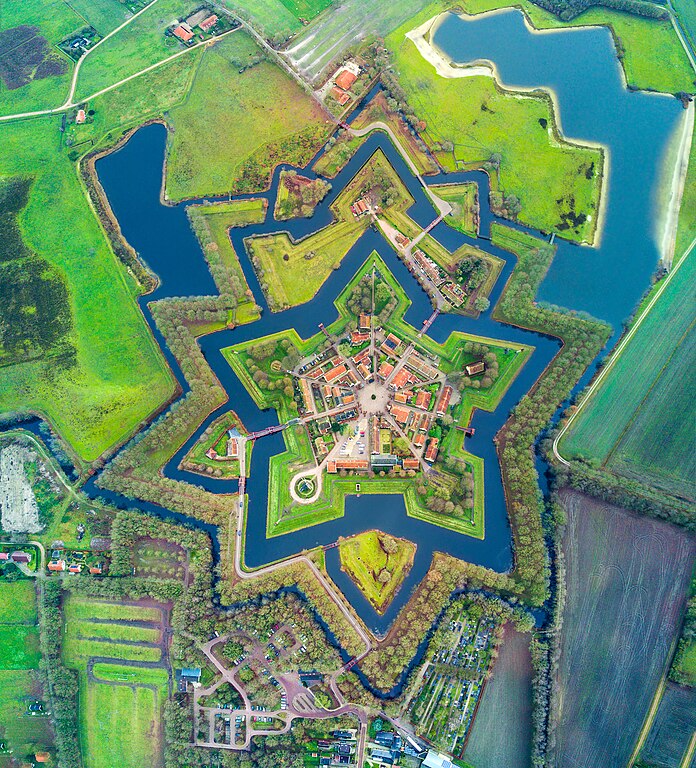
An aerial view of the Bourtange Fortress in Groningen, Netherlands. Built in 1593, the fort has been restored to its 1750s configuration, seen here.
Photo by Dack9 via Wikimedia Commons.But coming back to our fancy forts, of course such fortresses required larger and larger garrisons to fire all of the muskets and cannon that their firepower oriented defense plans required. Fortunately for the fortress designers, state capacity in Europe was rising rapidly and so larger and larger armies were ready to hand. That causes all sorts of other knock on effects we’re not directly concerned with here (but see the bibliography at the top). For us, the more immediate problem is, well, now we’ve built one of these things … how on earth does one besiege it?
Bret Devereaux, “Collections: Fortification, Part IV: French Guns and Italian Lines”, A Collection of Unmitigated Pedantry, 2021-12-17.
Comments Off on QotD: The trace italienne in fortification design
November 8, 2024
Highlights of Herculaneum (Part II)
Scenic Routes to the Past
Published Jul 12, 2024This second part of my survey of Herculaneum explores some of the site’s incredibly well-preserved houses.
(more…)
Comments Off on Highlights of Herculaneum (Part II)
November 7, 2024
Highlights of Herculaneum (Part I)
Scenic Routes to the Past
Published Jul 9, 2024An introduction to Herculaneum, buried and preserved by the eruption of Vesuvius in 79 AD. This video surveys the site and some of its public monuments. Part II explores Herculaneum’s incredibly well-preserved houses.
Check out my other channels, @toldinstone and @toldinstonefootnotes
Comments Off on Highlights of Herculaneum (Part I)


