
Tasting History with Max Miller
Published 6 May 2025Marinated baby back ribs served with a garlic and sapa sauce and roasted onions
City/Region: Italy
Time Period: 1570We actually know a fair bit about what was served at the 1549 papal conclave thanks to one of the first celebrity chefs, Bartolomeo Scappi, who was in charge of the food. In his incredible book, Opera dell’arte del cucinare, or Opera di Bartolomeo Scappi, he includes not only recipes that would have been served to the cardinals, but illustrations showing the many steps for preparing and transporting the food.
Dishes like these ribs would have been tested for poison, inspected for secret messages, put in special containers, and delivered via a sort of turntable.
A lot of hassle, but these ribs would be worth it. They’re so tender and the flavors of the rub and sauce are complex and delicious. It’s not as sweet as a modern barbecue sauce, but strikes a lovely balance between the sweetness of the sapa (reduced grape must) and the sharp and savory flavors of the vinegar, garlic, and coriander seeds. You could certainly make more sauce, but I think this amount is really nice.
Different ways to cook the back ribs of a domestic pig
If the pig is young, the ribs can be roasted on the spit with the rind, or without, and with onions split in the pan, which are cooked with the fat that drips from the meat as it cooks … and before it is put on the spit, it is sprinkled with salt and ground coriander seed. You could also let the ribs stand in a marinade of vinegar, grape must syrup, garlic cloves and coriander, and then cook it on the spit in the above way, serving it hot with a sauce on top made of the same seasoning …”
— Opera di Bartolomeo Scappi, 1570
October 10, 2025
Feeding the Papal Conclave
October 5, 2025
North Africa Episode 2: Rommel Arrives in Africa
World War Two
Published 4 Oct 2025
North Africa, February 1941. Operation Compass has shattered the Italian 10th Army, capturing over 100,000 men and pushing deep into Libya. But just as Britain celebrates its first major land victory of World War II, a new threat arrives: Erwin Rommel. Sent by Hitler to salvage the collapsing Italian front, the “Desert Fox” lands in Tripoli with orders to hold Libya — and immediately begins pushing east.
At the same time, British commanders face tough choices: should they secure North Africa, or divert their best troops to Greece as Churchill demands? With overstretched Commonwealth divisions left behind in the desert and fresh German forces arriving, a new campaign begins — one that will decide the future of the Mediterranean war.
(more…)
September 29, 2025
The Galactic Empire and a (Revised) Generic Model of “Fascism”
Feral Historian
Published 29 Sept 2023While we can classify significantly different regimes as “communist” based on their key similarities, we don’t have the same taxonomy for “fascism” as a political category. The term is either used so broadly it becomes meaningless, or defined so narrowly that it’s only relevant to Mussolini’s Italian Fascism.
But we can identify three key factors that, when all are present together, result in a system we can define as “fascist” in a sense that’s both historically based and general enough to be useful for analysis. In addition to laying out a simple model defining fascism, this video also dives into some history of Fascism and National Socialism, mixed with the kind of sci-fi analysis you’ve come to expect here.
00:00 Intro
00:35 Palp, Dolf, and Communists
04:05 Old Republic vs Weimar Republic
04:55 Party and State
08:57 Three-Point “Fascist Minimum”
09:24 “Third Way” Economics
15:12 Totalitarianism
19:19 Unifying Myth
22:53 Umberto Eco
24:46 Franco
26:25 Closing Miscellany🔹 Patreon | patreon.com/FeralHistorian
🔹 Ko-Fi | ko-fi.com/feralhistorian
September 28, 2025
North Africa Episode 1: Hitler’s Hand Forced
World War Two
Published 27 Sept 2025As Italy’s war effort collapses across Greece and North Africa, Hitler is forced to intervene. This episode explains why German troops are sent to Africa in early 1941 and sets the stage for Rommel’s arrival and the birth of the Desert War. The North African campaign begins not with a plan — but with a crisis.
(more…)
September 27, 2025
NATO – the alliance of paper tigers?
In UnHerd, Edward Luttwak suggests that despite President Trump calling the Russians “paper tigers”, the non-US members of the NATO alliance could more appropriately be described that way:
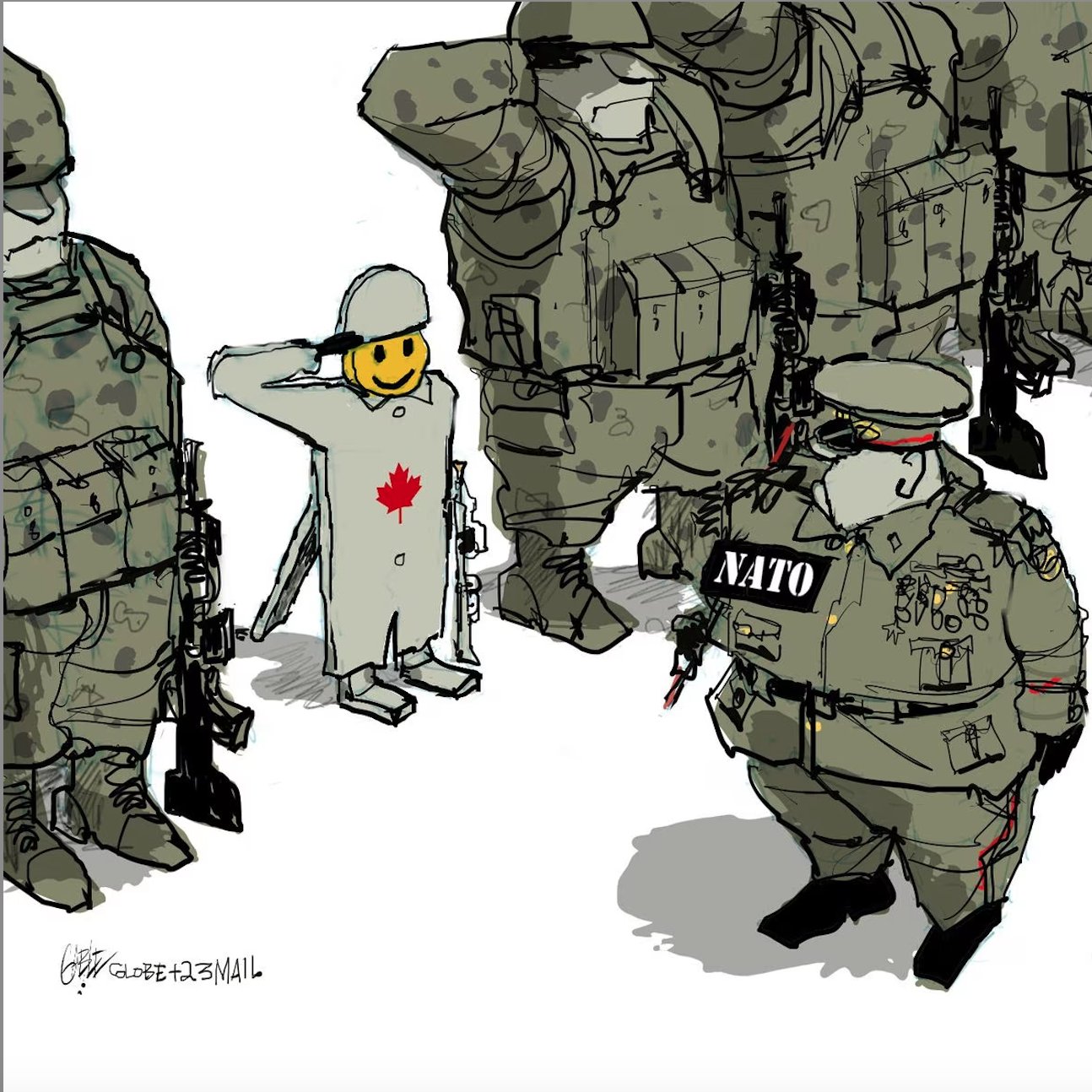
It’s been an open secret for decades that Canada’s NATO contributions are more rhetoric than reality, but it’s true of many of the European NATO allies, too.
… simply raising defence spending will not turn Europe’s states into genuinely effective military powers. For one thing, the GDP criterion is much too vague to mean much. Finland, for instance, spends only 2.4% of its GDP on defence and yet can mobilise some 250,000 determined soldiers. Other Nato members, which spend much more than the Finns, obtain far less for their money.
Moreover, focusing on GDP instead of force requirements — so many battalions, artillery regiments, fighter squadrons — is nothing but an invitation to cheat, an opportunity lustily taken up across the continent. The latest Spanish submarine, for instance, is not imported for €1 billion or so from Thyssen-Krupp, which supplies navies around the world with competent, well-proven submarines. Instead, it was proudly designed and built at the Navantia state-owned Spanish shipyard: for €3.8 billion, roughly the cost of a much bigger French nuclear-powered submarine. As a feeble justification for that absurdly high cost, Spain’s defence minister cited a supposedly advanced air-recirculation system — so greatly advanced, in fact, that it is not actually ready, and will not be installed even in the submarine’s next iteration.
Soon, though, Italy will outdo Spain’s platinum submarine: by including a new bridge to Sicily, set to cost some €13.5 billion, into its 2% of GDP Nato spending quota. The government’s excuse is that some 3,000 Italian troops may need to cross the Strait of Messina were the Italian army ever to be fully mobilised. But it would be much cheaper to fly them individually, each trooper in his own luxurious private jet. Even without the bridge, meanwhile, Italy’s cheating on the 2% target is bad enough. Most notably, much of the Italian Navy’s spending goes towards warships made by Italy’s state-owned Fincantieri shipyard. But there is not enough money for the fuel and maintenance expenses to operate more than half of them, meaning another industrial subsidy is camouflaged as defence spending. All the while, Italy refuses to increase its defence budget beyond the very modest target of 2% — which it has yet to meet.
As for Germany, three and half years since the start of the Ukraine war, with ever more ambitious rearmament plans loudly promised, the total number of personnel in uniform has actually slightly decreased. And, aside from beginning a multi-billion euro purchase on an Israeli missile-defence system, nothing much has happened. Despite its high demand in Ukraine, even the battle tank, that German specialty, is being produced in very, very small numbers: so low that the annual output could be lost in a morning of combat. In May 2023, indeed, a meagre 18 Leopard tanks were ordered to replace older models lost in Ukraine. The expected delivery date? Between 2025 and 2026! Then, in July, Germany purchased a further 105 advanced Leopard 2A8s. That is the number needed to equip a single brigade, the German force stationed in Lithuania — and they are expected to arrive in 2030!
The sad truth, then, is that Germany has yet to start working in earnest to correct the extreme neglect inflicted on its armed forces during the long Merkel premiership, when she kept saying that “even if we had the money we would not know how to spend it”. All the while, German helicopters lacked rotors and tanks lacked engines. The exceedingly slow recovery of the German army is especially frustrating because Nato is not actually short of air or naval forces. What it lacks are ground forces, soldiers more simply, or rather soldiers actually willing to fight. Having added Estonia, Latvia and Lithuania to the alliance, tiny countries with outsized defence needs, the alliance faces a severe troop deficit across the entire Baltic sector. The troops so far sent by Nato allies, such as visiting Alpini battalions from Italy, cannot improve the maths.
Update, 30 September: Welcome, Instapundit readers! Please do have a look around at some of my other posts you may find of interest. I send out a daily summary of posts here through my Substack – https://substack.com/@nicholasrusson that you can subscribe to if you’d like to be informed of new posts in the future.
September 23, 2025
Beretta Model 1934: Italy’s Unassuming Workhorse Service Pistol
Forgotten Weapons
Published 16 May 2025The Beretta Model 34 was basically the final iteration of a design by Tullio Marengoni that began all the way back in 1915. That pistol was updated in the early 1920s, and that one was updated in 1931. The Model 1931 was converted to .380 ACP (aka 9mm Short) as the Model 1932, which became the Model 1934 with the addition of a hammer half-cock notch and steel grip panel backing. Police and military contracts began in 1935, with the Italian Army formally adopting it in 1936 and purchasing nearly 400,000 of them by 1940. It would ultimately see service with basically all the armed elements of the Italian military and civil security services as well as foreign nations including Germany, Romania, and Finland. As a souvenir for British or American troops, the Model 1934 was also a prized piece.
Essentially, the Model 1934 is compact, simple, durable, and reliable. It is an excellent military pistol; easy to carry unobtrusively but dependable when called upon. After World War Two it stayed in production until 1980, despite introduction of many other more modern options by Beretta. Today a bunch of the pistols have become available on the US collector’s market. Thanks to Royal Tiger Imports for sending this example for me to film!
Beretta Model 1934 serial numbers and dates (source: “1915-1985 Settant’ Anni di Pistole Beretta“):
1934 – 1942 – from about 500073 to 999996
1934 – 1942 – from 1 to about 40000
1943 – 1945 – from F00001 to F99997
1943 – 1945 – from G00001 to G57486
1943 – 1945 – from 0001AA to 9997AA
1943 – 1945 – from 0001BB to 9971BB
1946 – 1949 – from C00001 to C99998
1949 – 1954 – from D00001 to D99999
1954 – 1967 – from E00001 to E95760
1967 – 1973 – from F50001 to F61693
1970 – 1975 – from G00007 to G49620
1972 – 1974 – from H00001 to H25000
1971 – 1980 – from T 1 to T 10217Other pistols in the Beretta development series:
Modle 1915: • Beretta 1915: the First of the Berett…
Model 1923: • Beretta Model 1923
Model 1931: • Beretta Model 1931
Trials Model 1934: • Military Trials Beretta 34 – Can You …
(more…)
September 14, 2025
September 4, 2025
Mussolini’s Blunder: Greece and North Africa 1940
Real Time History
Published 4 Apr 2025Hitler’s victories in 1940 present a historic opportunity to Italian dictator Benito Mussolini to expand the Italian Empire. Instead, Italy suffers a series of humiliating disasters in Greece and North Africa. So why did Mussolini declare war on the Allies at this moment, and could Germany be ultimately responsible for the Italian fiasco?
(more…)
August 7, 2025
War Rationing on the Italian Home Front during WWII
Tasting History with Max Miller
Published 4 Mar 2025Dry, dense wartime version of a traditional chestnut cake with lemon zest and no sugar
City/Region: Italy
Time Period: 1942Food shortages in Italy began years before WWII broke out, and cookbooks that focused on food scarcity had been published as early as 1935. They included recipes for things like soup made from vegetable peels and, like this recipe’s cookbook, instructions for cleaning when soap was rationed.
Castagnaccio is a traditional Tuscan chestnut cake, and this sugarless version is, I imagine, a far cry from what it should be. The cake is very dry, then turns gummy when you chew it, and I definitely recommend having something to wash it down (though you should probably just make a non-wartime version). The flavor isn’t bad, and the lemon really comes through, but it could really use some kind of sweetener.
Chestnut flour cake (without sugar).
What a sweet and lucky surprise to find in your pantry, still in its bag, some chestnut flour which you had completely forgotten about (an incredible thing, indeed, in these times!). Well, such a surprising and lucky circumstance happened to me, in these days, and since you must immediately take advantage of every piece of luck, I…measured 200 grams of the sweet flour; I poured it in a small bowl; I added half a tablespoon of oil, a pinch of salt and only the grated yellow part of a lemon zest; I mixed everything with as much milk as needed (I would have used water if I didn’t have milk at home); I added a whole sachet of yeast; I mixed everything well again; I poured everything in an oiled cake pan; I put the pan in the oven (not too hot); and…when I saw that the cake was swollen and baked…when I put it on the table in front of my family…insatiable gluttons…when the cake was celebrated…
“how lucky we were, mom, since you forgot about the flour” (the kids);
“today’s sweet cake is truly delicious” (the husband);
“what a pity the cake is so small” (the servant girl in her mind)
“it’s lucky that I was able to find such a good remedy for my unforgivable forgetfulness” (me, in my heart).”
— 200 Tips for…these times by Petronilla, 1942
August 5, 2025
QotD: Fighting a Middle Republic Legion
You’ve formed up in your fighting order and begun to advance and first a cloud of light enemies (the velites) move up against you. Behind them, you can vaguely see the main Roman body, but not in much detail yet. Instead, you are treated to shower of lighter javelins; these only mass around 250g or so, but some of them are bound to catch a face or an unarmored leg and bring someone down or get stuck in a shield. The damage is probably minimal, but what the velites are doing is already wearing you down: you are now, physically and mentally “in combat”, with weapons flying and adrenaline running (whereas the Roman heavy infantry are not!). The velites don’t need to inflict casualties at this stage to have an effect: they’re inflicting friction (in the Clausewitzian sense, drink!) and that is enough.
As you approach the velites, they scatter back to their lines and now the first real trial comes: when you are about twenty meters out from the enemy line, a storm of those heavy pila come in, thick and all at once. Each one masses around 1.3kg (just short of three pounds) so even if the tip doesn’t bite, one of these things clanging off of armor or a shield is going to hurt, the impacts stagger men near you as you struggle to keep formation (and for a Hellenistic army, get and keep those sarisa-points down). The impact of the massed volley, especially against close-order infantry with tight fighting-width, is going to be chaotic as some men are killed, others disabled, still more suddenly staggered. The volley is followed almost immediately by the on-rush of the hastati. These guys don’t have a long spear for keeping you at a distance, they’re all brandishing swords and aim to get in close, using their large body-shields to absorb any blows you might throw while they get right up in your face, where their swords can stab and slash viciously over or under your shield. These hastati are aggressive and they’re probably better armored than you are.
And of course an engagement in contact like this is unpredictable. Perhaps in some areas, your lines push forward, whereas in other places it bends back. For large maneuver units (like taxeis!) this can be a real problem, but Roman maniples are small, so one maniple can advance if it finds the opportunity while others hold position or are even forced back (we actually see a general give, essentially, an “advance at your own discretion” order at Pydna, Plut. Aem. 20.8).
After a short and terrifying experience – these moments of shock combat probably didn’t last all that long, perhaps as little as just a few minutes – the hastati fall back. The front of your line is already physically and mentally exhausted. Many men are wounded and certainly some have been killed or disabled. I don’t want to oversell the casualties aspect of this: armies don’t annihilate each other in stand-up engagements (instead more casualties happen in pursuit), but wounds and exhaustion matter. Latin has this phrase, of being confectus vulneribus, “exhausted by wounds” or perhaps “worn down by wounds” (Liv. 24.26.14, 31.17.11, Caes. BGall. 5.45) to describe how the accumulation of a lot of little wounds can sap soldiers of their ability to resist effectively, even if no one wound is lethal. And just as important, all of the emotional impetus of your initial attack is spent. And there’s a decent chance that, as you try to breath, you still have these light velites‘ javelins (the hasta velitaris) thudding into your line every few seconds, because – again – they carry seven of them. They’re not out.
And then, as you are getting your bearings, trying desperately to catch your breath, the principes come up. They’re not physically tired or emotionally exhausted, but eager (like you were a half an hour ago when you advanced), they’ve been waiting all this time. Worse yet, these are probably the most combat-effective soldiers the Romans have, in the prime of their life, with years of combat experience. Now the second volley of pila comes in, creating yet more chaos. And then more angry, heavily armored Romans, behind their big shields, stabbing and cutting with their deadly gladii.
Now the men at the back of your single line may be relatively fresh, but you have no real way to get them to the front, so the wrath of the principes falls on men who are already exhausted, already wounded, already tired and already out of fight. Your line isn’t advancing so stridently; the men in the back, if the formation is deep, don’t know why the advance is slowed, why the line seems to be wavering, only that it seems to be wavering. And meanwhile, everyone is hoping that, at any moment, the victorious cavalry on the flanks is going to show up and win the battle, but they can’t see it anywhere in the confusion. Maybe your cavalry has won and is moments away – or perhaps Antiochus III charged it off the field again and no help is coming. Or perhaps the enemy cavalry has tied it up or worse yet, the Romans’ highly skilled Numidian allies might have mastered the flanks. You have no idea, you only know that help isn’t here, you are tired and more Romans are upon you. And somewhere, the thin thread of human courage snaps, either from the exhausted men in front or the confused men behind and the formation begins to collapse.
As the collective defense of lapped shields or serried pikes gives way, the Romans are now truly in their element: their large shields function just fine in individual combat and their versatile swords do as well. Lead by their centurions, the principes, with practiced and experienced skill, are finding the gaps, cutting as they go. As the formation crumbles, the velites can pursue – lightly armored, but well enough armed, backed up by the equites if there are any left.
You can see thus how this is a formation designed to wear down an enemy’s main battle line. It isn’t that the Romans are set massively deeper than a Hellenistic army, either. Assuming a base-3 set of file-depths (which seems to me the most likely), the Roman ranks are probably six, six and three men deep (hastati, principes, triarii), for a total depth over each file of 15, one less than the normal Macedonian formation. And with the wider fighting intervals the Romans use, they won’t normally have much of a problem matching the fighting width of the enemy army, unless substantially outnumbered (as, for instance, at Magnesia).
It’s not the Roman formation is deeper, it’s that its successive battle lines avoid exposing the entire army to exhaustion, attrition and friction all at once. In effect, it uses the same principles as defense-in-depth, exploiting the effect of friction on the enemy line to wear it down, but does so on the offensive. I don’t think it is an accident that when the Romans do lose, it tends to be because this model battle was spoiled in some way, either because the army was ambushed, enveloped, something disrupted the triplex acies or because the enemy was able to carry the field with just the momentum of the first charge – the Roman lines essentially failing like a building undergoing controlled demolition, as each floor pancakes the next without slowing.
But an army that isn’t able to decisively win the battle either at the first onset or somewhere else on the line is going to find itself in quite a lot of trouble as the Romans almost inevitably sandpaper away the morale and stamina of the main line of resistance until it collapses.
Now many of you may already be realizing that this kind of force is going to present a Hellenistic army with a lot of problems, both because it is set up for a different kind of fight than they are, but also because it may end up matching much heavier troops against the lighter parts of a Hellenistic army. But before we jump into battles, we need to zoom up to the upper levels of military analysis – operations and strategy – and talk about the advantages the Romans have there.
Because if all the Romans had was an edge in their tactical system, we might expect them to win battles but sometimes lose wars. Instead, while the Romans sometimes lose battles, they seemingly always win the war.
Bret Devereaux, “Collections: Phalanx’s Twilight, Legion’s Triumph, Part IIa: How a Legion Fights”, A Collection of Unmitigated Pedantry, 2024-02-09.
July 23, 2025
QotD: The legion of the Middle Republic
With that said, we reach the first and arguably most important thing to know about the legion: the Roman legion (and socii ala) of the Middle Republic is an integrated combined arms unit. That is to say, unlike a Hellenistic army, where different “arms” (light infantry, heavy infantry, cavalry, etc.) are split into different, largely homogeneous units, these are “organic” to the legion, that is to say they are part of its internal structure (we might say they are “brigaded together” into the legion as well). Consequently, whereas the Hellenistic army aims to have different arms on the battlefield in different places doing different things to produce victory, the Roman legion instead understands these different arms to be functioning in a fairly tightly integrated fashion with a single theory of victory all operating on the same “space” in the enemy’s line.
And you may well ask, before we get to organization, “What is that theory of victory?” As we saw, the Hellenistic army aims to fix the enemy with its heavy infantry center, hold the flanks with lighter, more mobile infantry (to protect that formation) and win the battle with a decisive cavalry-led hammer-blow on a flank. By contrast, the Romans seem to have decided that the quickest way to an enemy’s vulnerable rear was through their front. The legion is thus not built for flanking, its cavalry component – while ample in numbers – is distinctly secondary. Instead, the legion is built to sandpaper away the enemy’s main battle line in the center through attrition, in order to produce a rupture and thus victory.
To do that, you need to create a lot of attrition and this is what the manipular legion is built to do.
The legion of the Middle Republic is built out of five components: three lines of heavy infantry (hastati, principes and triariivelites), and a cavalry contingent (the equites). Specifically, a normal legion has 1200 each of velites, hastati and principes, 600 triarii and 300 equites, making a total combined unit of 4,500. Organizationally, the light infantry velites were packaged in with the heavy infantry (Polyb. 6.24.2-5) for things like marching and duties in camp, but in battle they typically function separately as a screening force thrown forward of the legion.
So to take the legion as an enemy would experience them, the first force were the velites. These seem to have been deployed in open order in front of the legion to screen its advance. These fellows had lighter javelins, the hasta velitaris (Livy notes they carried seven, Livy 39.21.13), no body armor and a “simple headcovering” (λιτός περικεφάλαιος, Polyb. 6.22.3), possibly hide or textile; they also carried a smaller round shield, the parma, and the gladius Hispaniensis for close-in defense (Livy 38.21.13). These are, all things considered, fairly typical ancient javelin troops, aiming to use the mobility their light equipment offers them to stay out of close-combat.
Behind the velites was the first line of the heavy infantry, the hastati. These fellows were organized into units called maniples (lit: “a handful”) of 120, which in turn are divided into centuries of 60 each. The maniples are their own semi-independent maneuvering units (note how much smaller they are than the equivalent taxeis in the phalanx, this is a more flexible fighting system), each with its own small standard (Polyb. 6.24.6) to enable it to maintain coherence as it maneuvers. That said, they normally form up in a quincunx (5/12ths, after a Roman coin with the symbol of five punches, like on dice) formation with the rear ranks, as you can see above.
The hastati (and the principes, who are equipped the same way) have the large Roman shield, the scutum, two heavy javelins (pila), the gladius Hispaniensis sword, a helmet (almost always a Montefortino-type in bronze in this period) and body armor. Poorer soldiers, we’re told, wore a pectoral, wealthier soldiers (probably post-225, though we cannot be certain) wore mail. That is, by the standards of antiquity, quite a lot of armor, actually – probably more armor per-man than any other infantry formation on their contemporary battlefield. That relatively higher degree of protection – big shield, stout helmet (Montefortino’s in this period range from 1.5-2.5kg, making them unusually robust), and lots of body armor – makes sense because these fellows are going to aim to grind the enemy down.
Note that a lot of popular treatments of this assume that the hastati were worse equipped than the principes; there’s no reason to assume this is actually true. The principes are older than the hastati, but the way to understand this formation is that the velites are young or poor, whereas for the upper-classes of the infantry (probably pedites I-IV) after maybe the first year or so, they serve in the heavy infantry (hastati, principes, triarii) based on age, not on wealth (and then the equites are the truly rich, regardless of what age they are; the relevant passage here is Polyb. 6.21.7-9, which is, admittedly, not entirely clear on what is an age distinction and what is a wealth distinction).
We’ve discussed the combat width these guys fight with already – somewhat wider spacing than most, so that each man covers the other’s flanks but they all have room to maneuver. It seems like the standard depth in the Middle Republic was either base-3 (so 3 deep on close order, 6 deep for “fighting” open order) or base-4 (so 4 and 8). Even in open-order with the maniples stretched wide (possibly by having rear centuries move forward), there would have been open intervals (10-20m) between maniples, which reinforces the role of a maniple as a potentially independent maneuvering unit – it has the space to move.2
Behind the hastati are the principes, with the same equipment and organization, slightly off-set to cover the intervals between the hastati, with a gap between the two lines (we do not know how large a gap). These men are slightly older, though not “old”. The whole field army generally consists of iuniores (men under 46) and given how the Romans seem to like to conscript, the vast majority of men will be in their late teens and 20s. So we might imagine the velites to be poorer men, or men in their late teens (17 being the age when one become liable for conscription) or so, while the hastati are early twenties, the principes mid-twenties and the handful of triarii being men in their late twenties or perhaps early 30s. The positioning of the principes isn’t to spare older men the rigors of combat, but rather to put more experienced veterans in a position where they can steady the less experienced hastati.3
Finally, behind them are the triarii, who trade the pila for a thrusting spear, the hasta, the Roman version of the Mediterranean omni-spear. These men are, as noted, the oldest and so likely the calmest under pressure and thus form a reserve in the rear. The three-line system here is what the Romans call a triplex acies (“three battle lines”). This wasn’t the only way these armies engaged and they could sometimes be formed up into a single solid line, but the triplex acies seems to have been the standard. We don’t know exactly how deep such a formation would run, but we have fairly good evidence that a legion might occupy a space around 400m wide (with some variation), meaning a whole Roman army’s core heavy infantry component (the two legions and two alae) might be some 1.6km (about a mile) across.
The equites, while organic to the legion organizationally, will be tactically grouped in battle to form cavalry screens on the edges of the army, not as a grand flanking cavalry “hammer”, but as flank-protection for the advancing infantry body (as a result, they tend to fight more cautiously). The equites in this period are heavy cavalry, with armored riders (after c. 225, that would be mail), using a shield and a hasta, along with a gladius as a backup weapon and thus serving as “shock” cavalry. Roman cavalry, if we look at their deployments, is generally ample in numbers, but the Romans seem to have been well aware it wasn’t very good, and sought allied cavalry (especially non-Italian allied cavalry) whenever they could get it. But the cavalry, Roman or not, was almost never the decisive part of the army.
Polybius tells us that the socii supplies more cavalry than the Romans and implies that there was a standard rule of three socii cavalrymen to every Roman equites, while socii infantry matched Roman infantry numbers (Polyb. 6.26.7). Looking at actual deployments though, we see that the socii tend to outnumber the Romans modestly, on about a 2:3 ratio, with socii cavalry only modestly outnumbering Roman cavalry.4 Consequently a normal Roman consular field army (of which the Romans generally had at least two every year) was 8,400 Roman infantry, around 12,600 socii infantry, 600 Roman cavalry and perhaps a thousand or so socii cavalry, for a combined force of 21,000 infantry (c. 5,000 light 16,000 heavy, so that’s a lot of heavy infantry) and 1,600 cavalry. That somewhat undersells the cavalry force the Romans might bring, as Roman armies also often move with auxilia externa (allied forces not part of the socii), which are very frequently cavalry-heavy (especially, after 203, that really good Numidian cavalry).5 By and large, it’s not that the Romans bring a lot less cavalry (as a percentage of army size), but that Italian cavalry tends to perform poorly and the as a result the Romans do not built their battle plans around their weakest combat arm.
Perhaps ironically, the Romans used their cavalry like Alexander and Hellenistic armies used their light infantry: holding forces designed to keep the flanks of the battlefield busy while the decisive action happened somewhere else.
Bret Devereaux, “Collections: Phalanx’s Twilight, Legion’s Triumph, Part IIa: How a Legion Fights”, A Collection of Unmitigated Pedantry, 2024-02-09.
1. On this, see Burns, M. T. “The Homogenisation of Military Equipment under the Roman Republic”. In Romanization? Digressus Supplement I. London: Institute of Archaeology, University College London, 2003.
2. On this, M.J. Taylor, “Roman Infantry Tactics in the Mid-Republic: A Reassessment”, Historia 63.3 (2014): 301-322.
3. To expound at some length on my own thoughts on how I think the wealth/age issue was probably managed, Dionysius (4.19.2) claims that the Romans recruited by centuries in the comitia centuriata such that the wealthy, divided into fewer voting blocks, served more often, and we know from Polybius that the maximum period of service for the infantry was sixteen years and from some math done by N. Rosenstein in Rome at War (2004) that the average service must have been around seven years. My suspicion, which I cannot prove is that the very poorest Roman assidui (men liable for conscription) might have only been serving fewer years on average and so it wasn’t a problem having them do all of their service as velites (the only role they can afford), whereas wealthier Romans (my guess is pedites IV and up) are the ones who age into the heavy infantry, with pedites I, whose members probably serve more than the seven-year average (perhaps around 10?) might make up close to 40% of the actual heavy infantry body (which is their balance in the comitia centuriata). The velites thus serves two important functions: a place to “blood” wealthier young Roman men to prepare them to stand firm in the heavy infantry line, as well as a place for poorer Romans to contribute militarily in a way they could afford. But I think that, once in the heavy infantry, the division between hastati, principes and triarii was – as Polybius says (6.21.7-9 and 6.23.1) – an age division, not a wealth division. Instead, the next wealth line is for the equites.
4. The data on this is compiled by Taylor, Soldiers & Silver (2020), 26-28.
5. Taylor, op. cit., 54-7 compiles examples.

July 11, 2025
QotD: Pyrrhus arrives in Magna Graecia to support the Tarantines
There are a few reasons I think this is unlikely. First, sources enlarging armies to fit the narrative magnitude of battles is a very common thing. But more to the point, Pyrrhus has crossed to Italy with 28,500 men total and – as Plutarch notes – hasn’t had a chance to link any of his allies up to his army. That may mean he hasn’t even reabsorbed his scouting force of 3,000 and he may well have also had to drop troops off to hold settlements, secure supplies and so on. Pyrrhus’ initial reluctance to engage (reported by Plutarch) is inconsistent with him wildly outnumbering the Romans, but his decision to wait for reinforcements within reach of the Romans is also inconsistent with the Romans wildly outnumbering him. So a battle in which Pyrrhus has perhaps 20-25,000 men and the Romans a standard two-legion, two-alae army of 20,000 give or take, seems the most plausible.1
The two forces met along the River Siris at Heraclea on the coastal edge of Lucania, Laevinius having pushed deep into southern Italy to engage Pyrrhus. As usual for these battles, we have descriptions or partial descriptions from a host of sources (in this case, Plutarch, Dionysius of Halicarnassus, Zonaras, Florus) which don’t always agree, leaving the modern historian in a bit of a pickle. Generally, we assume that a lot of the later Roman narratives of a famous defeat are likely to have been tailored to try and minimize the embarrassment, either by implying the battle was closer than it was or that Pyrrhus was a very impressive foe (or both) or other “face-saving” inventions. Worse yet, all of our sources are writing at substantial chronological distance, the Romans not really having started to record their own history until decades later (though there would have been Greek sources for later historians to work with). Generally, Patrick Kent tends to conclude that – somewhat unusually – Plutarch’s moralizing focus renders him more reliable here: Plutarch feels no need to cover for embarrassing Roman defeats or to embellish battle narratives (which he’d rather keep short, generally) because his focus is on the character of Pyrrhus. Broadly speaking, I think that’s right and so I too am going to generally prefer Plutarch’s narratives here.
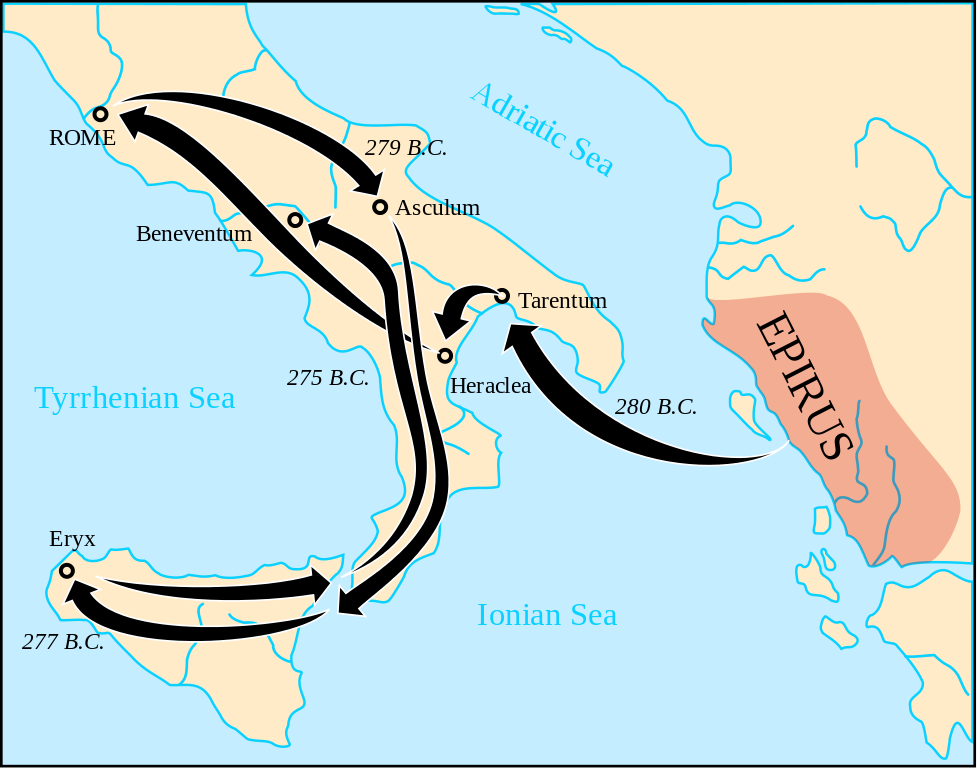
A fairly handy map of Pyrrhus’ campaigns (though some of the detail is lost in the big sweeping arrows). What is notable is, apart from Pyrrhus’ lightning raid into Latium in 280, he is almost invariably fighting in “friendly” territory, either in Lucania (Heraclea), Apulia (Asculum) or Samnium (Beneventum), the lands of his allies. Pyrrhus never fights an actual pitched battle on Roman-controlled territory, which I think speaks to his strategic intent: to carve out a kingdom in Greater Greece, not to conquer the whole of Italy.
Wikimedia Commons.The battle was defined by Pyrrhus’ use of terrain – Pyrrhus thought delay might be wiser (to link up with his allies) but left a blocking force on the river (the Romans being on the other side). The Romans responded by forcing the river – typical Roman aggression – but Plutarch at least thinks it caught Pyrrhus by surprise (he hadn’t fought Romans before) and so it leaves him in a scramble. He charges his cavalry (Plut. Pyrrh. 16.5) to give his main phalanx time to form up for battle resulting in what seems like a cavalry engagement near the river. Pyrrhus nearly gets himself killed in the fighting, but survives and falls back to his main infantry force, which then met the Romans in an infantry clash. The infantry fighting was fierce according to Plutarch and Pyrrhus, still shaken from being almost killed, had to come out and rally his troops. In the end, the Romans are described as hemmed in by Pyrrhus’ infantry and elephants before some of his Greek cavalry – from Thessaly, the best horse-country in Greece – delivers the decisive blow, routing the Roman force.
It is, on the one hand, a good example of the Hellenistic army “kit” using almost all of its tactical elements: an initial – presumably light infantry – screen holding the river, followed by a cavalry screen to enable the phalanx to deploy, then a fierce and even infantry fight, finally decided by what seems to be flanking actions by cavalry and elephants. Plutarch (Pyrrh. 17.4) gives two sets of casualty figures, one from Dionysius and another from Hieronymus; the former says that the Romans lost 15,000 to Pyrrhus’ 13,000 killed, the latter that the Romans lost 7,000 to Pyrrhus’ just a bit less than 4,000 killed. The latter seems almost certainly more accurate. In either case, the Roman losses were heavier, but Pyrrhus’ losses were significant and as Plutarch notes, his losses were among his best troops.
Even in the best case, in victory, Pyrrhus had lost around 15% of his force (~4,000 out of 28,000), a heavy set of losses. Indeed, normally if an army loses 15% of its total number in a battle, we might well assume they lost. Roman losses, as noted, were heavier still, but as we’ve discussed, the Romans have strategic depth (in both geography, political will and military reserves) – Pyrrhus does not. By contrast, Alexander III reportedly wins at Issus (333) with just 150 dead (and another 4,802 wounded or missing; out of c. 37,000) and at Gaugamela (331) with roughly 1,500 losses (out of c. 47,000). The Romans will win at Cynoscephelae (197) with just 700 killed.
This isn’t, I think, a product of Pyrrhus failing at all, but rather a product of the attritional nature of Roman armies: even in defeat they draw blood. Even Hannibal’s great victory at Cannae (216) costs him 5,700 men, according to Polybius (more, according to Livy). But the problem for Pyrrhus is that his relatively fragile Hellenistic army isn’t built to repeatedly take those kinds of hits: Pyrrhus instead really needs big blow-out victories where he takes few losses and destroys or demoralizes his enemy. And the Roman military system does not offer such one-sided battles often.
Nevertheless, Pyrrhus shows that a Hellenistic army, capable handled, could beat a third-century Roman army, albeit not cleanly, and that is well worth noting.
Bret Devereaux, “Collections: Phalanx’s Twilight, Legion’s Triumph, Part IIIb: Pyrrhus”, A Collection of Unmitigated Pedantry, 2024-03-08.
1. I should note, this is Kent’s assessment as well.
June 21, 2025
Cheese Gnocchi from Medieval Italy
Tasting History with Max Miller
Published 21 Jan 2025Groove-less cheese-based gnocchi from before potatoes were introduced
City/Region: Italy
Time Period: 14th CenturyGnocchi has been around for hundreds of years, and unsurprisingly, the gnocchi of the 14th century was quite a bit different from what we’re used to today. Before the potato was even a twinkle in Italy’s eye, cheese was a common base for the dough.
The first mention of grooves on gnocchi isn’t until 1570 when Bartolomeo Scappi writes about them, so this gnocchi is groove-less. The texture is very different from modern versions. It’s more crumbly, but that could depend on the kind of cheese that you use. Whatever you use, make sure it’s a cheese that you like, because this is essentially boiled cheese held together with some flour and egg. I may not eat a whole bowl of this, but it’s still quite nice.
If you want gnocchi. Take fresh cheese and pound it; then take flour and mix it with egg yolk in the manner of migliacci. Put a pot filled with water on the fire and when it boils, put the mixture on a board and spoon it off into the pot, and when they are cooked, place them on dishes and sprinkle on plenty of grated cheese.
— Fragment of a book on cooking from the 14th century
May 25, 2025
Rommel’s Dark Secrets in North Africa – WW2 Fireside Chat
World War Two
Published 24 May 2025Indy and Sparty handle your questions on the German intervention in North Africa. Why did Rommel make such an impact so quickly? What was the war like for the local populations? How deeply involved was Rommel in the persecution of North African Jews?
(more…)
May 20, 2025
The Battle of Aquino
Canadian Tank Museum
Published 13 Jan 2025You may know about AQUINO Tank Weekend at our Museum, but what was the Battle of Aquino? When did it take place? What happened to the Ontario Regiment RCAC during that action?
Enjoy this short documentary with our Curator Sam Richardson as he gives you a detailed look at the situation in May 1944 during the Italian campaign of the Second World War. Learn more about the soldiers that took part, the battle that took place and why it remains important to our Regiment and our Museum.
(more…)


