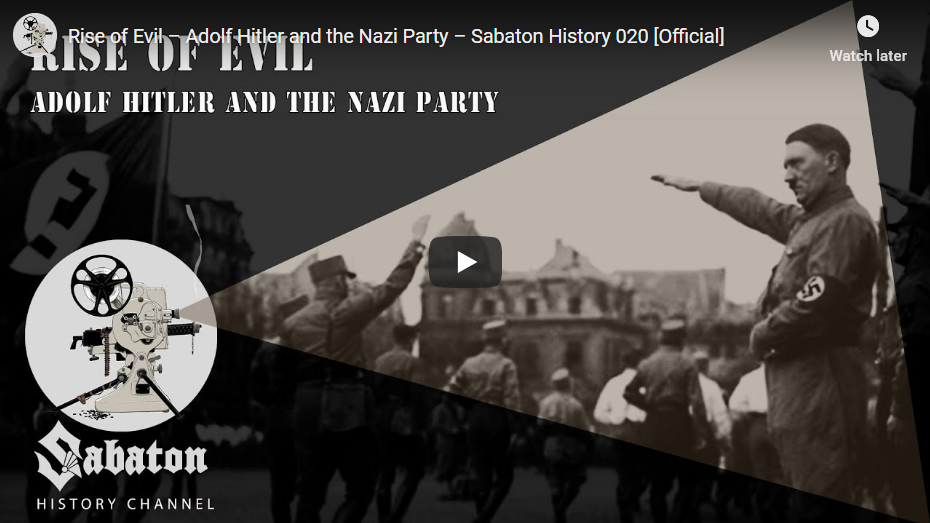
Sabaton History
Published on 21 Feb 2019In “Panzerkampf” on The Art of War album, Sabaton sings about the German offensive on the Kursk salient in the summer of 1943. We dive into the details of the Battle of Kursk and one of the biggest tank battles in world history, the Battle of Prokhorovka.
Support Sabaton History on Patreon: https://www.patreon.com/sabatonhistory
Hosted by: Indy Neidell
Written by: Markus Linke and Indy Neidell
Directed by: Astrid Deinhard and Wieke Kapteijns
Produced by: Pär Sundström, Astrid Deinhard and Spartacus Olsson
Creative Producer: Joram Appel
Executive Producers: Pär Sundström, Joakim Broden, Tomas Sunmo, Indy Neidell, Astrid Deinhard, and Spartacus Olsson
Maps by: Eastory
Edited by: Iryna Dulka
Sound Editing by: Marek KaminskiEastory YouTube Channel: https://www.youtube.com/channel/UCEly…
Archive by: Reuters/Screenocean https://www.screenocean.com
Music by Sabaton.
Photo of Bill Belichick: https://www.flickr.com/photos/2700360…
February 23, 2019
“Panzerkampf” – The Battle of Kursk – Sabaton History 003
February 22, 2019
Germany’s armed forces – from world class to laughing stock
Germany’s military has fallen on very hard times, and there’s so much wrong that it will be very difficult to fix even with all the goodwill in the world:

The German Navy training ship Gorch Fock (launched in 1958) under full sail (less the spanker topsail) in Kiel Fjord near the Laboe Naval Memorial in July 2006.
Photo by Felix Koenig via Wikimedia Commons.
Most Germans’ eyes glaze over at the mention of the Bundeswehr’s perpetual troubles, but an affair surrounding the Gorch Fock, the navy’s three-masted naval training ship, has caught their attention.
Launched in 1958 to school a new generation of West German naval recruits, the imposing 81-meter ship, which takes its name from a popular seafaring German author’s pseudonym, is more than just a training vessel; to many, the Gorch Fock — whose likeness was etched onto some Deutsche Mark bills — is a symbol of Germany’s postwar revival.
The ship’s iconic status is one reason why few objected when the Bundeswehr announced in 2015 that it needed a major overhaul. Until, that is, the price tag exploded from an initial projection of €10 million to €135 million, according to the latest estimate.
Bundeswehr officials claimed the depth of the ship’s troubles only became clear when it was in dry dock, but few are buying such explanations. “When the repairs cost more than a new ship, something is obviously amiss,” Bartels, the Bundeswehr’s parliamentary overseer, said in an interview.
The Gorch Fock “is a symptom of the Bundeswehr’s broader problems,” Bartels said. “Everything takes too long and costs too much money. It’s as if time and money were endless resources, and in the end no one takes responsibility.”
Almost overnight, the ship has gone from pride and joy to running gag. Last week, German weekly Der Spiegel pictured the Gorch Fock on its cover under the headline, “Ship of Fools.”
It’s an apt metaphor for Germany’s body politic as well. Given Germany’s size and economic might, Berlin’s attention to security is surprisingly shallow; citizens and politicians alike often seem oblivious to the challenges the country faces. Though Germany faces growing security threats from both Russia and China, one wouldn’t know it hanging around the German capital.
Much of the media now portrays the U.S. as a security threat on par with Russia. Public attitudes have moved in a similar direction. Security discussions are driven by a handful of like-minded think tank analysts who seem to spend most their time on Twitter, fretting about whether Trump will pull the plug on NATO.
More Germans believe China is a better partner for their country than the U.S., according to a survey published last week by Atlantik Brücke, a Berlin-based transatlantic lobbying group. About 80 percent of those surveyed consider U.S.-German relations to be “negative” or “very negative.”
H/T to Instapundit for the link.
February 21, 2019
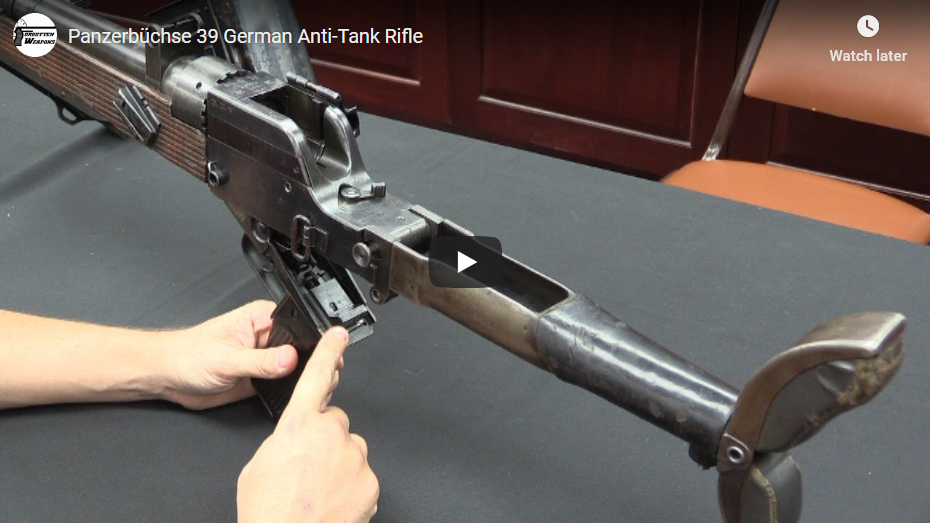
Walther’s .45ACP MP (P38 Precursor)
Forgotten Weapons
Published on 21 Jan 2019http://www.patreon.com/ForgottenWeapons
Cool Forgotten Weapons merch! http://shop.bbtv.com/collections/forg…
During the process of developing the pistol which would become the German army’s P38, the Walther company was also interested in potential export contracts (like the one they actually did get from Sweden). One potential contract briefly explored was to the United States, and a few prototype MP pistols were made in .45 ACP caliber. These were larger in all dimensions than the standard MP, and shared the features of those other developmental guns (most distinctively the shrouded hammer and internal extractor). This pistol was almost certainly taken as a souvenir form the Walther plant in 1945 by an American GI. No records exist of any American trials of the guns, and it seems that the plan to offer them for sale was never followed through on, probably because of the (9mm) guns’ success in German military trials.
Contact:
Forgotten Weapons
PO Box 87647
Tucson, AZ 85754
February 17, 2019
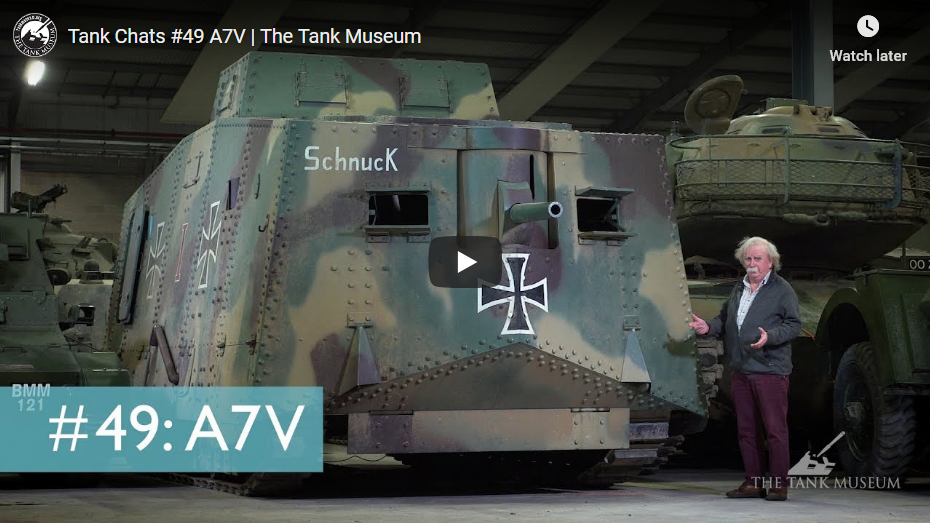
Tank Chats #42 Elefant | The Tank Museum
The Tank Museum
Published on 18 Aug 2017Originally known as the Ferdinand, then later renamed Elefant, 90 of this heavily armed and armoured vehicle were built, seeing service in the Soviet Union, Italy and Germany.
Although deployed as a tank destroyer, the Elefant had its origins in Ferdinand Porsche’s attempt to build what became the Tiger tank.
This particular Elefant is part of The Tiger Collection at The Tank Museum, Bovington, on loan from the US Army Ordnance Training and Heritage Center, VA.
Support the work of The Tank Museum on Patreon: ► https://www.patreon.com/tankmuseum
Or donate http://tankmuseum.org/support-us/donateTwitter: ► https://twitter.com/TankMuseum
Tiger Tank Blog: ► http://blog.tiger-tank.com/
Tank 100 First World War Centenary Blog: ► http://tank100.com/ #tankmuseum #tanks #tigertank tiger tanks tank chat
February 14, 2019
February 13, 2019
QotD: The goose-step
One rapid but fairly sure guide to the social atmosphere of a country is the parade-step of its army. A military parade is really a kind of ritual dance, something like a ballet, expressing a certain philosophy of life. The goose-step, for instance, is one of the most horrible sights in the world, far more terrifying than a dive-bomber. It is simply an affirmation of naked power; contained in it, quite consciously and intentionally, is the vision of a boot crashing down on a face. Its ugliness is part of its essence, for what it is saying is “Yes, I am ugly, and you daren’t laugh at me”, like the bully who makes faces at his victim. Why is the goose-step not used in England? There are, heaven knows, plenty of army officers who would be only too glad to introduce some such thing. It is not used because the people in the street would laugh. Beyond a certain point, military display is only possible in countries where the common people dare not laugh at the army. The Italians adopted the goose-step at about the time when Italy passed definitely under German control, and, as one would expect, they do it less well than the Germans. The Vichy government, if it survives, is bound to introduce a stiffer parade-ground discipline into what is left of the French army. In the British army the drill is rigid and complicated, full of memories of the eighteenth century, but without definite swagger; the march is merely a formalized walk. It belongs to a society which is ruled by the sword, no doubt, but a sword which must never be taken out of the scabbard.
George Orwell, “The Lion And The Unicorn: Socialism and the English Genius”, 1941-02-19.
February 9, 2019
40:1 – The Battle of Wizna – Sabaton History 001
Sabaton History
Published on 7 Feb 2019Sabaton wrote a song about the Battle of Wizna, called 40:1. When the Germans invaded Poland in 1939, they met determined and fierce resistance. Multiple battles show the steadiness of the Polish defenders, in contrast to the common narrative about the Polish defence. One of these Battles is the Battle of Wizna, where a Polish defensive force managed to hold off a much larger German army for several days.
Watch the official music video for 40:1 in full here: https://www.youtube.com/watch?v=epeQw…
Support Sabaton History on Patreon: https://www.patreon.com/sabatonhistory
Hosted by: Indy Neidell
Written by: Markus Linke and Indy Neidell
Directed by: Astrid Deinhard and Wieke Kapteijns
Produced by: Pär Sundström, Astrid Deinhard and Spartacus Olsson
Creative Producer: Joram Appel
Executive Producers: Pär Sundström, Joakim Broden, Tomas Sunmo, Indy Neidell, Astrid Deinhard, and Spartacus Olsson
Maps by: Eastory
Edited by: Iryna Dulka
Sound Editing by: Marek KaminskiEastory YouTube Channel: https://www.youtube.com/channel/UCEly…
Archive by: Reuters/Screenocean https://www.screenocean.comMusic by Sabaton
An OnLion Entertainment GmbH and Raging Beaver Publishing AB co-Production
© Raging Beaver Publishing AB, 2019 – all rights reserved.
February 5, 2019
Tiger vs. Comet – Germany 1945
Mark Felton Productions
Published on 18 Dec 2018The Comet was Britain’s newest tank in 1945, and led the charge into Northern Germany. In this episode, find out what happened when Royal Tank Regiment Comets encountered a lone German Tiger in the forest.
Help support Marks’ channel – see below for more details;
https://www.patreon.com/markfeltonpro…
https://www.paypal.me/markfeltonprodu…Film: YouTube Creative Commons
February 2, 2019
Curing Tuberculosis – The Hero Koch – Extra History – #1
Extra Credits
Published on 31 Jan 2019Fascinatingly enough, tuberculosis was actually considered “trendy” in the Victorian era of Europe — but Dr. Robert Koch, hero of the German Empire, was convinced that he could cure it. A British writer named Arthur Conan Doyle, however, was a little skeptical, and for good reason…
Enjoy today’s extra-Extra History! Dr. Robert Koch was going to save Germany, and the rest of Europe, from tuberculosis. Maybe he would even get his own institute, like his medical rival Louis Pasteur. He knew for sure he was on to something…
Join us on Patreon! http://bit.ly/EHPatreon
February 1, 2019
How Russia Stopped The Blitzkrieg
Real Engineering
Published on 27 May 2017Listen to our new podcast at:
Showmakers YouTube channel at: https://goo.gl/Ks1WMpItunes: https://itun.es/us/YGA_ib.c
RSS and Libsyn Audio is available on our site: https://www.showmakers.fm/Patreon:
https://www.patreon.com/user?u=282505…
Twitter:
https://twitter.com/Fiosracht
Website:
www.RealEngineering.netThank you to my patreon supporters: Adam Flohr, darth patron, Zoltan Gramantik, Josh Levent, Henning Basma, Karl Andersson, Mark Govea, Mershal Alshammari, Hank Green, Tony Kuchta, Sam Stockdale, Jason A. Diegmueller, Chris Plays Games, Peter Hogan-De Paul, William Leu, Frejden Jarrett, Vincent Mooney & Ian Dundore
Once again thank you to Maeson for his amazing music. Check out his soundcloud here: https://soundcloud.com/maeson-1/tracks
January 30, 2019
WW2 from German perspective
FootageArchive – Videos From The Past
Published on 18 Dec 2012Welcome to FootageArchive! On this channel you’ll find historic and educational videos from the 1900s. Watch, learn, and take a trip back in time as we gain insight into a previous time. Subscribe for more.
Note: this video contains archived public domain/licensed footage. This footage serves documentary purposes on world history and is to be viewed as educational.
January 28, 2019
The Cold War – OverSimplified (Part 2)
OverSimplified
Published on 24 Jan 2019
January 27, 2019
The Enigma of Germany’s Wartime Economy – WW2 – 022 – January 26 1940
World War Two
Published on 26 Jan 2019This week shows the Allies first attempts to break the German Enigma code. Meanwhile, the German war economy shows some flaws and the Soviets are massing artillery in an effort to break the Finnish defences.
As the Winter War rolls on the only help the Finns are getting are from volunteers. The Western Allies still have their thoughts on Norway, little do they know that the Phoney War almost ends this week…
Follow WW2 day by day on Instagram @World_war_two_realtime https://www.instagram.com/world_war_t…
Join us on Patreon: https://www.patreon.com/TimeGhostHistory
Or join The TimeGhost Army directly at: https://timeghost.tvBetween 2 Wars: https://www.youtube.com/playlist?list…
Written and Hosted by: Indy Neidell
Produced and Directed by: Spartacus Olsson and Astrid Deinhard
Executive Producers: Bodo Rittenauer, Astrid Deinhard, Indy Neidell, Spartacus Olsson
Creative Producer: Joram Appel
Research by: Indy Neidell
Edited by: Iryna Dulka
Map animations: EastoryColorizations by Norman Stewart.
Photos of the Winter War are mostly from the Finnish Wartime Photograph Archive (SA-Kuva).
Eastory’s channel: https://www.youtube.com/channel/UCEly…
Archive by Screenocean/Reuters https://www.screenocean.comA TimeGhost chronological documentary produced by OnLion Entertainment GmbH.
Churchill Tank vs German 88 – Tunisia 1943
Mark Felton Productions
Published on 19 Dec 2018The Battle of Steamroller Farm in Tunisia in 1943 is notable for how much damage a pair of British Churchill tanks managed to inflict on the Germans, whom they surprised after climbing a ‘tank-proof’ ridge. Find out the full thrilling story of the tough Churchill in action.
Help support Mark’s channel:
https://www.paypal.me/markfeltonprodu…
https://www.patreon.com/markfeltonpro…
January 24, 2019
The Sinking of HMS Glorious: An Avoidable Tragedy?
Historigraph
Published on 27 Aug 2018The Sinking of HMS Glorious, on June 8 1940, was one of the worst British naval disasters of the Second World War. Over 1500 losing their lives as two German battleships sunk three British ships. In this video, we will recount the events and the heroism of Glorious’ two escorts (HMS Ardent and HMS Acasta), before looking at the post-war controversy over whether the disaster was ‘covered up’ by the Admiralty.
If you enjoyed this video and want to see more made, consider supporting my efforts on Patreon: https://www.patreon.com/historigraph
► Twitter: https://twitter.com/historigraph
►Patreon: https://www.patreon.com/historigraph
►Discord: https://discord.gg/f8JZw93
►My Gaming Channel: https://www.youtube.com/c/AddawaySources:
John Winton, Carrier Glorious (Cassell: 1986)
Stephen Roskill, Churchill and the Admirals (Pen and Sword, 1977)
Corelli Barnett, Engage The Enemy More Closely: The Royal Navy in the Second World War (Penguin, 1991)
Henrik Lunde, Hitler’s Preemptive War: The Battle for Norway, 1940. (kindle edition)
Earl Ziemke, German Northern Theater of Operations 1940-1945. (kindle edition)
Record of the Hansard Debate from 1999: https://api.parliament.uk/historic-ha…
Full Casualty List for HMS Glorious can be found here: http://www.naval-history.net/xDKCas19…
From the comments:
1. Unlike the Battle of the River Plate from my last video, we do not know the precise movements of the ships, particularly the British ones, during the battle. The movements in this video should thus be taken as purely illustrative.
2. As you might be able to tell there is still a pretty intense debate over the reasons for Glorious’ sinking, particularly over what knowledge the officers on board Devonshire had or didn’t have about Glorious’ trouble. In particular there is testimony from one midshipman that the ship’s captain and Admiral Cunningham (who was on board) knew what was happening and took no action. It is only his word, so many of the historians I have read do not seem to have bought much into it, but it appears in this documentary from 1997: https://www.youtube.com/watch?v=1yAahSUiXt4