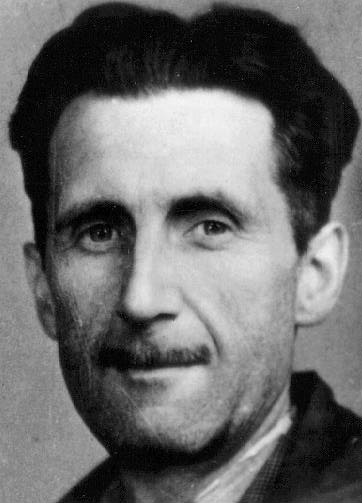
Orwell’s press card portrait, 1943
Mussolini, in “Cassius’s” book, after calling his witnesses, enters the box himself. He sticks to his Machiavellian creed: Might is Right, vae victis! He is guilty of the only crime that matters, the crime of failure, and he admits that his adversaries have a right to kill him — but not, he insists, a right to blame him. Their conduct has been similar to his own, and their moral condemnations are all hypocrisy. But thereafter come the other three witnesses, the Abyssinian, the Spaniard and the Italian, who are morally upon a different plane, since they have never temporized with Fascism nor had a chance to play at power politics; and all three of them demand the death penalty.
Would they demand it in real life? Will any such thing ever happen? It is not very likely, even if the people who have a real right to try Mussolini should somehow get him into their hands. The Tories, of course, though they would shrink from a real inquest into the origins of the war, are not sorry to have the chance of pushing the whole blame onto a few notorious individuals like Mussolini and Hitler. In this way the Darlan-Badoglio manoeuvre is made easier. Mussolini is a good scapegoat while he is at large, though he would be an awkward one in captivity. But how about the common people? Would they kill their tyrants, in cold blood and with the forms of law if they had the chance?
It is a fact that there have been very few such executions in history. At the end of the last war an election was won partly on the slogan “Hang the Kaiser”, and yet if any such thing had been attempted the conscience of the nation would probably have revolted. When tyrants are put to death, it should be by their own subjects; those who are punished by a foreign authority, like Napoleon, are simply made into martyrs and legends.
What is important is not that these political gangsters should be made to suffer, but that they should be made to discredit themselves. Fortunately they do do so in many cases, for to a surprising extent the war-lords in shining armour, the apostles of the martial virtues, tend not to die fighting when the time comes. History is full of ignominious getaways by the great and famous. Napoleon surrendered to the English in order to get protection from the Prussians, the Empress Eugénie fled in a hansom cab with an American dentist, Ludendorff resorted to blue spectacles, one of the more unprintable Roman emperors tried to escape assassination by locking himself in the lavatory, and during the early days of the Spanish Civil War one leading Fascist made his escape from Barcelona, with exquisite fitness, through a sewer.
It is some such exit that one would wish for Mussolini, and if he is left to himself perhaps he will achieve it. Possibly Hitler also. It used to be said of Hitler that when his time came he would never fly or surrender, but would perish in some operatic manner, by suicide at the very least. But that was when Hitler was successful; during the last year, since things began to go wrong, it is difficult to feel that he has behaved with dignity or courage. “Cassius” ends his book with the judge’s summing-up, and leaves the verdict open, seeming to invite a decision from his readers. Well, if it were left to me, my verdict on both Hitler and Mussolini would be: not death, unless in is inflicted in some hurried unspectacular way. If the Germans and Italians feel like giving them a summary court-martial and then a firing-squad, let them do it. Or better still, let the pair of them escape with a suitcaseful of bearer securities and settle down as the accredited bores of some Swiss pension. But no martyrizing, no St Helena business. And, above all, no solemn hypocritical “trial of war criminals”, with all the slow cruel pageantry of the law, which after a lapse of time has so strange a way of focusing a romantic light on the accused and turning a scoundrel into a hero.
George Orwell, “Who are the War Criminals?”, Tribune, 1943-10-22.
July 31, 2019
QotD: Foreshadowing Nuremberg
July 28, 2019
No Deal… Herr Hitler! – WW2 – 048 – July 27 1940
World War Two
Published on 27 Jul 2019Hitler searches for ways to force Britain out of the war, but the British sit safely behind their cliffs, their channel and their Royal Navy. Engaging the navy and invading Britain would require a major air-superiority. As a result, the Germans plan to knock the British out of the skies. This is the Battle of Britain.
Join us on Patreon: https://www.patreon.com/TimeGhostHistory
Or join The TimeGhost Army directly at: https://timeghost.tvFollow WW2 day by day on Instagram @World_war_two_realtime https://www.instagram.com/world_war_t…
Join our Discord Server: https://discord.gg/D6D2aYN.
Between 2 Wars: https://www.youtube.com/playlist?list…
Source list: http://bit.ly/WW2sourcesWritten and Hosted by: Indy Neidell
Produced and Directed by: Spartacus Olsson and Astrid Deinhard
Executive Producers: Bodo Rittenauer, Astrid Deinhard, Indy Neidell, Spartacus Olsson
Creative Producer: Joram Appel
Post-Production Director: Wieke Kapteijns
Research by: Indy Neidell
Edited by: Iryna Dulka
Map animations: EastoryColorisations by Norman Stewart and Julius Jääskeläinen https://www.facebook.com/JJcolorization/
Eastory’s channel: https://www.youtube.com/channel/UCEly…
Archive by Screenocean/Reuters https://www.screenocean.com.A TimeGhost chronological documentary produced by OnLion Entertainment GmbH.
From the comments:
World War Two
1 week ago (edited)
World War Two is a very complex topic, and even with one or more videos a week, there is a lot of information or context that we don’t get to cover on this channel. That’s why are doing series on the interwar years (1919-1939) called “Between Two Wars” on our TimeGhost History channel. We’re currently in 1929, and we’ll be making generally two thematic episodes for each year of the interwar period. If you want to understand what led up to this massive and destructive conflict, do make sure to check the channel out here: https://www.youtube.com/channel/UCLfMmOriSyPbd5JhHpnj4NgCheers,
Joram
Sea Lion: Why not just invade the UK in 1940?
Military History Visualized
Published on 13 Oct 2017Quite often people remark Hitler should just have finished off the UK before attacking the Soviet Union. Well, there are many problems with that assumption.
»» SUPPORT MHV ««
» patreon – https://www.patreon.com/mhv
» paypal donation – https://www.paypal.com/cgi-bin/webscr…Military History Visualized provides a series of short narrative and visual presentations like documentaries based on academic literature or sometimes primary sources. Videos are intended as introduction to military history, but also contain a lot of details for history buffs. Since the aim is to keep the episodes short and comprehensive some details are often cut.
July 26, 2019
“Attero Dominatus” – The Battle of Berlin – Sabaton History 025 [Official]
Sabaton History
Published on 25 Jul 2019The Sabaton song “Attero Dominatus” is about the Soviet advance on Berlin in the last months of World War Two. As the Soviets approach Berlin, two commanders, General Zhukov and General Konev, try their best to be the one to take the centre of the German capital. Meanwhile, thousands of Germans are raped or murdered by the Soviets in retaliation to the atrocities that the Germans committed in the east.
Support Sabaton History on Patreon: https://www.patreon.com/sabatonhistory
Listen to Attero Dominatus (where “Attero Dominatus” is featured):
CD: http://bit.ly/AtteroDominatusStore
Spotify: http://bit.ly/AtteroDominatusSpotify
Apple Music: http://bit.ly/AtteroDominatusAppleMusic
iTunes: http://bit.ly/AtteroDominatusiTunes
Amazon: http://bit.ly/AtteroDominatusAmzn
Google Play: http://bit.ly/AtteroDominatusGooglePlayCheck out the official videoclip for “Attero Dominatus” here: https://www.youtube.com/watch?v=eNlRq…
Listen to Sabaton on Spotify: http://smarturl.it/SabatonSpotify
Official Sabaton Merchandise Shop: http://bit.ly/SabatonOfficialShopHosted by: Indy Neidell
Written by: Markus Linke and Indy Neidell
Directed by: Astrid Deinhard and Wieke Kapteijns
Produced by: Pär Sundström, Astrid Deinhard and Spartacus Olsson
Creative Producer: Joram Appel
Executive Producers: Pär Sundström, Joakim Broden, Tomas Sunmo, Indy Neidell, Astrid Deinhard, and Spartacus Olsson
Maps by: Eastory
Edited by: Iryna Dulka
Sound Editing by: Marek KaminskiEastory YouTube Channel: https://www.youtube.com/channel/UCEly…
Archive by: Reuters/Screenocean https://www.screenocean.com
Music by Sabaton.An OnLion Entertainment GmbH and Raging Beaver Publishing AB co-Production.
Sources:
Colored portrait of W. Wenck by Ruffneck88
Ministry of Defence of the Russian Federation
Photos of Helmuth Weidling from ww2gallery on Flickr© Raging Beaver Publishing AB, 2019 – all rights reserved.
July 21, 2019
Good People on Both Sides? – WW2 – 047 – July 20 1940
World War Two
Published on 20 Jul 2019Peace seems to slowly return to the European mainland, but not for long, as the Germans move their airplanes to the French coast to Battle Britain in the skies while they make invasion plans, and the Soviets are entering the Baltics after ‘elections’ invited them to.
Join us on Patreon: https://www.patreon.com/TimeGhostHistory
Or join The TimeGhost Army directly at: https://timeghost.tvFollow WW2 day by day on Instagram @World_war_two_realtime https://www.instagram.com/world_war_t…
Join our Discord Server: https://discord.gg/D6D2aYN.
Between 2 Wars: https://www.youtube.com/playlist?list…
Source list: http://bit.ly/WW2sourcesWritten and Hosted by: Indy Neidell
Produced and Directed by: Spartacus Olsson and Astrid Deinhard
Executive Producers: Bodo Rittenauer, Astrid Deinhard, Indy Neidell, Spartacus Olsson
Creative Producer: Joram Appel
Post production director:Wieke Kapteijns
Research by: Indy Neidell
Edited by: Marek Kaminski
Map animations: EastoryColorisations by Norman Stewart and Julius Jääskeläinen https://www.facebook.com/JJcolorization/
Eastory’s channel: https://www.youtube.com/channel/UCEly…
Archive by Screenocean/Reuters https://www.screenocean.com.A TimeGhost chronological documentary produced by OnLion Entertainment GmbH.
July 20, 2019
A Bankrupt Germany Didn’t Create the Nazis | Between 2 Wars | 1928 Part 1 of 1
TimeGhost History
Published on 18 Jul 2019When the world goes into economic overdrive in the second half of the 1920s, contrary to popular belief Germany rises with the tide – it is the Goldener Zwanziger, the Golden Twenties.
Join us on Patreon: https://www.patreon.com/TimeGhostHistory
Hosted by: Indy Neidell
Written by Francis van Berkel and Spartacus Olsson
Directed and Produced by: Spartacus Olsson and Astrid Deinhard
Executive Producers: Bodo Rittenauer, Astrid Deinhard, Indy Neidell, Spartacus Olsson
Creative Producer: Joram Appel
Post-Production Director: Wieke Kapteijns
Edited By: Daniel Weiss
Research by: Francis van BerkelSources:
Bundesarchiv, Photos from the Jonatan Myhre Barlien photo collection.Colorization by Daniel Weiss
Thumbnail motive by Olga Shirnina
https://klimbim2014.wordpress.com/201…A TimeGhost chronological documentary produced by OnLion Entertainment GmbH
July 19, 2019
Swiss 1929 Simplified Luger (Yes, Swiss and Simplified)
Forgotten Weapons
Published on 15 May 2019http://www.patreon.com/ForgottenWeapons
Cool Forgotten Weapons merch! http://shop.bbtv.com/collections/forg…
Switzerland was the first nation to adopt the Luger as a service pistol, and they purchased them DWM in Germany from 1900 until 1914. World War One stopped deliveries, of course, and after the war the Swiss opted to begin their own production at Waffenfabrik Bern. These Swiss Lugers have become known as the model 06/24 by collectors, and were made until 1933. During that time, Bern was looking for ways to simplify and economize their production, and these efforts came together with the development of the Model 1929. It actually entered production in 1934, and was made until 1947 with a total of about 28,000 made for the military and about 1,900 made for the civilian market.
The main mechanical change to the 1929 pattern was a lengthening of the grip safety. Other changes included simplifying the profile of the front strap of the grip, removing knurling and serrations on the controls, and only serializing four parts. A production date stamp was also added to the inside of the frame, however.
Contact:
Forgotten Weapons
PO Box 87647
Tucson, AZ 85754

July 18, 2019
The Allied Occupation of Germany After The Treaty of Versailles I THE GREAT WAR July 1919
The Great War
Published on 17 Jul 2019When the Allied armies marched into German territory in late 1918 under the terms of the armistice, they were surprised to see a relatively untouched land. After the signing of the Treaty of Versailles, the Allied Occupation was made permanent and the troops settled in to stay in a country that did not want them there initially.
» SUPPORT THE CHANNEL
Patreon: https://www.patreon.com/thegreatwar
Merchandise: https://shop.spreadshirt.de/thegreatwar/» SOURCES
Leonhard, Jörn. Der überforderte Frieden. Versailles und die Welt 1918-1923 (CH Beck, 2018)
Macmillan, Margaret. The Peacemakers: Six Months that Changed the World (London: John Murray, 2001).
Le Naour, Jean-Yves. La Honte noire (Hachette, 2004).
Schröder, Joachim, Watson, Alexander. “Occupation during and after the War (Germany)” in: 1914-1918-online. International Encyclopedia of the First World War https://encyclopedia.1914-1918-online…
Roos, Julia. “Schwarze Schmach” in: 1914-1918-online. International Encyclopedia of the First World War https://encyclopedia.1914-1918-online…
Godfroid, Anne. “Occupation after the War (Belgium and France)” in: 1914-1918-online. International Encyclopedia of the First World War https://encyclopedia.1914-1918-online…
Pawley, Margaret. The Watch on the Rhine: The Military Occupation of the Rhineland, 1918-1930 (I.B.Tauris, 2007).
Hart, Keith. “A Note on the Military Participation of Siam in WWI.” Journal of the Siam Society (ndp): 133–136.
Lauter, Anna-Monika. Sicherheit und Reparationen. Die französische Öffentlichkeit, der Rhein und die Ruhr (1919-1923) (Essen: Klartext, 2006).
Krugler, Gilles. “Allemagne decembre 1918. Les premières heures de l’occupation“. In Revue historique des armées 254 (2009): 76-81. https://journals.openedition.org/rha/…
Mignon, Nicolas. “Boche, ex-ennemie ou simplement femme? Le point de vue des responsables politiques et militaires sur la question des mariages entre militaires belges et femmes allemandes pendant les occupations de la Rhénanie et de la Ruhr (1918-1929).” In Revue belge de Philologie et d’Histoire (2013) 91-4 : 1259-1283.»CREDITS
Presented by: Jesse Alexander
Written by: Jesse Alexander
Director: Toni Steller & Florian Wittig
Director of Photography: Toni Steller
Sound: Toni Steller
Editing: Toni Steller
Mixing, Mastering & Sound Design: http://above-zero.com
Motion Design: Christian Graef – GRAEFX
Maps: Daniel Kogosov (https://www.patreon.com/Zalezsky)
Research by: Jesse Alexander
Fact checking: Florian WittigChannel Design: Alexander Clark
Original Logo: David van StepholdA Mediakraft Networks Original Channel
Contains licensed material by getty images
All rights reserved – Real Time History GmbH 2019
July 16, 2019
QotD: Wartime atrocities
Orwell’s press card portrait, 1943
I have little direct evidence about the atrocities in the Spanish civil war. I know that some were committed by the Republicans, and far more (they are still continuing) by the Fascists. But what impressed me then, and has impressed me ever since, is that atrocities are believed in or disbelieved in solely on grounds of political predilection. Everyone believes in the atrocities of the enemy and disbelieves in those of his own side, without ever bothering to examine the evidence. Recently I drew up a table of atrocities during the period between 1918 and the present; there was never a year when atrocities were not occurring somewhere or other, and there was hardly a single case when the Left and the Right believed in the same stories simultaneously. And stranger yet, at any moment the situation can suddenly reverse itself and yesterday’s proved-to-the-hilt atrocity story can become a ridiculous lie, merely because the political landscape has changed.
In the present war we are in the curious situation that our “atrocity campaign” was done largely before the war started, and done mostly by the Left, the people who normally pride themselves on their incredulity. In the same period the Right, the atrocity-mongers of 1914-18, were gazing at Nazi Germany and flatly refusing to see any evil in it. Then as soon as war broke out it was the pro-Nazis of yesterday who were repeating horror stories, while the anti-Nazis suddenly found themselves doubting whether the Gestapo really existed. Nor was this solely the result of the Russo-German Pact. It was partly because before the war the Left had wrongly believed that Britain and Germany would never fight and were therefore able to be anti-German and anti-British simultaneously; partly also because official war-propaganda, with its disgusting hypocrisy and self-righteousness, always tends to make thinking people sympathize with the enemy. Part of the price we paid for the systematic lying of 1914-17 was the exaggerated pro-German reaction which followed. During the years 1918-33 you were hooted at in left-wing circles if you suggested that Germany bore even a fraction of responsibility for the war. In all the denunciations of Versailles I listened to during those years I don’t think I ever once heard the question, “What would have happened if Germany had won?” even mentioned, let alone discussed. So also with atrocities. The truth, it is felt, becomes untruth when your enemy utters it. Recently I noticed that the very people who swallowed any and every horror story about the Japanese in Nanking in 1937 refused to believe exactly the same stories about Hong Kong in 1942. There was even a tendency to feel that the Nanking atrocities had become, as it were, retrospectively untrue because the British Government now drew attention to them.
But unfortunately the truth about atrocities is far worse than that they are lied about and made into propaganda. The truth is that they happen. The fact often adduced as a reason for scepticism — that the same horror stories come up in war after war — merely makes it rather more likely that these stories are true. Evidently they are widespread fantasies, and war provides an opportunity of putting them into practice. Also, although it has ceased to be fashionable to say so, there is little question that what one may roughly call the “whites” commit far more and worse atrocities than the “reds”. There is not the slightest doubt, for instance, about the behaviour of the Japanese in China. Nor is there much doubt about the long tale of Fascist outrages during the last ten years in Europe. The volume of testimony is enormous, and a respectable proportion of it comes from the German press and radio. These things really happened, that is the thing to keep one’s eye on. They happened even though Lord Halifax said they happened. The raping and butchering in Chinese cities, the tortures in the cellars of the Gestapo, the elderly Jewish professors flung into cesspools, the machine-gunning of refugees along the Spanish roads — they all happened, and they did not happen any the less because the Daily Telegraph has suddenly found out about them when it is five years too late.
George Orwell, “Looking back on the Spanish War”, New Road, 1943 (republished in England, Your England and Other Essays, 1953).
July 14, 2019
The only WW2 battle with its own – fanatical – volunteer PR department
The 1943 battle of Kursk has been called “the most overhyped battle in history”. I’ve read many, many books and articles about the events of World War 2, I’ve generally avoided reading much about Kursk, because reasons. As I wrote nearly a decade back:
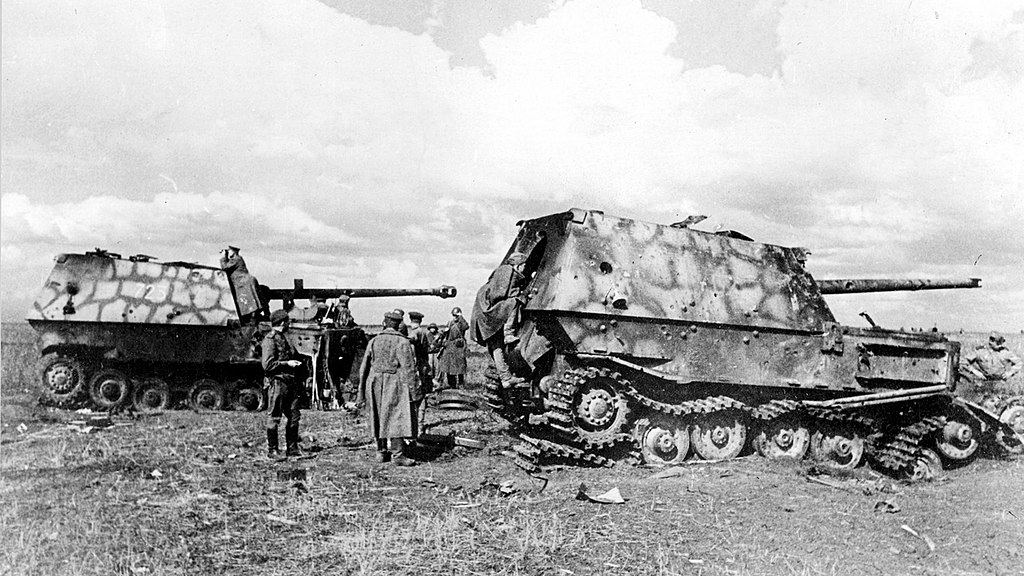
Советские бойцы и командиры осматривают немецкие САУ «Фердинанд», подбитые на Орловском участке фронта (“Soviet fighters and commanders examine German self-propelled guns Ferdinand, shot down on the Orel front”).
Photo by Pavel Troshkin, July 1943 via Wikimedia Commons.
Although I’ve read much about World War II, I haven’t read much about arguably the most critical part of the entire war: the gargantuan battles pitting the Soviet Red Army against Hitler’s Wehrmacht. Some of that is just sheer pig-headedness: I used to work for the biggest wargame store in Toronto, back when wargames meant cardboard counters, vast paper hexagonal maps, and charts and tables galore. The hardest of the hard-core gamers seemed to be either Napoleonic grognards (down to the secret stash of sabres and shakos in the gaming room) or even more dedicated junkies of the “Great Patriotic War”/”Operation Barbarossa”. Some of the latter were genuinely crazy, right down to the barely contained hints that “Hitler was just misunderstood”.
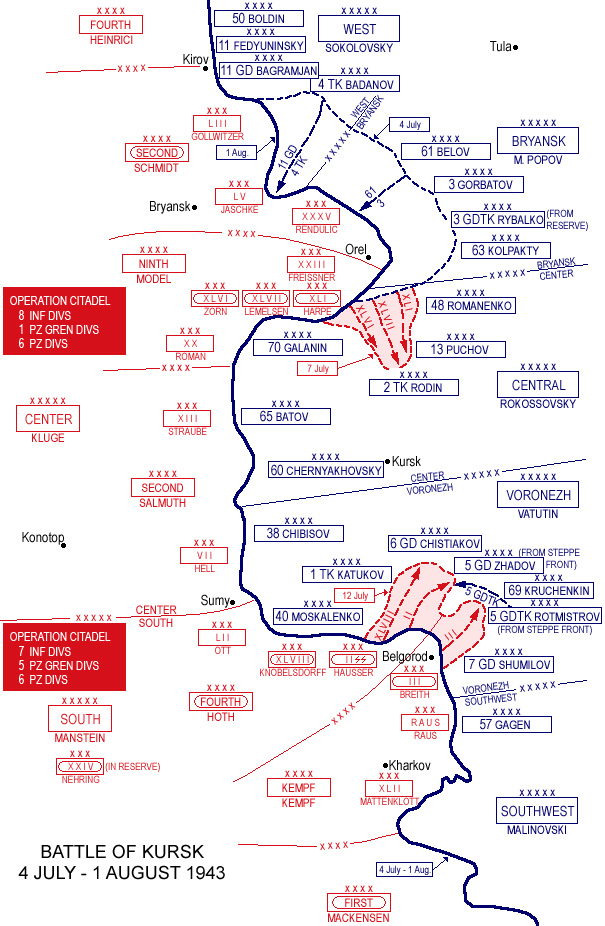
Battle of Kursk – 4 July-1 August 1943
Map drawn by Frank Martini for the Department of History at the United States Military Academy (http://www.dean.usma.edu/history/web03/atlases/ww2%20europe/ww2%20europe%20pages/ww2%20europe%20map%2027.htm), via Wikimedia Commons.On the assumption that certain forms of craziness are contagious, I avoided most of the latter as much as I could, consistent with my duty to sell them the latest and greatest game involving their particular passion.
One day, perhaps in a fit of weakness, I allowed myself to get lectured by one of the fanatics about the details of the Battle of Kursk. The fan who felt the need to bend my ear was eager to impart information about some “famous battle” that turned out to have been a serious tactical miscalculation by a Soviet officer. The story, as he told it, had a very large formation of Soviet tanks “taking a shortcut” through a major minefield, resulting in many disabled/destroyed tanks and wounded or dead men. In the telling, this kind of thing could not be admitted as having happened without some enemy contact, so it was propagandized as being a major tank battle involving significant formations of German panzer troops and/or SS units (of whom, of course, the glorious defenders of the Motherland took a greater toll than they suffered themselves).
The twitchy-eyed Panzertruppe fanboys helped keep my interest firmly directed away from much of the WW2 Eastern Front aside from the initial 1941 German invasion. A post at Blazing Cat Fur included a link to a BBC article discussing furious Russian reaction to an article recently published in Die Welt, but also indicates that there was actually some factual basis for the lecture I endured all those years ago:
The wider Battle of Kursk – from 5 July to 23 August 1943 – was indeed a turning-point in World War Two. Soviet forces thwarted a huge Nazi counter-attack, after Adolf Hitler’s troops had suffered a colossal defeat at Stalingrad in the winter of 1942-43.
But recently a British historian, Ben Wheatley, analysed German Luftwaffe aerial photos of the Prokhorovka battlefield, taken on 14-16 July, when the area was still in German hands. The photos were found in the US National Archives at College Park, Maryland.
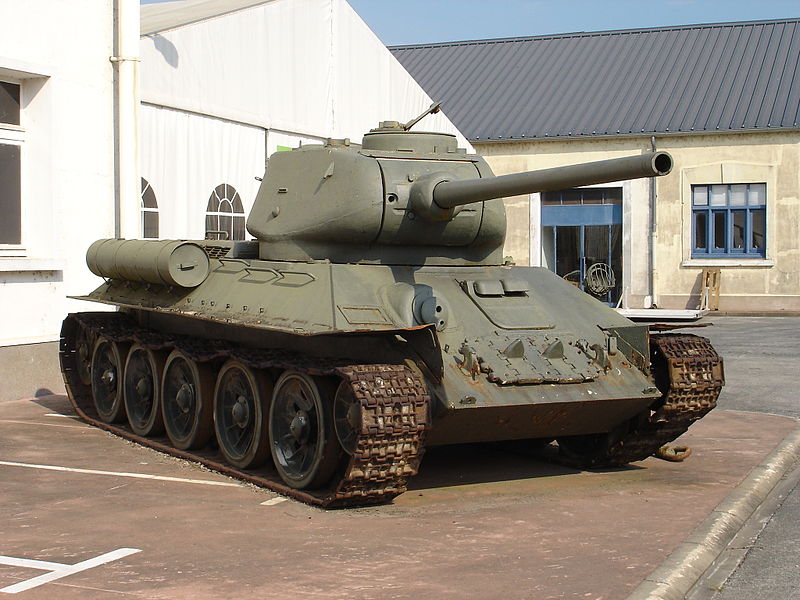
T-34/85 at musée des blindés de Saumur (via Wikipedia)
Wheatley’s assessment, backed by detailed study of battle reports and historical archives, is that on 12 July the Germans lost just five Panzer IV tanks at Prokhorovka, but decimated “kamikaze” Soviet tank formations, turning more than 200 Soviet tanks into smouldering wrecks.
He writes that dozens of Soviet T-34 tanks tumbled into an anti-tank ditch 4.5m (15ft) deep, dug by Soviet infantry, and when the Red Army realised its mistake other T-34s started queuing up to cross a bridge. German tanks were easily able to pick them off at the bridge.
Wheatley and a German military historian, Karl-Heinz Frieser, were cited in a feature in the German daily Die Welt, which hit a Russian raw nerve.
The writer, Sven Felix Kellerhoff, argued that the evidence of Soviet humiliation at Prokhorovka was so convincing that Russia ought to tear down its memorial there, which celebrates the heroism of Soviet tank crews on 12 July.
[…]
War photographer Anatoly Yegorov was in the thick of the fighting at Kursk. His nephew Mikhail Yegorov spoke to the daily Moskovsky Komsomolets, recalling what Anatoly told him about his work there.
“Most of those photos were not published. ‘Do you know why no panoramic photos of the Prokhorovka battlefield were ever shown in our country?’ my uncle asked me. ‘Because for every burning Tiger there were 10 of our smashed up T-34s! How could you publish such photos in the papers?'”
BCF also linked to this artice from a few years ago at The National Interest:
Kursk is the Santa Claus and Easter Bunny of World War II battles, whose popular history was constructed from German and Soviet propaganda, and based on early accounts lacking vital information buried in Russian archives until after the fall of the Soviet Union. Kursk was indeed an epic battle, that pitted 3 million German and Soviet soldiers and 8,000 tanks, all crammed into a small portion of southern Russia.
[…]
Top commanders such as Erich Von Manstein wanted to attack in May, before the Soviets had time to dig in and reinforce the salient. But a nervous and indecisive Hitler decided to postpone Operation Citadel until July, to allow time to deploy his vaunted new Panther, Tiger and Elefant tanks. While the big cats lumbered off the railroad cars near the front lines, the Germans managed to amass nearly 800,000 men, 3,000 tanks, 10,000 guns and mortars, and 2,000 aircraft. It would be the last time the Germans could concentrate such an attack force (by comparison, at the Battle of the Bulge, the Germans had 400,000 men and 600 tanks). Yet as usual, the Germans were outnumbered. They faced 1.9 million Soviet soldiers, 5,000 tanks, 25,000 guns and mortars and more than 3,000 aircraft.
Citadel was a prophetic name for the German offensive. The Soviets used the extra time to build an incredibly dense defense system of multiple layers of fortifications, including trenches, bunkers, tank traps and machine gun nests 25 miles deep, as well as minefields that averaged more than 3,000 mines per kilometer.
Kursk was not an imaginative battle. The Germans attacked an obvious target, the Soviets fortified the obvious target, and the German offensive on July 4, 1943 was a traditional pincer move against the north and south base of the salient to cut off the defenders inside. Despite support by 89 Elefants (a Porsche version of the Tiger that the German army rejected), the northern pincer quickly bogged down after advancing just a few miles. But the southern pincer, led by the II SS Panzer Corps, managed to advance 20 miles to the town of Prokhorovka, until its advance was checked by the Soviet Fifth Guards Tank Army.
The article then goes on to address many of the myths and legends that have grown up around the battle, including:
- The Tigers didn’t burn. Soviet tanks did
- Kursk was not a turning point of the war
- Prokhorovka was not the Greatest Tank Battle in History
- The Red Army was still not as good as the German Army
- It was the Soviet counteroffensive that bled the Germans
- Soviet tanks didn’t ram German tanks at Kursk
- Kursk was an Anglo-American victory as well as a Soviet one
July 12, 2019
“Devil Dogs” – U.S. Marines – Sabaton History 023 [Official]
Sabaton History
Published on 11 Jul 2019The United States entered the battlefields of Europe in 1918. Among the first Americans to participate in the fight were the U.S. Marines, who quickly adopted the name “Devil Dogs”. One of their most notable engagements is the Battle of Belleau Wood in June 1918, where the Marines fought the battle-hardened Germans for 26 days.
Support Sabaton History on Patreon (and possibly get a History Channel special edition): https://www.patreon.com/sabatonhistory
Pre-order The Great War here: https://www.sabaton.net/pre-order-of-…
Check out the trailer for Sabaton’s new album The Great War right here: https://www.youtube.com/watch?v=HCZP1…
Watch more videos on the Sabaton YouTube channel: https://www.youtube.com/user/Sabaton?…
Listen to Sabaton on Spotify: http://smarturl.it/SabatonSpotify
Official Sabaton Merchandise Shop: http://bit.ly/SabatonOfficialShopHosted by: Indy Neidell
Written by: Markus Linke and Indy Neidell
Directed by: Astrid Deinhard and Wieke Kapteijns
Produced by: Pär Sundström, Astrid Deinhard and Spartacus Olsson
Creative Producer: Joram Appel
Executive Producers: Pär Sundström, Joakim Broden, Tomas Sunmo, Indy Neidell, Astrid Deinhard, and Spartacus Olsson
Maps by: Eastory
Edited by: Iryna Dulka
Sound Editing by: Marek KaminskiEastory YouTube Channel: https://www.youtube.com/channel/UCEly…
Archive by: Reuters/Screenocean https://www.screenocean.com
Music by Sabaton.Sources:
IWM: Q 61342, Q 70181, NTB 319-2, IWM 687, 1061-08e, IWM 508-67, IWM 501-9, IWM 435, IWM 778, Q 98994, IWM 484An OnLion Entertainment GmbH and Raging Beaver Publishing AB co-Production.
© Raging Beaver Publishing AB, 2019 – all rights reserved.
From the comments:
Sabaton History
2 days ago
This episode is about the US Marines and their actions during the Battle of Belleau Wood in 1918. While most of the footage in this episode is depicting the Marines and the Germans in 1918, and some of it is even depicting the actual fighting in Belleau wood, there is not a whole lot footage or imagery from the action. So for whoever is enough of a history buff to spot that some of our illustrative material is in fact depicting other engagements, well spotted! We try to use authentic material whenever we can, but in the end we have to make an episode visually attractive and dramatic, and we can’t do that with just looking at Indy’s head for 15 minutes (although I’m sure that many of you wouldn’t mind). That was the announcement. Peace, rock on and cheers!

NEW VERSION – 107 Abandoned French Soldiers Killed for Propaganda – France 1940 – 02
World War Two
Published on 11 Jul 2019We stumbled on some of the propaganda footage shot by the Wehrmacht film teams during the actual attack at the Ouvrage de La Ferté, and we figured that it would do the topic justice to make an improved version of this video.
After the German army breaks through the French lines at Sedan, the left flank of the moving army has to be secured. The French Ouvrage la Ferté, part of the Maginot Line defense works, is subject to this consolidation. But the Germans move with ulterior motives, as to them capturing a Maginot Line fort in the first week of the offensive has a huge propaganda value. Tour guide Richard Tucker shows Indy the grounds of a modern tragedy, where 107 French soldiers gave their lives.
Join us on Patreon: https://www.patreon.com/TimeGhostHistory
Or join The TimeGhost Army directly at: https://timeghost.tvCheck out (and book!) Richard Tucker here: https://www.tripadvisor.nl/Attraction…
Follow WW2 day by day on Instagram @World_war_two_realtime https://www.instagram.com/world_war_t…
Join our Discord Server: https://discord.gg/D6D2aYN.
Between 2 Wars: https://www.youtube.com/playlist?list…
Source list: http://bit.ly/WW2sourcesWritten and Hosted by: Indy Neidell
Produced and Directed by: Spartacus Olsson and Astrid Deinhard
Executive Producers: Bodo Rittenauer, Astrid Deinhard, Indy Neidell, Spartacus Olsson
Creative Producer: Joram Appel
Research by: Indy Neidell
Edited by: Iryna Dulka
Map animations: EastoryColorisations by Norman Stewart and Julius Jääskeläinen https://www.facebook.com/JJcolorization/
Eastory’s channel: https://www.youtube.com/channel/UCEly…
Archive by Screenocean/Reuters https://www.screenocean.com.A TimeGhost chronological documentary produced by OnLion Entertainment GmbH.
From the comments:
World War Two
1 hour ago
Some of you might be getting flashbacks seeing this episode pop up. We published a version of this video already, but since we did that, we found some great footage depicting the actual fighting at Ouvrage de la Ferté. As we love history, we also love how this footage brings the story and the memorial to life. We wanted to share this experience with you, and decided to upload an improved version with new archive footage. We hope you like it as much as we do!Cheers,
Joram

The European Migration Crisis – WW2 – WaH 004 – June 1940
World War Two
Published on 11 Jul 2019When the Nazi German Reich invades western and northern Europe this creates a massive refugee and forced migration crisis all across Europe. In eastern Europe, The Nazis and the Soviets have already been forcing families out of their homes to be relocated, incarcerated and murdered for nine months by now.
Join us on Patreon: https://www.patreon.com/TimeGhostHistory
Or join The TimeGhost Army directly at: https://timeghost.tvFollow WW2 day by day on Instagram @World_war_two_realtime https://www.instagram.com/world_war_t…
Join our Discord Server: https://discord.gg/D6D2aYN.
Between 2 Wars: https://www.youtube.com/playlist?list…
Source list: http://bit.ly/WW2sourcesWritten and Hosted by: Spartacus Olsson
Produced and Directed by: Spartacus Olsson and Astrid Deinhard
Executive Producers: Bodo Rittenauer, Astrid Deinhard, Indy Neidell, Spartacus Olsson
Creative Producer: Joram Appel
Post Production Director Wieke Kapteijns
Research by: Spartacus Olsson
Edited by:Spartacus Olsson
Map animations: EastoryEastory’s channel: https://www.youtube.com/channel/UCEly…
Archive by Screenocean/Reuters https://www.screenocean.com.A TimeGhost chronological documentary produced by OnLion Entertainment GmbH.

July 7, 2019
Do the Brits hate the French?! – WW2 – 045 – July 6 1940
World War Two
Published on 6 Jul 2019The repercussions of the fall of France are not yet seen in full. But this week Britain makes it clear it isn’t about to give up, even if it will mean some really hard decisions.
Join us on Patreon: https://www.patreon.com/TimeGhostHistory
Or join The TimeGhost Army directly at: https://timeghost.tvFollow WW2 day by day on Instagram @World_war_two_realtime https://www.instagram.com/world_war_t…
Join our Discord Server: https://discord.gg/D6D2aYN.
Between 2 Wars: https://www.youtube.com/playlist?list…
Source list: http://bit.ly/WW2sourcesWritten and Hosted by: Indy Neidell
Produced and Directed by: Spartacus Olsson and Astrid Deinhard
Executive Producers: Bodo Rittenauer, Astrid Deinhard, Indy Neidell, Spartacus Olsson
Creative Producer: Joram Appel
Research by: Indy Neidell
Post production director: Wieke Kapteijns
Edited by: Iryna Dulka
Map animations: EastoryColorisations by Daniel Weiss, Norman Stewart and Julius Jääskeläinen https://www.facebook.com/JJcolorization/
Eastory’s channel: https://www.youtube.com/channel/UCEly…
Archive by Screenocean/Reuters https://www.screenocean.com.Sources:
WM: H 4610, A 3589
Narodowe Archiwum Cyfrowe
Jacques Mulard
Colorization of Göring by Klimbim
Romanian National ArchivesA TimeGhost chronological documentary produced by OnLion Entertainment GmbH.
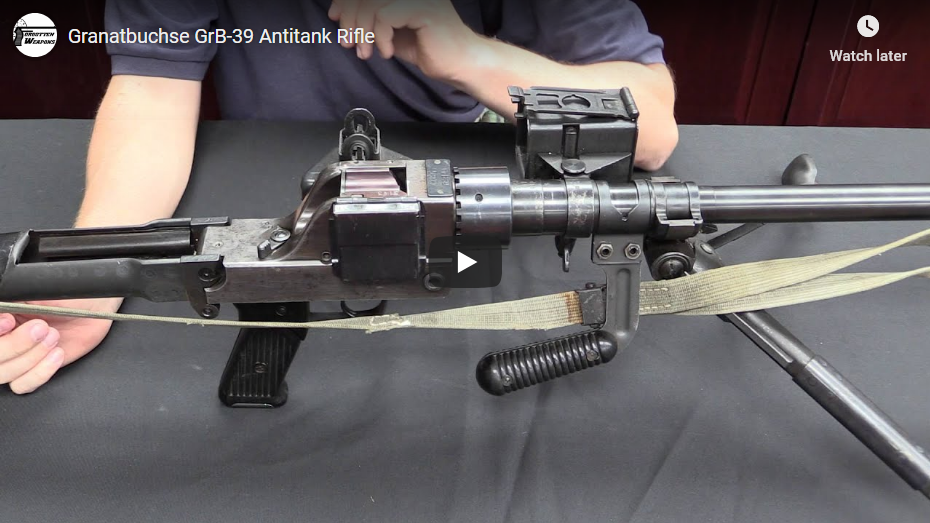
Granatbuchse GrB-39 Antitank Rifle
Forgotten Weapons
Published on 29 Aug 2015http://www.patreon.com/ForgottenWeapons
Hammer price: $13,000
Like most countries, Germany had a standard-issue antitank rifle when World War II began — the Panzerbuchse 39. It fired an 8 x 94mm cartridge with a small very high velocity armor-piercing bullet. And like the other AT rifles from the 1930s, the PzB-39 became obsolete quickly as tank armor improved during the war. However, while most countries simply scrapped their antitank rifles, the Germans opted instead to convert the guns into dedicated grenade launchers.
Because the PzB-39 was already designed for a very high pressure cartridge, it was ideally suited to handle the stresses of firing large anti-tank grenades. Rather than relying on simple kinetic energy to penetrate, the grenades could use shaped charge technology to be vastly more effective than AP bullets.
In converting the PzB-39 into the GrB-39, the barrels were cut down, grenade launching cups attached to the muzzles, new sights designed for grenade use, bipods lengthened, and the folding stocks were fixed in place. Most of the PzB-39 rifles in service were subject to these modifications, and the resulting GrB-39 guns were able to be reasonably effective through the end of the war.