World War Two
Published on 25 May 2019While the massive invasion of the Benelux countries and France was going down last week, things were also developing on the fronts in Norway and China. But this week, the German beast is let loose. After breaking through its cage at Sedan last week, nothing seems strong enough to block its way to the English Channel. And if one thing becomes clear, it is that the Allied command structure and the way they communicate is one big smoking mess…
Join us on Patreon: https://www.patreon.com/TimeGhostHistory
Or join The TimeGhost Army directly at: https://timeghost.tvFollow WW2 day by day on Instagram @World_war_two_realtime https://www.instagram.com/world_war_t…
Join our Discord Server: https://discord.gg/D6D2aYN.
Between 2 Wars: https://www.youtube.com/playlist?list…
Source list: http://bit.ly/WW2sourcesWritten and Hosted by: Indy Neidell
Produced and Directed by: Spartacus Olsson and Astrid Deinhard
Executive Producers: Bodo Rittenauer, Astrid Deinhard, Indy Neidell, Spartacus Olsson
Creative Producer: Joram Appel
Post-Production Director: Wieke Kapteijns
Research by: Indy Neidell
Edited by: Iryna Dulka
Map animations: EastoryColorisations by Joram Appel, Spartacus Olsson and Norman Stewart.
Eastory’s channel: https://www.youtube.com/channel/UCEly…
Archive by Screenocean/Reuters https://www.screenocean.com.Sources:
FDR Presidential Library & Museum
National Portrait Gallery
IWM: H 9218, F 4484, F 4613, F 4578, F 4743б (F 4339
MUSÉE DES ETOILES
Nationaal Archief
Sound effect: LittleRobotSoundFactoryA TimeGhost chronological documentary produced by OnLion Entertainment GmbH.
May 26, 2019
The Allied Clusterf**k in France – WW2 – 039 – May 25 1940
May 25, 2019
107 Abandoned French Soldiers Killed for Propaganda – WW2 on Location – France 1940 – 02
World War Two
Published on 23 May 2019After the German army breaks through the French lines at Sedan, the left flank of the moving army has to be secured. The French Ouvrage la Ferté, part of the Maginot Line defense works, is subject to this consolidation. But the Germans move with ulterior motives, as them capturing a Maginot Line fort in the first week of the offensive has a huge propaganda value. Tour guide Richard Tucker shows Indy the grounds of a modern tragedy, where 107 French soldiers gave their lives.
Check out (and book!) Richard Tucker here: https://www.tripadvisor.nl/Attraction…
Join us on Patreon: https://www.patreon.com/TimeGhostHistory
Or join The TimeGhost Army directly at: https://timeghost.tvFollow WW2 day by day on Instagram @World_war_two_realtime https://www.instagram.com/world_war_t…
Join our Discord Server: https://discord.gg/D6D2aYN.
Between 2 Wars: https://www.youtube.com/playlist?list…
Source list: http://bit.ly/WW2sourcesWritten and Hosted by: Indy Neidell
Produced and Directed by: Spartacus Olsson and Astrid Deinhard
Executive Producers: Bodo Rittenauer, Astrid Deinhard, Indy Neidell, Spartacus Olsson
Creative Producer: Joram Appel
Research by: Indy Neidell
Edited by: Wieke KapteijnsThumbnail Colorisation by Joram Appel
Eastory’s channel: https://www.youtube.com/channel/UCEly…
Archive by Screenocean/Reuters https://www.screenocean.com.A TimeGhost chronological documentary produced by OnLion Entertainment GmbH.
May 24, 2019
“No Bullets Fly” – Charlie Brown and Franz Stigler – Sabaton History 016
Sabaton History
Published on 23 May 2019Heroism isn’t always measured in blood or danger. Sometimes, to spare your foe is the honourable thing to do. A dramatic example comes in the shape of the American Charlie Brown and German Franz Stigler. Brown was flying his heavily damaged B17 “Flying Fortress” bomber home after a demanding bombing run on Bremen when Franz Stigler in his fighter plane caught sight of its tail. This story is about the encounter between the two enemies and the song that Sabaton wrote about it, called “No Bullets Fly” (on the Heroes album).
Support Sabaton History on Patreon: https://www.patreon.com/sabatonhistory
Find A Higher Call, the book that inspired “No Bullets Fly” here: https://www.valorstudios.com/a-higher…
Check out the trailer for Sabaton’s new album The Great War right here: https://www.youtube.com/watch?v=HCZP1…
Listen to Sabaton on Spotify: http://smarturl.it/SabatonSpotify
Official Sabaton Merchandise Shop: http://bit.ly/SabatonOfficialShopHosted by: Indy Neidell
Written by: Markus Linke and Indy Neidell
Directed by: Astrid Deinhard and Wieke Kapteijns
Produced by: Pär Sundström, Astrid Deinhard and Spartacus Olsson
Creative Producer: Joram Appel
Executive Producers: Pär Sundström, Joakim Broden, Tomas Sunmo, Indy Neidell, Astrid Deinhard, and Spartacus Olsson
Maps by: Eastory
Edited by: Iryna Dulka
Sound Editing by: Marek Kaminski
Eastory YouTube Channel: https://www.youtube.com/channel/UCEly…
Archive by: Reuters/Screenocean https://www.screenocean.com
Music by Sabaton.Sources:
IWM: CL 3395
Plane drawing by EmoscopesAn OnLion Entertainment GmbH and Raging Beaver Publishing AB co-Production.
© Raging Beaver Publishing AB, 2019 – all rights reserved.
May 21, 2019
Armoured Vehicles of the Invasion of France 1940, by The Chieftain – WW2 Special
World War Two
Published on 20 May 2019The Chieftain takes you on an extensive walkthrough of the armoured vehicles used by both sides during the German invasion of France in 1940.
The Chieftain’s channel: https://www.youtube.com/user/TheChief…
May 19, 2019
The German Breakthrough in the West – WW2 – 038 – May 18 1940
World War Two
Published on 18 May 2019The German invasion of Western Europe has been going for over a week now, and the Neutral and Allied countries are in disarray. The Netherlands, despite putting up fierce resistance on some occasions, faces overwhelming powers while Belgium, France and the British feel the pressure from an organised and armoured assault from the Ardennes. And still, the German tanks, soldiers and aircraft are not all the Allies have to fear, as many of their losses are caused by their own command.
Join us on Patreon: https://www.patreon.com/TimeGhostHistory
Or join The TimeGhost Army directly at: https://timeghost.tvChurchills ‘Blood, toil, tears and sweat’ speech: https://winstonchurchill.org/resource…

Follow WW2 day by day on Instagram @World_war_two_realtime https://www.instagram.com/world_war_t…
Join our Discord Server: https://discord.gg/D6D2aYN.
Between 2 Wars: https://www.youtube.com/playlist?list…
Source list: http://bit.ly/WW2sourcesWritten and Hosted by: Indy Neidell
Produced and Directed by: Spartacus Olsson and Astrid Deinhard
Executive Producers: Bodo Rittenauer, Astrid Deinhard, Indy Neidell, Spartacus Olsson
Creative Producer: Joram Appel
Research by: Indy Neidell
Post-Production Director: Wieke Kapteijns
Edited by: Iryna Dulka
Map animations: EastoryColorisations by Norman Stewart and Julius Jääskeläinen https://www.facebook.com/JJcolorization/
Eastory’s channel: https://www.youtube.com/channel/UCEly…
Archive by Screenocean/Reuters https://www.screenocean.com.Sources:
– © IWM (C 1666)A TimeGhost chronological documentary produced by OnLion Entertainment GmbH.
From the comments:
World War Two
This is the longest weekly episode of our World War Two series to this date, and boy are we proud. We made sure to make this the absolute best it could possibly be. After last week’s episode of WW2, it was hard to imagine that Eastory could surpass his efforts for that episode anytime soon, but it took him one week. Iryna, our editor in Warsaw, did an amazing job with putting together this episode. We hope you like it as much as we do. Thanks for your ongoing support and if you don’t already, please consider supporting us on Patreon.By the way, we have an Instagram feed where we dedicate one post per day of the war, which allows us to give some topics a little more attention, like the invasion of the Netherlands. You can check them out here:
11 May 1940 – Germans attack Dutch positions on the Grebbeberg and the Grebbeline: https://www.instagram.com/p/BxVBQcwnHAs/
12 May 1940 – Three German Panzer divisions approach Sedan to Force a breakthrough into France: https://www.instagram.com/p/BxYS8XqHdTh/
13 May 1940 – The Battle of the Grebbeberg ends in a German victory, allowing them to push into Holland: https://www.instagram.com/p/Bxauq9HnqOW/
14 May 1940 – German bombers destroy the inner city of Rotterdam while peace talks are going on: https://www.instagram.com/p/Bxc7zreiXo8/
15 May 1940 – The French fight a successful but practically meaningless battle at Gembloux: https://www.instagram.com/p/BxfGP1qCzV9/
16 May 1940 – Guderian rapidly moves westward, showing the full potential of tank-warfare: https://www.instagram.com/p/BxhxvyDClbY/
May 17, 2019
The Red Baron – The Great War – Sabaton History 015
Sabaton History
Published on 16 May 2019The Red Baron is one of the, if not THE MOST iconic heroes of The Great War. He simultaneously embodies the mechanisation of modern war and a romanticised version of war with his individual skill and heroism. Indy goes beyond the legend to tell the history of Manfred von Richthofen, a.k.a The Red Baron, the latter of which also is the name of a Sabaton song that will feature on their upcoming album The Great War.
You can find the eight points of the Dicta Boelcke in the pinned comment.
Support Sabaton History on Patreon (and possibly get a History Channel special edition): https://www.patreon.com/sabatonhistory
Pre-order The Great War here: https://www.sabaton.net/pre-order-of-…
Check out the trailer for Sabaton’s new album ‘The Great War’ right here: https://www.youtube.com/watch?v=HCZP1…
Watch more videos on the Sabaton YouTube channel: https://www.youtube.com/user/Sabaton?…
Listen to Sabaton on Spotify: http://smarturl.it/SabatonSpotify
Official Sabaton Merchandise Shop: http://bit.ly/SabatonOfficialShopHosted by: Indy Neidell
Written by: Markus Linke and Indy Neidell
Directed by: Astrid Deinhard and Wieke Kapteijns
Produced by: Pär Sundström, Astrid Deinhard and Spartacus Olsson
Creative Producer: Joram Appel
Executive Producers: Pär Sundström, Joakim Broden, Tomas Sunmo, Indy Neidell, Astrid Deinhard, and Spartacus Olsson
Maps by: Eastory
Edited by: Iryna Dulka
Sound Editing by: Marek KaminskiEastory YouTube Channel: https://www.youtube.com/channel/UCEly…
Archive by: Reuters/Screenocean https://www.screenocean.com
Music by Sabaton.Sources:
– © IWM: Q 66959, Q 105717, Q 73533, Q 67598, Q 50329, Q 50328, Q 42284, Q 111872, Q 54397, Q 63148, Q 63122, Q 3140, Q 57513 Q 58028, Q 52781, Q 63822, Q 50673, Q 72919, Q 12044, IWM 187, EPH 9001, Q 67832, IWM 1004, Q 63162, Q 67780, Q 58034, Q 63137, Q 63160
– © IWM Art: IWM ART 517, 1488, 517, 3071, 2659, 2660, 3199, 2754, 654
– Bendigo Soldiers Memorial Institute Military Museum: 2075P
– Klimbim Colorization
– James Miller ColorizationAn OnLion Entertainment GmbH and Raging Beaver Publishing AB co-Production.
© Raging Beaver Publishing AB, 2019 – all rights reserved.
From the comments:
Sabaton History
This is the second episode of Sabaton History about one of the songs of the upcoming Sabaton album The Great War. By supporting us on Patreon, you can help us continue making these YouTube videos. You will also get some exclusive content – like a full version of Indy and Joakim talking about The Red Baron, which is live on our Patreon site right here: https://www.patreon.com/posts/full-length-red-26854763Indy mentions the Dicta Boelcke in the video. These are the eight points that Boelcke and von Richthofen used in the skies (source: Werner, Johannes von, 1932):
1. Try to secure advantages before attacking. If possible, keep the sun behind you.
2. Always carry through an attack when you have started it.
3. Fire only at close range, and only when your opponent is properly in your sights.
4. Always keep your eye on your opponent, and never let yourself be deceived by ruses.
5. In any form of attack it is essential to assail your enemy from behind.
6. If your opponent dives on you, do not try to evade his onslaught, but fly to meet it.
7. When over the enemy’s lines never forget your own line of retreat.
8. For the Staffel (squadron): Attack on principle in groups of four or six. When the fight breaks up into a series of single combats, take care that several do not go for the same opponent.
May 16, 2019
Remembering Monte Cassino … and Wojtek the Bear, a Polish war hero
At the Daily Chrenk, Arthur Chrenkoff remembers the Polish soldiers who finally took Monte Cassino from the Germans in 1944, after earlier allied attempts by soldiers of many other nations (including Canada) had failed:

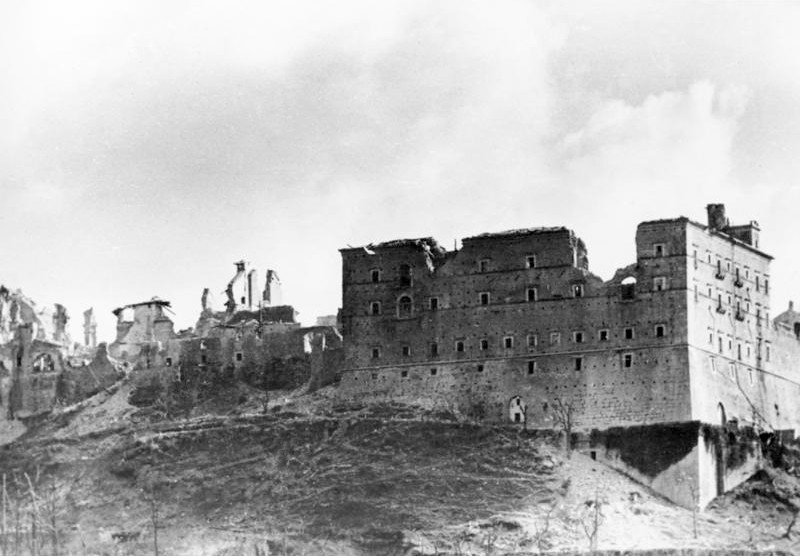
The ruins of the abbey at Monte Cassino after the 1944 battle.
Photograph credited to “Wittke” in the German Federal Archive (Bundesarchiv) via Wikimedia Commons.
On May 18, the day Australia goes to the polls, on the other side of the world we will be commemorating the 75th anniversary of the end of the bloodiest and hardest fought battle of the Italian campaign if not the whole of the Western front of WW2. On that day, a patrol from the 12th Podolian Cavalry Regiment raised the Polish flag above the ruins of the Benedictine monastery on top of Monte Cassino, bringing to an end four months and four Allied offensives against the heavily fortified Gustav (or Winter) Line, manned by crack German divisions across the entire width of the Italian boot about 100 miles south of Rome. Some of the German troops, veterans of the Eastern front, thought the fighting was worse than at Stalingrad. Others, on the Allied side, compared the conditions to Verdun. Unlike Russian cities or French fields, most of the fighting around Monte Cassino took place over an unimaginably difficult terrain of steep mountain slopes, deep valleys, wild rivers and landscape stripped bare by the artillery. It was a truly world battle in a world war: pitted against the Wehrmacht were the units from Great Britain, including British India and Rhodesia, the United States, France and its north African colonies like Morocco, Canada, Australia, New Zealand, including Maori troops, South Africa, Italy and Poland. Since the start of the Allied offensive in January 1944, waves after waves of troops of the 5th US and the 8th British armies smashed themselves against the rocks, unable to dislodge the well dug-in Germans. Finally, the fourth battle code-named Operation Diadem, which commenced with a massive bombardment on May 16, threw the British 13th Army Corp and the 2nd Polish Corp against the very linchpin of the Gustav Line at Monte Cassino and its monastery. Two days later it was over.
[…]
Churchill, right from the time of the Gallipoli disaster, remained obsessed about the vulnerability of the continental powers – primarily Germany – through what he called “the soft underbelly of Europe”. The war records are full of his harebrained schemes to attack the Axis through Italy, the Balkans or Greece and knock them out of the fight by a sharp thrust into the Central Europe. This was to be a masterstroke in place of the Normandy invasion, which Churchill strenuously opposed, and later in addition to it, to draw some of the German troops away from the northern France and indeed to get to Austria and southern Germany before the Red Army.
The problem with the soft underbelly of Europe is that it’s anything but. In fact it’s the hardest part of Europe; all rock, no roll. It’s mountains and deep valleys, fast rivers and vast forests, rudimentary roads and virtually no useful infrastructure. Unlike the northern European plains, this is the defender’s country where the Allies lost all the advantage of their numbers, their maneuverability and their armour. The two years of arduous slogfest from the southern Sicily to the Emilia-Romagna in the north might have indeed drawn valuable German troops from the other theaters of war but it was a bloody dead end. Poles were still stuck taking Bologna in April 1945, while only days later the patrols from Patton’s 3rd US Army were reaching the outskirts of Prague.
And Wojtek?
Monte Cassino is on my mind today, because entirely coincidentally I’m reading a delightful war book (that’s an oxymoron if there is one) titled Wojtek the Bear: Polish War Hero. It tells the surreal but entirely true story of a bear cub adopted by the Polish troops in northern Iran in 1942, towards the start of their anabasis from Stalin’s Siberia all the way to Italy and eventually Scotland. Accompanying the Poles through all their service in the Middle East and then southern Europe, Wojtek grew up to be a 6-foot, 500-pound ursine, who always thought he was a human. Quintessentially Polish (if only by adoption), he loved beer and cigarettes (he also ate them, but only if lit), taking showers with the troops and riding shotgun in army trucks. Some of his war-time exploits included capturing an Arab spy in Iraq and stealing underwear from a female support unit. But Wojtek truly became a legend during the battle of Monte Cassino, when to his comrades’ amazement he volunteered to carry ammunition in his paws. He was eventually made a Private in the Polish Army, and lived until 1963, continuing to win hearts in Scotland, where the Polish troops were repatriated after the war.
QotD: Reacting appropriately to criticism
Ich sitze in dem kleinsten Zimmer in meinem Hause. Ich habe Ihre Kritik vor mir. Im nächsten Augenblick wird sie hinter mir sein! (“I am sitting in the smallest room of my house. I have your review before me. In a moment it will be behind me!”).
Max Reger, responding to a review of his work by Rudolf Louis in the Münchener Neueste Nachrichten, 1906-02-07, as reported by Nicolas Slonimsky, Lexicon of Musical Invective, 1965.
May 12, 2019
Hitler Strikes in the West – WW2 – 037 – May 11 1940
World War Two
Published on 11 May 2019As the Allied troops in central Norway are evacuated and the Norwegian troops there surrender to the Germans, the Allied position around Narvik is still quite strong. With the addition of roughly 5000 Polish soldiers, the French, British and Norwegian force will prove to be a formidable foe for the Germans up North. This week however, the war drastically changes as not three but four Neutral countries are invaded. The Phoney War is ultimately over.
Join us on Patreon: https://www.patreon.com/TimeGhostHistory
Or join The TimeGhost Army directly at: https://timeghost.tvFollow WW2 day by day on Instagram @World_war_two_realtime https://www.instagram.com/world_war_t…
Join our Discord Server: https://discord.gg/D6D2aYN.
Between 2 Wars: https://www.youtube.com/playlist?list…
Source list: http://bit.ly/WW2sourcesWritten and Hosted by: Indy Neidell
Produced and Directed by: Spartacus Olsson and Astrid Deinhard
Executive Producers: Bodo Rittenauer, Astrid Deinhard, Indy Neidell, Spartacus Olsson
Creative Producer: Joram Appel
Research by: Indy Neidell
Edited by: Ben Ollerenshaw and Wieke Kapteijns
Map animations: EastoryColorisations by Norman Stewart and Julius Jääskeläinen https://www.facebook.com/JJcolorization/
Sources: IWM (A 7644), IWM (A 7637), IWM HU 55505, Bundesarchiv, Photos from the Jonatan Myhre Barlien photo collection.
Eastory’s channel: https://www.youtube.com/channel/UCEly…
Archive by Screenocean/Reuters https://www.screenocean.com.A TimeGhost chronological documentary produced by OnLion Entertainment GmbH.
From the comments:
World War Two
The Phoney War is over. This is the week that many have been anxiously waiting for (how did they know something big was going to happen). We have some great episodes coming up, which are like this one only as great as they are because of the amazing effort that our team puts in creating them. As is very apparent in this episode, Eastory’s maps take these videos to the next level. Every week we’re stunned by his level of detail and the amazing value that is added by these maps. As the war enters a new phase, so do we. Next week will see the first of our roadtrip to France specials going live as well as the longest weekly episode we have written up until now.Cheers,
Joram
May 3, 2019
“The Lost Battalion” – The Meuse-Argonne Offensive – Sabaton History 013
Sabaton History
Published on 2 May 2019In the last months of the Great War, the Americans join the fighting on the Western Front in an effort to break through the German Lines for once and for all. The Americans launch their Meuse-Argonne Offensive in the fall of 1918. As part of the offensive, nine companies of the United States 77th Division under command of Major Charles White Whittlesey pushes through the German lines with remarkable ease. Little did they know that the German lines were not abandoned, but that they simply found a hole. The Lost Battalion was surrounded and the men had to fight for days, awaiting their rescue.
Support Sabaton History on Patreon (and possibly get a special edition of The Great War): https://www.patreon.com/sabatonhistory
Watch the Official Lyric Video of “The Lost Battalion” here: https://www.youtube.com/watch?v=oSZtV…
Check out the trailer for Sabaton’s new album The Great War right here: https://www.youtube.com/watch?v=HCZP1…
Listen to Sabaton on Spotify: http://smarturl.it/SabatonSpotify
Official Sabaton Merchandise Shop: http://bit.ly/SabatonOfficialShopHosted by: Indy Neidell
Written by: Markus Linke and Indy Neidell
Directed by: Astrid Deinhard and Wieke Kapteijns
Produced by: Pär Sundström, Astrid Deinhard and Spartacus Olsson
Creative Producer: Joram Appel
Executive Producers: Pär Sundström, Joakim Broden, Tomas Sunmo, Indy Neidell, Astrid Deinhard, and Spartacus Olsson
Maps by: Eastory
Edited by: Iryna Dulka
Sound Editing by: Marek KaminskiEastory YouTube Channel: https://www.youtube.com/channel/UCEly…
Archive by: Reuters/Screenocean https://www.screenocean.com
Music by Sabaton.Sources:
© IWM (Q 8986), IWM (Q 10317), IWM (Q 8842), IWM (Q 9080), IWM (Q 87923), IWM (Q 61038), IWM (Q 53524), © IWM (Q 45553), IWM (Q 81616), IWM (Q 9078), IWM (Q 9079), IWM (Q 8844), IWM (Q 56607), IWM (Q 55559), IWM (Q 55558), IWM (Q 87940), IWM (Q 85383), IWM (Q 23719), IWM (Q 23709), IWM (Q 42057), IWM (Q 115198), IWM (Q 8161), IWM (Q 10316), IWM (Q 7928) IWM (Q 61481), IWM (Q 57695), IWM (Q 9088), IWM (Q 9083), IWM (Q 47997), IWM (Q 79595)
USMC Archives through Flickr: https://www.flickr.com/photos/6086806…An OnLion Entertainment GmbH and Raging Beaver Publishing AB co-Production.
© Raging Beaver Publishing AB, 2019 – all rights reserved.
From the comments:
Sabaton History
1 day ago
We met up with Indy in the Argonne to film Sabaton History’s episode for “The Lost Battalion”. As it happens, our new album is about the First World War as well. We have published a video earlier today presenting the “History Channel Edition” for the upcoming Sabaton Album The Great War. This is a special edition of the new album that is an exclusive reward for people who generously support us on Patreon as a Hussar or higher. If you want to check out the video in which Joakim and Indy explain the contents of the special edition, click here: https://youtu.be/Nk-VN_PjZyg If you want to support this channel on Patreon, go here: https://www.patreon.com/sabatonhistoryThanks for your time and cheers! 🤘
May 1, 2019
Bavarian Soviet Republic – 1919 Economy and Reconstruction I BEYOND THE GREAT WAR
The Great War
Published on 30 Apr 2019» SUPPORT THE CHANNEL
Patreon: https://www.patreon.com/thegreatwar
Merchandise: https://shop.spreadshirt.de/thegreatwar/Jesse Alexander takes a look at the short lived but historically important Bavarian Soviet Republic that existed for 3 weeks in April 1919. He also takes a look at the post armistice economy and reconstruction in the west.
» SOURCES
Deperchin, Annie. “Des destructions aux reconstructions,” in Stéphane Audoin-Rouzeau and Jean-Jacques Becker, eds. Encyclopédie de la Grande guerre 1914-1918 (Paris : Bayard, 2013): 1063-1074.Gerwarth, Robert. The Vanquished. Why the First World War Failed to End, 1917-1923 (Penguin, 2017).
Jones, Mark. Am Anfang war Gewalt. Die Deutsche Revolution 1918/19 und der Beginn der Weimarer Republik (Berlin: Propyläen, 2017). English edition: Founding Weimar. Violence and the German Revolution of 1918-19 (Cambridge University Press, 2016).
» SOCIAL MEDIA
Twitter: https://twitter.com/WW1_Series
Reddit: https://reddit.com/r/TheGreatWarChannel»CREDITS
Presented by: Jesse Alexander
Written by: Jesse Alexander
Director: Toni Steller & Florian Wittig
Director of Photography: Toni Steller
Sound: Toni Steller
Editing: Toni Steller
Mixing, Mastering & Sound Design: http://above-zero.com
Motion Design: Christian Graef – GRAEFX
Maps: Daniel Kogosov (https://www.patreon.com/Zalezsky)
Research by: Jesse Alexander
Fact checking: Florian Wittig
Channel Design: Alexander Clark
Original Logo: David van StepholdA Mediakraft Networks Original Channel Contains licensed material by getty images
All rights reserved – Real Time History GmbH 2019
From the comments:
The Great War
28 minutes ago
As a small production announcement: This was the last episode in the classical format where we answer questions directly. From May onward, every video we publish every other week will have one main topic: an important event from exactly 100 years ago. This will make it much easier to follow the channel and it will be more in line with our mission statement to cover the war in real time 100 years later. Of course, you can still ask questions. We will answer some of the directly in our Patreon podcast and we will use them as inspiration for our episodes. As an example: A lot of fans asked if we will cover the American “Polar Bear Expedition” and so that will be exactly what we will cover in our episode in late May. On top of that, we will do a small “time jump” and starting with our episode in June we will have a synchronized timeline again meaning: The episodes coming out in June 2019 will cover June 1919 and so forth.
April 30, 2019
The Neurology of Hate – WW2 – WaH SPECIAL EPISODE
World War Two
Published on 27 Apr 2019In this special episode of War Against Humanity, we take a look at the underlying neurological functions that allow us to hate another group of people. Maybe it helps us to understand the ultimate question about WW2; how on earth could all of this happen?
Join us on Patreon: https://www.patreon.com/TimeGhostHistory
Or join The TimeGhost Army directly at: https://timeghost.tvWritten and Hosted by: Spartacus Olsson
Produced and Directed by: Astrid Deinhard
Executive Producers: Bodo Rittenauer, Astrid Deinhard, Indy Neidell, Spartacus Olsson
Creative Producer: Joram Appel
Post Production Director: Wieke Kapteijns
Research by: Spartacus Olsson
Edited by: Spartacus OlssonArchive by Screenocean/Reuters https://www.screenocean.com
A TimeGhost chronological documentary produced by OnLion Entertainment GmbH.
April 29, 2019
System of a Nazi Terror – WW2 – WaH 002 – April 1940
World War Two
Published on 27 Apr 2019In April 1940 in Poland, if you are on the list of Nazi or Soviet non-desirables, there three options: run for your life, be shipped off to a camp, or face the execution squad… if you happen to be Jewish it’s likely to be the fourth option: the Ghetto.
Neurology of Hate Special: https://youtu.be/yeZ3_OtDa7E
Join us on Patreon: https://www.patreon.com/TimeGhostHistory
Or join The TimeGhost Army directly at: https://timeghost.tvFollow WW2 day by day on Instagram @World_war_two_realtime https://www.instagram.com/world_war_t…
Source list: http://bit.ly/WW2sourcesWritten and Hosted by: Spartacus Olsson
Produced and Directed by: Astrid Deinhard
Executive Producers: Bodo Rittenauer, Astrid Deinhard, Indy Neidell, Spartacus Olsson
Creative Producer: Joram Appel
Post Production Director: Wieke Kapteijns
Research by: Spartacus Olsson
Edited by: Wieke KapteijnsArchive by Screenocean/Reuters https://www.screenocean.com
A TimeGhost chronological documentary produced by OnLion Entertainment GmbH.
From the comments:
World War Two
4 hours ago
Now… this is a tough episode. It’s also tough to illustrate with images. Many of the events we speak of were, for obvious reasons not documented at the time. As a result we have had to resort to using some imagery that is from later dates when similar events, or the aftereffects of these events were documented on film and photo. We have labeled these images as best we can when it is relevant. Last but not least… do please remember our rules, especially on an episode like this one. Respect the dead and never forget that the only way we can do them justice is to remember their loss and sacrifice.
April 28, 2019
Norway is Burning – WW2 – 035 – April 27 1940
World War Two
Published on 27 Apr 2019The invasion and subsequent Battle of Norway has only just begun when the British decide to pull back. Poor planning and misfortune after misfortune harms the British campaign, which becomes very apparent this week while the fighting continues. Almost everywhere, except for in the far north, the Allied troops pull back under heavy German pressure.
Join us on Patreon: https://www.patreon.com/TimeGhostHistory
Or join The TimeGhost Army directly at: https://timeghost.tvFollow WW2 day by day on Instagram @World_war_two_realtime https://www.instagram.com/world_war_t…
Join our Discord Server: https://discord.gg/D6D2aYN.
Between 2 Wars: https://www.youtube.com/playlist?list…
Source list: http://bit.ly/WW2sourcesWritten and Hosted by: Indy Neidell
Produced and Directed by: Spartacus Olsson and Astrid Deinhard
Executive Producers: Bodo Rittenauer, Astrid Deinhard, Indy Neidell, Spartacus Olsson
Creative Producer: Joram Appel
Research by: Indy Neidell
Edited by: Iryna Dulka
Map animations: EastoryColorisations by Norman Stewart and Julius Jääskeläinen https://www.facebook.com/JJcolorization/
Eastory’s channel: https://www.youtube.com/channel/UCEly…
Archive by Screenocean/Reuters https://www.screenocean.comSources:
© IWM (HU 74922)
© IWM (HU 104678)
© IWM (A 22641)
© IWM (TR 209)
© IWM (N 97)
© IWM (A 1873)
© IWM (N 102)
© IWM (HU 104688)
© IWM (Q 88619)
© IWM (N 107)
© IWM (Q 92253)
© IWM (HU 91803)National Army Museum (NAM), 1984-10-79-.
A TimeGhost chronological documentary produced by OnLion Entertainment GmbH.
The Battle of Lützen – 1632 – The 30 Years War (in Swedish, with English sub-titles)
Gripen
Published on 3 Dec 2015One of the bloodiest battles of the Thirty Years War. Sweden vs. the Holy Roman Empire. A mass grave has been found, with the victims from the battle. Are they Swedish/Finnish soldiers or German mercenaries?
(This Swedish documentary has English subtitles).
From the comments:
Blah b
2 years ago
This documentary is often painful to watch, the way inexperienced modern people with no sense of empathy project their values onto those times. They weren’t “defenseless men standing still”. Armies had learned the hard way that massed musket fire won battles. If everybody is looking for cover and looking out for themselves, you can never operate such rigid units.So the individual soldier was harshly drilled to indeed stand still even with cannonballs tearing through his unit, or another unit standing 30-80 meters away. Because if individuals acted as individuals, the battle would be lost and the army would be destroyed.
But when that machine operated, it would win battles. The system invented by Maurice of the Netherlands ensured that if you were attacking a group of musketeers, every 20-25 seconds, they could deliver a crushing volley that can kill or injure 10-25% of a another unit, that means they only needed 2-3 salvos to achieve a local victory. Untrained units would literally never touch a musketeer, as his unit would’ve routed the attackers before they got within touching range.
Also there were no standing armies, there was no national identity as such. Mercenaries were totally acceptable. Mercenaries could become very loyal and reliable if paid on time [and] consistently, and would easily crush national armies that usually lacked the routine of professional soldiers. Loyalty and your identity was constructed differently. It would’ve been perfectly normal for me to utterly hate and maybe kill my neighbours if they were of a different religion. Otherwise, a Swedish protestant from far away was an ally with the right ideas. I wouldn’t have been able to understand him and everything would be alien about him, but I’d consider him a friend, and Catholics from the next village where I’d lived all my life would be enemies.
Unless the king comes around and says the Catholics are friends. Because the king is appointed by God who runs the world on a day to day [basis], and you obey without question. If the king says it’s so, that means God himself agrees and says it’s so, and you don’t question God. Loyalty until death is about the least you owed your king in those days.
People who can’t understand how such things worked historically, really should not be making documentaries…