
Ich sitze in dem kleinsten Zimmer in meinem Hause. Ich habe Ihre Kritik vor mir. Im nächsten Augenblick wird sie hinter mir sein! (“I am sitting in the smallest room of my house. I have your review before me. In a moment it will be behind me!”).
Max Reger, responding to a review of his work by Rudolf Louis in the Münchener Neueste Nachrichten, 1906-02-07, as reported by Nicolas Slonimsky, Lexicon of Musical Invective, 1965.
May 16, 2019
QotD: Reacting appropriately to criticism
Comments Off on QotD: Reacting appropriately to criticism
May 12, 2019
Hitler Strikes in the West – WW2 – 037 – May 11 1940
World War Two
Published on 11 May 2019As the Allied troops in central Norway are evacuated and the Norwegian troops there surrender to the Germans, the Allied position around Narvik is still quite strong. With the addition of roughly 5000 Polish soldiers, the French, British and Norwegian force will prove to be a formidable foe for the Germans up North. This week however, the war drastically changes as not three but four Neutral countries are invaded. The Phoney War is ultimately over.
Join us on Patreon: https://www.patreon.com/TimeGhostHistory
Or join The TimeGhost Army directly at: https://timeghost.tvFollow WW2 day by day on Instagram @World_war_two_realtime https://www.instagram.com/world_war_t…
Join our Discord Server: https://discord.gg/D6D2aYN.
Between 2 Wars: https://www.youtube.com/playlist?list…
Source list: http://bit.ly/WW2sourcesWritten and Hosted by: Indy Neidell
Produced and Directed by: Spartacus Olsson and Astrid Deinhard
Executive Producers: Bodo Rittenauer, Astrid Deinhard, Indy Neidell, Spartacus Olsson
Creative Producer: Joram Appel
Research by: Indy Neidell
Edited by: Ben Ollerenshaw and Wieke Kapteijns
Map animations: EastoryColorisations by Norman Stewart and Julius Jääskeläinen https://www.facebook.com/JJcolorization/
Sources: IWM (A 7644), IWM (A 7637), IWM HU 55505, Bundesarchiv, Photos from the Jonatan Myhre Barlien photo collection.
Eastory’s channel: https://www.youtube.com/channel/UCEly…
Archive by Screenocean/Reuters https://www.screenocean.com.A TimeGhost chronological documentary produced by OnLion Entertainment GmbH.
From the comments:
World War Two
The Phoney War is over. This is the week that many have been anxiously waiting for (how did they know something big was going to happen). We have some great episodes coming up, which are like this one only as great as they are because of the amazing effort that our team puts in creating them. As is very apparent in this episode, Eastory’s maps take these videos to the next level. Every week we’re stunned by his level of detail and the amazing value that is added by these maps. As the war enters a new phase, so do we. Next week will see the first of our roadtrip to France specials going live as well as the longest weekly episode we have written up until now.Cheers,
Joram
Comments Off on Hitler Strikes in the West – WW2 – 037 – May 11 1940
May 3, 2019
“The Lost Battalion” – The Meuse-Argonne Offensive – Sabaton History 013
Sabaton History
Published on 2 May 2019In the last months of the Great War, the Americans join the fighting on the Western Front in an effort to break through the German Lines for once and for all. The Americans launch their Meuse-Argonne Offensive in the fall of 1918. As part of the offensive, nine companies of the United States 77th Division under command of Major Charles White Whittlesey pushes through the German lines with remarkable ease. Little did they know that the German lines were not abandoned, but that they simply found a hole. The Lost Battalion was surrounded and the men had to fight for days, awaiting their rescue.
Support Sabaton History on Patreon (and possibly get a special edition of The Great War): https://www.patreon.com/sabatonhistory
Watch the Official Lyric Video of “The Lost Battalion” here: https://www.youtube.com/watch?v=oSZtV…
Check out the trailer for Sabaton’s new album The Great War right here: https://www.youtube.com/watch?v=HCZP1…
Listen to Sabaton on Spotify: http://smarturl.it/SabatonSpotify
Official Sabaton Merchandise Shop: http://bit.ly/SabatonOfficialShopHosted by: Indy Neidell
Written by: Markus Linke and Indy Neidell
Directed by: Astrid Deinhard and Wieke Kapteijns
Produced by: Pär Sundström, Astrid Deinhard and Spartacus Olsson
Creative Producer: Joram Appel
Executive Producers: Pär Sundström, Joakim Broden, Tomas Sunmo, Indy Neidell, Astrid Deinhard, and Spartacus Olsson
Maps by: Eastory
Edited by: Iryna Dulka
Sound Editing by: Marek KaminskiEastory YouTube Channel: https://www.youtube.com/channel/UCEly…
Archive by: Reuters/Screenocean https://www.screenocean.com
Music by Sabaton.Sources:
© IWM (Q 8986), IWM (Q 10317), IWM (Q 8842), IWM (Q 9080), IWM (Q 87923), IWM (Q 61038), IWM (Q 53524), © IWM (Q 45553), IWM (Q 81616), IWM (Q 9078), IWM (Q 9079), IWM (Q 8844), IWM (Q 56607), IWM (Q 55559), IWM (Q 55558), IWM (Q 87940), IWM (Q 85383), IWM (Q 23719), IWM (Q 23709), IWM (Q 42057), IWM (Q 115198), IWM (Q 8161), IWM (Q 10316), IWM (Q 7928) IWM (Q 61481), IWM (Q 57695), IWM (Q 9088), IWM (Q 9083), IWM (Q 47997), IWM (Q 79595)
USMC Archives through Flickr: https://www.flickr.com/photos/6086806…An OnLion Entertainment GmbH and Raging Beaver Publishing AB co-Production.
© Raging Beaver Publishing AB, 2019 – all rights reserved.
From the comments:
Sabaton History
1 day ago
We met up with Indy in the Argonne to film Sabaton History’s episode for “The Lost Battalion”. As it happens, our new album is about the First World War as well. We have published a video earlier today presenting the “History Channel Edition” for the upcoming Sabaton Album The Great War. This is a special edition of the new album that is an exclusive reward for people who generously support us on Patreon as a Hussar or higher. If you want to check out the video in which Joakim and Indy explain the contents of the special edition, click here: https://youtu.be/Nk-VN_PjZyg If you want to support this channel on Patreon, go here: https://www.patreon.com/sabatonhistoryThanks for your time and cheers! 🤘
Comments Off on “The Lost Battalion” – The Meuse-Argonne Offensive – Sabaton History 013
May 1, 2019
Bavarian Soviet Republic – 1919 Economy and Reconstruction I BEYOND THE GREAT WAR
The Great War
Published on 30 Apr 2019» SUPPORT THE CHANNEL
Patreon: https://www.patreon.com/thegreatwar
Merchandise: https://shop.spreadshirt.de/thegreatwar/Jesse Alexander takes a look at the short lived but historically important Bavarian Soviet Republic that existed for 3 weeks in April 1919. He also takes a look at the post armistice economy and reconstruction in the west.
» SOURCES
Deperchin, Annie. “Des destructions aux reconstructions,” in Stéphane Audoin-Rouzeau and Jean-Jacques Becker, eds. Encyclopédie de la Grande guerre 1914-1918 (Paris : Bayard, 2013): 1063-1074.Gerwarth, Robert. The Vanquished. Why the First World War Failed to End, 1917-1923 (Penguin, 2017).
Jones, Mark. Am Anfang war Gewalt. Die Deutsche Revolution 1918/19 und der Beginn der Weimarer Republik (Berlin: Propyläen, 2017). English edition: Founding Weimar. Violence and the German Revolution of 1918-19 (Cambridge University Press, 2016).
» SOCIAL MEDIA
Twitter: https://twitter.com/WW1_Series
Reddit: https://reddit.com/r/TheGreatWarChannel»CREDITS
Presented by: Jesse Alexander
Written by: Jesse Alexander
Director: Toni Steller & Florian Wittig
Director of Photography: Toni Steller
Sound: Toni Steller
Editing: Toni Steller
Mixing, Mastering & Sound Design: http://above-zero.com
Motion Design: Christian Graef – GRAEFX
Maps: Daniel Kogosov (https://www.patreon.com/Zalezsky)
Research by: Jesse Alexander
Fact checking: Florian Wittig
Channel Design: Alexander Clark
Original Logo: David van StepholdA Mediakraft Networks Original Channel Contains licensed material by getty images
All rights reserved – Real Time History GmbH 2019
From the comments:
The Great War
28 minutes ago
As a small production announcement: This was the last episode in the classical format where we answer questions directly. From May onward, every video we publish every other week will have one main topic: an important event from exactly 100 years ago. This will make it much easier to follow the channel and it will be more in line with our mission statement to cover the war in real time 100 years later. Of course, you can still ask questions. We will answer some of the directly in our Patreon podcast and we will use them as inspiration for our episodes. As an example: A lot of fans asked if we will cover the American “Polar Bear Expedition” and so that will be exactly what we will cover in our episode in late May. On top of that, we will do a small “time jump” and starting with our episode in June we will have a synchronized timeline again meaning: The episodes coming out in June 2019 will cover June 1919 and so forth.
Comments Off on Bavarian Soviet Republic – 1919 Economy and Reconstruction I BEYOND THE GREAT WAR
April 30, 2019
The Neurology of Hate – WW2 – WaH SPECIAL EPISODE
World War Two
Published on 27 Apr 2019In this special episode of War Against Humanity, we take a look at the underlying neurological functions that allow us to hate another group of people. Maybe it helps us to understand the ultimate question about WW2; how on earth could all of this happen?
Join us on Patreon: https://www.patreon.com/TimeGhostHistory
Or join The TimeGhost Army directly at: https://timeghost.tvWritten and Hosted by: Spartacus Olsson
Produced and Directed by: Astrid Deinhard
Executive Producers: Bodo Rittenauer, Astrid Deinhard, Indy Neidell, Spartacus Olsson
Creative Producer: Joram Appel
Post Production Director: Wieke Kapteijns
Research by: Spartacus Olsson
Edited by: Spartacus OlssonArchive by Screenocean/Reuters https://www.screenocean.com
A TimeGhost chronological documentary produced by OnLion Entertainment GmbH.
Comments Off on The Neurology of Hate – WW2 – WaH SPECIAL EPISODE
April 29, 2019
System of a Nazi Terror – WW2 – WaH 002 – April 1940
World War Two
Published on 27 Apr 2019In April 1940 in Poland, if you are on the list of Nazi or Soviet non-desirables, there three options: run for your life, be shipped off to a camp, or face the execution squad… if you happen to be Jewish it’s likely to be the fourth option: the Ghetto.
Neurology of Hate Special: https://youtu.be/yeZ3_OtDa7E
Join us on Patreon: https://www.patreon.com/TimeGhostHistory
Or join The TimeGhost Army directly at: https://timeghost.tvFollow WW2 day by day on Instagram @World_war_two_realtime https://www.instagram.com/world_war_t…
Source list: http://bit.ly/WW2sourcesWritten and Hosted by: Spartacus Olsson
Produced and Directed by: Astrid Deinhard
Executive Producers: Bodo Rittenauer, Astrid Deinhard, Indy Neidell, Spartacus Olsson
Creative Producer: Joram Appel
Post Production Director: Wieke Kapteijns
Research by: Spartacus Olsson
Edited by: Wieke KapteijnsArchive by Screenocean/Reuters https://www.screenocean.com
A TimeGhost chronological documentary produced by OnLion Entertainment GmbH.
From the comments:
World War Two
4 hours ago
Now… this is a tough episode. It’s also tough to illustrate with images. Many of the events we speak of were, for obvious reasons not documented at the time. As a result we have had to resort to using some imagery that is from later dates when similar events, or the aftereffects of these events were documented on film and photo. We have labeled these images as best we can when it is relevant. Last but not least… do please remember our rules, especially on an episode like this one. Respect the dead and never forget that the only way we can do them justice is to remember their loss and sacrifice.
Comments Off on System of a Nazi Terror – WW2 – WaH 002 – April 1940
April 28, 2019
Norway is Burning – WW2 – 035 – April 27 1940
World War Two
Published on 27 Apr 2019The invasion and subsequent Battle of Norway has only just begun when the British decide to pull back. Poor planning and misfortune after misfortune harms the British campaign, which becomes very apparent this week while the fighting continues. Almost everywhere, except for in the far north, the Allied troops pull back under heavy German pressure.
Join us on Patreon: https://www.patreon.com/TimeGhostHistory
Or join The TimeGhost Army directly at: https://timeghost.tvFollow WW2 day by day on Instagram @World_war_two_realtime https://www.instagram.com/world_war_t…
Join our Discord Server: https://discord.gg/D6D2aYN.
Between 2 Wars: https://www.youtube.com/playlist?list…
Source list: http://bit.ly/WW2sourcesWritten and Hosted by: Indy Neidell
Produced and Directed by: Spartacus Olsson and Astrid Deinhard
Executive Producers: Bodo Rittenauer, Astrid Deinhard, Indy Neidell, Spartacus Olsson
Creative Producer: Joram Appel
Research by: Indy Neidell
Edited by: Iryna Dulka
Map animations: EastoryColorisations by Norman Stewart and Julius Jääskeläinen https://www.facebook.com/JJcolorization/
Eastory’s channel: https://www.youtube.com/channel/UCEly…
Archive by Screenocean/Reuters https://www.screenocean.comSources:
© IWM (HU 74922)
© IWM (HU 104678)
© IWM (A 22641)
© IWM (TR 209)
© IWM (N 97)
© IWM (A 1873)
© IWM (N 102)
© IWM (HU 104688)
© IWM (Q 88619)
© IWM (N 107)
© IWM (Q 92253)
© IWM (HU 91803)National Army Museum (NAM), 1984-10-79-.
A TimeGhost chronological documentary produced by OnLion Entertainment GmbH.
Comments Off on Norway is Burning – WW2 – 035 – April 27 1940
The Battle of Lützen – 1632 – The 30 Years War (in Swedish, with English sub-titles)
Gripen
Published on 3 Dec 2015One of the bloodiest battles of the Thirty Years War. Sweden vs. the Holy Roman Empire. A mass grave has been found, with the victims from the battle. Are they Swedish/Finnish soldiers or German mercenaries?
(This Swedish documentary has English subtitles).
From the comments:
Blah b
2 years ago
This documentary is often painful to watch, the way inexperienced modern people with no sense of empathy project their values onto those times. They weren’t “defenseless men standing still”. Armies had learned the hard way that massed musket fire won battles. If everybody is looking for cover and looking out for themselves, you can never operate such rigid units.So the individual soldier was harshly drilled to indeed stand still even with cannonballs tearing through his unit, or another unit standing 30-80 meters away. Because if individuals acted as individuals, the battle would be lost and the army would be destroyed.
But when that machine operated, it would win battles. The system invented by Maurice of the Netherlands ensured that if you were attacking a group of musketeers, every 20-25 seconds, they could deliver a crushing volley that can kill or injure 10-25% of a another unit, that means they only needed 2-3 salvos to achieve a local victory. Untrained units would literally never touch a musketeer, as his unit would’ve routed the attackers before they got within touching range.
Also there were no standing armies, there was no national identity as such. Mercenaries were totally acceptable. Mercenaries could become very loyal and reliable if paid on time [and] consistently, and would easily crush national armies that usually lacked the routine of professional soldiers. Loyalty and your identity was constructed differently. It would’ve been perfectly normal for me to utterly hate and maybe kill my neighbours if they were of a different religion. Otherwise, a Swedish protestant from far away was an ally with the right ideas. I wouldn’t have been able to understand him and everything would be alien about him, but I’d consider him a friend, and Catholics from the next village where I’d lived all my life would be enemies.
Unless the king comes around and says the Catholics are friends. Because the king is appointed by God who runs the world on a day to day [basis], and you obey without question. If the king says it’s so, that means God himself agrees and says it’s so, and you don’t question God. Loyalty until death is about the least you owed your king in those days.
People who can’t understand how such things worked historically, really should not be making documentaries…
Comments Off on The Battle of Lützen – 1632 – The 30 Years War (in Swedish, with English sub-titles)
April 26, 2019
“Bismarck” – Battle of the Atlantic – Sabaton History 012
Sabaton History
Published on 25 Apr 2019Despite restrictions that were put on the German navy by the Treaty of Versailles, the Kriegsmarine rebuilt in the 1930s with one goal: to be bigger and better than ever. Two powerful Bismarck-class battleships formed the pinnacle of the German naval warship production. When the British caught wind that the Bismarck was out in the open in May 1941, they in turn formulated a goal of their own: to take it down for once and for all. The Sabaton song “Bismarck” is about the chase, the battle in the Atlantic and subsequent fate of the Bismarck.
Support Sabaton History on Patreon (and possibly get a special edition of The Great War): https://www.patreon.com/sabatonhistory
Endless hours of strategy, tactical gameplay and pulse pounding combat! Play World of Warships for FREE: https://wo.ws/sabatonYou can find the official music video for “Bismarck” right here: https://www.youtube.com/watch?v=oVWEb…
Check out the trailer for Sabaton’s new album The Great War right here: https://www.youtube.com/watch?v=HCZP1…Hosted by: Indy Neidell
Written by: Markus Linke and Indy Neidell
Directed by: Astrid Deinhard and Wieke Kapteijns
Produced by: Pär Sundström, Astrid Deinhard and Spartacus Olsson
Creative Producer: Joram Appel
Executive Producers: Pär Sundström, Joakim Broden, Tomas Sunmo, Indy Neidell, Astrid Deinhard, and Spartacus Olsson
Maps by: Eastory
Edited by: Iryna Dulka
Sound Editing by: Marek KaminskiEastory YouTube Channel: https://www.youtube.com/channel/UCEly…
Archive by: Reuters/Screenocean https://www.screenocean.com
Music by Sabaton.Sources: © IWM (CS 159), © IWM (A 14840), © IWM (A 178), © IWM (HU 385), © IWM (HU 381), © IWM (HU 384), © IWM (HU 382), © IWM (A 3769), © IWM (A 9798), © IWM (MH 15929), © IWM (A 4386).
An OnLion Entertainment GmbH and Raging Beaver Publishing AB co-Production.
© Raging Beaver Publishing AB, 2019 – all rights reserved.
From the comments:
Sabaton History
1 day ago
I’m sure that many – if not all of you have seen Sabaton’s new single “Bismarck” by now. If not, make sure to check it out after you’re done watching this video – it’s awesome. The link is in the video description. Now, we have already used some of videoclip’s footage in this episode of Sabaton History, because it is incredible and does tremendous job in showing some of the drama of this historical event. Enjoy the episode about one of the most well-known naval battles of World War Two! Cheers and ROCK ON! 🤘🤘🤘
Comments Off on “Bismarck” – Battle of the Atlantic – Sabaton History 012
April 21, 2019
The Scramble For Norway – WW2 – 034 – April 20 1940
World War Two
Published on 20 Apr 2019The German Invasion of Norway is still very much in full swing. The German Wehrmacht is moving north from Oslo, where a Norwegian force is trying to halt them in anticipation of Allied reinforcements. The British do land in Norway, but don’t necessarily rush to relief the Norwegian army. Meanwhile, Norwegian “traitor” and “failure” Vidkun Quisling rises to be the new leader of Norway – only to get rejected by Hitler again. Numerous powers are now trying to grab, restore or consolidate military or political power in Norway. It’s a mess.
Join us on Patreon: https://www.patreon.com/TimeGhostHistory
Or join The TimeGhost Army directly at: https://timeghost.tvFollow WW2 day by day on Instagram @World_war_two_realtime https://www.instagram.com/world_war_t…
Join our Discord Server: https://discord.gg/D6D2aYN.
Between 2 Wars: https://www.youtube.com/playlist?list…
Source list: http://bit.ly/WW2sourcesWritten and Hosted by: Indy Neidell
Produced and Directed by: Spartacus Olsson and Astrid Deinhard
Executive Producers: Bodo Rittenauer, Astrid Deinhard, Indy Neidell, Spartacus Olsson
Creative Producer: Joram Appel
Research by: Indy Neidell
Edited by: Iryna Dulka
Map animations: EastoryColorisations by Norman Stewart and JuliusJaa (https://www.flickr.com/photos/juliusjaa/)
Eastory’s channel: https://www.youtube.com/channel/UCEly…
Archive by Screenocean/Reuters https://www.screenocean.comSources:
© IWM (N 159)
© IWM (HU 104676)
© IWM (HU 104684)A TimeGhost chronological documentary produced by OnLion Entertainment GmbH.
Comments Off on The Scramble For Norway – WW2 – 034 – April 20 1940
April 16, 2019
QotD: Romania and the Nazi Final Solution
Last place goes to Romania, which had been anti-Semitic since the beginning of time and was genuinely excited to have Nazi orders as an excuse to carry out their own worse impulses:
In Rumania even the S.S. were taken aback, and occasionally frightened, by the horrors of old-fashioned, spontaneous pogroms on a gigantic scale; they often intervened to save Jews from sheer butchery, so that the killing could be done in what, according to them, was a civilized way.
The Romanians started their own concentration camps to supplement the Nazi’s, “more elaborate and atrocious affairs than anything we know of in Germany”, but they didn’t always need them – “deportation Rumanian style consisted in herding five thousand people into freight cars and letting them die there of suffocation while the train traveled through the countryside without plan or aim for days on end; a favorite followup to these killing operations was to expose the corpses in Jewish butcher shops.” Things became so bad that Nazi emissary Manfred von Killinger, intervened and asked them to stop and defer to German efforts. I feel like when a Nazi named Commander von Killinger is horrified by your brutality, it’s time to take a step back and evaluate whether you may have crossed a line.
Other interesting profiles include Greece (hopelessly depressing), Slovakia (very Catholic, in favor of killing Jews but got in a bunch of fights with the Nazis about ethnic Jews who had been baptized into Catholicism), Hungary (ruled by an Admiral despite being landlocked; otherwise hopelessly depressing), Belgium (deliberately left the trains unlocked so the Jews could escape!), Holland (kind of like France; the local Gentiles tried to help, but the assimilated Jews sold out the refugee Jews in the hope of placating the Nazis; the Nazis were not placated; three-quarters of Jews died), and Poland (I don’t even want to talk about how hopelessly depressing this one is).
Scott Alexander, “Book review: Eichmann in Jerusalem”, Slate Star Codex, 2017-01-30.
Comments Off on QotD: Romania and the Nazi Final Solution
April 14, 2019
British diplomatic blunders in history – German unification
An interesting article in Vox, suggesting that the gradual unification of all the German principalities, electorates, duchies, counties, bishoprics, free cities, and miscellaneous other semi-independent bits and bobs of the Holy Roman Empire was not inevitable and that — absent British blundering after the Napoleonic wars — it would have produced a very different 20th century:
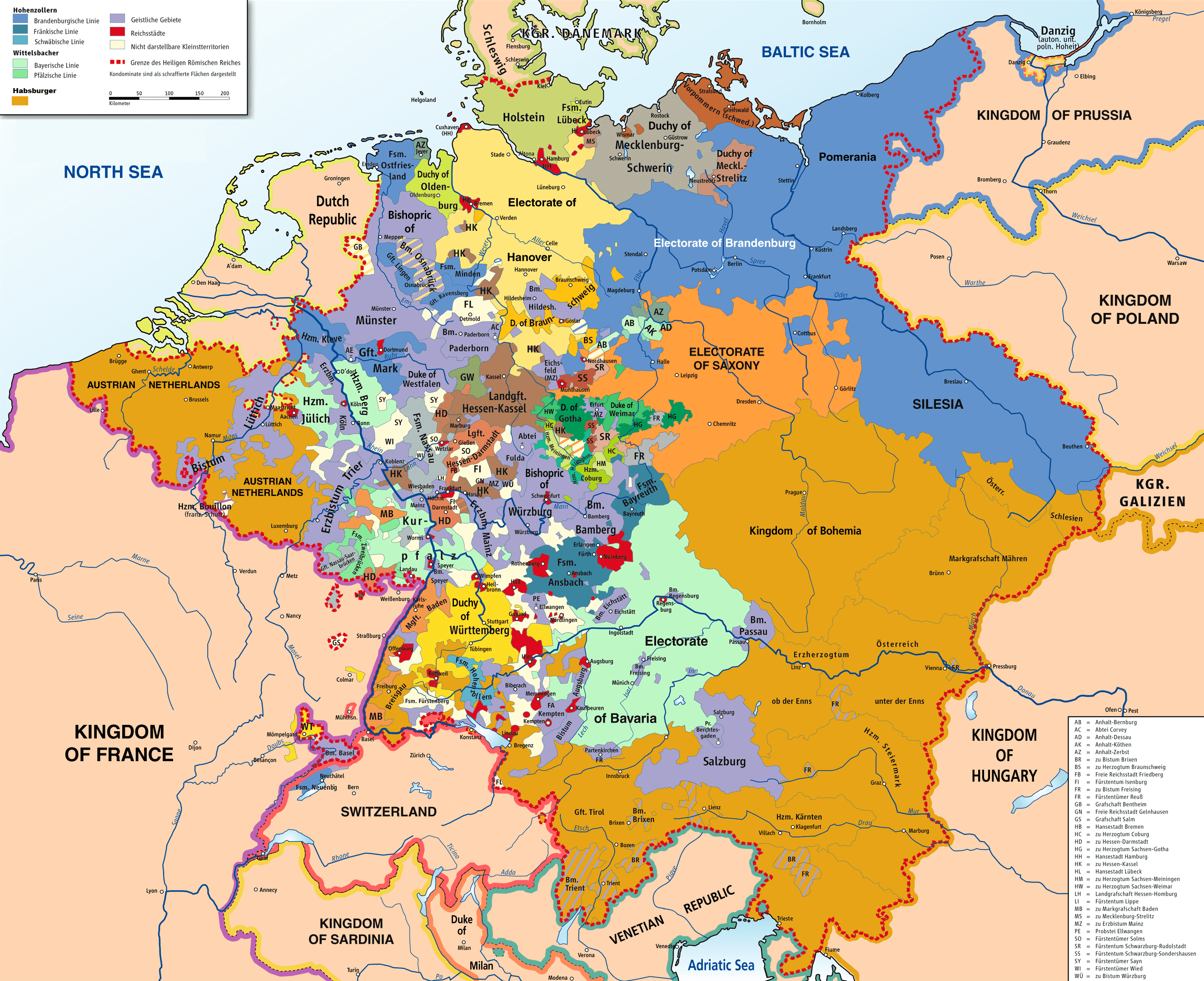
The Holy Roman Empire in 1789, before Napoleon “rationalized” hundreds of smaller entities into the Confederation of the Rhine.
Image from Wikimedia Commons.
The boundaries of states are the heart of many recent debates, be it the European refugee crisis, the Transatlantic Trade and Investment Partnership (TTIP), or Brexit (Snower and Langhammer 2019). After decades of stability, today we are again seeing heated discussions about the shape and extent of political borders. Clearly, borders are neither naturally given nor random. In Europe and elsewhere, the current state borders have been formed and changed over centuries, sometimes peacefully, often in bloody wars. In Huning and Wolf (2019), we look at the formation of the German nation state led by Prussia and trace it back to a change in borders decided at the Congress of Vienna in 1814/15.
In a nutshell, we have two findings:
- First, the geographic position of a state can be a crucial factor for institutional change and development.
- Second, the formation of the German Zollverein in 1834 under Prussian leadership was a truly European story, involving Britain, the Russian Empire, and the Belgian revolution of 1830/31. We show in particular that the Zollverein formed as an unintended consequence of Britain’s intervention in 1814/15 to push back Russian influence over Europe.
In theory, why would the geographic position of a state relative to that of other states matter? Intuitively, it should matter as long as the costs of trade and factor flows depend on their routes. If a large share of my trade has to pass the territory of one or several neighbours, my trade and trade policy will depend on the trade policy of my neighbours. Moreover, if tariffs are levied not only on imports but also on transit trade, as was general practice until the Barcelona Statute of 1921 (Uprety 2006), policymakers face the problem of multiple marginalisation, which is well known from the literature on supply chains. In our work, we provide a simple theoretical framework (in partial equilibrium) to show how the location of a revenue maximising state planner will affect its ability to set tariffs. Some states can increase their tariff revenue at the expense of their hinterland. Next, we show that a customs union can be beneficial for a group of states exactly because it solves the problem of multiple marginalisation.
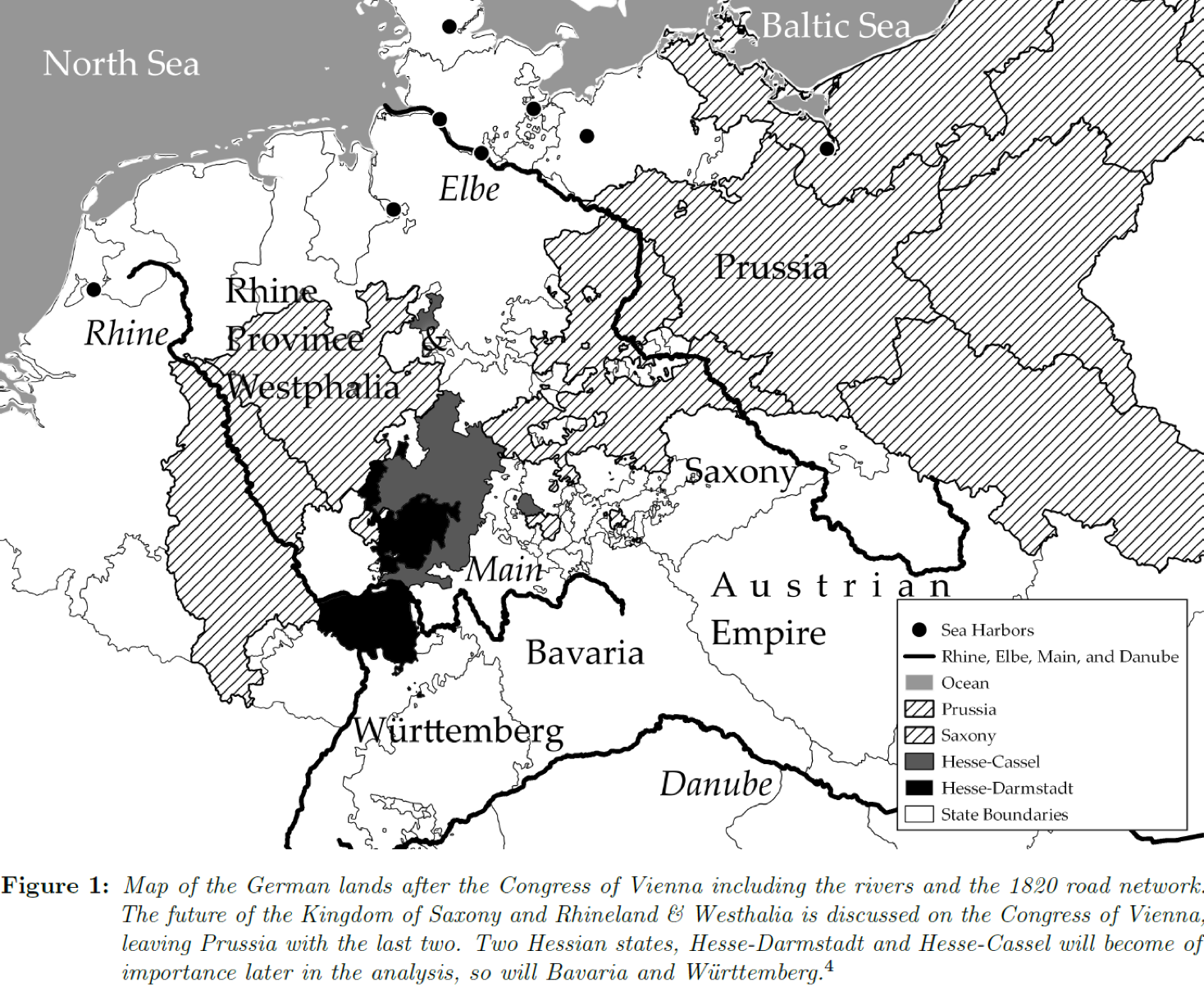
A major challenge to testing our idea empirically is that a state’s political boundaries (and hence its location) do not change very often, and if they do, the change is unlikely to be unrelated to trade or factor flows. However, the formation of the German Zollverein in 1834 can be considered as a quasi-experiment. Let us briefly revisit this historical episode. At the end of the Napoleonic wars of 1792-1814/15, only Russia and the UK were left as major military powers. Habsburg, Prussia, and the defeated France attempted to consolidate their positions at the expense of the many smaller states that had just about survived the wars, notably the former allies of Napoleon such as Saxony and Poland. Overall, the negotiations at the Congress of Vienna in 1814 were dominated by military-strategic considerations between the two great powers. Russia wanted to expand westwards, Prussia was desperate to annex the populous Kingdom of Saxony, which bordered Prussia in the south and would create a large and coherent territory. To this end, Prussia was willing to give up not only her Polish territories to Russia, but also her positions and claims on the Rhineland (Müller 1986). This met stiff resistance from Britain, joined by Habsburg and France, which feared a new Russian hegemony on the continent – the ‘Polish Saxon question’. After weeks of diplomatic struggle, the outcome was a division of Saxony, another division of Poland and Prussia being established as the “warden of the German gate against France” (Clapham 1921: 98). Figure 1 shows the result of these negotiations.
H/T to Continental Telegraph for the link.
Comments Off on British diplomatic blunders in history – German unification
The Invasion of Norway and Denmark – WW2 – 033 – April 13 1940
World War Two
Published on 13 Apr 2019This week, the Phoney War seems to come to an end when Germany invades Denmark and Norway. The Allies seek confrontation with Germany in the hope to at least deny them full access to the Swedish iron mines. Nevertheless, the Germans are prepared and have been planning this for weeks. It looks like it will cost a lot to put a stop to it.
Join us on Patreon: https://www.patreon.com/TimeGhostHistory
Or join The TimeGhost Army directly at: https://timeghost.tvFollow WW2 day by day on Instagram @World_war_two_realtime https://www.instagram.com/world_war_t…
Join our Discord Server: https://discord.gg/D6D2aYN.
Between 2 Wars: https://www.youtube.com/playlist?list…
Source list: http://bit.ly/WW2sourcesWritten and Hosted by: Indy Neidell
Produced and Directed by: Spartacus Olsson and Astrid Deinhard
Executive Producers: Bodo Rittenauer, Astrid Deinhard, Indy Neidell, Spartacus Olsson
Creative Producer: Joram Appel
Research by: Indy Neidell
Edited by: Iryna Dulka
Map animations: EastoryColorisations by Norman Stewart and JuliusJaa (https://www.flickr.com/photos/juliusjaa/)
Eastory’s channel: https://www.youtube.com/channel/UCEly…
Archive by Screenocean/Reuters https://www.screenocean.comSources:
Riksarkivet
File reference: RA/PA-1209/U/Uj/L0203
Author: unknown
File reference: RA/PA-1209/U/Uj/L0203
Author: unknownA TimeGhost chronological documentary produced by OnLion Entertainment GmbH.
From the comments:
World War Two
1 hour ago
Hey all! The Phoney war is over, and although we have learned in the last months that it wasn’t as uneventful as is generally believed, the war really takes off here. While this is going live, we are in France to film future events, which I won’t spoil in this video. If you don’t mind too much, do check out our road trip vlogs (the many specials we shot here will have to be edited and will be published over the spring). We have seen very interesting things and we will challenge many misconceptions and myths about the upcoming events of World War Two. Thank you all for your ongoing support!Cheers,
Joram
Comments Off on The Invasion of Norway and Denmark – WW2 – 033 – April 13 1940
April 12, 2019
Fields of Verdun – The Battle of Verdun – Sabaton History 010
Sabaton History
Published on 11 Apr 2019One of the bloodiest battles in the history of humankind was fought out on the hills in Northern France. Verdun was a tactical and symbolical city with great value to France. In 1916, the German army launched a massive attack, accompanied by a tremendous artillery bombardment, upon which the French defenders put their foot down, stating that “on ne passe pas!” — they shall not pass.
Check out the trailer for Sabaton’s new album The Great War on which “Fields of Verdun” will be featured right here: https://www.youtube.com/watch?v=HCZP1-JsD0M
Support Sabaton History on Patreon (and possibly get a special edition of ‘The Great War): https://www.patreon.com/sabatonhistory
Listen to Sabaton on Spotify: http://smarturl.it/SabatonSpotify
Official Sabaton Merchandise Shop: http://bit.ly/SabatonOfficialShopHosted by: Indy Neidell
Written by: Markus Linke and Indy Neidell
Directed by: Astrid Deinhard and Wieke Kapteijns
Produced by: Pär Sundström, Astrid Deinhard and Spartacus Olsson
Creative Producer: Joram Appel
Executive Producers: Pär Sundström, Joakim Broden, Tomas Sunmo, Indy Neidell, Astrid Deinhard, and Spartacus Olsson
Maps by: Eastory
Edited by: Iryna Dulka
Sound Editing by: Marek Kaminski© IWM (Q 56546), (Q 23760), (Q 23892), (Q 69971), (Q 87751), Q 87757), (Q 23878).
Battle Of Verdun, Uploaded by RV1864 on Flickr.Eastory YouTube Channel: https://www.youtube.com/channel/UCEly…
Archive by: Reuters/Screenocean https://www.screenocean.com
Music by Sabaton.An OnLion Entertainment GmbH and Raging Beaver Publishing AB co-Production.
© Raging Beaver Publishing AB, 2019 – all rights reserved.
From the comments:
Sabaton History
1 day ago (edited)
Last week we announced our upcoming album The Great War which will release on July 19 this year. This week, we’re covering a song from that album. “Fields of Verdun” is about the Battle of Verdun 1916 and will be featured on the new album. Since Indy hosted “The Great War” for over four years, the episode is very personal for everyone involved. Thank you all very much for your support and positive reactions to the trailer release. Haven’t seen the trailer? You can find it here: https://www.youtube.com/watch?v=HCZP1-JsD0MCheers and Rock on!!
Comments Off on Fields of Verdun – The Battle of Verdun – Sabaton History 010
April 7, 2019
Germans and British make their way to the North – WW2 – 032 – April 6 1940
World War Two
Published on 6 Apr 2019While China gets a new government, or at least in the eyes of Japan, the British are trying to cope with the rationing of meat and dairy products by trying out some new recipes. More importantly, Germany seems to be very serious about invading Norway. However, the British also plan to move closer to Norway.
Join us on Patreon: https://www.patreon.com/TimeGhostHistory
Or join The TimeGhost Army directly at: https://timeghost.tvFollow WW2 day by day on Instagram @World_war_two_realtime https://www.instagram.com/world_war_t…
Join our Discord Server: https://discord.gg/D6D2aYN.
Between 2 Wars: https://www.youtube.com/playlist?list…
Source list: http://bit.ly/WW2sourcesWritten and Hosted by: Indy Neidell
Produced and Directed by: Spartacus Olsson and Astrid Deinhard
Executive Producers: Bodo Rittenauer, Astrid Deinhard, Indy Neidell, Spartacus Olsson
Creative Producer: Joram Appel
Research by: Indy Neidell
Edited by: Iryna Dulka
Map animations: EastoryColorisations by Norman Stewart
Eastory’s channel: https://www.youtube.com/channel/UCEly…
Archive by Screenocean/Reuters https://www.screenocean.comA TimeGhost chronological documentary produced by OnLion Entertainment GmbH.
From the comments:
World War Two
2 days ago (edited)
The war seems to be heating up. As both the Germans and the Allies move towards Norway, the Soviets commit a big war crime in Katyn. We have made a ‘War Against Humanity’ episode in which we explain how Stalin and Beria ordered the mass murder. You can see that right here: https://www.youtube.com/watch?v=gd5YhhNcC44 And a friendly reminder for the existence of our own discord server: https://discord.gg/D6D2aYN.Cheers!
Comments Off on Germans and British make their way to the North – WW2 – 032 – April 6 1940


