Quotulatiousness

August 18, 2021

Tank Chats #120​ | Sd.Kfz. 234 Panzerspähwagen | The Tank Museum

Filed under: Germany, History, Military, Weapons, WW2 — Tags: , , — Nicholas @ 02:00

The Tank Museum
Published 26 Mar 2021

The Tank Museum’s Curator David Willey presents a Tank Chat on the Sd.Kfz. 234 Panzerspähwagen, a heavy German reconnaissance vehicle from the Second World War, and the only wheeled German armour in The Tank Museum collection. Join David as he tells you more.
(more…)

August 17, 2021

Opening Battles of the Franco-Prussian War: Saarbrücken, Wissembourg, Wörth I GLORY & DEFEAT Week 4

Filed under: France, Germany, History, Military — Tags: , , , , , — Nicholas @ 04:00

realtimehistory
Published 5 Aug 2021

Support Glory & Defeat: https://realtimehistory.net/gloryandd…

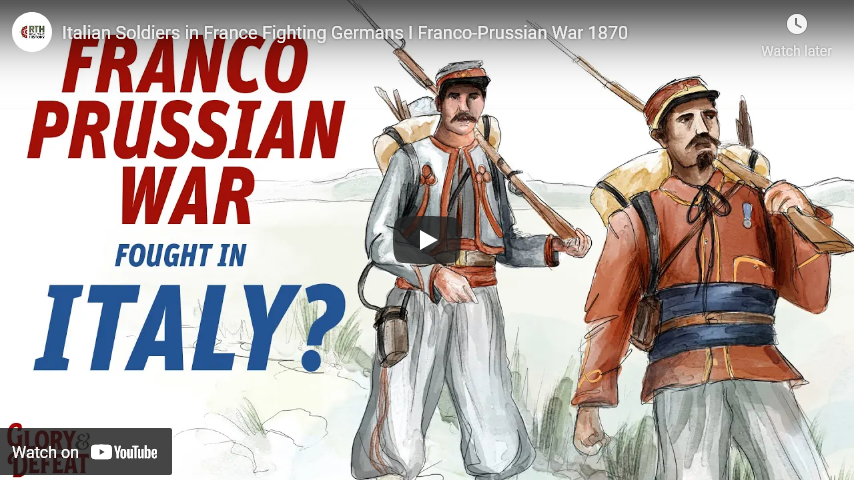
Early August 1870 saw the first series of opening battles of the Franco-Prussian War. The Battle of Saarbrücken was the only battle of the entire war fought on German soil, the following Battle of Wissembourg, the Battle of Wörth and the Battle of Spicheren happened right after and gave a glimpse of the carnage to come.

» THANK YOU TO OUR CO-PRODUCERS
John Ozment
James Darcangelo
Jacob Carter Landt
Thomas Brendan

» OUR PODCAST
https://realtimehistory.net/podcast – interviews with historians and background info for the show.

» LITERATURE
Arand, Tobias: 1870/71. Die Geschichte des Deutsch-Französischen Krieges erzählt in Einzelschicksalen. Hamburg 2018

Bourguinat, Nicolas/Vogt, Gilles: La guerre franco-allemande de 1870. Une histoire globale. Paris 2020

Gall, Lothar (Hrsg.): Deutschland Archiv. Deutsche Geschichte in Dokumenten. O.O., o. J. (2007)

Mährle, Wolfgang: “Das württembergische Heer im Deutsch-Französischen Krieg 1870/71“, in: Nation im Siegesrausch. Württemberg und die Gründung des Deutschen Reichs 1870/71, hrsg.v. Wolfang Mährle. Stuttgart 2020. S. 45-64.

Milza, Pierre: L’année terrible. La guerre franco-prussienne septembre 1870 – mars 1871. Paris 2009

Roux, Georges: La Guerre de 1870. Paris 1966

» SOURCES
Bazaine, François-Achille: Episoden aus dem Krieg von 1870 und der Belagerung von Paris. Berlin 1884

Chuquet, Arthur: La guerre 1870/71. Paris 1895

Engel, o.V.: Die Verluste der deutschen Armeen an Offizieren und Mannschaften im Kriege gegen Frankreich 1870 und 71. Berlin 1872

Engels, Friedrich: Der Deutsch-Französische Krieg. Sechzig Artikel aus der ‘Pall Mall Gazette’. Berlin (Ost) 1957

Goncourt, Edmond de: Journal. Bd. 5. 1869-1872. Leipzig 2013

Henderson, George: The battle of Spicheren, August 6th 1870, and the events that preceded it – a study in practical tactics. London 1891

Klein, Karl: Fröschweiler Chronik. Kriegs- und Friedensbilder aus dem Jahre 1870/71. Illustrierte Jubelausgabe. München 1897

Kriegsgeschichtliche Abtheilung des Großen Generalstabs (Hg.): Der deutsch-französische Krieg 1870/71. Erster Theil. Erster Band. Berlin 1874

Kühnhauser, Florian: Erinnerungen eines Soldaten des königlich bayerischen-Infanterie-Leib-Regiments. Partenkirchen 1898

Le Faure, Amédée: Atlas de la guerre 1870/71. Paris 1875

Meisner, Heinrich Otto (Hrsg.): Kaiser Friedrich III. Das Kriegstagebuch von 1870/71. Berlin, Leipzig 1926

Pietsch, Ludwig: Von Berlin bis Paris. Kriegsbilder 1870-1871. Berlin 1871

» OUR STORE
Website: https://realtimehistory.net

»CREDITS
Presented by: Jesse Alexander
Written by: Cathérine Pfauth, Prof. Dr. Tobias Arand, Jesse Alexander
Director: Toni Steller & Florian Wittig
Director of Photography: Toni Steller
Sound: Above Zero
Editing: Toni Steller
Motion Design: Philipp Appelt
Mixing, Mastering & Sound Design: http://above-zero.com
Maps: Battlefield Design
Research by: Cathérine Pfauth, Prof. Dr. Tobias Arand
Fact checking: Cathérine Pfauth, Prof. Dr. Tobias Arand

Channel Design: Battlefield Design

Contains licensed material by getty images
All rights reserved – Real Time History GmbH 2021

August 16, 2021

French and German Armies in 1870 – Dreyse and Chassepot Rifle Overview I GLORY & DEFEAT Week 3

Filed under: France, Germany, History, Military, Weapons — Tags: , , , , — Nicholas @ 04:00

realtimehistory
Published 29 Jul 2021

Sign up for Curiosity Stream and get Nebula bundled in and SAVE 26%: https://curiositystream.com/realtimeh…

While the French and different German Armies are gathering we are taking the time this week to take a look at military organization and warfare in 1870. As a special guest we also have Cap And Ball on the show who introduces the famous Chassepot and Dreyse rifles which will be important in this conflict.

» THANK YOU TO OUR CO-PRODUCERS
John Ozment
James Darcangelo
Jacob Carter Landt
Thomas Brendan

» OUR PODCAST
https://realtimehistory.net/podcast – interviews with historians and background info for the show.

» LITERATURE
Arand, Tobias: 1870/71. Die Geschichte des Deutsch-Französischen Krieges erzählt in Einzelschicksalen. Hamburg 2018
Delpérier, Louis; Mirouze, Laurent: Der Deutsch-Französische Krieg 1870/71. Bd. 2. Uniformierung und Ausrüstung der französischen Armeen. Wien 2020
Herre, Franz: Kaiser Wilhelm I. Der letzte Preuße. Köln 1980
Milza, Pierre: L’année terrible. La guerre franco-prussienne. Septembre 1870 – mars 1871. Paris 2009
Stein, Markus; Bauer, Gerhard: Der Deutsch-Französische Krieg 1870/71. Bd. 1. Uniformierung und Ausrüstung der deutschen Armeen. Wien 2020

» SOURCES
Fontane, Theodor: Der Krieg gegen Frankreich. Bd. 1. Berlin 1873
Kriegsgeschichtliche Abtheilung des Großen Generalstabs (Hg.): Der deutsch-französische Krieg 1870/71. Erster Theil. Erster Band. Berlin 1874
Pflugk-Harttung, Julius: Krieg und Sieg 1870-1871. Bd. 2 Berlin 1896

» OUR STORE
Website: https://realtimehistory.net

»CREDITS
Presented by: Jesse Alexander
Written by: Cathérine Pfauth, Prof. Dr. Tobias Arand, Jesse Alexander
Director: Toni Steller & Florian Wittig
Director of Photography: Toni Steller
Sound: Above Zero
Editing: Toni Steller
Motion Design: Philipp Appelt
Mixing, Mastering & Sound Design: http://above-zero.com
Maps: Battlefield Design
Research by: Cathérine Pfauth, Prof. Dr. Tobias Arand
Fact checking: Cathérine Pfauth, Prof. Dr. Tobias Arand

Channel Design: Battlefield Design

Contains licensed material by getty images
All rights reserved – Real Time History GmbH 2021

August 15, 2021

No Soviet Oil for Hitler – WW2 – 155 – August 14, 1942

World War Two
Published 14 Aug 2021

The Axis advance into the Caucasus is going great … except the oil towns they take have no oil, and wasn’t that the whole purpose? Meanwhile in the Pacific, the US Navy is suffering perhaps its greatest defeat ever off Savo Island, even as the Marines take Tulagi, Gavutu, and Tanambogo.
(more…)

August 13, 2021

Spycraft and the Special Operations Executive – WW2 – Spies & Ties 07

World War Two
Published 12 Aug 2021

Astrid talks about spying all the time, but what was it actually like for people on the ground? We look through the lens of the British Special Operations Executive (SOE) to find out!
(more…)

August 11, 2021

The Symphony That Defeated the Wehrmacht – WAH 040 – August 1942, Pt .1

Filed under: China, Europe, Germany, History, Japan, Military, Russia, USA, WW2 — Tags: , , , , , , — Nicholas @ 04:00

World War Two
Pubished 10 Aug 2021

The Big Action at the Warsaw Ghetto continues, while The Japanese carry out retaliations against the Chinese for aiding American airmen. Dmitri Shostakovich’s “Symphony no. 7” premieres in the besieged city of Leningrad.
(more…)

August 10, 2021

Franco-Prussian War – First Fighting and Casualties I GLORY & DEFEAT Week 2

Filed under: France, Germany, History, Military — Tags: , , , , , — Nicholas @ 04:00

realtimehistory
Published 22 Jul 2021

Support Glory & Defeat: https://realtimehistory.net/gloryandd…

With the official declaration of war from France, Prussia mobilizes and calls in the defensive alliances with the other German states within the North German Confederation but also with Bavaria, Württemberg and Baden. And while the bigger armies still assemble, the first skirmishes happen near the French border.

» OUR PODCAST
https://realtimehistory.net/podcast – interviews with historians and background info for the show.

» LITERATURE
Arand, Tobias: 1870/71. Der Deutsch-Französische Krieg erzählt in Einzelschicksalen. Hamburg 2018

Arand, Tobias / Bunnenberg, Christian (Hrsg.): Karl Klein. Fröschweiler Chronik. Kriegs- und Friedensbilder aus dem Krieg 1870. Kommentierte Edition. Hamburg 2021

Bourguinat, Nicolas / Vogt, Gilles: La guerre franco-allemande de 1870. Une histoire globale. Paris 2020

Howard, Michael: The Franco-Prussian War. London 1961

Milza, Pierre: L’année terrible. La guerre franco-prussienne septembre 1870 – mars 1871. Paris 2009

» SOURCES

Becker, Josef (Hrsg.): Bismarcks spanische «Diversion« 1870 und der preußisch-deutsche Reichsgründungskrieg. Bd. III. Paderborn, München, Wien, Zürich 2003

Bebel, August / Bernstein, Eduard (Hrsg.): Der Briefwechsel zwischen Friedrich Engels und Karl Marx. Bd. IV. Stuttgart 1921

Fontane, Theodor: Krieg gegen Frankreich, Bd. 1. Berlin 1873

Napoléon III: Proclamation de l’Empereur. Paris, 23. Juillet 1870

» OUR STORE
Website: https://realtimehistory.net

»CREDITS
Presented by: Jesse Alexander
Written by: Cathérine Pfauth, Prof. Dr. Tobias Arand, Jesse Alexander
Director: Toni Steller & Florian Wittig
Director of Photography: Toni Steller
Sound: Above Zero
Editing: Toni Steller
Motion Design: Philipp Appelt
Mixing, Mastering & Sound Design: http://above-zero.com
Maps: Battlefield Design
Research by: Cathérine Pfauth, Prof. Dr. Tobias Arand
Fact checking: Cathérine Pfauth, Prof. Dr. Tobias Arand

Channel Design: Battlefield Design

Contains licensed material by getty images
All rights reserved – Real Time History GmbH 2021

August 9, 2021

The German Wars of Unification – Bismarck’s Rise I GLORY & DEFEAT

Filed under: Europe, Germany, History, Military — Tags: , , , , , — Nicholas @ 04:00

realtimehistory
Published 19 Jul 2021

Support Glory & Defeat: https://realtimehistory.net/gloryandd…

After the failed revolution of 1848, the German states within the German confederation were still moving towards unification. This movement would come from the citizens this time though but from the top. Prussia’s chancellor Otto von Bismarck was using clever and aggressive diplomacy to outmaneuver his biggest German rival: Austria.

» OUR PODCAST
https://realtimehistory.net/podcast – interviews with historians and background info for the show.

» LITERATURE
Arand, Tobias: 1870/71. Der Deutsch-Französische Krieg erzählt in Einzelschicksalen. Hamburg 2018
Bremm, Klaus-Jürgen: 1866. Bismarcks Krieg gegen die Habsburger. Darmstadt 2016
Buk-Swienty: Schlachtbank Düppel. Geschichte einer Schlacht. Hamburg 2015
Fesser, Gerd: Königgrätz – Sadowa. Bismarck Sieg über Österreich. Berlin 1994

» SOURCES
Böhme, Helmuth (Hrsg.): Die Reichsgründung. dtv-Dokumente. München 1967

Dollinger, Hans: Das Kaiserreich. Seine Geschichte in Texten, Bildern und Dokumenten. München, 1966

Hardtwig, Wolfgang /Hinze, Helmuth (Hrsg.): Deutsche Geschichte in Quellen und Darstellungen. Bd. 7: Vom Deutschen Bund zum Kaiserreich 1815 – 1871. Stuttgart 1997

Huber, Ernst Rudolf (Hrsg.): Dokumente der Verfassungsgeschichte, Bd. 2. 1851 – 1900. Stuttgart u.a. 1961

N.N.: Helmuth von Moltkes Briefe an seine Braut und Frau. Stuttgart u.a. 1911

Low, Sidney / Sanders Lloyd C.: The History of England During the Reign of Victoria (1837-1901) Volume 12 of 12, [Part of Series: The Political History of England in Twelve Volumes, Edited by William Hunt and Reginald L. Poole], Longmans, Green, and Co., London. 1907

» OUR STORE
Website: https://realtimehistory.net

»CREDITS
Presented by: Jesse Alexander
Written by: Cathérine Pfauth, Prof. Dr. Tobias Arand, Jesse Alexander
Director: Toni Steller & Florian Wittig
Director of Photography: Toni Steller
Sound: Above Zero
Editing: Toni Steller
Motion Design: Philipp Appelt
Mixing, Mastering & Sound Design: http://above-zero.com
Maps: Battlefield Design
Research by: Cathérine Pfauth, Prof. Dr. Tobias Arand
Fact checking: Cathérine Pfauth, Prof. Dr. Tobias Arand

Channel Design: Battlefield Design

Contains licensed material by getty images
All rights reserved – Real Time History GmbH 2021

August 8, 2021

Guadalcanal – Allies Take the Initiative – WW2 – 154 – August 7, 1942

Filed under: Britain, Germany, History, Japan, Military, Pacific, Russia, USA, WW2 — Tags: , , , , , , — Nicholas @ 04:00

World War Two
Published 7 Aug 2021

The Axis Forces are on the move on the Eastern Front and in the Caucasus, but this week the Allies begin an offensive of their own: this week come Allied landings and attacks on Guadalcanal and nearby islands, the first American offensive against the Japanese.
(more…)

QotD: Clausewitz’s concept of “friction” in war

Filed under: Books, Germany, History, Military, Quotations — Tags: , , — Nicholas @ 01:00

    Everything in war is very simple, but the simplest thing is difficult. The difficulties accumulate and end by producing a kind of friction that is inconceivable unless one has experienced war.

[Military theorist Carl von] Clausewitz’s most enduring and insightful idea in On War is friction.

Friction explains why a general can have a plan for battle that looks perfect on paper, but falls apart in real life. Friction torpedos morale and slows down action.

Friction isn’t just one thing. It’s the accumulation of a bunch of little things. Says Clausewitz:

    Countless minor incidents — the kind you can never really foresee — combine to lower the general level of performance, so that one always falls far short of the intended goal.

To help his readers understand friction in warfare, he gives an analogy from everyday life in the 19th century that we can still imagine parallels to today:

    Imagine a traveler who late in the day decides to cover two more stages before nightfall. Only four or five hours more, on a paved highway with relays of horses: it should be an easy trip. But at the next station he finds no fresh horses, or only poor ones; the country grows hilly, the road bad, night falls, and finally after many difficulties he is only too glad to reach a resting place with any kind of primitive accommodation.

As the complexity in any endeavor increases, friction increases as well, because there are simply more opportunities for things to get mucked up. The bigger and more complicated the endeavor, the larger the amount of friction.

A factor that increases complexity, and thus friction, more than any other, is the inclusion of other human beings. Humans are the ultimate friction creators. Clausewitz notes that a battalion, by its very nature, will experience plenty of friction, because it’s made up of many different individuals who can interact with each other in a multiplicity of problem-producing ways. One soldier gets scared and runs, resulting in other soldiers catching the fear contagion and running. Before you know it, you’ve got an unplanned, chaotic retreat. Damn you, friction!

[…]

Thus, Clausewitz says, the first step to getting a handle on friction is to recognize its reality, and inevitability:

    An understanding of friction is a large part of that much-admired sense of warfare which a good general is supposed to possess. … The good general must know friction in order to overcome it whenever possible, and in order not to expect a standard of achievement in his operations which this very friction makes impossible.

To keep friction from throwing you for a loop, you have to manage your expectations; you have to account for friction in assessing what you’re realistically going to be able to accomplish. Making this assessment, accurately gauging how much friction you’ll encounter, Clausewitz says, is a matter of instinct, honed over time and field-testing:

    As with a man of the world instinct becomes almost habit so that he always acts, speaks, and moves appropriately, so only the experienced officer will make the right decision in major and minor matters — at every pulsebeat of war. Practice and experience dictate the answer: “this is possible, that is not”.

Even though it’s crucial to accept the inevitability of friction, this needn’t be a matter of resentful resignation. If friction is normal in any endeavor, then it is something to embrace, and even take a kind of pride in — a sign that you’re doing something, taking action, engaging in life’s heroic struggle.

Brett and Kate McKay, “Clausewitz on Overcoming the Annoying Slog of Life”, The Art of Manliness, 2021-04-27.

August 7, 2021

The Black Markets of World War Two – WW2 – On the Homefront 012

World War Two
Published 6 Aug 2021

With the scarce food supply brought about by war, many turn to the black market and its astronomic prices as supplements. It is a place for opportunists and patriotic protesters, but mainly it’s a means to survive.
(more…)

QotD: “The English spoke of the ‘German custom’, the French referred to the vice allemande, and Italians called gay men and women ‘Berlinese'”

Filed under: Germany, Health, History, Quotations — Tags: , , , , , — Nicholas @ 01:00

Beginning in the nineteenth century, Germany was closely associated with homosexuality. The English spoke of the “German custom”, the French referred to the vice allemande, and Italians called gay men and women “Berlinese”. Queer people existed across Europe, of course, but German thinkers actively studied non-heteronormative sexualities and openly debated the rights of queer people, inaugurating the field of sexology. In the first decade of the twentieth century, more than a thousand works on homosexuality were published in German. Researchers from England to Japan cited German sexologists as experts and often published their own works in Germany before their home countries.

The Weimar Republic, the zenith of modernism, witnessed new social liberalization and experimentation. Fritz Lang premiered his Expressionist film Metropolis in 1927, Alfred Döblin published his dizzyingly innovative novel Berlin Alexanderplatz in 1929, and the following year Hannah Höch unveiled her Dadaist photomontage Marlene. And alongside reinventing traditional forms of artistic expression, Germans began interrogating gender roles and sexual identities. As the historian Clayton Whisnant observes, “Perhaps more than anywhere else, Weimar Germany became associated with experimentation in sexuality.” Berlin was the undisputed queer capital of Europe. By 1900, over fifty thousand gay men and lesbians lived there, and countless more visited, looking for friendship, love, and sex. By 1923, some hundred gay bars in Berlin catered to diverse groups: men and women, the old and the young, the affluent and the working class. Nightclubs like the Mikado, the Zauberflöte, and the Dorian Gray became international hot spots, and the city’s elaborate queer balls attracted worldwide attention. Associations offered opportunities for socializing and political organization. Crucially, relaxed rules of censorship allowed for the publication of dozens of pulpy gay novels, queer periodicals, and even personal ads. The British writer Christopher Isherwood, whose account of his thirties stay in Germany inspired the musical Cabaret, put it simply: “Berlin meant boys.” In 1928, the poet W. H. Auden similarly described the German capital as “the bugger’s daydream.” In her famous guide to the Berlin lesbian scene from the same year, Ruth Margarete Roellig concluded, “Here each one can find their own happiness, for they make a point of satisfying every taste.”

The experience was different for trans people. The Third Sex [likely the world’s first magazine devoted to trans issues] bore the subtitle “The Transvestites”, but at the time, the historian Laurie Marhoefer notes, the term meant different things to different people. German speakers were in the middle of developing a critical vocabulary to describe the expansion of recognized identities. Karl-Maria Kertbeny coined the word homosexual in 1869, and in 1910 Magnus Hirschfeld invented the term transvestite. It described both cross-dressers and transgender people. According to contemporary self-reports, some transvestites considered themselves homosexual, but most did not. Many wore clothes traditionally associated with the opposite sex only on special occasions. Others lived fully as a gender different from their sex at birth. A majority seemed interested in passing and adhering to expectations of respectability, while a minority sought to challenge the normative order. Gender affirmation surgeries were available — the first such operation was conducted in 1920 by, no surprise, a German doctor — but uncommon. From today’s perspective, it is therefore unclear whether an individual who identified as a transvestite in thirties Germany, including Hans Hannah Berg, was what we would today consider transgender, nonbinary, a cross-dresser, or something else altogether. In the very first issue of The Third Sex, an essay by Dr. Wegner acknowledges the richness of the term. “Just as people are all different in their outward appearance and inner attitudes, so are the characteristics of transvestites.” Many queer activists in the Weimar Republic were concerned that the population of gender variant people was too fragmented. Trans people were not as visible or as organized as gays and lesbians. Friedrich Radszuweit, the leader of the Federation for Human Rights and the publisher of several queer periodicals, saw a solution. To foster a trans community, he produced The Third Sex.

Matthew H. Birkhold, “A Lost Piece of Trans History”, The Paris Review, 2019-01-15.

August 6, 2021

Shostakovich: Stalin’s Composer? – WW2 Biography Special

Filed under: Germany, History, Media, Russia, WW2 — Tags: , , , , , — Nicholas @ 04:00

World War Two
Published 5 Aug 2021

Leningrad’s Dmitri Shostakovich has risen from a child prodigy to be one of the Soviet Union’s most celebrated composers, having rescued his career from Stalin’s interference along the way. Desperate to defend Russia after the German invasion, he fights back, not with a rifle, but with music.
(more…)

August 5, 2021

The Ems Dispatch – The Outbreak of the Franco-Prussian War I GLORY & Defeat Week 1

Filed under: Europe, France, Germany, History, Military — Tags: , , , , , , — Nicholas @ 04:00

realtimehistory
Published 13 Jul 2021

Support Glory & Defeat: https://realtimehistory.net/gloryandd…

French and Prussian animosity have been swelling in the background since the German Wars of Unification started in the 1860s. The French Duc de Gramont hopes that a victory over Prussia could restore French prestige while Prussian Chancellor Bismarck needs a reason to fulfill his dream of German unification from above. When the crisis about the Spanish throne escalates with the Ems Dispatch, the die is cast and the Franco-Prussian War begins.

» OUR PODCAST
https://realtimehistory.net/podcast – interviews with historians and background info for the show.

» LITERATURE
Arand, Tobias: 1870/71 – Die Geschichte des Deutsch-Französischen Krieges erzählt in Einzelschicksalen. Hamburg 2018

Böhme, Helmut: (Hrsg.): Die Reichs-gründung. dtv-Dokumente. München 1967

Gall, Lothar (Hrsg: Deutschland Archiv). Kaiserreich Bd. I. o.O. 2007

Girard Louis: Napoléon III. Paris 1986

Mährle, Wolfgang (Hrsg.): Nation im Siegesrausch. Württemberg und die Gründung des Deutschen Reiches 1870/71. Stuttgart 2020

Milza, Pierre: L’année terrible. La guerre franco-prussienne septembre 1870 – mars 1871. Paris 2009

» SOURCES
Fontane, Theodor: Der Krieg gegen Frankreich Bd. I. Berlin 1873

Louis L. Snyder, ed., Documents of German History. New Brunswick, N.J.: Rutgers University Press, 1958

» OUR STORE
Website: https://realtimehistory.net

»CREDITS
Presented by: Jesse Alexander
Written by: Cathérine Pfauth, Dr. Tobias Arand, Jesse Alexander
Director: Toni Steller & Florian Wittig
Director of Photography: Toni Steller
Sound: Above Zero
Editing: Toni Steller
Motion Design: Philipp Appelt
Mixing, Mastering & Sound Design: http://above-zero.com
Maps: Battlefield Design
Research by: Cathérine Pfauth, Prof. Dr. Tobias Arand
Fact checking: Cathérine Pfauth, Prof. Dr. Tobias Arand

Channel Design: Battlefield Design

Contains licensed material by getty images
All rights reserved – Real Time History GmbH 2021

QotD: September 1939 was pretty much the optimal moment for Germany to go to war

Filed under: Britain, Europe, France, Germany, History, Military, Quotations, Russia, WW2 — Tags: , , , , , — Nicholas @ 01:00

The German economy was already in poor condition, and it was the looting of Austrian gold and Czech armaments that gave it a temporary boost in what was effectively still peacetime. (The later looting of the Polish and French economies never made up for the costs of a full world war being in progress.)

Demographically German military manpower was at a height in 1940/41 that gave it an advantage over the allies and potentially the Russians, that would quickly evaporate within a few years. (Demographics was an important science between the wars, and many leaders – like Hitler and Stalin – made frequent references to it. The Russians in particular would start having more manpower available starting in 1942 … perhaps not a coincidence that Germany invaded in 1941?)

The Nazi air forces had a temporary superiority over the Allies in 1939 that was already being rapidly undercut as both the British and the French finally started mass production of newer aircraft. (By mid-1940 British aircraft production had overtaken the Germans, even without the French. If the war had not started in 1939, by 1941 the Luftwaffe would have been numerically quite inferior to the combined British and French air forces, even without the surprisingly effective new fighters being brought on line by the Dutch and others.)

German ground forces, while not really ready for war in September 1939 (half of their divisions were still pretty much immobile, and they had only 120,000 vehicles all up compared to 300,000 for the French army alone), were nonetheless in a peak of efficiency considering the Czechs and Poles had been knocked out, and the British and French were struggling to get new equipment into service. The Soviet short-term decision to ally with the Germans to carve up Eastern Europe (Stalin knew this was only a temporary delay to inevitable conflict), also allowed the Germans an easy victory and much greater freedom of action. Again, by 1941 British conscription and production, and French (and Belgian, and Dutch, etc.) upgrades and increases in fortifications, would have come a lot closer to making the German task next to impossible. (Even then it was the collapse of French morale after the loss of Finland — leading to the collapse of the French government – and Norway, that really defeated France, not vastly inferior divisions or equipment.)

A byproduct of an Allied ramp up might also have seen Belgium rejoin the allied camp in 1941, or at least make significant planning preparations to properly add its 22 divisions and strong border fortifications to allied defences if Germany attacked. (Rather than the hopeless mess that happened in 1940 when the allies rushed to rescue the temporary non-ally that had undermined the whole interwar defensive project …) Again, the Germans managed to find a sweet spot in 1939-40 that temporarily undermined long-standing interwar co-operation, and one that was not likely to last very long.

Similarly a delay of war would have allowed allied negotiations with the Balkan states to advance. The same guarantee that was given to Poland had been given to Yugoslavia, Rumania and Greece. (It is usually forgotten that Greece – attacked by Italy – and Yugoslavia – voluntarily – joined the British side at the worst possible moment in 1941. (Only to be crushed by the Germans … but with the interesting by-product of effectively undermining Germany’s chances of defeating the Soviets and occupying Moscow in the same year …)

Nigel Davies, “If the War hadn’t started until December 1941, would it?”, rethinking history, 2021-05-01.

« Newer PostsOlder Posts »

Powered by WordPress