
Sabaton History
Published 1 Dec 2022The Bulgarian defenses in the Lake Doiran region were pretty much the best defenses any country had anywhere in the Great War, which the Entente forces discovered as they tried time and again and failed time and again — to break the front.
(more…)
December 3, 2022
“The Valley of Death” – The Battles of Doiran – Sabaton History 115
Comments Off on “The Valley of Death” – The Battles of Doiran – Sabaton History 115
This Is What A British Sailor Ate In Nelson’s Royal Navy!
History Hit
Published 23 Oct 2021‘This Is What A British Sailor Ate In Nelson’s Royal Navy!’
200 years ago, Britain’s Royal Navy was the most technologically advanced and supremely efficient force in the history of naval warfare.
But what was it like to live and work on board these ships? What did the men eat? How did the ships sail? What were the weapons they used?
In our latest documentary on History Hit TV, to commemorate the Battle of Trafalgar, Dan Snow explores what life would have been like for those whose served in the Nelson’s Navy.
(more…)
Comments Off on This Is What A British Sailor Ate In Nelson’s Royal Navy!
December 2, 2022
Bombing Berlin with Ed Murrow of CBS – War Against Humanity 089
World War Two
Published 1 Dec 2022Ed Murrow accompanies the RAF on a bombing raid on Berlin, and files one of his most iconic broadcasts with CBS. In Teheran, Winston Churchill walks out on a dinner with Joseph Stalin, after the USSR Premiere suggests mass murdering German officers.
(more…)
Comments Off on Bombing Berlin with Ed Murrow of CBS – War Against Humanity 089
December 1, 2022
Medieval Table Manners
Tasting History with Max Miller
Published 19 Jul 2022
(more…)
Comments Off on Medieval Table Manners
November 30, 2022
Victorious Italians, Swedish Turnips, and Battlefield Songs – OOTF 29
World War Two
Published 29 Nov 2022Rommel disliked Italian officers, but how bad were the troops during the North Africa Campaign? DID German pilots use skip-bombing in the Atlantic? AND what kind of wartime songs did soldiers sing? Find out in this episode of Out of the Foxholes!
(more…)
Comments Off on Victorious Italians, Swedish Turnips, and Battlefield Songs – OOTF 29
James Gillray
In The Critic, James Stephens Curl reviews a new biography of the cartoonist and satirist James Gillray (1756-1815), who took great delight in skewering the political leaders of the day and pretty much any other target he fancied from before the French Revolution through the Napoleonic wars:
During the 1780s Gillray emerged as a caricaturist, despite the fact that this was regarded as a dangerous activity, rendering an artist more feared than esteemed, and frequently landing practitioners into trouble with the law. Gillray began to excel in invention, parody, satire, fantasy, burlesque, and even occasional forays into pornography. His targets were the great and good, not excepting royalty. But his vision is often dark, his wit frequently cruel and even shockingly bawdy: some of his own contemporaries found his work repellent. He went for politicians: the Whigs Charles James Fox (1749-1806), Edmund Burke (1729-97), and Richard Brinsley Butler Sheridan (1751-1816) on the one hand, and William Pitt (1759-1806) on the other. Fox was a devious demagogue (“Black Charlie” to Gillray); Burke a bespectacled Jesuit; and Sheridan a red-nosed sot. But Gillray reserved much of his venom for “Pitt the Bottomless”, “an excrescence … a fungus … a toadstool on a dunghill”, and frequently alluded to a lack of masculinity in the statesman, who preferred to company of young men to any intimacies with women, although the caricaturist’s attitude softened to some extent as the wars with the French went on.
As the son of a soldier who had been partly disabled fighting the French, Gillray’s depictions of the excesses of the Revolution were ferocious: one, A Representation of the horrid Barbarities practised upon the Nuns by the Fish-women, on breaking into the Nunneries in France (1792), was intended as a warning to “the FAIR SEX of GREAT BRITAIN” as to what might befall them if the nation succumbed to revolutionary blandishments. The drawing featured many roseate bottoms that had been energetically birched by the fishwives. He also found much to lampoon in his depictions of the Corsican upstart, Napoléon.
[…]
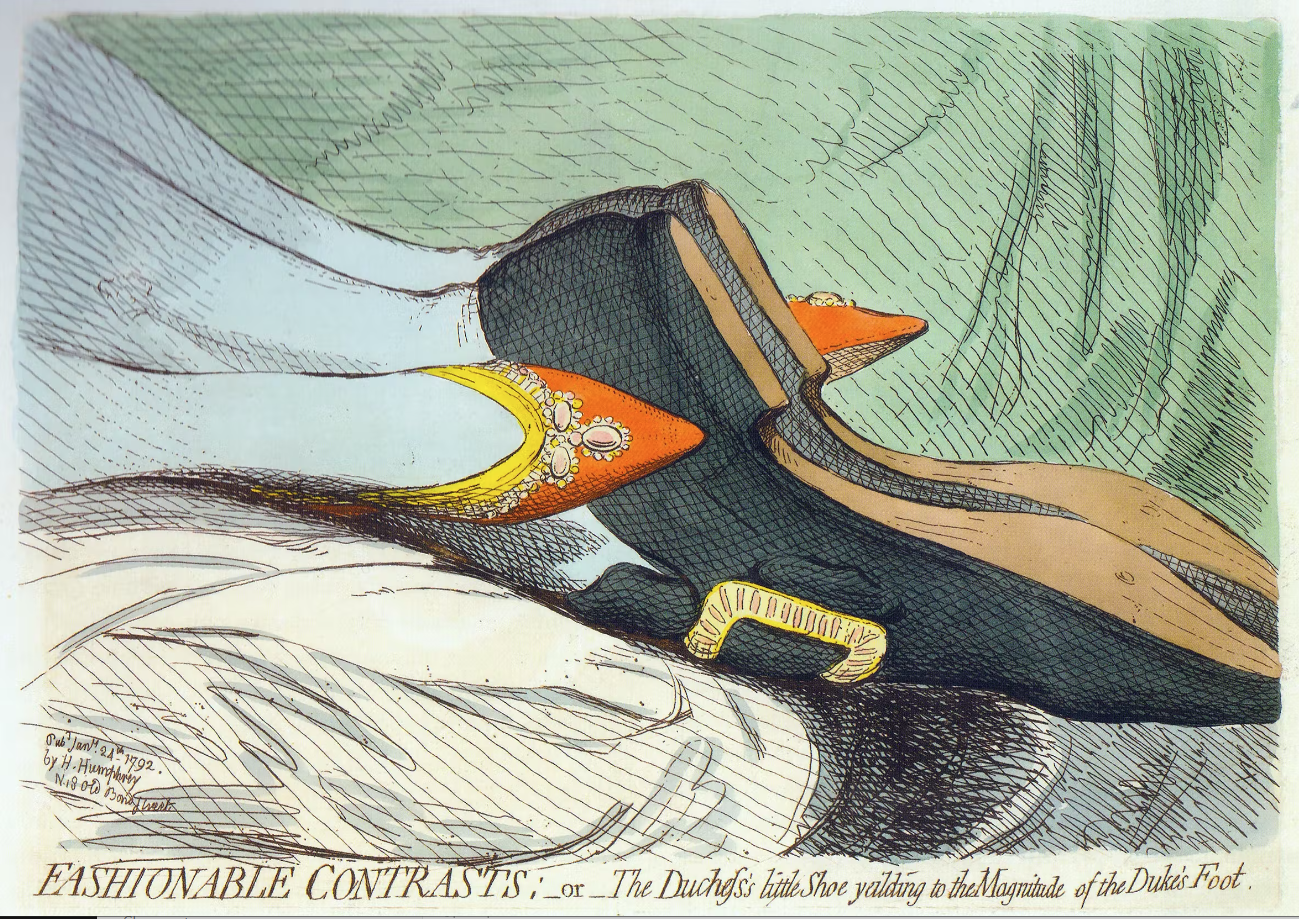
Some of Gillray’s works would pass most people by today, thanks to the much-trumpeted “world-class edication” which is nothing of the sort: one of my own favourites is his FASHIONABLE CONTRASTS;—or—The Duchefs’s little Shoe yeilding to the Magnitude of the Duke’s Foot (1792), which refers to the remarkably small hooves of Princess Frederica Charlotte Ulrica Catherina of Prussia (1767-1820), who married Frederick, Duke of York and Albany (1763-1827) in 1791: their supposed marital consummation is suggested by Gillray’s slightly indelicate rendering, in which the Duke’s very large footwear dwarfs the delicate slippers of the Duchess.
“In 1791 and 1792, there was no one who received more attention in the British press than Frederica Charlotte, the oldest daughter of the King of Prussia, whose marriage to the second (and favorite) son of King George and Queen Charlotte, Prince Frederick, the Duke of York set off a media frenzy that can only be compared to that of Princess Diana in our own day.”
Description from james-gillray.org/fashionable.htmlAll that said, this is a fine book, beautifully and pithily written, scholarly, well-observed, and superbly illustrated, much in colour. However, it is a very large tome (290 x 248 mm), and extremely heavy, so can only be read with comfort on a table or lectern. The captions give the bare minimum of information, and it would have been far better to have had extended descriptive captions under each illustration, rather than having to root about in the text, mellifluous though that undoubtedly is.
What is perhaps the most important aspect of the book is to reveal Gillray’s significance as a propagandist in time of war, for the images he produced concerning the excesses of what had occurred in France helped to stiffen national resolve to resist the revolutionaries and defeat them and their successor, Napoléon, whose own model for a new Europe was in itself profoundly revolutionary. What he would have made of the present gang of British politicians must remain agreeable speculation.
Comments Off on James Gillray
QotD: The rise of liberalism
Liberalism, in its own turn, came out of the accidents of European reformations, revolts, and revolutions, in an existing polity of hundreds of more or less independent political units, such as the Dutch cities in their Golden Age, or the Kleinstaaterei of German polities even after 1648. The success of the accidents made people bold — not necessarily and logically, but contingently and factually. For example, the Dutch Revolt 1568–1648 imparted the idea of civic autonomy against the hegemon of the time, Spain, and by analogy against other hegemons international and local. For another example, the initial successes of the English Civil War of the 1640s made ordinary people think they could make the world anew. For still another example, the Radical Reformation of Anabaptists, Mennonites, Congregationalists, and later the Quakers and Methodists let people take charge of their own religious lives, and by analogy their economic lives. The tiny group of English Quakers made for Lloyd’s insurance, Barclay’s bank, Cadbury’s chocolate. It was in the religious case not the doctrines of Calvinism as such (not the Protestant ethic and the spirit of capitalism) but a flattened church governance that mattered for inspiriting people.
In sum, as one of the Levellers in the English Civil War of the 1640s, Richard Rumbold, said from the scaffold in 1685, “there was no man born marked of God above another, for none comes into the world with a saddle on his back, neither any booted and spurred to ride him.” It was a shocking thought in a hierarchical society. In 1685 the crowd gathered to see Rumbold hanged surely laughed at such a sentiment. By 1885 it was a solemn cliché.
Dierdre McCloskey, “How Growth Happens: Liberalism, Innovism, and the Great Enrichment (Preliminary version)” [PDF], 2018-11-29.
Comments Off on QotD: The rise of liberalism
November 29, 2022
Tank Chat #159 | Warrior | The Tank Museum
The Tank Museum
Published 29 Jul 2022Join David Willey for a new Tank Chat on Warrior.
(more…)
Comments Off on Tank Chat #159 | Warrior | The Tank Museum
November 28, 2022
Mulberry Harbours – Rhinos, Whales, Beetles, Phoenixs and Spuds against the Axis
Drachinifel
Published 13 Jul 2022Today we take a look at the artificial harbours designed, built and then installed on the Normandy beaches in 1944.
Many thanks to @Think Defence for finding and collating so many images and letting me use them! Follow them on Twitter or on their website for more interesting articles!
(more…)
Comments Off on Mulberry Harbours – Rhinos, Whales, Beetles, Phoenixs and Spuds against the Axis
November 27, 2022
The Costliest Day in US Marine History – WW2 – 222 – November 26, 1943
World War Two
Published 26 Nov 2022The Americans attack the Gilbert Islands this week, and though they successfully take Tarawa and Makin Atolls, it is VERY costly in lives, and show that the Japanese are not going to be defeated easily. They also have a naval battle in the Solomons. Fighting continues in the Soviet Union and Italy, and an Allied conference takes place in Cairo, a prelude for a major one in Teheran next week.
(more…)
Comments Off on The Costliest Day in US Marine History – WW2 – 222 – November 26, 1943
QotD: Gambling is not a “public health” issue
Nevertheless, the public-health lobby is keen to take over this area of policy and PHE ended its days with the following conclusion: “The evidence suggests that harmful gambling should be considered a public-health issue because it is associated with harms to individuals, their families, close associates and wider society.”
By this definition, anything that can cause harm to individuals and / or other people is a public-health issue. This would make every health problem and most social problems public-health issues. It spreads the net across such a vast expanse of human behaviour that it renders the term “public health” totally meaningless. Still, this is very much in keeping with the mission creep of a sector that claims everything from poverty and war to housing and climate change can be public-health issues.
It can be argued that almost everything has an effect on health, but what is the point of making everything a public-health issue? What expertise do people with a masters in public health have that makes them better at solving complex social and economic problems than anyone else? And as we saw during the pandemic, when the public-health lobby spreads itself too thinly, it becomes incapable of doing its day job. The World Health Organisation and Public Health England, for instance, were both far more interested in pushing for nanny-state interventions than in preparing for pandemics.
But if we see the modern public-health movement for what it really is – a paternalistic, bourgeois crusade for moral reform – it becomes obvious why gambling is in the crosshairs. A classic target of puritans, gambling will fit in well alongside the other supposed public-health “epidemics” of our age: gluttony, sloth, smoking and the demon drink. It wouldn’t surprise me if usury and lust were its next targets.
Christopher Snowdon, “No, gambling is not a “public health” issue”, Spiked, 2022-08-25.
Comments Off on QotD: Gambling is not a “public health” issue
November 26, 2022
Britain’s experiment with mass immigration since 2014
Ed West considers the legacy media’s quick dismissal of conservative concerns about rising immigration from poorer European countries in 2014 with the reality only eight years later:
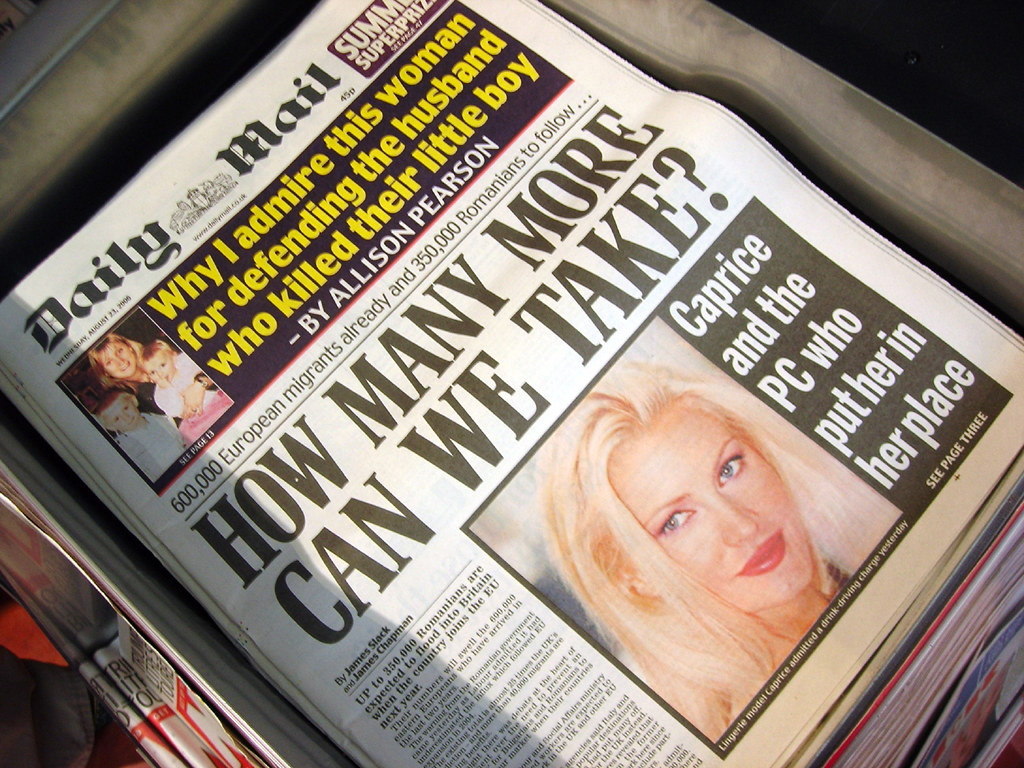


It was a sort of mini-publicity stunt by Vaz, but all for a good cause: a response to fear mongering by the Right-wing press who warned that we’d be “flooded” by Romanians, and predictions by MigrationWatch that’d we have 50,000 new arrivals a year from the A2 countries (as Romania and Bulgaria were called).
Twitter that day was full of journalists and other public intellectuals laughing about how we were going to be “swamped”. Why would Romanians, after all, want to come here, to this miserable rainy island?
“We’ve seen no evidence of people who have rushed out and bought tickets in order to arrive because it’s the 1st of January,” Vaz concluded.
Various publications, with the ill-founded confidence so often found in the journalist trade, soon declared that the Romanian influx was a conservative fantasy.
“Eastern European invasion comes to nothing”, the Independent declared on the day, just a tad prematurely you might say.
A Guardian commentator suggested the year before that the number of Romanians and Bulgarians arriving might actually fall following accession, and that “all the ‘invasion’ predictions … have more in common with astrology than demography.”
[…]As it turned out, in the year to September 2015, 206,000 Romanians and Bulgarians took out a National Insurance number, meaning they were registering to work here. By late 2017, there were 413,000 Romanian and Bulgarians living in Britain, suggesting 90,000 had arrived each year since January 2014, while just 6,200 Britons had made the opposite journey.
By mid-2018, there were more than 400,000 Romanians in Britain, making them one of the largest national minorities in England. The real figure is hard to tell, because the British state has lost the capacity or will to count the number of foreign residents, and it may be higher.
[…]
The scale of immigration in the 2000s and 2010s led to the rise of Ukip, the referendum and the political chaos that followed; what follows now we can’t yet say, but no one has seemed to have learned the lesson: that in the 21s century, because of easier travel, smartphones, smuggling networks and establishment communities in the West, the sheer scale of potential migration is astronomical. Yet people often have a very 20th or even 19th century understanding of how much people are able and willing to move, which makes them vastly underestimate the potential numbers arriving.
The Turkish Cypriots of north London are a case in point, the example Paul Collier used in Exodus to show the huge extent of potential migration between countries with different levels of wealth.
Because of colonial links, North Cyprus had free movement with Britain and so provided a test case: as a result, there are now more Turkish Cypriots in Britain than in Cyprus. In fact, not only did the majority of Turkish Cypriots move, but back in their homeland they become outnumbered by arrivals from a third, even poorer country, mainland Turkey, who are permitted to settle there.
In a theoretical world of open borders, Britons would be outnumbered very quickly; infrastructure would start to buckle under the strain, and governments would find it difficult to increase the necessary number of houses, schools, hospitals and other services for this expanded population, because society would now lack the social capital and cohesion to make the personal sacrifices. People would begin to lose faith in the police, a difficult role in such a transient and diverse society, and politics would become increasingly unstable and aligned along ethnic lines.
Comments Off on Britain’s experiment with mass immigration since 2014
November 25, 2022
The Secret Radio in Auschwitz – War Against Humanity 088
World War Two
Published 24 Nov 2022In Auschwitz the inmates gathering evidence of Nazi crimes score two successes, while the RAF score a direct hit on Goebbels as they set Berlin aflame. In the Pacific the accidental sinking of the SS Suez Maru triggers a Japanese war crime.
(more…)
Comments Off on The Secret Radio in Auschwitz – War Against Humanity 088
Canada’s all-purpose VTOL transport that could have changed everything; the Canadair CL-84 Dynavert
Polyus Studios
Published 14 Jul 2018The program that developed the CL-84 lasted for almost 20 years and produced one of the most successful VTOL aircraft ever, as far as performance. Canadair produced four Dynavert’s over those 20 years and two of them crashed. In fact one crashed twice. The story of the great CL-84 is one of perseverance and missed potential.
(more…)
Comments Off on Canada’s all-purpose VTOL transport that could have changed everything; the Canadair CL-84 Dynavert
November 23, 2022
Morris – A Minor Documentary
mglmedia
Published 28 Feb 2014The Morris Minor is a classic British car which has been given another lease of life by a new generation of young drivers. Join us on a journey from its humble beginnings to its current adventures on British roads with interviews with Mike Barson (Madness) Zac Ware (Charles Ware & The Proclaimers) Martin Wainwright (Author/Journalist) and a host of Morris Minor owners.
Comments Off on Morris – A Minor Documentary


