
World War Two
Published 23 Feb 2023Thanks to Curiosity Stream for sponsoring today’s video
Even as the Allied and Axis commanders focus on the sweeping warfare of the Eastern Front and the planning for the invasion of Europe, their men continue to fight a grinding war of attrition high in the Italian mountains. It’s a war of merciless terrain, brutal close-quarters combat, and vast quantities of artillery and bombs. They may be playing second fiddle, but the soldiers on the Italian front will never forget these battles.
(more…)
February 24, 2023
Up Close and Personal – Mountain Warfare in Italy – WW2 Special
Comments Off on Up Close and Personal – Mountain Warfare in Italy – WW2 Special
War of 1812 – Freshwater Edition
Drachinifel
Published 4 Sept 2019Today we take a look at the War of 1812 as it progressed on the Great Lakes.
(more…)
Comments Off on War of 1812 – Freshwater Edition
February 23, 2023
Doctor Who – long-term sleeper agent for the WHO?
I haven’t followed the TV series for a very long time (“my” Doctor was William Hartnell, then Patrick Troughton and by the time I watched another episode there’d been two more Doctors), but I still have fond memories of the show. Along comes Caroline Kaye to suggest that I was an unwitting victim of globalist propaganda:

The BBC science fiction television series Doctor Who has been a part of British popular culture since 1963. It is centred on the Doctor figure, a scientist who works to save civilisations, help people in need and to prevent evil forces from harming people. Remember that description.
A Doctor Who fanatic once told me that the “Who” of the Doctor’s name obliquely refers to the other WHO, the World Health Organisation. There appears to be something in this, however implausible. I find the strange coincidences between fiction and reality curious and uncanny.
The Doctor is a scientific adviser to the organisation UNIT, standing for United Nations Intelligence Unit, which happens to be based in Geneva, home of the WHO. UNIT has its military element in the form of “the brigadier” who liaises with the government and occasionally has to reach out to Geneva to “gain authority” when government does not co-operate.
The most famous Doctor Who monsters will always be the Daleks. In the story Genesis of the Daleks (1975), the Doctor’s nemesis is Davros, the creator of the Daleks. Davros sounds rather like Davos, the home of the World Economic Forum, the WEF.
In the story, the Doctor is tasked with preventing the creation of the Daleks and faces a moral dilemma when confronted with the means to destroy them. He ponders in a renowned scene, “Have I the right [to destroy them]?” Declining to destroy the Daleks, the Doctor escapes, and the Daleks continue on their path of evil.
Doctor Who‘s other famous monsters, the Cybermen, are cyborgs – amoral, unfeeling transhuman creatures of our nightmares; surely the creations of mad or evil persons. Yet the idea of cyborgs and transhumanism is being pushed enthusiastically by the WEF, inspired by the ideas of Yuval Noah Harari who sees human beings merely as “hackable animals” to be augmented as necessary.
The WHO acronym is the emblem of an organisation supposedly formed, like the Doctor, to help people and protect them. Instead, in the last three years we have seen, at the behest of the WHO, the poorest and weakest of the world economically hammered, a swathe of unnecessary deaths from a treatable coronavirus, worldwide harms and deaths through forced vaccination, all of which break every human right established in the wake of WWII. This is outlined in devastating detail by Toby Green and Thomas Fazi in their book, The Covid Consensus: The Global Assault on Democracy and the Poor – A Critique from the Left.
Now the WHO is preparing a new treaty which ultimately will result in signing member states becoming legally subordinate to the WHO. It is designed to subsume us all into a malleable collective. In other words, as per the sprawling EU project, our politicians will be able to blame the WHO for mandating medical treatments, lockdowns and prevention of travel, all of which could happen at the whim of the director general. Or more likely, its biggest, unelected, non-medically trained funder Bill Gates.
Comments Off on Doctor Who – long-term sleeper agent for the WHO?
Scottish First Minister Nicola Sturgeon had become “a marmite figure during her time in office, loathed and loved in equal measure”
In The Line, Andrew MacDougall looks at what caused the departure of Nicola Sturgeon despite the continued strong support for her party in Scotland:

Last week, Scotland’s most popular politician suddenly announced that she would retire. While Sturgeon’s popularity has dipped in recent days, she remains, by a long way, the most recognized and respected politician in the land. And she is leaving absent any obvious firing offense, nor any looming electoral deadline.
More importantly, Sturgeon is leaving without her raison d’être — Scottish independence — fulfilled, with the next election having already been framed as an (unofficial) referendum on that most cherished of prizes for any leader of the Scottish Nationalist Party. That Sturgeon would choose this moment to exit has prompted a flurry of speculation.
To Sturgeon’s credit, she was admirably clear with her reasons during the press conference announcing her decision to stand aside. She decried the “brutality” and “intensity” of modern political life, stating the job took everything she could give and that, like Jacinda Arden before her, she had come to the realization she didn’t quite have enough left to get independence over the line.
On that front, Sturgeon also said it would be unfair on her colleagues and her party to have her views on independence — and how best to achieve it — bind them if she no longer had the will or energy to contest the next election. And fair enough. Sturgeon has been First Minister for eight years, and was number two to former First Minister Alex Salmond for the eight years prior to that, having assumed the leadership after Salmond’s failed push for Scotland’s independence in the 2014 referendum.
And yet, with support for Scottish independence still fairly strong — a poll taken in late January had it at 52 per cent, an eight-point gap over the forces of unity — it still seems a strange time for someone whose entire life’s work has been ditching the UK to ditch the most powerful post to help usher it along.
So, what gives?
Comments Off on Scottish First Minister Nicola Sturgeon had become “a marmite figure during her time in office, loathed and loved in equal measure”
February 22, 2023
Mosquito Bombers Bust Out French Resistance – War Against Humanity 098
World War Two
Published 21 Feb 2023Across Europe the anti-Nazi Resistance continues to rise as does the infighting. In France the RAF carry out Operation Jericho to break out captured resistance members held at the prison in Amiens.
(more…)
Comments Off on Mosquito Bombers Bust Out French Resistance – War Against Humanity 098
Toward a taxonomy of military bullshit
Bruce Gudmundsson linked to this essay from “Shady Maples“, a serving officer in the Canadian Army, on the general topic of bullshit in the military:

Armies, as a rule, are quagmires of bullshit. The Canadian Army is no exception. We accept that bullshit is an occupational hazard in the Army, but it’s a hazard that we struggle to manage and it’s one that threatens our effectiveness as a force.
In order to understand bullshit we need a taxonomy, that is, a map of bullshit and the common varieties found in the wild. Using our taxonomy, we can develop diagnostic tools to detect bullshit and expose its corrosive effects on our integrity and professional culture. I assume that bullshit is also a hazard in other environments and government departments, but since my experience is in the land force I will be focusing my attention on that.
The subject of bullshit entered the mainstream in 2005 when Princeton University Press issued a hardcover edition of Harry G. Frankfurt’s 1988 essay “On Bullshit“. Frankfurt doesn’t mince words: “[one] of the most salient features of our culture is that there is so much bullshit. Everyone knows this. Each of us contributes his share.” He argues that even though we treat bullshit as a lesser moral offence than lying, it’s actually more harmful to a culture of truth. I believe this wholeheartedly, for reasons which will become clear.
In Frankfurt’s view, even though a liar and a bullshitter both aim to deceive their targets, bullshitting and lying require different mental states. In order to lie, someone must believe that they know the truth and intentionally make a false account of it. For example, if you believe that today is Monday but today is in fact Tuesday, and somebody asks you what day it is, you’re not a liar if you say “today is Monday”. You’re not lying because you really do believe that today is Monday, even though this belief is incorrect. In order to lie, you have to intentionally make a statement that is contrary to the truth as you understand it. In this example, you would be lying if you said “today is Tuesday” while believing that today is actually Monday. You would be accidentally correct, but you would still be lying because you are providing a false account of what you believe is true.
This means that lying actually requires a tacit respect for the truth on the part of the liar. The liar has to at least acknowledge the existence of truth in order to avoid it. To provide a false account of the truth, the liar must first believe in the truth.
The bullshitter, by contrast, does not operate under this constraint. Bullshit according to Frankfurt is speech without any regard for the truth whatsoever. To Frankfurt, “[the bullshitter] does not care whether the things he says describe reality correctly. He just picks them out, or makes them up, to suit his purpose.” Bullshit, Frankfurt argues, is speech that is disconnected from a concern for truth. The bullshitter will say anything if it helps them achieve their desired ends.
[…]
Let’s move on to the topic of “bull”, which is discussed at length by British psychologist Norman F. Dixon, author of On the Psychology of Military Incompetence. Dixon beat Frankfurt to the punch by publishing his own theory of bullshit in 1976, twelve years before “On Bullshit”. Dixon is a Freudian psychologist writing in the 1970s, so I am skeptical of the scientific merit of his book. Nonetheless, he provides an interesting outsider’s perspective of British military culture from the Crimean War up to the Second World War and how that culture enabled terrible officers while punishing competent ones (spoiler: aristocrats and nepotism are bad for meritocracy).
There is an entire chapter of the book about bullshit as a contributing factor to military incompetence. Dixon attributes the origin of the word “bullshit” to Australian soldiers, who in 1916 “were evidently so struck by the excessive spit and polish of the British Army that they felt moved to give it a label”. His theory of the Australian origin of bullshit is supported by Australian philosopher David Stove, who believed that it’s a signature national expression.
[…]
Canadian political philosopher G. A. Cohen added some depth to the discourse when he responded to Frankfurt in “Deeper into Bullshit“. Cohen wasn’t satisfied that Frankfurt had explored full range of bullshit as a social phenomenon. Frankfurt anchors his definition of bullshit in the intention or mental state of the speaker (the bullshitter) whose lack of concern for truth is what makes their statements bullshit. Cohen responds to this by pointing out that there are many people who honestly profess their bullshit beliefs. Reading this brought me back to my undergrad days. I had a TA in a 300-level philosophy course who claimed that he doubted his own existence. Personally, I wondered whether he would still doubt his own existence if I punched him in the balls for spewing such performative bullshit in class. So I think that Cohen makes a good point: there are bullshitters who honestly believe their own bullshit.
Cohen’s argument is squarely aimed at a certain style of academic writing, which he calls “unclarifiable unclarity.” These are intentionally vague statements which cannot be clarified without distorting their apparent meaning or dropping the veil of profundity altogether. If you want an example, you can try reading Hegel or a postmodernist philosopher, or just save yourself the effort and click on this postmodern bullshit generator (trust me, it’s indistinguishable from the real thing). Pennycook et al. label statements of this type as “pseudo-profound bullshit“. Hilariously, they ran a series of experiments to see if test subjects would find the appearance of profound truth in both real and algorithmically-generated Deepak Chopra tweets. The result, disappointingly, was yes.
Cohen adds a fourth type of bullshit to our taxonomy: “irretrievably speculative comment”. Basically, when someone is arguing for a proposition which they have no way of knowing is true or false, or they put forward an argument that’s completely unsupported by readily available evidence, then that argument is bullshit.
[…]
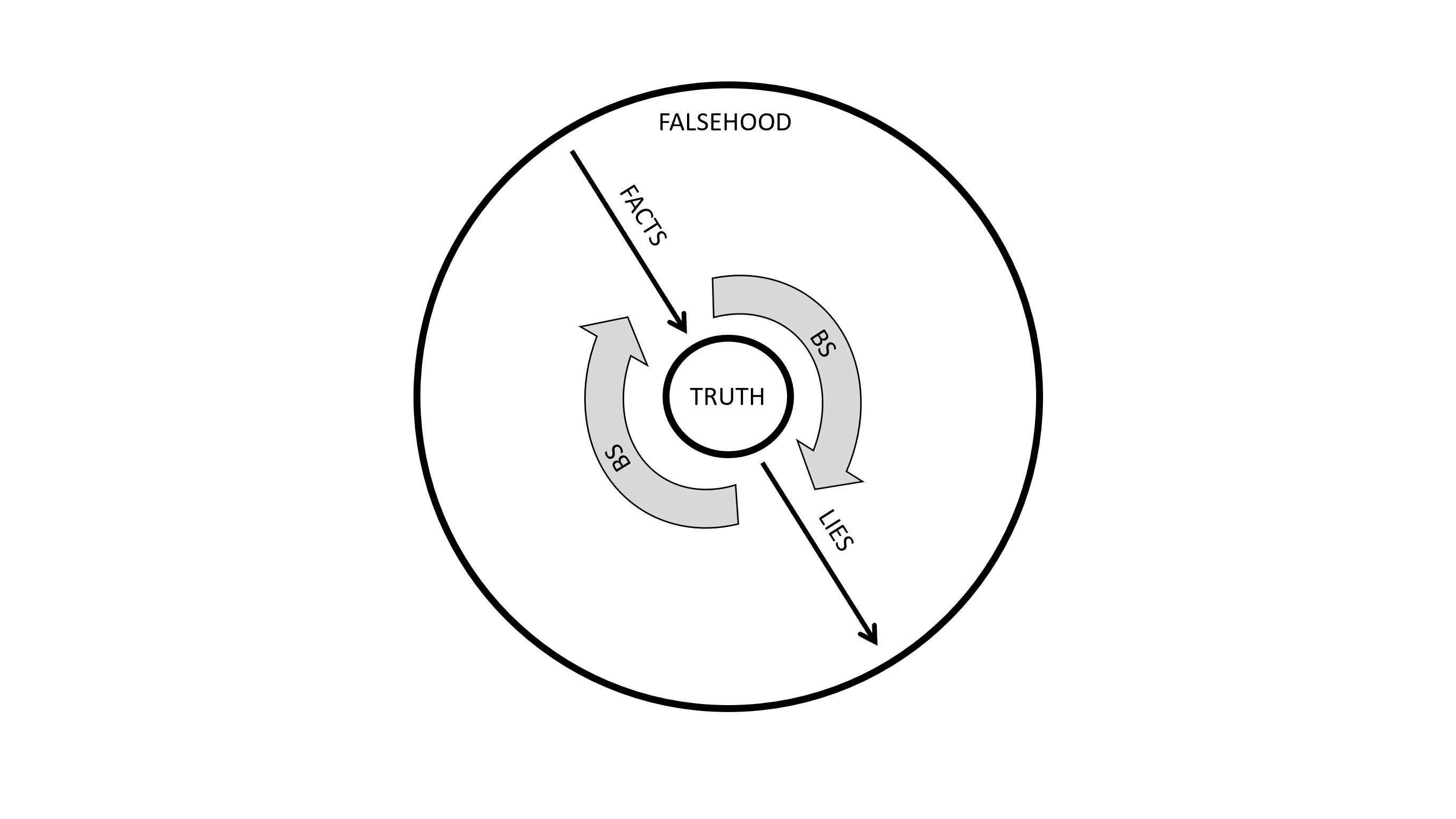
Still with me? So far we’ve identified and defined four types of bullshit (BS):
BS1 (Frankfurt): propositions made without concern for truth.
BS2 (Dixon): ritualistic activity which doesn’t serve its stated aim or justification.
BS3 (Cohen/Pennycook): unclarifiable unclarity aka pseudo-profound bullshit.
BS4 (Cohen): speculation beyond what’s reasonably permitted by the evidence.
The common denominator of all four types of bullshit is their disconnection from reality. Bullshit statements don’t enhance our understanding and bullshit activity doesn’t get us any closer to achieving our goals in the real world. Bullshit doesn’t necessarily move us further away from truth, like lies do, but it certainly doesn’t get us any closer to it either. Essentially, bullshit lowers the signal-to-noise ratio of discourse.
The endless carousel of bullshit.
Comments Off on Toward a taxonomy of military bullshit
QotD: The soul of the bureaucrat
It is amazing how a small circumstance can in a trice overturn a mood from one of equanimity to one of anxiety and irritation. What most upset me was the thought of having to deal with the British bureaucracy in order to obtain some kind of travel document or other. I could just see in my mind’s cinema the drab room in the consulate where a minor official, who hated his work and was thoroughly bored with and disgusted by the procession of incompetents, liars, and con men who day after day appeared before him claiming that their case was particularly urgent or in some way deserving of his special attention, eked out his miserable existence, praying every day for the time of closure of the consulate to approach quickly rather than at its usual snail’s pace. Nominally, of course, he was the servant of the citizenry whose taxes paid his salary, but drawing this to his attention would only have slowed him down and made him more determined than ever to draw out the agony of the scum with whom he had always to deal. The fact is that no Middle Eastern or Central Asian peasant at the diwan of the potentate’s vizier was ever more a powerless petitioner than is the average Western citizen in a situation such as this. The citizen is nothing and the bureaucrat is everything.
I had all kinds of documents with me to prove that I was the person I said I was, namely me; besides which, it was surely obvious, even to the most casual observer, that I was a respectable citizen not given to obtaining travel or other documents by false pretensions. But these days we live under a regime, if not exactly of laws rather than of men, at least of regulations rather than of men, and an official such as the one with whom I would have to deal would be allowed to exercise no discretion in case he thereby revealed his social prejudices. “Let justice be done though the heavens fall,” said Cicero, which we have changed to “Though the heavens fall, let the forms be filled and the boxes ticked.”
To do my imaginary official justice, I would have behaved just like him if our positions had been reversed. There are many jobs whose sole pleasure or delight must be in disobliging the public. Bureaucrats are themselves so oppressed by bureaucracy that their only way of finding relief is to make others suffer like them. The wonder, then, is not that they are bad, but that they are not worse.
Theodore Dalrymple, “The Bureaucrat’s Point of View”, Taki’s Magazine, 2018-05-12.
Comments Off on QotD: The soul of the bureaucrat
February 20, 2023
Thirteen reasons the Dutch did better financially than the English in the Seventeenth Century
In the latest Age of Invention newsletter, Anton Howes investigates the huge differences between the rival English and Dutch financial markets in the 17th century:
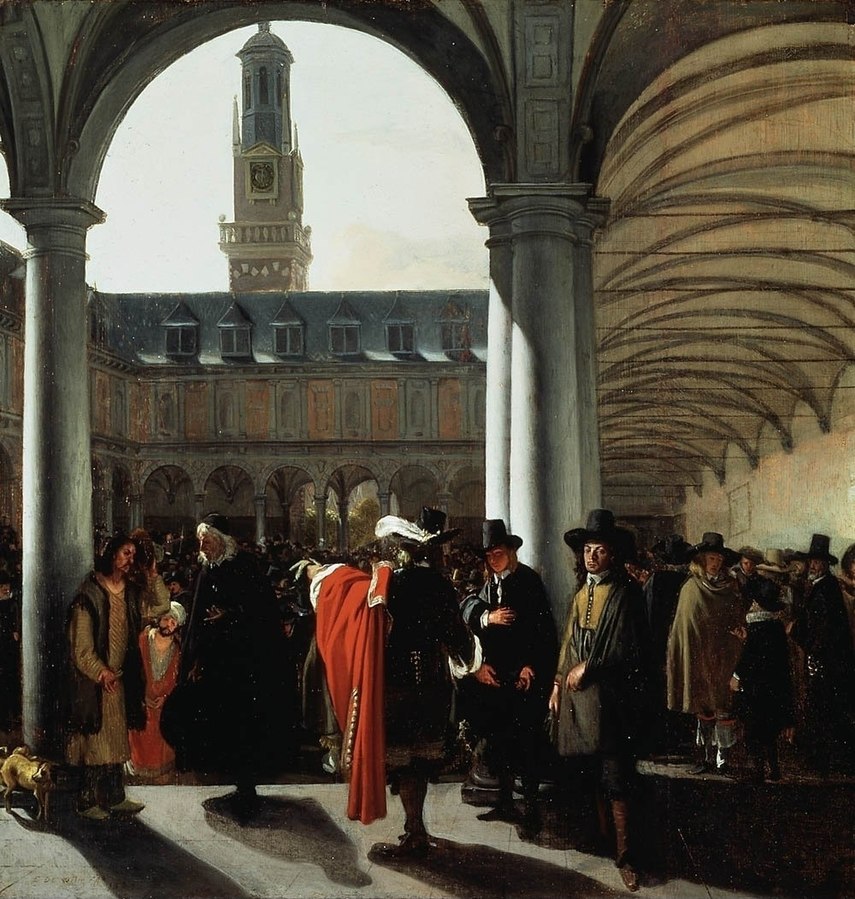
The courtyard of the exchange in Amsterdam (De binnenplaats van de beurs te Amsterdam), 1653.
Oil painting by Emanuel de Witte (1617-1692) from the Museum Boijmans Van Beuningen collection via Wikimedia Commons.
One of the weird things about Britain, despite its being the birthplace of the Industrial Revolution, is that its financial infrastructure was for a long time remarkably backward. Its “Financial Revolution”, by which both people and the state began to borrow at ever lower interest rates, only really took off in the early eighteenth century — long after London’s extraordinary growth in 1550-1650, when it had suddenly expanded eightfold to become one of Europe’s most important commercial hubs. Indeed, even for much of the late seventeenth century, England lacked many of the most basic financial institutions that had been used for decades and decades by their most important rival and trading partner, the Dutch Republic.
I was especially intrigued when I stumbled across a discussion of Dutch policies and customs, written up in around 1665 by the young merchant Josiah Child, and published a few years later: a kind of wishlist of many of the things that made the Dutch so wealthy, and which the English continually failed to emulate:
- The Dutch councils of state and war always included merchants who had experience of trading and living abroad — Child was perhaps just angling for some influence here, but for all that merchants were getting more influential, in England they were not actually in charge.
- Gavel-kind succession laws, whereby all children got an equal share of their parents’ estates, rather than it all going to the eldest. English primogeniture, by contrast, apparently left a lot of gentlemen’s younger sons having to become apprenticed to merchants.
- High regulatory standards for goods. A barrel of Dutch-packed herring or cod would apparently be accepted by buyers just by viewing the marks, without having to open them up to check. English-packed goods, by contrast, were rarely trusted because the fish would turn out to be rotten or even missing — the English regulators’ stamps of approval were reputedly given to anyone who would pay.
- Encouragement for inventors of new products, techniques, and import trades, who received rewards from the state, and not just temporary monopoly patents.
- Ships, called fluyt, which were cheaper to build, required fewer sailors, and were easier to handle. Despite being only very lightly armed, they sailed in fleets for protection, when necessary being convoyed by ships of war. English trading ships, by contrast, were each heavily armed, but with those cannon taking up room and weight that could have been used for carrying merchandise.
- Education of all children, even girls, in arithmetic and keeping accounts. As Child put it, this infused in the Dutch “a strong aptitude, love, and delight” for commerce. It also meant that husbands and wives were real partners in many businesses — something that impressed almost all foreign visitors to the Netherlands.
- Low customs duties, but high consumption taxes. Very low customs duties, on both imports and exports, meant that it was often very profitable to trade with the Netherlands. The Dutch were famed for their many ships, and for their granaries bursting with grain, despite growing hardly any trees or crops themselves. To fund their state, they instead overwhelmingly relied on the gemene middelen — taxes on the sale of wine, beer, meat, fuel, candles, salt, soap, flour, cloth, and a host of other goods, with many of the higher rates reserved for expensive luxuries. Much like modern value-added taxes, these taxes on consumption raised revenue while preserving the all-important incentive to save and invest.
- Thrifty living — which, come to think of it, was probably related to the high consumption taxes, although Childs doesn’t seem to have noticed the connection. Dutch thrift was thought by the English to be especially useful because it allowed wage costs to be kept low — essential for maintaining competitiveness in international markets — while preventing the country having a trade deficit. The English always worried they were sending too much of their silver abroad to pay for French wines and other luxuries, but the Dutch appeared to have prevented this without resorting to import tariffs that might annoy trading partners and prompt retaliation.
- Religious toleration, which attracted all sorts of industrious immigrants to bring their families and wealth. (Incidentally, as I’ve mentioned before, this was also one of the key attractions of Livorno, set up by the Medici Dukes of Tuscany to be a major trading hub.)
- The use of the Law-Merchant, which meant that all controversies between merchants and tradesmen were decided in just 3 or 4 days’ time. England, rather strangely for such an increasingly commercial nation, did not develop merchant courts with a specific jurisdiction or a distinct body of merchant law — disputes instead had to be resolved in the royal common-law or equity courts, in the Admiralty court, or else abroad. The English courts, however, were often slow. Child complained that cases often took half a year, and often much longer. (Incidentally, slow and rotten justice in the Court of Chancery, the key equity court used by merchants in England, was one of the reasons Francis Bacon was impeached by Parliament and sacked as Lord Chancellor.)
- Transferrable bills of exchange — in other words, the circulation of credit notes as a currency. These were not properly supported by English laws, but allowed Dutch merchants to trade a lot more frequently. English merchants often had to wait some six months to a year before receiving all the coin from selling their foreign goods in London, so as to purchase goods again to make fresh trades. They spent much of their time chasing shopkeepers for payment. But the Dutch, by being able to easily buy and sell their credit notes, could “turn their stocks twice or thrice in trade”, immediately settling their accounts and making fresh purchases. (I intend to look into this in a lot more detail soon, as finding a way to bills of exchange transferrable in England appears to have been a major project for many of the mid-seventeenth-century inventors and improvers — after just a cursory glance, transferability was only secured in law as late as 1704.)
- Banks. Or rather, as Child actually put it, “BANKS”. In England many of the functions of banks gradually evolved from the practices of individual goldsmiths and the scriveners — legal clerks who specialised in property transfers and mortgages. There was certainly nothing so secure as the municipal Wisselbank of Amsterdam, established in 1609, which had various monopoly powers as a clearing-house for bills of exchange and was backed by a vault full of bullion. Nor the municipal Bank van Lening, established in 1614, which was a pawnbroker modelled on the Italian Monte di Pietà, or mounts of piety, designed to make small and low-cost loans to the poor.
- “PUBLIC REGISTERS” — again capitalised by Child — of all lands and houses sold or mortgaged. This item on the policy wishlist would not be ticked off for England until two centuries later, but the key advantage was to prevent lawsuits over land titles — still cited as a major problem even in the 1690s — and so make land more genuinely secure for mortgages.
Finally, the result of many of these policies was the Dutch had significantly lower interest rates — often just 3-4% when the English were still lending and borrowing at 6-8%. Indeed, this list was made because of a long-standing English policy debate I’ve been researching, on whether to lower the legal maximum rate of interest.
Comments Off on Thirteen reasons the Dutch did better financially than the English in the Seventeenth Century
February 19, 2023
Andrew Sullivan on the legacy media’s coverage of transgender issues
In the free portion of his Weekly Dish, Andrew Sullivan looks at how the legacy media chooses to cover (or ignore) different aspects of pre-teen and teenage transgenderism:

Two people at EuroPride 2019 in Vienna holding an LGBTQ+ pride rainbow flag featuring a design by Daniel Quasar; this variation of the rainbow flag was initially promoted as “Progress” a PRIDE Flag Reboot.
Photo by Bojan Cvetanović via Wikimedia Commons.
One more criticism of the letter. It uses the terrible history of the [New York Times] on coverage of gay men and AIDS in the 20th century as equivalent to the reporting of Bazelon, Baker, et al, today. This is unhinged. Transgender people today are fully covered under the Civil Rights Act; in the 1980s, gays had nothing. In the 1980s and 1990s, the NYT opposed using the word “gay” because it legitimized homosexuality in some way; today the NYT prints “queer” or “trans” or LGBTQ+ in almost every other article.
Today, the paper has published a mountain of empathetic coverage of trans people — over 800 stories in the past year. Since January 1, the NYT has run a moving profile about a trans man in Mexico; a celebration of “queer” life in Alabama by a trans staffer; an exploration of nonbinary fashion; a critical orgasm over “queer” theater; and a news story explaining that “the flood of [trans-related] legislation is part of a long-term campaign by national groups that see transgender rights as an issue on which they can harness voter anger”. Comparing this with A.M. Rosenthal’s reign of homophobic terror and censorship is just obscene.
One historical analogy does seem salient to me, though: the drugs they now give to gender-dysphoric teens are very closely related to the drugs they used to “cure” Alan Turing of his gayness. Every time I think of that I shudder.
And this attempt to suppress reporting on the subject comes at a very strange time. Next week, a new book will be published about the Tavistock Centre, the place responsible for the medical and psychological treatment of children with gender dysphoria in Britain. It’s written by a liberal female journalist, Hannah Barnes, of a flagship British documentary show, Newsnight.
Her book exposes a huge medical scandal, in which countless children were put on puberty blockers with almost no psychological evaluation, and with rates of autism and domestic abuse that were already through the roof. It shows what happened when the new affirmation-only puberty-blocker experiment, only begun in the late 1990s, was left to run its course, with no opposition and no dissent allowed. Check out an extract here. Here’s where I sat up straight:
Clinicians recall multiple instances of young people who had suffered homophobic bullying at school or at home, and then identified as trans. According to the clinician Anastassis Spiliadis, “so many times” a family would say, “Thank God my child is trans and not gay or lesbian.” Girls said, “When I hear the word ‘lesbian’ I cringe”, and boys talked to doctors about their disgust at being attracted to other boys.
When Gids [the Gender Identity Development Service] asked adolescents referred to the service in 2012 about their sexuality, more than 90 per cent of females and 80 per cent of males said they were same-sex attracted or bisexual. Bristow came to believe that Gids was performing “conversion therapy for gay kids” and there was a bleak joke on the team that there would be “no gay people left at the rate Gids was going”.
Just think about that for a second. And remember that gay groups cheer this on; and several gay writers put their names to the letter. What a massive reckoning may be in store for them. If any of this pans out, and gay groups have endorsed it, it could easily be the greatest scandal in the history of the gay rights movement.
More than a third of the kids pushed onto the trans track had autism, sometimes severe. Others were victims of domestic abuse: “[A natal girl] who’s being abused by a male, I think a question to ask is whether there’s some relationship between identifying as male and feeling safe”, one clinician at the center said. No questions about other aspects of a child’s mental health were considered if the kid was identifying as the opposite sex. And this took place in a socialized system, with constant oversight, and no massive financial incentives to treat children. Just imagine what could be happening in the US private system where trans patients are among the most lucrative to have in your care, and are under treatment their entire life.
[…]
One obvious area for research: why have the sex ratios shifted so radically in the past decade or so — with girls now vastly outstripping boys in the young patients involved? Why the explosion in requests? It’s far more dramatic and skewed to one sex than it would be if merely a function of declining stigma. Yet for woke journalists, it’s all Principal Skinner: “Let’s have no more curiosity about this bizarre cover-up.”
Something is going on among teen girls more generally. The CDC just issued a frightening new report:
Nearly 3 in 5 teen girls (57%) said they felt “persistently sad or hopeless”. That’s the highest rate in a decade. And 30% said they have seriously considered dying by suicide — a percentage that’s risen by nearly 60% over the past 10 years.
Now check out Jamie Reed’s and Tavistock’s overwhelmingly female, often deeply unhappy, clients. Is there a connection? I don’t know. What I do know is that it’s the job of the media to find out, and not to shut itself down.
The lobby groups and often well-intentioned doctors who have pioneered this massive experiment on children will naturally resist any idea they have been facilitating abuse, or concede any points — because as soon as they confess doubt, the whole house of cards can come tumbling down; and lawsuits alone could end the practice very quickly. The Democrats and the Biden administration have locked themselves to the idea that this kind of treatment is a no-brainer and never does any harm — and they just keep repeating that like a mantra and never address the recent restriction of these experimental practices in progressive Europe. The far right can use the issue to gin up homophobic tropes and cruel treatment of trans people.
The Destruction of Monte Cassino – Week 234 – February 18, 1944
World War Two
Published 18 Feb 2023The Allies bomb the monastery atop Monte Cassino in Italy, but just to the Northwest it’s the Germans attacking them at Anzio this week. In the Soviet Union, the Axis break out of the Korsun Pocket, but at great cost, and in the Pacific comes a major Allied raid on the Japanese base at Truk and landings on Eniwetok Atoll.
(more…)
Comments Off on The Destruction of Monte Cassino – Week 234 – February 18, 1944
Flower-Class Corvettes – WW2 Atlantic Defender
Matsimus
Published 29 Jun 2020The Flower-class corvette (also referred to as the Gladiolus class after the lead ship) was a British class of 294 corvettes used during World War II, specifically with the Allied navies as anti-submarine convoy escorts during the Battle of the Atlantic. Royal Navy ships of this class were named after flowers, hence the name of the class.
The majority served during World War II with the Royal Navy (RN) and Royal Canadian Navy (RCN). Several ships built largely in Canada were transferred from the RN to the United States Navy (USN) under the lend-lease programme, seeing service in both navies. Some corvettes transferred to the USN were manned by the US Coast Guard. The vessels serving with the US Navy were known as Temptress and Action-class patrol gunboats. Other Flower-class corvettes served with the Free French Naval Forces, the Royal Netherlands Navy, the Royal Norwegian Navy, the Royal Indian Navy, the Royal Hellenic Navy, the Royal New Zealand Navy, the Royal Yugoslav Navy, and, immediately post-war, the South African Navy.
After World War II many surplus Flower-class vessels saw worldwide use in other navies, as well as civilian use. HMCS Sackville is the only member of the class to be preserved as a museum ship. Flower Class corvettes were originally intended for coastal escort and mine clearing work. Derived from a whaler design, they were simple, highly seaworthy vessels that could be constructed in secondary yards. The dire lack of ocean escorts early in the war necessitated their being used to screen convoys traversing the North Atlantic between Nova Scotia and the UK. This was a role for which they were ill-designed, and their crews suffered accordingly. The Flowers were wet, highly cramped and impossibly lively. Many sailors could not adjust to the exhausting routine. Compounding the misery was the inexperience of the crews, most of whom had never been to sea. But any escort was better than none at all, so the yards continued to turn out corvettes. 120 were built in Canadian yards, and slightly more in the UK.
(more…)
Comments Off on Flower-Class Corvettes – WW2 Atlantic Defender
February 18, 2023
British Empire Crackdown in South Africa – Boer War 1899-1902
The Great War
Published 17 Feb 2023The 2nd Boer War saw the British Empire bring to bear the entire imperial might to put to rest a dispute with the Boer Republics in South Africa. With scorched earth tactics and the use of concentration camps, the Boer War was a glimpse of what was to come in 20th century warfare.
(more…)
Comments Off on British Empire Crackdown in South Africa – Boer War 1899-1902
George Hudson: Railway King or Prince of Darkness?
Jago Hazzard
Published 20 Dec 2020Entrepreneur, politician, businessman, visionary, benefactor, conman. There’s a lot to unpick with old George.
(more…)
Comments Off on George Hudson: Railway King or Prince of Darkness?
February 15, 2023
QotD: The divine right of kings
England’s James I, for instance, was a deeply weird dude. Though he wrote a whole book about his divine right to rule, he kept his weirdness sufficiently in check so as not to alienate his court. Alas, his heir didn’t bother, and we know how that turned out. And so it went with just about any divine right monarch — the more people who actually saw him, the flimsier the theory seemed. History is full of examples of kingdoms “ruled” by insane kings, but not too many of kingdoms thriving when the people knew the king was a lunatic. Feebleminded monarchs are generally kept under lock and key by their courtiers, or they end up Epsteined.
Even democracies once understood this. Pick any 19th century American legislator, for example. As P.J. O’Rourke once said about rock stars, to call one of these guys a drunken, borderline-illiterate pervert just means you’ve read his autobiography. But they knew enough to keep it sufficiently in check around the voters, so that so long as they didn’t actually Chappaquiddick someone, they’d face no repercussions.
Speaking of Chappaquiddick, the Media has always been complicit in the great game of Fool-the-Rubes. They only do it for Democrats now, of course, but that’s the real problem these days: the Media has been doing all this for so long, and so successfully, that they no longer feel the need to bother. Just as Charles I decided to let his freak flag fly because hey, why not, I’m the king, so the Democrat-Media complex went all-in in 2008. You watch these guys — Don Lemon, say, mocking Trump voters as illiterate hicks — and the expression on their face is one of relief. It feels good to finally let it all out, and the more you do it, the better it feels.
Severian, “Rule by Lunatic”, Rotten Chestnuts, 2020-01-29.
Comments Off on QotD: The divine right of kings
February 14, 2023
QotD: Outrage
Julie Burchill, “The pervert community? Oh please”, Spiked!, 2019-05-08
Comments Off on QotD: Outrage


