
Barcode
Published 11 Oct 2021A summary of the entire Jeeves & Wooster series in roughly 6 minutes.
P.G. Wodehouse’s Jeeves (played by Stephen Fry) and Bertie Wooster (Hugh Laurie) have been lauded as one of the greatest comic double acts of all time. Set in the late 1920s-1930s, Jeeves and Wooster (1990-1993) follows the hilarious misadventures of Bertram Wilberforce Wooster — a young, affable English gentleman of the idle rich — and Jeeves — Bertie’s omniscient and resourceful valet. Jeeves discreetly takes control of his “mentally negligible” employer’s life, while Bertie Wooster finds himself pushed and reeled into countless imbroglios, fiascoes, and romantic entanglements led by his hapless friends and imperious aunts. But each disaster is drawn to its own satisfactory conclusion through a concatenation of intriguing coincidences … or so they would seem. Until, that is, the silent force behind every “coincidence” is revealed to be none other than the brilliant and inimitable Jeeves.
(more…)
December 4, 2023
Jeeves and Wooster, in a nutshell …
December 3, 2023
“I find myself despising the elites I joined in ways that shock me. I have come to despise the woke left, their indifference to crime, their reveling in reverse-racism, their deep hatred of Western civilization”
I’ve been reading Andrew Sullivan’s Substack since he started and it’s always been a pretty clear indicator that as soon as the name Trump is mentioned, the rest of the piece can be ignored because he’s been saying the same things for literally years now. This week’s article is a significant break with that tradition. It’s not that he suddenly likes Trump but that he seems to have gained more understanding about why other people support him:

As old-time Dishheads may recall, I was one of a handful of pundits who thought in early 2016 that Trump not only could, but probably would, win the election. I could feel his appeal in my lizard brain, and had long studied the fragility of liberal democracy in my frontal cortex. But the moment I knew his presidency was almost certain was when the Brexit result was announced in June, when everyone still assumed Hillary was a shoo-in. Something was stirring. And that’s why, after my annual trip back to Britain last week, I’m feeling the nausea again.
[…]
Add to that anger a lockdown far more intense than in the US and a period of crippling inflation, and you have a recipe that will likely lead to a Labour landslide next year. And in so many countries right now, for a variety of reasons, you see the same “blow it all up” mentality, turfing out incumbents mercilessly, often in favor of performative populists of various hues and flavors.
Look at the Netherlands: a progressive country that just saw Geert Wilders’ hard-right anti-immigration party go from 10 percent in 2021 to 23.5 percent of the vote, and become by far the biggest party in the Dutch House of Representatives, with center-right parties open to joining them. Or Argentina, where a weirdly coiffed, former rock-singer, Javier Milei — who had a near mental breakdown in a televised interview during the campaign, complaining about voices that weren’t there — wiped out the Peronist establishment in a landslide.
Orbán’s decisive re-election, Meloni’s electoral victory in Italy, and Sweden’s lurch to the right all suggest a sudden widening of the Overton window in much of Europe. In Germany, the AfD, the far-right movement, is now polling at 21 percent of the electorate, compared with 15 percent for Chancellor Scholz’s Social Democrats and 9 percent for the Greens. None of it is particularly coherent. Milei is Steve Forbes in a very bad toupee — about as far away from Boris’ Red Toryism or entitlement-friendly Trumpism as you can get. The only truly consistent thing is the ridiculous hair, and contempt for elites.
And the fear of the crazy right has gone. Milei and Wilders instantly moderated on some of their most outlandish positions, as soon as power was within reach. No, Milei won’t dollarize the Argentine economy, it turns out; and no, Wilders won’t ban mosques, as he tries to build a coalition government. Meloni has talked up immigration control, but in power, she hasn’t done much about it, and her support for Ukraine and the EU has been a big surprise. Poland’s hard-right party showed it could not stay in power forever this year, and in Spain, Vox lost ground. But in all this, a taboo has been broken — the same kind of taboo that the election of Donald Trump represented. The small-c conservatism of the Western electorate has expired.
That’s why I find the re-election of Joe Biden so hard to imagine. Biden is the incumbent of all incumbents. He became a senator in 1973! He has been vice president for eight years and president for four. He’s extremely old for the job he is doing, and everyone knows it. He has presided over inflation higher than at any time since the 1970s, and a huge new wave of legal and illegal immigration. We may now have a higher percentage of the population that is foreign-born than in the entire history of this country of immigration. Americans’ support for a border wall is the highest it’s been since 2016.
And Gallup’s latest polling on how the public feels about crime should terrify the Democrats. Coming back to DC this week after seven months away, I’m struck by how stark the decline has become. It says something when a city is experiencing a massive wave of carjackings, bars the cops from pursuing them, and just hands out free AirTags so you can track your stolen car yourself.
And the key, lame argument from Biden will be that Trump is too big a risk to take. He’s right. Broadly speaking, I agree with Bob Kagan on the crazed ambitions of this tyrant wannabe. But how has that argument worked out so far? Impeachments and indictments seem to have strengthened, not weakened him. And what we’re seeing all over the world is that voters are rushing toward the risky candidates, not away from them.
And Trump has already been in office for four years, and … democracy didn’t end, did it? Or at least, that’s what his supporters will say. They’ll remember the pre-Covid years as the good old days (and economically they wouldn’t be wrong), and also vent anger at an elite that seems to care more about pronouns and “equity” than protecting the border or controlling crime — the core functions of government. I’d be worried if Biden were ahead of Trump by five points in the battleground states. But he’s actually behind.
And though I will never vote for Trump, in my lizard brain, I kind of get the appeal. Inflation and mass immigration, alongside a bewildering and compulsory cultural revolution, are the kind of uncontrollable things that make people vent, especially if the president seems oblivious to these concerns — as Biden does. When Elon Musk f-bombed on Andrew Ross Sorkin and the advertisers who are boycotting X this week, the rational part of me shook my head. He’s bonkers and may see his company collapse from his whims and rages.
But at some deeper level, I also wanted to yell “Fuck yeah!” I find myself despising the elites I joined in ways that shock me. I have come to despise the woke left, their indifference to crime, their reveling in reverse-racism, their deep hatred of Western civilization. I hate how they’ve taken so much of the progress we made on gay integration and thrown it all away in transqueer solipsism. I loathe their piety and certainty and smugness. I found their instant condemnation of Israel, even as October 7 was taking place, shocking.
Was Hürtgen Forest Worth it? WW2 – Week 275 – December 2, 1944
World War Two
Published 2 Dec 2023The bulk of the fight for Hürtgen Forest is now over, and today we look at the results. We also look at Soviet plans for their January offensive. In the field this week, the Red Army is still fighting in Hungary, the Allies are still trying to reach the Roer River in the west, and in the Pacific Theater the kamikaze menace is wreaking havoc with Allied scheduling.
00:00 INTRO
01:06 Soviet Offensive Plans for 1945
03:12 Red Army attacks in Hungary
06:19 The Port of Antwerp is clear for use
07:23 The Battle of Hurtgen Forest is Over
12:20 Allied advances to the Roer
14:19 Tension builds in Greece
15:32 The aerial situation in the Philippines
21:36 CONCLUSION
(more…)
Doctor What-are-your-pronouns
I don’t watch Doctor Who although I have fond childhood memories of watching William Hartnell and Patrick Troughton’s respective “Doctors” and I caught one or two episodes of Jon Pertwee and Tom Baker in the role. That the show is still running on British TV is a wonder … but it got headlines for a recent installment that had the Doctor being told off for “assuming” an alien creature’s pronouns:
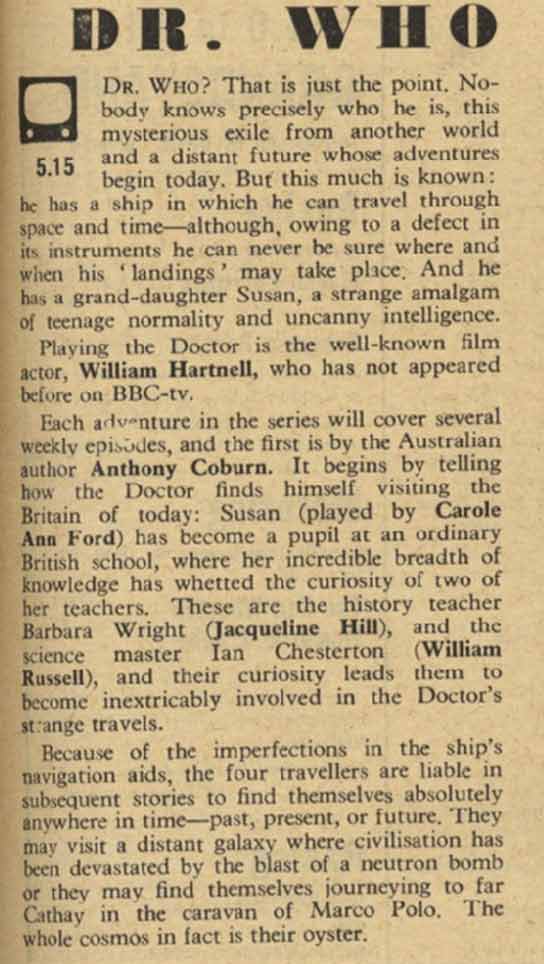
Remember when Doctor Who was fun? Watching it now is about as much fun as being publicly humiliated at work by some jumped-up nonbinary form-filler from HR who thinks he’s amazing because he’s painted one of his fingernails black.
A good example of this joylessness is a scene in the most recent special, “The Star Beast”, which has been treated by right-on broadsheet types as a moment of profound importance. Yet all that happened was a transwoman character – played by transwoman actor Yasmin Finney – lectured the Doctor about pronouns. In a moment of unforgivable Time Lord-cis privilege, the Doctor had assumed a diminutive alien called Beep the Meep used male pronouns. What was he thinking?
It is this sort of banal plot line that encapsulates the shrivelling ambition of science fiction. Once the genre dared to hold up a provocative mirror to contemporary society. From Mary Shelley’s Frankenstein to Octavia Butler’s Parable of the Sower, sci-fi challenged lazy assumptions. Now it revels in groupthink that feeds the collective self-righteousness of indolent teenagers and adults with teenage imaginations.
This matters, because at its best sci-fi can dazzle and even inspire us with the potential strangeness of the imagined future. A few years ago I made a series presented by William Shatner tracing the cultural and technological influence of Star Trek. In one episode, the inventor of the mobile phone, Martin Cooper, told director Julian Jones how he had been inspired by the example of Captain Kirk’s hand-held “communicator”. Will anyone invent something inspired by the new Doctor Who? A new set of guidelines for pronoun use, perhaps?
You can tell how out of touch Doctor Who has now become by the fact its enormously pompous showrunner, Russell T Davies, seemed to think that the new series would shock viewers with its “progressive” radicalism. The only shock was the alien pronoun scene’s patent stupidity.
I mean, why on Earth would the Doctor assume the gender of any alien? He has been encountering aliens with no fixed gender since the 1960s. The Doctor has effectively been asking aliens for their pronouns for nigh on 60 years.
Davies may think he’s blazing a trail with the new series of Doctor Who. But the truth is that gender-bending in science fiction is as old as the frozen hills of Gallifrey. In The War of the Worlds, published 125 years ago, HG Wells regaled us with Martian invaders who reproduced asexually. And hermaphrodites pepper sci-fi, from the work of Philip K Dick to that of Ursula K Le Guin.
December 2, 2023
Shane MacGowan, RIP
I’ve been a long-time fan of the Pogues, and Shane MacGowan was the original lead singer for their first several albums. His lifestyle and undependability brought about a break with the rest of the band who continued on without him. I rather lost track of him soon after his next band, the Popes, had one okay album that showed MacGowan hadn’t shaken his demons. I still post his duet with the late Kirsty MacColl every Christmas. In The Pillar, Ed Condon remembers MacGowan:

Shane MacGowan performing in Japan on an unknown date.
Photo by Masao Nakagami via Wikimedia Commons.
Yesterday Shane MacGowan, lead singer of the Pogues, died at age 65.
He was, in every sense, a living legend of Irish music — so much so that many people, sincerely, expressed shock that he was actually still alive. [NR: Literally the words out of my mouth when Elizabeth told me he’d died.]
Most people, at least in this country, know him best for his fiercely melancholic Christmas ballad “Fairytale of New York”, though the Pogues albums Rum, Sodomy & the Lash and If I Should Fall from Grace with God firmly fixed MacGowan as the living conduit of a musical tradition all too often dismissed as a postcard anachronism, created to appeal to tourists.
There was nothing contrived, though, about MacGowan, who was the living embodiment of the distinctly Irish contradiction of “fierce melancholy.” An incredibly gifted writer and poet, he wrote, performed — and lived — with a kind of burning urgency that seemed at once self-consuming and yet in him, rather than from him.
It would be easy to dismiss the riotous drinker and singer, whose punk-inflected incarnation of Irish ballardry seemed stoked with some terrible ferocity, as just an eloquently wounded product of a now nearly vanished Irish society. But what marked him out, to me, was that he was driven by something from within, not without.
Born on Christmas Day in 1957 to Irish parents in England, he spent his early life back in Ireland, living in a family cottage in rural Tipperary, where the children slept three to a bed, there was no running water, and the family cooked on an open fire.
According to his parents, music and storytelling were the focus of their family life in those days.
“It was basic and beautiful,” he said of his childhood. “It was the end of an era that I just happened to catch. And I’m glad I caught it, you know?”
[…]
“All I ever had were happy times,” is how MacGowan described his childhood in Ireland.
This deep understanding and love for his own history and where he came from, which John Paul II also wrote about in Memory and Identity, suffused MacGowan’s music.
But even as he became a kind of living totem in his home country it was clear he loathed the spotlight, writhed during interviews, and fought, often unsuccessfully, to balance his natural reticence with the convulsive need to make his music.
It drove him to at times terrible self-destruction, but the defiance and desperation of his singing seemed always directed back within himself. And it was a great comfort to read his family’s announcement that he’d died with the last rites imparted.
He was a man for whom the words of Jim Harrison, another great poet, seemed to be written:
Some people hear their own inner voices with great clearness and they live by what they hear. Such people become crazy, or they become legend.
Rest in peace, Shane.
November 30, 2023
Men and Morale: Canadian Army Training in the Second World War
WW2TV
Published 1 Feb 2023Men and Morale: Canadian Army Training in the Second World War
Part of Canadian Week on WW2TV With Megan HamiltonThe Canadian Army of the Second World War spent more time preparing and training their citizen soldiers then they did in sustained action. This chiefly took place across Canada and in the United Kingdom. Adequate training functioned as a cradle for collective action, morale, empowerment, self-confidence, and, ultimately, success in battle. Yet, due to a number of factors, a sufficient standard of training was not always achieved by all.
There were limits to the Canadian Army’s ability to control the morale of its men as it created a vast organization from scratch. Training camp experiences varied, influenced by factors such as food, weather, comfort, group cohesion, leadership, skill level, discipline, social activities, and interactions with local civilians. In fact, it required a constant negotiation between camp leadership and the rank and file. Drawing from her research on both the Canadian and wider Commonwealth armies, Megan’s presentation will explain why soldiers’ morale in training was a difficult, yet vital, balancing act.
Originally from Vernon, British Columbia, Megan Hamilton is a social and military historian of the 20th century. She has an Honours Bachelor of Arts degree from Wilfrid Laurier University and a Master of Arts degree from the University of Waterloo. Her federally-funded master’s research focused on the Canadian experience of the Second World War, specifically the Vernon Military Camp. Megan’s work has been published by a number of platforms and in 2022 she won the Tri-University History Program’s top essay prize for master’s students.
She is currently located in London, England, where she has begun a fully-funded PhD at King’s College London and the Imperial War Museum, supervised by Dr. Jonathan Fennell. Her dissertation is a study of Second World War army training across the Commonwealth.
(more…)
QotD: “Information velocity” in the English Civil War
Information velocity had increased exponentially by the 1630s, such that the English Civil War was, in a fundamental way, a propaganda war, an intellectual war.
Some of the battles of the Wars of the Roses were bigger than some of the Civil War’s battles – an estimated 50,000 men fought at Towton, in 1461 – but the Civil War was inconceivably harder and nastier than the Wars of the Roses, because the Civil War was an ideological war. The Wars of the Roses could’ve ended, at least theoretically, at any time – get the king and five dukes in a room, hammer out a compromise, and simply order everyone in each lord’s affinity to lay down his weapons. The Civil War could only end when everyone, in every army, was persuaded to lay down his arms.
Thus the winners had to negotiate with the people, directly. The Putney Debates didn’t involve everyone in the realm, but they were representative, truly representative, of everyone who mattered. Though no one explicitly made an appeal to competence alone, it was – and is, and must be – fundamental to representative government. Guys like Gerrard Winstanley had some interesting ideas, but they were fundamentally impractical, and Winstanley was not popularly viewed as a competent leader. Oliver Cromwell, on the other hand, was competence personified – the Protectorate became Cromwell’s military dictatorship largely because the People, as literally represented by the New Model Army, wanted it so … and, thanks to much faster information velocity, could make their wishes known.
Severian, “Inertia and Incompetence”, Founding Questions, 2020-12-25.
November 29, 2023
Alfred the Great
Ed West‘s new book is about the only English king to be known as “the Great”:
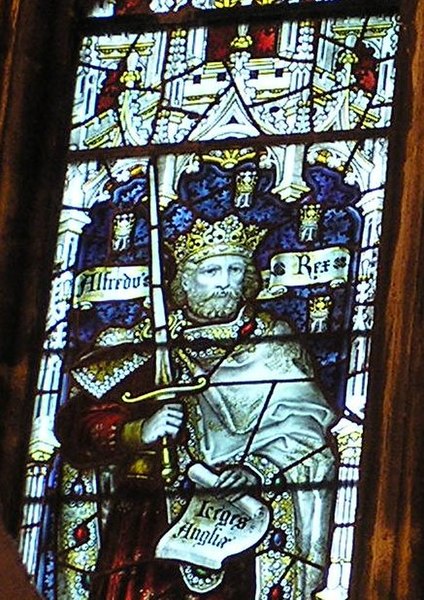
There are no portraits of King Alfred from his time period, so representations like this 1905 stained glass window in Bristol Cathedral are all we have to visually represent him.
Photo by Charles Eamer Kempe via Wikimedia Commons.
History was once the story of heroes, and there is no greater figure in England’s history than the man who saved, and helped create, the nation itself. As I’ve written before, Alfred the Great is more than just a historical figure to me. I have an almost Victorian reverence for his memory.
Alfred is the subject of my short book Saxons versus Vikings, which was published in the US in 2017 as the first part of a young adult history of medieval England. The UK edition is published today, available on Amazon or through the publishers. (use the code SV20 on the publisher’s site, valid until 30 November, which gives 20% off). It’s very much a beginner’s introduction, aimed at conveying the message that history is just one long black comedy.
The book charts the story of Alfred and his equally impressive grandson Athelstan, who went on to unify England in 927. In the centuries that followed Athelstan may have been considered the greater king, something we can sort of guess at by the fact that Ethelred the Unready named his first son Athelstan, and only his eighth Alfred, and royal naming patterns tend to reflect the prestige of previous monarchs.
Yet while Athelstan’s star faded in the medieval period, Alfred’s rose, and so by the fifteenth century the feeble-minded Henry VI was trying to have him made a saint. This didn’t happen, but Alfred is today the only English king to be styled “the Great”, and it was a word attached to him from quite an early stage. Even in the twelfth century the gossipy chronicler Matthew Paris is using the epithet, and says it’s in common use.
However, much of what is recorded of him only became known in Tudor times, partly by accident. Henry VIII’s break from Rome was to have a huge influence on our understanding of history, chiefly because so many of England’s records were stored in monasteries.
Before the development of universities, these had been the main intellectual centres in Christendom, indeed from where universities would grow. Now, along with relics, huge amounts of them would be lost, destroyed, sold … or preserved.
It was lucky that Matthew Parker, the sixteenth-century Archbishop of Canterbury with a keen interest in history, had a particularly keen interest in Alfred. It was Parker who published Asser’s Life of Alfred in 1574, having found the manuscript after the dissolution of the monasteries, a book that found itself in the Ashburnham collection amassed by Sir Robert Cotton in the late sixteenth and early seventeenth centuries.
Sadly, the original Life was burned in a famous fire at Ashburnham House in Westminster on October 23, 1731. Boys from nearby Westminster School had gone into the blaze alongside the owner and his son to rescue manuscripts, but much was lost, among them the only surviving manuscript of the Life of Alfred, as well as that of Beowulf. In fact the majority of recorded Anglo-Saxon history had gone up in smoke in minutes.
A copy of Beowulf had also been made, although the poem only became widely known in the nineteenth century after being translated into modern English. The fire also destroyed the oldest copy of the Burghal Hidage, a unique document listing towns of Saxon England and provisions for defence made during the reign of Alfred’s son Edward the Elder. An eighth-century illuminated gospel book from Northumbria was also lost.
So it is lucky that Parker had had The Life of Alfred printed, even if he had made alterations in his copy that to historians are infuriating because they cannot be sure if they are authentic. He probably added the story about the cakes, for instance, although this had come from a different Anglo-Saxon source.
We also know that Archbishop Parker was a bit confused, or possibly just lying; he claimed Alfred had founded his old university, Oxford, which was clearly untrue, and he was probably trying to make his alma mater sound grander than Cambridge. Oxford graduates down the years have been known to do this on one or two occasions.
November 28, 2023
Light Tank Mk IV | Tank Chats #173 | The Tank Museum
The Tank Museum
Published 18 Aug 2023Weighing in at five tons, machine gun armed and with a two-man crew, the Tank, Light, Mk IV was one of a series produced for the British Army by Vickers before World War II, seeing service on the NW Frontier of India. Recently restored, the Mk IV is the oldest running tank in our collection.
(more…)
November 27, 2023
This Cold War bomber was perfect. Why was it cancelled? | TSR2
Imperial War Museums
Published 9 Aug 2023In 1951, Britain introduced the English Electric Canberra. It would go onto become the RAF’s longest serving aircraft, designed to operate at high level. It was an incredibly efficient aircraft, but by the late 1950s everything changed. The Soviet Union brought into service brand new surface-to-air missiles and suddenly overnight the Canberra was vulnerable.
Now the British government needed a new aircraft, one that could beat this threat and fly under the radar. It was a huge ask for the technology of the time, but had it been successful the aircraft itself would have been a world beater. In this epsiode of Duxford in Depth, Liam Shaw takes a details look at the aircraft that never was, the BAC TSR-2.
(more…)
November 26, 2023
General Patton’s Metz Obsession – WW2 – Week 274 – November 25, 1944
World War Two
Published 25 Nov 2023Metz finally falls to Patton’s 3rd Army, but boy, it’s taken some time. To the south, the Allies also take Belfort and Strasbourg, and to the north Operation Queen continues trying to reach the Roer River. The Soviets complete their conquest of the islands in the Gulf of Riga and continue advancing in Hungary to the south, but it’s the Axis Powers — the Japanese — who are advancing in China, taking Dushan and Nanning.
01:15 Operation Queen Continues
04:49 9th Army attacks toward the Roer
05:54 Pattons 3rd Army takes Metz
09:22 Allies take Belfort, Mulhouse, and Strasbourg
13:56 8th Army Attacks in Italy
15:42 Soviet advances and German indecision
18:05 Japanese take Dushan and Nanning
19:21 The fight for Peleliu ends
21:43 Notes from all over
22:23 Conclusion
(more…)
Lancaster Howdah Pistols
Forgotten Weapons
Published 8 Nov 2014Charles Lancaster was a London master gunsmith who made 2-barrel and 4-barrel pistols in a variety of British revolver cartridges (commonly known as Howdah pistols). Many of his pistols was purchased privately by British military officers, explorers, and big-game hunters to use as backup weapons throughout the Empire. These three examples are chambered for the .380, .476, and .577 centerfire cartridges, and are all excellent examples of Lancaster’s work and the quality of Victorian-era British craftsmanship.
(more…)
QotD: From Industrial Revolution labour surplus to modern era academic surplus
The great thing about industrial work, though, is that you don’t have to be particularly bright to do it. There’s always going to be a fraction of the population that fails the IQ test, no matter how low you set the bar, but in the early Industrial Revolution that bar was pretty low indeed. So much so, in fact, that pretty soon places like America were experiencing drastic labor shortages, and there’s your history of 19th century immigration. The problem, though, isn’t the low IQ guys. It’s the high-IQ guys whose high IQs don’t line up with remunerative skills.
My academic colleagues were a great example, which is why they were all Marxists. I make fun of their stupidity all the time, but the truth is, they’re most of them bright enough, IQ-wise. Not geniuses by any means, but let’s say 120 IQ on average. Alas, as we all know, 120-with-verbal-dexterity is a very different thing from 120-and-good-with-a-slide-rule. Academics are the former, and any society that wants to remain stable HAS to find something for those people to do. Trust me on this: You do not want to be the obviously smartest guy in the room when everyone else in the room is, say, a plumber. This is no knock on plumbers, who by and large are cool guys, but it IS a knock on the high-IQ guy’s ego. Yeah, maybe I can write you a mean sonnet, or a nifty essay on the problems of labor over-supply in 16th century England, but those guys build stuff. And they get paid.
Those guys — the non-STEM smart guys — used to go into academia, and that used to be enough. Alas, soon enough we had an oversupply of them, too, which is why academia soon became the academic-industrial complex. 90% of what goes on at a modern university is just make-work. It’s either bullshit nobody needs, like “education” majors, or it’s basically just degrees in “activism”. It’s like Say’s Law for retards — supply creates its own demand, in this case subsidized by a trillion-dollar student loan industry. Better, much better, that it should all be plowed under, and the fields salted.
Any society digging itself out of the rubble of the future should always remember: No overproduction of elites!
Severian, “The Academic-Industrial Complex”, Rotten Chestnuts, 2021-05-30.
November 25, 2023
Crystal Palace Station is Needlessly Magnificent
Jago Hazzard
Published 9 Aug 2023Crystal Palace and the station built for it. Well, one of them.
(more…)
November 24, 2023
The Man Who Started the Cold War
World War Two
Published 23 Nov 2023What if I told you that a new conflict will sweep the globe in less than a year? It will open not with gunshots but with silent, shadowy espionage. The man who will kick off the Cold War is a quiet Canadian pilot, millionaire, and spymaster. A trusted aide to Churchill and FDR. I bet you haven’t heard this name before: William Stephenson.
(more…)


