
BBCWorldwide
Published on 24 May 2010The palace entertains two distinguished and highly superstitious actors. Blackadder is careful not to mention the name of the Scottish play. Funny clip taken from the classic BBC comedy Blackadder.
January 31, 2018
Don’t mention Macbeth – Blackadder – BBC
Comments Off on Don’t mention Macbeth – Blackadder – BBC
January 30, 2018
British Special Forces – Bulgarian-Ottoman Relations – Caporetto I OUT OF THE TRENCHES
The Great War
Published on 29 Jan 2018Ask your questions here: http://outofthetrenches.thegreatwar.tv
Comments Off on British Special Forces – Bulgarian-Ottoman Relations – Caporetto I OUT OF THE TRENCHES
Fitness tracker heat map shows dangerous activity near wrecked WW2 ammunition ship
The SS Richard Montgomery was a WW2 Liberty ship that ran aground near Sheerness in August 1944 carrying a cargo of bombs and other explosives. Part of the cargo was removed before the ship broke up and sank just offshore. There’s still quite a lot of TNT onboard the wreck, and it’s recently come to light that someone has been visiting the wreck, thanks to fitness tracker data:
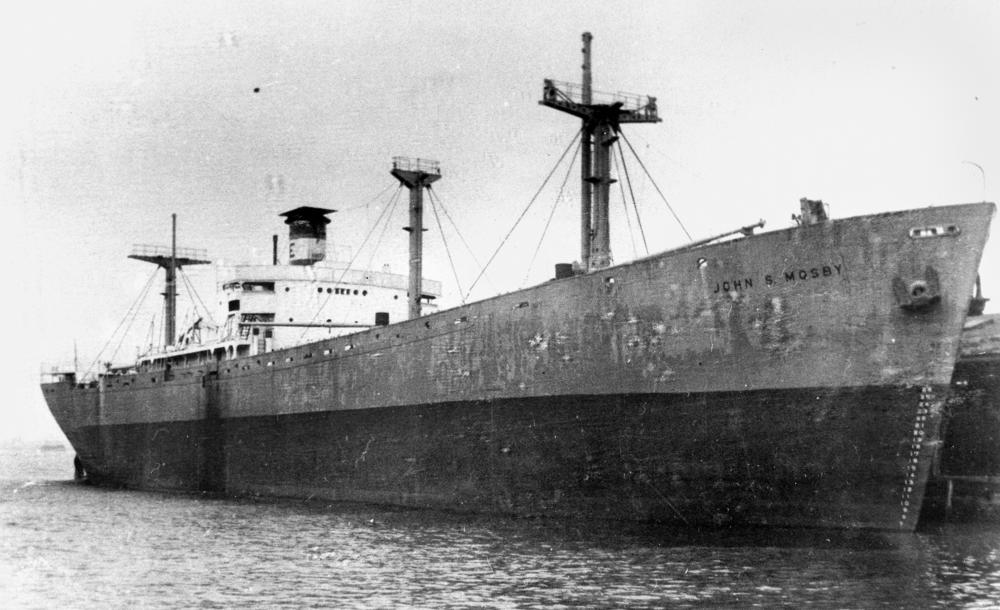
The SS John S. Mosby, a Liberty ship similar to the SS Richard Montgomery
Photo from the John Oxley Library, State Library of Queensland, via Wikimedia.
The information came to light after social media users realised that the latest version of Strava’s heat map, which shows the aggregated routes of all of its users, could be used to figure out where Western military bases in the Middle East are. Fitness-conscious soldiers, running around the bases’ perimeters, built up visible traces on the heat map over time.
However, of much more concern is the revelation that people have been poking around the wreck of the SS Richard Montgomery, a Second World War cargo ship that was carrying thousands of tonnes of explosive munitions from America to the UK. The ship grounded in the Thames Estuary, in England, in August 1944, barely two miles north of Sheerness.
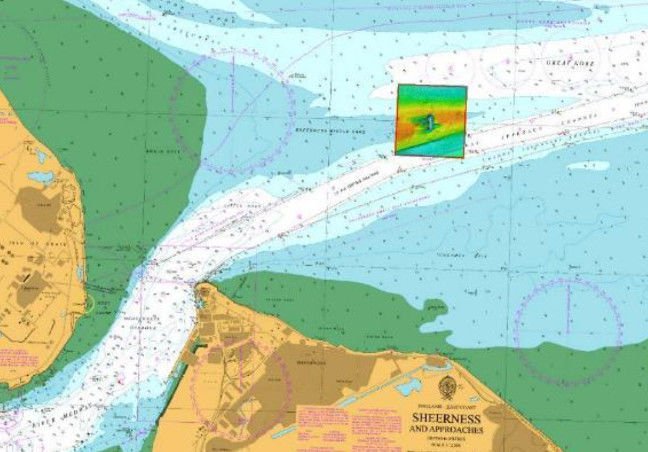
Extract from Admiralty chart of Sheerness (Crown copyright):
The multicoloured box is the location of the SS Richard Montgomery wreckAlthough wartime salvage parties managed to scavenge a large amount of ordnance from the grounded Liberty ship, her hull split in two and sank, taking around 1,400 tonnes of explosives down with her, before the job could be completed. Officials decided to leave the wreck in place.
According to a 1995 survey report [PDF] on the wreck: “The bombs thought to be on board are of two types. The bulk are standard, un-fused TNT bombs. In addition, some 800 fused cluster bombs are believed to remain. These bombs were loaded with TNT. They could be transported fused because the design included a propeller mechanism at the front which only screwed the fuse into position as the bombs fell from an aircraft. All the bombs could therefore be handled – with care – when the accident occurred.”
[…]
The 1995 report noted that TNT “does not react with water and will not explode if it is damp”, before adding that the brass-cased cluster bombs’ lead-based fuses “will combine with brass to produce a highly unstable copper compound which could explode with the slightest disturbance”. Although the compound “if formed, will wash away in a few weeks”, it was not made clear in the report how often the compound forms and creates the dangerous hair-trigger condition. Experts believe that the best way of keeping the wreck safe is not to disturb it, which led to a 500-metre exclusion zone being imposed around it.
I thought the ship’s name sounded familiar … I posted a video about the dangers of this wreck back in 2013. Last month, I posted a video about the Liberty ship program.
Comments Off on Fitness tracker heat map shows dangerous activity near wrecked WW2 ammunition ship
January 29, 2018
QotD: Churchill’s drinking habits
In the not so distant past around the sodden precincts of Westminster you were as likely to spot a yeti as a sober politician. The level of drinking that went on among MPs and their leeches for most of the last century was prodigious and was by and large expected. It was, as Ben Wright describes in his breezy, anecdote-rich and instructive survey of booze and politics, part of a culture which was tolerated and, to a degree, encouraged.
It was not without justification, for instance, that Adolf Hitler, who might have been a nicer fellow had he not been a teetotaller, described Winston Churchill as an “insane drunkard”, a “garrulous drunkard”, and “whisky-happy”.
If Order, Order! has a star it is undoubtedly Churchill who rarely let a day go by able to pass a breathalyser test. On occasion he would have a glass of wine at breakfast followed by a liquid lunch which invariably included Champagne and brandy. At tea-time he would progress to whisky. Then he would wash down dinner with more Champagne and brandy after which he had at least another whisky. According to one loyal aide who may have been sight impaired he was never the worse for wear for this intake and he “never felt the slightest ill-effects in the morning”.
Alan Taylor, “Lush tales of our political classes’ drinking exploits”, The National, 2016-06-20.
Comments Off on QotD: Churchill’s drinking habits
January 26, 2018
Civil War in Finland and the Ukraine I THE GREAT WAR Week 183
The Great War
Published on 25 Jan 2018This week in the Great War, two more wars start – the Finnish Civil War and the Ukrainian War of Independence. Meanwhile, David Lloyd George pulls some strings in France, even as Ludendorff settles on a target for Germany’s upcoming Spring Offensive.
Comments Off on Civil War in Finland and the Ukraine I THE GREAT WAR Week 183
Tank Chats #21 Mark V
Tank Museum
Published on 27 May 2016Although similar in appearance to earlier models the Mark V was a much better tank, more powerful and easier to drive.
It was equipped with a new engine and steering system which meant that one man could handle all the controls, compared with four in the Mark IV.
Commanded by a young officer named Whittenbury the Museum’s Mark V tank, seen in this video, took part in the Battle of Amiens and its young commander was awarded the Military Cross.
Comments Off on Tank Chats #21 Mark V
QotD: Britain’s boozy parliamentarians
It is Wright’s contention [in his book Order! Order!] that alcohol has as many benefits as it does drawbacks. Not only does it help loosen ties and tongues it also boosts confidence and dilutes stress. Most prime ministers drank, many to excess. Herbert Asquith went by the nickname “Squiffy Asquith” and regularly appeared in the Commons three sheets to the wind. Margaret Thatcher did her best to promote the whisky industry, the uncapping of a bottle of Bell’s marking the end of the working day. She believed that whisky rather than gin was good for you because “it will give you energy”, which I fear could be a hard fact to prove scientifically.
Tony Blair, whose reign ushered in an era of 24-hour drinking, thought his relatively modest drinking was getting out of control because he calculated it exceeded the government’s weekly recommended limit. This did not impress Dr John Reid, Bellshill’s finest, who once drank like a navvy. “Where I come from,” Reid told GMTV, “a gin and tonic, two glasses of wine, you wouldn’t give that to a budgie.” Blair, of course, did not have to look further than next door to find an explanation why his consumption increased over the years. Gordon Brown, his nemesis, was fond of Champagne – Möet & Chandon no less – which he did not nurse but washed down in a gulp. “He was like the cookie monster,” recalled one aide. “Down in one, whoosh!” Drinking is of course one of those areas in which we Scots have long punched above our weight and Wright’s pages are replete with examples of intoxicated Jocks carousing nights away and causing mayhem. Former Labour leader John Smith was one such. Occasionally I encountered him on the overnight train that carried Scottish MPs home from Westminster on a Thursday night. Known as “the sleeper of death”, it was a mobile pub that never closed until it reached Waverley, whereupon politicians were disgorged red-eyed and pie-eyed among bemused early morning commuters.
Alan Taylor, “Lush tales of our political classes’ drinking exploits”, The National, 2016-06-20.
Comments Off on QotD: Britain’s boozy parliamentarians
January 25, 2018
Looking deeper than just England, Scotland, Wales and Northern Ireland
H/T to @GarethSoye for posting this one (originally from Brilliant Maps):
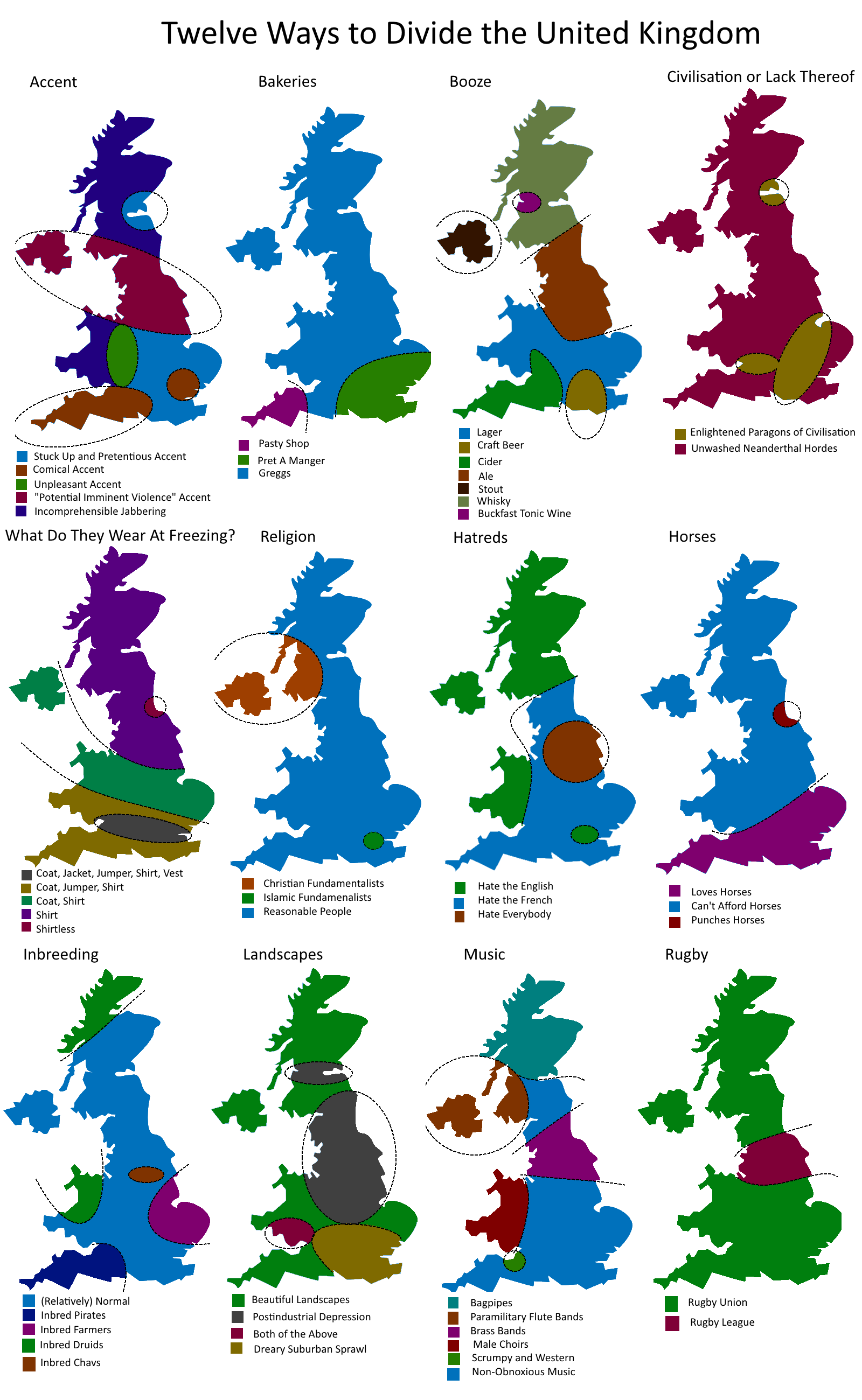
[Click to see full-sized image]
Comments Off on Looking deeper than just England, Scotland, Wales and Northern Ireland
January 24, 2018
Peter Jackson to bring modern digital technology to bear on IWM film footage of the Great War
Elizabeth sent me a link to this Daily Mail article on Peter Jackson’s new project:
When you think of First World War footage, chances are you conjure up grainy images of soldiers and jumpy footage of the trenches.
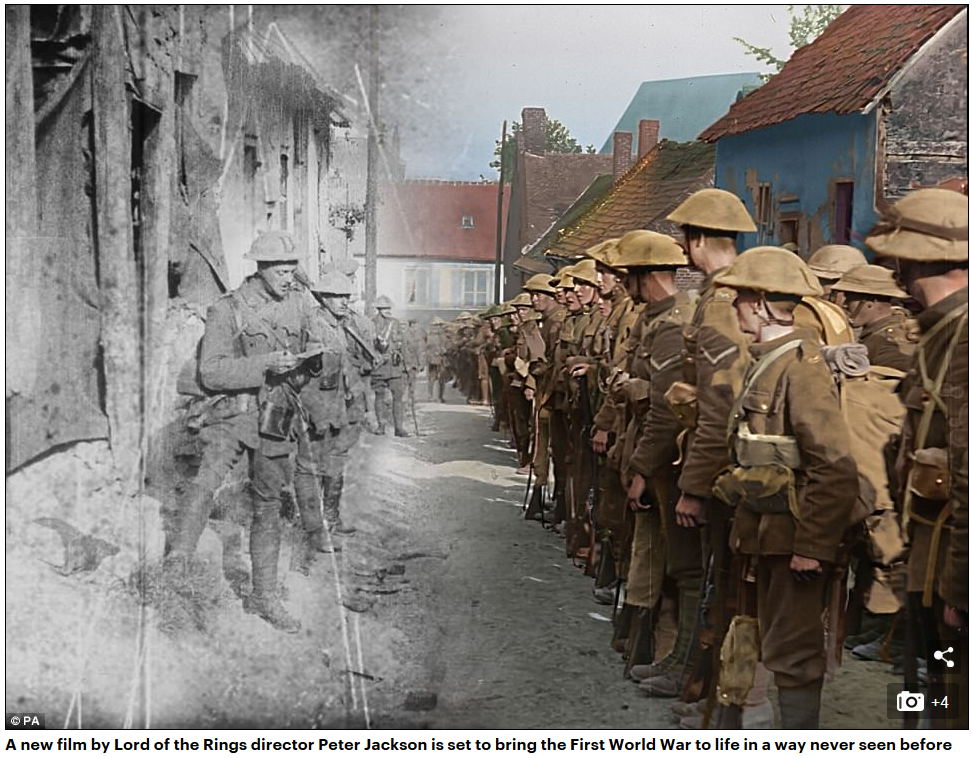
But a new 3D film by Lord of the Rings director Peter Jackson is set to bring the conflict to life in a way never seen before.
The Oscar-winner has restored and colourised 100-year-old footage from the Imperial War Museum’s vast archive, and early photos suggest the results will be remarkable.
One comparison shot shows the dramatic transformation from poor quality black-and-white scenes to clear colour images, while another shows the radically sharpened faces of our troops.
Jackson said he hoped the film, which will premiere at the BFI London Film Festival before airing on BBC1 later this year, will help audiences better connect ‘with the events on screen’.
Explaining the painstaking process of restoring the footage, he said: ‘We started to do some experiments and I was honestly stunned by the results we were getting. We all know what First World War footage looks like.
‘It’s sped up, it’s fast, like Charlie Chaplin, grainy, jumpy, scratchy, and it immediately blocks you from actually connecting with the events on screen.
Comments Off on Peter Jackson to bring modern digital technology to bear on IWM film footage of the Great War
January 23, 2018
British Pistols of World War 1 I THE GREAT WAR Special feat. C&Rsenal
The Great War
Published on 22 Jan 2018Check out Othais’ YouTube channel: https://www.youtube.com/candrsenal
Othais introduces the standard British pistols and revolvers to Indy, including the iconic Webley series.
Comments Off on British Pistols of World War 1 I THE GREAT WAR Special feat. C&Rsenal
Top Gear – lost in translation
Jean Girard
Published on 26 Feb 2009James May and Jeremy Clarkson discover the perils of a literal translation.
Comments Off on Top Gear – lost in translation
January 22, 2018
Rowan Atkinson Stand Up – 1989
Just For Laughs
Published on 6 Jan 2016Rowan Atkinson, actor and comedian best known for his work as Mr. Bean, brings his hilarious physical comedy to the 1989 Just for Laughs Festival in Montreal.
Just For Laughs is the world’s premiere destination for stand-up comedy. Founded in 1983, JFL produces the world’s largest and most prestigious comedy event every July in Montreal, as well as annual festivals in Toronto and Sydney.
Comments Off on Rowan Atkinson Stand Up – 1989
January 20, 2018
Sir Humphrey Appleby: The Consummate Civil Servant
rubatirabbit
Published on 3 Feb 2017From Yes Minister S03E06: “The Whisky Priest”
Comments Off on Sir Humphrey Appleby: The Consummate Civil Servant


