
Military History Visualized
Published on 22 Dec 2017This video discusses what killed the most tanks in World War 2. Was it anti-tank guns, mines, planes, hand-held anti-tank weapons, mechanical breakdowns, etc. Also a short look at the problems of the term “kill”, e.g., mobility, firepower and catastrophic/complete kill.
Original Question by Christopher: “What destroyed the most tanks during WW2: infantry, planes, anti-tank guns, or other tanks (I’m not sure if tank destroyers needs its own category or not).”
January 19, 2018
What “killed” the most tanks in World War 2?
Comments Off on What “killed” the most tanks in World War 2?
January 18, 2018
That Mitchell and Webb Look – “Grammar Nazi” (Mitchell & Webb Sketch Show)
David Mitchell
Published on 19 Dec 2017That Mitchell and Webb Look – “Grammar Nazi” (Mitchell & Webb Sketch Show)
Series: That Mitchell and Webb Look
Episode:
Year: 2007
Comments Off on That Mitchell and Webb Look – “Grammar Nazi” (Mitchell & Webb Sketch Show)
January 16, 2018
Yet another money squeeze for Britain’s military
At the Thin Pinstriped Line, Sir Humphrey outlines the difficult financial position the British Ministry of Defence (MOD) finds itself in and the very limited options available for the decision makers to choose among:
The Times has broken details of the planned cuts put forward by the MOD to meet the likely scale of budget cuts needed under the ongoing national Security Review being conducted in the Cabinet Office. The planned cuts as leaked to the Times highlight the sheer scale of the challenge facing the MOD at the moment, and seem to resort to many of the ‘greatest hits’ intended to arouse strong opposition, such as ‘merging the Parachute Regiment and Royal Marines’ option.
It is indicated that the Prime Minister has opposed the measures put forward, and that this in turn will lead to a full blown Strategic Defence and Security Review [SDSR], which will look again at force structures and outputs, and hopefully deliver a more balanced force in due course. The challenge is doing this against a budget which reportedly is £20bn in debt, with no meaningful way to find savings without serious pain.
[…]
The difficulty then for Defence is conducting an SDSR in a world where politicians seem unsure as to what their ambition is for the UK in the next 5-10 years, and whether they want to find the money to do this or not. There is probably strong political support for the idea of maritime and air power, both of which can easily be deployed (and recovered) discretely and with no long-term entanglements. It is reasonable to assume that the RN and RAF have a compelling case that they should receive the lions share of investment in the review.
By contrast the Army will find itself facing a difficult time – it is telling that all three options presented in the Times focused on a major loss of Army manpower, and capability reduction. What is also likely is the wider impact of further delays in procurement and reduction of exercises, training and other tools essential to keeping the Army credible. As its vehicle fleet ages, and with almost all of its primary weapon systems verging on becoming near obsolete, politicians face a difficult choice – do they continue to direct funding into high end high capability ground equipment, or do they take the ‘UOR [Urgent Operational Requirement] it on the day’ option of reducing the size of the Army and hope that come the next long-term ground operation, there is enough time to sort a round of UOR purchases out to equip people to the right standard.
At its heart though is the difficulty that the UK seems pathologically incapable of taking and sticking to credible long-term plans on defence and seeing them through to fruition. Strategic now seems to mean ‘two-year horizon’ at best, and there is a real sense that for all the glossy PowerPoint slides and publications, it is a department in a perpetual state of crisis as it struggles to afford the equipment needed to do the tasks asked of it.
This cycle of unaffordability is not new, in fact it seems never ending. There is an occasional period of a few years when things seem a bit better, but then another thing goes wrong and the Department is back to square one. Part of this problem lies in an eternally optimistic set of planning assumptions, coupled with such regular turn over of staff that no one ever has to see through the impact of their work.
The other problem is that rather than bite the bullet, take some incredibly tough decisions and wholesale withdrawal from commitments and capability, the Department lurches on, occasionally being bailed out by some deal that finds a few extra quid to just about see it through. What isn’t happening is systematic and thorough reforms to really grip and address the problems that the Department has got to stop them cropping up time and time again.
At some point the UK must have a serious policy discussion about what it really wants from its defence and national security capability. Does it want to seriously fund it, at a time of economic challenge and government austerity, or does it want to scale back ambition in order to find funding for other national projects? This conversation will not happen though in any meaningful sense, and instead the debate will be shallow, superficial and focus on numbers not outputs and leaked papers warning of an inability to defend the UK if something is cut.
It is all very well having an SDSR again (the third in 8 years), but unless there is a real change in behaviours, there will simply be another one in a couple of years’ time when the new plan proves unaffordable and unworkable. We cannot go on like this indefinitely.
Comments Off on Yet another money squeeze for Britain’s military
PIAT: Britain’s Answer to the Anti-Tank Rifle Problem
Forgotten Weapons
Published on 25 Nov 2017The British began World War Two with the Boys antitank rifle, but like all antitank rifles it rather quickly became obsolete. The replacement for it was adopted in 1942 as the PIAT – Projector, Infantry, Anti-Tank. This was a unique sort of weapon which fired a 3 pound (~1.35kg) hollow charge projectile using a combination of a massive spring and a firing charge much like a rifle grenade blank cartridge – a spigot mortar, really. The large (3.25″, 83mm) projectile was able to defeat almost any tank that would be developed during the war, as it could burn through 3-4 inches of hardened armor. However, it had a terrifyingly short effective range – 110 yards on paper and more like 50 yards in practice.
The PIAT would recock itself upon firing, but the initial cocking was something like a crossbow, requiring the shooter to brace their feet on the buttplate and pull the body of the weapon upwards, compressing the 200 pound (90kg) mainspring. When fired, the weapon has a pretty harsh recoil, although it did not have any flash or backblast like the American Bazooka did. By the end of the war more 115,000 PIATs had been made, and they would serve the British military into the 1950s, when they were replaced with more traditional rocket launchers.
Comments Off on PIAT: Britain’s Answer to the Anti-Tank Rifle Problem
January 15, 2018
The postwar “international order”
Niall Ferguson on the notion of a post-1945 international liberal order:
The phrase international order reminds me of the phrase Western civilization. As Indian independence icon Mahatma Gandhi wittily replied when asked about Western civilization, “It would be a good idea.” The notion that international order exists or has ever existed seems highly questionable to me. The notion of a liberal international order is even more questionable because it is neither liberal, nor international, nor very orderly.
It is often claimed by political scientists that the liberal international order came into existence in 1945. The argument goes that American and British statesmen, having learned from the terrible mistakes of the 1930s and 1940s, decided to make the world anew by creating a series of remarkable international institutions: the United Nations, the International Monetary Fund and later the World Bank. According to this narrative, Donald Trump’s election as US president in 2016 was a wrecking ball directed at the liberal international order created by the generation of 1945.
Yet this is a fairy tale. For one thing, there was nothing very liberal about the economic order that was established in 1945. It was devised by people – notably John Maynard Keynes – who had repudiated classical liberal economics and believed that international trade should be limited and capital movements controlled.
It was also not a truly international order. After 1945, it very quickly became a bipolar order that divided the world. There was nothing international about the Cold War. It was a battle between two empires and two ideologies, and the rest of the world’s nations had to choose sides.
In short, the notion of a liberal international order, born in 1945, is a historical fantasy. The reality is that it was only in 1991 when the Soviet Union collapsed and the Cold War ended that it was possible to create a liberal international order. The era of truly free trade, truly free capital flows and large-scale migration across borders did not begin until the 1990s.
Comments Off on The postwar “international order”
Top Gear Discusses Emergency Sirens
Jacob Epstein
Published on 12 Jun 2014Series 18, Episode 7
Comments Off on Top Gear Discusses Emergency Sirens
January 10, 2018
Rowan Atkinson – Interview with Elton John
SlugBalancer
Published on 23 Mar 2009Rowan Atkinson interviews Elton John at Hysteria 3 (1991)
Comments Off on Rowan Atkinson – Interview with Elton John
QotD: Winston Churchill as First Lord of the Admiralty
It did not take me very long to find out that Mr. Churchill was very apt to express strong opinions upon purely technical matters. Moreover, not being satisfied with expressing opinions, he tried to force his views upon the Board [of the Admiralty]. His fatal error was his entire inability to realize his own limitations as a civilian. I admired very much his wonderful argumentative powers. He surpassed the ablest of lawyers and would make a weak case appear exceedingly strong. While this gift was of great use to the Admiralty when we wanted the naval case put well before the government, it became a positive danger when the First Lord started to exercise his powers of argument on his colleagues on the Board. Naval officers are not brought up to argue a case and few of them can make a good show in this direction.
Vice-Admiral Sir John Jellicoe, Second Sea Lord of the Admiralty 1912-14, quoted by Robert K. Massie, in Castles of Steel.
Comments Off on QotD: Winston Churchill as First Lord of the Admiralty
January 9, 2018
The Seven Years War: Crash Course World History #26
CrashCourse
Published on 19 Jul 2012In which John teaches you about the Seven Years War, which may have lasted nine years. Or as many as 23. It was a very confusing war. The Seven Years War was a global war, fought on five continents, which is kind of a lot. John focuses on the war as it happened in the Americas, Asia, and Africa. the “great” European powers were the primary combatants, but they fought just about everywhere. Of course, this being a history course, the outcomes of this war still resonate in our lives today. The Seven Years War determined the direction of the British Empire, and led pretty directly to the subject of Episode 28, the American Revolution.
Comments Off on The Seven Years War: Crash Course World History #26
January 8, 2018
Forests in the olden days
Lindybeige
Published on 20 Apr 2016Forests and woodland in the ancient and medieval worlds didn’t look the way they show in the movies.
Support me on Patreon: https://www.patreon.com/LindybeigeMore archaeology videos here: https://www.youtube.com/playlist?list…
I visited a local wildlife sanctuary based in a wood. In order to attract birds, they left the woods unmanaged, so that the undergrowth and rotting falling trees afforded good habitat for insects and ground-nesting birds. I talk about a few things, including climax vegetation, the burning of woods by hunter-gatherers, the medieval practices of coppicing and pollarding, and the way a modern managed woodland (the sort that you almost always see in the movies) looks neither like a heavily-managed medieval wood nor a wilderness unmanaged wood.
Lindybeige: a channel of archaeology, ancient and medieval warfare, rants, swing dance, travelogues, evolution, and whatever else occurs to me to make.
Comments Off on Forests in the olden days
Mark Steyn reviews Darkest Hour
The latest screen depiction of Winston Churchill gets the once-over from Mark Steyn:
Churchill tends to the Churchillian, which is to say the epic. Darkest Hour, by contrast, is very finely focused. Joe Wright, director, and Edward McCarten, writer, confine their two dark hours of screen time to a couple of critical weeks in May 1940, when Hitler’s invasion of Norway precipitated Neville Chamberlain’s retreat from Downing Street. Aside from some rather elaborately choreographed overhead shots and a lush grandiose score, Darkest Hour is filmed claustrophobically, too – in poky sitting rooms, Downing Street basements, attics, Westminster ante-rooms, and chilly lavatories; the lighting is crepuscular. The fate of the world is being determined, but we never glimpse the far horizons, only the dingy backrooms.
What happened that month was a showdown between the two principal contenders for the Prime Ministership, Mr Churchill and Lord Halifax. Stephen Dillane is excellent as Halifax, the vulpine cadaver looking down (in every sense) from the Commons gallery at Churchill’s turns at the dispatch box. Unfortunately, aside from skillful deployments of his inscrutable yet condescending eyebrows, he gets somewhat short shrift on screen, so as a Churchill vs Halifax cage match it never quite comes off – presumably because the third Viscount Halifax is entirely unknown in Hollywood. (“Third Viscount Halifax? Hey, let’s see what the first two gross before we commit to that…”)
This is a pity, because the two men were on opposite ends of the seesaw, and, capacious as Churchill’s own bottom is, most of the other players – the King, Chamberlain, the parliamentary party, defeatist generals, Dominion prime ministers around the globe – were inclined to park their own butts down Halifax’s end. On May 10th, the day Winston became PM, the Germans invaded Belgium, France and the Netherlands. Ten days later, Hitler’s army reached the Channel, and was within reach of throttling the 300,000-strong British Expeditionary Force at Dunkirk, and seizing the entire French fleet. In that dreadful month of May, Churchill wanted to fight on; Halifax preferred to use Mussolini’s “good offices” to sue for a “peace” that would leave Britain and its empire more or less “intact” – save for East Africa, Suez, Malta, Gibraltar and sundry other places that would have to be addressed, per the Italian ambassador in London, “as part of a general European settlement”.
In other words, we are at the great hinge moment of the twentieth century: Had Halifax prevailed, there would have been a neutered Berlin-friendly British Empire directly bordering America on the 49th parallel and all but directly the Soviet Union in Central Asia. There would have been no potential allies for Moscow in the event of war with Germany, thus incentivizing a successful conclusion in late 1940 to Molotov’s talks in Berlin to join the Axis; and no allies whatsoever for Washington, assuming Japan still felt the need to bomb Pearl Harbor the following year. Instead, Churchill prevailed – and Britain and its lion cubs fought on, playing for time until first the Soviets and then the Americans joined the war against Germany, Italy and Japan. That year in which the moth-eaten Britiish lion and its distant cubs stood alone is, more than any other single factor, the reason why the world as ordered these last seventy years exists at all.
[…]
As with Christopher Nolan’s Dunkirk, one’s admiration for the film is tempered by a terrible profound sadness – for a people who “won the war, and lost their country anyway”. To anyone old enough to remember an England where one could “walk into any pub in the country and ask with perfect confidence if the major had been in”, the sense of loss can bring tears to the eye. Unlike Iron-Man 5 and Spider-Man 12 and Cardboard-Man 19 and Franchise-Man 37, this is the story of an actual, real-life superhero: You leave the theater with the cheers of the House ringing in your ears …and return to a world where quoting Churchill in his own land can get you arrested.
Comments Off on Mark Steyn reviews Darkest Hour
January 7, 2018
Inside the Rolls Royce Armoured Car I THE GREAT WAR Special
The Great War
Published on 6 Jan 2018Check out The Tank Museum on Patreon: https://www.patreon.com/tankmuseum
Indy speaks to David Willey, curator of The Tank Museum in Bovington, about the Rolls Royce Armoured Car, one of the most iconic armoured cars of World War 1. From its early, improvised days on the Western Front to deployment in the far corners of the British Empire.
Comments Off on Inside the Rolls Royce Armoured Car I THE GREAT WAR Special
January 5, 2018
Machinations In The British High Command I THE GREAT WAR Week 180
The Great War
Published on 4 Jan 20181918 starts with machinations in the British High Command since Prime Minister Lloyd George is holding back troops and generally would like to replace Sir Douglas Haig as commander.
Comments Off on Machinations In The British High Command I THE GREAT WAR Week 180
January 4, 2018
HMS Ocean to be sold to Brazil
In The Register, Gareth Corfield sums up reports on the disposition of the Royal Navy’s current flagship after a 20-year service life:
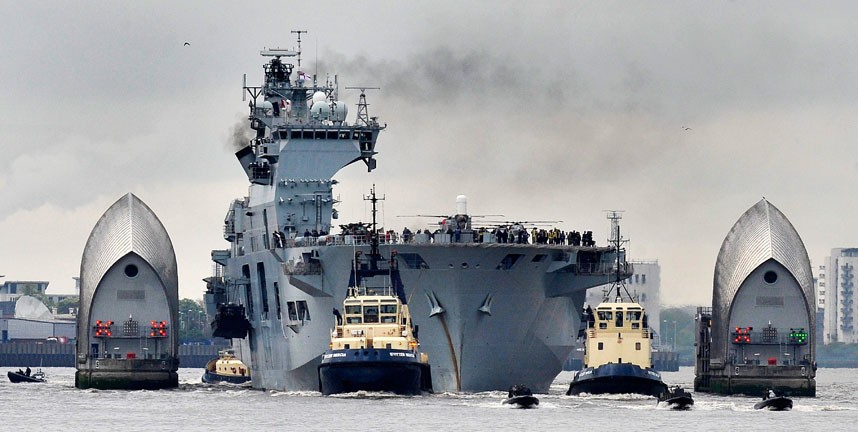
HMS Ocean at the Thames Barrier in 2012, being moved into position to support the Olympic Games in London.
The 22,000-tonne helicopter carrier, which returned from her last British deployment to the Caribbean just weeks ago, will be formally decommissioned from the RN in spring this year.
Although it was well known that Ocean was up for sale and that Brazil (as well as Turkey) were interested in buying the 20-year-old warship, confirmation of the deal and the purchase price were all “known unknowns” until now.
The news was broken by defence blog UK Defence Journal, citing a Brazilian journalist.
The Brazilian Navy’s end-of-year roundup statement, published on Christmas Eve 2017, also included the line: “Minister Raul Jungmann and the Brazilian Navy Commander Eduardo Bacellar Leal Ferreira took the opportunity to announce the purchase of the Royal Navy’s HMS Ocean multifunction vessel, valued at £84m sterling.”
A British Ministry of Defence spokesman told El Reg: “Discussions with Brazil over the long-planned sale of HMS Ocean are at an advanced stage, but no final decisions have been made. HMS Ocean has served admirably with us since 1998 and the revenue she generates will be reinvested in defence as we bolster our Royal Navy with two types of brand new frigates and two huge aircraft carriers.”
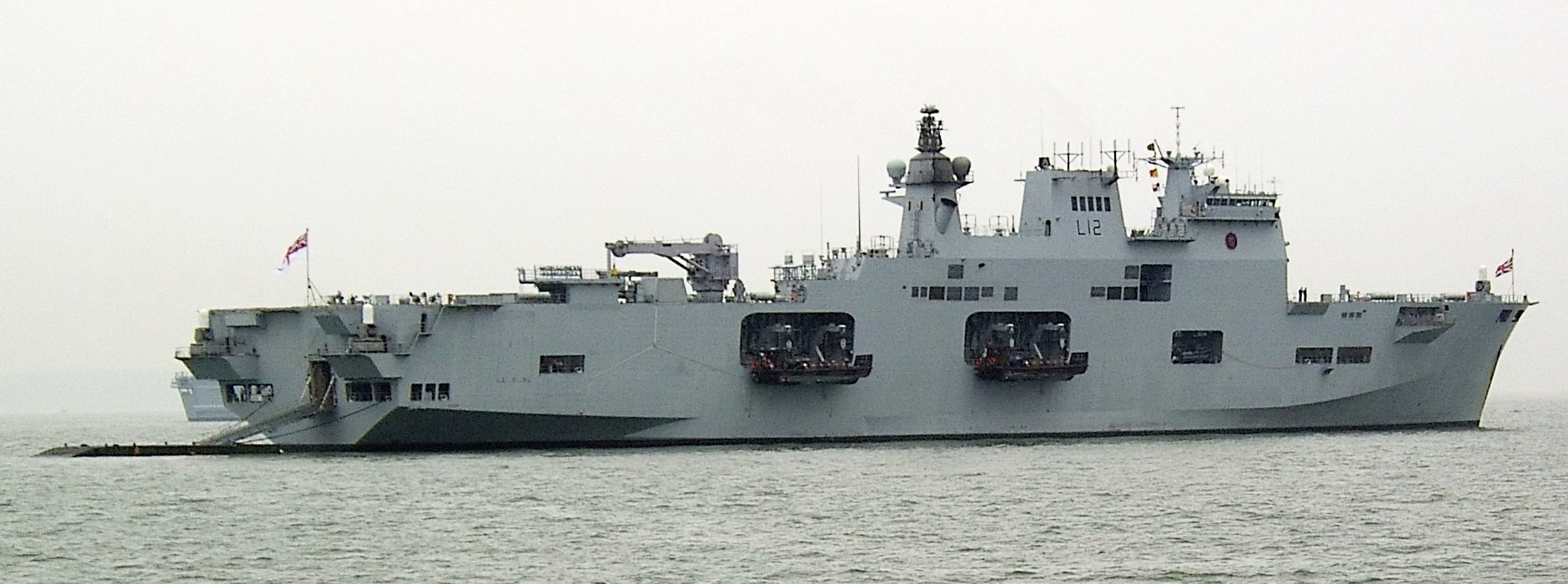
HMS Ocean at the 2005 International Fleet Review, showing Landing Craft on davits and Stern Ramp deployed.
Photo via Wikimedia.
At the Thin Pinstriped Line, Sir Humphrey explains why selling the ship now makes sense for the Royal Navy:
The big change to this requirement came in 2015, when the SDSR [Strategic Defence and Security Review]confirmed that the RN would keep both carriers in active service, and that neither would be CTOL [conventional take-off and landing]. Suddenly the RN found itself planning for a future where it would have two CVF available [the Queen Elizabeth class carriers], both of which would need to have manpower available to crew them. It also meant that the RN could make modifications to the ships to ensure that either of them could operate as an LPH [Landing Platform Helicopter] and carry helicopters and troops as well as a fixed wing airgroup.
This decision has had major ramifications for Ocean – suddenly the need for her to remain in service was gone. The LPH role that she would have done would now be filled by two newer and vastly more capable ships – the UK wasn’t losing capability but gaining it. In practical terms the RN actually would have more chance of an LPH being available without Ocean as CVF availability will be higher, both can role as an LPH (rather than CTOL which would not do this task) and with both platforms active, there is far less chance of the nightmare situation of both the CTOL carrier and the old LPH being stuck in refit at the same time.
From a capability perspective, the move to CVF makes a lot of sense. There are issues to be resolved (arguably the littoral manoeuvre capability offered by her landing craft, the vehicle issue and the question of what to do about afloat 1&2* command platforms and where to put them), but Ocean paying off is not going to remove the LPH capability from the UK toolkit.
The second problem has been that even if the RN wanted to run Ocean on, it has run out of manpower to do so. This year will see Queen Elizabeth at sea doing complex trials, drawing heavily on the Fleet Air Arm personnel to do so. As Prince of Wales (POW) stands up, more and more crew (usually very specialised engineers and the like) will be needed to bring her out of build. On the old plan this wouldn’t have been an issue – one would have gone straight into reserve. Now, the RN has to bring both carriers into service at roughly the same time (a helpful reminder of RN capability here is that it is the only navy in the world currently introducing two supercarriers into service at roughly the same time).
Ocean requires a lot of specialist crew who will be needed on QE and POW, and more importantly so will their reliefs. The manpower planners have not been working on the assumption of three carriers available and at sea (something the RN arguably has not done consistently for many years), and so the manpower structure is not designed to provide this. It could be changed, but would need many years to produce the right numbers of people in the right slots to deliver it without breaking manpower and causing retention challenges.
Comments Off on HMS Ocean to be sold to Brazil
January 2, 2018
The Defence of Baku – The Adventures of Dunsterforce Part 2 I THE GREAT WAR Special
The Great War
Published on 1 Jan 2018In part two of the Adventures of Dunsterforce, we follow the Hush Hush Army on their travels through the Caucasus. Picking up where we left off, the Dunsterforce leave Enzeli, clash with Jangalis en route, and head for Baku. They had to journey through territory controlled by warlords, cossacks and bolshevik soviets and when they arrived during the Siege of Baku, Dunsterville and his men meet the five dictators that make up the Centrocaspian Dictatorship.
Comments Off on The Defence of Baku – The Adventures of Dunsterforce Part 2 I THE GREAT WAR Special


