
Drachinifel
Published 4 Sept 2019Today we take a look at the War of 1812 as it progressed on the Great Lakes.
(more…)
February 24, 2023
War of 1812 – Freshwater Edition
Comments Off on War of 1812 – Freshwater Edition
February 22, 2023
Toward a taxonomy of military bullshit
Bruce Gudmundsson linked to this essay from “Shady Maples“, a serving officer in the Canadian Army, on the general topic of bullshit in the military:

Armies, as a rule, are quagmires of bullshit. The Canadian Army is no exception. We accept that bullshit is an occupational hazard in the Army, but it’s a hazard that we struggle to manage and it’s one that threatens our effectiveness as a force.
In order to understand bullshit we need a taxonomy, that is, a map of bullshit and the common varieties found in the wild. Using our taxonomy, we can develop diagnostic tools to detect bullshit and expose its corrosive effects on our integrity and professional culture. I assume that bullshit is also a hazard in other environments and government departments, but since my experience is in the land force I will be focusing my attention on that.
The subject of bullshit entered the mainstream in 2005 when Princeton University Press issued a hardcover edition of Harry G. Frankfurt’s 1988 essay “On Bullshit“. Frankfurt doesn’t mince words: “[one] of the most salient features of our culture is that there is so much bullshit. Everyone knows this. Each of us contributes his share.” He argues that even though we treat bullshit as a lesser moral offence than lying, it’s actually more harmful to a culture of truth. I believe this wholeheartedly, for reasons which will become clear.
In Frankfurt’s view, even though a liar and a bullshitter both aim to deceive their targets, bullshitting and lying require different mental states. In order to lie, someone must believe that they know the truth and intentionally make a false account of it. For example, if you believe that today is Monday but today is in fact Tuesday, and somebody asks you what day it is, you’re not a liar if you say “today is Monday”. You’re not lying because you really do believe that today is Monday, even though this belief is incorrect. In order to lie, you have to intentionally make a statement that is contrary to the truth as you understand it. In this example, you would be lying if you said “today is Tuesday” while believing that today is actually Monday. You would be accidentally correct, but you would still be lying because you are providing a false account of what you believe is true.
This means that lying actually requires a tacit respect for the truth on the part of the liar. The liar has to at least acknowledge the existence of truth in order to avoid it. To provide a false account of the truth, the liar must first believe in the truth.
The bullshitter, by contrast, does not operate under this constraint. Bullshit according to Frankfurt is speech without any regard for the truth whatsoever. To Frankfurt, “[the bullshitter] does not care whether the things he says describe reality correctly. He just picks them out, or makes them up, to suit his purpose.” Bullshit, Frankfurt argues, is speech that is disconnected from a concern for truth. The bullshitter will say anything if it helps them achieve their desired ends.
[…]
Let’s move on to the topic of “bull”, which is discussed at length by British psychologist Norman F. Dixon, author of On the Psychology of Military Incompetence. Dixon beat Frankfurt to the punch by publishing his own theory of bullshit in 1976, twelve years before “On Bullshit”. Dixon is a Freudian psychologist writing in the 1970s, so I am skeptical of the scientific merit of his book. Nonetheless, he provides an interesting outsider’s perspective of British military culture from the Crimean War up to the Second World War and how that culture enabled terrible officers while punishing competent ones (spoiler: aristocrats and nepotism are bad for meritocracy).
There is an entire chapter of the book about bullshit as a contributing factor to military incompetence. Dixon attributes the origin of the word “bullshit” to Australian soldiers, who in 1916 “were evidently so struck by the excessive spit and polish of the British Army that they felt moved to give it a label”. His theory of the Australian origin of bullshit is supported by Australian philosopher David Stove, who believed that it’s a signature national expression.
[…]
Canadian political philosopher G. A. Cohen added some depth to the discourse when he responded to Frankfurt in “Deeper into Bullshit“. Cohen wasn’t satisfied that Frankfurt had explored full range of bullshit as a social phenomenon. Frankfurt anchors his definition of bullshit in the intention or mental state of the speaker (the bullshitter) whose lack of concern for truth is what makes their statements bullshit. Cohen responds to this by pointing out that there are many people who honestly profess their bullshit beliefs. Reading this brought me back to my undergrad days. I had a TA in a 300-level philosophy course who claimed that he doubted his own existence. Personally, I wondered whether he would still doubt his own existence if I punched him in the balls for spewing such performative bullshit in class. So I think that Cohen makes a good point: there are bullshitters who honestly believe their own bullshit.
Cohen’s argument is squarely aimed at a certain style of academic writing, which he calls “unclarifiable unclarity.” These are intentionally vague statements which cannot be clarified without distorting their apparent meaning or dropping the veil of profundity altogether. If you want an example, you can try reading Hegel or a postmodernist philosopher, or just save yourself the effort and click on this postmodern bullshit generator (trust me, it’s indistinguishable from the real thing). Pennycook et al. label statements of this type as “pseudo-profound bullshit“. Hilariously, they ran a series of experiments to see if test subjects would find the appearance of profound truth in both real and algorithmically-generated Deepak Chopra tweets. The result, disappointingly, was yes.
Cohen adds a fourth type of bullshit to our taxonomy: “irretrievably speculative comment”. Basically, when someone is arguing for a proposition which they have no way of knowing is true or false, or they put forward an argument that’s completely unsupported by readily available evidence, then that argument is bullshit.
[…]
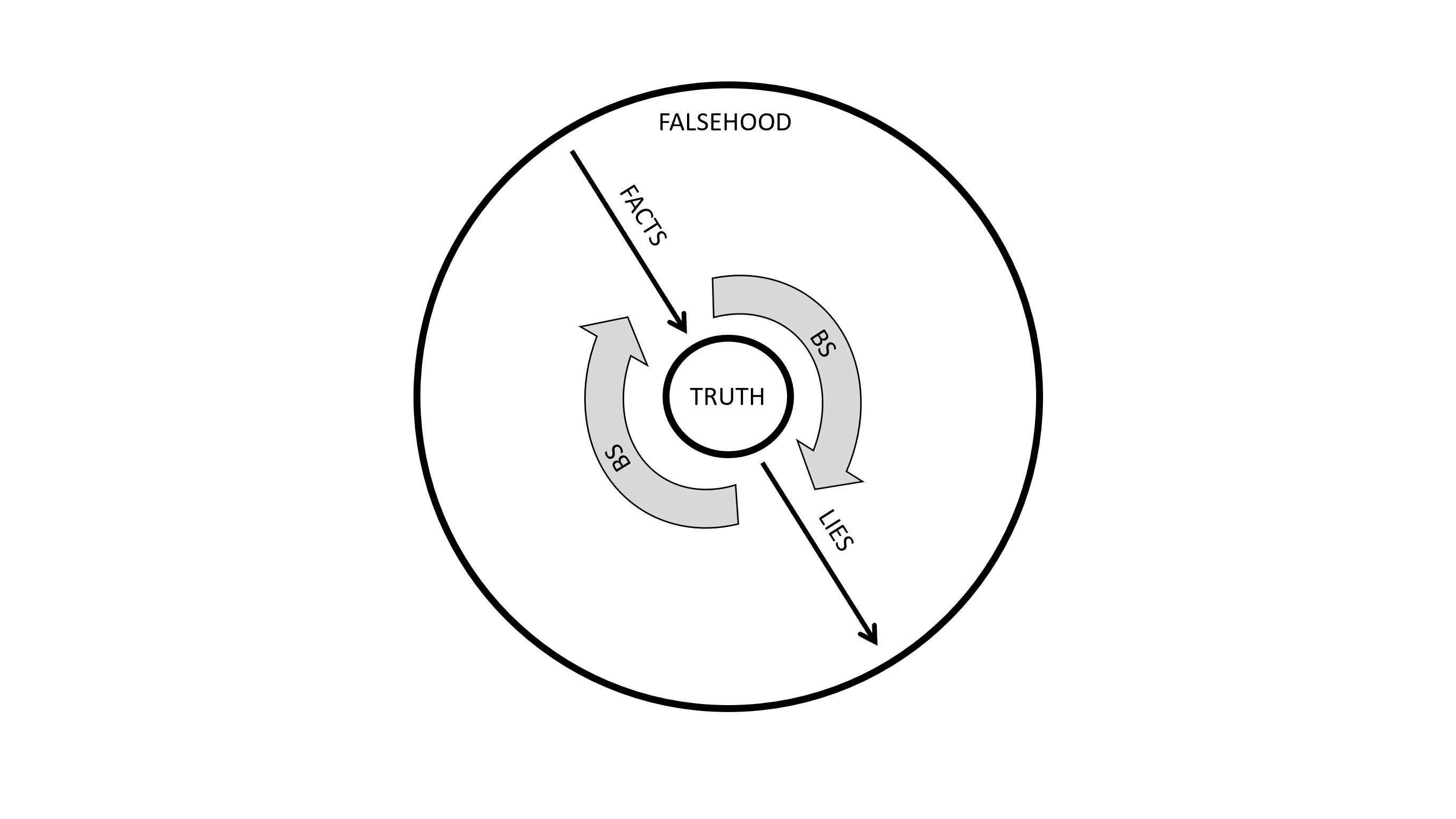
Still with me? So far we’ve identified and defined four types of bullshit (BS):
BS1 (Frankfurt): propositions made without concern for truth.
BS2 (Dixon): ritualistic activity which doesn’t serve its stated aim or justification.
BS3 (Cohen/Pennycook): unclarifiable unclarity aka pseudo-profound bullshit.
BS4 (Cohen): speculation beyond what’s reasonably permitted by the evidence.
The common denominator of all four types of bullshit is their disconnection from reality. Bullshit statements don’t enhance our understanding and bullshit activity doesn’t get us any closer to achieving our goals in the real world. Bullshit doesn’t necessarily move us further away from truth, like lies do, but it certainly doesn’t get us any closer to it either. Essentially, bullshit lowers the signal-to-noise ratio of discourse.
The endless carousel of bullshit.
Comments Off on Toward a taxonomy of military bullshit
February 20, 2023
“There is no way Justin Trudeau won any of the last three elections”
Elizabeth Nickson on recent rather alarming confirmation of many things told by various “conspiracy theorists” and purveyors of “misinformation”:
Cracks are beginning to appear in the massive election fraud strategy prosecuted against western democracies. Berlin last week reversed its city election because it had been stolen by the left, and Berliner-Zeitung revealed that a team of reporters from The Marker, Haaretz and Radio France had gone undercover for six months as clients of a company that did nothing but election theft. That company, Jorge, had “intervened in 33 national election campaigns and votes. In 27 cases, it is said to have influenced the elections in favor of its clients. In order to control the opinion on the Internet, the secret company controls over 30,000 credible fake accounts on social media platforms”.
And in Canuckistan this morning, in the organ of the bien-pensant liberal establishment, there was this nugget.
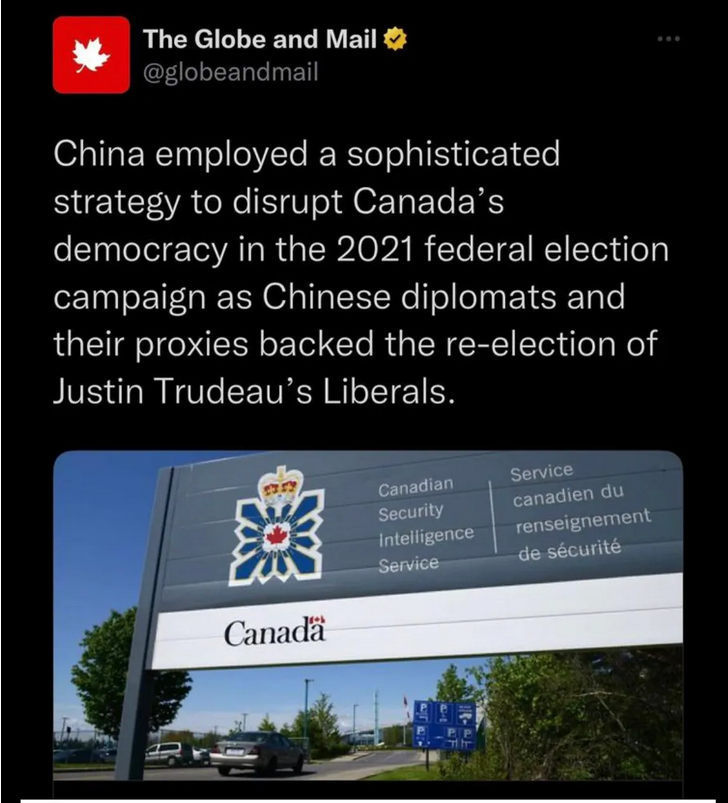
There is no way Justin Trudeau won any of the last three elections. And, honey, this little story from Canada’s most prestigious newspaper is just the beginning.
But first, a story of my own …
When I turned right I had been hired to write an op-ed column for the above Globe and Mail, and what unfurled from my fingers was pure conservatism. I’d hold up my fingers and think, What the hell? Where did that come from? But I continued, and as I did, family and friends sheered away until, except for my mother, I was left virtually friendless.
I had moved back to Canada, you see, and we are 100% captured by the left. There are a handful of conservative writers in the country, but they are soft and weak and they prevaricate because otherwise they would not eat. Luckily I had spent most of my adult life out of the country, had a broader pool to draw from, and given my new thinking, mirable dictu for every friend I lost, I made five new ones. And they were smarter, more responsible, more interesting people. I missed the clothes, restaurants and parties for a while, then I gave up on those too. Essentially, sickening. Finally corrupting.
But it continues, since we live in a hard-left community. We are isolated. Even Jamie, because he lives with me, has lost friends and family. We have his sons, his ex-wife, one of my brothers. The rest are just cold, pitiless. Cruel.
This has happened to hundreds of thousands of people. It’s called “bad-jacketing” and is part of the Fifth Generation Warfare launched against malcontents large and small (like me) up and down the social ladder. Millions. Tens of millions. The competent are targeted, isolated and bad jacketed. It is meant to drive the competent out of the culture. Why is everything breaking? Why is the economy failing? Everyone left in the system is incompetent and vicious with it. It’s why Soviet Russia failed, why the Eastern Bloc collapsed, it is why China went for a capitalist hybrid. Everywhere socialism is tried it destroys the competent and then destroys everything else.
The left is implacable and they punish. They hurt you until you give up. They will break anything you have. Thinking about helping a young neighbor last month, which would require a week or more of brutal work, I finally thought: I have not helped or befriended one single socialist — and she was an avowed socialist — who hasn’t eventually stabbed me in the back. Not one.
When I was driven out of the profession, I spent ten years studying. Was I right? Was I wrong? I should have signed up for a remote doctoral program, because I worked. I study, therefore I am. I studied therefore I was, should be written on my cremation plaque in the family plot. Not that they’ll let me in.
We are all intimidated by that level of hate and exclusion. All of us, politicians, editors, bureaucrats, charities, all of us are terrified of being taken down in our personal lives. Bad-jacketed, rejected by those you love deeply. I know how that feels and I bet you do too.
Comments Off on “There is no way Justin Trudeau won any of the last three elections”
February 19, 2023
“Enjoy the report”
When the Canadian federal government invoked the Emergencies Act in February 2022, it began a legal timer for the government to set up a formal inquiry into the situation that triggered the use of the act which was intended to provide some clarity on whether the government was justified to do so. This inquiry had no legal powers to punish wrongdoing, but was merely supposed to uncover what went on both in public and behind the scenes at this time last year. The head of the commision, Paul Rouleau, was a long-time Liberal who’d once worked for former Liberal Prime Minister John Turner and had been appointed to the judiciary during Jean Chrétien’s premiership. It was perhaps too much to hope that he might return a report that made Trudeau or his government look bad.
Donna Laframboise started the Thank You, Truckers! Substack to record the events of the Freedom Convoy and the reports of participants, supporters, and opponents of the protests. She clearly wasn’t surprised at this outcome from the commission:
“Enjoy the report”. Those were the last words Commissioner Paul Rouleau uttered before rising and leaving the room yesterday. The room in which he cheerfully announced that the Canadian government was justified when it invoked the Emergencies Act against festive, peaceful, working class protesters a year ago.
Which part did he imagine we’d enjoy? The knowledge that there’s absolutely no accountability in our political system? The knowledge that a vast network of supposed checks and balances (funded year in and year out by the sweat of working Canadians) offers us no protection from tyrannical, rogue politicians?
Three months ago I wrote: Let us fervently hope Commissioner Rouleau is a man of integrity. One who understands that this is his moment. History will judge him by what he does here.
[…]
Given the opportunity to help resuscitate the limp, battered carcass of public trust, this gentleman instead extended every benefit of the doubt to the government, to the establishment, to police goons who crossed lines that should never, ever be crossed.
This is very bad news. Because, as Martin Luther King Jr observed 60 years ago, when peaceful protests get shut down some individuals
will seek expression through violence; this is not a threat but a fact of history.
Many Canadians predicted this result. They had few expectations. They said Commissioner Rouleau was hopelessly compromised by long association with the Liberal Party of Canada. They said that, because the Liberal government had sole discretion to select its own judge, real accountability was never on the table.
The cynics were correct.

In the preview to The Line‘s weekly dispatch, the editors take a less pessimistic view of their initial sampling of the report:
Justice Paul Rouleau’s report on the federal government’s decision to invoke the Emergencies Act was published Friday. It is thousands of pages long. We have not read it all yet. But we have tackled parts of it, with an eye to answering two questions, for ourselves and for our readers. What the hell happened last year — what went wrong? And: do we agree with Justice Rouleau’s decision that that the federal government’s decision to invoke the act was indeed appropriate?
We’ll get to those questions, but let’s say a few things first.
First: if you sat down to read the Rouleau report to find evidence for what you’d already decided, you’ll find it. We believe that Justice Rouleau has written a fair and balanced report. He is clearly struggling, as we were a year ago, to accurately describe and probably even to fully perceive and understand just what “the convoy” was. Line editor Gurney, in reading Rouleau’s efforts to describe how the protest was both a largely peaceful and lawful assembly and also a meeting place for radical extremists, including some dangerous ones, found himself nodding along in recognition of Rouleau’s thought process. This nuance and complexity was precisely what he tried to convey from Ottawa last year.
Second: the same very much applies to political blame. There’s some for everyone here, folks. The federal government comes in for less than some others, but we don’t see in that any bias, but instead a recognition that none of this should have been the federal government’s problem. If the convoy protests had been effectively handled by local and provincial officials, it wouldn’t have been a federal issue at all. This has long been The Line‘s position, but we have also been critical the Trudeau government’s nasty habit of seeing in moments of crisis not a threat to be defused, but instead, a wedge to be eagerly seized upon and exploited. Justice Rouleau is kinder to the Liberals than we are. Perhaps he is simply less cynical. But he did make a point of criticizing Justin Trudeau for inflammatory language, and we were glad of that.
[…]
Third: Justice Rouleau’s finding that the federal government acted appropriately is more conditional and guarded than we think the overall tone of the report, and much of the attendant media coverage, suggests. We’ll get into this in more detail in a minute, but we wanted this front and centre before we start doing the heavy lifting: Rouleau does indeed side with the government, but it’s a pretty nuanced and cautious alignment. A win is a win, and the Liberals got their win here, but Rouleau’s report isn’t an endorsement of how the feds handled anything last year. It would be better for literally all of us if we tried to remember that.
The legacy media’s ability to sway public opinion has waned, but it still has some strength and this was especially so during the lockdowns where people had less opportunity to see for themselves or to talk with others outside the curated gardens of sites like Facebook. If the media had given the Freedom Convoy coverage the same credibility it chose to give to the violent riots, uh, I mean “mostly peacful protests” after the death of George Floyd, the federal government would not have treated the convoy participants and supporters as cavalierly as they did.
Only one federal political party dared to show any significant support for the protest, and the other day PPC leader Maxime Bernier posted a retrospective on the Freedom Convoy to YouTube:
Individual Conservative MPs may have expressed a bit of timid support but were noteworthy by their unwillingness or inability to do anything in Parliament to force the government to at least talk to the protest leaders or give them any benefit of the doubt.
Comments Off on “Enjoy the report”
Flower-Class Corvettes – WW2 Atlantic Defender
Matsimus
Published 29 Jun 2020The Flower-class corvette (also referred to as the Gladiolus class after the lead ship) was a British class of 294 corvettes used during World War II, specifically with the Allied navies as anti-submarine convoy escorts during the Battle of the Atlantic. Royal Navy ships of this class were named after flowers, hence the name of the class.
The majority served during World War II with the Royal Navy (RN) and Royal Canadian Navy (RCN). Several ships built largely in Canada were transferred from the RN to the United States Navy (USN) under the lend-lease programme, seeing service in both navies. Some corvettes transferred to the USN were manned by the US Coast Guard. The vessels serving with the US Navy were known as Temptress and Action-class patrol gunboats. Other Flower-class corvettes served with the Free French Naval Forces, the Royal Netherlands Navy, the Royal Norwegian Navy, the Royal Indian Navy, the Royal Hellenic Navy, the Royal New Zealand Navy, the Royal Yugoslav Navy, and, immediately post-war, the South African Navy.
After World War II many surplus Flower-class vessels saw worldwide use in other navies, as well as civilian use. HMCS Sackville is the only member of the class to be preserved as a museum ship. Flower Class corvettes were originally intended for coastal escort and mine clearing work. Derived from a whaler design, they were simple, highly seaworthy vessels that could be constructed in secondary yards. The dire lack of ocean escorts early in the war necessitated their being used to screen convoys traversing the North Atlantic between Nova Scotia and the UK. This was a role for which they were ill-designed, and their crews suffered accordingly. The Flowers were wet, highly cramped and impossibly lively. Many sailors could not adjust to the exhausting routine. Compounding the misery was the inexperience of the crews, most of whom had never been to sea. But any escort was better than none at all, so the yards continued to turn out corvettes. 120 were built in Canadian yards, and slightly more in the UK.
(more…)
Comments Off on Flower-Class Corvettes – WW2 Atlantic Defender
February 17, 2023
Spy ballooning has a remarkably long history (that’s clearly still ongoing)
In The Line, Scott Van Wynsberghe outlines the history of balloons in wartime and (as many are now aware from recent events) in peacetime:

China’s balloon spying is shocking on so many levels that you can take your pick. There is the ultra-flagrant violation of foreign sovereignty, the stunningly surreal air of denial exhibited by Beijing, and the fearful sense that something in the world order just lurched. There is also puzzlement: what, balloon spying is still a thing? Indeed it is, and its centuries-long history is instructive as to what China is now doing. It also makes clear that the U.S. is no innocent victim here but rather a past offender with a cleaned-up act.
Among the first major studies of aerial reconnaissance was a book brought out by military author Glenn B. Infield way back in 1970. In a way, Infield was charting unknown territory. When he addressed balloons in particular, he traced their use in spying to the many wars associated with the French Revolutionary and Napoleonic eras. In 1794, he related, the French military officer Jean-Marie-Joseph Countelle made an ascent at the city of Maubeuge in order to monitor enemy forces in the area. In the process, Countelle became the first balloon spy.
As technology improved, other firsts followed. By the 1850s, cameras were mounted on French military balloons. In the 1860s, during the American Civil War, Union forces battling the Confederacy used balloons trailing telegraphic wires, which transmitted immediate updates from the balloonists. Yet technology cut both ways. By the early 1900s, balloons had a nemesis in sight, in the form of winged and powered aircraft.
The inevitable showdown occurred in the First World War, and it was ugly. Large numbers of observation balloons were used by all sides in the conflict, and WWI historian Denis Winter claims the Germans alone deployed 170 of them in France by 1917. Typically, such balloons were tethered in place near the frontline, floating at several thousand feet, with telephone wires dangling to the ground. Although they seemed vulnerable, they were actually protected from below by anti-aircraft units, which blasted at any enemy plane that got too close. However, the reverse was also true, with balloons themselves being fired at from the ground. By 1915, says aviation writer Ralph Barker, the British were losing at least a dozen balloons a month from all forms of enemy action. Those balloonists who were not shot to pieces often had to bail out, putting their faith in parachutes that did not always work. (Horrified onlookers called them “balloonatics.”) The fighter pilots responsible for much of this mayhem — which they called “balloon-busting” — may not have had an easy time, but some of them scored heavily, with one Frenchman named Coiffard tallying 28 balloons. Although observation balloons managed to make it to the end of the war, it was a near-run thing. According to author Linda Hervieux, nobody after the war was talking about repeating that experience in any future fighting.
[…]
Once the Second World War was underway, some propaganda leafleting did occur, but secret balloon activity seemed to be at a low level. That was very misleading, because one of the tensest moments in ballooning history was playing out in the background, but it occurred amid so much security that the entire tale took years to emerge. In 1944, Japan launched the first of over 9,000 bomb-rigged balloons across the Pacific. Robert C. Mikesh, in a comprehensive 1973 monograph issued by the Smithsonian Institution, noted that almost a thousand of the balloons may have reached North America, but the true number is unknowable, because so many came down in remote wilderness. (One was found by forestry workers in British Columbia as late as 2014.) Mikesh tabulated 285 known incidents, ranging from Alaska all the way south to Baja California and as far inland as Manitoba. Both the U.S. and Canada clamped down hard on any news about the balloons, for fear of providing Tokyo valuable feedback about the results of the campaign. (In other words, balloon counterintelligence became a priority.) In general, the balloons did not cause a lot of harm, but one of them slaughtered six people in Oregon in 1945. By a strange fluke, one of the few groups in the U.S. that knew the full story of the balloons was an element of the Black community. The all-Black 555th Parachute Infantry Battalion was sent to the U.S. West to handle emergencies caused by the balloons.
The remains of a Japanese balloon bomb found in the Monashee Mountains near Lumby, BC in 2014. It was detonated on-site by the bomb disposal unit of Maritime Forces Pacific of the Royal Canadian Navy.
There is a strong temptation to blame the Japanese balloon bombs for what happened next, because the U.S. unaccountably entered the Cold War as the most pugnacious exponent of clandestine ballooning up to that time. Whatever the explanation, the epic struggle between the United States and the Union of Soviet Socialist Republics plunged U.S. ballooning into a tangle of psychological warfare, shadowy science, under-the-table finances, and clandestine belligerence indistinguishable from military attacks. Plus, UFOs and breakfast foods were involved (seriously).

Comments Off on Spy ballooning has a remarkably long history (that’s clearly still ongoing)
Quebec suddenly realizes there are significant problems with Bill C-11
Michael Geist, who has been doing heroic work covering the federal government’s attempts to seize control of what Canadians can see and publish online, says that Quebec has finally woken up to the threat to their culture embedded in the federal government’s Bill C-11:

Bill C-11 – and its predecessor Bill C-10 – have long been driven by the government’s view that the bill was a winner in Quebec. Bill C-10 was headed for easy passage in 2021, but was derailed by the government’s decision to remove safeguards over regulating user generated content that came largely from the Quebec-based music lobby. Nearly two years later, Canadian Heritage Minister Pablo Rodriguez and his staff have ignored the concerns of thousands of digital creators, disrespected indigenous creators, and indicated that he will likely reject Senate amendments designed to craft a compromise solution, all in the name of keeping Quebec lobby interests satisfied. Yet as the government considers the Senate amendments, the Quebec legislative assembly this week passed a last minute motion calling for further changes to the bill, including scope to enact its own rules and mandatory consultations with the province on the contents of a policy direction to the CRTC that Rodriguez has insisted on keeping secret until after the bill receives royal assent (a full copy of the motion is contained at the bottom of this post). The Conservatives have been calling for the Quebec motion and the Senate amendments to be sent back to committee for further study, which the Globe reports may delay the government’s response to the Senate amendments.
It is not clear what prompted the Quebec government to finally wake up to the centralizing power over digital culture that comes from the bill (and just wait until it realizes that Bill C-18 encroaches on provincial jurisdiction with the regulation of newspapers). But this issue has been there from the beginning. In March 2021, Philip Palmer, a former Justice counsel, argued that Bill C-10 was unconstitutional, making the case it fell outside federal jurisdiction. In a post on his submission, I noted:
Quebec has a long history of taking issue with federal involvement in broadcasting, putting a potential challenge in play. Indeed, it is odd to see this legislation viewed as a political winner in Quebec, when it effectively asserts federal jurisdiction over an area that has long been contested in the province.
Palmer appeared before the House committee studying Bill C-11 and warned MPs about the constitutional jurisdictional overreach. His opening statement noted:
C-11 lacks a foundation in Canadian constitutional law. Internet streaming services do not transmit to the public by radio waves, nor do they operate telecommunications facilities across provincial boundaries. They and their audiences are the clients of telecommunications common carriers, which are subject to federal regulation. Netflix, for instance, in this case is no more a federal undertaking than a law firm such as McCarthy Tétrault or a chain store like Canadian Tire, both of which rely extensively on telecommunications services.
Liberal MP Anthony Housefather followed up on the issue, asking Palmer to cite caselaw to back his claim. His response:
The principal case for all federal regulation of broadcasting space is, of course, the radio reference of 1932. In that, the court relied upon the provisions of subsection 92(10) of the Constitution Act to find that, in transmitting radio waves, they necessarily exceeded provincial boundaries and, therefore, could only be effectively regulated at the federal level. The key is that, in order to be regulated by the federal government, the “undertaking”, as the Constitution uses the word, has to be one that has the facilities to exceed provincial limitations and provincial boundaries.
Housefather wasn’t convinced and asked Professor Pierre Trudel, a vocal supporter of Bill C-11, for his view. Trudel didn’t deny the issue. In fact, he confirmed it, suggesting that the Supreme Court would ultimately have to determine the question:
If this were unconstitutional, it would be because it would be a matter of provincial jurisdiction. The question would then have to be asked: is it better for 10 provinces to put in place regulations on these matters or for the federal authority to do so? There are arguments that radio waves are not the only basis for federal jurisdiction in these matters. There is, among other things, the question of national interest and the inherently interprovincial nature of the activity. In short, all these arguments may have to be argued before the Supreme Court. Either the federal government has authority, or the provinces do. Therefore, it is to be expected that the Canadian state will intervene sooner or later, whether through the provinces or through the federal government.
The takeaway from this exchange – a former justice lawyer citing caselaw to confirm the shaky constitutional foundation of the bill and a professor confirming the Supreme Court would have to decide – should have provided a wakeup call to Quebec, which has a long history of challenging federal jurisdiction in communications that dates back nearly 100 years with repeated efforts to enact provincial laws and policies in the area. Left unsaid is that if the “national interest” dictates federal regulation of anything that touches the Internet, there are few limits on federal powers and little left for the provinces.
Comments Off on Quebec suddenly realizes there are significant problems with Bill C-11
February 13, 2023
It’s open season for balloons over North America
In The Line, yet another incursion into NORAD air space, and no, this isn’t a re-post from last week:
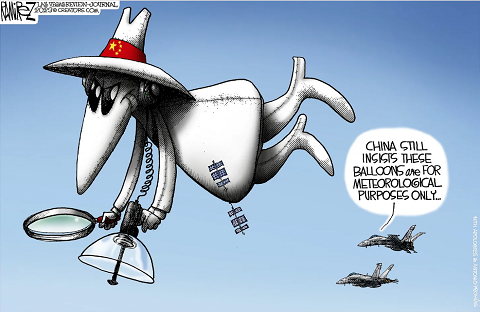
Holy jumpin’ Jeepers, folks, we’ve got more balloons!
On Friday, the Americans shot down another unidentified flying object — gulp — off the coast of Alaska. By Saturday, NORAD was reporting yet another one, this time over Canadian territory. NORAD jets scrambled, and an American F-22 destroyed the object over Yukon. Canadian military teams are now en route to recover the wreck and find out what the hell we are shooting at.
This was an exciting enough little pick-me-up on Saturday, but it wasn’t done. Later that night, another air defence emergency was declared over Montana, and American F-15 jets were scrambled out of Oregon to intercept an object that had been detected on radar. They were not able to find anything, and as of press time, NORAD has said only that they will continue to monitor the situation.
A few points we’d make about a truly bizarre series of stories.
The first is that there’s nothing wrong or particularly embarrassing about an American plane defending Canadian air space. NORAD is a joint bi-national command. Missions are tasked to the first available aircraft. That might sometimes mean a Canadian jet defending U.S. territory. It’s happened! On Saturday, the object was closer to American bases in Alaska than the nearest CF-18 base in Alberta. There probably is a conversation worth having about whether Canada should maintain a small alert force of jets further north, better able to respond in the future. That’s expensive and logistically complicated, but may still be worth considering. For now, the system functioned as intended. So we say, quite sincerely, thanks, America. We appreciate the help.
That being said, we do think this is a useful reminder that the long and repeated delays by Canada to both replace the aging CF-18 jets and modernize NORAD with new sensors and capabilities were reckless and dumb. It was obvious that the CF-18s needed replacing when Stephen Harper took office, but we only got that underway in recent months. NORAD, for its part, functions well as an institution but needs upgraded technology. That project also should have begun many years ago. In both cases, we delayed because we didn’t want to spend the money and because defence projects in this country are almost always politically fraught. The Russian invasion of Ukraine and now the weird series of aerial intruders is a useful reminder that neglecting your own defences is never a good idea. We are realists about Canada’s ability to field a massive military, but our geography, in so many ways a blessing, does impose a few costs back on us. It’s not easy to patrol and police such massive territories, especially with a relatively small and concentrated population. But we have to do it. It’s what being a country means. Too often, we haven’t. We hope that changes. With the NORAD modernization announced and the F-35s ordered, perhaps we’re finally making right some of these failures. We hope so. But we are jaded, friends. We admit that.
Our final point is an appeal to calm. We don’t really know what the hell is happening with all these aerial intruders either, but there could easily be a pretty mundane explanation. Radar sets have programmable software filters that are intended to avoid cluttering up the scopes with too much information. Without these filters, clouds, snow storms and birds can cause returns that may look like planes and missiles. One way of filtering out such clutter is by establishing a minimum speed for flagging an object. Balloons are likely normally below that minimum. Your Line editors suspect that part of what is happening right now is that we’ve adjusted those filters, and are suddenly seeing things that were already there all along.
Is that better, or worse? We don’t know. We can make that argument either way. In any case, that may be what’s happening.
Or hell, maybe it’s aliens, and Canada and the U.S. just declared war on a more sophisticated race that travelled across the vastness of the stars only to end their journey by being murdered by Justin Trudeau and Joe Biden. We doubt it, to be honest. But it’s been a weird few years already, no?
Comments Off on It’s open season for balloons over North America
Appliance futility by design
Tal Bachman recounts a miserable — but increasingly common — experience with modern “energy efficient” home appliances:

“A-rated energy appliances” by Tom Raftery is licensed under CC BY-NC-SA 2.0


The LG 5.8 cubic foot Capacity Top Load Washer sat in the laundry room, brand new. Maybe it was my imagination, but it looked insouciant.
Dad said it was the latest and greatest in laundering technology. Supposedly, some sort of internal sensor system (having something to do with a computer) fine-tuned water levels depending on clothing weight. Or something. I can’t remember exactly what he — or was it the moving guy? — said.
I did notice the washing machine had several preset wash cycles — Allergiene, Sanitary, Bright Whites, Towels, Heavy Duty, Bedding, and more. You could select them with a shiny, space-age-looking chrome dial. (I would later discover the machine had other fancy features with names like TurboWash™ 360, ENERGY STAR® Qualified, Smart Diagnosis™, and ThinQ™ Technology [Wi-Fi Enabled]).
[…]
Well, it was win-win-win, with a minor caveat. The caveat was the washing machine. Turns out that for all its razzle-dazzle features, it didn’t actually clean clothes. Even worse, it took hours to not clean clothes. The “Allergiene” cycle, for example, took almost four hours. Yet when you pulled your clothes out, you could still make out the orange juice or tomato sauce stains. I’d never encountered a more useless washing machine.
“How you feeling about this new washing machine?”, I asked Dad, a few days after the hunkering down began.
“Great!”, said Dad.Okay, I thought. That’s not unusual. Music — as opposed to the mundane or practical — occupies most of Dad’s awareness, and always has. Besides, most of his clothes are black, and he probably hasn’t noticed it’s not removing the ketchup stains. Maybe he will in a few weeks.
And maybe in the meantime, I thought, I could figure out a way to reprogram the machine for cycles which actually washed. And were faster.
But no. That turned out to be way too much to hope for. The machine allowed no independent control over water volume, cycle time, or water temperatures. It only allowed selection of a preset computerized cycle — none of which got your clothes clean.
[…]
Yet more irritating was the reason it skimped on water and power: it was trying to stop global warming. Oops — I mean “climate change”. It was “environmentally friendly”. Except it wasn’t, because you usually had to run at least two cycles to get your clothes clean. That’s right: you had to use the same amount of water in the end anyway, and double the electricity.
And so — not for the first time — I had stumbled upon yet another example of technological “progress” which exacerbated the very (pseudo) problem it purported to solve. The new useless LG “Save the World!” piece of garbage was the home equivalent of Hollywood stars taking private jets to a carbon reduction conference in Switzerland.
[…]
The US Department of Energy, I discovered, had begun imposing energy efficiency regulations in the early 1990s. A decade later, they made the regulations even stricter (see here also). Then, as the years passed, they made them even stricter. And then stricter. And then stricter. All the while, the feds offered appliance manufacturers huge tax incentives — i.e., huge cash rewards — to accelerate their phase out of functional washing machines.
Government succeeded. Today, minus the loophole-exploiting Speed-King (which the feds will probably crush soon), you cannot find a new washing machine — front- or top-loading — which washes clothes anywhere near as well as its predecessors. The rationale for this — saving the world from global warming — doesn’t even rise to the level of ludicrous. Just for starters, as I type this, we’re enduring one of the coldest winters ever recorded. New Hampshire’s Mount Washington Observatory just recorded a wind chill calculation of minus 109 degrees Farenheit, an all-time record for the United States (and approaching midway between the average temperatures of Jupiter and Mars). Temperatures are thirty degrees Farenheit colder than average in many places. Why would anyone want to bring temperatures down even further? And at the cost of destroying washing machine functionality? And what loon could actually believe home washing machines change the climate?
In any case, thanks to an essentially totalitarian government run by bought-and-paid-for liars, control freaks, and imbeciles, we have gone technologically backward — certainly in the appliance domain, but in others — for no good reason at all. (Regulations have also downgraded dishwashers, toilets, showers, and other appliances, but we can discuss those another time)
Back in 2019, Sarah Hoyt expressed her frustrations with “modern” “energy-efficient” appliances which matched our experiences exactly.
Comments Off on Appliance futility by design
February 9, 2023
Attractive VTOL autogyro with unrealised potential; the story of the Avian 2/180 Gyroplane
Polyus
Published 10 Jan 2019The Avian 2/180 Gyroplane was a project that rose from the ashes of the Avro Arrow cancellation. Five former employee formed their own company and set out to build a new kind of autogyro. Their Gyroplane could take off and land vertically and could fly at speeds up to 265 km/h. Although it never made any sales, it is an impressive project that deserves some attention.
(Also sorry for the flickering in the video. I did my best to limit it but the source video didn’t give me much to work with.)
(more…)
Comments Off on Attractive VTOL autogyro with unrealised potential; the story of the Avian 2/180 Gyroplane
February 7, 2023
Making Canada’s gun laws more illogical, but appealing to urban Liberal voters, regardless of the political cost elsewhere
In The Line, Matt Gurney recounts the federal government’s political gyrations over their attempt to ban vast numbers of rifles and shotguns owned by law-abiding Canadians:

Classifying guns is complicated. There are a lot of ways to do it. You can do it by the “action”: is it a pump action? A lever action? Is it semi-automatic, or even fully automatic? You can do it by the length of the total firearm, or the length of just the barrel. You can do it by the caliber of the ammunition. You can do it by the type of magazine the firearm uses, and what its capacity is (the magazine is the compartment, which can be removable or integrated with the firearm, that holds the ammunition). You can try and be targeted with your definitions, or you can just go across the board and say “All rifles are allowed but all handguns are banned.” The point here isn’t to argue what the policy should be, but simply to note that whatever your policy is, you have to be able to define it in a way that makes sense.
Canada’s current gun laws date, more or less, to the 1990s. They’ve been changed a bunch of times since, for better or worse, but that’s when the current overall system of firearms legislation began. We came up with three broad categories of firearm then. There are “non-restricted” firearms, which you must be licensed to own, and mostly mean very typical rifles and shotguns, of which millions of licensed Canadians own many millions. There’s also the “restricted” category, which basically meant handguns — either semi-automatic pistols or revolvers. These require extra licensing, more background checks and training, and are subject to much stricter conditions for storage and use. And then there’s the very rare “prohibited” firearms, which are mostly either very compact handguns, or fully automatic weapons, including machine guns, which were owned by Canadians already when the new laws came in almost 30 years ago. These owners were given a special and highly limited rights to retain the firearms they already owned, but not to transfer them to others, except to someone else with a rare prohibited licence, or to a direct descendent. (That last bit was to cover family heirlooms.)
None of the above is as simple as I’ve just described it. Weird absurdities have been part of the system from the outset. The reason for these absurdities was always political. Back in the 1990s, the Liberals, under then-prime minister Jean Chrétien, realized that the categories above would result in certain kinds of rifle (including the AR-15) being classified as non-restricted, and subject to the least onerous controls. Unhappy with the optics of that, and other similar examples, they wrote in exceptions to the way some firearms are categorized. A firearm would be categorized by its technical specifications unless the government specifically ordered it classified as something else, is probably the easiest way to summarize a complicated policy.
Using the AR-15 again, according to the “evergreen” technical definitions we settled on in the 1990s, that’s a non-restricted gun. To avoid awkward political questions, the then-Liberals deemed it a “restricted” firearm, and therefore subject to tighter controls.
There were other similar examples, and they resulted, as noted above, in a lot of absurdities, with very similar guns categorized differently, but since only a relatively small number of firearms were so specially categorized, the system more or less functioned reasonably well for decades. The absurdities were limited enough to be broadly known and adapted to, and the overall system made enough sense to function coherently enough to do a reasonably good job regulating the sale, ownership and use of firearms in Canada. And very successfully: gun crime by licensed gun owners in Canada is, as is well known, quite rare. The system basically worked, and was working.
[…]
But hey, then politics happened. The sunny ways days ended. Liberal fortunes waned. Scandals and baggage and awkward photos of the PM in his younger days accumulated. And suddenly, the Liberals were talking a lot about banning assault rifles. They talked about it even more after the 2019 election reduced them to a parliamentary minority, leaving them dependent on a cluster of urban and suburban ridings in Quebec and Greater Toronto where support for just about any half-coherent sounding gun-control measure is typically high. The Liberals didn’t do much of anything — mostly just talk, as is their style. Then, in early 2020, there was the horrific massacre in Nova Scotia, and within days, the Liberals announced they were banning 1,500 models of assault rifle. (It was actually far fewer — closer to 20 — but the Liberals counted each different version and brand as an entirely different rifle to get to a more-impressive sounding figure. Those fierce opponents of disinformation at work again!)
Anything even close to meeting a broadly shared definition of “assault rifle” was already banned in Canada, of course — it had been classified “prohibited” back in the 1990s. There’s no universally agreed upon definition of an “assault rifle”, but those who know guns could agree in broad terms what it would mean — and in Canada, they were all banned, and had been for decades. So the Liberals, keen to have their lookin’-tough-and-bold moment, started talking about “assault-style” rifles.
Appending “-style” to anything is a gigantic red flag for bullshit, as I’ve noted here before. That somehow failed to deter them, alas, setting the stage for their current woes.
Comments Off on Making Canada’s gun laws more illogical, but appealing to urban Liberal voters, regardless of the political cost elsewhere
February 6, 2023
Food prices going up? Destroying “excess” production? That’s Canada’s Supply Management system working at peak efficiency!
Jon Miltimore reports on recent comments about some of the weird requirements for quota-holding dairy farmers under the Canadian Supply Management system:

Canadian dairy farmer is speaking out after being forced to dump thousands of liters of milk after exceeding the government’s production quota.
In a video shared on TikTok by Travis Huigen, Ontario dairy farmer Jerry Huigen says he’s heartbroken to dump 30,000 liters of milk amid surging dairy prices.
“Right now we are over our quotum, um, it’s regulated by the government and by the DFO (Dairy Farmers of Ontario)”, says Huigen, as he stands beside a machine spewing fresh milk into a drain. “Look at this milk running away. Cause it’s the end of the month. I dump thirty thousand liters of milk, and it breaks my heart.”
Huigen says people ask him why milk prices are so high.
“This here Canadian milk is seven dollars a liter. When I go for my haircut people say, ‘Wow, seven dollars Jerry, for a little bit of milk'”, he says, as he fills a glass of the milk being dumped and drinks. “I say well, you have to go higher up. Cause we have no say anymore, as a dairy farmer on our own farm. They make us dump it.”
[…]
In the United States, the primary regulations are high-level price-fixing, bans on selling unpasteurized milk (which means farmers have to dump their product if dairy processors don’t buy it), and “price gouging” laws that prevent retailers from increasing prices when demand is low, which incentivizes hoarding.
In Canada, the regulations are even worse.
While the price-fixing scheme for milk in the US is incredibly complicated and leaves much to be desired — there’s an old industry adage that says “only five people in the world know how milk is priced in the US and four of them are dead” — in Canada the price is determined by a single bureaucracy: the Canadian Dairy Commission.
The Ottawa-based commission (technically a “Government of Canada Crown Corporation”), which oversees Canada’s entire dairy system (known as Supply Management), raised prices three times in 2022, citing “the rising cost of production”.
Food price inflation remains a serious issue in Canada, but the problem is particularly acute in regards to dairy products, which has seen their annual inflation rate triple over the past year, to almost 12 percent.

If the farmers were doing this sort of price-fixing themselves, it would be illegal. Instead, because it’s the government doing it, it’s mandatory. You aren’t allowed to produce any of the supply-managed products outside the system, and the government helpfully protects Canadians from being “victimized” by cheaper imports by high tariffs on anything competing with supply managed output.
As with any rigged market, the costs of “protecting” the market are diffused among all Canadian consumers, but the benefits are concentrated in the hands of the quota-holders (and the bureaucrats who oversee the system). My issues with the supply management system are one of the “hobby horses” I’ve ridden many times over my nearly 20 years of blogging.
Comments Off on Food prices going up? Destroying “excess” production? That’s Canada’s Supply Management system working at peak efficiency!
February 4, 2023
Federal regulation of the Canadian book market has resulted in 95% of the market now being foreign owned
For the record, I don’t think this kind of cultural regulation is a good idea to start with, but as Ken Whyte points out, if staving off foreign ownership was the primary intent, could it have failed any more comprehensively than this?

Sometime last year, the Association of Canadian Publishers, which represents most of the independent book publishers in English Canada (Sutherland House is not a member), began discussing a radical — some might say dangerous — new form of regulation for the Canadian book industry.
The ACP started from the reasonable position that the existing federal approach to regulating the Canadian book industry has failed. That approach is to encourage a Canadian-owned book sector and, ipso facto, to discourage foreign ownership of Canadian publishing. Successive Canadian governments, Conservative and Liberal, have paid lip-service to the policy and failed to enforce it. The multinational publishers — Simon & Schuster, Penguin Random House, HarperCollins — have moved into Canada in a big way. Great chunks of the Canadian-owned industry, including McClelland & Stewart and Harlequin Books, have been sold to foreign buyers.
The multinationals now account for about 95 or 96 percent of book sales in Canada. All but the last 5 or 6 percent of their revenue comes from sales of imported books, most of them produced in the US or UK.
The Canadian-owned component of the book sector, which produces the vast majority of Canadian author books, has shrunk to about 4 or 5 percent of the market and sales of Canadian-authored books, says the ACP, have “flatlined”.
So you can see why the ACP is interested in a new approach: for more than half a century, while pursuing an official policy of encouraging Canadian-ownership, our government has managed to hand almost the whole of our book industry to foreign-owned firms.
I, too, am interested in a new approach. It’s the ACP’s next step that worries me.
The ACP has been watching over the past couple of years as the federal government rewrites its Broadcasting Act. The thrust of Bill C-11 is to bring foreign-owned streaming services operating in Canada — the likes of Netflix, Apple, YouTube — under the jurisdiction of the Canadian Radio-televison and Telecommunications Commission (CRTC). The bill would grant the CRTC the power to impose on streaming services the same rules it imposes on the likes of CTV and Global and the companies that own them. It would compel streamers to use Canadian talent, abide by Canadian diversity requirements, prioritize Canadian content on their platforms, and give a percentage of their revenues to a fund to support the production of Canadian content.
It has occurred to the ACP that no one in government is asking foreign-owned book publishers to abide by Canadian content quotas or to deliver percentages of their revenue to a fund to support Canadian-owned book producers: “The absence of a CRTC or related regulatory body, along with the policies and programs that such a body can enact, has meant that non-Canadian firms enjoy unfettered access to the Canadian marketplace.”
That’s not quite right. Non-Canadian firms dominate Canadian publishing because the feds won’t enforce their existing policy, not because we don’t have a CRTC for books. In any event, the ACP is embracing the spirit of Bill C-11.
Oh, goody! Government bureaucratic oversight is bound to make Canadians more interested in reading Canadian books, right? I see no way that this could possibly fail.
Comments Off on Federal regulation of the Canadian book market has resulted in 95% of the market now being foreign owned
February 3, 2023
A spectre is haunting Ontario politics: the spectre of [Shock! Horror!] American-style healthcare!
Everyone in Canada has heard alarming stories of people in the United States being presented with five- or six-figure bills for hospital care, and any hint that one of our provincial healthcare systems might move in that direction scares the pants off almost everyone. Politicians know this well, and salivate at the chance of deploying charges that their opponents favour “American-style” changes to our system because it’s a guaranteed vote-winner. None of it has to be true — very few Canadians know much about US systems aside from the horror stories — but it’s always effective.
In The Line, Harrison Ruess makes the sensible point that there are more healthcare systems in the western world than those of Canadian provinces and our closest neighbour:

Toronto General Hospital in 2005.
Photo via Wikimedia Commons.
First, to be emphatic on this point, we need to be realistic about where our system ranks globally.
It is truly bewildering to me the lengths that otherwise smart and empathetic Canadians will go to to defend the status-quo approach to health care in Canada. The results we get, versus the money we spend, is simply not brag-worthy. The argument that our system works great, if only we threw more money at it, doesn’t stand up to scrutiny.
Is our health care okay? Sure. Decent? Probably. Is it great? Hardly. Could we do better? Yes, much. Do we need to spend more? Maybe a tad, but not likely much, if any. To wit:
According to OECD data, on life expectancy Canada ranks 16th. On mortality rates from avoidable causes, we’re 23rd. On cancer survival rates we range from 13th down to 18th, depending on the cancer type. On the number of one-year-olds vaccinated for diphtheria, tetanus and pertussis, we rank an abysmal 37th (even the U.S. is higher here at 27th. Gulp.). One area where we do rank closer to the top is spending as a proportion of GDP, where we sit seventh.
World Health Organization (WHO) data wasn’t any more flattering, where Canada’s health care ranked 30th in overall performance despite being 10th in spending. The Commonwealth Fund ranks Canada 10th out of 11 in performance and 6th out of 11 in spending. In report after report Canadians aren’t getting the outcomes we need or want based on the money we’re spending on our current system.
Besides for reasons of nostalgia, why would anyone spend their energy defending these sorts of results? “We’re 16th! We’re 16th!” is hardly a chant you’d hear at a rally. It’s time to do better. And I get the feeling most people recognize this – certainly when you get onto Main Street.
Ipsos polling from December 2021 reported that 55 per cent of Canadians are “somewhat satisfied” with their health care, alongside 22 per cent that are “somewhat dissatisfied.” I.e. three quarters of Canadians find themselves in the middle of the road on the quality of our health care. This seems about right — mediocre support for mediocre health care. (The strongly satisfied and strongly dissatisfied were about even, at 12 per cent and 10 per cent respectively.)
But today Canadians are also, rightly, very worried. Leger polling in January 2023 showed that 86 per cent of Canadians are worried about the state of our health care.
Comments Off on A spectre is haunting Ontario politics: the spectre of [Shock! Horror!] American-style healthcare!
January 30, 2023
Crime on Toronto’s public transit system is merely a symptom of a wider social problem
As posted the other day, Matt Gurney’s dispiriting experiences on an ordinary ride on the TTC are perhaps leading indicators of much wider issues in all of western society:

“Toronto subway new train” by BeyondDC is licensed under CC BY-NC-ND 2.0 


 .
.
Caveats abound. Toronto is, relatively speaking, still a safe city. The TTC moves many millions of people a week; a large percentage of whom are not being knifed, shot or burnt alive. And so on. We at The Line also suspect that whatever is happening in Toronto isn’t happening only in Toronto, but Toronto’s scale (and the huge scope of the TTC specifically) might be gathering in one place a series of incidents that would be reported as unconnected random crimes in any other city. A few muggings in Montreal or Winnipeg above the usual baseline for such crimes won’t fit the media’s love of patterns as much as a similar number of incidents on a streetcar or subway line.
Fair enough, duly noted, and all that jazz.
But what is happening out there?
Your Line editors have theories, and we’ve never hesitated to share them before: we think the pandemic has driven a portion of the population bonkers. We’d go further and say that we think it has left all of us, every last one, less stable, less patient, less calm and less empathetic. For the vast majority of us, this will manifest itself in many unpleasant but ultimately harmless ways. We’ll be more short-tempered. Less jovial at a party. Less patient with strangers, or even with loved ones. Maybe a bit more reclusive.
But what about the relatively small majority of us that were, pre-2020, already on the edge of deeper, more serious problems? What about those who were already experiencing mental-health issues, or living on the edge of real, grinding poverty?
It’s not like the overall societal situation has really improved, right? COVID-19 itself killed tens of thousands, and took a physical toll on many more, but we all suffered the stress and fear not just of the plague, but of the steps taken to mitigate it. (Lockdowns may have been necessary early in the pandemic, but they were never fun or easy, and that societal bill may be coming due.) Since COVID began to abate, rather than a chance to chill out, we’ve had convoys, a war, renewed plausible risk of nuclear war, and now a punishing period of inflation and interest-rate hikes that are putting many into real financial distress. We are coping with all of this while still processing our COVID-era stress and anxiety.
The timing isn’t great, is what we’re saying.
And on the other side of the coin, basically all our societal institutions that we’d turn to to cope with these issues — hospitals, social services, homeless shelters, police forces, private charities, even personal or family support networks — are fried. Just maxed out. We have financial, supply chain and, most critically, human-resource deficits everywhere. The people we have left on the job are exhausted and at their wits’ end.
This leaves us, on balance, less able to handle challenges than we were in 2020, due to literal exhaustion of both institutions and individuals. Meanwhile, against the backdrop of this erosion of our capacity, our challenges have all gotten worse!
It’s not hard to do the mental math on this, friends. It seems to us that in 2020, the policy of Canadian governments from coast to coast to coast, and at every level, was to basically keep a lid on problems like crime, homelessness, housing prices and shortages, mental health and health-care system dysfunction, and probably others we could add. One politician might put a bit more emphasis on some of these issues than others, in line with their partisan priors, but overall, the pre-2020 status quo in Canada was pretty good, and our political class, writ large, basically self-identified as guardians of that status quo, while maybe tinkering a bit at the margins (and declaring themselves progressive heroes for the trouble of the tinkering).
But then COVID-19 happens, and all our problems get worse. And all our ways of dealing with those problems get less effective. It doesn’t have to be by much. Just enough to bend all those flatlined (or maybe slightly improving) trendlines down. Instead of homelessness being kind of frozen in place in the big cities, it starts getting worse, bit at a time, month after month. The mental-health-care and homeless shelter systems that weren’t really doing a great job in 2020, but were more or less keeping big crises at a manageable level, started seeing a few more people fall through the cracks each month, month after month. Those people are just gone, baby, gone.
The health-care system that used to function well enough to keep people reasonably content, if not happy, locks up, and waitlists balloon, and soon we can’t even get kids needed surgeries on time.
The housing shortage goes insane, and prices somehow survive the pandemic basically untouched.
The court system locks up, meaning more and more violent criminals get bail and then re-offend, even killing cops when they should be behind bars.
None of these swings were dramatic. They were all just enough to set us on a course to this, a moment in time where the problems have had years to compound themselves and are now compounding each other.
Here’s the rub, folks. The Line doesn’t believe or accept that any of the problems we face today, alone or in combination, are automatically fatal. We can fix them all. But we need leaders, including both elected officials and bureaucrats, who fundamentally see themselves as problem fixers, and who understand right down deep in their bones that that is what their jobs are, and that they are no longer what they’ve been able to be for generations: hands-off middle managers of stable prosperity.
Comments Off on Crime on Toronto’s public transit system is merely a symptom of a wider social problem


