
What does the soul of a people sound like? With the Germans, you have adequate proof; Wagner spoke for them, for better or worse — grandeur and myth that elevated the soul as easily as it rotted to the soundtrack for a meglomaniacal death cult. Italian music — well, no one ever marched off to war to Respighi’s ode to a peacock. Music for life, lived without lasting consequence. (They did their part in the Roman times; they’ve earned a nap.) French music is best expressed by the gauzy wash of Debussy and his comrades, music that doesn’t confront the ear but gently appeases it. America: cheerful tootling Souza marches or great broad optimistic Copeland yawps. Or jazz. Or rock and roll. Or country twangs. (It’s not that we have no sound — we have many, and each is as much a part of us as the other. Few cultures can pull that off.) Russian music has that delicious third-drink moodiness. Canadian music — no such thing, really, which is telling. Unless you define it as American style music recorded in a Canadian studio to satisfy a government requirement.
James Lileks, Screedblog, 2005-07-08.
January 9, 2020
QotD: National music
December 31, 2019
QotD: Canadian journalism
… a Canadian Journalist’s main job is to smooth over any rough spots and shush away worries as the Liberal government plunders the public purse to pay for technocratic solutions to problems we didn’t know we had while adopting a laissez-faire attitude to the problems we do have. If the Opposition has a point, it falls to a Canadian Journalist to correct the record and say that, well, actually, no they don’t.
Josh Lieblein, “Hack or Flack: Aaron Wherry Edition”, Raving Canuck, 2017-11-29.
December 30, 2019
The federal Conservative Party’s dilemma
Canadians currently have two left-of-centre federal parties (three if we count the Greens), but only one party on the right (Maxime Bernier’s PPC), leaving the right-of-left-of-centre to the hapless, leaderless, useless, spineless, craven Conservative Party. “Conservative” in name only, of course, for those of you who don’t follow Canadian politics (and neither blame nor shame to you if you fall into that happy group). Bernier’s been labouring under an almost complete media blackout except where engineered drama can be used to demonize him or members of his party, so the roughly one-third of Canadian voters who would prefer an actual conservative alternative don’t really have anyone to vote for.
Jay Currie offers his analysis of the Conservative dilemma (but he’s also a known PPC sympathizer, so good Canadians must pay no attention to what he says):
Frank Graves and Michael Valpy ask the question, “What if the Conservatives had a ‘centrist’ leader?” like Rona Ambrose or Peter MacKay. To their credit Graves and Valpy recognize that while a centrist Conservative party would appeal to the media and various elites in Canada it would effectively maroon the 30% of Canadians who might loosely be described as “populist”.
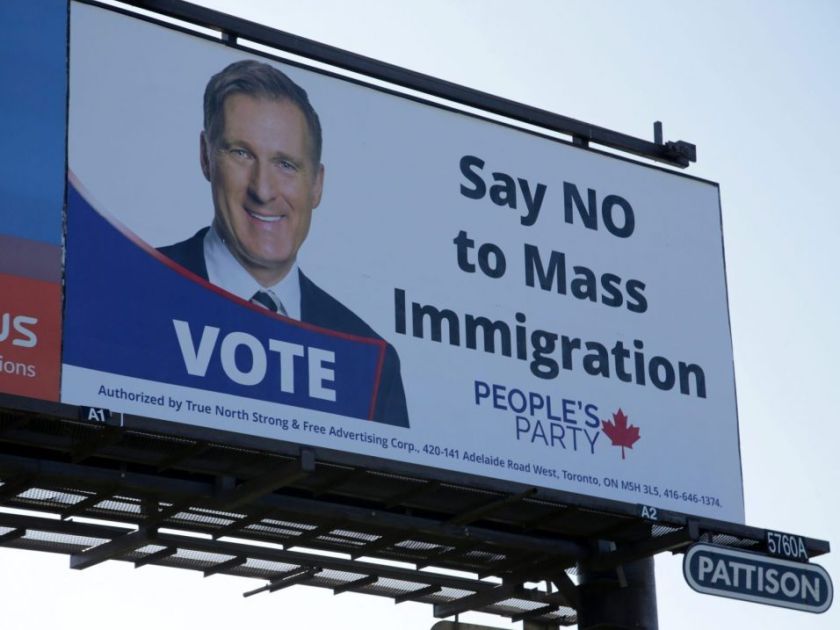
A billboard in Toronto, showing Maxime Bernier and an official-looking PPC message.
Photo from The Province – https://theprovince.com/opinion/columnists/gunter-berniers-legitimate-position-on-immigration-taken-down-by-spineless-billboard-company/wcm/ecab071c-b57d-4d93-b78c-274de524434cI think Graves and Valpy are right and I can’t wait for that exact outcome.
Scheer managed to hoodwink a lot of natural populists with a combination of Liberal-lite policies and some goofy socon gestures (I am not sure Pride Parade non-attendance really counts for much with the serious socons.)
Graves and Valpy maintain that this was enough to avoid “orphaning the party’s biggest lump, and he more or less cut off oxygen to Maxime Bernier’s People’s Party of Canada (PPC).” It might have been last election but if the CPC goes centrist with its next leader, the lump will be looking elsewhere.
I am fairly certain that the CPC will go for a centrist leader if only because there are really no populist candidates available to it. Pierre Poilievre might fill the bill but it is not obvious that the CPC will be willing to support an MP who is as “direct” as Poilievre.
Which will leave “the lump” looking for a home. Graves and Valpy give a rundown of the lump’s core issues,
Like the United States, the United Kingdom and sizeable chunks of Western Europe, Canada has a significant portion of citizens — about 30 per cent — who are attracted to the current psychographic and demographic binge of ordered populism. They are profoundly economically pessimistic and mistrustful of science and the elites. They have no interest in climate change, they don’t really see an active role for public institutions and believe there are too many immigrants. Of those immigrants coming to Canada, they think that too many are not white.
Other than the dig about thinking “too many are not white”, that is a pretty good summary. (On the “not white” thing, I suspect it is more nuanced than that: more along the lines of the current Quebec government’s desire to preserve its culture in the face of immigration.)
QotD: Microbrew beer
Risk-taking microbreweries these days are known to replace or supplement hops with such oddities as heather, bog myrtle, ginseng, and hemp. As hops are related (by marriage) to cannabis — that other great medicinal herb — we shouldn’t be surprised to encounter hemp beer, and indeed you can usually find it on tap in Toronto at C’est What down on Front Street. It’s not bad either, once you get it lit, which is the hard part.
Nicholas Pashley, Notes on a Beermat: Drinking and Why It’s Necessary, 2001.
December 22, 2019
The North Magnetic Pole … a refugee from Canada’s Arctic
Colby Cosh on the latest refugee to flee from Canada:
On Dec. 10, the World Magnetic Model used to calibrate compasses was officially updated. The “model” can be thought of as a map that you would use, given your location on or near the Earth’s surface, to find out how many degrees your magnetic compass is off from true geographic north (or south). This ordinarily happens every five years, but the wizards in charge of the system decided to update a year early because the north magnetic pole is moving particularly fast right now.
Positions of North Magnetic Pole of the Earth. Poles shown are dip poles, defined as positions where the direction of the magnetic field is vertical. Red circles mark magnetic north pole positions as determined by direct observation, blue circles mark positions modelled using the GUFM model (1590–1890) and the IGRF-12 model (1900–2020) in 1 year increments. For the years 1890–1900, a smooth interpolation between the two models was performed. The modelled locations after 2015 are projections.
Map by Cavit via Wikimedia Commons.As most Canadians will have heard, magnetic north is, at the moment, fleeing Canadian territory and heading toward Russia. The rate of change is still very high by historic standards, first established in the early 19th century, but it has slowed just a little. In the year 1900 the pole was firmly in the Canadian Arctic, off Somerset Island. It wandered north, broke out of our high Arctic archipelago in about 2000, and has been streaking Siberia-ward across the open sea at more than 50 km a year since. The time component in the new WMM forecasts a slight slowing over the next five-year period, to about 40 km/yr.
This, like everything else involving Earth’s magnetic field, is a bit of a guess. The WMM has to be updated often because it does incorporate guesswork about the magnitude and direction of changes in the short-term future. The model will be most accurate now, and increasingly less so over the five-year term as the magnetic poles do their little dance — independently, by the way; the magnetic poles are not exactly opposite the Earth from one another, and the “south” one is scooting along much more slowly than the “north.” (Also, the magnetic north pole, the one to which the “north” needle of your compass is attracted, is actually a “south” pole to physicists.)
The truth is that the naive inquirer should not research Earth’s magnetism in the expectation that it is as well understood by scientists as, say, oceanic tides. (You can probably detect that I am talking about myself here.) The question “Why is the magnetic pole leaving Canada?” does not really admit of a solid answer. Maybe it’s the investment climate?
Probably most everybody is dimly aware that the magnetic poles flip outright from time to time — every half-million years on average. But the assumptions embedded in your handheld compass run much deeper than that. The Earth itself is only a big dipole magnet generally, rather than locally, and there is no guarantee of only one “north magnetic pole” as the field is measured near the surface. Competing “north poles” can form. (Which would, at least, let Russia and Canada each have their own …)

December 20, 2019
QotD: Ontario pubs
Nicholas Pashley, Notes on a Beermat: Drinking and Why It’s Necessary, 2001.
December 18, 2019
Mark Steyn on what passes as “conservatism” these days
It’s certainly Conservative-In-Name-Only:
In 2000, when the Vermont Supreme Court mandated same-sex “civil unions”, American conservatives were outraged. By 2010, when the left had moved on to gay marriage, conservatives were supportive of civil unions but insisted marriage was an ancient institution between a man and a woman. Now, the left having won that one and moved on to transgenderism, conservatives profess to be a bit queasy about transitioning grade-schoolers.
So you can take it to the bank that by 2030 rock-ribbed Republicans will be on board with penises in the girls’ changing rooms, but determined to hold the line against whatever the left’s next cause du jour is: human cloning, the state appropriation of parenthood, voting rights for animals.
There really isn’t much point to conservatism that’s just leftism ten years late, is there? It’s like that ITV+1 satellite service they have in Britain that offers you the ITV schedule but an hour later, in case you were caught in traffic heading home. If you’re considering on which side to bestow your tribal loyalty, the left is right quicker; the right is left behind — but only for a few years until they throw in the towel. If you’re all headed to the same destination, why not ride first class on the TGV instead of the creaking, jerking stopping service? Justin Trudeau’s vapid modishness was perfectly distilled by his campaign catchphrase of four years ago: “Because it’s 2015.” But that beats waiting till 2025 to say “Because it’s 2015”.
While we’re on the subject of the northern Tories: Because the late unlamented Andrew Scheer finessed his views on same-sex nuptials as lethargically as did Barack Obama, he was flayed by the Canadian media as some fire-and-brimstone social conservative of televangical inflexibility. I wish. As I wrote the other day, he’s as unmoored from principle as Boris Johnson, but without the countervailing strengths of being able to stick it to the other guy and to pass himself off as a human being. He was particularly contemptible in the hours before my appearance at the House of Commons Justice Committee, as I may discuss in detail one of these days. Yet the never-learn Conservatives are minded to replace an entirely hollow man with someone just like him, only more so.
It is surely telling that the only issues on which the right has made any progress at all in moving the ball in its direction — Brexit in the UK; illegal immigration and a belated honesty about the rise of China in the US — had to be injected into public discourse by two outsiders, Nigel Farage and Donald Trump. And indeed in the teeth of opposition by the establishment’s catch-up conservatives.
Catch-up conservatism gives the game away: The right has lost the knack of persuasion, and increasingly doesn’t even bother to try.
Repost – Induced aversion to a particular Christmas song
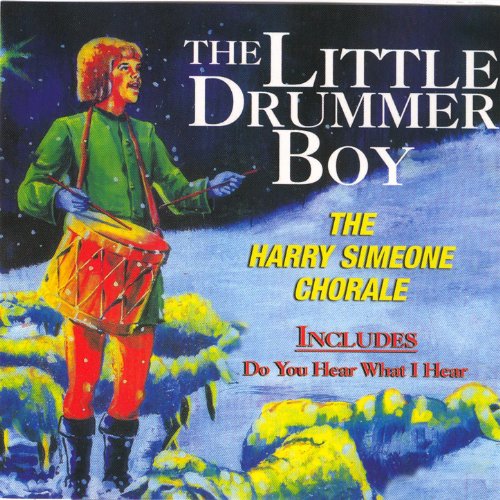
Earlier this year, I had occasion to run a Google search for “Mr Gameway’s Ark” (it’s still almost unknown: the Googles, they do nothing). However, I did find a very early post on the old site that I thought deserved to be pulled out of the dusty archives, because it explains why — to this day — I can barely stand to listen to “Little Drummer Boy”:
Seasonal Melodies
James Lileks has a concern about Christmas music:
This isn’t to say all the classics are great, no matter who sings them. I can do without “The Little Drummer Boy,” for example.
It’s the “Bolero” of Christmas songs. It just goes on, and on, and on. Bara-pa-pa-pum, already. Plus, I understand it’s a sweet little story — all the kid had was a drum to play for the newborn infant — but for anyone who remembers what it was like when they had a baby, some kid showing up unannounced to stand around and beat on the skins would not exactly complete your mood. Happily, the song has not spawned a sequel like “The Somewhat Larger Cymbal Adolescent.”
This reminds me about my aversion to this particular song. It was so bad that I could not hear even three notes before starting to wince and/or growl.
Back in the early 1980’s, I was working in Toronto’s largest toy and game store, Mr Gameway’s Ark. It was a very odd store, and the owners were (to be polite) highly idiosyncratic types. They had a razor-thin profit margin, so any expenses that could be avoided, reduced, or eliminated were so treated. One thing that they didn’t want to pay for was Muzak (or the local equivalent), so one of the owners brought in his home stereo and another one put together a tape of Christmas music.
Note that singular. “Tape”.
Christmas season started somewhat later in those distant days, so that it was really only in December that we had to decorate the store and cope with the sudden influx of Christmas merchandise. Well, also, they couldn’t pay for the Christmas merchandise until sales started to pick up, so that kinda accounted for the delay in stocking-up the shelves as well …
So, Christmas season was officially open, and we decorated the store with the left-over krep from the owners’ various homes. It was, at best, kinda sad. But — we had Christmas music! And the tape was pretty eclectic: some typical 50’s stuff (White Christmas and the like), some medieval stuff, some Victorian stuff and that damned Drummer Boy song.
We were working ten- to twelve-hour shifts over the holidays (extra staff? you want Extra Staff, Mr. Cratchitt???), and the music played on. And on. And freaking on. Eternally. There was no way to escape it.
To top it all off, we were the exclusive distributor for a brand new game that suddenly was in high demand: Trivial Pursuit. We could not even get the truck unloaded safely without a cordon of employees to keep the random passers-by from snatching boxes of the damned game. When we tried to unpack the boxes on the sales floor, we had customers snatching them out of our hands and running (running!) to the cashier. Stress? It was like combat, except we couldn’t shoot back at the buggers.
Oh, and those were also the days that Ontario had a Sunday closing law, so we were violating all sorts of labour laws on top of the Sunday closing laws, so the Police were regular visitors. Given that some of our staff spent their spare time hiding from the Police, it just added immeasurably to the tension levels on the shop floor.
And all of this to the background soundtrack of Christmas music. One tape of Christmas music. Over and over and over and over and over and over and over again.
It’s been over 20 years 30 years now, and I still feel the hackles rise on the back of my neck with this song … but I’m over the worst of it now: I can actually listen to it without feeling that all-consuming desire to rip out the sound system and dance on the speakers. After two three decades.
December 14, 2019
Huot Automatic Rifle: The Ross Goes Full Auto
Forgotten Weapons
Published 13 Dec 2019http://www.patreon.com/ForgottenWeapons
Cool Forgotten Weapons merch! http://shop.bbtv.com/collections/forg…
During World War One, Joseph Alphonse Huot, a Canadian machinist and blacksmith living in Quebec, designed a conversion of the Ross MkIII rifle to become an automatic rifle. The Ross was the standard issue Canadian rifle at the beginning of the war, and Huot wanted to find a way to economically provide Canadian forces with an automatic weapon. His conversion functioned by mounting a gas piston onto the side of the Ross barrel, adding a large action cover and 25-round drum magazine, and a Lewis-style cooling shroud over the barrel.
In initial testing with the Canadian army, the Huot performed well. It was seriously considered for adoption, but had to undergo British testing and approval before that could happen. In British testing (by now near the end of the war), it was found to run well enough and have some positive attributes, but not sufficient to justify replacement of the Lewis Gun. It was rejected, and the Canadian Corps finished the war with the Lewis instead. Huot had spent several years privately developing the weapon and two more working on salary for the Canadian military, and had gone into considerable personal debt for the project. He had secured a deal to receive royalties on production, but that of course came to naught when the design was rejected. Ultimately, he was compensated $25,000 in 1936 (of the $36,000 he claimed to have spent).
Only five of the guns were made in total, with four known to still exist. Two of them are in Ottawa at the Canadian War Museum and one in the Seaforth Highlanders Museum in Vancouver and one in the Army Museum in Halifax.
Thanks to the Canadian War Museum for providing me access to film this Huot for you!
Contact:
Forgotten Weapons
6281 N. Oracle #36270
Tucson, AZ 85704

Who will “Big Dairy” push as the next Conservative leader?
The Canadian supply management system is a classic case of concentrated benefits and diffused costs … all Canadians pay more for milk, cheese, and other dairy products, but the extra profits go to those who hold the quota allotment for production. During the last federal Conservative leadership race, the “temporary conservatives” were enough to push the Milk Dud over the top to defeat Maxime Bernier — because Bernier was outspoken in his opposition to the whole supply management cartel and threatened those guaranteed profits for the insiders. The Milk Dud has announced he’s stepping down, so who will Big Dairy choose to replace him?

Andrew Scheer, paid tool of Big Dairy, chugs some milk during a Press Gallery speech in 2017. I’ve called him the “Milk Dud” ever since.
Screencapture from a CTV video uploaded to YouTube.
To my mind the defining image of Andrew Scheer’s efforts to become prime minister of Canada, which officially came to an end Thursday, comes from the 2017 Press Gallery Dinner in Ottawa. “There’s some suggestion out there that I’m beholden to a certain group within the Conservative family,” he told the crowd, grinning. And then, dimples at maximum, he took a swig from a one-litre carton of Neilson two-per-cent milk.
It’s nice when politicians can poke fun at themselves. Most are really bad at it, betraying only their own ego. Scheer’s routine, by contrast, reportedly brought the house down. The problem is that, by all the evidence, Scheer was utterly beholden to the dairy industry. And absent the effects of alcohol, that’s not really very funny.
We knew at the time that, days before, Scheer had barely beaten Maxime Bernier in the party leadership contest with help from a few thousand votes from people whom Bernier not unreasonably called “fake Conservatives” — i.e., people who had purchased memberships for the sole purpose of voting for Scheer, for the sole purpose of maintaining supply management in the dairy industry (which Bernier opposes) intact.
We came to know later, thanks to a Dairy Farmers of Canada briefing book discovered by an aggrieved delegate to the 2018 party convention in Halifax, that the dairy lobby considered Scheer a “safety net.” Regardless of any vote by the party membership that might recommend freer markets in dairy, the book alleged, the farmers had Scheer’s commitment never to undermine supply management in an election platform.
Scheer denied any such deal existed, of course. But it seemed doubtful the dairy industry’s notoriously fearsome, professional and effective lobbyists could have been so misinformed.
It ought to have been a liability from the start: Here was the self-styled middle-class alternative to Justin Trudeau, the man who knows what it’s like to plan a family budget around the breakfast table, to scrimp and save, whose parents didn’t own a car, declaring his fealty to a cartel dedicated to inflating milk prices for the benefit of wealthy businesses. Har, har, har.
December 13, 2019
We won’t have the Milk Dud to kick around any more … eventually
News of the moment in Canada is the sudden resignation of “Conservative” party leader Andrew “The Milk Dud” Scheer:
Andrew Scheer, paid tool of Big Dairy, chugs some milk during a Press Gallery speech in 2017. I’ve called him the “Milk Dud” ever since.
Screencapture from a CTV video uploaded to YouTube.
Andrew Scheer used money from the Conservative Party to pay costs of private schooling for his children, according to sources in contact with Global News. Some are suggesting this story might have ultimately let to Scheer’s resignation.
Scheer has since stepped down as leader of the Conservative Party, but he will not fully resign until the party has a replacement to fill the position.
According to some senior Conservative members, Scheer’s use of the Conservative Party of Canada funds was improper.
While in the House of Commons, Scheer said, “I just informed my colleagues in the Conservative caucus that I will be resigning as the leader of the Conservative Party of Canada and I will be asking the Conservative Party national council to immediately begin the process of organizing a leadership contest.”
“In order to chart the course ahead in the direction this party is heading, the party needs someone who can give 100 percent.”
Dustin van Vugt, the Executive Director of the Conservative Party of Canada wrote a statement saying, “All proper procedures were followed and signed off on by the appropriate people.”
Van Vugt talked about the party covering some of Scheer’s costs in the statement saying, “As is the normal practice for political parties, the Party offered to reimburse some of the costs associated with being a national leader and re-locating the family to Ottawa.”
Where, oh where will the “Conservatives” find a leader of Scheer’s “stature” to fill his dainty little shoes? Maybe Justin can spare one of his cast-offs…
December 10, 2019
Warren Kinsella, the PPC, and “Operation Cactus”
Kate at SDA linked to this interesting article by James Di Fiore on the Conservative Party’s contract with Warren Kinsella to smear Maxime Bernier and the PPC in the run-up to the Fall election:
If you were new to this country, or part of our sect of apathetic voters, there was a good chance you walked away from the election believing Bernier and his party were nothing but a bunch of racists who thought they finally found a home. From there, being branded the racist party in Canada, all the media had to do was either ignore the PPC, or only run negative stories, not wanting to be seen as an outlet giving positive coverage to what was deemed as obvious bigotry.
Enter Warren Kinsella.
I sometimes wonder how well-known Kinsella really is. Everyone in the Ottawa and Toronto bubble knows him. The media and party members know him. But he’s not exactly a household name, until now maybe. Kinsella, a throwback operative going back to the Chretien years, still manages to convince people to hire him, despite having a reputation of being hopelessly unsavoury, where the ends always justifies the means as long as you remind everyone along the way how great of a person you are.
Kinsella was hired by the Conservative Party of Canada to execute a campaign painting The People’s Party of Canada as a haven for bigotry and white nationalism. Secretly recorded by an employee, Kinsella was heard giving his team a pep talk on how to effectively destroy Bernier. He even tried to reinforce his motivational speech by bragging about falsely smearing three prominent politicians as racists when he knew they were not. He tries to catch himself by saying how easy it is to smear Bernier as a racist because, as Kinsella put it, “this guy actually is a racist.”
When a strong federal party hires a notoriously unethical operative to smear a new party as a gang of racists and bigots, it can be difficult to define your own brand. I asked Bernier if he thought there was a reason some racists did seem drawn to his party’s platform.
“It happened when Preston Manning started the Reform Party more than 25 years ago. People were saying that party was a racist party. The Conservative Party and Kinsella tried to do the same thing with us. That’s why I am looking at all my options to look at the legal procedures that we can do.”
Bernier might have a very strong case, especially now that Kinsella’s mask has been taken off by his own hand.
“The Conservative Party of Canada is morally and intellectually corrupt, and they proved that with their contract with Kinsella.”
It is still unknown how much the CPC and Kinsella impacted Bernier’s party, but it is reasonable to believe Kinsella was ultimately successful. On September 29th, at an event in Hamilton, several protestors accosted event attendees as they tried to get into the building at Mohawk College. The aggressiveness of the demonstrators was palpable as they screamed at seniors, calling them Nazis and preventing them from entering the building. Instances like this make Kinsella’s contract all the more mysterious. After all, his job, according to his own admission, was to activate Canadians against Bernier by stoking the flames of racial intolerance.
There are questions as to whether Kinsella’s fingerprints are on several other party missteps and controversies, including a rash of resignations earlier this year when former loyalists mysteriously began trashing the party publicly.
Operatives normally do not get caught bragging about having a track history of how their lies about other people’s bigotry have been successfully used to disrupt campaigns. In Bernier’s case, Kinsella, a self-proclaimed, lifelong fighter for racial justice, actually spent a career monetizing racial divisions he helped to stoke. When his shtick was exposed through his own accidental confessions, the hindsight view of Maxime Bernier became less blurry.
December 9, 2019
Nikki Haley, 2024?
Ted Campbell looks at the US political scene and wonders if Nikki Haley will be the President after the 2024 federal election:
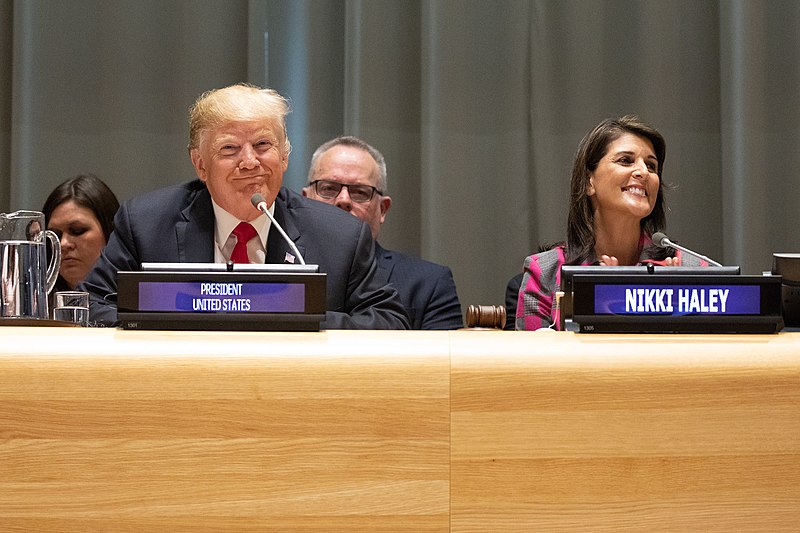
President Donald Trump and Ambassador Nikki Haley at the United Nations Headquarters in New York City, 24 September, 2018.
Official White House photograph by Shealah Craighead via Wikimedia Commons.
Following on from my previous post, I suspect that former Governor (South Carolina) and US Ambassador (to the United Nations) Nikki Haley might be President-elect of the United States five years from now. She is, right now, I think, the wholly unofficial but very clear voice of the post-Trump Republicans. She shares many of the Trumpian aims but she will campaign with a much different mixture of grit and grace, as the title of her recent book (campaign manifesto?) suggests.
It also seems pretty obvious to me, and to some other observers, that Justin Trudeau and the Liberal Party of Canada have decided that they can win a majority in (probably) 2021 by appealing even more strongly to the Laurentian Elites and thereby securing a half dozen more seats in each of Greater Vancouver and in urban Quebec and another dozen in (mainly) South-Western Ontario.
[…]
I think that Ambassador Haley’s comments are a shot across Canada’s bows made on behalf of the American establishment, not just Donald Trump. I suspect her remarks were very carefully crafted and even blessed by influential leaders in government, academe and in the huge array of think tanks in which America’s “government in waiting” resides. She is not speaking for Donald Trump; he can (likely will) speak for himself in his own, inimitable, bullying style. She is speaking for a larger, more permanent establishment, the “deep” administrative state that guards America’s permanent, vital interests.
Canadians need to pay attention. Nikki Haley matters; she (or someone very like her) is the future and she (or that similar someone) is the future to which we must accommodate ourselves for the 2020s and into the 2030s. We must remain a steadfast, trusted member of the US-led West. We, under Mackenzie-King and Louis St Laurent and John Diefenbaker, helped to build the US-led West, we even helped to lead it. Pierre Trudeau wanted to change Canada; he did, but not as much as he wished. His own Liberal ministers would not follow him all the way. Justin Trudeau is following in his father’s deeply flawed strategic footsteps which aim to make Canada irrelevant. He has a much tamer (weaker) cabinet allowing him and Chrystia Freeland to push Canada towards a strategic place where our country will be politically isolated, largely friendless and poor.
Liberals, by which, in the 2020s, I mean Conservatives, must speak out and offer Canadians a better, principled strategic vision which aims to secure our sovereignty, our prosperity and a respectable, responsible, leadership role ~ what Paul Martin called a role of pride and influence ~ in the world. Otherwise, Canada’s very sovereignty is in peril. If, as I expect, Donald Trump is re-elected next year and is then followed in 2024 by another, albeit “kinder, gentler” Trumpian, (which I believe is very likely because I think the Democratic Party in the USA will shatter after the 2020 election and will not be a real force again for a decade or more) then Canada must adapt. The importance of our bilateral relationship with America is to all other things as ten is to one.

December 8, 2019
The “Church of Atheism” doesn’t get charitable status … this time
Colby Cosh on the recent court decision on the Church of Atheism’s attempt to qualify as a church — and receive the tax benefits — under Revenue Canada’s rules:
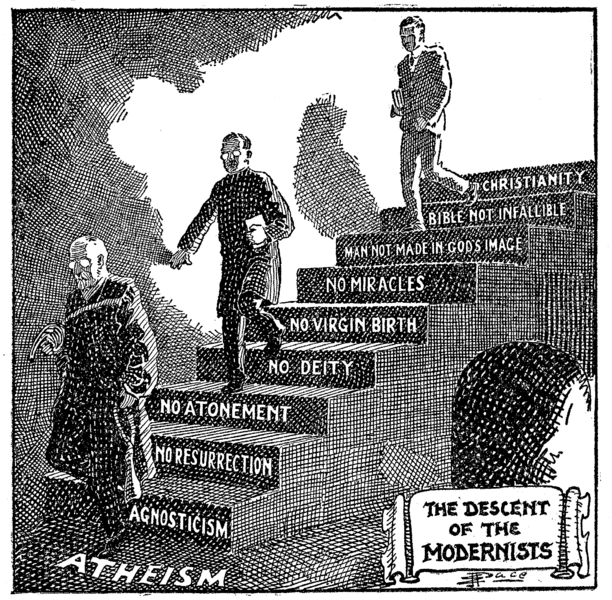
“The Descent of the Modernists”, by E.J. Pace, first appearing in his book Christian Cartoons, published in 1922.
Public domain via Wikimedia Commons.
Last week the Federal Court of Appeal upheld Revenue Canada’s rejection of an application for charitable status made by a “Church of Atheism” tucked away in Ontario’s Lanark Highlands. The idea of making a gesture like this has probably occurred to every atheist who looks around at a world of tax-exempt churches and wonders why his kind is excluded from the gravy train. (Clergymen pay tax on their income, but they have access to a generous residential deduction, and any professional expenses covered by the church go untaxed.)
The fact is that the “Church’s” efforts were a bit amateurish and confused. But they may, like a doomed military reconnaissance, have revealed weaknesses in the anomalous exclusion of atheists from religious tax exemptions.
These weaknesses cannot be any big secret. You probably remember the Supreme Court’s Mouvement laïque québécois v. Saguenay decision of 2015 — that’s the case in which the Quebec Court of Appeal had ruled that a statue of Christ with an electrically illuminated Sacred Heart was “devoid of religious connotation.” The Supreme Court, perhaps suppressing a chuckle or two, proceeded to unanimously overturn the Quebec ruling and expound the concept that the Canadian state has a Charter-based “duty of religious neutrality” (except, of course, where the constitution explicitly specifies otherwise, as with Catholic schools). Government, the SCC insisted, “must neither favour nor hinder any particular belief, and the same holds true for non-belief.”
Given that this is our law, what can be the problem with a “Church of Atheism”? Good question! Justice Marianne Rivoalen, writing on behalf of a three-judge Federal Court panel, confirmed the general point that there is a state duty of religious neutrality; in fact, even Revenue Canada, acting as the respondent, conceded this.
But the court simply ruled, without any logical elucidation, that “the Minister (of Revenue)’s refusal to register the appellant as a charitable organization does not interfere in a manner that is more than trivial or insubstantial with the appellant’s members’ ability to practise their atheistic beliefs. The appellant can continue to carry out its purpose and its activities without charitable registration.”
December 6, 2019
“‘The world needs more Canada’, some of us love to boast. Just not if it costs money”
In hindsight, President Trump let Justin Trudeau off rather lightly for his blatant disrespect on the world stage. Trump has all the cards in our bilateral trade relationship, and the Canadian economy isn’t in a healthy state at the moment. It’s not a risk any Canadian PM should be running when we are so “delinquent” on our NATO commitments, as Chris Selley points out:
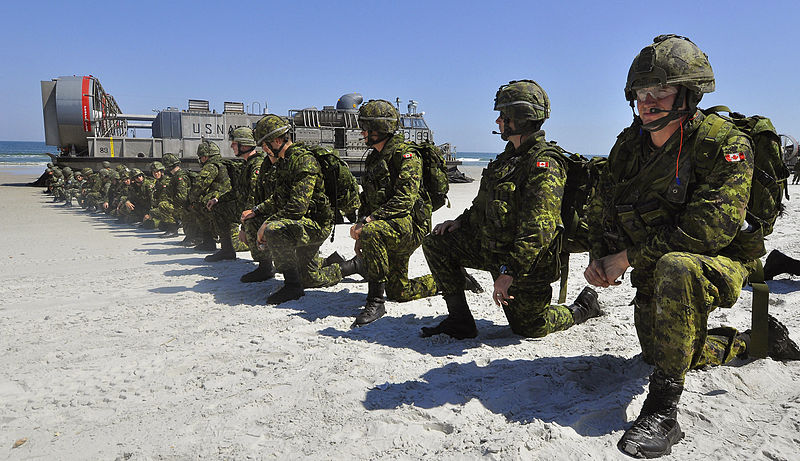
Canadian soldiers set a perimeter position after disembarking a U.S. Navy landing craft during a simulated amphibious landing, 24 April 2009. The training exercise was part of the 50th iteration of UNITAS, a multi-national exercise intended to increase interoperability among participating navies. Other participating nations include Brazil, Peru, Mexico, Germany, Ecuador, Argentina and Chile.
U.S. Coast Guard photo by Petty Officer Seth Johnson via Wikimedia Commons.
The unfortunate thing is that the precipitating event for this little spat could have been useful: An American president publicly calling out Canada, in effect, as a deadbeat brother. At their media availability-cum-fireside chat, Trump accused Canada — again in remarkably diplomatic language, by his standards — of being “slightly delinquent” when it comes to military spending, particularly as it relates to our NATO obligations. The unofficial target for NATO countries is two per cent of GDP. In 2018, the World Bank pegged Canada at 1.25.
This is far from a unique state of affairs. “The world needs more Canada,” some of us love to boast. Just not if it costs money. As a percentage of gross national income, Canada’s foreign aid spending is 0.26 per cent — below the OECD average of 0.31 and a pale shadow of countries like Sweden and Norway, which spend quadruple that. During the last election campaign, no doubt having extensively focus grouped the idea, the Conservatives promised to cut aid spending by 25 per cent.
Canada routinely lobbies for a seat on the UN Security Council for reasons no one can quite articulate — I suspect because it’s a relatively inexpensive thing that we can then boast about. Trudeau’s Liberals orated furiously about Canada’s alleged peacekeeping imperative during the 2015 election, dithered for an eon about how to fulfil it, sent 200 soldiers and eight helicopters to Mali for a year, and then brought them home. Peace kept! Conservatives spent the previous decade talking up Canada’s hard-power credentials even as military spending fell, as a percentage of GDP, for five out of the nine years Stephen Harper was prime minister.
No Canadian government of any stripe can procure a new fighter jet, icebreaker or frigate to save its life — because at the end of the day, we can’t use them to save our lives. If things really go pear-shaped we’re basically begging at Uncle Sam’s feet anyway, so military procurement has become about buying votes and very little else. Military spending has risen under Trudeau’s Liberals, but it’s still less than the 2009 high point under Harper — 1.4 per cent of GDP, in 2009. It was above two per cent as recently as 1987.
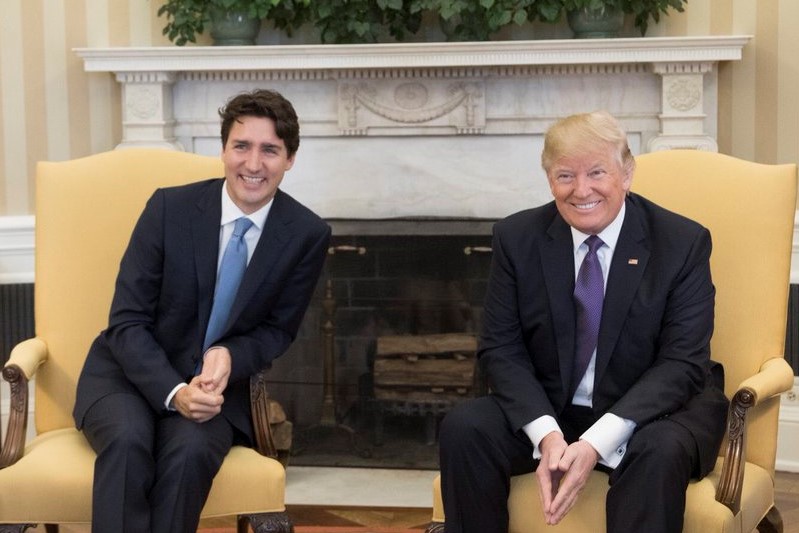
Justin Trudeau meets with President Donald Trump at the White House, 13 February, 2017.
Photo from the Office of the President of the United States via Wikimedia Commons.


