Quotulatiousness

July 4, 2019

Assorted green scams

David Warren briefly returns to the current day (away from his normal 13th-century preferences) to look at a few of the many green scams being run by various government and industry scam artists:

Speaking with a gentleman who vends in a neighbourhood farmers’ market, I learnt something interesting, and probably true. Surviving family farms usually lack “organic” credentials. This is because getting them, from the bureaucracies that dispense them, is an immensely time-consuming process, and involves costs that would erase most of the little farmer’s profits. You have to be a big, faceless, industrial operation to afford the official “organic” labels that sucker big city consumers into paying double for essentially the same goods. That the whole system is massively corrupt, can almost go without saying. It was designed to be.

Organic scams are far from new, but perhaps more insidious because corporations love to add that “organic” label on stuff to jack up the prices on all sorts of things, like spices, wine, and many, many other items. Restaurants do the same trick on their menus, frequently assuming nobody will ever check up on them. That said, it’s mostly the well-off who get fooled because, well, they’re eager to be fooled on that score. The US government even admitted that organic certification is not about food safety or nutrition: it’s all marketing.

By coincidence, the same day my eye caught, by accident on the Internet, the announcement of a Green Award to a big car assembly “park.” They had changed all the light bulbs in their factory buildings, thus saving themselves a few thousand dollars on their multi-million electric bill, and seem to have installed new toilets, too. This sprawling high-tech carriage works remains three hundred acres of unspeakable aesthetic horror, in which human beings are enslaved to machines. But now it is “Green.”

The greenwashing of modern industrial and commercial buildings is a long-running scam, with the much-desired “LEED Platinum” certification usually, if not always, awarded to those who game the system most successfully. “What LEED designers deliver is what most LEED building owners want – namely, green publicity, not energy savings

The environmental business — currently buoyed by unprovable, often fatuous claims of anthropogenic global warming — is perhaps the most cynical. It has spawned vested interests on a global scale, that will not be overturned by occasional exposure. At its heart is the manipulation of statistics, and scare-mongering through compliant mass media. The general public are hypnotized by repetition. I have noticed in desultory dips into the news that e.g. anomalous weather will invariably be attributed to “climate change,” when more plausible explanations are easily at hand.

This zombification extends to most other areas of reportage: invisible bogeys blamed for imaginary trends. Solutions to “environmental problems” are proposed that will not make the slightest dent in them.

Of course, the constant demands for “clean energy” almost always explicitly reject the use of nuclear power because reasons.

Darlington Nuclear Generating Station in Clarington, Ontario.
Photo by Óðinn via Wikimedia Commons.

But nuclear power, most easily in the form of molten salt reactors (on which research was killed fifty years ago), could replace most uses of coal, oil, and gas within a decade, through much smaller facilities eliminating huge transmission costs. It would be the cheaper because the fuels are readily available to start in the form of recycled nuclear waste, and the raw materials would be abundantly available thereafter.

On the question of safety, the death toll from mining, drilling, hydro dams, &c, is quite considerable — in the tens of thousands at least, post-War. Except for Chernobyl (one of many Soviet-era environmental disasters), the death toll from nuclear accidents remains about nil. No one died at Three Mile Island. Not one death was caused by the flooded Fukushima reactors (though well over twenty thousand were killed by the tsunami that caused the difficulty there).

In short, “clean energy” is not a problem. It had to be made into one by the fright campaigns of the environmentalcases, whose own power and income depends on sustaining the problem, and preventing the most obvious solutions.

July 3, 2019

QotD: Elon Musk as a modern-day Ferdinand DeLesseps

Filed under: Business, Law, Quotations, USA — Tags: , , , , — Nicholas @ 01:00

I used to love Elon like everyone else. I still think that having four or five billionaires in a space race against each other is finally the world I thought I was going to get growing up reading Heinlein. The Tesla Model S was probably one of the most revolutionary cars of the last 50 years. But he lost me when he committed outright fraud in the Solar City – Tesla deal and since then have only become more skeptical about he and Tesla.

Elon Musk at the 2015 Tesla Motors annual meeting.
Photo by Steve Jurvetson via Wikimedia Commons.

I sort of laugh when folks tell me that really smart successful rich people believe in Tesla. You mean like James Murdoch, on the board of Tesla and who also was lost his entire investment in Theranos? Or like Larry Ellison, an adviser and fan of Elizabeth Holmes who invested $1 billion in Tesla just 6 months ago and has already lost 40% of it? The window on this is probably closing, but over the last 10 years if you wanted to get Silicon Valley investors to throw a lot of money at you, find a traditional bricks and mortar business and devise a story in which you take that industry and convert its economics to that of the networked software world (see: Uber, WeWork, Tesla, and even Theranos in some of its strategic pivots).

Or how about true millennials and Elon Musk? Name a wealthy millennial supporter of Elon Musk and Tesla and I can bet you any amount of money they have not looked at Tesla’s balance sheet or cash flow or the details of its global demand trends. They have not thought about its dealership strategy or manufacturing strategy and the cash flow implications of these. They just like what Elon says. It sounds big and visionary. They buy into Elon’s formulation that he is saving the environment and everyone opposed to him is in a cabal with big oil (ignoring the fact that Elon routinely uses his Gulfstream VI to commute distances less than 60 miles). So saying that rich millenials adore Elon is effectively saying that they want to be associated with the same things Elon says he is for — the environment and space travel et al.

Elon Musk is Ferdinand DeLesseps. He is PT Barnum. He is Elizabeth Holmes. He is the pied piper. He is fabulous at spinning visions and making them sound science-y. But he is not Tony Stark. There is a phenomenon with Elon Musk that everyone thinks he is brilliant until they hear him speak about something about which they have domain knowledge, and then they realize he is full of sh*t. For example, no one who knows anything about transportation or physics or basic engineering has thought his Boring Company and Hyperloop make any sense at all. His ideas would have been great cover stories for Popular Mechanics in the 1970’s, wowing 13-year-old boys like me with pictures of mile-long cargo blimps and flying RV’s. He is like a Marvel movie that spouts science that is just believable-enough sounding that it moves the plot along but does not stand up to any scrutiny.

All of this would be harmless if he was not running a public company. I don’t really care about the rich folks who were duped by Elizabeth Holmes, but hundreds of thousands of small millenial investors who have totally bought into the Elon hype are literally putting their last dollar into Tesla, and sometimes borrowing more. Tesla shorts often laugh at these folks on Twitter, calling them “bagholders,” but it is a tragedy. Unless Tesla finds a sugar daddy sucker, and the odds of that are getting longer, I think it is going to end badly for many of these investors.

As a disclosure, I have been short Tesla via puts for a while now. It you really want to understand Elon, the best book I can recommend is The Path Between The Seas about the building of the Panama Canal. First, it is a great book you should read no matter what. And second, Ferdinand DeLesseps is the best analog I can find for Musk.

Warren Meyer, “People Who Express Opinions Outside of their Domain Seldom Have Really Looked into it Much”, Coyote Blog, 2019-05-28.

June 29, 2019

Canada’s inability to deal with Chinese hard ball tactics

Filed under: Business, Cancon, China, Law, USA — Tags: , , , — Nicholas @ 05:00

The Canadian government complied with a request from the United States government to detain a Chinese national for possible extradition to the US. But this was no ordinary Chinese citizen: it was Meng Wanzhou, the Chief Financial Officer for Huawei, a very big and very well-connected Chinese conglomerate. Ms. Wanzhou is not just a high-ranking executive, but also the daughter of the founder of the company. The Chinese government is more than miffed at Canada’s legal presumption and has been piling on the means of persuasion to get Canada’s notoriously pliable government to just pretend this never happened and to let Ms. Wanzhou proceed on her way. Under normal circumstances, this might well happen, but the US government is now under the control of a man who reputedly makes our Prime Minister lose control of his bladder, so we can’t just be seen to knuckle under to the bullying of the Bad Orange Man, nor can we be seen to knuckle under to the bullying of the PRC, leaving poor Justin Trudeau looking weak and powerless (and, to be fair, he is weak and powerless).

Andrew Coyne suggests that the best way to help a couple of poor Canadians who have been caught up in the inter-governmental shenanigans is to stop talking about some sort of “deal”:

U.S. Department of Justice among others announced 23 criminal charges (Financial Fraud, Money Laundering, Conspiracy to Defraud the United States, Theft of Trade Secret Technology and Sanctions Violations, etc.) against Huawei & its CFO Wanzhou Meng
Image via Wikimedia Commons.

I don’t doubt that behind the scenes government officials are doing everything they can, or think they are. But the pressure to bring the Canadians home is surely less for the conspicuous failure of other Canadians to give a damn.

Indeed, what is striking throughout this standoff is that most of the pressure has come from the other side. It is China, not Canada, that has used trade as a weapon, blocking imports of Canadian meat and canola. It was the Chinese air force that buzzed a Canadian warship in the East China Sea.

It is the departing Chinese ambassador to Canada who has launched one incendiary attack after another on this country, while Canada’s now-former ambassador to China was floating trial balloons about getting the Americans to drop the charges against Meng. It is China’s leaders who refuse to meet ours.

And yet for all of China’s lawlessness, for all its bestial mistreatment of our citizens and baseless attacks on our interests, the most common response in this country is not to demand that China repair its relationship with Canada, but to ask how Canada can mollify China.

June 26, 2019

Social media giants can be publisher or platform, but not both

Filed under: Business, Law, Liberty, Media, Politics, USA — Tags: , , , , — Nicholas @ 06:00

At Ace of Spades H.Q., Ace explains why Facebook, Google, and the other social media companies have been playing fast and loose with the rules, sometimes using the rules that apply to publishers and sometimes the ones that apply to platforms, depending on their whim:

Only a speaker or publisher of claimed defamatory content can be sued.

Not being a speaker or publisher of a defamatory statement gives you total immunity from suit. You’re just a guy, you had nothing to do with the tort alleged.

Section 230 [of the Community Decency Act] specifically says that “neutral content platforms” shall not be deemed to be the “speaker or publisher” of a claimed defamatory statement made by a third party using their service — hence, the complete immunity from suit. You can’t be sued for something someone else said, obviously.

Now newspapers can be sued for the defamatory remarks of, say, an interview subject. They are publishers of that defamatory statement — they chose to publish it. The interview subject made the statement, but then they chose to publish it themselves, becoming another “speaker” of the defamation.

Now, “neutral content platforms” are never considered “speakers” of third-party defamations (or any third-party crime involving speech, such as offering to sell contraband or conspiring to commit a crime). But a newspaper or media company — or this blog — could be.

The corporate cucks claim that you cannot put restrictions on Google, Facebook, or Twitter as regards their right to censor opinions they disagree with because that constitutes “compelled speech.” You’re compelling them to speak things they do not believe, the cucks’ argument goes.

But… section 230 states that, as a legal matter, they are not considered the “speakers” of any statement made on their “neutral content platforms.”

So which is it? Are they the speakers of these words — in which case, like a newspaper or tv station, they’d have every right to exercise editorial judgment and decide what they wish their company to say — or are they not the speakers of these words, which is their claim whenever someone tries to sue them?

As it stands, they are speakers when it comes to their power to block people from speaking on their platforms — and thus can indulge in the vice of censorship — but not speakers when it comes to people suing them for what other people said on their platforms.

Choose one or the other: Either you are a speaker of other people’s words or you’re not. You can’t forever choose one and then the other when it’s in your interest to have the Clown Nose On or the Clown Nose Off.

June 23, 2019

They managed to get 7% approval? That’s surprising

Filed under: Business, Law, Liberty, Politics, Technology, USA — Tags: , , , , , — Nicholas @ 05:00

Michael van der Galien reports on a recent poll of registered voters in the United States that will not be happy reading for many social media companies:

Only seven percent are happy with social media companies being able to harvest and sell data without permission or compensation.
Chart from Hill.TV – https://thehill.com/hilltv/what-americas-thinking/449576-poll-voters-overwhelmingly-want-more-regulations-on-personal

Thirty-six percent of those polled say there is no scenario imaginable to them in which it’s OK for companies to collect and sell such information. Read that again: one-third of those asked always oppose companies like Facebook, Twitter, Amazon, and Google collecting and selling such data. Another 36% said they can support the collection and selling of personal data if the individuals involved are compensated for it.

Only 21% say they believe companies should be able to collect and sell personal information of users if they’ve expressly asked for permission. As for selling and collecting it without permission:

    Eight percent of Republicans and also Democratic respondents said that firms should be allowed to sell information without permission. Seven percent of independents agreed.

In other words, this is a bipartisan issue, which makes perfect sense. After all, this issue affects all of us, whether we are conservative or liberal.

Matthew Sheffield has more for Hill.TV:

On Monday, the Washington Post reported that the Federal Trade Commission has been investigating Google’s YouTube division for tracking child users, a practice allegedly in violation of a 1998 law which forbids tracking and targeting children under 13 years of age.

The poll found broad bipartisan agreement on what companies should be allowed to do with consumer data. Eight percent of Republicans and also Democratic respondents said that firms should be allowed to sell information without permission. Seven percent of independents agreed.

About the same number of Democrats and Republicans said that companies should not be able to sell data under any circumstance. Thirty-three percent of GOP respondents took this position, as did 35 percent of Democrats. Forty percent of independents agreed.

Younger voters were more willing to allow companies to sell consumer data than older ones although it was still a minority position. Fourteen percent of respondents who were between 18 and 34 said they supported letting companies compile and sell personal data without permission while only 2 percent of those 65 and above agreed.

June 22, 2019

The African Continental Free Trade Area (AfCFTA)

Filed under: Africa, Business, Economics, Government, USA — Tags: , , , — Nicholas @ 05:00

Alexander Hammond explains why a free trade deal among many African nations is good news for the United States and other non-African nations:

2018 map showing the African countries involved in the African Continental Free Trade Agreement.
Dark green indicates ratification, medium green are countries that signed in March 2018, and light green are countries that signed in July 2018 but did not ratify the agreement immediately.
Map by Themightyquill at Wikimedia Commons.

The poorest continent in the world is about to lend a hand to the United States. Last week, Africa implemented the world’s largest free-trade area, and that’s great news for American foreign policy. Back in December, U.S. National Security Advisor John Bolton unveiled a plan for the Trump administration’s titled the “Africa Strategy.”

The plan is simple — the United States will give less aid to Africa, instead prioritizing enhancing America’s “economic ties with the region.” Now that many African nations have unified under a single market, trading with the continent will become far easier — and a trade deal between the United States and Africa would help out everyone involved.

Streamlining Trade

The African Continental Free Trade Area (AfCFTA) trade deal officially came into force on May 30, a month after it reached the twenty-two-nation threshold needed to do so. Now, tariffs on 90 percent of the goods traded among AfCFTA member states will be removed — a move that, according to the UN, will boost intra-African trade by 52 percent in only a few years.

Given the United States’ new plans for the continent, the AfCFTA’s member states aren’t the only economies that will reap the benefits of an African single market.

A key component of the Trump administration’s Africa Strategy is to advance “U.S. trade and commercial ties” with Africa by creating “modern comprehensive trade agreements.” A single African market will be a far simpler trade partner for America. Now, only one set of trade deals will need to be negotiated with the AfCFTA — as opposed to fifty-five intricately-crafted trade deals with each small African economy. The U.S. Trade Representative has even released a report noting how time-consuming and costly it is to negotiate trade deals with each African nation. Because trade deals are long and expensive processes, creating a solitary trade deal with the AfCFTA will keep more money in the U.S. government’s purse.

June 13, 2019

American anarchism

Filed under: Business, Politics, USA — Tags: , , , , — Nicholas @ 05:00

Not all anarchists are bomb-throwers, as Christopher Schwarz explains:

The idea of pairing anarchism and design work seems – on its face – to be a ridiculous marriage. After all, design is about creating things from scratch, and anarchism is about burning everything down, right?

Well, no. Anarchism – particularly the American flavor of it – is woefully simplified and misunderstood by people on both the left and the right of the political spectrum. The truth is that most of the furniture designers and graphic designers I’ve worked with in my career possess strong anarchistic tendencies. They just don’t know what to call their urges and beliefs.

I’ve been an aesthetic anarchist for more than 25 years, after first encountering the concept in graduate school (thanks Noam Chomsky), then observing one of my cousins, Jessamyn West, an anarchist librarian. There’s a chance you might be one, too. And while I’m certain that you probably should be working on something far more pressing and billable for work at McCorp, reading this short article isn’t going to hurt anything….

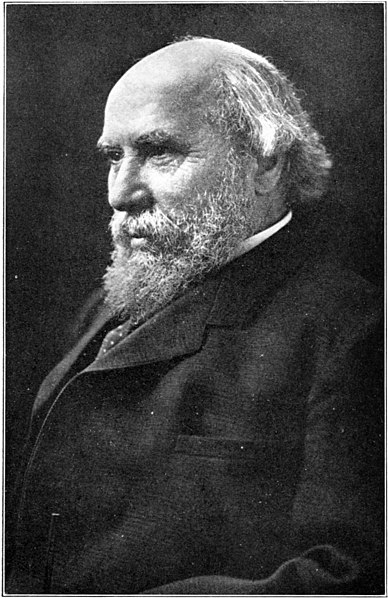
The face of American anarchism. Josiah Warren is considered the father of American anarchism. Among his many accomplishments was the founding of the Cincinnati Time Store, where you traded your labor for goods. No money.
Photo via Wikimedia Commons.

The Briefest Description Ever of American Anarchism

America’s individualist anarchism is not about the violent overthrow of the government and its institutions. Period. Full stop. Instead, it is a tendency to eschew the enormous organizations – churches, states and corporations – that we have created during the last 250 years.

Why do this? While working with others is generally a good thing, there is some threshold upon which an organization becomes so large that it is capable of inhumane behavior – war, slavery, environmental destruction, mass extinctions or even just failing to treat its employees and contractors fairly. These are things that individuals are (mostly) incapable of accomplishing.

Anarchists like myself avoid working with these massive and dehumanizing institutions. I don’t want to burn them down, but I also don’t want to prop them up by shopping in their stores, praying in their cathedrals or voting in their elections.

That doesn’t mean I’m opposed to making money, that I’m an atheist or that I’m uninvolved in my community. I just decline to work, pray and serve others via these institutions. Working with them gives them power, while working with the family architectural firm a few blocks away helps your neighbors in every way imaginable.

June 6, 2019

iTunes is dead – “There will be no funeral, because it had no friends”

Filed under: Business, Technology — Tags: , , , — Nicholas @ 03:00

I use iTunes because I have to, not because I particularly want to. Apparently that’s not uncommon among iPhone users:

iTunes, Apple’s Frankenstein’s monster of an MP3-player-cum-record store-cum-video-store-cum-iPhone-updater-cum-random-task-performer, a piece of software which opens on your computer whenever it wants and which seems to require you to download an updated version every eight hours, was pronounced dead on Monday. It was 19 years old. There will be no funeral, because it had no friends.

Apple CEO Tim Cook announced that in its future operating systems, iTunes will be replaced by three separate programs: One for music (Apple Music), one for podcasts (Apple Podcasts) and one for video (Apple TV). Updating your phone — which never had anything to do with music, podcasts or video — will now be a function of the operating system. This sounds promising. It sounds normal.

But the mystery remains how Apple, of all companies, found itself sullying its machines for so long with iTunes’ wretched presence. By the end iTunes wasn’t just bad, it was fascinatingly bad — a “toxic hellstew,” as programmer Marco Arment put it in 2015. It was a master class in bad user experience from a company whose brand is excellent user experience: Put your trust in Apple’s machines and its native apps and everything will just work. There are no viruses, no blue screens of death, no pre-installed junkware popping up all over your brand-new desktop. Things just show up where they’re supposed to be. Mac’s user interface is so vastly superior to Windows’ that it seems ridiculous even to compare them. They’re both operating systems in the sense that the stick-shift on a Yugo and the flappy paddles on a Ferrari are both transmissions. Yet by 2015 one of Apple’s essential apps wasn’t just horrid to look at and baffling to use — it couldn’t even store and play people’s MP3s properly.

I never experienced the horror stories myself; [lucky bastard!] the idea of buying music from Apple and, because of its aggressive digital rights management, not even getting an MP3 file with which I could do what I liked always struck me as daft. But the Internet is full of tales of woe from people who entrusted their music collections to Apple and got royally screwed. iTunes would make curatorial decisions all by itself: If you bought Neil Young’s 1977 compilation album Decade, but already had On the Beach in your library, it might just decide not to include Walk On and Tired Eyes on your version of Decade. Or it might delete them from On the Beach, depending on its mood.

This was presumptuous and annoying, but at least somewhat explicable: iTunes consumers were far more singles-focused than album-focused. (Indeed the app is widely credited with ending the “age of the album.”) Less explicable were reports of Apple Music replacing people’s legacy music collections — songs they had ripped from CDs and entrusted to iTunes — with new downloads. People spoke of entire collections being corrupted or lost overnight. People reported that their libraries looked nothing alike on their various Apple devices. At one point, apparently under the impression that not many people loathe U2, Apple famously went ahead and beamed one of the band’s new snorefests onto everyone’s iTunes without asking.

My experiences with iTunes have been mostly of the minor irritant variety: disappearing songs, paid-for tracks that refused to play on certain devices, and songs showing up in playlists that they don’t belong to, for example. But at least — most of the time — the non-Apple songs were not randomly deleted from my library. Not too often, anyway.

June 5, 2019

Sensible proposals from the copyright review report

Filed under: Business, Cancon, Law, Liberty, Media, Technology — Tags: , , — Nicholas @ 06:00

Michael Geist summarizes the — seemingly quite sensible — recommendations from the copyright review process:

Assignments of copyrights photostat copies by mollyali (CC BY-NC 2.0) https://flic.kr/p/5JbsPE

In December 2017, the government launched its copyright review with a Parliamentary motion to send the review to the Standing Committee on Industry, Science and Technology. After months of study and hundreds of witnesses and briefs, the committee released the authoritative review with 36 recommendations [PDF] that include expanding fair dealing, a rejection of a site blocking system, and a rejection of proposals to exclude education from fair dealing where a licence is otherwise available. The report represents a near-total repudiation of the one-sided Canadian Heritage report that was tasked with studying remuneration models to assist the actual copyright review. While virtually all stakeholders will find aspects they agree or disagree with, that is the hallmark of a more balanced approach to copyright reform.

This post highlights some of the most notable recommendations in the report that are likely to serve as the starting point for any future copyright reform efforts. There is a lot here but the key takeaways on the committee recommendations:

  • expansion of fair dealing by making the current list of fair dealing purposes illustrative rather than exhaustive (the “such as” approach)
  • rejection of new limits on educational fair dealing with further study in three years
  • retention of existing Internet safe harbour rules
  • rejection of the FairPlay site blocking proposal with insistence that any blocking include court oversight
  • expansion of the anti-circumvention rules by permitting circumvention of digital locks for purposes that are lawful (ie. permit circumvention to exercise fair dealing rights)
  • extend the term of copyright only if ratifying the USCMA and include a registration requirement for the additional 20 years
  • implement a new informational analysis exception
  • further study of statutory damages for all copyright collectives along with greater transparency
  • adoption of an open licence rather than the abolition of crown copyright

My submission to the Industry committee can be found here. The submission and my appearance is cited multiple times in the report and I’m grateful that the committee took the submissions from all witnesses seriously.

June 1, 2019

Paying taxes is only for the little people like you and me…

Filed under: Bureaucracy, Business, Cancon — Tags: , , , , — Nicholas @ 03:00

Canada’s tax-gathering bureaucracy is eager to crack down on scams that attempt to hide taxable funds from scrutiny, although they seem to be rather more vigilant when it’s some poor slob who forgets to declare a grand or two from part-time work than multi-national organizations running decades-long scams to benefit deep-pocketed clients:

The Canada Revenue Agency has once again made a secret out-of-court settlement with wealthy KPMG clients caught using what the CRA itself had alleged was a “grossly negligent” offshore “sham” set up to avoid detection by tax authorities, CBC’s The Fifth Estate and Radio-Canada’s Enquête have learned.

This, despite the Liberal government’s vow to crack down on high-net-worth taxpayers who used the now-infamous Isle of Man scheme. The scheme orchestrated by accounting giant KPMG enabled clients to dodge tens of millions of dollars in taxes in Canada by making it look as if multimillionaires had given away their fortunes to anonymous overseas shell companies and get their investment income back as tax-free gifts.

KPMG is a global network of accounting and auditing firms headquartered out of the Netherlands and is one of the top firms in Canada.

“Tax cheats can no longer hide,” National Revenue Minister Diane Lebouthillier promised in 2017.

Now, Tax Court documents obtained by CBC News/Radio-Canada show two members of the Cooper family in Victoria, as well as the estate of the late patriarch Peter Cooper, reached an out-of-court settlement on May 24 over their involvement in the scheme.

Details of the settlement and even minutes of the meetings discussing it are under wraps. A CBC News/Radio-Canada reporter who showed up to one such meeting this spring left after realizing it was closed to the public.

Journalists discovered references to the final settlement agreement in Tax Court documents only by chance.

May 30, 2019

Doug Ford versus the Ontario neo-prohibitionists, progressive temperance snobs and other social control freaks

Filed under: Business, Cancon, Law — Tags: , , , , — Nicholas @ 03:00

During the last Ontario election, it was common to disparage Doug Ford as being “Trump-like”, and now that he’s the Premier, it turns out to be true in at least one aspect: Ford does have a Trump-like ability to induce a form of hysteria in his opponents. Ford’s crusade to liberalize Ontario’s alcohol market is a case in point. In the Toronto Star, all the old arguments against liberalization — usually portraying Alberta’s long-since liberalized market as a dystopian hell-hole of alcohol-shattered lives — are being dragged out again:

The key is that the Ford team doesn’t actually care about wine that will be sold in corner stores and more supermarkets. It’s a sop to tourists, which seems reasonable.

No, it cares about beer because beer is a social marker, a shorthand. Wine is considered urban but buck-a-beer is rural/semi-urban. Men drink it. Men with beerbellies drink it. To a government mysteriously seeking a vote that it already has, drinking beer is a signal that a man is a regular guy. But Ford is not a regular guy. He doesn’t drink. He’s not anxious. He’s not renting.

It is very much a problem that any government in power would believe this of the regular guy vote. Alcohol causes hospitalization, crime and early death. It destroys families and jobs, and eventually its victims drink to block out what they lost by drinking.

[…]

They may not know it, they may be doing it instinctively, but it is still madness. Alcoholics are costly to treat and they suffer terribly. Courting their vote comes courtesy of a report by a former health minister in Alberta where booze is sold in private liquor stores.

The problem, as Albertans know, is you’re too afraid to buy it. These stores are often shabby places that are magnets for violence. Watch out, Premier Ford, it’s Ontario and there’s going to be NIMBY.

I am aware that I’m writing like a preacher. Preach on, sister. Anyone over 30 learns to distinguish between people who drink for pleasure and those who cannot cope with it. We are horrified. We offer help.

Back in 2013, Colby Cosh neatly summarized the Ontario neo-prohibitionist rhetoric:

Albertans find it instructive to watch Ontario politicians debate the privatization of liquor retailing, which Klein’s cabinet bulldog, Dr. Stephen West, executed almost overnight in 1993. It was perhaps the representative policy move of the Klein era, the best symbol of his approach to government. Today one will hear Ontarians telling themselves the most bizarre things about Alberta in order to support the idiot belief that booze is a natural monopoly. “You can’t even get red wine there! All they have in the stores is various flavours of corn mash and antifreeze! The streets resound with the white canes of the blinded!” Talk to the saner residents and you rapidly discover the real root of Ontarians’ positive feeling for the LCBO, which is esthetic. It’s just nicer to buy a handle of Maker’s Mark from someone who makes a union wage and has a vague halo of officialdom. You leave the shop feeling okay about your vice.

Klein was liked by Albertans, not because of some mythic popular touch, but because there wasn’t an ounce of tolerance for this sort of thing in him. Alcohol was something he understood very well. (Too well.) People do not need liquor to be flogged to them any harder than the manufacturers already do; put a man in prison and he will make the stuff in the toilet starting on day two. What the old ALCB was really marketing to the public, and what the LCBO markets now, was itself — its own role as social protector/moral approver/tastemaker. Klein identified that part of the system as a parasitic growth, a vestige with no function but its own preservation; and he had West ectomize it with the swiftness of a medieval barber.

May 22, 2019

QotD: A “conservative” argument for regulating social media companies

There should be a high barrier for any company seeking to interfere with the marketplace of ideas in which the right of free correspondence is practiced.

Critics of regulating dot com monopolies have made valid points.

Regulating Google or Facebook as a public utility is dangerous. And their argument that giving government the power to control content on these platforms would backfire is sensible.

Any solution to the problem should not be based on expanding government control.

But there are two answers.

First, companies that engage in viewpoint discrimination in response to government pressure are acting as government agents. When a pattern of viewpoint discrimination manifests itself on the platform controlled by a monopoly, a civil rights investigation should examine what role government officials played in instigating the suppression of a particular point of view.

Liberals have abandoned the Public Forum Doctrine, once a popular ACLU theme, while embracing censorship. But if the Doctrine could apply to a shopping mall, it certainly applies to the internet.

In Packingham v. North Carolina, the Supreme Court’s decision found that, “A fundamental principle of the First Amendment is that all persons have access to places where they can speak and listen.”

The Packingham case dealt with government interference, but when monopolies silence conservatives on behalf of government actors, they are fulfilling the same role as an ISP that suspends a customer in response to a law.

When dot com monopolies get so big that being banned from their platforms effectively neutralizes political activity, press activity and political speech, then they’re public forums.

Second, rights are threatened by any sufficiently large organization or entity, not just government. Government has traditionally been the most powerful such organization, but the natural rights that our country was founded on are equally immune to every organization. Governments, as the Declaration of Independence asserts, exist as part of a social contract to secure these rights for its citizens.

Government secures these rights, first and foremost, against itself. (Our system effectively exists to answer the question of who watches the watchers.) But it also secures them against foreign powers, a crisis that the Declaration of Independence was written to meet, and against domestic organizations, criminal or political, whether it’s the Communist Party or ISIS, that seek to rob Americans of their rights.

A country in which freedom of speech effectively did not exist, even though it remained a technical right, would not be America. A government that allowed such a thing would have no right to exist.

Only a government whose citizens enjoy the rights of free men legally justifies is existence.

If a private company took control of all the roads and closed them to conservatives every Election Day, elections would become a mockery and the resulting government would be an illegitimate tyranny.

That’s the crisis that conservatives face with the internet.

Daniel Greenfield, “Americans Paid for the Internet, We Deserve Free Speech On It”, Sultan Knish, 2019-05-16.

May 20, 2019

A “cutting-edge mediaeval Catholic” view of the modern economy

Filed under: Business, Economics, Liberty — Tags: , , , — Nicholas @ 03:00

David Warren explains some of his disquietude about our modern world:

Gentle reader may object that none of these entities is a government department, except insofar as it is the subject of taxes and regulations, and as it grows larger, an ever more formidable force in lobbying for subsidies and legislation favourable to itself. Objection sustained. Verily, this is just my point.

Each entity made its way until the gobbling by means of mass consumer advertising, in which morally illegitimate methods of persuasion — principally hype, actual lies, irrelevant claims and endorsements — are instrumental to sales success. Honest advertising (e.g. catalogues with exact descriptions) is theoretically possible but practically extinct; campaigns are based on the tawdry manipulation of human “perceptions” — behaviourist psychology at the level of Ivan Petrovich Pavlov, but elaborately quantified, with financial and pricing arrangements factored in.

Indeed, one may link most disastrous marketing decisions to the decline of intuitive reasoning, as statistical reasoning takes its place. The manager who knows in his gut, from experience, what might work and what won’t, or can’t, is displaced by the young analyst with computer modelling skills and all the jargon of “science” to express the platitudes he was drip-fed in school.

But here, too, “private” and “public” enterprise are fully integrated. Both are adapted to the “planning” paradigm, and each is utterly dependent on the other, in what is misleadingly called “the mixed economy.” The critics of abstract Capitalism, on the one side, and abstract Socialism, on the other, draw a false contrast between two administrative orders, when they are both bureaucratic in nature, inhumanly oversized, and habitually dedicated to the pursuit of monopoly.

Several of the readers with whom I correspond are under the immovable impression that I am against making money, or improvements in technology, per se. In fact my outlook is cutting-edge mediaeval Catholic. The moral questions are instead such as, How is the money made? And, for what are the improvements to be used? As I must remind e.g. my Chief Texas Correspondent, I am not against electricity or indoor plumbing. But I am against worshipping such things, or making them the criteria for high civilization.

May 19, 2019

Malcom McLean’s container shipping revolution

Filed under: Business, Economics, History, Railways, USA — Tags: , — Nicholas @ 03:00

At the Foundation for Economic Education, Alexander Hammond recounts the tale of a former truck driver who was instrumental in revolutionizing the way we ship products around the world:

Deep-sea containers from China at Ely, Cambridgeshire
Via Wikimedia Commons.

In 1937, McLean made a routine delivery of cotton bales to a port in North Carolina for shipment to New Jersey. As McLean couldn’t leave until his cargo had been loaded onto the ship, he sat for hours watching dozens of dockhands load thousands of small packages onto the ship. McLean realized that the current loading process wasted enormous amounts of time and money, and he began to wonder if there could be a more productive alternative.

In 1952, McLean thought of loading entire trucks onboard a ship to be transported along the American Atlantic coast (i.e., from North Carolina to New York). Although this idea would dramatically reduce loading times, he soon realized that these “trailer ships” would not be very efficient due to the large amount of wasted cargo space.

Mclean modified his original design so that just the containers—and not the trucks’ chassis—were loaded onto the ship. He also developed a way for the containers to be stacked on top of one another. That was the origin of the modern-day shipping container.

In 1956, McLean secured a bank loan for $22 million. He used the money to buy two World War II tanker ships and convert them to carry his containers. Later that year, one of his two ships, the SS Ideal-X, was loaded with 58 containers and sailed from New Jersey to Houston, Texas. At the time, McLean’s shipping company offered transport prices that were 25 percent lower than those of his competitor as well as the ability to lock the containers in order to prevent cargo theft, which also appealed to many new customers.

By 1966, McLean launched his first transatlantic service and three years later, McLean had started a transpacific shipping line. As the advantages of McLean’s container system became clear, bigger ships, more sophisticated containers, and larger cranes to load cargo were developed.

Update 21 May: Here’s a breathtaking example of just how much McLean’s containers changed the world:

QotD: The purpose of the corporation

Filed under: Business, Economics, Quotations — Tags: — Nicholas @ 01:00

The key is that the purpose of the firm is set by the folk who created it and those who own it. If it meets customers’ needs it will thrive, and if it doesn’t, it goes out of business. If you and I, dear reader, found a business to sell chocolate ice cream, at what point do we suddenly become “responsible” in some sense to “society” or “the environment” or “God” in how we run things unless we have expressly chosen to make those considerations part of our business mission?

It is crucial to be clear on this point. If a group of individuals band together to create a corporation that expressly states that it shall distribute 30 per cent of profits to a specific charity/cause, or that it will source its supplies from a particular group on ethical grounds, or hire as equal a balance of men and women as possible, regardless of other considerations, then anyone who becomes, say, a shareholder in that business cannot complain if things go wrong. And in fact there are more and more cases of firms that go out of their way to brandish their ethical principles, with varying levels of credibility or cant. Also it turns out that firms which are run by honest people, publish transparent accounts and don’t treat staff like crap tend, according to some metrics, to outperform their peers over the long term (see a study claiming this here). As Adam Smith might have noted, if people pursue their rational self-interest it tends to be the case that dealing with decent, honest people tends to work out better than dealing with shysters.

Johnathan Pearce, “Corporate social responsibility – is it socialism by the back door?”, Samizdata, 2019-04-18.

« Newer PostsOlder Posts »

Powered by WordPress