
… the entire left seems determined to go around pretending that the intention is the action. That is, they believe whatever they intended to do is what will come about, and there will be no glitch, no second-order effects, nor will people adjust their behavior in ways unanticipated by the left.
The results can be uproariously funny, like the “push model” in publishing leading eventually to the success of indie ebooks. (The short explanation is this: the push model is where, in dealing with chain bookstores, the publishers, who are overwhelmingly leftist, realized they could push them to stock whatever books they wanted to succeed, and then the customers would have to buy them because they were the only thing available. The end result was a nosedive in book sales, the death of Borders, and eventually the success of indie-published ebooks.) However, even there, on the way there, there was the tragedy of people not being able to find good things to read for a long time. (I remember us calling bookstore trips “going to be disappointed by Barnes and Noble.”)
Other times, their carefully laid plans are foiled by new technology — see, for instance, their slow-crawl through news reporting and other institutions being nullified by the internet and blogs, and a bunch of us bums working in their pajamas. […]
But often the tragic/comic effects of their action lead directly to their undoing, in a beautiful, almost Shakespearean effect.
Sarah Hoyt, “Nobody Expects These Predictions”, PJ Media, 2017-12-31.
March 8, 2020
QotD: The essential difference between intentions and results
March 3, 2020
QotD: Public service and competitive private enterprise
And I’m not suggesting that the levels of corruption and incompetence are comparable to those found in third world hellholes. A local official in your county council is very unlikely to demand a bribe and then have your daughter raped by his buddies if you decline. He’s especially unlikely to get away with it, and then douse your family in petrol and burn them alive if you complain – those are the levels of corruption found elsewhere in the world, so we need to retain some perspective here.
But those countries have not benefited from a thousand years of sacrifice to earn us a culture that has learned through bitter experience how to run a country. Our civil servants should be performing at the highest standard and be the best in the world, because what they inherited was a culture that conquered that world, and brought civilisation and progress (often at great cost) to every corner of it.
That they have fallen from these heights and now occupy such low places should be a matter for great national shame. And yet they continue to lord it over those they pretend to serve – try calling your local planning department if you want instruction in how supercilious a local functionary feels able to be when speaking to those he claims to serve. If you just want them to do their job, you better be prepared to beg.
Whereas on the flip side, we might agree that the private (voluntary) sector is largely filled with honest and hardworking people and entrepreneurs, but there are crony capitalists out there too.
Your local butcher and baker (those that have survived the regulatory avalanches under which the crony capitalists have begged their pet politicians to bury them) remain staunch servants of their customers (through regard to their own interests), whereas oligoplists (supermarkets, telcos, insurance companies, banks, energy suppliers or transport companies) deliver to us just what the monopolists of government do – an icy contempt that would soon turn to withering small arms fire if the laws allowed it.
Alex Noble, “Corruption In The Coercive And Voluntary Sectors: Rotten Apples? Or The Tips of Icebergs?”, Continental Telegraph, 2019-12-02.
February 26, 2020
“… the First World’s most dysfunctional train: The Canadian, which in theory links Vancouver to Toronto”
Chris Selley fires all his guns at the pride of VIA Rail Canada’s passenger services, The Canadian:

VIA dome observation car, on The Canadian in 2007.
Photo by Savannah Grandfather via Wikimedia.
With the Ontario Provincial Police somehow finally roused to action in Tyendinaga, Ont., it seems the CN railway blockade may not last its third week. This outstanding achievement in law enforcement will come as a relief in particular to the nation’s business community, people who enjoy staple foods, and the propane-dependent. The minority of travellers along the Windsor-to-Quebec City corridor who ride VIA Rail were not as imperilled: most essential, tight-budgeted VIA trips can also be made by bus, with only moderate time lost and with money saved as a consolation. But they too will be pleased. As maddening as VIA’s corridor services can be, with their ancient rolling stock, outrageously stale food, mostly theoretical wi-fi, schedules that get slower rather than faster and reliable delays regardless, trains are just genetically superior to buses.
Or at least, most are. The Windsor-to-Quebec City services are practically Japanese in comparison to what must be the First World’s most dysfunctional train: The Canadian, which in theory links Vancouver to Toronto. It has been shut down almost since the blockade began, and hardly anyone has noticed. It’s time we talk about this crazy thing.
What, you may ask, is the most ridiculous thing about The Canadian? Some might point to the astonishing level of subsidy: In 2018, the average corridor passenger enjoyed a subsidy of $32, or 17 cents per mile. The average passenger on The Canadian: $596, or 48 cents a mile, for a total of $49 million.
But never mind the price for a second; look what it’s buying. Fifty years ago, CN’s Super Continental was scheduled to take 67 hours. Today The Canadian, plying the same route and giving way to every freight train, is budgeted a mind-boggling 85 hours eastbound and 97 westbound.
[…]
For all the subsidies, The Canadian is eye-wateringly expensive. For the full one-way trip, a cabin for two will set you back $3,824, meals included. You can take a five-day mid-range Caribbean cruise for that, and that’s no coincidence: The Canadian is essentially a cruise ship on rails. It’s just that, well, Canadian taxpayers don’t subsidize cruise lines. Because that would be nuts.
I’ve always wanted to ride The Canadian, but I never could afford both the time and the money at the same time. (I have the time now, but I’m struggling to pay my bills, so even a GO Train trip into Toronto needs to be carefully budgeted … a trip on The Canadian would be a very significant percentage of my gross annual income!).

Canadian Pacific FP7 locomotive 1410 at the head of The Canadian stopped at Dorval, Quebec on 6 September, 1965. The Canadian was Canadian Pacific’s premier passenger train before VIA Rail was formed.
Photo by Roger Puta via Wikimedia Commons.
February 21, 2020
British wages to be further impacted by Brexit
As we were told for years, if Brexit happened there were going to be dire consequences to the British economy, and here’s the latest one:

Employers are complaining that without badly paid immigrant labour they’ll just not be able to get the staff. The answer to which is that they’d better start paying higher wages then, eh?
[…]
The analysis here stems from something Marx got right. It’s competition among capitalists for scarce labour which pushes wages up. If there’s a vast reserve army of the unemployed then anyone needing more straining backs just tosses a crust to those in that army and gets as many limbs and torsos to exploit as desired. But if all are already employed then any desire for extra labour requires tempting it away from current employer and occupation to the new. That means a better job offer. Some mixture of conditions, enjoyment of the job, cash and so on that makes up a more attractive package.
The combination of cheap flights and free movement of labour has meant that the reserve army lives in Wroclaw and Debrecen. It’s also been near unlimited – compared to the size of the UK economy – these past couple of decades.
The absence of free movement – what is being complained about here – will mean that to gain the desired labour those employers are going to have to offer higher wages, higher compensation rather, to those not ordinarily resident or stemming from central Europe.
[…]
But back to the basic complaint here. These employers are complaining that Brexit will mean they’ve got to raise the wages they pay. To which the correct response is “Ah, Diddums”.
February 20, 2020
QotD: Preventing bureaucratic mission creep
Private companies are just as vulnerable. However in that private sector we have a mechanism by which the seemingly inevitable bureaucratization is dealt with. Once it happens, the organization goes bankrupt and is removed from the scene. What we need is a similar system to deal with this process in the public sphere.
I don’t, given the above, find it at all remarkable that the WTO is regarded as succumbing to these forces, nor the UN, Amnesty, the European Union or even our own domestic governments (just how did the interstate commerce clause become a justification for Congress to restrict something that is not interstate and is not commerce?). I think it inevitable.
Various solutions appear to be available, the French one might be an example. Put up with it for 50 years then have a revolution and start again. Perhaps the answer is never to allow the public bodies to have much power in the first place, a solution that hasn’t really been tried anywhere. The Italian one? Let the system carry on adding ever more layers but ignore it? Stalin’s? Every 15 years or so shoot the bureaucrats?
All such methods have their attractions and their faults but a solution we do need to find. For one of the lessons I take from the history of the 20th century is that we don’t actually want to be ruled by those who stay awake in committee meetings.
Tim Worstall, “‘Any Organization Will, In the End, Be Run By Those Who Stay Awake in Committee'”, Ideas in Action, 2005-06-23.
February 14, 2020
The reaction to the Mohawk blockade near Belleville shows that VIA Rail isn’t a serious company
Mohawk protesters began blocking the main CN and VIA line between Toronto and Montreal near Belleville nearly a week ago. The police, having learned so often that the government and the courts won’t back them up, did little to try to get the blockade lifted other than to prevent active confrontations with the First Nations activists. Canadian National announced that they were being forced to park trains all over Eastern Canada as a result of the blockade and that deliveries of goods would be snarled for quite some time even after service is allowed to resume. VIA rail, on the other hand, seems to care not a bit about the thousands of travellers who have been stranded mid-journey and made no apparent efforts to bring in buses or any other arrangements. Chris Selley says this proves that VIA is not an essential service even in their own minds:

“The 6424” by Stephen Downes is licensed under CC BY-NC-SA 2.0


Of all the bad news to befall VIA Rail this week, with the cancellation of all its trains between Toronto and Ottawa and Toronto and Montreal — that’s roughly 50 per cent of its ridership and 60 per cent of its revenues — the worst news might be just how little news it has made. Mostly, the Mohawk blockade of the CN main line near Belleville, Ont., has been treated as a side story to the anti-pipeline protests and arrests in the British Columbia interior.
That’s what it is in the grand scheme of things: The battle between Wet’suwet’en members and chiefs and the federal government speaks to much larger, existential questions about the future of the Canadian economy, about the Liberal government’s reconciliation agenda, about the very nature of the Canadian federation and the rule of law. This blockade, launched in the name of solidarity with the Wet’suwet’en, just means people have to take the bus, or fly, instead of the train.
But that’s no small inconvenience, no small expense. Canadians in general are not quick to anger, but very few of the VIA refugees interviewed by various news outlets sounded even slightly furious, which they had every right to be. When protesters from the same First Nation blockaded the same set of tracks six years ago, VIA properly exhibited some concern with getting their customers to their destinations and put on replacement buses.
This time around, no buses. No suggestions. No response to media inquiries asking why there are no buses. Just a cancellation notice on the website and a fare-thee-well. At a time when VIA is seeking untold billions from the federal government to build a new Toronto-Ottawa-Montreal route and run vastly more trains, this does not bespeak a company that takes itself very seriously.
[…]
And never mind VIA, what sort of country lets a few people close down a key piece of national infrastructure, in violation of a court injunction — not for an hour or a day, but literally indefinitely? For a time it wasn’t even clear whose job it was to enforce the injunction: On Sunday an Ontario Provincial Police spokesperson told Global News it was up to the CN Police Service. On Tuesday, a CN spokesperson told the National Post it was up to the OPP, and indeed, late Tuesday OPP officers warned protesters to leave or they would be forced out. Perhaps the threat of massive economic disruption finally lit a fire under them: earlier in the day, CN had said it was considering shutting down huge parts of its freight network across the country. Had it just been rail passengers, though, the idea of this side-protest dragging on for weeks or even months seems absurdly plausible.

VIA Rail 918, a General Electric model P42DC locomotive, at Belleville, Ontario on 23 December 2008.
Photo by Martin Cathrae via Wikimedia Commons.
While VIA may not be serious, others are extremely serious:
Left-wing blogs have been offering instructions and maps during the #ShutDownCanada protests on how to blockade and destroy train tracks and other pieces of Canada’s infrastructure, according to True North.
Two websites in particular, these being North Shore and Warrior Up, have instructed demonstrators how to damage Canada’s pipelines, roads and railways.
In some of North Shore’s posts, for instance, they told their readers to stand in solidarity with the Wet’suwet’en tribe by destroying train tracks. In this article, the author makes it perfectly clear that he wants to damage Canada’s economy at large.
More absurdly, however, the article then went on to instruct the reader on how to compose a chemical mixture that destroys steel rail tracks — taking particular care to describe how not to leaving fingerprint or DNA evidence.
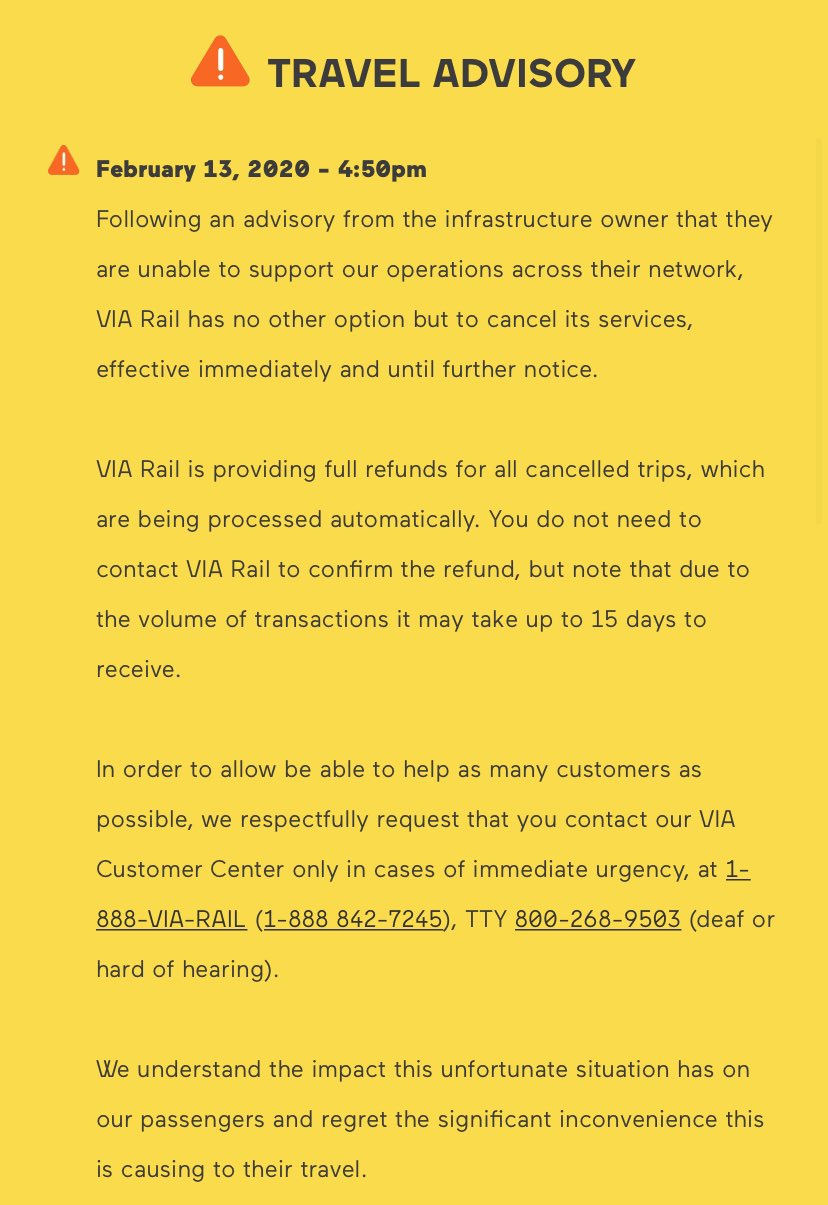
Thursday evening, VIA Rail announced their whole passenger network would be shut down until further notice: Service cancellation notice.
February 12, 2020
“… perhaps the biggest Internet cash grab in the OECD with mandated payments and levies on thousands of Internet services with Canadian users”
Michael Geist refutes the claim that the recent Broadcast and Telecommunications Legislative Review Panel report does not recommend a “Netflix tax”:
The reference to a Netflix tax in the overview is the only such reference in the 235 page report. It was likely included in the overview in the hope that media coverage would jump on the claim and seek to re-assure Canadians that there was no Netflix tax or higher prices likely for consumers as a result of the report’s recommendations.
Yet the reality for anyone that reads beyond the overview is that the panel’s report not only recommends what would widely be considered a Netflix tax but proposes perhaps the biggest Internet cash grab in the OECD with mandated payments and levies on thousands of Internet services with Canadian users. This includes online streaming services, social media companies, news aggregators, and online communications services such as Skype, WhatApp, and Viber. In the view of the panel, any service or site with Canadian users is part of the “Canadian system” and should be expected to contribute to the development of Canadian content, Canadian news organizations, or building broadband connectivity. Note that all of this is above and beyond sales taxes, which the panel also recommends should be implemented with respect to foreign services.
Some of the panel’s plans are admittedly somewhat confusing. For example, the panel states:
Media curation undertakings brought under the regime – including Netflix and other online streaming services – would be required to devote a portion of their program budgets to Canadian programs.
That statement, along with chair Janet Yale’s comment at the opening press conference that there was no need for Netflix to spend additional money on Cancon but rather merely divert existing on foreign location and service production spending in Canada, has been interpreted by some to mean that Netflix would not have to increase its Canadian programming budget. But that is apparently not what the panel means. I spoke with Yale who confirmed that the panel expects the CRTC to establish a minimum Cancon spend requirement on Netflix based on its Canadian revenues. In other words, the requirement has nothing to do with its existing spending on production in Canada. For Netflix, that could certainly represent an increase in spending costs in Canada with those costs likely passed along to consumers.
Yet the panel’s plan extends far beyond just online streaming services such as Netflix. It also envisions mandatory levies against social media services and news aggregators that would be used to fund Canadian news services. It similarly targets a myriad of communications services that would pay into funds to support broadband development.
February 10, 2020
QotD: Welfare programs as a form of subsidy to employers
But what about other programs like food stamps or housing assistance? These means tested public assistance programs are not tied to work, and we should not expect them to lower wages. Let’s take food stamps, which are available to eligible families whether or not a family member works or not. Indeed, when people are not working, they are more likely to be eligible for food stamps since their family incomes will be lower. Therefore, SNAP [Supplemental Nutrition Assistance Program] is likely to raise, and not lower a worker’s reservation wages — the fallback position if she loses her job. This will tend to contract labor supply (or improve a worker’s bargaining position), putting an upward pressure on the wage. Whether or not wages are increased is an empirical matter: there is evidence that the initial roll-out of the food stamps program across counties in the 1970s lowered work hours, consistent with an increase in the reservation wage. The key point is that it is difficult to imagine how food stamps would lower wages. And if they don’t lower wages, they can’t be thought of as subsidies to low wage employers. The same logic applies to other means tested programs like energy or housing assistance. Moreover, these conclusions hold in a wide array of models of the labor market, including ones that emphasize bargaining or efficiency wage concerns.
Arindrajit Dube, “Public Assistance, Private Subsidies and Low Wage Jobs”, Arindrajit Dube, 2015-04-19.
February 9, 2020
The lightbulb conspiracy again
I’ve banged on a few times over the years about lightbulbs, specifically about our government’s passionate desire for us to abandon the tried-and-tested (and cheap) incandescent bulbs to move first to (ultra-expensive, dim, and potentially dangerous) compact fluorescent bulbs and now to (cheaper, but still not living up to longevity promises) LED bulbs instead. Tim Worstall explains how governments were persuaded to enforce this crony capitalist plot over the years (he’s discussing the European market, but Canadian regulators were doing exactly the same thing):
We all recall when we used to use incandescent light bulbs. Simple, cheap, the result of a century’s worth of fiddling with the basic technology to make it around and about right for the use to which it was put.
A spiral compact fluorescent bulb (CFL).
Image by Sun Ladder via Wikimedia Commons.Then they were banned. Sure, there was that energy and thus planet saving argument but that was always very weak indeed. It was an excuse, not the actual reason itself. The reason was that the big three manufacturers, Phillips, Osram and GE, had invested heavily in the next generation of technology, compact fluorescents. These cost not pennies per bulb but pounds. Rather better profit margins that is. Oh, and also, not subject to that crippling competition from China.
So, we get the EU ban on incandescents, driven entirely by the manufacturers. There’s a lot of the Baptist and Bootlegger in here given the environmentalist support for it.
The problem with the technology being the use of mercury in those bulbs.
An aside, I made my living for a number of years selling weird metals that are added to that mercury. I do actually know quite a bit about the nuts and bolts here. I’m also out of the business and have been for a decade and more. So it’s knowledge driving this, not knife sharpening.
Mercury’s not good stuff to have floating around. So, what happens next? Yep, a decade or a bit more after the incandescents were banned so now they’re coming for the CFLs.

The mercury issue was not as well publicized here in Canada as it was in Australia, for example:
How many of them have looked up the Environment Department’s website to find what its bureaucrats falsely describe as the “simple and straightforward” precautions to take against poisoning should one of these lamps smash:
- Open nearby windows and doors to allow the room to ventilate for 15 minutes before cleaning up the broken lamp. Do not leave on any air conditioning or heating equipment which could recirculate mercury vapours back into the room.
- Do not use a vacuum cleaner or broom on hard surfaces because this can spread the contents of the lamp and contaminate the cleaner. Instead scoop up broken material (e.g. using stiff paper or cardboard), if possible into a glass container which can be sealed with a metal lid.
- Use disposable rubber gloves rather than bare hands.
- Use a disposable brush to carefully sweep up the pieces.
- Use sticky tape and/or a damp cloth to wipe up any remaining glass fragments and/or powders.
- On carpets or fabrics, carefully remove as much glass and/or powdered material using a scoop and sticky tape; if vacuuming of the surface is needed to remove residual material, ensure that the vacuum bag is discarded or the canister is wiped thoroughly clean.
- Dispose of cleanup equipment (i.e. gloves, brush, damp paper) and sealed containers containing pieces of the broken lamp in your outside rubbish bin – never in your recycling bin.
- While not all of the recommended cleanup and disposal equipment described above may be available (particularly a suitably sealed glass container), it is important to emphasise that the transfer of the broken CFL and clean-up materials to an outside rubbish bin (preferably sealed) as soon as possible is the most effective way of reducing potential contamination of the indoor environment.
February 6, 2020
Fallen flag – The Nickel Plate Road
Kevin J. Holland provides a brief look at the history of the New York, Chicago & St. Louis, better known as the “Nickel Plate Road”:
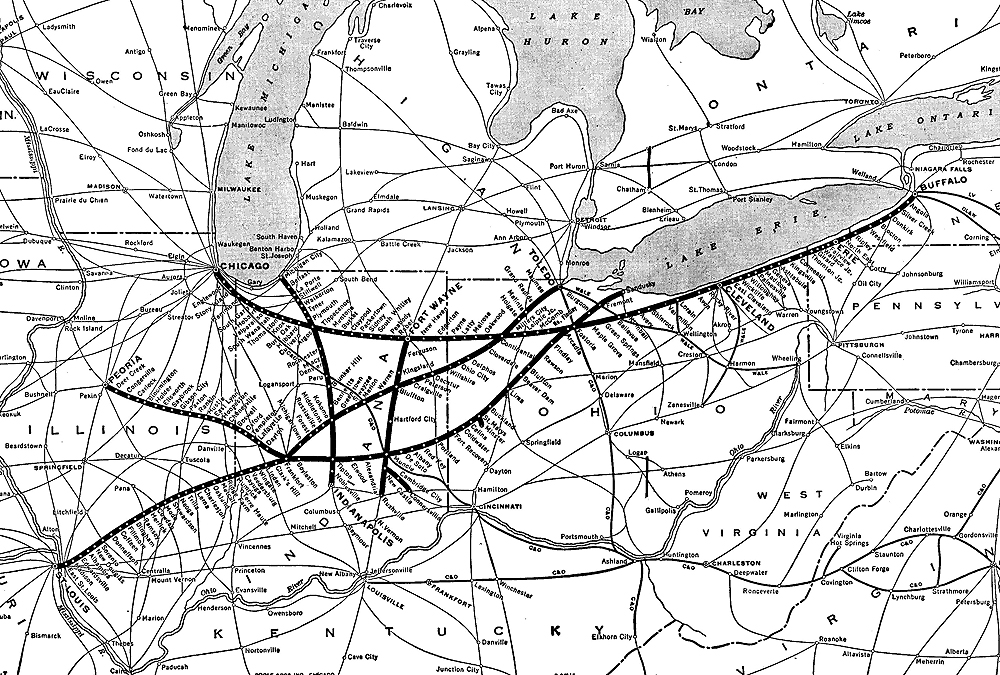
The New York, Chicago & St. Louis opened between Buffalo and Chicago on October 23, 1882, in many spots east of Cleveland just a stone’s throw from rival Lake Shore & Michigan Southern Railway. What would become the Nickel Plate became a Vanderbilt property in January 1883.
Although eclipsed by the Lake Shore’s plush limiteds, NYC&StL from 1893 fielded three unpretentious, reliable Chicago to Buffalo, N.Y., passenger trains, establishing a long-standing pattern of modest passenger service. In 1897, Delaware, Lackawanna & Western entered the picture, conveying NYC&StL cars from Buffalo to Hoboken, N.J.
“The great … Nickel-plated railroad”
When NYC&StL was being surveyed, Editor F. R. Loomis of Ohio’s Norwalk Chronicle waxed enthusiastically on the railroad coming to town referring to it as “the great New York and St. Louis double-track, nickel-plated railroad.” Use of “Nickel Plate Road” proliferated, in newspapers and by the road itself.In 1914, LS&MS and Nickel Plate were wards of New York Central. Passage of the Clayton Act that same year was intended to bolster the earlier Sherman Antitrust Act, and left NYC with a dilemma. Enter brothers Oris P. and Mantis J. Van Sweringen, self-made Cleveland real-estate developers who purchased acreage from NYC Vice President Alfred H. Smith. “The Vans” as the brothers were known, approached Smith, by then NYC president, to discuss their plans involving land owned by the Nickel Plate. As the Clayton Act’s divestiture deadline loomed, Smith engineered a sale to the Vans of not only the land they sought, but of the entire Nickel Plate Road. Their Alleghany Corporation holding company eventually included control of the Nickel Plate, Chesapeake & Ohio, Pere Marquette, Erie, Wheeling & Lake Erie, Chicago & Eastern Illinois, and Missouri Pacific.
The gaunt NYC&StL was ripe for re-equipping under its new owners. Addressing the Vans’ lack of railroad experience, Smith orchestrated John J. Bernet’s move from an NYC vice-presidency to be Nickel Plate’s president. Neglected physical plant and obsolete motive power received needed attention under Bernet, who reincarnated the road into a lean and aggressive contender.


Nickel Plate Road GP9 number 526 switching a way freight at Gibson City, IL on November 24, 1962.
Roger Puta photo from the Mel Finzer Collection via Wikimedia Commons.
February 2, 2020
Boeing and the kitchen sink
In the Continental Telegraph, Tim Worstall looks at the mess the new Boeing management has inherited and what they may need to do to be seen to be fixing it:

“Boeing 521 427”by pmbell64 is licensed under CC BY-SA 2.0
Which brings us to another piece of stock market wisdom, about trying to catch a falling knife. A dangerous occupation and the reference is to trying to call the bottom on some stock that has just had a disaster. At some point, surely, the tumble in price will stop and there will be a bounce. Well, yes, or perhaps maybe, for we must not forget that that proper bottom is that end of life – the bankruptcy – price of nothing. For everything that isn’t about to go bust then yes, there’s a price at which buying in the face of everyone else’s panic can be highly profitable. The question being, well, what is about to go bust? Toys R Us did, after all. Actually, so have quite a lot of retailers just recently. There was no above zero price at which it was sensible to buy in.
So, some stock crashes in price, should we buy in? After all, there is that phenomenon known as the dead cat bounce – anything will bounce at least once if you drop it from high enough. The question becomes one of, well, is this crash a result of something that can be reversed, or perhaps something that’s not going to be terminal for the organisation? Or is this just the start of that realisation process that the organisation is coming to the end of its life and going to that final resting place of a zero dollar valuation?
[…]
So, Boeing and the 737 Max. The changes in airframe had the unfortunate consequence of diving a couple of the planes into the ground. We’ve had a drip of stories about how the development process wasn’t all we would wish it to be. The FAA isn’t going to let it back up into the air until the summer at earliest. The Dreamliner seems to be having demand problems and, well, things aren’t looking good.
But is this the start of some spiral to zero? No, don’t be daft. Partly because the American government simply would not allow that. Boeing’s too much part of the backdrop of the US economy for that to be left to happen. The military business is also of significant value whatever happens to the civil aviation side. And of course the numbers we’re talking about here could be painful to stock holders – they are already in part of course – but at the very worst we’re looking at some tens of billions of problem here. That’s just not enough to drive a company Boeing’s size down to zero. Not in this decade at least, given that the only reasonable competition is Airbus. Global duopolies don’t end that way.
So, at this point there’s an argument to say that trying to catch that falling knife of the Boeing stock price might be worthwhile. So, when might that be? At which point another idea, kitchen sinking. This is when a new management team decides to make themselves look good by declaring how bad things had got under the previous one. Absolutely anything and everything that looks like, it might even smell of a problem in the future is taken out and declared. Provisions are made for this problem on this contract, for that problem that might occur over there, add a bit more and then heck, why not, double it! This has, assuming the company survives this balance sheet massacre, the obvious effect of making the new management team look good over the years. Not just because everything starts from this new low place. But also because many of those provisions – those over-provisions – won’t be needed and can be written back from reserves into the P&L.
January 31, 2020
“… the report envisions unprecedented government and regulatory intervention into the delivery of news services”
Michael Geist heaps scorn on the recommendations of a panel that would empower the CRTC to regulate the internet in Canada to a very high degree:
The Broadcast and Telecommunications Legislative Review Panel released its much anticipated report yesterday with a vision of a highly regulated Internet in which an expanded CRTC (or a renamed Canadian Communications Commission) would aggressively assert its jurisdictional power over Internet sites and services worldwide with the power to levy massive penalties for failure to comply with its regulatory edicts. The recommendations should be rejected by Innovation, Science and Industry Minister Navdeep Bains and Canadian Heritage Minister Steven Guilbeault as both unnecessary to support a thriving cultural sector and inconsistent with a government committed to innovation and freedom of expression.
[…]
Yet the strengths of the telecommunications and consumer rights portions of the report are overshadowed by a stunning set of recommendations related to Internet content, some of which are unlikely to survive constitutional scrutiny, likely violate Canada’s emerging trade commitments, and rest of shaky policy grounds. If enacted, the Canadian Internet would be virtually unrecognizable with the CRTC empowered to licence or require registration from a myriad of Internet services, mandate what Canadians see on those services, and intervene in commercial negotiations. The 235 page report will require several posts to address all of its aspects and implications (including notable CBC and copyright reforms), but this post seeks to set out its broad-based content regulatory vision and make the case that the panel’s plan should be firmly rejected by the government.
The foundation of the content section of the report is the decision to regulate all media content, which includes audio, audiovisual, and news content delivered by telecom. In doing so, the report envisions unprecedented government and regulatory intervention into the delivery of news services. It argues that there are three types of services that provide this content that require regulation where they access the Canadian market:
- Curators – services that disseminate media content with editorial control (broadcasters and streaming services such as Netflix, Spotify, and Amazon Prime)
- Aggregators – cable companies, news aggregators such as Yahoo News
- Platforms for Sharing – services that allow users to share amateur and professional content such as YouTube, Facebook and other platforms
The panel recommends that all of these kinds of companies be regulated (either by way of licence or registration), be required to contribute to Canadian content through spending percentages or levies, and comply with CRTC regulations on discoverability that would include regulatory rules on how prominently Canadian content is displayed within the service. The CRTC would be empowered to decide whether to exempt services from regulation with the power to levy huge penalties for failure to comply with its decisions (described as “high enough to create a deterrent foreign undertakings”).
January 29, 2020
“CanCon” rules for internet streaming services will be “inevitable”
Yes, the federal government is serious about extending the moronic “Canadian content” regime to internet streaming companies (like Netflix). Canadians are too blind to be allowed to select all of their own viewing without the paternal hand of government jiggling those choices in a politically desired direction, as Michael Geist explains:
Later this week, a government appointed panel tasked with reviewing Canada’s broadcast and telecommunications laws is likely to recommend new regulations for internet streaming companies such as Netflix, Disney, and Amazon that will include mandated contributions to support Canadian film and television production. In fact, even if the panel stops short of that approach, Canadian Heritage Minister Steven Guilbeault and Canadian Radio-television and Telecommunications Commission chair Ian Scott have both signalled their support for new rules with Mr. Guilbeault recently promising legislation by year-end and Mr. Scott calling it inevitable.
My Globe and Mail op-ed notes that the new internet regulations are popular among cultural lobby groups, but their need rests on a shaky policy foundation as many concerns with the fast-evolving sector have proved unfounded.
[…]
Third, the not-so-secret reality of the Canadian system is that foreign location and service production and Canadian content are frequently indistinguishable. Qualifying as Canadian requires having a Canadian producer along with meeting a strict point system that rewards granting roles such as the director, screenwriter, lead actors, and music composer to Canadians.
Yet this is a poor proxy for “telling our stories”. The rules mean foreign companies can never produce Canadian content leading to the absurd outcome that revivals of Canadian programs such as Trailer Park Boys and Degrassi will not meet the qualification requirements if Netflix is the sole funder and producer. Moreover, programs such as The Handmaid’s Tale may be based on a Margaret Atwood novel, but using one of Canada’s best known novelists as the source doesn’t count in the Canadian points system.
So what is Canadian? A quick scan of Canadian Audio-Visual Certification Office data turns up Blood and Fury: America’s Civil War, The Kennedys, Murder in Paradise, Natural Born Outlaws, Who Killed Ghandi?, and dozens of other programs that are Canadian in regulation-only. Further, there are also “co-productions”, in which treaty agreements deem predominantly foreign productions such as The Borgias or Vikings as Canadian.
January 26, 2020
You, your new DeLorean, and the LVMVMA
Many people — not all of them rabid fans of the Back to the Future movies — would like to own a DeLorean and it is going to be possible … eventually:

Photo of a DeLorean by grayesun is licensed under CC BY-NC-SA 2.0
Basically, the legislation [the Low Volume Motor Vehicle Manufacturers Act of 2015], which was signed into law by President Barack Obama in 2015, would allow companies to produce limited-run replica vehicles without being bound by certain safety and emissions standards. But after that administration ended, the law stalled because the National Highway Traffic Safety Administration didn’t follow through with implementation.
“One problem, Espey explains, was that NHTSA hasn’t had a permanent administrator since the previous presidential election, and the acting administrator would not sign off on the regulations,” writes Hagerty. Thankfully, the Specialty Equipment Market Association (SEMA) took matters into their own hands and filed a lawsuit, and now it looks like the law could take effect soon.
That means DMC is once again gearing up to sell new turnkey DeLoreans, and this time around they’ll have modern conveniences like power steering and cruise control (imagine that!) and potentially features like heated seats and smartphone integration (the future!).
While they’re not available to order just yet, interested buyers can fill out a non-binding pre-order form. Just don’t expect to hit 88 miles per hour in 2020; as Espey said, “There will be no cars produced under this legislation for at least a year, and that’s presuming the feds do their job this time and don’t drag it out for four more years.”
H/T to Colby Cosh for the link.
January 23, 2020
The EU apparently fears a “Singapore on the Thames”
In the Continental Telegraph, Tim Worstall explains why the EU negotiators are reportedly offering a much worse trade deal to the United Kingdom than they’ve already agreed with Canada, Japan, and other trading partners:
Take, for example, this idea of Singapore on Thames. It’s trivially easy to rally the peeps against one or other relaxation of regulation. Chlorine washed chicken for example. But what about lifting the entire burden? Singapore is, after all, about 50% richer than Britain on a per capita basis. The correct question therefore is would you like a 50% pay raise at the price of shooting all the bureaucrats? Given the manner in which the bureaucrats don’t want the question even asked we have a reasonable enough guide that the answer would be yes.
Which is why the terms on offer to a Britain which could do the SonT thing are so terrible. Because of SonT succeeded it would be a death blow to the entire idea of how Europe is regulated. Lille, Leipzig and Livorno will all put up with interfering bureaucracy because that’s just the way the world is. But if Les Rosbifs become richer by half again simply by that bonfire of the regulations then the auto da fes will light up all over Europe.
So, yes, of course the EU is offering shit trade terms. They can’t allow an independent and free Britain to succeed. That we will anyway is what will bring that freedom and liberty to the continent – once again. For as so often it will be us that saves Europe from itself.


