
Every student of human institutions is familiar with the standard test by which the importance of the individual may be assessed. The number of doors to be passed, the number of his personal assistants, the number of his telephone receivers — these three figures, taken with the depth of his carpet in centimeters, have given us a simple formula that is reliable for most parts of the world.
C. Northcote Parkinson, “Plans And Plants, or the Administration Block”, Parkinson’s Law (and other studies in administration), 1957.
May 29, 2014
QotD: Formula for measuring the importance of managers
Comments Off on QotD: Formula for measuring the importance of managers
May 27, 2014
Internet privacy advice for kids (who are not “Digital Natives”)
Cory Doctorow sympathizes with young people who have literally grown up with the internet:
The problem with being a “digital native” is that it transforms all of your screw-ups into revealed deep truths about how humans are supposed to use the Internet. So if you make mistakes with your Internet privacy, not only do the companies who set the stage for those mistakes (and profited from them) get off Scot-free, but everyone else who raises privacy concerns is dismissed out of hand. After all, if the “digital natives” supposedly don’t care about their privacy, then anyone who does is a laughable, dinosauric idiot, who isn’t Down With the Kids.
“Privacy” doesn’t mean that no one in the world knows about your business. It means that you get to choose who knows about your business.
It’s difficult to explain to people just how open their online “secrets” really are … and that’s not even covering the folks who are specifically targets of active surveillance … just being on Facebook or other social media sites hands over a lot of your personal details without your direct knowledge or (informed) consent. But you can start to take back some of your own privacy online:
If you start using computers when you’re a little kid, you’ll have a certain fluency with them that older people have to work harder to attain. As Douglas Adams wrote:
- Anything that is in the world when you’re born is normal and ordinary and is just a natural part of the way the world works.
- Anything that’s invented between when you’re fifteen and thirty-five is new and exciting and revolutionary and you can probably get a career in it.
- Anything invented after you’re thirty-five is against the natural order of things.
If I was a kid today, I’d be all about the opsec — the operational security. I’d learn how to use tools that kept my business between me and the people I explicitly shared it with. I’d make it my habit, and get my friends into the habit too (after all, it doesn’t matter if all your email is encrypted if you send it to some dorkface who keeps it all on Google’s servers in unscrambled form where the NSA can snaffle it up).
Here’s some opsec links to get you started:
- First of all, get a copy of Tails, AKA “The Amnesic Incognito Live System.” This is an operating system that you can use to boot up your computer so that you don’t have to trust the OS it came with to be free from viruses and keyloggers and spyware. It comes with a ton of secure communications tools, as well as everything you need to make the media you want to send out into the world.
- Next, get a copy of The Tor Browser Bundle, a special version of Firefox that automatically sends your traffic through something called TOR (The Onion Router, not to be confused with Tor Books, who publish my novels). This lets you browse the Web with a much greater degree of privacy and anonymity than you would otherwise get.
- Learn to use GPG, which is a great way to encrypt (scramble) your emails. There’s a Chrome plugin for using GPG with Gmail, and another version for Firefox
- If you like chatting, get OTR, AKA “Off the Record,” a very secure private chat tool that has exciting features like “perfect forward secrecy” (this being a cool way of saying, even if someone breaks this tomorrow, they won’t be able to read the chats they captured today).
Once you’ve mastered that stuff, start to think about your phone. Android phones are much, much easier to secure than Apple’s iPhones (Apple tries to lock their phones so you can’t install software except through their store, and because of a 1998 law called the DMCA, it’s illegal to make a tool to unlock them). There are lots of alternative operating systems for Android, of varying degrees of security. The best place to start is Cyanogenmod, which makes it much easier to use privacy tools with your mobile device.
Comments Off on Internet privacy advice for kids (who are not “Digital Natives”)
WSJ – “…the Canadian government is paying almost 80% of his developers’ salaries”
Stephen Gordon linked to this rather boggling Wall Street Journal article that outlines how the Canadian and provincial governments are attempting to lure start-up technology businesses to locate in Canada with vast bribes of taxpayer money:
Imagine you are launching or running a startup and there’s a place where all of your developers — the biggest expense for most tech companies — cost one quarter what they do in Silicon Valley. Sure, it’s cold there, but talent is plentiful and the locals are friendly. Would you trade your hash browns for poutine?
Adam Adelman, co-founder of Mighty Cast, a startup working on a new kind of wearable technology, recently told me the Canadian government is paying almost 80% of his developers’ salaries. And that’s not a tax credit. It’s a rebate, a check he gets from the government whether or not his startup makes money.
Even at Mighty Cast, a two-year-old hardware startup, salaries have been 80% of expenses. Combine that with the lower salaries demanded by engineers in Montreal, where Mighty Cast moved its headquarters after its genesis in Silicon Valley, and Mr. Adelman says he’s able to stretch his angel round of investment four times as far.
So the federal government is literally giving away money to start-up tech companies to compete at a huge advantage against actual Canadian companies? Nearly 80% of the payroll is funded from taxes, partly collected from the domestic competition? Does this seem like a good idea to anyone who isn’t already drawing 100% of their income from Ottawa?
The government is particularly badly suited to picking technology winners, and this program sounds like a vast give-away for the well-connected few, literally at the expense of everyone else. Maple-flavoured crony capitalism, with the official stamp of approval of Stephen Harper’s “conservative” government.
Comments Off on WSJ – “…the Canadian government is paying almost 80% of his developers’ salaries”
QotD: What capitalism should do now
Just as democracy can be corrupted by repressive populism, so can capitalism be perverted by “rent-seeking” — when people seek to gain more than the goods and services they produce are worth to others.
Sometimes they use political influence to sustain monopolies or to prevent new entrants and innovators from competing for custom. Sometimes they use governments to provide subsidies from taxpayers, or to prohibit cheaper imports.
Sometimes they do deals with governments that provide taxpayer funds to cushion losses derived from incompetence or recklessness. These forms of crony capitalism detract from capitalism’s real benefits and achievements.
What capitalism should now do is to free itself from these rent-seeking perversions and spread its benefits as widely as possible.
It should act against anti-competitive practices to give people instead the power of free choices between competing goods and services. It should spread ownership of capital and investment as widely as possible through such things as personal pensions and individual savings accounts.
It should lower the barriers to entry so that everyone can aspire to start up a business to bring goods and services to others. It should seek a tax system that rewards success rather than punishing it.
Capitalism should become inclusive, making it as easy and as attractive as possible for as many as possible to set aside some part of present consumption in order to invest some of their resources and their time in providing goods and services that others will want. It should become true capitalism.
Dr. Madsen Pirie, contributing to “Viewpoints: What should capitalism do?”, BBC News, 2014-05-26.
Comments Off on QotD: What capitalism should do now
May 25, 2014
QotD: Free markets and quality
“It is not from the benevolence of the butcher, the brewer, or the baker, that we can expect our dinner, but from their regard to their own interest.” Adam Smith, The Wealth of Nations
A tender medallion of steak, a foaming pint of bitter and a crusty roll still hot from the oven — no wonder that Adam Smith chose an alliterative trio of artisanal food providers to make his point about the benefits of capitalism. If he had chosen a junk bond salesman, a fund manager, and a quantitative analyst, wielding a Gaussian copula in an effort to price a synthetic credit derivative, his defence of the market mechanism might not have resonated down the centuries in quite the same way.
Smith’s point was a good one. We are unlikely to give our custom to butchers who poison us, brewers who serve foul beer or bakers who overcharge; food sellers find it profitable to serve decent food at reasonable prices. The system needs some oversight — hygiene inspectors, trading standards officers, the Competition Commission — but the main engine of quality is the market mechanism. People prefer cheap and delicious food to food that is pricey and tastes horrid — and that fact alone delivers more than regulators ever could.
Tim Harford, “Why can’t banking be more like baking?”, TimHarford.com, 2013-11-05
Comments Off on QotD: Free markets and quality
May 24, 2014
Michael Geist – Who’s Watching Whom?
Published on 22 May 2014
One of the most talked about technology tradeoffs today is the question of how much privacy we give up to live in a world of convenience, speed and intelligence. We’re now less anonymous than many people are aware of or comfortable with, and headline-grabbing stories like the Heartbleed Bug don’t provide much reassurance for those of us seeking comfort around data privacy. How can we balance our need for anonymity with the incredible benefits of our connected world? World class Internet privacy expert Dr. Michael Geist helps us understand which current surveillance and privacy issues should be on your mind.
Dr. Michael Geist is a law professor at the University of Ottawa where he holds the Canada Research Chair in Internet and E-commerce Law. He has obtained a Bachelor of Laws (LL.B.) degree from Osgoode Hall Law School in Toronto, Master of Laws (LL.M.) degrees from Cambridge University in the UK and Columbia Law School in New York, and a Doctorate in Law (J.S.D.) from Columbia Law School. Dr. Geist is an internationally syndicated columnist on technology law issues with his regular column appearing in the Toronto Star and the Ottawa Citizen. Dr. Geist is the editor of From “Radical Extremism” to “Balanced Copyright”: Canadian Copyright and the Digital Agenda (2010) and In the Public Interest: The Future of Canadian Copyright Law (2005), both published by Irwin Law, the editor of several monthly technology law publications, and the author of a popular blog on Internet and intellectual property law issues.
Dr. Geist serves on many boards, including the CANARIE Board of Directors, the Canadian Legal Information Institute Board of Directors, the Privacy Commissioner of Canada’s Expert Advisory Board, the Electronic Frontier Foundation Advisory Board, and on the Information Program Sub-Board of the Open Society Institute. He has received numerous awards for his work including the Kroeger Award for Policy Leadership and the Public Knowledge IP3 Award in 2010, the Les Fowlie Award for Intellectual Freedom from the Ontario Library Association in 2009, the Electronic Frontier Foundation’s Pioneer Award in 2008, Canarie’s IWAY Public Leadership Award for his contribution to the development of the Internet in Canada and he was named one of Canada’s Top 40 Under 40 in 2003. In 2010, Managing Intellectual Property named him on the 50 most influential people on intellectual property in the world.
Comments Off on Michael Geist – Who’s Watching Whom?
May 22, 2014
Here’s a suddenly topical idea that (if implemented) will increase the gender wage gap
I don’t know why the topic of menstrual sick leave is suddenly a topic of discussion at many media sites, but it’s a bad idea for womens’ equality as Tim Worstall explains:
Standard theory tells us that if we raise the cost to employers of employing a certain class or group of people then the wages paid to that class or group will fall relative to those groups that have not had the extra costs loaded onto their employment. For the employer is paying to get a job done. If we mandate free lunches, or impose employment taxes (like the employer side of social security), or a certain amount of sick leave, then the cost of providing those will be coming from that gross amount that the employer is willing to pay to get that job done. The more we insist that some of those costs be spent on not wages then the less there is that will be paid in wages.
And if we insist that one group or another has an extra set of costs associated with their employment then we’ll end up seeing the wages of that group fall relative to groups that don’t have those associated costs. The provision of paid menstrual leave will act in exactly this manner. Sure, whatever the allowance is not all women will take it. Say that it’s one day a month out of a standard 22 or 23 day working month. If all women religiously took it we would expect female wages to fall by 1/22 or 1/23 relative to those of men (or of post-menopausal women). Not all women would take it, undoubtedly, so the effect would probably be less than this.
[…]
As above, if we formalised this arrangement then we don’t think that all women would take all of those sick days. But we do have evidence that part of the gender pay gap is already caused by this very problem. And formalising the arrangement will lead to more women taking the sick leave than happens currently. That’s just a natural human reaction. All of which means that, if we did institute formal paid menstrual leave then we’d expect to see a widening of the gender pay gap.
As more women entered the formal work force over the last century or so, many governments and regulators have imposed additional costs on businesses by mandating different treatment for women: while they often claimed they were acting out of concern, the typical result was to make women’s work proportionally more expensive than that of men. If women are limited — by law — to a shorter working day, or to have additional breaks, or to be entitled to extra sick days, then the rational response of businesses will be to hire more men and fewer women (even for work that does not require more physical strength). The push for a new category of special treatment for women will have exactly the same effect: making women more expensive as employees than men.
Comments Off on Here’s a suddenly topical idea that (if implemented) will increase the gender wage gap
May 21, 2014
Minnesota’s new stadium to host Super Bowl LII
 As I noted in an update to yesterday’s post on Bud Grant’s 87th birthday, the NFL has awarded the hosting rights for Super Bowl LII in 2018 to the Minnesota Vikings.

Pretty clearly, the winning edge during the bid process was the attraction of having a brand new stadium in which to hold the event, which is why even the 300th anniversary of the founding of New Orleans came in second in the bidding. (That, plus the fact that New Orleans has already hosted the Super Bowl ten times…)
At 1500ESPN.com, Judd Zulgad talks about the winning bid:
Depending on whom you listen to, the NFL’s decision to award 2018 Super Bowl to the Twin Cities on Tuesday is either going to bring great financial gain or it’s going to be a nuisance that’s not worth the time and money that will be spent to host the game.
Making the argument either way is easy.
It’s no different than the spin that was put on building the Xcel Energy Center, Target Field or the new Vikings stadium.
The pro-stadium folks point to the benefits of the venues, and the fact they either attract a team or keep one in town, and the anti-stadium groups rail on the amount of public money that is invested in building a playground for billionaire owners and millionaire athletes.
But what can’t be argued is this: Hosting events such as the Super Bowl, or this summer’s All-Star Game, are what make a city, and state, big league in the public eye.
Patrick Reusse, my colleague at 1500 ESPN and a longtime Star Tribune sports columnist, did a blog for the paper in 2013 that attempted to trace the use of the phrase, “a cold Omaha.”
Reusse wrote that Hubert Humphrey was credited with having said the Twin Cities would become “a cold Omaha” without the presence of major league sports. This dated to 1976, as the back-and-forth was picking up about the Vikings and Twins needing a new home to replace Metropolitan Stadium.
That new stadium, the Hubert H. Humphrey Metrodome, would open in 1982 and host numerous big events, including the 1992 Super Bowl, before meeting its demise this year.
As a Vikings fan, I’m delighted that the team’s new facility will be front-and-centre during the 2018 Super Bowl media blitz (although the non-football-fans among the taxpayers of Minnesota may be less than happy with how some of their tax dollars have been used to build a sports complex for billionaires to be used by millionaires). The optimists in Minneapolis may hope that 2018 will be the first time ever that the Super Bowl champions can be crowned in their own stadium, but that’s unlikely (not impossible, but it hasn’t happened yet).
Update: Speaking of optimists, here’s The Daily Norseman‘s Ted Glover, right on schedule.
After 40 plus years of pessimism and waiting for the other shoe to drop, it’s time to get positive about this team, the new coaching staff, the new stadium, Teddy Bridgewater, and hosting a Super Bowl. Why?
The stadium was dead in the water. Better luck next time, Minnesota. Maybe next year. Then not only wasn’t it dead, it passed in record time for a bill moving through the legislature.
The Vikings blew their chance to get a potential franchise quarterback in the draft, after they had an opportunity to get one early on. Better luck next time, Minnesota, maybe next year. Then Teddy Bridgewater fell in to their laps.
New Orleans was going to get that Super Bowl bid. Better luck next time, Minnesota. Maybe next year. Then they won. And oh yeah…FUCK THOSE GUYS.
Franchise changing moment, turning the corner, things looking up — use whatever phrase you want. I am of the belief that the events of the last couple of seasons (new stadium, new coach, last few drafts) are milestones in the history of this franchise, and twenty years from now, when we look back on it, we’ll look at these events and say:
“Here. It all started right here.”
Comments Off on Minnesota’s new stadium to host Super Bowl LII
May 19, 2014
Gillespie – Don’t let the FCC ruin the internet!
Nick Gillespie thinks that the uproar about net neutrality may end up with the worst of all possible solutions by letting the FCC control the internet:
Reports of the imminent death of the Internet’s freewheeling ways and utopian possibilities are more wildly exaggerated and full of spam than those emails from Mrs. Mobotu Sese-Seko.
In fact, the real problem isn’t that the FCC hasn’t shown the cyber-cojones to regulate ISPs like an old-school telephone company or “common carrier,” but that it’s trying to increase its regulatory control of the Internet in the first place.
Under the proposal currently in play, the FCC assumes an increased ability to review ISP offerings on a “case-by-case basis” and kill any plan it doesn’t believe is “commercially reasonable.” Goodbye fast-moving innovation and adjustment to changing technology on the part of companies, hello regulatory morass and long, drawn-out bureaucratic hassles.
In 1998, the FCC told Congress that the Internet should properly be understood as an “information service,” which allows for a relatively low level of government interference, rather than as a “telecommunication service,” which could subject it to the sort of oversight that public utilities get (as my Reason colleague Peter Suderman explains, there’s every reason to keep that original classification). The Internet has flourished in the absence of major FCC regulation, and there’s no demonstrated reason to change that now. That’s exactly why the parade of horribles — non-favored video streams slowed to an unwatchable trickle! whole sites blocked! plucky new startups throttled in the crib! — trotted out by net neutrality proponents is hypothetical in a world without legally mandated net neutrality.
Apart from addressing a problem that doesn’t yet exist, if you are going to pin your hopes for free expression and constant innovation on a government agency, the FCC is about the last place to start. For God’s sake, we’re talking about the agency that spent the better part of a decade trying to figuratively cover up Janet Jackson’s tit by fining Viacom and CBS for airing the 2004 Super Bowl.
Comments Off on Gillespie – Don’t let the FCC ruin the internet!
May 16, 2014
The built-in confusion about net neutrality
While I’ve been following the net neutrality debate, I was still unconvinced that either side had the answers. In a post from 2008, ESR helps to explain why I was confused:
Let it be clear from the outset that the telcos are putting their case for being allowed to do these things with breathtaking hypocrisy. They honk about how awful it is that regulation keeps them from setting their own terms, blithely ignoring the fact that their last-mile monopoly is entirely a creature of regulation. In effect, Theodore Vail and the old Bell System bribed the Feds to steal the last mile out from under the public’s nose between 1878 and 1920; the wireline telcos have been squatting on that unnatural monopoly ever since as if they actually had some legitimate property right to it.
But the telcos’ crimes aren’t merely historical. They have repeatedly bargained for the right to exclude competitors from their networks on the grounds that if the regulators would let them do that, they’d be able to generate enough capital to deploy broadband everywhere. That promise has been repeatedly, egregiously broken. Instead, they’ve creamed off that monopoly rent as profit or used it to cross-subsidize competition in businesses with higher rates of return. (Oh, and of course, to bribe legislators and buy regulators.)
Mistake #1 for libertarians to avoid is falling for the telcos’ “we’re pro-free market” bullshit. They’re anything but; what they really want is a politically sheltered monopoly in which they have captured the regulators and created business conditions that fetter everyone but them.
OK, so if the telcos are such villainous scum, the pro-network-neutrality activists must be the heroes of this story, right?
Unfortunately, no.
Your typical network-neutrality activist is a good-government left-liberal who is instinctively hostile to market-based approaches. These people think, rather, that if they can somehow come up with the right regulatory formula, they can jawbone the government into making the telcos play nice. They’re ideologically incapable of questioning the assumption that bandwidth is a scarce “public good” that has to be regulated. They don’t get it that complicated regulations favor the incumbent who can afford to darken the sky with lawyers, and they really don’t get it about outright regulatory capture, a game at which the telcos are past masters.
[…]
In short, the “network neutrality” crowd is mainly composed of well-meaning fools blinded by their own statism, and consequently serving mainly as useful idiots for the telcos’ program of ever-more labyrinthine and manipulable regulation. If I were a telco executive, I’d be on my knees every night thanking my god(s) for this “opposition”. Mistake #2 for any libertarian to avoid is backing these clowns.
In the comments, he summarizes “the history of the Bell System’s theft of the last mile”.
Comments Off on The built-in confusion about net neutrality
May 15, 2014
Craft brewers face potential hop shortages
BBC News has terrible news for craft beer fans:
Hops are hot. Their price in the US has doubled in 10 years. Some even predict the equivalent of Armageddon for beer lovers — a hops shortage.
The reason is craft beer, which has come from nowhere to claim 8% of the US beer market.
Far more hops go into craft beer than the equivalent produced by large corporate brewers — roughly six times more. The brewing revolution has triggered a shift away from bland, high-yield alpha hops to the “aroma” varieties responsible for the striking citrus notes in craft beer. It is a “double whammy” — more hops needed but they are of the varieties that are less productive.
By next year, acreage will be planted 60/40 in favour of aroma varieties, says Ann George, director of Hop Growers of America. It used to be 70/30 the other way. The hop plants take a couple of years to be productive. It’s going to be touch and go. “Craft breweries are opening faster than farmers can grow hops,” reported US online magazine Vox.
Clearly this calls for a blue-ribbon panel to recommend government solutions to the impending doom of higher prices! Let’s set up a bureaucracy to allocate the market so that all current brewers get a fair share … and of course, we must protect the companies already in the market from upstart competitors! We should have the first report in by 2016, which will allow the new organization to be set up by 2018 or so, and by 2020 the market will be fully regulated and operating smoothly under the benevolent guidance of government officials.
Or, y’know, let the market decide. Which it appears to be doing nicely — demand for more aromatic hops is up, so prices have risen to the market-clearing level. Higher prices for hops are signalling to hop producers that they need to produce more, to take advantage of the higher prices. Higher prices are also telling brewers that they need to economize in the short term or raise retail prices for the hoppiest brews to reflect the higher input costs. Knowing that a shortage is possible — signalled by higher prices now — means that brewers will adapt quickly (or, for a few less-well-managed firms, go out of business).
Comments Off on Craft brewers face potential hop shortages
May 14, 2014
Not fewer entrepreneurs – fewer resources for entrepreneurs
This image showed up in a post at Coyote Blog a couple of days ago, and it’s an indication of the decline in new business formation in the United States:
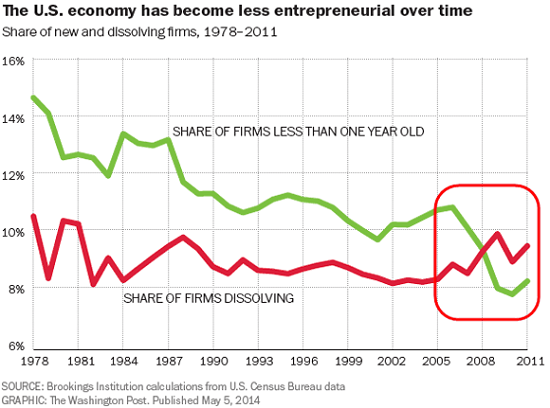
Increasing bureaucracy — especially at the state level — undoubtedly contributes to that depressing chart, but it’s far from the whole story:
Home equity has historically been an important source of capital for small business formation. My first large investment in my company was funded with a loan that was secured by the equity in my home. What outsiders may not realize about small business banking nowadays is that it is nothing like how banking is taught in high school civics. In that model, the small business person goes to her local banker and presents a business plan, which the banker may fund if they think it is a good risk.
In the real world, trying to get such an unsecured loan from a bank as a small business will at best result in laughter. My company is no longer what many would call “small” — we will do millions in revenue this year. But there is no way in the world that my banker of over 10 years will lend to my business unsecured — they will demand some asset they can put a lien on. So we can get financing of equipment purchases (as a capital lease on the equipment) and on factored receivables and inventory. But without any of that stuff, a new business that just needs cash for startup cash flow is out of luck — unless the owner has a personal asset, typically a house, on which the banker can place a lien.
So, without home equity, one of the two top sources of capital for small business formation disappears (the other top source is loans from friends and family, which one might also expect to dry up in a tough economy).
Comments Off on Not fewer entrepreneurs – fewer resources for entrepreneurs
The rich boozehound’s guide to globetrotting
Got lots of money burning a hole in your bank account? Want to show off just how filthy stinking rich you are? Like spending your however-earned-or-inherited loot on fancy booze? Then there’s a million-dollar booze vacation you’ll probably like:
UK-based travel company Holidaysplease is offering a luxury world drinking tour in which you can learn and demonstrate the art of conspicuous consumption.
Starting and ending in London — although pickups are possible elsewhere — the ultimate hedonistic, money-no-object vacation takes in the world’s best hotels, swankiest restaurants and most exclusive bars in 10 upmarket destinations.
En route, drinkers take in the universe’s most ludicrously expensive niche beverages.
In Monaco, members of the bottomless budget brigade will mingle with other surreally high net individuals at the high end Hotel Hermitage Monte-Carlo and party at Flavio Briatore’s Billionaire Sunset Lounge in the hotel Fairmont Monte Carlo, quaffing selections from the $565,000 “in-house Armand de Brignac Dynastie” champagne collection.
It all comes complete with fawning waiters and diamond-filled ice buckets.
“We spend the first three nights in London in the five-star Corinthia Hotel and hang out in the Playboy Club, Park Lane, Mayfair,” says Byron Warmington of Holidaysplease.
Hef once said: “Life needs to be lived with a sense of style.”
As a taste of things to come, surrounded by grinning Bunnies, guests will sample the glam high life and swallow what’s reported to be the second most expensive drink in the history of mixology.
The Legacy cocktail includes 1788 Clos de Griffier Vieux Cognac, which comes in at $21,000 for a 40 ml shot.
It also includes ancient Kummel liqueur, vintage orange Curacao and four dashes of circa 1900 Angostura bitters.
Comments Off on The rich boozehound’s guide to globetrotting
May 13, 2014
Coravin – a new technique for sampling wine in the bottle
Brendan linked to this article about an innovative wine sampling device:
Five years later and news of another device with even more exciting ramifications for the wine trade began to ripple across from the US. Nuclear engineer and, crucially, wine lover Greg Lambrecht turned his mind to exploring whether it might be possible to sample the contents of a cellar without having to pull the cork.
Fourteen years and 23 prototypes later, Coravin was born. The portable apparatus allows a needle to be inserted through the foil capsule and cork; it then extracts the wine, fills in the gap with inert argon and withdraws, leaving the flexible cork to reseal itself.
Having initially launched in the US, Coravin is now available to be shipped to 22 countries and made its first UK appearance last October, priced at £300.
Although vice-president for marketing Howard Leyda says “the primary target market for Coravin is wine enthusiasts first for personal use”, it is the UK restaurant scene that has been generating the biggest buzz around what many believe is a real game changer.
[…]
Until Coravin becomes more easily available, a number of restaurants that have managed to get their hands on one can be seen drumming up excitement among their clientele by promoting this gadget’s most obvious application: the chance to taste some serious old wines.
At one early adopter, D&D London restaurant Avenue, the French- and American-focused wine list now reaches its apogee in the form of vertical flights of Mouton Rothschild and the first growth’s Californian sister venture Opus One.
Other options include Cheval Blanc 1999 at £91 for a 125ml glass or, for those looking to treat themselves on a tighter budget, a 75ml sample of Clerc Milon 2004 for £13.
“It’s really interesting for us to be able to offer these wine flights,” enthuses Avenue restaurant manager Robert Kihlstrom.
Comments Off on Coravin – a new technique for sampling wine in the bottle
May 12, 2014
Amazon gets a patent for a decades-old photographic technique
Stephen Shankland provides another exhibit in the patent-system-is-broken case:

Photographers are hooting derisively at a patent Amazon won in 2014 for a photography lighting technique that’s been in use for decades, a patent that’s helped undermine the credibility of the patent system.
Amazon’s patent 8,676,045, granted in March and titled “Studio Arrangement,” describes a particular configuration of the photography subject in the foreground and a brightly lit white screen behind, an approach that “blows out” the background to cleanly isolate the subject.
It’s a fine idea, but not a novel invention, argued David Hobby, a professional photographer since 1988 who runs the Strobist site that for years has been a popular source of advice on flash photography. He used the approach himself as a staff photographer on his first job decades ago for a business publication.
Comments Off on Amazon gets a patent for a decades-old photographic technique


