Feral Historian
Published Jan 9, 2026The Day The Earth Stood Still (1951) is in some ways the most successful translation of the alien invasion story from 19th Century colonial assumptions to those of the post-WWII world. They no longer come to take our land and plunder our resources, but to keep us from threatening their “Rules Based Order” and turn us into a low-fidelity copy of themselves.
00:00 Intro
02:46 Nukes and Norms
06:48 Ultimatum
09:00 Farewell to the Master
11:08 Hello Remake
(more…)
May 28, 2026
The Day The Earth Stood Still: a Post-WWII War of the Worlds
Comments Off on The Day The Earth Stood Still: a Post-WWII War of the Worlds
May 24, 2026
QotD: Historians, past and present
The average ancient historian led troops, tutored a prince, governed a province, advised a king, made a fortune, fell from favor, was exiled, and buried 7 of their 10 children. The average modern historian passed a few tests then wrote a book on their laptop next to their cat. And worse, they all passed the same tests at the same institutions. And they all wrote the same statements on their applications to get into those institutions. And while attending those institutions, they all adopted the same opinions. Anyone who did otherwise was filtered out before they could become a professor with a publishing deal. Everything is like this now.
Meanwhile Xenophon was an Athenian student of Socrates who joined a Greek mercenary group that marched 1000 miles into Persia to overthrow the King of Kings on behalf of the King’s brother. When the King’s brother died and the group’s commanders were all killed by Persian treachery, he led the troops 1000 miles home himself while being constantly harried by hostile armies. He then tried to establish a colony on the Black Sea, survived a mutiny, raided the Thracians, fought for the Spartans, was exiled by Athens, and settled down to manage an estate and write it all up.
Contrast Xenophon with Mary Beard, who studied at Cambridge and now teaches at Cambridge. She holds the same opinions as everyone else at Cambridge. She’s remarked before that, “I actually can’t understand what it would be to be a woman without being a feminist”. This seems like a peculiar failing for an ancient historian. After 9/11, she wrote an article saying that many people thought “the United States had it coming”, and that “world bullies, even if their heart is in the right place, will in the end pay the price”. That caused some controversy on the world stage, but earned her a promotion at Cambridge. I don’t know if she’s ever talked publicly about religion or democracy or climate change or immigration, but I could tell you exactly what she thinks about these things anyway. So why would you bother reading what she thinks about Rome? The answers are just as predictable.
Roman Helmet Guy, “New Books Aren’t Worth Reading”, Atlas Press, 2026-01-13.
Comments Off on QotD: Historians, past and present
May 23, 2026
“The primary skill of an author is empathy“
On the social media site formerly known as Twitter, Devon Eriksen describes the real skill a fiction author needs to have to produce fully satisfying stories:
Woke message fiction may be slowly dying, but stories won’t magically get better when it’s dead.
Because there’s a deeper problem.
I found it in a book I’ll call MillenialQuest. That wasn’t its real name, of course. I’m not trying to dunk on some poor soul just for writing a bad book. If I did that, I’d never be stopping.
It was some medieval fantasy thing with a rather likely premise involving a fallen paladin and an army of steampunk centaurs.
But when I opened it up, I quickly realized that every single character, despite living in a world where “horse” was the peak of transportation technology, was a Joss Whedon character wearing a Tolkien skinsuit.
Complete with sarcasm, cutesy little quips, and no emotional self-control whatsoever. Didn’t matter if the character was a professional assassin or a cloistered scholar, he talked, acted, and thought as if he were auditioning for a episode of Buffy the Vampire Slayer.
My first impulse was to be annoyed with the author for disappointing me. But I quickly realized that the problem ran deeper, and the author, annoying as her habits were, was both symptom and victim of a deeper malaise.
The primary skill of an author is empathy.
Now, I don’t mean the “empathy” that socialist twats are constantly talking up, in lectures about how we must all immediately dismantle Western civilization to create infinity third world biomass.
I mean the actual skill of figuring out what other people are thinking and feeling.
To excel at his craft, an author must empathize in two directions at once. Not alternately, but simultaneously. He must empathize with the audience to understand how they will experience what he writes, and he must empathize with characters, to understand how they see the world, and what they would do and say.
Empathy must be learned. And it can be learned in two ways, either by having lots of conversations with people who are as different from you as possible, or by reading books with characters who are also totally unlike you.
Well, we’ve now raised several entire generations who cannot withstand the stress of a real conversation with someone from their own nation who happened to vote for the other idiot on a two-option menu.
And what have those people been watching, listening to, and reading?
Well, Whedonized stories wherein every character is a reskinned version of a white, middle class, left-leaning liberal arts student in a small East Coast private college.
The author of MillenialQuest didn’t set out to write The Message™. Nobody was a purple-haired mixed-race fat wheelchair lesbian, and there weren’t any thinly veiled rants about capitalism or diversity.
Sure, the word “misogynist” was used a bunch, without any apparent awareness of the confused look of incomprehension that your standard medieval knight would respond with.
But so was the word “allergies”. And “expense account”. And “psychology”. And “self-medication”.
No, the core pathology here wasn’t the irrepressible urge to preach the author’s values at all.
It was a complete lack of ability to put her head into someone else’s world view.
To the new breed of author, the 21st century liberal zeitgeist isn’t just the only moral viewpoint, it’s the only imaginable viewpoint.
This is why they think you are evil and crazy if you voted for the other guy. Because they literally have no idea what might have motivated you to do that.
The author of MillenialQuest couldn’t imagine a world where differing responsibilities for men and women are a necessity for survival, rather than a cause for complaint.
She couldn’t imagine how the concept of an expense account would be expressed in a world where peak financial technology is pounding your shiny metal into discs with faces on them.
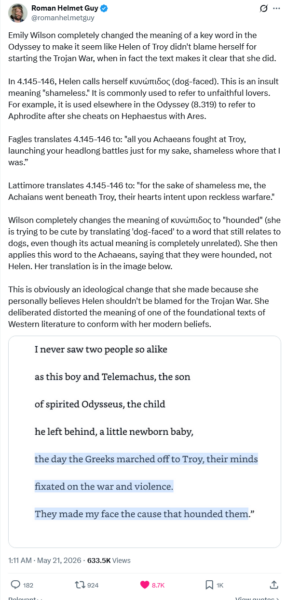
Emily Wilson can’t understand a woman who would be ashamed of cheating on her husband, or men who would start a war over an insult.
Yes, often it’s deliberate. Often it’s preaching, or venting their own desire to debate with someone whose response they cannot hear.
But the point is, even if and when they are forced, by threat of major film studio bankruptcy, to stop deliberately trying to preach and propagandize, they won’t magically gain the ability to write characters different from themselves.
Empathy is a skill. It has to be learned and then practiced. And most people in the writing game today simply haven’t had the opportunity.
We may be exiting the age of DEI slop, but we are entering the age of just plain slop.
Comments Off on “The primary skill of an author is empathy“
May 22, 2026
QotD: The cargo cults of New Guinea
You may remember that Guns, Germs, and Steel is framed as a reply to a man named Yali, a “remarkable local politician” whom Diamond encountered while walking on the beach in New Guinea in July of 1972. (Back before Diamond’s second career as a pop-science public intellectual, he was an ornithologist focusing on the birds of northern Melanesia.)1 They chatted for a while about the prospects for New Guinean independence, and local birds, and then Yali asked a question that Diamond spends a couple of paragraphs boiling down to something like, “Why did human development proceed at such different rates on different continents?” (Which is of course what Guns, Germs, and Steel tries to answer.) But that’s not actually the way Yali put it, and his real question — indeed, his whole story, which is fascinating in its own right — suggests a whole ‘nother set of answers
Yali should be better-known.2 He may have been from a backwards backwater, but he’s one of the true Player Characters of history. If we lived in a better world, he would be the subject of a prestige cable drama3 — or maybe a Robert Eggers film, because the values and assumptions of his society are incredibly foreign to a Western audience. And so to really understand and appreciate Yali’s story (and the question he asked an American ornithologist on the beach one day) you need some background about the tribal cultures of the New Guinea coast and their reaction to contact with Europeans. Which is to say, you need to understand cargo cults! Because what Yali actually asked (per Diamond’s recollection twenty-odd years later) was: “Why is it that you white people developed so much cargo and brought it to New Guinea, but we black people had little cargo of our own?”
“Cargo” is the catchall word for Western material culture in Pidgin English,4 the lingua franca of New Guinea’s many language isolates, and New Guineans were understandably obsessed: before European contact, they were living in the literal Stone Age. It would be an exaggeration to say that they hadn’t made any technological progress since their ancestors settled the island 50,000 years earlier, since they domesticated several local plants (taro, yams, and the cooking banana) and got pigs plus a little admixture from some passing Austronesians about 1500 BC, but they were solidly Neolithic and had been since time immemorial. So of course as soon as they encountered cargo — especially steel tools, tinned meat and dried rice, and cotton cloth — they wanted it desperately. And they almost universally believed they could get it by ritual activity.
The prescribed rituals varied. One set, recorded in secret by an American Lutheran missionary in the late 1930s, involved the locals setting up tables in front of the local cemetery and decorating them with flowers, food, and tobacco. Then they danced wildly until dawn in twitching, trembling fits so uncontrolled that some devotees continued to sway and shake for days or weeks afterward. Those lucky people were believed to have a special connection to the ancestors that would let them receive dream messages about the cargo shipments their tables and dancing would surely bring. A different cult was led by a man who had a long piece of iron he claimed brought him messages from the future. He told his followers that if they set out all their food in cemeteries as offerings to their ancestors, handed all their Western goods and money to him for safekeeping, and renamed Tuesday to Sunday, they could expect a god to send them airplanes full of cargo flown by the spirits of the dead disguised as Japanese servicemen. These spirits would bring them rifles, tanks, and other materiel and help them drive out the white people, and then the god would change the natives’ skin from black to white. Oh, and also there would be storms and earthquakes of unimaginable violence.
Forget everything you think you know about cargo cults. (Especially forget those pictures you may have seen of “decoy” airplanes or satellite dishes made out of straw and wood: one popular airplane photo is from a Japanese straw festival, another is a Soviet wind tunnel model, and the radio telescope is just one advertisement from a British ice cream company.)5 Nowadays we use “cargo cult” as a lazy shorthand for “copying what someone successful seems to be doing without really knowing why and hoping you get the same result,” but that’s not what was happening at all. If the New Guinea natives built airstrips, it wasn’t out of a belief that airstrips attract cargo planes like planting milkweed brings Monarch butterflies — that would be seem silly but basically understandable from our frame of reference. No, it’s much weirder than that. They built airstrips for exactly the same reason anyone else does: because they thought cargo planes were coming. They just thought the planes were coming because of the dancing.
This is a story about epistemology. And also about Jesus sending you a case of Spam in the mail.
Jane Psmith, “REVIEW: Road Belong Cargo, by Peter Lawrence”, Mr. and Mrs. Psmith’s Bookshelf, 2025-04-21.
- Okay, fine, it’s actually his third career — he was a specialist in cell membrane biophysics before he started publishing on birds.
- Kudos to commenter Gary Mar, who did his part in this project by alerting me to this book in the first place.
- Just in case anyone reading this has contacts in showbiz, my other idea for a cable drama is the story of Charles V, Philip II, and William of Orange. The emperor of half the known world, the son and heir raised far away, the beloved ward who betrayed him… It would win twelve Emmys.
- Which is not actually a pidgin but a creole! Nowadays it’s more often called Tok Pisin (etymologically, obviously, from “talk pidgin”). Most Tok Pisin vocabulary comes from English, but the grammar and pronunciation are very different and the orthography makes it hard to read. Still, if you try saying it out loud you can sometimes get the gist: “Wetman noken haitim samting moa” pretty easily becomes “white man no can hide’em something more”, and actually means something like “the white man will not keep anything secret from us any longer”.
- Credit for tracking down the sources of those images goes to Ken Shirriff in this blog post, which Gwern kindly sent me when I started talking about this book review.
Comments Off on QotD: The cargo cults of New Guinea
May 21, 2026
QotD: “Theory” in film interpretation
[Camille Paglia] What has been called “theory” since the arrival of deconstruction in elite U.S. universities in the 1970s is in my view one of the most pointless and pretentious movements in modern cultural history. The catastrophic results should be obvious by now: the humanities are in ruin and have lost public respect and even internal support in academe, where budget reduction has come to the fore. I would refer those seeking greater specifics to my long attack on poststructuralism, Junk Bonds and Corporate Raiders: Academe in the Hour of the Wolf, published by Arion in 1991. Seven years ago, I did a follow-up assessment of current “theory” when the Chronicle of Higher Education asked me to review three new academic books by women about the bondage and domination trend. My unhappy response was “Scholars in Bondage”, which laments the damage done to promising young professors by a tyrannical academic establishment still chained to the bleached-out corpse of “theory”.
My approach to art is grounded in the sensory. Art is not philosophy. Art by definition refracts meaning through some medium of the material world. Hence my interpretation of art is grounded in the five senses. Perhaps the only theorist who fully grasped this issue was Gaston Bachelard in his 1957 book, The Poetics of Space, animated by a phenomenology that partly aligns with my own practice. It is no coincidence that I have spent most of my teaching career at art schools, where the body remains front and center in most art forms. Digital genres are certainly spreading and flourishing, but dance, music, and theater remain grounded in physicality — which is partly why art schools are finding it so difficult to adapt to the harsh, distancing realities of the virus crisis.
Comments Off on QotD: “Theory” in film interpretation
May 19, 2026
The War People by Lucian Staiano-Daniels
At Dead Carl and You, Kiran Pfitzner reviews The War People: A Social History of Common Soldiers during the Era of the Thirty Years War and finds it has value in bringing to life some of the ordinary people involved in that bloody, interconnected series of wars that we group together as the Thirty Years’ War:
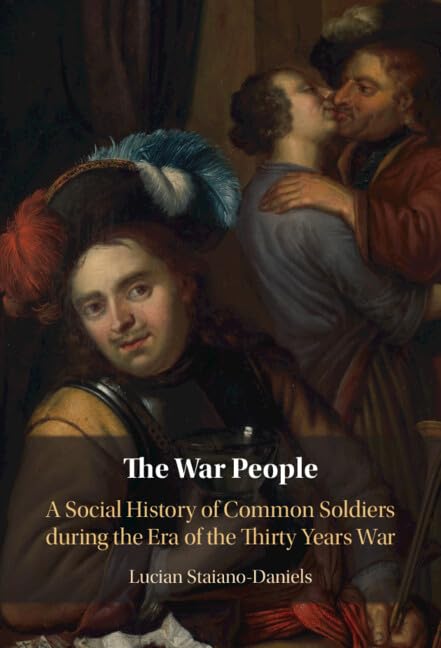
“Their word for themselves was People. Early seventeenth-century common soldiers were Die Leute, Das Volk, les gens, or la gente. They were Das Kriegsvolk, Die Kriegsleute, les gens de guerre, the War People.” So begins Lucian Staiano-Daniels’s aptly titled The War People: A Social History of Common Soldiers during the Era of the Thirty Years War. Using the technique of micro-history, Staiano-Daniels follows the Mansfeld regiment from its raising in 1625 to its unhappy dissolution in 1627. This unexceptional regiment is notable because of the primary source documentation that survives, specifically its original internal legal records — investigations, debts, trials, and last testaments. Through this unusually immediate resource, we gain glimpses of the reality of the 17th century common soldier and so a clearer view of the social conditions he lived within.
One way Staiano-Daniels situates this investigation is in terms of the relationship between military organization and state-building. Describing the existing historiography, he writes: “In this argument, early-modern states increased their control over their civilian populations in part to raise tax money for larger armies that were inhabited by soldiers who were themselves increasingly well-disciplined”. He instead finds, “neither an intensification of military discipline nor unadulterated thuggishness. The military community was made up of systems of relationships that were subtle, intricate, and disorganized.” (7). These findings are well evidenced, and significant, as earlier literature (drawing on more normative sources like manuals and regulations) asserted the intensification of discipline as part of the emergence of the modern state. Instead, we see states forced to engage in the paradoxically complexly and loosely organized world of the mercenary, unable in this time of crisis and state-emergence to fully subordinate the armed forces they employed.
The 17th century and the Thirty Years’ War serve as an important benchmark in understanding the development of war. In witnessing the lives of the kind of men with which wars of the 17th century were fought, we gain a greater understanding of the society that they moved in. In so doing, we can more easily conceptualize the forces that both constrained and enabled war in the 17th century, producing its particular form. This conception provides the opportunity to more easily understand war in other places and times and what conditions reduced or intensified its violence.
Reading this work as a Clausewitz scholar, I could also not help but see a connection between the culture of the war people and Clausewitz’s support for a national militia or Landwehr as a step towards more inclusive governance. There is, of course, a great distance between the unruly mercenaries of the Thirty Years’ War and the “nation in arms” envisioned by Clausewitz and the other Prussian reformers, but at its core we find a common phenomenon: the connection between military service and rights, personal and political.
This book demonstrates well the value of microhistory; in looking closely at the practices and prevalent attitudes of these soldiers of the 17th century, we gain a more concrete view of the prevailing social conditions. This is not just of interest for its own sake (as social history), but because social conditions greatly shape the practice of war, as Clausewitz tells us. This is so because social conditions both reflect and affect the political conditions that create war, as well as the political purpose that exercises a continuous influence upon it.
Comments Off on The War People by Lucian Staiano-Daniels
May 16, 2026
QotD: History doesn’t repeat, but sometimes it rhymes
Let me just quote a couple of passages that might be written with very slight alterations today:
My object is to relate all the follies of the day to their common origin. The committers of folly, the authors of the rubbish which I commit to my symbolical flames, have not, in all probability, the wit to understand any general principles of puerility. It needs reason to understand that the source of the trouble is a general flight from reason and from the legacy of civilised opinion in which past reason has been embodied. The world increasingly substitutes fisticuffs for argument, flags and symbols for facts and realities, belief in the omnipotence of the sub-conscious for faith in self-determination of the will by reason guided … it teaches its children that impulse is divine. Consequently it has no standards.
Brown asked a question nearly a century ago now that has surely occurred to many of us:
Why should all acquired knowledge, all human experience, all civilisation be cast aside? It needs sifting, that is acknowledged; but why scrap it? The passion for such root-and-branch abolition invades the arts as well as the schools.
Later, he provides the sketch of an explanation for the radical iconoclasm that he sees in his own time:
It is a commonplace that the person most easy to deceive is the recipient of a higher education that has failed to be high enough. The schooling system of Europe and America had just reached the stage at which it was creating the pseudo-intellectual in very considerable numbers.
This seems more than ever applicable now: the contemporary pullers-down of statues are educated enough to formulate simplistic generalisations, but not educated enough to appreciate the complexities and ironies of existence.
Theodore Dalrymple, “Sufficiently Educated to Embrace the Simplistic”, The Iconoclast, 2020-09-24.
Comments Off on QotD: History doesn’t repeat, but sometimes it rhymes
May 15, 2026
QotD: Rediscovering Cræft
So why am I telling you about a book on how to do things by hand that you can do far more quickly and efficiently with a machine?
Well.
Langlands frames his book around the concept of cræft, which (as you can probably guess from that æsc) is the Old English origin of our modern “craft”. The ancestral word is richer and more complicated than the modern one, though, pointing to far more than handmade tchotchkes and beer with too much hops. The Dictionary of Old English explains:
“Skill” may be the single most useful translation for cræft, but the senses of the word reach out to “strength”, “resources”, “virtue”, and other meanings in such a way that it is often not possible to assign an occurrence to one sense in [modern English] without arbitrariness and loss of semantic richness.
Like the modern “craft”, it does convey a sense of ability, especially when it comes to one’s livelihood: the students in Ælfric’s Colloquy use cræft as well as weorc when discussing what they do all day. But it can also mean might or power: when the Old English Orosius tells us that the strength of the Medes failed them in battle, for example, it’s Meða cræft that gefeoll,1 and when Judah Maccabee’s foes join the fray, they begin to fight mid cræfte. Of course, there are semantic connections among these varied meanings: the ideas of physical strength and physical skill blend into one another at the edges, and a word for a thing you’re good at doing with your hands can also be used for a thing you’re good at doing with your mind. (After all, we still refer to writing as a “craft”.) And ideally you’re fairly talented at whatever set of things provide your livelihood! So we can say that Old English cræft broadly means something like “a person’s ability to bring his will to bear on the world, and his skill in doing so”.
There’s one more meaning, though, and it appears more or less exclusively in the writings of Alfred the Great: cræft as spiritual or mental excellence.2 Anglo-Saxon scholars had mostly used cræft as a way of rendering Latin ars, but when King Alfred translated Boethius into Old English he used cræft for Latin virtus, virtue as in moral excellence.3 A contemporary reader might be tempted to see this as merely an extension of the “mental skill” sense of the word (a virtuous person is one who is good at being good), but that would be misleading; the general meaning of cræft leaves the word freighted with powerful and inescapably physical implications. (Remember, too, that before the Reformation the Christian image of spiritual excellence universally emphasized asceticism, which necessarily involves the body a great deal.) Cræft as virtue is not an internal moral condition, it’s an internal activity, a kind of doing or making of the soul.
Or, as Langlands glosses his title, cræft is “a hand-eye-head-heart-body coordination that furnishes us with a meaningful understanding of the materiality of our world”.
Langlands is now a professor of archaeology at Swansea University, but he got his professional start as a circuit digger, the kind of “hired trowel” real estate developers pay to quickly catalog all the ancient remains they’re about to turn into the foundation of a new Tesco. It was not a fulfilling job — “crude and expedient” is the line he uses for his commercial excavations — and he was beginning to grow disillusioned with archaeology as a field. So naturally he did what any sensible person would do if he didn’t like his job: he applied to be on a TV show. This was in 2003, and BBC Two was advertising for people to spend a year in 1620, living on and running a historical farm using reconstructed period techniques and equipment. Langlands got the gig (along with Ruth Goodman and another archaeologist whose book I haven’t read), and had a wild year in the Stuart era and then a few more in the Victorian and Edwardian periods.
The shift from examining the archaeological record to experiencing how it was made was an eye-opener, and the success of that first program took him by surprise: “I’d often wondered to myself who on earth would want to watch a bunch of cranky, oddball re-enactors and archaeologists bimbling around in costume, pretending to be in the past”, he writes. “But I didn’t care too much because I was spending nearly every single hour of every day immersed in historical farming. I was tending, ploughing, scything, chopping, sweeping, hedging, sowing, walling, slicing, chiselling, digging, sharpening, thatching, shoveling; the list was almost endless.” And the longer he spent doing all these things (he was on three more shows), the more he realized that the skills, and the knowledge they required, were slipping away.
True cræft, in Langlands’s version, is a combination of know-how and make-do. It’s when you live on the Outer Hebrides and don’t have any trees, so you use whatever driftwood washes up as the ridgebeam for your roof. No timber for the rafters? No problem — a sufficiently strong rope, drawn tightly enough over the ridgeline and secured on both sides, makes something like a giant net on which you can lay your thatch. The straw left in the fields after harvest will do nicely for making both rope and thatch, but if (say) it’s the early twentieth century and you’ve abandoned cereal crops because cheap North American grain knocked the bottom out of the market, then you can make rope from heather and thatch with bunches of bracken. (On the Danish coast, they use seaweed.)
Or it’s when you’re an early Anglo-Saxon who wants to boil some water. A few generations ago, some Romano-Briton on the same spot would simply have bought a beautifully thrown pot from any one of a dozen proto-industrial centers across the Empire, but these days that production has slowed or stopped and the trade networks that would’ve brought them to you are kaput anyway. All you’ve got is some lousy local clay, too weathered to be easily worked. You don’t even have the fuel to fire it hot. So you add organic tempers like grass or chaff (or even dung) to make the clay more plastic, you shape it by hand without a wheel, and when you fire your pot the chaff burns away and leaves tiny voids in the ceramic. Your pot is soft, it’s brittle, it’s kind of lumpy, and fifteen hundred years from now Bryan Ward-Perkins is going to point to it as evidence that civilization collapsed when Rome fell — but it’s still a pot, and it still holds water. You’ve made ingenious use of the world around you to solve your problem. You are, in a word, cræfty.
So when Langlands says cræft, he means the way people behave under conditions of scarcity and resource constraint. And when you’re in that kind of situation, of course you have to be intimately familiar with all your materials — you have to squeeze every last drop of performance out of them! And while Langlands is interested in preindustrial techniques, this isn’t just a matter for drystone wallers and skep-making beekeepers; you can also be cræfty with machines or computers. Cræft is the Havana mechanics who keep 1950s cars running on an income of $40/month, or the engineers who fit all the computer code for the Apollo Guidance Computer into 80 kilobytes. It’s the defining feature of the Real Programmer who “tuck[ed] a pattern matching program into a few hundred bytes of unused memory in a Voyager spacecraft that searched for, located, and photographed a new moon of Jupiter”. We rightly admire these cræfty solutions for their elegance and their makers’ skills, but aside from a few weird hobbyists we don’t imitate them. You don’t spend days hauling rocks and building a wall to keep your sheep in when you have wire fencing. You don’t learn the skies so you can time your haymaking for clement weather when you can just wrap your machine-mown grass in plastic and make silage instead. And you don’t work in unreal mode when you have 64-bit processor. Technological advances have freed up our time precisely because they’ve freed us from the need for clever, thoughtful, material-aware solutions to our problems. No one is cræfty in the midst of abundance, because they don’t have to be.
Your reaction to that last paragraph reveals where you fall in the Wizard/Prophet divide: are you pumping your fist for humanity, or are you a little sad that a kind of mastery has been lost? Is our ability to simply throw more resources at the problem and go on with our day a blessed liberation from the bonds of brute necessity, or is it a tragic separation of our thinking, making, doing selves from our world? Are our practical limitations something to be defeated or innovated around, or are they something to embrace because they are, in some sense, good for us?
Langlands is, unsurprisingly, well over on the Prophet side. He warns that “while some machines are clever, the net result of our using them is that we become lazy, stupid, desensitized, and disengaged” — it’s not that a thing made by hand is better as an object than its mass-produced counterpart (although in some cases it is, and a stone wall does last longer than a wire fence), it’s that the making changes the maker. And while he likes to warn that climate change or Peak Oil or the fragility of international supply chains make our uncræftiness a serious survival risk (think of those poor imported-pot-dependent Britons when Rome withdrew!), that’s not really the point. Even if our technological society never falters — even if we soar to greater and greater heights of prosperity and can afford to automate and mechanize more and more of our interface with the world — Langlands argues that would just mean more missing out.
Jane Psmith, “REVIEW: Cræft, by Alexander Langlands”, Mr. and Mrs. Psmith’s Bookshelf, 2025-03-24.
- As in modern German and Dutch, Old English used the ge– prefix for past participles.
- For more on Old English cræft, especially in the Alfredian corpus, see here. Langlands quotes from the late Peter Clemoes, who wrote extensively on the topic, but no obliging Kazakh has put that online for me.
- This is a fascinating word choice, because virtus is also a complicated and interesting word; it’s derived from the Latin word for man, vir, and means things like “force” but also “manliness” or “bravery” (like Greek ἀνδρεία). In the classical world, it came to mean something like moral worth or excellence in a particularly masculine way, and though it was adopted as a western Christian term for something like spiritual ἀρετή, it retained some of those echoes.
Comments Off on QotD: Rediscovering Cræft
May 10, 2026
The “death of the reader” is how art stops being for people and becomes just for artists
When I first got interested in Jazz, I bought all sorts of music from multiple musicians and groups, liking some more and some less. But it seemed that at some point in the 1960s, I was finding less and less of the music to be interesting and entertaining. More and more from that point on, the music seemed to be deliberately less accessible, more intricate without being pleasant or compelling to hear, and (as I characterized it years ago on the old blog) more oriented to other musicians rather than the non-musician general listening audience. On the social media site formerly known as Twitter, Devon Eriksen shows that this happens in many artistic and creative pursuits and groups them all together in a phenomenon he calls “the death of the reader”:
This is what I call “The Death of the Reader”.
Authors write for readers, who aren’t authors. Artists paint for non-artists. Musicians play for non-musicians.
This keeps fiction, art, and music grounded.
But when any group stops creating for an external audience, and starts trying to impress only each other, they create a weird, self-reinforcing feedback loop.
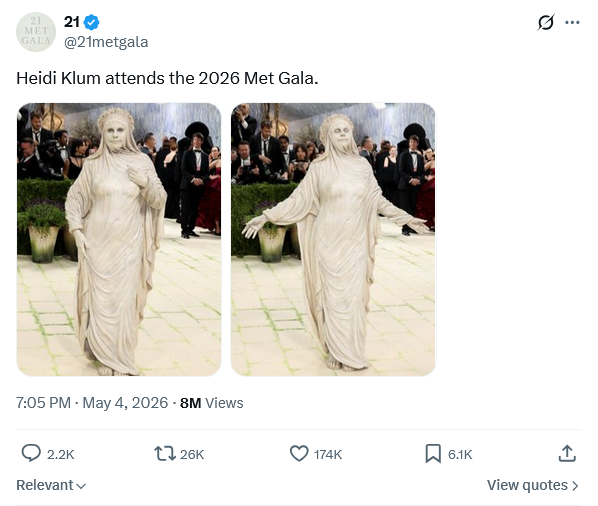
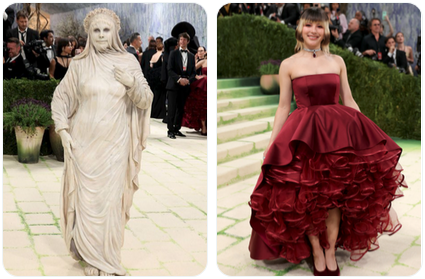
This isn’t clothing, or even fashion. It’s a costume party. They’re all trying one-up each other with something weirder and more eye-catching.
So when an athlete, of recent and topical celebrity, who isn’t a part of their Bored Billionaires’ Club, shows up in a dress that’s just a dress, of course they are going to mock her. She’s just revealed that she didn’t get the memo. That she’s not an insider.
How she looks to the world at large is not the point.
This is why 99.999…% of copies of Infinite Jest have never been read. This is why John Cage “wrote” four minutes of silence. This is why competitive bodybuilders from the 80s looked like Greek gods, and modern ones look like gargoyle freaks.
It’s all the Death of the Reader.
Hollywood doesn’t make movies for you now. They hate you. They make movies for each other.
And then cry about how you didn’t buy a ticket, because they think your only role is to pay for their onanistic circle of self indulgence.
This game isn’t going to stop. It’s just going to keep getting weirder until someone’s dress malfunctions and catches fire, and the rest of us all have a good laugh.
Comments Off on The “death of the reader” is how art stops being for people and becomes just for artists
May 9, 2026
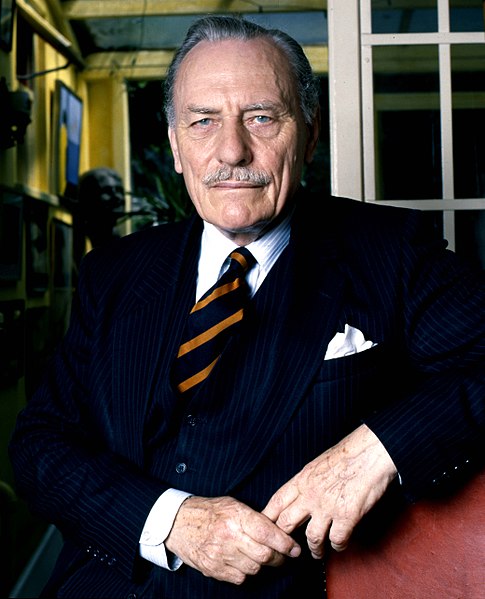
Like the Roman. The Life of Enoch Powell, by Simon Heffer
I think it’s fair to say that Enoch Powell is having a moment, nearly sixty years after he shocked the establishment with his 1968 “Rivers of Blood” speech. He became a pariah even in his own party, and his political career never recovered … but his warnings have more than been fulfilled over the intervening decades. In The Critic, Jeremy Black reviews the recently reprinted 1998 biography of Enoch Powell by Simon Heffer:
Enoch Powell in a 1987 portrait by Allan Warren.
Wikimedia Commons.
The new imprint of this important biography provides an opportunity to reread one of the most skilful works on British political history published over the last half century. As with Heffer’s other books, it is also very well written — although might I offer a plea for leaving aside sentences such as “He still saw no reason to lay off Heath”?
Before turning to the substance, it is worth considering the Foreword. Written this January, it underlines Powell’s significance to many issues, notably: “His deep scepticism about the confluence of America’s interest with those of Britain”. I am, however, dubious about the proposition that “Powell was, quite simply, one of the foremost Conservative thinkers in living memory, possibly the greatest since Burke”. Leaving aside the question of whether Burke can be described as Conservative or even, prior to the 1790s, as conservative, and, separately, the implicit dig at claims for Disraeli whom Heffer is on the record as describing as a Charlatan, I myself would make the case for Salisbury, while agreeing that Macmillan, Hailsham and MacLeod did not measure up to Powell. He returned the damage done him by Macmillan with “bilious” reviews of his Memoirs.
While I am sceptical of the claim that Powell was a great Conservative thinker in the cosmic sense, he was an impressive critic of many of the shibboleths of establishment Conservatism from the 1960s to the 1980s, including on immigration, the nuclear deterrent, the Common Market, the American alliance, Northern Ireland, and economic policy.
A significant aspect of the intellectual character of Powell was the return of this one-time atheist to the Church in the late 1940s, the subject of the “Interlude” “Powell and God” in the book. There is, as Salisbury and Cowling among others underlined, a significant link between Conservatism and the Church of England, and Powell, like Thatcher, can be profitably discussed in these terms, with Thatcher far less convincing.
The discussion of Powell’s elision from public debate is also interesting. Published by Weidenfeld and Nicolson in 1998, the biography was kept on print-on-demand until cancelled in the aftermath of the Black Lives Matter movement. Heffer compares the treatment of Powell to that of Orwell in facing difficulties in publishing Animal Farm and Nineteen Eighty-Four. For several years, Heffer found it impossible to persuade a publisher to republish the book and suggests that this was due to a craven fear of public opinion “real or perceived”, one about which Orwell had warned not least when referring to “intellectual cowardice”. The publisher he has found, it has to be said, is another instance of the very valuable work being done by non-metropolitan concerns.
Comments Off on Like the Roman. The Life of Enoch Powell, by Simon Heffer
May 8, 2026
The Strugatskys’ The Doomed City and the Soviet Experiment
Feral Historian
Published 12 Dec 2025While The Doomed City isn’t the last book Boris and Arkady Strugatsky wrote, it is arguably the end of their journey from idealism to cynicism with regards to the whole Soviet project and serves as an almost spiritual history of the period. Let’s meander through it to look at some things not covered in a literary review.
00:00 Intro
03:12 New Jobs
04:45 Aside – Facts and Theory
05:42 Laws and Mentors
09:36 The Experiment
10:50 Regime Change
13:25 Aside – Maps
15:45 Status and Power
18:22 The Ground Beneath Our Feet
(more…)
Comments Off on The Strugatskys’ The Doomed City and the Soviet Experiment
May 7, 2026
Does the REAL Odyssey Survive From the Ancient World?
MoAn Inc.
Published 17 Dec 2025This video was filmed in July of 2025. I wasn’t going to upload it due to the weird not-really-focused-but-also-kinda-focused-thing my phone camera was clearly going through, but decided I didn’t care that much because the content itself was fine x
(more…)
Comments Off on Does the REAL Odyssey Survive From the Ancient World?
May 5, 2026
Orwell: “It would probably not be beyond human ingenuity to write books by machinery”
In the portion above the paywall, Matt Johnson discusses Orwell’s career as we face an unending deluge of writing “assisted” by AI or even entirely created by AI:
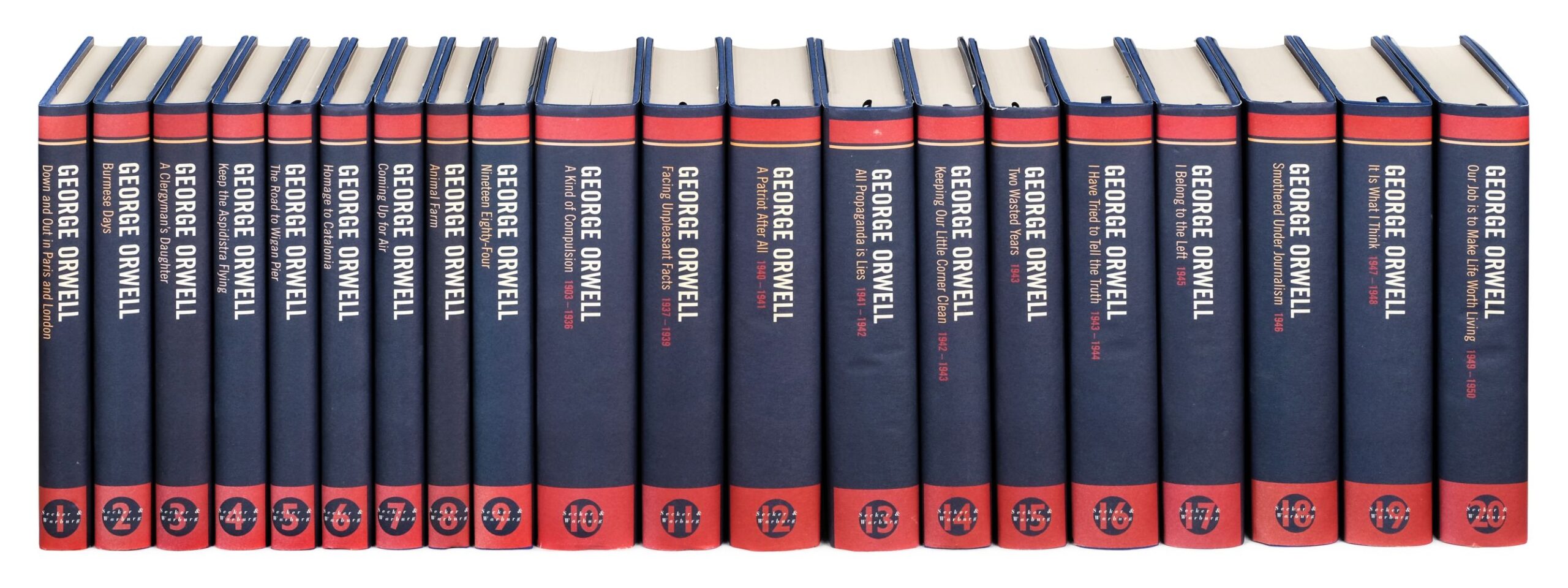
In the introduction to his 1991 book Orwell: The Authorised Biography, Michael Shelden distinguishes his approach from that of Bernard Crick’s George Orwell: A Life, published a decade earlier. While Crick’s volume offered the most complete portrait of Orwell available at that point, Shelden argues that it’s too dull and impersonal — a flood of facts that bury Orwell’s singular, idiosyncratic personality. Shelden observes that Crick “relies heavily on the notion that facts speak for themselves if presented in enough detail”. So he attempts to provide a more intimate account of Orwell’s life: “A writer’s character and personal history influence what he writes and how he writes it. And the more we know about him, the better we are able to appreciate his work.” After all, “Books are not written by machines in sealed compartments”.
But we have now entered an era in which books can, in fact, be written by machines in sealed compartments. Large language models (LLMs) generate billions of words a day and are increasingly capable of producing long, structured, and sophisticated texts. While Orwell could not have foreseen the AI revolution, he predicted that synthetic text could someday replace human writing. In his 1946 essay “The Prevention of Literature”, he observes: “It would probably not be beyond human ingenuity to write books by machinery”. Although he doesn’t linger on this possibility, he laments the depersonalisation and mass production of writing already underway in the 1940s, and these arguments are just as applicable to AI-generated writing today.
Orwell expressed an almost eerie sensitivity to the ways in which literary ability — and even the quality of thought — can decline alongside a growing reliance on automated writing processes. For example, he cites radio features “commonly written by tired hacks to whom the subject and the manner of treatment are dictated beforehand”. The writing itself was “merely a kind of raw material to be chopped into shape by producers and censors”. His experience dealing with the pressures of working in a strictly controlled corporate environment at the BBC during wartime undoubtedly left him with this impression. He also cites “innumerable books and pamphlets commissioned by government departments” created in the same industrial manner.
Orwell’s scrutiny of the “machine-like” creation of “short stories, serials, and poems for the very cheap magazines” holds up particularly well today. In an uncanny anticipation of the process by which millions of users now produce creative content with AI, he writes:
Papers such as the Writer abound with advertisements of Literary Schools, all of them offering you readymade plots at a few shillings a time. Some, together with the plot, supply the opening and closing sentences of each chapter. Others furnish you with a sort of algebraical formula by the use of which you can construct your plots for yourself. Others offer packs of cards marked with characters and situations, which have only to be shuffled and dealt in order to produce ingenious stories automatically.
“The Prevention of Literature” was published around the time Orwell began work on Nineteen Eighty-Four, and it shows. Winston Smith’s job in the Ministry of Truth is to rewrite historical documents to match Party propaganda. He deletes “unpersons” from old news stories and ensures that recorded events always line up with the latest party line, all with the help of his speakwrite dictation machine. He dumps original documents into the Memory Hole for incineration. In the essay, Orwell moves from a discussion of increasingly robotic forms of literary production to the role this shift could play in a totalitarian state:
It is probably in some such way that the literature of a totalitarian society would be produced, if literature were still felt to be necessary. Imagination — even consciousness, so far as possible — would be eliminated from the process of writing. Books would be planned in their broad lines by bureaucrats, and would pass through so many hands that when finished they would be no more an individual product than a Ford car at the end of the assembly line.
In some ways, Orwell’s bleak prophecies would turn out to be more accurate than he could have imagined. The idea that human thought would be replaced by an “algebraical formula” and that consciousness would be eliminated from the writing process is now a reality on a vast scale (though the question of whether consciousness will emerge from AI systems remains open). But Orwell filtered his predictions about the future of writing through his fixation on state power and the possible emergence of a “rigidly totalitarian society”, and this led him astray. In such a society, Orwell assumed that “novels and stories will be completely superseded by film and radio productions”. To the extent that people would want to keep reading, “perhaps some kind of low-grade sensational fiction will survive, produced by a sort of conveyor-belt process that reduces human initiative to the minimum”. He concluded: “It goes without saying that anything so produced would be rubbish”.
Comments Off on Orwell: “It would probably not be beyond human ingenuity to write books by machinery”
May 2, 2026
“… a New York Times bestseller!”
I thought this was well-known years ago, but it still apparently surprises people to learn that the famous New York Times bestseller list is … not actually in any way a valid measurement of book popularity and sales:
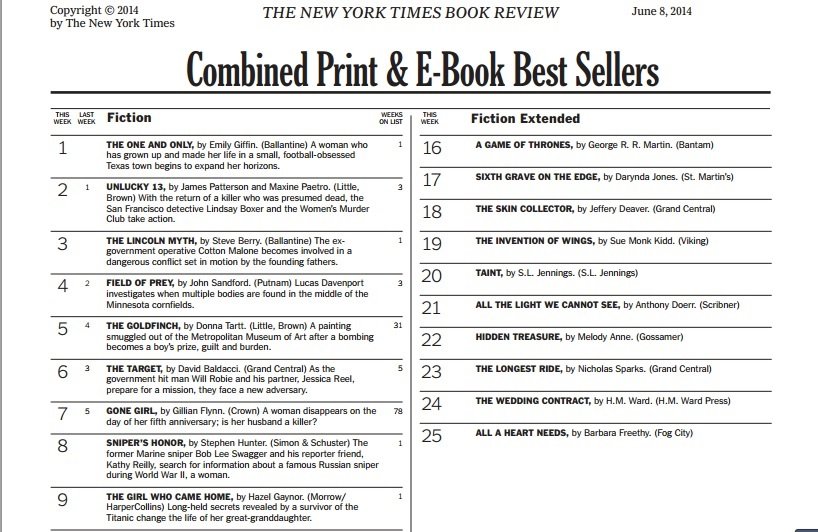
For those of you not familiar with the total scam that is the NYT bestseller list, as a NYT bestseller myself, it’s utter bullshit. It’s not an actual list of bestsellers. It’s “curated editorial”.
As in, stuff they like gets on there, and stuff they don’t like doesn’t. Or stuff they like places higher, and stuff they don’t like but obviously sells too much to deny its a bestseller gets on there lower.
I still tell people I’m a NYT bestseller because most regular normies think that actually means something impressive, and it’s just quicker to say that to establish that you’re a certain level. Within the actual publishing industry its fairly meaningless and everybody knows it.
In reality I made it on there a couple of times early on in my career before they realized who I am and what I’m into (the totally wrong politics, loudly!), because then it was like a post it note got stuck on the wall there saying FUCK THIS GUY, because after that no matter how many copies I sold, even if I was mud stomping half their list in actual sales, I wasn’t getting on there ever again.
Everybody is aware of this scam. The key to getting on the list is the NYT wanting to promote you. They don’t actually track all book sales. They track certain “reporting stores” (which are supposed to be secret but we all know how they are). But then the NYT takes whatever reality is and massages it to fit their narrative.
It isn’t just to keep wrong thinking pariahs like me off there either. I’ve got friends who are apolitical or even mildly liberal who still make the list, but who get bumped down a bunch of spaces from what they should be because there’s somebody else with a new book out the NYT wants to fluff.
Even when the NYT isn’t putting its finger on the scale, it also only measures velocity, as in how many books sold that week. So if you sell 20k copies that week, but never sell another book again, you’re a bestseller. But a guy who sells 1k copies a week every week for an entire year, is not.
Also, I don’t know if it is still this way, because I quit paying attention to what makes the NYT list years ago after I understood what a joke it was, but it was only for physical books, not ebooks, not audio. And there are authors who crush it in ebook who sell very few physical copies in stores. I don’t know if this is still the case on what they claim to track or not today.
So basically it is a biased list of what one small part of the industry sells in a short period of time that the NYT then tweaks to ignore reality if they feel like it anyway. And this isn’t just my opinion as a disgruntled former NYT bestseller, this has gone to court. Authors have sued the NYT which is where the “editorial” thing comes from.
This gets some attention periodically when somebody really famous raises a stink about it. A couple years ago it was Elon. Before that it was Mike Rowe. Etc. But then regular people all forget and go back to thinking the NYT‘s bestseller list isn’t as full of shit as everything else the NYT does.
Comments Off on “… a New York Times bestseller!”
May 1, 2026
We are much more Brave New World than 1984
Culturally, we had lots of warning from George Orwell and Aldous Huxley about their future — our present — and while we have had some success avoiding what Orwell feared for us, we’ve had much less success avoiding a Brave New World culture:
As the curtain of totalitarianism descended across much of the globe, in the mid-twentieth century, the Western intellectual class pointed to George Orwell’s 1984 as a blueprint for societal ruin.
I’m sure many of you are familiar with Orwell’s magnum opus, but for those who don’t know the gist: Orwell envisioned a dystopian future governed by a panoptic state, where an externally imposed oppression would ruthlessly strip humanity of its autonomy, its history, and its capacity for critical thought.
It is a great novel and many believe it was prophetic (I certainly believe parts of it ring true), but, as the cultural critic Neil Postman astutely observed in his foreword to Amusing Ourselves to Death, it was not Orwell but Aldous Huxley, author of Brave New World, who accurately mapped the specific destiny of the modern collapse.
Huxley recognised a far more insidious threat:
What Orwell feared were those who would ban books. What Huxley feared was that there would be no reason to ban a book because there would be no one who wanted to read one.
No “Big Brother” is required to deprive a populace of its cognitive liberty. He foresaw a society that would come to adore the very technologies that undid its capacity to think.
Where Orwell feared those who would ban books, Huxley feared there would eventually be no reason to ban a book, for there would be no one left who wanted to read one. Where Orwell feared the truth would be actively concealed, Huxley feared it would be drowned in an endless sea of irrelevance. Ultimately, Orwell feared that what we hate will ruin us, while Huxley feared that what we love will ruin us.
[…]
The Collapse of Literacy in the Intellectual Elite
The symptoms of this cognitive counter-revolution are visible not only in the general populace but at the very apex of the educational system, signalling a crisis that threatens the reproduction of the intellectual class itself. Over the past decade, professors at elite academic institutions have sounded the alarm regarding a precipitous and bewildering decline in student literacy. In a widely discussed exposition in The Atlantic, Nicholas Dames, a professor of Columbia University’s required Literature Humanities course since 1998, noted that his undergraduate students, the supposed academic elite of the nation are now “bewildered by the thought of finishing multiple books a semester“.1
Two decades ago, Dames’s classes effortlessly engaged in sophisticated, week-to-week analyses of lengthy texts like Jane Austen’s Pride and Prejudice and Fyodor Dostoevsky’s Crime and Punishment. Today, the landscape is unrecognisable. In 2022, a first-year student confessed to Dames that during her entire tenure at a public high school, she had never been required to read a single book cover-to-cover.2 Instead, her education consisted of excerpts, isolated poems, and fragmented news articles. This is a systemic failure; middle and high schools have largely ceased assigning whole books, breaking them down into easily digestible, context-free fragments to accommodate dwindling attention spans. High-achieving students can still decode words, but they struggle to muster the sustained attention or cognitive ambition required to immerse themselves in substantial texts. As technology provides instant gratification, the sustained labor of reading feels deeply unnatural to a generation raised on screens.
This anecdotal evidence from the highest echelons of the academy is overwhelmingly corroborated by a mountain of empirical data. The decline in sustained reading and linguistic proficiency is measurable and accelerating.