Quotulatiousness

January 25, 2026

QotD: Dostoevsky’s views on revolutionaries in Demons

Filed under: Books, History, Politics, Quotations, Russia — Tags: , , , , — Nicholas @ 01:00

In a novel about political radicalism you might expect the ideas to take center stage, but here they’re treated as pure comic relief (if you’ve read The Man Who Was Thursday, the vibe is very similar). The guy who wants to kill all of humanity and the guy who wants to enslave all of humanity have some seriously conflicting objectives (and don’t forget the guy who just wants to kill himself and the guy who refuses to say what his goal is), yet they all belong to the same revolutionary society. The leader of their society takes it to an extreme, he has no specific ideas at all. His political objectives and philosophical premises are literally never mentioned, by him or by others. What he has is boundless energy, an annoying wheedling voice,1 and an infinite capacity for psychological cruelty. But all these impressive capacities are directed at nothing in particular, just at crushing others for the sheer joy of it,2 at destruction without purpose and without meaning.

Does that seem unrealistic? That ringleader was actually based on a real life student revolutionary named Sergey Nechayev, whose trial Dostoevsky eagerly followed. Nechayev wrote a manifesto called The Catechism of a Revolutionary, here’s an excerpt from that charming document:

    The revolutionary is a doomed man. He has no personal interests, no business affairs, no emotions, no attachments, no property, and no name. Everything in him is wholly absorbed in the single thought and the single passion for revolution … The revolutionary despises all doctrines and refuses to accept the mundane sciences, leaving them for future generations. He knows only one science: the science of destruction … The object is perpetually the same: the surest and quickest way of destroying the whole filthy order … For him, there exists only one pleasure, one consolation, one reward, one satisfaction – the success of the revolution. Night and day he must have but one thought, one aim – merciless destruction.

The ideas don’t matter, because at the end of the day they’re pretexts for desires — the desire to dominate, the desire to obliterate the world, the desire to obliterate the self, the desire to negate.3 Just as in their parents’ generation the desire for status came first and wrapped itself in liberal politics in order to reproduce and advance itself, so in their children the desire for blood and death reigns supreme, and the radical politics serve only as a mechanism of self-justification and a lever to pull. This is not a novel about people, and it’s also not a novel about ideas. It’s a novel about desires, motives, urges, and the ways in which we construct stories to make sense of them.

John Psmith, “REVIEW: Demons, by Fyodor Dostoevsky”, Mr. and Mrs. Psmith’s Bookshelf, 2023-07-17.


  1. To Dostoevsky’s own surprise, when he wrote the main bad guy of the story, he turned out a very funny, almost buffoonish figure. He may be the most evil person in literature who’s also almost totally comic.
  2. Dostoevsky is notorious for dropping hints via the names of his characters — applied nominative determinism — and this one’s name means something like “supremacy”.
  3. Or as another famous book about demons once put it:
  4. I am the spirit that negates
    And rightly so, for all that comes to be
    Deserves to perish wretchedly;
    ‘Twere better nothing would begin.
    Thus everything that your terms, sin,
    Destruction, evil represent —
    That is my proper element.

January 22, 2026

D’Joan, C’Mell, and the Rediscovery of Man

Filed under: Books — Tags: , , , — Nicholas @ 02:00

Feral Historian
Published 29 Aug 2025

Cordwainer Smith, through short stories and novellas, tells a sprawling history spanning thousands of years and an entire galaxy. In this one, I’m looking at a single narrative thread of that world, the gulf between man and animal and the partnerships that make humanity whole again after a long span of cultural stagnation and loss of vitality.

00:00 Intro
02:19 Partners and Divisions
05:15 Heading Down to Clown Town
15:53 Mans’ Other Friend
19:22 Norstrilia

The first month’s ad revenue from this video will be donated to 2 animal rescues. https://pauseforpawsaz.com/ and https://sites.google.com/site/catalli…
(more…)

January 20, 2026

Feeding the Great Mongol Khan

Filed under: Books, China, Food, History, Wine — Tags: , , , , , — Nicholas @ 02:00

Tasting History with Max Miller
Published 29 Jul 2025

Mastic stew with black rice, spices, and lamb, garnished with cilantro

City/Region: Mongol Empire | China
Time Period: 1330

The grandson of Genghis Khan, Kublai Khan doubled the size of the largest land empire the world had ever known by conquering China. We actually know quite a bit about the foods that fueled his empire-expanding efforts. Shortly after his death, Yinshàn zhèngyào, or The Proper and Necessary Things for the Emperor’s Food and Drink, was written, and its recipes include ingredients from across Kublai Khan’s vast empire.

The mastic in this stew is a resin from the mastic tree in the Mediterranean, and it has a bitterness along with cedar or pine notes. I really like it in sweet things, but there is no sugar in this dish. The stew is aromatic and smells of cardamom and cinnamon, but they don’t come through in the flavor. The bitterness of the mastic and the lamb dominate the dish, but Kublai Khan was eating this dish to invigorate his chi, so maybe the flavor didn’t matter as much.

I used black rice, or forbidden rice, so named because supposedly it was only eaten by the emperor and his court for much of Chinese history, and it makes the stew a deep purple. You can use long grain white or brown rice, which will make for a lighter colored dish.

    Nourishes, warms the middle and grants chi. Leg of mutton, five tsaoko cardamoms, 2 ch’ien cinnamon, one half sheng chickpeas, mash and remove the skins. Boil the ingredients together to make a soup, strain it. Cut up the meat and set aside. Add 2 ho of cooked chickpeas, 1 sheng of aromatic rice, 1 ch’ien of mastic. Mix well with a little salt. Add chopped meat and cilantro.
    Yinshàn zhèngyào by Hu Sihui, 1330

(more…)

January 17, 2026

Scott Adams, RIP

Filed under: Books, Bureaucracy, Business, Humour, Media, Politics, USA — Tags: , , , , , — Nicholas @ 03:00

Another Scott, Scott Alexander, has a long essay about the career and life of the late comic strip artist, author, and internet personality. When I first encountered his Dilbert comic strip, I was living the cubicle life and far too many of the jokes and situations felt like Adams must be in the same company — possibly even the same department. I read a couple of his non-Dilbert books, but I didn’t follow his work very much after I escaped the cube farm, so reading this essay told me a number of things about Adams that I didn’t already know:

Thanks to everyone who sent in condolences on my recent death from prostate cancer at age 68, but that was Scott Adams. I (Scott Alexander) am still alive.1

Still, the condolences are appreciated. Scott Adams was a surprisingly big part of my life. I may be the only person to have read every Dilbert book before graduating elementary school. For some reason, 10-year-old-Scott found Adams’ stories of time-wasting meetings and pointy-haired bosses hilarious. No doubt some of the attraction came from a more-than-passing resemblance between Dilbert’s nameless corporation and the California public school system. We’re all inmates in prisons with different names.

But it would be insufficiently ambitious to stop there. Adams’ comics were about the nerd experience. About being cleverer than everyone else, not just in the sense of being high IQ, but in the sense of being the only sane man in a crazy world where everyone else spends their days listening to overpaid consultants drone on about mission statements instead of doing anything useful. There’s an arc in Dilbert where the boss disappears for a few weeks and the engineers get to manage their own time. Productivity shoots up. Morale soars. They invent warp drives and time machines. Then the boss returns, and they’re back to being chronically behind schedule and over budget. This is the nerd outlook in a nutshell: if I ran the circus, there’d be some changes around here.

Yet the other half of the nerd experience is: for some reason this never works. Dilbert and his brilliant co-workers are stuck watching from their cubicles while their idiot boss racks in bonuses and accolades. If humor, like religion, is an opiate of the masses, then Adams is masterfully unsubtle about what type of wound his art is trying to numb.

This is the basic engine of Dilbert: everyone is rewarded in exact inverse proportion to their virtue. Dilbert and Alice are brilliant and hard-working, so they get crumbs. Wally is brilliant but lazy, so he at least enjoys a fool’s paradise of endless coffee and donuts while his co-workers clean up his messes. The P.H.B. is neither smart nor industrious, so he is forever on top, reaping the rewards of everyone else’s toil. Dogbert, an inveterate scammer with a passing resemblance to various trickster deities, makes out best of all.

The repressed object at the bottom of the nerd subconscious, the thing too scary to view except through humor, is that you’re smarter than everyone else, but for some reason it isn’t working. Somehow all that stuff about small talk and sportsball and drinking makes them stronger than you. No equation can tell you why. Your best-laid plans turn to dust at a single glint of Chad’s perfectly-white teeth.

Lesser lights may distance themselves from their art, but Adams radiated contempt for such surrender. He lived his whole life as a series of Dilbert strips. Gather them into one of his signature compendia, and the title would be Dilbert Achieves Self Awareness And Realizes That If He’s So Smart Then He Ought To Be Able To Become The Pointy-Haired Boss, Devotes His Whole Life To This Effort, Achieves About 50% Success, Ends Up In An Uncanny Valley Where He Has Neither The Virtues Of The Honest Engineer Nor Truly Those Of The Slick Consultant, Then Dies Of Cancer Right When His Character Arc Starts To Get Interesting.

If your reaction is “I would absolutely buy that book”, then keep reading, but expect some detours.


  1. As is quantum complexity blogger Scott Aaronson.

At Ace of Spades H.Q., Buck Throckmorton remembers Scott Adams:

Scott Adams’ death is being eloquently covered by others, so there is not much I can add. But I do want to offer up a few quick thoughts. Aside from Dilbert being my favorite cartoon for decades, I was a loyal reader of Mr. Adams’ blog for many years before his greater celebrity during the Trump era. Mr. Adams often expanded my views, and occasionally frustrated me, but he helped me understand how rational people can understand things differently.

Back in 2016, when I doubted that Donald Trump was in any way conservative, and when I thought Trump had no chance to beat Hillary in the presidential election, Scott Adams was one of two writers who made an impact on my attitude toward that election. Mr. Adams famously wrote about the reasons why Trump was likely to win. He was right. (The other writer was John Hinderaker of Powerline, who was the first legacy conservative I read who stated that of course we traditional Republicans needed to vote for Trump.)

I was flattered once when Scott put out a call for Dilbert topics and he ended up using one of my submissions. As I recall, his invitation to the public was something to the effect of “You provide the workplace situation and I’ll provide the humor“. I wrote him and offered up what a special hell it was to be working for a company campaigning for recognition in a local “Best Places to Work” contest. Shortly thereafter he used that in a cartoon.

Finally, my favorite Dilbert character was one who got very little screen time. Scott Adams may be gone, but Mordac, The Preventer of Information Services lives on.

I think of Mordac every time I have a spontaneously obsolete password, or I’m blocked from being able to access a system necessary for my job, or I can’t access an SaaS app because there are too few licenses, or I’m logged out of a system because I got called away for a short meeting, etc. In all these circumstances, I give a tip of the hat to Mordac, and I applaud his success in protecting my employer by preventing me from doing my job.

January 16, 2026

“During the 1990s, the midlist disappeared at major publishing houses”

Filed under: Books, Business, Economics — Tags: , , , — Nicholas @ 03:00

It’s no secret that the publishing industry has changed substantially — and from most readers’ point of view, for the worse — but when did it happen, and why? Ted Gioia points to the mid-1990s in New York City:

Everybody can see there’s a crisis in New York publishing. Even the hot new books feel lukewarm. Writers win the Pulitzer Prize and sell just few hundred copies. The big publishers rely on 50 or 100 proven authors — everything else is just window dressing or the back catalog.

You can tell how stagnant things have become from the lookalike covers. I walk into a bookstore and every title I see is like this.

They must have fired the design team and replaced it with a lazy bot. You get big fonts, random shapes, and garish colors — again and again and again. Every cover looks like it was made with a circus clown’s makeup kit.

My wife is in a book club. If I didn’t know better, I’d think they read the same book every month. It’s those same goofy colors and shapes on every one.

Of course, you can’t judge a book by its cover. But if you read enough new releases, you get the same sense of familiarity from the stories. The publishers keep returning to proven formulas — which they keep flogging long after they’ve stopped working.

And that was a long time ago.

It’s not just publishing. A similar stagnancy has settled in at the big movie studios and record labels. Nobody wants to take a risk — but (as I’ve learned through painful personal experience) that’s often the riskiest move of them all. Live by the formula, and you die by the formula.

How did we end up here?

It’s hard to pick a day when the publishing industry made its deal with the devil. But an anecdote recently shared by Steve Wasserman is as good a place to begin as any.

He’s describing a lunch with his boss at Random House in the fall of 1995. Wasserman is one of the smartest editors I’ve ever met, and possesses both shrewd judgment and impeccable tastes. So he showed up at that lunch with a solid track record.

But it wasn’t good enough. The publishing industry was now learning a new kind of math. Steve’s boss explained the numbers:

    Osnos waited until dessert to deliver the bad news … First printings of ten thousand copies were killing us. It was our obligation to find books that could command first printings of forty, fifty, even sixty thousand copies. Only then could profits be had that were large enough to feed the behemoth — or more precisely, the more refined and compelling tastes — that modern mainstream publishing demanded.

Wasserman countered with infallible logic:

    I pointed out, if such a principle were raised to the level of dogma, none of the several books that were then keeping Random House fiscally afloat — Paul Kennedy’s The Rise and Fall of the Great Powers, John Berendt’s Midnight in the Garden of Good and Evil (eventually spending a record two hundred and sixteen weeks on the bestseller list, and adapted into a film by Clint Eastwood), and Joe Klein’s Primary Colors (published anonymously and made into a movie by Mike Nichols in 1998) — would ever have been acquired. None had been expected to be a bestseller, and each had started out with a ten-thousand copy first printing.

But it was a hopeless cause. And I know because I’ve had similar conversations with editors. And my experience matches Wasserman’s — something changed in the late 1990s.

The old system offered more variety. It took greater risks. It didn’t rely so much on formulas. So it could surprise you.

In a post about the jinned-up anger about CEO pay versus average worker pay, Tim Worstall briefly touches on the plight of writers:

Or even more fun perhaps.

    In 2006, median author earnings were £12,330. In 2022, the median has fallen to £7,000, a drop of 33.2% based on reported figures, or 60.2% when adjusted for inflation.

That’s median earnings so 50% of all authors earn less than £7,000. And note this is only among those taking it seriously enough to join the Society of Authors (a number which does not include me). Even at my level of scribbling 5x to 10x, depends upon the year, of those median earnings can be gained.

But top level authors, well, they do earn rather more. No, not thinking of the JK Rowling level of global superstardom. But it would astonish me if Owen Jones is earning less than 50x those median earnings (yes, Guardian column, books, Patreon, YouTube and whatever, £350k would be my lower guess).

Writers display that similar sort of income disparity and range, no? Because we’re not about to suggest that Owen is top rank earning now, are we, even if it is a damn good income there.

Which shows us what is wrong with the Cardiganista’s1 initial calculation. They’re pointing only to the incomes of the very tippy toppy of the income distribution for that job. If we apply the same sort of reasoning to writers or footie players (and it’ll be the same for actors and all sorts of other peeps) we find very similar distributions.


  1. They all seem to be Guardian retirees and their byline pictures have them wearing cardigans — or did — therefore …

January 15, 2026

QotD: Process knowledge

Filed under: Asia, Books, Business, Quotations, USA — Tags: , , — Nicholas @ 01:00

Dan Wang, in his wonderful essay on how technology grows, describes process knowledge as the sine qua non of industrial capitalism, more fundamental than the machines and factories that everybody sees:

    The tools and IP held by these firms are easy to observe. I think that the process knowledge they possess is even more important. The process knowledge can also be referred to as technical and industrial expertise; in the case of semiconductors, that includes knowledge of how to store wafers, how to enter a clean room, how much electric current should be used at different stages of the fab process, and countless other things. This kind of knowledge is won by experience. Anyone with detailed instructions but no experience actually fabricating chips is likely to make a mess.

    I believe that technology ultimately progresses because of people and the deepening of the process knowledge they possess. I see the creation of new tools and IP as certifications that we’ve accumulated process knowledge. Instead of seeing tools and IP as the ultimate ends of technological progress, I’d like to view them as milestones in the training of better scientists, engineers, and technicians.

    The accumulated process knowledge plus capital allows the semiconductor companies to continue to produce ever-more sophisticated chips. […] It’s not just about the tools, which any sufficiently-capitalized firm can buy; or the blueprints, which are hard to follow without experience of what went into codifying them.

Process knowledge lives in people, grows when people interact with other people, and spreads around when skilled individuals relocate between cities or companies. But this also means it can wither and die, can be lost forever, either when old workers shuffle off to the Big Open Plan Office in the Sky, or when an ecosystem no longer has the energy or complexity to sustain a critical mass of skilled workers in a particular vocation. Some East Asian societies have gone to extreme lengths to retain process knowledge, for instance by deliberately demolishing and rebuilding a temple every 20 years.

In fact this is far from the most extreme thing East Asian societies have done to retain the process knowledge that lives within their workers! There are some components of an ecosystem, whether natural or technological, that are especially important keystone species. In the technological case, these species can be unprofitable at the current scale of an ecosystem, or inefficient, or they might not make economic sense until one or more of their customers exist, but those customers might not be able to exist until the keystone species does. Venture capital is very practiced at solving this kind of Catch-22, but in the East Asian economic boom it was national governments that actively sheltered keystone industries until they could get their footing, thus making entire ecosystems possible. A wonderful book about this is Joe Studwell’s How Asia Works, but if you can’t read it, read Byrne Hobart’s thorough review instead.

Process knowledge is so powerful, the ecosystem it enables so vital, it can break the assumptions of Ricardo’s theory of trade. Steve Keen has a perceptive essay about how the naive Ricardian analysis treats all capital stock as fungible and neglects the existence of specialized machinery and infrastructure. But naive defenders1 of trade liberalization often make an exactly analogous error with respect to the other factor of production — labor. Workers are not an undifferentiated lump, they are people with skills, connections, and expertise locked up in their heads. When a high-skill industry moves offshore, the community of experts around it begins to break up, which can cripple adjacent industries, stymie insights and breakthroughs, and make it almost impossible to bring that industry back.

John Psmith, “REVIEW: Flying Blind by Peter Robison”, Mr. and Mrs. Psmith’s Bookshelf, 2023-02-06.


  1. Like all coastal-Americans, I am generally in favor of trade liberalization, but I’m consummate and sophisticated about it, unlike Noah Smith.

January 9, 2026

QotD: “My goal is to get paid for having fun”

Filed under: Books, Business, Media, Quotations, USA — Tags: , — Nicholas @ 01:00

My critics consider me a pulp hack, but I’ve proven I can do the deep, dark, and serious better than they can. I’ve demonstrated that I can hop into whatever genre I feel like and do well there. But mostly I just like to have fun and entertain my fans.

True multi genre authors are rare. I’ve done really well in a bunch of different genres because I’m good at recognizing what people enjoy about those, and then giving them what they want, with my own spin on it. I can tweak it, but I shouldn’t break it.

“What if your childhood heroes are really losers and here’s a new girl boss? OOOOH SO EDGY.” That kind of shit bores me.

Far too many authors are pretentious shit heads who climb up their own ass thinking they need to “subvert” expectations, but they’re really not brilliant enough to pull that off. They’re just crapping on the stuff that made people like those genres to begin with. They’re not nearly as clever as they think they are.

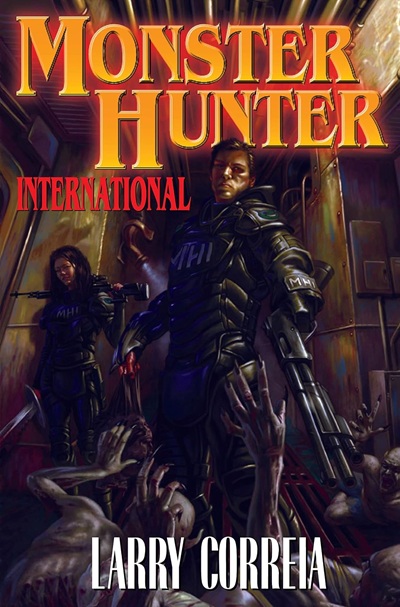
Me? I’m happy to be a pulp hack. If I’m writing epic fantasy, I’m going to do the big, deep, thematic, emotional, stuff (and Saga of the Forgotten Warrior rocks) and if I’m doing progression fantasy then it’s going to be fun and adventure and scrappy nobodies trying to make it in the world and becoming heroes along the way. American Paladin is a dark and gritty vigilante story (with monsters in it). And Monster Hunter is urban fantasy soaked in testosterone and gun oil (that’s next for 2026). I’ve done sci-fi. I’ve done horror. I’ve done comedy. I’ve done thrillers. Hell, I’ve done stuff like Hard Magic where good luck pinning down what the hell genre that is … alternate history, hard boiled, pulp noir, super heroes? Hell if I know.

My goal is to get paid for having fun. 😀

Larry Correia, The social media site formerly known as Twitter, 2025-10-08.

January 7, 2026

Red Star: The Dawn of Soviet Sci-Fi

Filed under: Books, History, Media, Russia — Tags: , , , , , , , , — Nicholas @ 02:00

Feral Historian
Published 15 Aug 2025

Soviet science fiction is a long winding road and it starts with Alexander Bogdanov’s Red Star. Let’s start down that road.

00:00 Intro
03:15 Introducing Martian Socialism
06:35 Tektology
10:03 Crafting Communism
15:08 Mars Has Problems
19:06 Old Man of the Mountain
20:32 The Engineer Menni
(more…)

QotD: Refuting “Limitarianism”

Filed under: Books, Economics, Media, Politics, Quotations — Tags: , , , , — Nicholas @ 01:00

The visible edge of economic populism — the slogans, the soundbites — often conceals an intellectual iceberg beneath: ideas inherited from defunct economists, or sometimes living ones. One such idea with deep roots is limitarianism: the belief that there should be a cap on personal wealth.

Thomas Piketty defines it as “the idea that we should set a maximum on how much resources one individual can appropriate”. Its most articulate modern advocate is Ingrid Robeyns, whose recent book, Limitarianism: The Case Against Extreme Wealth, calls for a global wealth cap, which she suggests could be set around $10 million per person.

But limitarianism rests on an old intellectual error. An error common not only on the Left but even among some classical liberals too: the mistaken division between “production” and “distribution”. The assumption is that production happens through economic forces and that distribution is purely political, so policymakers can reshape who gets what without damaging how much is created.

This assumption leads to the view of the economy as a fixed pie. If one person has a large slice, others must go hungry. As Percy Shelley put it in Queen Mab (1813), “The rich have become rich by the toil of the poor … they increase in wealth by the misery of the workers”. While that may describe life under socialism, it misunderstands how wealth is generated in a capitalist system.

In capitalism, you can grow rich by making the pie bigger: creating products, companies, jobs and innovations that benefit not only yourself, but millions of others. This insight was first observed by French sociologist Gabriel Tarde, and later expanded by economists like Ludwig von Mises and Friedrich Hayek. Tarde noted how luxuries eventually become necessities. His example was forks and spoons, once the preserve of the wealthy, now found in every home.

For our generation, consider childbirth. Queen Anne had 17 pregnancies, yet none of her children survived to adulthood. Today, even the poorest families in developed countries can expect their children to live. This transformation wasn’t delivered by committees or redistribution. It was driven by the freedom of innovators to experiment, often starting with products only the wealthy could afford.

As Hayek wrote in The Constitution of Liberty:

    What today may seem extravagance or even waste, because it is enjoyed by the few and undreamed of by the masses, is payment for the experimentation with a style of living that will eventually be available to many.

Mani Basharzad, “What Zohran Mamdani Doesn’t Understand about Wealth”, Foundation for Economic Education, 2025-09-30.

January 5, 2026

Friedman on Orwell

On his Substack, David Friedman considers some of the things that George Orwell was mistaken about in his non-fiction writings:

    It cannot be said too often – at any rate, it is not being said nearly often enough – that collectivism is not inherently democratic, but, on the contrary, gives to a tyrannical minority such powers as the Spanish Inquisitors never dreamed of. (George Orwell, The Observer, April 9, 1944)

George Orwell got some things right; unlike most political partisans, he saw the problems with the position he supported. He also got quite a lot of things wrong. The quote is from Orwell’s review of two books, The Road to Serfdom by Friedrich Hayek and The Mirror of the Past by K. Zilliacus, a left-wing writer and politician. The conclusion of the review is that Hayek is right about what is wrong with socialism, Zilliacus is right about what is wrong with capitalism, hence that “the combined effect of their books is a depressing one”.

But Zilliacus was wrong about capitalism, as was Orwell, who wrote:

    But he [Hayek] does not see, or will not admit, that a return to “free” competition means for the great mass of people a tyranny probably worse, because more irresponsible, than that of the State. The trouble with competitions is that somebody wins them. Professor Hayek denies that free capitalism necessarily leads to monopoly, but in practice that is where it has led, and since the vast majority of people would far rather have State regimentation than slumps and unemployment, the drift towards collectivism is bound to continue if popular opinion has any say in the matter. (“As I Please”, pp.117-119)1

The problem is that Orwell, like many of his contemporaries (and ours), did not understand economics and thought he did. Since he wrote we have had extensive experience with free competition, if not as free as Hayek would have wanted, and the result has not been the nightmare that Orwell expected. “The trouble with competitions is that somebody wins them” sounds right only if you don’t actually understand the logic of a competitive market. In most industries organizational diseconomies of scale, the effect of more layers between the head office and the factory floor, limit the size of the firm to something considerably below the size of the market for what the firm produces. In some fields, such as restaurants or barber shops, the result is an industry with thousands of firms, in some five or ten, in only the rare case of a natural monopoly can one large firm outcompete all of its smaller competitors.

The effect of free competition is not the only thing that Orwell got wrong. Consider his essay on Kipling.2 He gets some things right, realizes that Kipling is not a fascist, indeed less of one than most moderns, and recognizes his talent:

    During five literary generations every enlightened person has despised him, and at the end of that time nine-tenths of those enlightened persons are forgotten and Kipling is in some sense still there.

But he gets quite a lot wrong. In arguing that Kipling misunderstood the economics of imperialism, Orwell writes:

    He could not understand what was happening, because he had never had any grasp of the economic forces underlying imperial expansion. It is notable that Kipling does not seem to realize, any more than the average soldier or colonial administrator, that an empire is primarily a money-making concern.

In explaining his own view of the logic of empire, what he thought Kipling was missing, Orwell writes:

    We all live by robbing Asiatic coolies, and those of us who are “enlightened” all maintain that those coolies ought to be set free; but our standard of living, and hence our “enlightenment”, demands that the robbery shall continue.3

Britain let go of its empire, starting with India. British standards of living did not collapse; by the time all of the colonies were independent, the average real wage in the UK was 50% higher than when Orwell wrote. He could not know the future but he could observe that Switzerland, before the war, was richer than England, Denmark, with no significant colonies, almost as rich, Portugal, with an enormous African empire, much poorer. Whether Britain ran its empire at a net profit or a net loss is, I think, still an open question, but Orwell’s view of colonialism is strikingly inconsistent with the observed effects of decolonization.

Economics is not all that Orwell got wrong about Kipling; he badly underestimated the quality of Kipling’s work, due to having read very little of it. The clearest evidence is Orwell’s description of The Light that Failed as Kipling’s “solitary novel”. Kipling wrote three novels, of which that is by a good margin the worst. Orwell not only had not read Kim, Kipling’s one world class novel, he did not know it existed. In a recent post I listed eighteen works by Kipling that I liked. Orwell mentions only one of them.


  1. That free capitalism would ultimately fail was still Orwell’s view in 1947:
  2. In North America the masses are contented with capitalism, and one cannot tell what turn they will take when capitalism begins to collapse (“Toward European Unity“)

  3. Discussed in more detail in an earlier post.
  4. As late as 1947, Orwell wrote:
  5. The European peoples, and especially the British, have long owed their high standard of life to direct or indirect exploitation of the coloured peoples. (“Toward European Unity“)

January 3, 2026

Penelope vs Clytemnestra in Greek Mythology

Filed under: Books, Greece, History — Tags: , , , , — Nicholas @ 02:00

MoAn Inc.
Published 10 Sept 2025

I’m trying out shorter videos on the channel, so this is a very basic breakdown explanation. Clytemnestra and Penelope are polar opposites, and their characters bookend The Odyssey. One is seen as the best wife, one is seen as the worst. They’re supposed to be compared and contrasted in this way: Agamemnon’s homecoming to Mycenae is a warning to Odysseus about what could potentially go very, very wrong with his own return to Ithaca. There are so many fascinating ways to dissect these two women, so please don’t take this as a be-all-end-all!

Voice of Erica Stevenson, host of MoAn Inc.
(more…)

January 2, 2026

QotD: From Rousseau to Marx, Hegel to Gramsci

Filed under: Books, Europe, History, Politics, Quotations, USA — Tags: , , , — Nicholas @ 01:00

How did we get here? Can those of us who understand what Communism and socialism would mean for our republic win the election that will be upon us in less than 100 days? Only if we understand how on earth Karl Marx’s ideology survived the end of the Cold War to flourish and grow here in America.

The fundamentals are clear enough. The New Left in America, which is the conveyor belt for everything from Representative Alexandria Ocasio-Cortez’s (D-N.Y.) Green New Deal to Black Lives Matter, can trace its genetic roots back to Jean-Jacques Rousseau, who almost single-handedly upturned centuries of Western philosophical and theological wisdom.

Instead of believing that man is fallen, fatally flawed, and prone to selfishness and evil, Rousseau denied the reality of thousands of years of human history and posited that man is inherently good. Further, this goodness could be maximized by engineering society away from individual rights and liberties, prioritizing communal good, communal needs, and the communal will.

Thus civilization built according to how man actually behaves in real life fell out of favor; and eventually, Karl Marx’s collectivist ideology predicated on the subversion of individual human souls to the common interest (as defined by political leaders) gained steam.

Like an ideological scrapbooker, Marx picked and purloined the ideas of others to build his theory. Socialism is but a temporary stepping stone towards the eventual and inevitable end-state of all mankind, the utopian “Worker’s Paradise.” Marx stole the “inevitability” factor from Hegel and his eponymous “dialectic.”

Hegel, a profoundly religious man, unlike the rabidly and militantly atheist Marx, saw the history of man as a perpetual progression, a series of qualitative improvements in our collective lot as one new idea (antithesis) impacted upon an existing idea (thesis) and resulted in an improved conceptualization (synthesis) that has more truth value than the previous two ideas combined. This progression, so Hegel believed, would increase our enlightenment, until we perceived the ultimate synthesis, the purest version of truth’s expression, which is God himself.

Marx took Hegel’s key inevitability dynamic and removed the metaphysical elements. For Marx the intangible was irrelevant. His “dialectic materialism” posits that thesis and antithesis are instead expressions of the inherent conflict within society — the clash between the have and have nots, the oppressor and the oppressed, the capitalist and the exploited workers — which will result in a final revolution permanently removing class distinction and conflict from society.

This garbage is what Karl Marx sold the world with his books Das Kapital and the Communist Manifesto. And incredibly, some people believed this rubbish. So much so that they used it as a blueprint to sabotage and subvert multiple nations around the world, starting with czarist Russia and stretching all the way to Cuba and China. But then there was a problem. In all their attempts to effect a Communist revolution west of the Russian Empire, Marx’s followers would fail. America was an especially tough nut for Marxists to crack, because of how our nation was born.

America’s Founders, knowing full well that man is fallen and tends toward the selfish and the bad, built America with a system of separation of powers and also bequeathed us a written Constitution founded not on some absurd utopian collectivist vision of society, but built upon the recognition of the liberty of the individual and the unalienable God-given rights we each possess. Despite the advent of Progressive presidents, such as Theodore Roosevelt and Woodrow Wilson, America remained staunch in its resistance to socialism. Marx’s disciples, however, were not ready to surrender.

This is where the influence of a hunchback Italian cripple comes in.

Antonio Francesco Gramsci is the ideational grandfather to all that threatens modern America and our freedoms today, from AOC’s Green New Deal to the violence of Antifa. His writings, penned in an Italian prison cell, would be leveraged by the Hungarian Jewish writer and politician, Gyӧrgy Lukacs, each sharing the same conviction: Communism had failed in established Western democracies — as opposed to the backward and mostly peasant society of czarist Russia — because these societies are too resilient and too developed. For Marxism to flourish in the rest of Europe and America, these “bourgeois” societies must be dismantled piece by piece. From the inside.

The conceptual progeny of that realization leads straight to the panoply of Democratic Party articles of belief today — from Obamacare’s unprecedented intrusion into private healthcare choices to the anti-scientific insanity of transgenderism and beyond. This isn’t a random accusation, devoid of context. It’s not some accusation floating in space. The path from Gramsci and Lukacs to Ocasio-Cortez and Rep. Ilhan Omar (D-Minn.) is a path that may be mapped historically, geographically, and institutionally.

Sebastian Gorka, “From Alinsky to AOC: Will Communism Finally Win in America?”, American Greatness, 2020-07-29.

Update, 3 January: Welcome, Instapundit readers! Please do have a look around at some of my other posts you may find of interest. I send out a daily summary of posts here through my Substackhttps://substack.com/@nicholasrusson that you can subscribe to if you’d like to be informed of new posts in the future.

January 1, 2026

QotD: Niccolao Manucci’s improbable early career

Filed under: Books, History, India, Quotations — Tags: , , , , , — Nicholas @ 01:00

There are people who say “you can just do things”, and then there are people who at the age of fourteen stow away on an ocean-going vessel heading who-knows-where. Niccolao Manucci was the latter sort, and he held out down in that ship’s hold as long as he could, until hunger got the best of him. In fact, he lasted so long that when he finally gave in and presented himself to the captain it would have been inconvenient and uneconomical to return him to his parents in Venice. As the sailors debated whether to toss him overboard, press him into service, or maroon him on the closest bit of coastline, young Niccolao went and chatted up the other passengers. One of them, Lord Henry Bellomont, had recently escaped death at the hands of Oliver Cromwell, and invited Manucci to accompany him on an important mission to Persia.

That sounded pretty good to the teenager, so he disembarked with Bellomont at Smyrna, made the hazardous journey across Ottoman Anatolia, thence through Armenia, and finally to the Safavid Empire, where Bellomont declared himself an ambassador from the rightful king of England and sought Persian intervention in the English Civil War (!). The Shah was horrified by the regicide and amazed that the other Christian kings of Europe had not come to the aid of Charles I,1 but gently rebuffed Bellomont’s request by pointing out that it would be quite impractical to send a large army from Persia to England.

Frustrated, Bellomont set off once again with his young charge, this time to the Mughal Empire. He got as far as the port of Surat, where he suddenly died, leaving the teenage Manucci completely on his own, thousands of miles from his home, in the middle of a civil war.

I sometimes wonder how often this sort of thing happens without us ever finding out. Perhaps history is full of ridiculous people having ridiculous adventures, it’s just that most of them aren’t Zhu Yuanzhang, or they don’t write detailed memoirs, or those memoirs are lost or destroyed before they reach us. Something like this very nearly happened to Manucci. The Venetian teenager left all alone in India not only survived, but flourished socially and financially, lived to a ripe old age, and wrote thousands of pages of penetrating social observations. His account is both the most entertaining and the most reliable history of the Mughal Empire at its zenith. Manucci had the singular talent of moving through every social circle, from the royal court to the lowest of peasants. He interacted with generals and statesmen, harem attendants, Islamic jurists, Hindu sages, elephant drivers,2 Portuguese mercenaries, eunuchs, merchants, prostitutes, common soldiers, missionaries, beggars, and even the emperor himself. There are very few cases where we get to see a premodern society laid out in all its intimate detail and from every angle, and we only missed losing this one by the barest of lucky strokes.

The story of Manucci’s manuscript is a twisting one. The original copies of his tale fell into the hands of a French Jesuit who mutilated the text — excising all the fun parts, all the personal observations, the adventure stories, and of course anything remotely critical of the Catholic Church. The resulting “edition” found its way back to India and into Manucci’s hands before his death. Naturally, he freaked out and tried to reproduce his original text from memory, sending it along with a letter of protest by sealed courier directly to the Venetian Senate. But this second copy is the work of a much older man, much farther from the stories and events described, and has numerous omissions and differences from the original.3 In 1763, the Jesuit order was expelled from France and their Paris library, including Manucci’s first manuscript, was seized by the state. It was then lost during the Revolution and believed destroyed, before turning up in damaged and partial form at an auction-house in Berlin a century later.

Countless European intellectuals have tried their hand at stitching the mishmash of fragments we have back into a cohesive whole, including a “J. Bernoulli” (yes, one of those Bernoullis, but I can’t figure out which brother it was). But everybody agrees the most successful of these efforts was that by William Irvine, a British colonial administrator and fellow of both the Royal Asiatic Society and the Asiatic Society of Bengal, who also helpfully translated the whole thing into English. Irvine’s edition has been republished many times, most recently by the wonderful people at Forgotten Books, which is how it found its way into my hands.4

Irvine is not the sort of editor who confines his remarks to a preface and some footnotes. Instead, he directly injects his own commentary inline, into the body of the text. These asides range from bracketed remarks like “[here I have deleted a coarse and obscene description]” all the way up to essays dozens of pages long containing his reflections and opinions on the text. And this is layered on top of the various modifications and emendations made by French Jesuits and Venetian scribes. All of this gives the book a meta-textual, almost postmodern feeling. It’s a bit like House of Leaves. Sometimes you’re reading Manucci, and sometimes you’re reading three nested layers of people commenting on people commenting on people commenting on Manucci. And the effect is heightened when you suddenly realize that Manucci, like the protagonist of a Gene Wolfe story, is not telling you all that he knows.

John Psmith, “REVIEW: Storia do Mogor, by Niccolao Manucci”, Mr. and Mrs. Psmith’s Bookshelf, 2025-09-08.


  1. Bellomont’s only real success in his mission was to completely poison the well for all future European travelers in Persia. Manucci reports that the next Englishman to visit the court of the Shah was thrown into a dungeon for disloyalty to his liege lord (a story independently corroborated by the French adventurer Jean-Baptiste Tavernier). “[The shah’s] object was to give a lesson to his own nobles as to the manner in which they should serve their king and the fidelity they ought to display, when the occasion arose, in defence of their monarch.”
  2. The book contains extensive discussion of how all elephants and horses that the Mughal princes might want to ride are pre-ridden by an attendant, to “loosen its stomach” and eliminate any flatulence.
  3. This is actually a huge simplification — there are four distinct Venetian codices, all with major differences from each other.
  4. I started with the Forgotten Books paperback, but halfway through the first volume I was hooked, and seeing that I had a thousand pages left to go, picked up a handsome leatherbound set from a used book seller for a song. I would normally never dream of buying a second copy of a book I already own just because it feels nicer in my hands, but you, dear subscribers, have spoiled me.

December 30, 2025

Childhood’s End (Youtube Copyright Edit)

Filed under: Books, Bureaucracy, Media, Space — Tags: , , — Nicholas @ 02:00

Feral Historian
Published 30 Jul 2024

The 2015 adaptation of Arthur C. Clarke’s Childhood’s End has a lot going on. But Youtube won’t let me use clips from it, so here’s a stills-only recut covering the major points. A far superior cut is available at my Patreon page, along with a few other exclusives in what will surely be a growing collection of Youtube no-nos.

🔹 Patreon | patreon.com/FeralHistorian

December 29, 2025

What Do We ACTUALLY Know About Homer? (Author of Iliad & Odyssey)

Filed under: Books, Greece, History — Tags: , , , — Nicholas @ 04:00

MoAn Inc.
Published 23 Dec 2025
(more…)

« Newer PostsOlder Posts »

Powered by WordPress