
Feral Historian
Published 5 Dec 2025A quick look at two Arthur C. Clarke stories from the early 1950s that pair well as allegories for the still-new Cold War fears of the time.
00:00 Intro
03:03 Psychics and Nukes
03:37 “Second Dawn”
09:13 The Phileni
11:50 New World, New DangersAudio note: On the previous vid (Riddick) I used some new tools for post-processing the audio. It was much cleaner, removed almost all the noise … and the response has been entirely negative. It seems people don’t miss the wind and the birds until they’re gone. So I’m back to the old approach of using essentially raw sound.
EDIT: If you’re not seeing a link to the old Childhood’s End video on the pop-up card or the end screen, here’s the link. • Childhood’s End (Youtube Copyright Edit)
🔹 Patreon | patreon.com/FeralHistorian
🔹 Ko-Fi | ko-fi.com/feralhistorian
🔹 and Merch! | feral-shop.fourthwall.com
Still plugging Ninti’s Gate
🔹 amazon.com/dp/B0CYXH9BWD
May 1, 2026
“Second Dawn”, Childhood’s End, and the Nuclear Age
April 28, 2026
QotD: The cultural history of the Tidewater and Deep South regions of the United States
The first nation [as described in American Nations, by Colin Woodard] that struck my interest was Tidewater, earliest of the English nations. (El Norte and New France, as Woodard names them, are the remnants of colonial empires that predate English settlement in North America.) Founded on the shores of the Chesapeake Bay by gentlemen from southern England, and with a sizeable population influx a generation later from Royalists who had found themselves on the losing side of the English Civil War, Tidewater began with an aristocratic ethos. Its gentlemen wanted to recreate the rural manor life of the English landowners: ruling benevolently over their estates and the tenants who inhabited the associated villages, presiding over the courts and local churches, hunting and visiting their neighbors and paying for the weddings and funerals of the poor. To play the role of the peasantry in this semi-feudal system, they imported indentured servants from among the English poor. But unlike English villagers, who were engaged in a variety of subsistence farming endeavors or local forms of production in much the same way that their ancestors had been, the indentured servants of Tidewater were mostly put to work farming tobacco for export.
This may not seem like a huge difference — does it really matter if you’re growing wheat or tobacco, if you’re farming someone else’s land? — but it had profound implications for what happened after the indenture. In theory, the formerly-indentured should have taken on the role of either the English tenant farmer (think Emma‘s Robert Martin) or yeoman/freeholder (a small-time landowner but not of the scale or social class to be a “gentleman”). In practice, though the colony was a plantation economy exporting a cash crop: there was very little local manufacturing, since it was so easy for a ship from London or Bristol to sail right up to some great landowner’s dock on the river and unload whatever he might have ordered. Independent small-scale farmers simply couldn’t compete for tobacco export with their larger neighbors, and especially not if they also had to pay rent. But luckily for them, they had something no Englishman had had for centuries: empty land nearby. Or, you know, sort of empty. (Several of the rebellions in early Virginia were fought over the colonial government’s refusal to drive the Indians off the land former servants wanted to settle.) They could just leave.
The obvious solution for the Tidewater elites — the clear way for gentlemen to maintain an aristocratic lifestyle without a peasantry tied to the land — was African slaves. And here’s the important difference between Tidewater and it neighboring nation, the Deep South: Tidewater turned to slavery in the hopes of perpetuating their social structures, while the Deep South was envisioned from the first as a slave society.
The Deep South had been founded in the 1670s by Barbados sugar planters who ran out of room on their tiny island and were now exporting their particularly brutal combination of slave gangs and sugarcane to the coastal lowlands around Charleston Harbor. (Like the Tidewater gentry, the Barbadians had originally experimented with indentured servants from Britain, but they were worked to death so rapidly that the authorities objected.) The planter class quickly became phenomenally wealthy — by the American Revolution, per capita wealth in the Deep South was four times that of Tidewater and six times either New York or Philadelphia, and the money was much more concentrated than anywhere else in the colonies — but unlike the manorial idyll of Tidewater, with its genteel pursuits and colonial capitals all but abandoned when the legislature was out of session, the Deep South planters spent as much time as possible in the city.
Charles Town (later Charleston), South Carolina, modeled on the capital of Barbados, was filled with theaters, taverns, brothels, cockfighting rings, private clubs, and shops stocked with goods imported from London. Life in the city was a constant churn of social engagements, signalling, and status competition: in 1773, a pseudonymous correspondent wrote in the South Carolina Gazette that “if we observe the Behavior of the polite Part of this Country, we shall see, that their whole Lives are one continued Race; in which everyone is endeavouring to distance all behind him, and to overtake or pass by, all before him; everyone is flying from his Inferiors in Pursuit of his Superiors, who fly from him with equal Alacrity …” The planters of the Deep South had no interest in being lords of their estates, which were managed by overseers, or indeed in their land or the people who worked it. Certainly there existed poor whites in the colonies of the Deep South, but they never entered into the conversation: where Tidewater imagined agricultural labor performed by the English “salt of the earth” but had to fall back on slaves, the Deep South always planned on slaves.
This may not seem like an important difference, especially if you’re a slave,1 but it matters a great deal for national character. Culture, after all, lives as much in a people’s values and ideals as in their daily routines: a culture that praises loyalty to clan and family will behave very differently from one that lauds fair dealing with strangers. And the Deep Southern ideal, the nation’s vision of how life ought to be, was more or less Periclean Athens: a tremendous efflorescence of wealth, art, and personal distinction for the great and the good, with no consideration whatsoever for the slaves and metics who made up the bulk of the population. A good life meant leisure and luxury, wealth and freedom, the full exploration of personal capacity for the few and who cares about the many. The Tidewater ideal, on the other hand, was basically the Shire: bucolic, rural, politically dominated by a cousinage of great families who shared a profound sense of noblesse oblige and populated by a virtuous, hardworking yeomanry who knew their place but were worthy of their betters’ respect.
Did that world actually exist? Of course not, neither here or in its English model,2 any more than the Puritans’ commonwealth in Massachusetts Bay was a new Zion inhabited by saints. But a culture’s picture of how life ought to be determines its reaction to changing circumstance, and Tidewater pictured an enlightened rural gentry ruling benevolently over lower orders who nevertheless mattered. In contrast to the aggressively middle class northern nations, the fiercely independent Appalachians, and the elite-centric Deep South, Tidewater imagined itself as an aristocracy. And it was the only one among the American nations.
Tidewater had a disproportionate influence on the early United States, contributing far more than its fair share of early statesmen and generals as well as a healthy dose of the philosophical underpinnings for many of our founding documents. Unfortunately for the lowland Virginia gentlemen, however, they were hemmed in to the west by the hill people of Greater Appalachia: when the other nations began to expand deeper into the continent after 1789, Tidewater was stuck in its starting position. Soon the nation that had been “the South” on the national stage was dwarfed by Greater Appalachia (more than doubled between 1789 and 1840) and especially by the Deep South (ten times larger). When the young United States began to polarize over the issues of slavery, Tidewater — by then a minority in Maryland, Delaware, North Carolina, and even Virginia3 — had to retreat to the political protection of the Deep South and began to lose its cultural distinctiveness. It never really emerged again as its own ideological force.
Jane Psmith, “REVIEW: American Nations, by Colin Woodard”, Mr. and Mrs. Psmith’s Bookshelf, 2024-02-19.
- Though it actually mattered a great deal to slaves, who were imported to the Deep South in great waves only to be worked to death; the enslaved population of Tidewater, by contrast, increased steadily over the entire antebellum period.
- Though I will point out that Akenfield suggests the total immiseration of the tenant farmers in the early 20th century has something to do with the land being owned by rich farmers and implies that the local gentry are more generous employers.
- West Virginia’s eventual secession back to the Union would put Tidewater back in the majority there.
April 25, 2026
Frank Furedi’s In Defence Of Populism
On his Substack, Frank Furedi explains why he wrote his new book In Defence Of Populism with especial reference to the recent Hungarian election results:
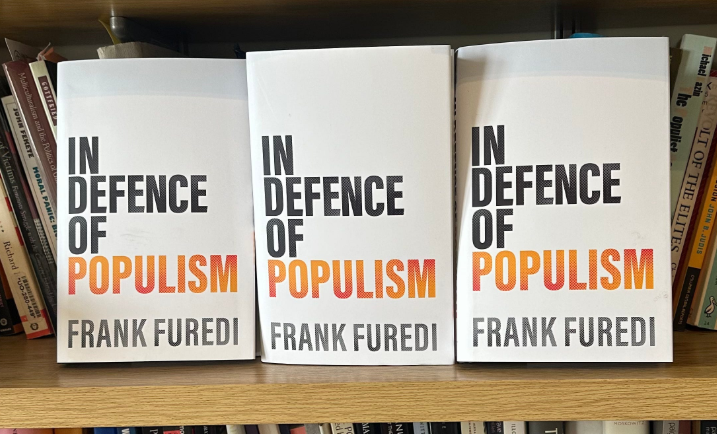
Photo from Roots & Wings with Frank Furedi
Have you noticed the flood of commentaries and articles appearing in the mainstream media dwelling on the topic of how to crush populism once and for all? The recent electoral defeat of Viktór Orbán’s Fidesz Party in Hungary has emboldened the European centrist technocratic elite to hope that this result spells the end of populist surge on both sides of the Atlantic.
The “is this the end of populism?” literature has been around for some time. To this day, mainstream commentators frequently express the hope that populism is a passing phenomenon. “Has Europe reached peak populism?”, asked a commentator in Politico in 2019, before expressing the hope that “the tide could be turning against the anti-establishment nationalist movements that have upended politics across the Continent, leaving the barbarians howling in frustration at the gates”.1 “We seem to have passed peak populism”, predicted Andrew Adonis, a leading British anti-Brexit voice.2
The outcome the Hungarian elections has led to an explosion of commentaries that are driven by the anti-populist dream of a world where populism is forced back into the margins of society. Polly Toynbee of The Guardian noted that “Viktor Orbán inspired rightwingers across the EU and in Britain. His defeat could represent a turning of the tide”.3
[…]
The main reason why I wrote In Defence of Populism is because it is necessary to counter the anti-populist hysteria about populism. Populism is surrounded by ceaseless hostility and mystification. Just about everything you are likely to read about populism in the specialist academic literature is motivated by their authors’ animosity and contempt towards their subject matter. Their sentiments are reproduced in an intensely polemical form by the mainstream media which habitually dismisses populists as far right and even fascists. According to the dominant media narrative, populists are racist xenophobes, homophobes and a variety of other phobes. At times the media hysteria regarding the so-called populist threat echoes the Red Scare of the 1920s and 1950s in the United States.
The populist voice has been systematically distorted by its opponents. I argue that this movement has been subjected to ideological warfare and recast through a teleology of evil. It is important to grasp the systematic attempt to demonise populism because, in the media and public life, a distorted and fundamentally flawed characterisation of populism prevails. What’s remarkable about this subject is that virtually everything that is communicated in the media and in the literature about populism is framed by individuals who are external to it. The definitions authored by these individuals communicate their bias and suspicion towards populism. Consequently, the way that populism is represented in public life is an invention of its opponents. Those who are ascribed the label populist do not get to decide who they are nor what populism means.
So although the populist movement is in the ascendancy, its actual definition is still unresolved and remains interpreted though the medium of a modern mythology. Almost everything you are likely to read about contemporary populism bears little relationship to the real impulses that drive this movement forward. In Defence of Populism offers an antidote to the confusions and distortions peddled by the anti-populist idealogues. I look forward to getting your feedback regarding what you think about the case for populism advanced in my book.
- Paul Taylor, “Has Europe reached peak populism?”, Politico, 5 September 2019 https://www.politico.eu/article/europe-reached-peak-populism-far-right-anti-european-government-election/
- Andrew Adonis, “We seem to have passed peak populism”, Prospect, 11 January 2023 https://www.prospectmagazine.co.uk/politics/peak-populism-donald-trump-boris-johnson-jair-bolsonaro
- https://www.theguardian.com/commentisfree/2026/apr/14/viktor-orban-europe-britain-hard-right-populism
April 24, 2026
Defending Heinlein and his most controversial novel – Farnham’s Freehold
Grammaticus Books
Published 21 Nov 2025An indepth review of Robert A. Heinlein’s most controversial novel. A novel sometimes referred to as Science Fiction’s most controversial novel, Farnham’s Freehold.
00:00 Intro
02:30 Why I Read Farnham’s Freehold
04:33 The Plot (Spoilers)
12:48 The Critics’ Complaints
21:40 Is it A Fun Read?My Video on Time Enough for Love:
• Heinlein’s MOST CONTROVERSIAL Novel – Time…
Update, 25 April: Welcome, Instapundit readers! Have a look around at some of my other posts you may find of interest. I send out a daily summary of posts here through my Substack – https://substack.com/@nicholasrusson that you can subscribe to if you’d like to be informed of new posts in the future.
April 21, 2026
QotD: “Bibliophiles are massive losers, why can’t we just admit that?”
I don’t buy it. I bet billionaires don’t read at all. Not only because they don’t have the time, but because every big reader I know is broke. Without exception, books have overloaded their minds, and their lives are in total disarray. When they’re not consumed by tortuous examinations of Socialist Realism in the shallower subsections of the Baltic Canal between late October 1933 and early March 1934, they’re deconstructing turgid translations of 9th Century Glagolitic poetry from the White Carpathian territories of Great Moravia. On weekends, for light relief, they dip into obscure anthologies of critically-acclaimed feminist speculative fiction championing unsung writers born in the shadow of the Chappal Waddi in the Mambilla Plateau. What should have been their office hours are spent haggling with elderly volunteers in Oxfam bookshops over worthless, dogeared volumes of Dietrich Bonhoeffer’s early letters or needlessly exhaustive histories of the Sepoy Mutiny of 1857 in the Ganges-Brahmaputra basin. They own vast stacks of surplus, dust-magnet books, but they never own art, or cars, or houses. Bibliophiles are massive losers — why can’t we just admit that? There’s a clear correlation between reading and underachievement. There’s a reason homeless vagabonds line their coat pockets with paperbacks and newspapers. Our children must be warned, before it happens to them.
Reading is even less helpful to writers. If you write, you are incurably influenced by whatever garbage you happen to be reading at the time. For example, if I’m reading Hemingway, I finish this sentence here. Whereas, in the rare, transcending moments that I am reading, say, Henry James, I find, to my eternal chagrin, that I write — if, indeed, “write” is the morpheme, or mot juste, for which I rightly delve — in my lasting endeavours — my contention, if you will, against the ordained — in a spirit of refined demonstration, or braggadocio, as the case may be, that … Where was I?
Then, of course, there’s the snobbery associated with reading. “Read a book!” command the enlightened few, should you dare disagree with them on any trendy subject. It’s ridiculous, but if you read — or, better still, opine pretentiously about what you read — the chattering classes will clamber to pressgang you into their fanatical ranks. Nobody cares if you write anything, so long as you describe the latest high-status books as “vital”, “necessary”, “required”, or “essential”. Trust me, you can get away for years with pretending that you are “working on something big that I’d rather not talk about for fear of jinxing it” while freely enjoying all the wine and canapes you can stomach. But suggest you don’t read, and people quickly get suspicious.
Dominic Hilton, “All Booked Up”, The Critic, 2020-08-17.
April 16, 2026
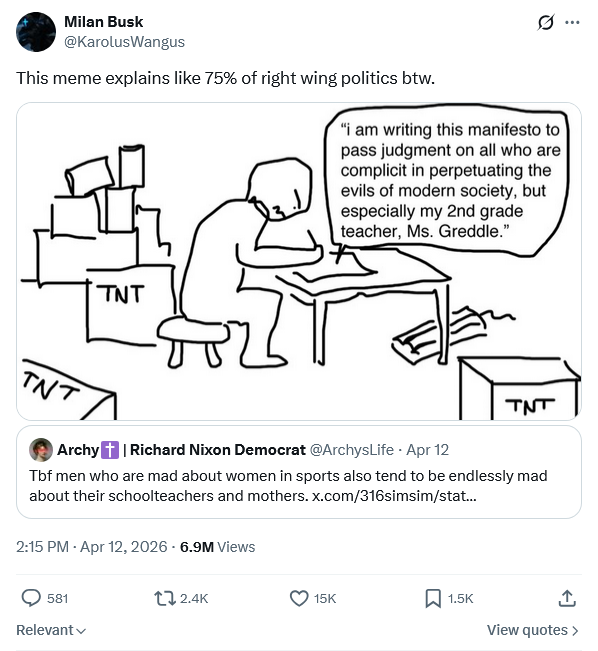
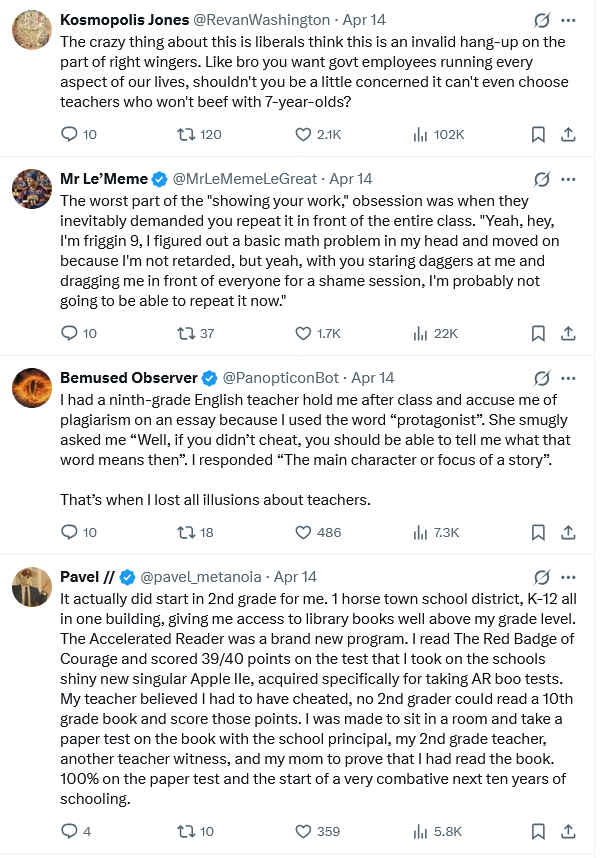
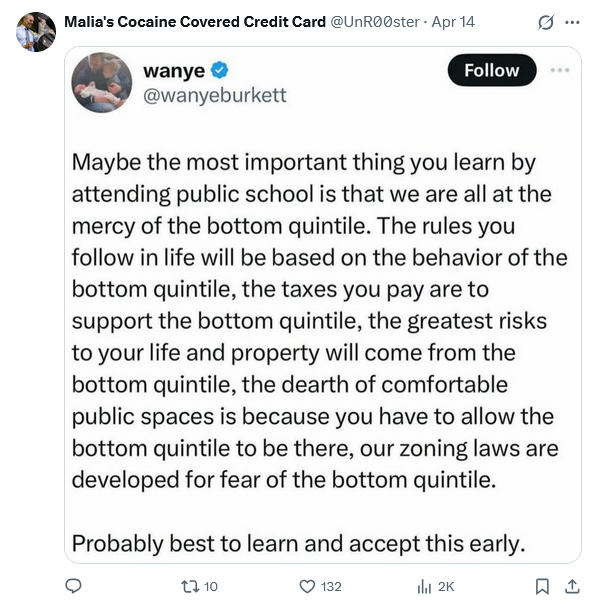
Never say that teachers have no influence
Of course, that influence isn’t always benign:
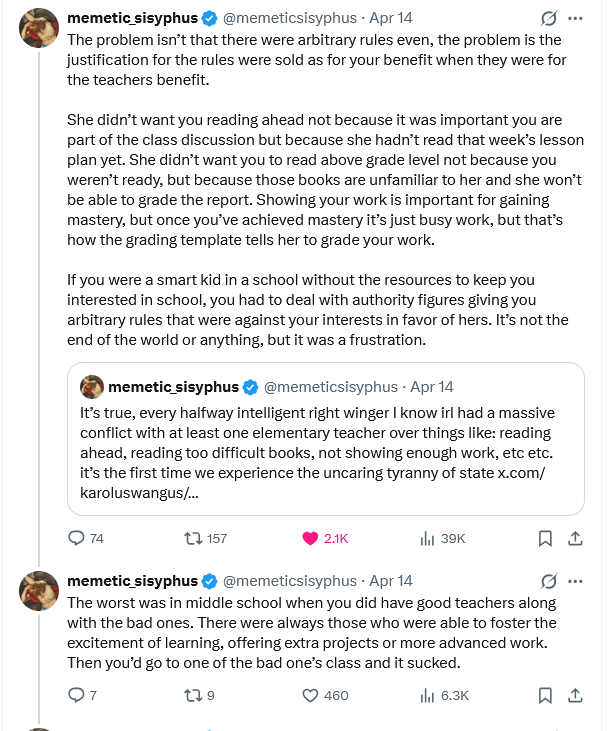
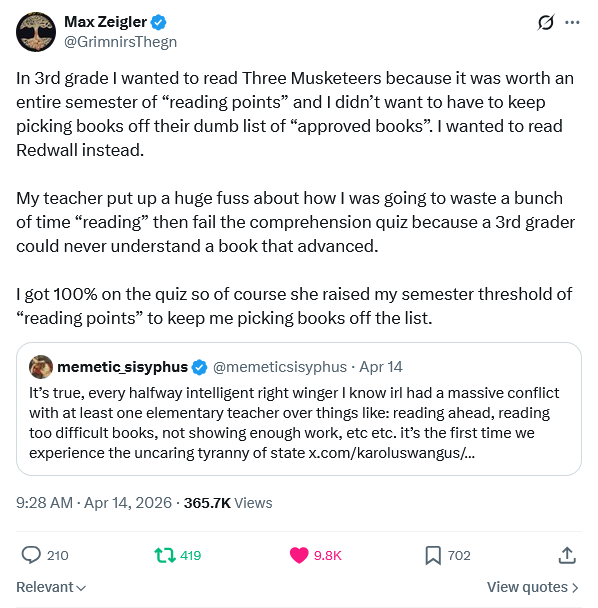
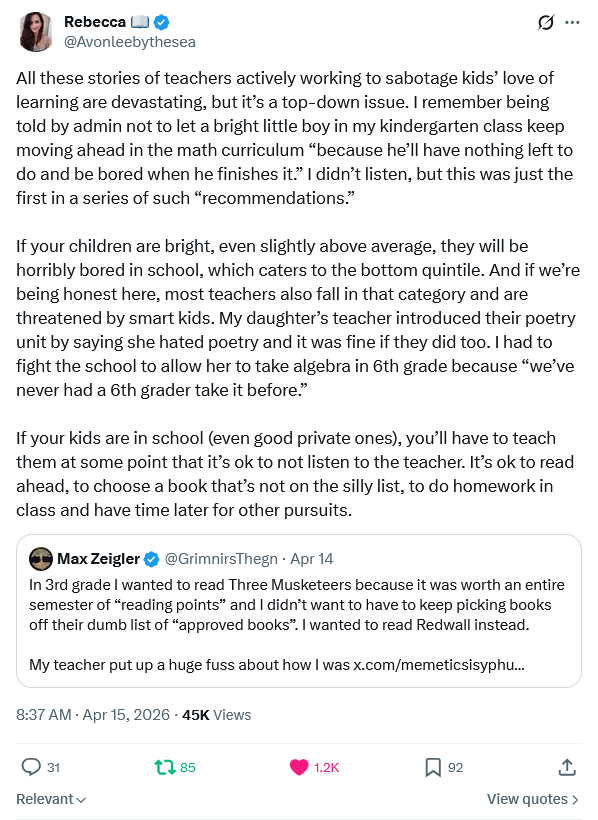
It’s true, every halfway intelligent right winger I know irl had a massive conflict with at least one elementary teacher over things like: reading ahead, reading too difficult books, not showing enough work, etc etc. it’s the first time we experience the uncaring tyranny of state bureaucracy and it sucks.
April 14, 2026
QotD: Holden Caulfield
Anyway, the point is, you name your kid “Holden” and what can you expect? The Catcher in the Rye is the greatest dickhead-identification device known to man. Even pretentious little snots in desperate need of a beating — I speak from experience here — think Holden Caulfield was a pretentious little snot in desperate need of a beating. It’s a 100% true scientific fact that the only people who liked The Catcher in the Rye are so repulsive to ordinary humans that they have no choice but to become high school English teachers, or go to work for the Washington Post.
I even once got linked on a site called “Kiwi Farms”, that seems to consist of nothing but Internet People making fun of other Internet People, and they all agreed with me (also with my interpretation of MTV’s Daria as “the female Holden Caulfield”, although that show took the piss out of itself more than once, and had actual human affection for its characters, and thus was actually pretty good (although of course serving the Catcher-esque function of mate sorting — if you met a girl who identified with it, run far far far away). I know, I know … MTV. And late-90s MTV, too, the guys who gave us both The Real World and Road Rules. Yeah, I’m scared too).
Anyway, though I think The Catcher in the Rye is the worst book ever written, and anyone who liked it should be beaten with the entire Jack Reacher series until their serum testosterone raises at least 300 points or whatever, I’m willing to hear other opinions: Is there in fact a worse book? Not in terms of writing etc. — even I have to admit that it’s not technically bad — but in terms of influence?
Severian, “Alt Thread: Worst Books Ever”, Founding Questions, 2022-06-10.
April 13, 2026
Should you read The Iliad or Odyssey first? (The Epic Cycle EXPLAINED)
MoAn Inc.
Published 11 Dec 2025This video was filmed in July of 2025. I wasn’t going to upload it due to the weird not-really-focused-but-also-kinda-focused-thing my phone camera was clearly going through, but decided I didn’t care that much because the content itself was fine
#AncientGreece #GreekMythology #TrojanWar
April 10, 2026
QotD: William Cobbett
Cobbett was a scrapper on the same majestic scale as our Henry V and our Horatio, except he dished it out to Vested Interest rather than Jean-Pierre Foreigner. He is the faded star of the British Awkward Squad (Capt. Jon. Swift; Vice Capt. Geo. Orwell) and he needs a boost. He needs a blue plaque on every place he ever visited. In his long life — he was born in 1763 and died in 1835 — Cobbett was a farmer, Tory, soldier, Radical, MP, agony uncle (his books include Advice to Young Men), and the founder of Hansard.
His obituary in The Times, after categorising him as a “self-taught peasant”, declared Cobbett “by far the most voluminous writer that has ever lived for centuries”. The funniest, too: when some town council somewhere banned his anti-Malthusian play Surplus Population, he riposted with a drama entitled Bastards in High Places.
Above all, though, Cobbett was the champion of the rural poor, the village labourer and the small farmer. He was their one true tribune. He spoke at The King’s Head in 1820 because country folk were suffering a triple wham from agricultural depression, enclosure and the rise of agri-business. Or, to precis, “Hodge” (his name for the generic farm worker) was low-waged or unwaged and deprived of the bits of land he had once enjoyed under commoner’s rights.
Cobbett railed against “The Thing” (the capitalist, manufactory system) and the centrifugal, corrupting force of smoky London (“The Wen”, in Cobbettian). But he was no bloviator: he was a farm boy, and hence entirely empirical and properly pragmatic. He spent a decade travelling around the English sticks to discover the true state of affairs. His descriptions of his horseback journeys were published in 1830 as Rural Rides, the first sociological study of the English countryside.
No dry-as-dust tome by the way, the Rides: it brims with pinned-to-the-specimen-board descriptions of people and places, nature, wit. Cobbett knew beauty and, the proper Englishman that he was, he loved horses:
The finest sight in England is a stage coach ready to start. A great sheep or cattle fair is a beautiful sight; but in the stage coach you see more of what man is capable of performing. The vehicle itself, the harness, all so complete and so neatly arranged; so strong and clean and good. The beautiful horses, impatient to be off. The inside full and the outside covered, in every part with men, women, children, boxes, bags, bundles. The coachman taking his reins in hand and his whip in the other, gives a signal with his foot, and away go, at the rate of seven miles an hour.
One of these coaches coming in, after a long journey is a sight not less interesting. The horses are now all sweat and foam, the reek from their bodies ascending like a cloud. The whole equipage is covered perhaps with dust and dirt. But still, on it comes as steady as the hands on a clock.
Speaking at The King’s Head coaching inn in Monmouth must have been the dream gig for Cobbett the horseman.
John Lewis-Stempel, “Why Britain needs a peasants’ revolt”, UnHerd, 2020-08-06.
April 8, 2026
QotD: Without You, There is No Us, by Suki Kim
Also note the passages about Her Relationship. That’s how she refers to the poor bastard. It’s something along those lines, I forget — maybe it’s “My Ex” — but either way, he never even gets the goddamn common courtesy of being referred to by name … because to Mx. Kim, he really doesn’t have one. He’s just another interchangeable character in the all-encompassing soap opera that is her life.
Severian, “Recommended Reading”, Founding Questions, 2022-06-09.
April 6, 2026
QotD: Taylorism
Taylor was unpopular in his own day and is even less popular today, because his particular brand of optimization of the great living machine was all about stripping autonomy (or as Marx would say, “control and conscious direction“) from workers. But the particular kind of optimization he advocated is less important than the conceptual breakthrough that while a nail factory and a car factory might look very different on the surface, they are both governed by the same set of abstract laws: laws of time and motion, concurrency, bottlenecks, worker motivation and so on. A master of those laws could optimize a nail factory, and then go on to optimize a car factory, and could do both without knowing very much at all about nails or cars.
Who could have a problem with that? Even I don’t think it’s entirely wrong — I may have misgivings about the sheer volume of people going into fields like management consulting, but I’ll admit that there remains alpha in asking a smart and incisive outsider to take a look at your operation and tell you what seems crazy. The trouble comes with confusing that sporadic, occasional sanity-check with the actual business of leading a team of people who are working together to achieve an objective. Because, get this, it’s impossible to lead such a team without a deep understanding of the details of every person’s tasks.
It’s surreal to me that this point has to be made, yet somehow it does. If the team you lead makes nails, you need to know everything there is to know about making nails. If the team you lead operates a restaurant, you need to be an expert, not in “management”, but in restaurants. If the team you lead sells mortgage-backed derivatives, you better know a heck of a lot about finance in general, mortgages in particular, the art of sales, and the specific world of selling financial instruments. There are a thousand reasons why this is true, but consider just one: a subordinate is failing at a task, and tells you that it isn’t because he’s lazy or unqualified but because the task is unexpectedly difficult. How on earth can a manager evaluate this claim without being able to do the job himself?
There’s another, very different reason managers need to be experts in whatever it is their team is doing, and it has to do with morale. A subordinate in any sort of hierarchical organization needs to see that his superior can do his own job as well or better than he can. Almost everybody gets this. In a high-pressure commercial kitchen, if a chef or sous-chef doesn’t like the performance of one of their line cooks, they will often leap in, take over that cook’s station, and begin “expediting.” This has a dual purpose: it both relieves a genuine production bottleneck, and also acts as a showy demonstration of prowess, reminding everybody that they got to be the boss through excellence. At the better tech companies, those managing software engineers are always former engineers themselves, and often the very best of the lot. Just like a chef would do, an engineering manager needs to be able to seize a computer and begin expediting under pressure, both to solve a real problem and as a dominance display. But it’s not just about keeping the troops in line, it’s about inspiring them. Nothing motivates a soldier like seeing his commander leading the charge, weapon in hand.1
John Psmith, “REVIEW: Scaling People by Claire Hughes Johnson”, Mr. and Mrs. Psmith’s Bookshelf, 2023-08-28.
- This shows up in places you wouldn’t expect to. I was once cast in a show, and quickly came to understand that our director could (and often did) leap onto the stage, snatch a script out of somebody’s hand, and play their part better than they could. For any part. Before he did this to me, I found him annoying and bossy. Afterwards, I would follow him into the Somme.
Update, 7 April: Welcome, Instapundit readers! Have a look around at some of my other posts you may find of interest. I send out a daily summary of posts here through my Substack – https://substack.com/@nicholasrusson that you can subscribe to if you’d like to be informed of new posts in the future.
April 5, 2026
“Easter remains one of the major annual high holy days of confectionery derangement”
At The Freeman, Nicole James remembers her early chocolate obsessions:

Roald Dahl’s chocolate river was the economic policy of my childhood. Dripping with glossy abundance, and available to any enterprising glutton with a low sense of self-preservation. I never looked at Augustus Gloop and thought, “There goes a cautionary tale about excess”. I thought, “There goes a boy with initiative”. I wanted the river. I wanted the factory. I wanted an Oompa Loompa or two, ideally unionized and living in a tasteful outbuilding, making me truffles on demand. I wanted a world in which everything was edible and slightly mad. While everyone else was apparently learning moral lessons, I was busy fantasizing about a life in which I could plunge both arms into a molten tributary of cacao and come up glistening, like some sort of deranged dessert otter.
Easter seemed to offer the nearest thing to this ideal. It was the one annual moment when adults, in a dramatic collapse of judgment, agreed that children should be handed industrial quantities of wrapped chocolate and told to go hard. Easter had tiny eggs hidden in pot plants and larger ones with enough packaging to survive atmospheric re-entry. It was capitalism in a bunny suit.
Then adulthood arrived, lugging excellent literary references. Along came Like Water for Chocolate, with its sexy sorrow and culinary melodrama, and suddenly chocolate was not just a childhood frenzy but a vehicle for yearning and seduction. It could communicate things one would never dream of saying aloud at a suburban dinner party. Chocolate had range.
And this is why the present state of it feels so personally offensive because what is happening to chocolate is a slow-motion mugging. Cocoa is being shaved out. Bars are shrinking. Prices are soaring. Palm oil and vegetable fats are barging into flavor. Chocolate flavor. Not real chocolate, but a cheap mockery of the original deity.
And yet Easter remains one of the major annual high holy days of confectionery derangement. According to Cargill, in the United States, people are expected to plough through around 73 million pounds of chocolate over the Easter season. Around 90 million chocolate bunnies are produced, with — fun fact — 78% being devoured from the ears first.
Easter spending in the US has in recent years hovered around the $23 billion mark, with candy doing much of the heavy lifting. Chocolate, marshmallow Peeps, baskets, flowers, brunches, the whole pastel circus. Christianity may supply the headline act, but the event itself has clearly been workshopped by a mall.
But beneath the cellophane gaiety lies an increasingly grubby truth. Cocoa prices have surged, largely because harvests in West Africa have been hammered. Ghana and Côte d’Ivoire, which together produce the bulk of the world’s cocoa, have been clobbered by poor weather, crop disease, supply chain fragility, deforestation, and the sort of labor abuses that make any cheerful Easter ad feel criminal. The global appetite for chocolate remains immense, but the cacao tree itself is having a nervous collapse.
Update, 19 April: To the surprise of many who’ve latched on to the “woe, woe, mankind bad” chorus, there are now reports of a bumper crop of cocoa and the market prices are dropping:
It all seemed to kick off in March 2024 with the BBC’s chief climate headbanger Justin Rowlatt noting that “climate change” was one of the reasons for chocolate Easter eggs getting more expensive. Experts are said to have claimed that “human-induced” climate change had made extreme heat “10 times more likely” in the main cocoa bean-growing areas of West Africa. The story has had excellent fearmongering legs with a couple of years of bad weather-related harvests sending the world price of cocoa soaring. As late as October last year, the New York Times was stating that higher cocoa prices pushed up by climate change had led to companies changing their chocolate confectionary concoctions. Alas, sadly missing in recent chocolate climate claptrap is that an improved recent harvest (no weather-adjusting humans thought to be involved) has led to a massive 75% slump in global cocoa prices from the peak reached in January last year.
Like coral, polar bears and Arctic ice, any narrative-disturbing news is ignored. The media barkers promoting the Net Zero fantasy simply move onto the next promising climate porn project that can be ramped up to Armageddon level. The Great Choccy Catastrophe is a classic of its kind, but it is just the latest in a long and increasingly tedious line of crying wolf climate tantrums.
[…]
They get a lot of weather in the tropics, particularly in countries like Ivory Coast which accounts for up to 45% of world cocoa bean production. Dry periods alternate with wetter conditions, and there is some short-term variability in decadal temperatures. But according to World Bank climate figures, the average temperature since 1900 has risen just 1°C, while rainfall totals have remained remarkably stable. The average annual total since 1900 is around 1,354 mm. This is nearly identical to the 1,283 mm recorded in 2023, and similar to the 1,239 mm that fell in the supposedly drought conditions in 2024. Neighbouring Ghana is the world’s second largest cocoa producer and its 125 year precipitation average is 1,236 mm. This is a little higher than the 2024 ‘drought’ total of 1,181 mm, and a tad lower than the 1,278 mm in 2023.
The tropics have provided good pickings for climate and Net Zero agitators. Temperatures and rainfall can vary widely over individual years and decades. For instance, Ghana had record low rainfall in 1983 of 851 mm compared with a record high of 1,775 mm in 1968. As we have repeatedly seen over the last few years, any departure from the norm becomes the basis for a politicised junk science prediction that the climate is in crisis.
April 1, 2026
The fall of Rome and the rise of Islam
Gustavo Jalife points out that a work from nearly a century ago identified the rise of Islam as being far more disruptive to western civilization than the fall of the western Roman Empire (and the surge of Islamic power destroyed the Persian Empire and nearly toppled Constantinople as well):
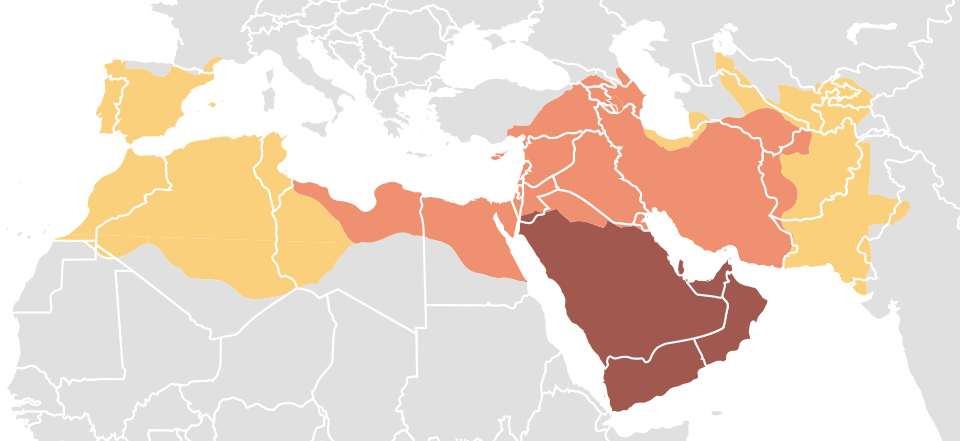
Expansion of the Caliphate: Mohammed, 622-632 (red), Rashidun Caliphate, 632-661 (orange), and the Umayyad Caliphate, 661-750 (yellow).
Wikimedia Commons.
In Mohammed and Charlemagne – posthumously published in 1937 – renowned historian Henri Pirenne (1862-1935) advanced a thesis at once simple and much contested: that the true rupture between Late Antiquity and the beginning of the Middle Ages was not the fall of Rome in the fifth century, as traditionally held, but the expansion of Islam in the seventh. The Germanic kingdoms, he argued, had preserved much of the Roman economic and cultural architecture. Trade across the Mediterranean continued; cities, though diminished, remained nodes in a wider network sustained by the circulation of goods and by administration. For the Romans, the mare nostrum was a highway rather than a barrier.
If a good article starts after it ends, one might say that a civilisation reveals itself most clearly not in its proclamations, but in the modification of its habits – when what was once assumed becomes contested. In such subtle alterations, Pirenne discerned the end of the ancient world.
With the Islamic expansion the greater part of the Mediterranean’s southern and eastern shores fell under Muslim control, from the Levant and Egypt to North Africa and the Iberian Peninsula. The sea was no longer a unified Roman basin, but a divided one. Authority and function shifted: the Mediterranean ceased to operate as a shared commercial zone. Long-distance trade dwindled, the flow of goods between East and West was disrupted and with it the urban and monetary life that depended upon it. Only then did Western Europe withdraw inward, shrinking into the medieval world as it is recognised today.
The argument has been debated, qualified, and revised. Yet its inner core endures: civilisations are sustained not merely by armies or laws, but by the invisible fibres of exchange – commercial, intellectual and cultural – that bind their parts together. Sever those threads and, without even the cut of a sword, a whole order may vanish into a rumour.
To draw a parallel with present-day Europe is to tread on disputed ground. The language of “invasion” is often employed with more heat than light; yet to deny that significant demographic and cultural changes are under way would be equally unhelpful. The question, then, is whether Pirenne’s model can illuminate what many believe is a tragedy without reducing it to a farce.
The spread of Islam in the seventh and eighth centuries was a series of military conquests. The Arab fleets that took North Africa and Spain, the armies that crossed into Gaul, and the long struggle for control of the Mediterranean were enterprises of war and empire. Contemporary migration into Europe, by contrast, occurs largely through civilian movement, legal and illegal. However, both historical processes demonstrate that massive migratory movements, whatever their specific nature, do not merely add numbers to a population; they introduce new networks, new loyalties, new values and new norms that eventually fracture the existing state of affairs.
Before the eighth century, the Mediterranean economy continues to function, vibrant and connected. After the eighth century, that system is shattered. The sea is closed. Trade disappears. Europe faces an empire whose only wealth is the land, where the movement of goods is reduced to a bare minimum. Far from advancing, society regresses.
Pirenne’s thesis gains thrust and edge in presenting the Islamic expansion as embodying a fundamental alteration in coexistence.
March 28, 2026
QotD: The moment the American empire began to decline
The second story comes from an anonymous source who described to Michael Mazarr, the author of this book, the basic occupation strategy that the National Security Council was settling on. The concept was that once you “cut off the head” of the Iraqi government, you would witness a “rapid and inevitable march toward Jeffersonian democracy”. What I find amazing about this is that nobody even stopped to think about the metaphor — how many things march rapidly and decisively after being decapitated?
I am of the exact right age for the Iraq War to be the formative event of my political identity.2 But even if that hadn’t been true, it still feels like the most consequential geopolitical event of my life. The United States spent trillions of dollars and caused the deaths of somewhere between half a million and a million people in Iraq alone. The goal of this was “regional transformation”, and we transformed the region all right. The war destabilized several neighboring regimes, which led them to collapse into anarchy and civil war. Consequences of that included millions more deaths and the near extinction of Christianity in the place it came from.
As an American, I didn’t feel any of this directly,3 but with the benefit of hindsight the war looks even more epochal for us. It marks, in so many ways, the turning point from our decades of unchallenged global supremacy to the current headlong charge into “multipolarity”. I know this may sound melodramatic, but I truly believe future historians will point to it as the moment that we squandered our empire. Remember, hegemonic empires work best when nobody thinks they’re an empire. True strength is not the ability to enforce your commands, it’s everybody being so desperate to please you that they spend all their time figuring out what you want, such that you don’t even have to issue edicts.
Between the fall of the Soviet Union and the Iraq War, American global dominance was so unquestioned we didn’t even have to swat down any challengers. This is a very good position for an empire to be in, because it means you don’t run the risk of blunders or surprise upset victories that make you look weak and encourage others to take a chance. Conversely, there’s a negative spiral where the hegemon has to start making demands of its clients, which makes the clients resentful and uncooperative, which in turn means that they have to be told what to do. All of this makes the hegemon-client relationship start to look less like a good “deal” and more purely extractive, which can rapidly lead the whole system to fall apart.
Iraq was the moment the American empire went into this negative cycle.
Even if you don’t agree with me about that, presumably you will agree that it was very bad for American soft power and prestige, bad for a number of friendly regimes in the area, and bad for our finances and our military readiness. So to anybody curious about the world, it seems very important to ask why we did this, why we thought it was a good idea, and how nobody predicted the ensuing debacle that seems so obvious in hindsight.
The conventional answers to these questions tend to be either “George W. Bush was dumb” or “Dick Cheney was evil”. I totally reject these as answers. Or I think at best they’re seriously incomplete: if the first Trump administration taught us anything, it’s that the US President can’t actually do very much on his own if the bureaucracy is set against him. The United States is an oligarchy, a kind of surface democracy; big decisions don’t happen without a lot of buy-in from a lot of people. More to the point, the decision to invade Iraq actually was endorsed and supported by pretty much every important politician and every institution, including the whole mainstream media and most of the Democratic Party. Blaming it on a single bad administration is too easy. It’s an excuse designed to avoid asking hard questions about how organizations filled with well-meaning people can go totally off the rails
Fortunately, Michael Mazarr has written the definitive4 book on this very question. It’s not a history of the Iraq War and occupation: it’s a history of the decision to invade Iraq, ending shortly after the tanks went steaming across the border. It’s an exhaustively-researched doorstopper composed out of hundreds and hundreds of interviews with officials working in the innards of the White House and of various federal bureaucracies and spy agencies, all aimed at answering a single question: “What were they thinking?”
John Psmith, “REVIEW: Leap of Faith, by Michael J. Mazarr”, Mr. and Mrs. Psmith’s Bookshelf, 2025-06-30.
- Those plans were provided by the Russians, who prior to multiple rounds of NATO expansion were our allies.
- Given that almost everybody in the US mainstream, both Democrats and Republicans, were for it, this probably explains a lot about how I turned out.
- Sure, maybe someday we’ll have a fiscal crisis, but the incredible thing about America is that all the money wasted in Iraq still won’t be in the top 5 reasons for it. >
- “Definitive” is publisher-speak for “very, very long.”
March 27, 2026
The Greatest Scoundrel Story Ever Written
Lotuseaters Dot Com
Published 29 Nov 2025Luca is joined by Dan to discuss Flashman by George MacDonald Fraser. They explore Fraser’s skill in writing historical fiction, the genius of the Harry Flashman character, and the sheer hilarity of the novel’s dark humour.


