Quotulatiousness

August 29, 2023

The Souls of Black Folk by W.E.B. Du Bois “runs so fantastically counter to the entire ideology of ‘decolonise'”

Filed under: Books, Britain, Education, History, Liberty, USA — Tags: , , , , — Nicholas @ 09:10

In Spiked, Brendan O’Neill finds himself surprised at the inclusion of a very unusual book on a list demanded by those pushing for “decolonization” of university curricula:

W.E.B. Du Bois by James E. Purdy, 1907, gelatin silver print, from the National Portrait Gallery which has explicitly released this digital image under the CC0 license.
Wikimedia Commons.

“Decolonise the curriculum” is a movement that wants university courses to focus less on dead white European males and more on writers of colour. Its argument is that black students need texts that speak directly to them. They need books by authors who look like them. They need books about experiences and ideas they can more readily relate to than they can the stuff written about in “high white culture”. Black students must be able to recognise themselves in what they study, we’re told, or else they’ll feel cheated and demeaned.

I was surprised to find that one of the leading decolonise movements, at the University of Edinburgh, was arguing for WEB Du Bois’ 1903 book, The Souls of Black Folk, to be included on the English curriculum. The activists said it was unreasonable to expect black students to engage with so many white authors. They also need to engage with people like Du Bois, in whose work they might “recognise themselves”. I was surprised, not because I think The Souls of Black Folk shouldn’t be on more university courses – absolutely it should. No, it’s because The Souls of Black Folk runs so fantastically counter to the entire ideology of “decolonise”. It made me wonder if these activists have even read it. Du Bois’ book contains some of the finest arguments you will ever read against the idea that high culture is a white thing that others cannot connect with.

One of my favourite passages in the book, from the chapter on what kind of education black men are fit for, touches on this very question. Here Du Bois makes his critique of those in his own time who were arguing that blacks only require basic education and industrial training. He describes his own experience of higher learning, writing:

    I sit with Shakespeare and he winces not. Across the colour line I move arm in arm with Balzac and Dumas … From out the caves of evening that swing between the strong-limbed earth and the tracery of the stars, I summon Aristotle and Aurelius and they come all graciously with no scorn or condescension.

That passage, Du Bois’ moving belief that Shakespeare does not wince at him, captures a central thread of his writing: universalism. Du Bois agitates against accommodating to segregation or low expectations, and argues for the rights of “black folk” to assimilate into the spoils of civilisation; to become, as he puts it, “co-workers in the kingdom of culture”. To those in the late 1800s and early 1900s who argued that black people needed a targeted form of culture, one specific to their needs and capacities, Du Bois said: “We daily hear that an education that encourages aspiration, that sets the loftiest of ideals and seeks as an end culture and character rather than breadwinning, is the privilege of white men, and the danger and delusion of black men.”

Du Bois insisted that it is only through assimilation into the “kingdom of culture” that self-knowledge and self-improvement can truly occur. As he wrote: “Wed with Truth, I dwell above the veil.” The veil he’s referring to is the veil of colour, the one that separated blacks from whites in post-slavery America. For Du Bois, that veil was best lifted via assimilation into the American republic’s political universe and its realm of culture.

Du Bois’ critique of the notion that high culture was for white men, and would prove mystifying to black men, has sadly been superseded by an “anti-racism” with an entirely different outlook. Now, the supposedly radical stance is to believe that high culture is disorientating for black people, and possibly even damaging to their self-esteem, and therefore they require something more targeted. In short, they need release from the kingdom of culture. That, in essence, is what the decolonise movement desires: the “liberation” of non-white peoples from the cultural gains of Western civilisation. Behold the crisis of universalist belief.

August 28, 2023

QotD: Progressives don’t have collections, but they may have fetish objects

Filed under: Education, Politics, Quotations, USA — Tags: , , , , , — Nicholas @ 01:00

The reason SJWs are so hung up on “capitalism” is, as we’ve seen, they regard it as something very like an addiction. Specifically, like sex addiction — we “capitalists” are compelled to accumulate new, different, better, more-for-more’s-sake, though the acquisition is harmful to both ourselves and society. Ever known a Leftist with a collection? Coins, stamps, baseball cards, anything? It’s 100 to 1 that you don’t, because Leftists aren’t wired like that.

Leftists put their entire lives on display at all times. They might have some knickknacks or mementos (though it’s shocking how few of them have even that), but they’re all for show — if a Leftist ever had a baseball card, it would be framed and displayed in the center [of] xzhyr apartment’s living room, and would have something to do with the player’s politics (the only openly gay player on the Yankees or something). The collector’s joys are unknown to them, because the collector collects for personal reasons. Collectors often can’t wait to show you their collections, of course, and they can be godawful tedious about it, but — pace the Left — they aren’t showing you to brag about it; they’re showing you because you’re their friend, and they assume you’re interested in what interests them.

[…]

SJWs always project, right? They know better than anyone that money can’t buy you happiness, because SJW-ism is strictly an upper-middle-class pursuit. They have all the stuff in the world, and they’re miserable. Look at the ivory tower. I hate to keep beating this dead horse, but it’s really the best example I can think of. Those people are “the 1%” by any measure that makes sense. They have everything. They work 24/7 — that’s “24 hours a week, 7 months a year” — and get comped, on average, nearly $100K for it. You can always tell which one is the faculty parking lot — no make cheaper than Volvo; no model year earlier than 2017. The houses in the faculty ghetto tend to be physically small, it’s true, but that’s because they’re all restored Victorians — go ahead and cost out what it takes to fully restore one of those puppies, and contemplate a lifetime of pauperism.

Commodity fetishism? In spades, kameraden, and we haven’t even gotten to the “lifestyle” stuff yet. Organic food — tiny little bananas from Trader Joe’s that wouldn’t feed a pygmy marmoset, but cost $4 per pound. Hot yoga lessons — $100 per hour. Eat-pray-loving your way across Indonesia — I can’t even begin to calculate it. SJWs live niiiice; way too nice for us deplorables to afford, filthy “capitalists” that we are.

Severian, “Junkies (II)”, Rotten Chestnuts, 2021-01-18.

August 26, 2023

“Email jobs”, as defined by Freddie deBoer

Filed under: Bureaucracy, Business, Government, USA — Tags: , , , — Nicholas @ 04:00

Freddie deBoer offers some notes on what he calls “a book I’ll probably never write”:

When I talk to people about college-educated workers, even informed people, there’s a constant tendency to immediately think of doctors, lawyers, engineers, data scientists … Reflexively, people seem to think of educated labor in terms of college graduates who a) tend to go on to some sort of graduate study, b) work in fields that directly utilize domain-specific knowledge from their majors or graduate education, and c) are generally high-income relative to the economy writ large. These professions, combined, are a healthy slice of our labor force, and there’s nothing wrong with paying an appropriate amount of attention to them. But I think the amount of attention they’re given in the educational and economic discourse is in fact disproportionate. And I also think that there’s a kind of profession that is intuitively very understandable but which (despite considerable effort on my part) remains very difficult to classify and thus to quantify. Though it has many names, I think my preferred term is “email job”.

[…]

To me, prototypical email jobs

  • Depend, naturally, on email and other digital communicative tools like video conferencing, online calendars, and networked workspaces for the large majority of their actual productive capability
  • Are staffed almost entirely by people with college degrees, but while they do take advantage of time management and organizational skills that can be developed in college, almost never call on domain-specific knowledge related to a particular major
  • Dedicate a considerable amount of time not to the named productive goals of the job themselves but to meta-tasks that are meant to facilitate those goals (scheduling, coordinating, assigning responsibility, “touching base”, enhancing productivity, ensuring compliance with various HR-mediated job requirements and odd whims of the boss)
  • Have no immediate observable impact on the material world; an email job might involve coordinating or supporting or assessing a project that will eventually move some atoms around, but the email job itself results only in the manipulation of bits
  • Cannot be considered creative in any meaningful sense — they do not entail the production of new stories, scripts, code, images, video, blueprints, patents, research papers, etc — but may involve the creation of materials that are subsidiary to larger administrative goals, such as PowerPoint presentations, reports, postmortems, or white papers
  • May or may not be partially or fully remote but could likely be performed fully remotely/on a “work from home” basis without issue
  • Can involve supervising lower-level workers, even teams, but these positions are not themselves fundamentally supervisory and the holder of an email job is rarely the only “report” for anyone; these positions, in other words, are not executive or executive-track, though some may escape the email job track and gain entry to the executive track
  • Tend to top out at middle management, and often have a salary range (with a great deal of wiggle) between $50,000 and $200,000/year.

Doctors do not have email jobs because the human bodies they treat exist in the world of atoms, not the world of bits, and their work involves domain-specific knowledge. There are some lawyers who are effectively in email jobs, as their law credentials are used for hiring purposes but their actual task is handling particular kinds of paperwork that a non-lawyer could complete, but most lawyers are not in email jobs as their work involves various functions at courthouses and otherwise away from the computer, and anyway their work too involves domain-specific knowledge. Most accountants and actuaries are not in email jobs as their jobs require domain-specific knowledge that they acquired in formal education. Architects create new things that will someday exist in the world of atoms and utilize domain-specific knowledge they learned in college. Programmers take advantage of skills gained in college to create new things that exist for their own purpose, rather than to satisfy other administrative functions. Professors don’t have email jobs, even those who work at online colleges, as working with students takes place in the world of atoms and they are constantly accessing domain-specific knowledge they learned in formal education. Screenwriters create something new; engineers move atoms and usually get graduate degrees; CEOs don’t have email jobs because they’re on the executive track and enjoy the ability to delegate most of the email work to subordinates. I could go on.

So who does have an email job? Take someone who works in accreditation at a college in a large public university system. He or she didn’t get a major in accreditation (there is no such major) and is unlikely to have majored in education, and even if they did they would have learned about pedagogy and “theory” and assessment rather than anything having to do with their daily work lives. Essentially everything they do for work takes place within the confines of their laptop screen, and the exception is various in-person meetings that accomplish nothing beyond delegating various tasks, defining roles, critiquing past performance, and otherwise reflecting on how to do a better job of supporting the tasks that other people do. A person in this job might have a secretary or lower-level administrative functionary that reports to them, but they are not on a track that makes advancement likely — becoming a VP somewhere will likely require many years of service and going on the job market to get a job at another school. A person in this position will never interact with students in any real capacity, demonstrating the psychic distance between email jobs and the actual function of their institutions. Though they have a clear and defined set of responsibilities written into their job description, their overall impact on the day-to-day functioning of their college is nebulous, and far more time is spent on administrivia than their “real” duties. They live between the 50th and 75th percentile for individual income in their state.

August 16, 2023

That useful German word, Fremdschämen

Filed under: Books, Britain, Education, History, Humour — Tags: , — Nicholas @ 03:00

At Oxford Sour, Christopher Gage recounts a cringe-worthy example of Fremdschämen from his university days:

Back in university, our English literature professor assigned Jonathan Swift’s A Modest Proposal.

After peeling myself off an undisclosed living room carpet, I trundled into university at the ungodly, semi-torturous hour of 9 a.m. The Geneva Convention still drags its heels in deeming this a cruel and unusual punishment.

The hall filled up in dribs and drabs. One kid, the type who nodded furtively even when there was nothing to nod at, couldn’t wait to tell the world what he thought of The Modest Proposal.

Reader, I cannot directly quote here. One, because memory fails, and two because memory fails. Anyway, he charged into the work.

“Quite frankly,” he said. “I think it is disgusting. To think that even a few hundred years ago someone of apparent letters would propose such a twisted solution to poverty and to hunger is quite frankly abhorrent.”

After relishing his clearly rehearsed diatribe, he sat down and glanced over at the girls. To reward his brilliance, had they disrobed in the hope he sires them with his superior genes right then and there? There was to be no public Genghis Khan moment.

The lecturer, a Clark Kent lookalike with an expressive Roman nose, didn’t know what to say. Neither did anyone else. I admit that in my hungover, hangxiety-ridden, did-I-use-protection state, I briefly pondered whether the joke was on me. Swift was serious?! He meant we should feed poor children to the rich?

The professor said: “Interesting point”.

The lecture hall took on the air of the firing squad. Surely, someone would let fly the first bullet? Aiming neatly above his head, the professor revealed as one would deliver a diagnosis of a terminal illness. Swift’s Modest Proposal was “not given in sincerity” — the bourgeoise version of the proletarian phrase: Are you fucking stupid or something?

The boy crimsoned. His face beat so red he looked like a disgruntled toffee apple. “Oh, no. I knew that” he said. “Of course. I just. It’s just. I think. You know. Of course. I … it’s just shocking to me how … you know… how like … anyone could even print that as a joke?”

(I add the question mark to denote the Millennial tendency to dement declarative sentences into questions for fear of getting things wrong.)

I learned a new word that day. Fremdschämen: The German word for vicarious embarrassment or “cringe”.

August 8, 2023

QotD: The British imperial educational “system”

The history of “education”, of the university system, whatever you want to call it, is long and complicated and fascinating, but not really germane. Like all human institutions, “educational” ones grew organically around what were originally very different foundations, the way coral reefs form around shipwrecks. Oversimplifying for clarity: back in the day, “schools” were supposed to handle education […] while universities were for training. That being the case, very few who attended universities emerged with degrees — a man got what training he needed for his future career, and unless that future career was “senior churchman”, the full Bachelor of Arts route was pretty much pointless.

(At the risk of straying too far afield, let’s briefly note that “senior churchman” was a common, indeed almost traditional, career path for the spare sons of the aristocracy. Well into the 18th century, every titled parent’s goal was “an heir and a spare”, with the heir destined for the title and castle and the spare earmarked for the church … but not, of course, as some humble parish priest. It was pretty common for bishops or abbots, and sometimes even cardinals, to be ordained on the day they took over their bishoprics. See, for example, Cesare Borgia. Meanwhile the illiterate, superstitious, brutish parish priest was a figure of satire throughout the Middle Ages and Renaissance. A guy like Thomas Wolsey was hated, in no small part, precisely because he was a commoner who leveraged his formal education into a senior church gig, taking a bunch of plum positions away from the aristocracy’s spare sons in the process).

That being the case — that schools were for education, universities for training — the fascinating spectacle of some 18 year old fop fresh out of Eton being sent to govern the Punjab makes a lot more sense. His character, formed by his education (in our sense), was considered sufficient; he’d pick up such technical training as he needed on the job … or employ trained technicians to do it for him. So too, of course, with the army, and the more you know about the British Army before the 20th century, the more you’re amazed that they managed to win anything, much less an empire — the heir’s spare’s spare traditionally went into the army, buying his commission outright, which meant that quite senior commands could, and often did, go to snotnosed teenagers who didn’t know their left flank from their right.

Alas, governments back in the days were severely under-bureaucratized, meaning that the aristocracy lacked sufficient spares to fill all the technician roles the heirs required in a rapidly urbanizing, globalizing world… which meant that talented commoners had to be employed to fill the gaps. See e.g. Wolsey, above. The problem with that, though, is that you can’t have some dirty-arsed commoner, however skilled, wiping his nose on his sleeve while in the presence of His Lordship, so universities took on a socializing function. And so (again, grossly oversimplifying for clarity) the “bachelor of arts” was born, meaning “a technician with the social savvy to work closely with his betters”. A good example is Thomas Hobbes, whose official job title in the Earl of Devonshire’s household was “tutor”, but whose function was basically “intellectual technician” — he was a kind of man-of-all-work for anything white collar …

At that point, if there had been a “system” of any kind, what the system’s designers should’ve done is set up finishing schools. The “universities” of Oxford, Cambridge, etc. are made up of various “colleges” anyway, each with their own rules and traditions and house colors and all that Harry Potter shit. Their Lordships should’ve gotten together and endowed another college for the sole purpose of knocking manners into ambitious commoners on the make (Wolsey might actually have had something like this in mind with Cardinal College … alas).

But they didn’t, and so the professors at the traditional colleges were forced into a role for which they were not designed, and unqualified. That tends to happen a lot — have you noticed? It actually happened to them twice, once with the need for technicians-with-manners became apparent, and then again when the realization dawned — as it did by the 1700s, if not earlier — that some subjects, like chemistry, require not just technicians and technician-trainers, but researchers. Hard to blame the “system” for this, since of course there is no “system”, but also because such a thing would be ruinously expensive.

Hence by the time an actual system came into being — in Prussia, around 1800 — the professors awkwardly inhabited the three roles we started with. The Professor of Chemistry, say, was supposed to conduct research while training technicians-with-manners. As with the pre-machinegun British army, the astounding thing is that they managed to pull it off at all, much less to such consistently high quality. They were real men back then …

Severian, “Education Reform”, Rotten Chestnuts, 2020-11-17.

August 4, 2023

QotD: The “knowledge base” problem in teaching history

Filed under: Education, History, Quotations — Tags: , , — Nicholas @ 01:00

Knowledge base. This is both over- and under-supplied in the Biz [teaching history]. If one were inclined to make efforts to remain humble, History is a good place to start, because a) it’s accessible to all, which means b) a lot of your “students” know a LOT more, about a lot more things, than you do. […]

The point is this: Even if I were an expert in that particular field (I’m not; as with Sovietology, I’m a gentleman amateur), there are zillions of people who know more of the details than I do. It seems like half the Internet can reel off, from memory, the entire command structure of the 6th Volksgrenadier regiment. Teach a “Modern Europe” class, and you’re guaranteed to have at least one of them among the studentry. Knowledge, in that sense, is over-supplied.

It’s over-supplied in another way, too. There have been tremendous recent advances in the study of, say, the Roman Empire. Computer modeling of seed-distribution patterns and asdzlsjdfjkha … sorry, my head hit the keyboard, I can’t stay awake for this stuff, but I’m sure glad someone can, because it’s important. As I understand it, there have been revolutions even in older fields like numismatics and epigraphy — you can learn a lot from coins and inscriptions, and they’re changing our understanding of some fundamental stuff (see e.g. Roman coins in Japan).

But knowledge is also under-supplied, especially from the teachers’ side. Not just “knowledge of human nature”, above, though of course that’s a biggie. Here’s a far from exhaustive list of what I was NOT taught in graduate school:

  • economics
  • military strategy
  • ecology
  • agriculture
  • logistics
  • Western languages
  • non-Western languages

and so on. Now, some of these you’re supposed to have supplied yourself (e.g. the languages, provided you don’t need them for your specialty, and at one time I could muddle through a few), but nobody checks. Obviously nobody checks when it comes to economics, because everyone in the Biz is a Marxist, and sentence one of page one of any basic economics textbook should read “Marxism is a comprehensive crock of horseshit”, but it works that way for all the others, too. Considering that “farming” and “fighting” are two of the Three F’s that comprise “what almost all humans did, all the time, for all of recorded history”, those are some pretty goddamn big oversights … you know, if actually knowing how humans do is the point.1

Severian, “How to Teach History”, Rotten Chestnuts, 2020-12-23.


    1. the third F, for the record, is “fucking”, and like the languages, you’re supposed to have acquired a working knowledge of that on your own before you arrive. Alas, that obviously didn’t work out as planned. The 40 Year Old Virgin wasn’t supposed to be a documentary, but it’s pretty much cinéma vérité in your average graduate program. Trust me: The persyn with bespoke pronouns has them because xzhey have absolutely no idea what to do with their naughty bits. When I say that a night on the town with a sailor on shore leave would cure most of these … organisms … of the majority of their problems, I mean it. Getting eggheads blued, screwed, and tattooed wouldn’t save America, but it would be a damn good start.

July 16, 2023

“A school is a hole we fill with money”

Filed under: Education, USA — Tags: , — Nicholas @ 03:00

One of the readers of Scott Alexander’s Astral Codex Ten has contributed a review of The Educated Mind: How Cognitive Tools Shape Our Understanding by Kieran Egan. This is one of a few dozen anonymous reviews that Scott publishes every year with the readers voting for the best review and the names of the contributors withheld until after the voting is finished:

I got a master’s degree in something like educational theory from a program whose name looked good on paper, and when I was there, one of the things that I could never quite make sense of was my professors’ and fellow students’ rock-solid assumption that schools are basically doing a good job.

Egan disagrees. He opens his book by laying that out:

    Education is one of the greatest consumers of public money in the Western world, and it employs a larger workforce than almost any other social agency.

    The goals of the education system – to enhance the competitiveness of nations and the self-fulfillment of citizens – are supposed to justify the immense investment of money and energy.

    School – that business of sitting at a desk among thirty or so others, being talked at, mostly boringly, and doing exercises, tests, and worksheets, mostly boring, for years and years and years – is the instrument designed to deliver these expensive benefits.

    Despite, or because, the vast expenditures of money and energy, finding anyone inside or outside the education system who is content with its performance is difficult.

Q: Oh, can it really be that bad?

Imagine a group of 100 American adults, chosen at random. They’ve sat through years of science lessons, so you decide to ask them some basic questions. What will they know?

Bryan Caplan, in his book Against Education, cites surveys of what Americans know about basic scientific concepts. Here’s what they find:

  • of the hundred adults, 76 know that the center of the Earth is hot (this is good!)
  • only 54 know that the Earth goes around the Sun
  • only 50 know that not all radioactivity is man-made
  • only 29 know that ordinary (as opposed to GMO) tomatoes have genes

Q: Well, those are facts, not understanding — and that’s just looking at American adults in general! Surely good schools are doing a better job educating than that?

Caplan cites a famous study by the educational psychologist Howard Gardner:

    Researchers at Johns Hopkins, M.I.T., and other well-regarded universities have documented that students who receive honor grades in college-level physics courses are frequently unable to solve basic problems and questions encountered in a form slightly different from that on which they have been formally instructed and tested.

Q: Okay, but schools teach reading, writing, and math … right?

Basic literacy and numeracy: yes. Adult-level: no.

If you gave someone two editorials that clashed over interpreting economic evidence, what percent of American adults could compare the editorials? One U.S. Department of Education study that Caplan cites finds: just 13%.

And while 78% could “calculate the cost of a sandwich and a salad, using prices from a menu”, only 13% could “calculate an employee’s share of health insurance costs for a year, using a table that shows how the employee’s monthly cost varies with income and family size”.

Q: I’m afraid to ask about reasoning abilities.

Caplan quotes from a study that looked into how well college students were at applying academic learning to everyday life. The authors write:

    The results were shocking. Of the several hundred students tested … the overwhelming majority of responses received a score of 0. Fewer than 1% obtained the score of 2 that corresponded to a “good scientific response”.

America isn’t so much of an outlier; numbers across the rest of the world are comparable. The 4.7 trillion-dollar question is why.

July 15, 2023

QotD: Historical figures didn’t think of themselves as doing evil

Filed under: History, Quotations — Tags: , , , , — Nicholas @ 01:00

Back in my professing days, I used to try to “bring history alive”, as it were, by “humanizing” historical figures. Let’s stipulate that Adolf Hitler was evil, I’d tell my students. Still, he obviously didn’t think of himself that way. Like all of us, he thought well of himself. In his own mind, he was a good person doing good things (or, at worst, doing bad things for good ends). We won’t learn anything meaningful about Hitler’s policies, I told them, unless we try to understand how he saw himself, as an historical actor.

If I thought it would help, I’d quote Machiavelli at them, to the effect that it’s impossible for a person to be thoroughly, consistently evil, even when it’s obviously to his best advantage. If I thought they were capable of grasping it, I’d follow by observing that this quote is just Machiavelli restating – in his inimitable style – the thoroughly conventional, utterly uncontroversial, indeed banal, opinion that people like to think well of themselves, and balk at doing things which make them bad people in their own eyes.

By that point, I’d have lost all but the sharpest undergrads, so I’d spell out the lesson Machiavelli intended us to take from his observation: While no one wants to think of himself as doing evil, when it comes to something that’s obviously advantageous, pretty much any rationalization will do.

Severian, “Acid”, Founding Questions, 2020-12-17.

July 12, 2023

“[E]lite colleges are machines for laundering privilege”

Scott Alexander ponders the reasons our elite universities operate as they do:

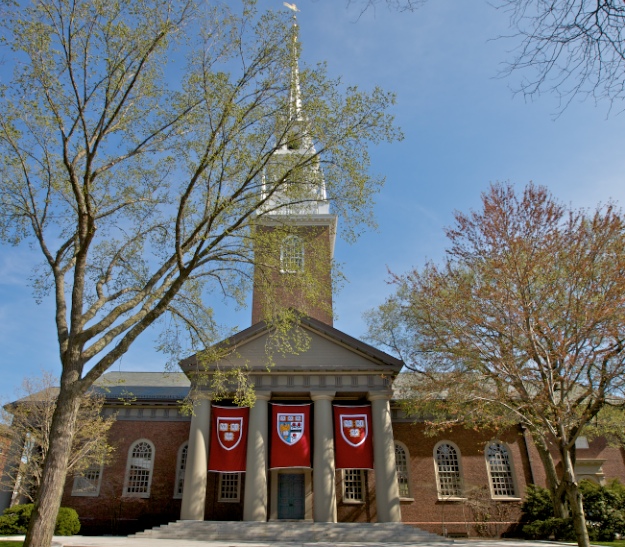
Harvard University Memorial Church.
Photo by Crimson400 via Wikimedia Commons.

We could think of “the best college” as a self-fulfilling prophecy; for whatever reason, one college has gotten a reputation as the one whose signal is most valuable. Everyone naturally tries to get in there; if they fail, they go to the college with the next-best reputation, and so on. The system is stable; the “best” college will keep its reputation (since it gets the best students) and the best students will always want to go to the best college. If, as Matt’s son suggests, all the Ivies started accepting the worst students instead, an Ivy degree would soon become a signal that you’re bad, and employers would stop respecting it.

I heard a fascinating variation of this hypothesis from Matt Christman of Chapo Trap House: elite colleges are machines for laundering privilege.

That is: Harvard accepts (let’s say) 75% smart/talented people, and 25% rich/powerful people. This is a good deal for both sides. The smart people get to network with elites, which is the first step to becoming elite themselves. And the rich people get mixed in so thoroughly with a pool of smart/talented people that everyone assumes they must be smart/talented themselves. After all, they have a degree from Harvard!

The most blatant form of this obfuscation: suppose you own a very successful family business. You can leave your son your fortune, you can leave him the business, you can leave him your mansion, but you can’t (directly) leave him an aura of having deserved all these things. What you can do is make a $10 million donation to Harvard in exchange for them accepting your son. Your son gets a Harvard degree, a universally-recognized sign of being a highly meritorious person. Then when you leave him the business, everyone will agree he deserves it. Who said anything about nepotism? Leaving a Harvard graduate in control of your business is an excellent decision!

This happens a little, but I think it mostly isn’t this obvious. More often the transactions are for abstract goods: prestige, associations, favors. The Maharaja of Whereverstan sends his daughter to Harvard so that she appears meritorious. In exchange, Harvard gets the credibility boost of being the place the Maharaja of Whereverstan sent his daughter. And Harvard’s other students get the advantage of networking with the Princess Of Whereverstan. Twenty years later, when one of them is an oil executive and Whereverstan is handing out oil contracts, she puts in a word with her old college buddy the Princess and gets the deal. It’s obvious what the oil executive has gotten out of this, but what does the Princess get? I think she gets the right to say she went to Harvard, an honor which is known to go mostly to the meritorious.

People ask why Harvard admissions can still be bribed or influenced by the rich or well-connected. This is the wrong question: the right question is why they ever give spots based on merit at all. The answer is: otherwise the scheme wouldn’t work. The point of a money-laundering operation is to take in both fairly-earned and dirty money, then mix them together so thoroughly that nobody can tell which is which. Likewise, the point of a privilege-laundering operation is to take in both fairly-earned and dirty privilege, then stamp both with a Harvard degree. “Fairly-earned privilege” means all the brilliant talented ambitious youngsters admitted on the basis of their SAT scores and grades and impressive accomplishments; “dirty privilege” means the kids of various old-money aristocrats, foreign potentates, and ordinary super-rich people. Colleges mix them together, with advantages for both groups.

Is this good or bad? It’s good insofar as it provides a justification for making some elite positions dependent on merit and accessible to anyone, but bad insofar as it helps defend and obfuscate the ones that aren’t. It’s good if you think it’s good for all the elites (meritocratic and otherwise) to know each other and be on the same page; it’s bad if you don’t want them to be (maybe because it helps them oppress people more efficiently).

I expect that without such a system the elites would do their own thing without any concession to merit whatsoever – so maybe it beats the alternative.

June 18, 2023

Today, “‘gender-critical’ is a jargonny way of describing the ordinary views held by the vast majority of the planet’s population”

Filed under: Australia, Media, Politics — Tags: , , , , , , — Nicholas @ 03:00

The Quillette Editorial Board on the startling difference between LGBT activists’s views and the default view of most of humanity:

“What is feminism? Who is it for? Can men be feminists, or only allies? What is intersectionality, and must feminism be intersectional?” These are some of the questions tackled in a University of Melbourne course on the philosophy of feminism, formally designated in the university’s handbook as PHIL20046. Prospective students are informed that course content will include “a range of feminist theories, including both radical feminism and liberal feminism, and from all four ‘waves’ (with an emphasis on second wave feminism). We’ll also consider a range of applied topics like prostitution and pornography, inclusion of transwomen, theories of gender, gendered social norms, and reproductive rights.”

Content that is not included in PHIL20046, on the other hand, includes white supremacist propaganda, neo-Nazi talking points, and an approving literary exegesis of Mein Kampf. This might seem like an odd detail to note. But it is important to state for the record, given the profusion of stickers and posters recently plastered around the University of Melbourne campus, accusing the course instructor, Holly Lawford-Smith, of crafting her syllabus for the exclusive benefit of “fascists”.

Those who are familiar with the mantras of “intersectional feminism” likely won’t require an explanation for the quantum logic leap by which feminist philosophizing might be casually equated with the doctrines of Hitler, Mussolini, and Franco. But for those unschooled in such matters, the basis of complaint here is that Lawford-Smith is a “gender-critical feminist” — a term indicating one’s belief that biologically rooted differences between men and women are real; and so must be considered when marking the boundaries of female-protected spaces, such as women’s sports leagues, prisons, and domestic-violence centres.

Which is to say that “gender-critical” is a jargonny way of describing the ordinary views held by the vast majority of the planet’s population. And it speaks to the shocking extent of academia’s radicalization that Lawford-Smith’s belief in biological science would be regarded as the academic equivalent of a Nazi salute.

Gender-critical feminists trace their roots to the radical-feminism movement of the 1960s. They often focus on the pernicious effects of gender stereotypes; and critique the industries that profit from women’s pain, such as pornography. This kind of analysis focuses attention on the hardships that have historically gone along with existing as a woman. It also focuses attention on the real policy solutions required to address such hardships, including, where necessary, the maintenance of safe single-sex spaces. As one might assume, gender-critical feminists typically have little time for men who, having recently announced the discovery of some soul-like spark of womanhood within them, commence hectoring women about the imperfect nature of their intersectional feminism.

Gender crits speak their mind at their professional peril. In 2021, Kathleen Stock, a British analytic philosopher, was forced to abandon her academic position at Sussex University following a prolonged harassment campaign. Like other prominent gender-critical intellectuals, Stock is perfectly forthright about her support for the rights of trans people to live, study, and work as they please, free from discrimination and harassment — while also being equally forthright about the plain fact that transwomen are not literal women. As a consequence of expressing such (again, widely held) views, Stock was advised to install CCTV cameras in her home and to venture onto campus only when accompanied by bodyguards.

June 15, 2023

Sarah Hoyt objects to being an “imaginary creature”

Filed under: Media, Politics, USA — Tags: , , , , , , , — Nicholas @ 03:00

Recent revisions to the quasi-official dictionary of the woke English language seem to have classified individuals like Sarah as “non-men”:

I was born female in a country that was profoundly patriarchal and, back then, patriarchal without guilt. So, it was acceptable to make jokes about women being dumber than men. And it was acceptable for teachers to assume you were dumb because female.

Most of these things amused me. It was always fun in mixed classes after the first test to watch the teacher look at my test and at the boys in the class trying to figure out what parent was so cruel as to name their son a girl’s name.

I enjoyed breaking people’s minds. And once I was known in a group or place, I was not treated as inferior. The only things that truly annoyed me were the ones I thought were arbitrary restrictions, like not going out after 8 pm alone. Took flaunting them a few times to find out they weren’t arbitrary. Or rather, they were arbitrary but since culture-wide flaunting was dangerous, and I was lucky not to pay for the flaunting with life or limb.

Yes, I went through a phase of screaming that I was just as good as any man. Then realized it was true and stopped screaming it.

Then got married and had kids, and realized I was just as good but different. I could do things men couldn’t do. Parenthood is different as a woman. And none of it mattered to my worth, just like being short and having brown hair doesn’t make me inferior to tall blonds. Just different.

And even though I’m a highly atypical woman, at the beginning of my sixth decade, I find myself completely at peace with the fact I am a woman and not apologetic at all for it.

Imagine my surprise when I found out women don’t exist. There’s only man and non-man.

This nonsense, from here, has got to stop. When you get so “inclusive” you’re excluding an entire biological sex (but curiously not the other) you might want to re-evaluate your principles. Also, your sanity.

Yes, I know, saying this makes me a TERF, which is nonsense. Maybe a TERNF, since I’ve not called myself a feminist since I was 18 and realized feminism aimed for making women “win” at men’s expense. It wasn’t aiming for equality but for “equity” and since I never needed a movement to outcompete males, I decided it was spinach and to h*ll with it.

Also I’m not trans-exclusionary. If women don’t exist, what the heck are men who are trans trans TO? Non-man? Uh … what? What are drag queens imitating? Is it just non-man?

June 5, 2023

QotD: The four types of college papers for English Majors – 4. The Old Switcheroo

Filed under: Education, Humour, Quotations — Tags: , — Nicholas @ 01:00

Only superstars write the Old Switcheroo. But if you pull this off, the sky is the limit. You might end up as a Senator or in the Cabinet, or have a prominent byline in a newspaper of record.

That’s because the Old Switcheroo turns everything into its opposite. If you master this technique, you can prove anything, no matter how implausible. Water isn’t wet. War is Peace. We have always been at war with Eastasia. You name it.

Everybody thinks that Shakespeare’s King Lear is a tragedy, but for the Old Switcheroo, you prove that it’s actually a comedy. Everybody thinks that Mozart is a great composer, but you prove that he stole everything he wrote from Salieri’s butler. Frankenstein wasn’t a monster, but a respected scientist. Etc. etc.

Up is down. Black is white. Fire is ice.

Make no mistake, the Old Switcheroo is A+ work, and no fooling. Even more, it’s a surefire path to career success. There’s just one tiny problem: The people who master the Old Switcheroo are batshit crazy and have a psychological profile dangerously close to that of a serial killer. They might end up in the White House, but you wouldn’t trust them to house-sit your chia pet.

Ted Gioia, “The 4 Types of College papers for English Majors”, The Honest Broker, 2023-02-27.

June 4, 2023

QotD: The four types of college papers for English Majors – 3. The DIM

Filed under: Education, Humour, Quotations — Tags: , — Nicholas @ 01:00

We are now trying to impress the professor and get an A. So we can’t just write about what’s happening at the surface level — we must identify the Deep Inner Meaning (DIM) that others don’t see.

Those bozos think that Moby Dick is a novel about a great white whale. But we know there’s a Deep Inner Meaning to the book — that whale is actually a stand-in for the author’s annoying mother-in-law. Or maybe it’s a surrogate for the President of the United States. Or a displaced sex object.

Let your imagination run free. It really doesn’t matter which you choose. It just can’t be anything obvious. And then you need to talk a good game, and not pay too much attention to facts and plausibility.

And who said you don’t learn useful job skills as an English major?

If you spread the B.S. thick enough, and never let on that you even sniff the stench, you have better than even odds of getting a top grade. It helps, by the way, if you show up in class dressed in something unseemly and having omitted several steps in your morning grooming routine — which are seen as signs of incipient genius in the School of Humanities.

Ted Gioia, “The 4 Types of College papers for English Majors”, The Honest Broker, 2023-02-27.

June 3, 2023

QotD: The four types of college papers for English Majors – 2. The TWIT (They Were Idiots Then)

Filed under: Education, Humour, Quotations — Tags: , , — Nicholas @ 01:00

Back in the old days, everybody was a fool — They Were Idiots Then (TWIT).

We know that unfailingly, for the simple reason that they didn’t think like us. They were stupid and stodgy and superstitious and held all sorts of irritating views.

And it’s true. You can take absolutely any book from a hundred years ago, and find infractions on almost every page. The past is a different country, where everybody is a knucklehead.

Here’s how to write a TWIT: You take a yellow marker and highlight every time somebody in the book makes a blunder, according to our current rules of decorum this week. Trust me, you won’t even have to read the whole book. Within a chapter or two, your book will have more yellow highlights than Nicki Minaj’s hairdo.

Now you’re ready to roll.

You write up the infractions like it’s a district attorney’s indictment. But here’s the key — you must give it some fancy name. You can’t just call a twit a twit in your TWIT paper; you have to refer to your harangue as a critique or an exegesis or a deconstruction, starting with the title — which should be something like “A Critique of Phallogocentrism in Henry James’s Turn of the Screw“.

Once you get the hang of this, it’s as easy as shooting fish in a barrel. There’s just one problem — everyone else in the class is also writing TWIT papers. It’s the most popular thing on campus since the invention of the senior admin job. So you only get a B on these. Or maybe B+ if you throw in a few French words (for example, inserting différance whenever you’d normally say difference).

Ted Gioia, “The 4 Types of College papers for English Majors”, The Honest Broker, 2023-02-27.

June 2, 2023

QotD: The four types of college papers for English Majors – 1. The Reliable C&C

Filed under: Education, Humour, Quotations — Tags: , — Nicholas @ 01:00

This is the “compare and contrast” paper, and is about as simple as they come. You take two things that aren’t exactly like each other. It’s just like Sesame Street, but with books.

Then you list 5 ways they are similar and 5 ways they are different. Voilá — you’ve written a college paper!

    Ernest Hemingway and Jane Austen are both writers who share the same language: English. But Hemingway is an American who liked bullfighting and drinking martinis. Jane Austen is English and never fought a bull. She probably drank tea, because the martini wasn’t invented until 1863, some 47 years after her death …

You can write this stuff in your sleep, provided you dream about Wikipedia entries. But be forewarned: the reliable C&C probably only gets you a reliable C grade.

Ted Gioia, “The 4 Types of College papers for English Majors”, The Honest Broker, 2023-02-27.

« Newer PostsOlder Posts »

Powered by WordPress