
As y’all undoubtedly know, mental illness is something of a badge of honor in the ivory tower. Screw HIPAA; most people in academia are willing, indeed eager, to tell you all about their mental problems. The students mostly do it to get out of classwork, of course — the minute you get the letter from Student Services, you can go ahead and start filing the “incomplete” paperwork with the registrar — but grad students and professors collect DSM diagnoses and SSRI prescriptions like the Japanese collect Pokemon and used panties.
Given that, and given how lunatic professors’ actual beliefs are, there’s pretty much nothing you can’t get away with saying in the ivory tower if you play your cards right. In much the same way Jon Stewart rode his “clown nose on / clown nose off” act to adulation from the smart set, you can say whatever you want if you keep it ambiguously crazy. (You know how it goes — if you agree with Stewart, he’s doing straight political commentary; but if you disagree with him to the point where he might lose sponsors, c’mon man, he’s just a tv comedian).
I’ll give you an example. Back in 2008, during the Democratic primaries, it was all the rage on campus to be anti-Obama. You’ll just have to trust me on that, I guess, but if you believed my previous “inside the ivory gulag” posts, I’m sure you’ll understand why that fad existed — everyone’s playing the “more radical than thou” game, and what’s more radical than being against the black guy, because his positions are such weak sauce Liberal boilerplate? The real People’s Candidate back then was Dennis Kucinich, and if normal people remember anything about him, it’s that he was more than a little Fox Mulder-y on the question of extraterrestrial life.
Anyway, whenever anyone asked me who I was voting for, I’d give Obama both barrels, always from the most extreme conservative position … but when I noticed the SJW I was talking to had finally cottoned to that, I ended with something like “And what’s worst is that unlike some candidates, Obama refuses to take the saucer people menace seriously!!”
Severian, “Friday Mailbag”, Rotten Chestnuts, 2021-06-04.
June 5, 2024
May 25, 2024
“Education” versus “learning”
At Astral Codex Ten, Scott Alexander discusses some of the ideas from Bryan Caplan’s book The Case Against Education:
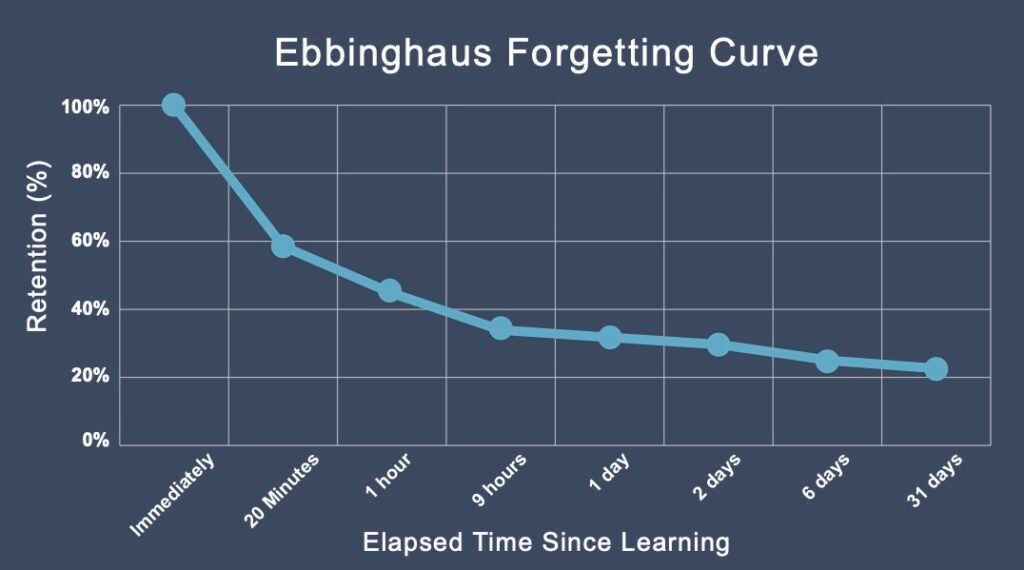
Source here. Note deranged horizontal axis.
Education isn’t just about facts. But it’s partly about facts. Facts are easy to measure, and they’re a useful signpost for deeper understanding. If someone has never heard of Chaucer, Dickens, Melville, Twain, or Joyce, they probably haven’t learned to appreciate great literature. If someone can’t identify Washington, Lincoln, or either Roosevelt, they probably don’t understand the ebb and flow of American history. So what facts does the average American know?
In a 1999 poll, only 66% of Americans age 18-29 knew that the US won independence from Britain (as opposed to some other country). About 47% of Americans can name all three branches of government (executive, legislative, and judicial). 37% know the closest planet to the sun (Mercury). 58% know which gas causes most global warming (carbon dioxide). 44% know Auschwitz was the site of a concentration camp. Fewer than 50% (ie worse than chance) can correctly answer a true-false question about whether electrons are bigger than atoms.
These results are scattered across many polls, which makes them vulnerable to publication bias; I can’t find a good unified general knowledge survey of the whole population. But there’s a great survey of university students. Keeping in mind that this is a highly selected, extra-smart population, here are some data points:
- 85% know who wrote Romeo and Juliet (Shakespeare)
- 56% know the biggest planet (Jupiter)
- 44% know who rode on horseback in 1775 to warn that the British were coming (Paul Revere)
- 33% know what organ produces insulin (pancreas)
- 31% know the capital of Russia (Moscow)
- 30% know who discovered the Theory of Relativity (Einstein)
- 19% know what mountain range contains Mt. Everest (Himalayas)
- 19% know who wrote 1984 (George Orwell)
- 16% know what word the raven says in Poe’s “The Raven” (“Nevermore!”)
- 10% know the captain’s name in Moby Dick (Ahab)
- 7% know who discovered, in 1543, that the Earth orbits the sun (Copernicus)
- 4% know what Chinese religion was founded by Lao Tse (Taoism)
- <1% know what city the general Hannibal was from (Carthage)
Remember, these are university students, so the average person’s performance is worse.
Most of these are the kinds of facts that I would expect school to teach people. Some of them (eg the branches of government) are the foundations of whole subjects, facts that I would expect to get reviewed and built upon many times during a student’s career. If most people don’t remember them, there seems to be little hope that they remember basically anything from school. So what’s school even doing?
Maybe school is why at least a majority of people know the very basics – like that the US won independence from Britain, or that Shakespeare wrote Romeo and Juliet? I’m not sure this is true. Here are some other questions that got approximately the same level of correct answers as “Shakespeare wrote Romeo and Juliet“:
- What is the name of the rubber object hit by hockey players? (Puck, 89%)
- What is the name of the comic strip character who eats spinach to increase his strength? (Popeye, 82% correct)
- What is the name of Dorothy’s dog in The Wizard of Oz? (Toto, 80% correct)
I don’t think any of these are taught in school. They’re absorbed by cultural osmosis. It seems equally likely that Romeo and Juliet could be absorbed the same way. Wasn’t there an Academy-Award-winning movie about Shakespeare writing Romeo and Juliet just a decade or so before this study came out? Sure, 19% of people know that Orwell wrote 1984 – but how many people know the 1984 Calendar Meme, or the “1984 was not an instruction manual!” joke, or have heard of the reality show Big Brother? Nobody learned those in school, so maybe they learned Orwell’s name the same place they learned about the other 1984-related stuff.
Okay, so school probably doesn’t do a great job teaching facts. But maybe it could still teach skills, right?
According to tests, fewer than 10% of Americans are “proficient” at PIIAC-defined numeracy skills, even though in theory you need to know algebra to graduate from most public schools.
I took a year of Spanish in middle school, and I cannot speak Spanish today to save my life; that year was completely wasted. Sure, I know things like “Hola!” and “Adios!”, but I also know things like “gringo” and “Yo quiero Taco Bell” – this is just cultural osmosis again.
So it seems most people forget almost all of what they learn in school, whether we’re talking about facts or skills. The remaining pro-school argument would be that even if they forget every specific thing, they retain some kind of scaffolding that makes it easier for them to learn and understand new things in the future; ie they keep some sort of overall concept of learning. This is a pretty god-of-the-gaps-ish hypothesis, and counterbalanced by all the kids who said school made them hate learning, or made them unable to learn in a non-fake/rote way, or that they can’t read books now because they’re too traumatized from years of being forced to read books that they hate.
It’s common-but-trite to encounter people who say things like “I love learning, but I hated school” — I’ve undoubtedly said that myself many times. A weird experience was having to study a book in school that I’d already read on my own: it was like an early form of aversion therapy … here’s something you loved once, let’s make you hate it now.
May 24, 2024
“[I]t is offensive to say that women should help men reach their potential; but … men must help women reach theirs“
There has been a lot of online outrage after Kansas City Chiefs placekicker Harrison Butker spoke at the graduation ceremonies at his alma mater:

“Stop giving men microphones,” wrote one of the signers of the petition to have NFL kicker Harrison Butker fired.
“As a woman living in post-Roe America,” declared another, “I’m exhausted from men telling women what to do with their lives.”
“How offensive to imply women are put here on this planet to help a man reach his full potential,” fumed a third. “We should be empowering women to achieve greatness however that looks for them. Having children or being a mother isn’t the currency we must pay to be treated as equal members of this society.”
And on and on they go in predictable, and predictably incoherent, statements. Apparently, it is offensive to say that women should help men reach their potential; but, in the next breath, men must help women reach theirs.
At a time when women encourage one another in “rage rituals” and feminists like Mona Eltahawy call for perpetual anger as the route to liberation, few can be surprised by the hysteria that followed National Football League kicker Harrison Butker’s speech to the graduating students of Benedictine College in Kansas. It is a rage that has led well over 200,000 of the furious, mostly women, to sign a petition demanding he be fired by the Kansas City Chiefs.
Manufacturing outrage is what feminist journalism does best, and its audience is eager for cosplay rebellion and narcissistic posturing even when, as in the case of the speech, the hyperventilating is far in excess of the fact. That even Benedictine nuns have joined the chorus shows how many women in all walks of life find such posturing near-irresistible.
Of course, if Butker had addressed the Benedictine College graduates to say that Catholicism was riddled with misogyny and homophobia, no popular petitions would have been launched. If he had said that abortion was a gift to humanity and that female priests would lead the church to glory, his words would have sparked dissent only in the most marginal of venues.
Let a man praise his wife for her devotion to family, and we witness a stampede of foul-mouthed nasties to their bullhorns.
May 18, 2024
QotD: Academic research and the “phantom cite”
Happens all the time. There are a couple of reasons for this. Being as charitable as I possibly can, I’m going to call one “survivorship bias”. I’m sure you’ve seen this … Since, again, we’re being extremely charitable here, this isn’t actually a case of “just tell ’em what they want to hear”. I’ll illustrate from my own research experience. My dissertation asserts that General Ripper, commander of the 43rd Imaginary Infantry in Au Phuc Dup province, Republic of Vietnam, was convinced that the local provincial governor, Long Duc Dong, was a Communist infiltrator. Now, this is a 100% true fact, that Gen. Ripper believes Long Duc Dong is a Communist. Armies are awash in paperwork, and moreover Gen. Ripper was an obsessive letter-writer and diarist, so you can find hundreds if not thousands of citations stating it directly: “I, Gen. Ripper, believe that Long Duc Dong is a Communist”.
Which explains quite a bit about why Gen. Ripper made the decisions he did, which in turn is why this 100% indisputably true fact — that Gen. Ripper thought Long Duc Dong was a Communist — features so prominently in that study of the dynamics of command in the 43rd Imaginary Infantry.
The problem, though, is that some other historian comes along, looking at something very different — say, the effectiveness of anti-Communist propaganda in the IV Corps operational area — and comes across my dissertation. From this, he writes “So ineffective was the anti-Communist propaganda campaign that even the governor, Long Duc Dong, was strongly suspected of being a Communist infiltrator”. And from that, another historian, looking for the prevalence of pro-Communist sentiment, concludes that “despite the Americans’ best efforts, the extreme south of the RVN was so thoroughly indoctrinated that even the Governor, Long Duc Dong, was a Communist”.
Now, all of that is true except for the last bit. It is not, in fact, proven that Long Duc Dong was a Communist. Gen. Ripper sure thought he was. And Gen. Ripper continued to think so, even after the anti-Communist propaganda campaign, which means that the campaign indisputably failed in Long Duc Dong’s case — he carried on acting like enough of a commie to keep Gen. Ripper’s suspicions up. But thanks to the thicket of citations, it’s the last bit — the assertion that Long Duc Dong was, indisputably, a Communist — that has by far the most footnotes attached to it. Hell, the footnotes probably cite all the same things I did — the truckloads of letters and documents from Gen. Ripper saying “Damn that Long Duc Dong, he’s a Communist!!”
That’s because he lifted them straight from my dissertation, all impeccably footnoted — by which is meant, giving ME full credit — and do you see what I mean? None of the historians involved had any obvious axe to grind, no viewpoint to push. It’s just that everyone’s bibliography is a hundred pages long, and nobody has the time to read every page of every book in those hundred pages. Jones just skimmed Smith’s index, looking for names of commies. Smith did the same thing with my index, of course, in which he found “Dong, Long Duc, Communist sympathies of,” with dozens of page numbers referenced.
Severian, “‘Studies'”, Rotten Chestnuts, 2021-05-22.
May 17, 2024
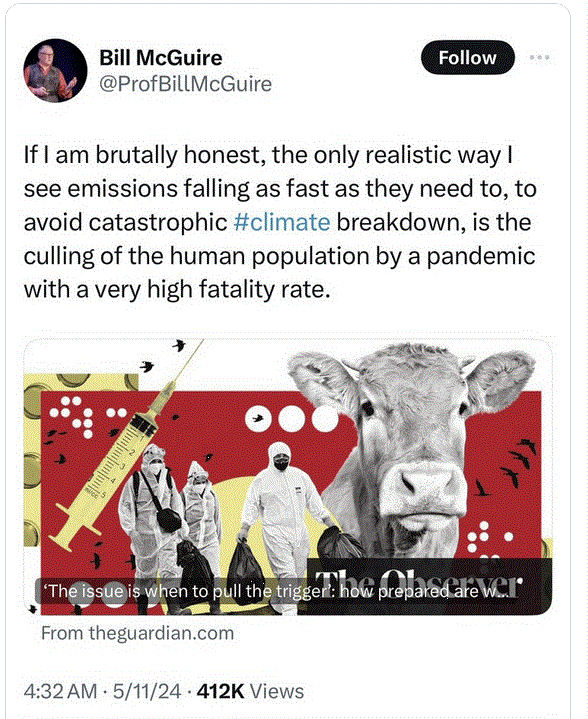
“Once a mind is infected with Climate Change, bioweapons are just another kind of carbon credit”
Jo Nova presents evidence of a university professor — a vulcanologist — who perhaps has more sympathy for the volcanoes he studies than the human race:
Let’s just say, hypothetically, that someone wanted an excuse to reduce global population, or limit competing tribes and religions, there’s a scientific hat for that. Climate Change is the ultimate excuse for mass death — done in the nicest possible way and for the most honorable of reasons. But isn’t that what they all say: Jim Jones, the Branch Davidians, Heavens Gate — death makes the world a better place?
The cult that pretends it isn’t a cult sells itself as “science”. I mean, what the worst thing you can think of? Would that be one degree of warming, or the Black Death?
In Bill McQuire’s mind the catastrophe is not when billions of innocent people die.
One hundred years from now, what would our great grandchildren prefer: that the world was slightly cooler or they were never born at all? If you hate humans it’s a terrible dilemma …
Bill McGuire, vulcanologist, accidentally put his primal instincts in a tweet last weekend:
Thirty years of telling us that humans are bad has consequences. As Elon Musk said” They want a holocaust for humanity.” It turns out a televised diet of one-sided climate projection by mendicant B-Grade witchdoctors might be a dangerous thing for mental health. If only Bill McQuire had seen a skeptic on TV?
Predictably the McGuire tweet spread far, and got crushing replies so the Emeritus Professor deleted it, as all cowards do, yelling at us:
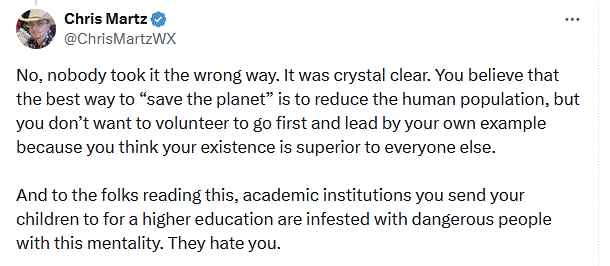
To which the winning reply was:

May 16, 2024
The replication crisis and the steady decline in social trust
Theodore Dalrymple on the depressing unreliability — and sometimes outright fraudulence — of far too high a proportion of what gets published in scientific journals:
Until quite recently — I cannot put an exact date on it — I assumed that everything published in scientific journals was, if not true, at least not deliberately untrue. Scientists might make mistakes, but they did not cheat, plagiarise, falsify, or make up their results. For many years as I opened a medical journal, the possibility simply that it contained fraud did not occur to me. Cases such as those of the Piltdown Man, a hoax in which bone fragments found in the Piltdown gravel pit were claimed to be those of the missing link between ape and man, were famous because they were dramatic but above all because they were rare, or assumed to be such.
Such naivety is no longer possible: instances of dishonesty have become much more frequent, or at least much more publicised. Whether the real incidence of scientific fraud has increased is difficult to say. There is probably no way to estimate the incidence of such fraud in the past by which a proper comparison can be made.
There are, of course, good reasons why scientific fraud should have increased. The number of practising scientists has exploded; they are in fierce competition with one another; their careers depend to a large extent on their productivity as measured by publication. The difference between what is ethical and unethical has blurred. They cite themselves, they recycle their work, they pay for publication, they attach their names to pieces of work they have played no part in performing and whose reports they have not even read, and so forth. As new algorithms are developed to measure their performance, they find new ways to play the game or to deceive. And all this is not even counting commercial pressures.
Furthermore, the general level of trust in society has declined. Are our politicians worse than they used to be, as it seems to everyone above a certain age, or is it that we simply know more about them because the channels of communication are so much wider? At any rate, trust in authority of most kinds has declined. Where once we were inclined to say, “It must be true because I read it in a newspaper”, we are now inclined to say, “It must be untrue because I read it in a newspaper”.
Quite often now I look at a blog called Retraction Watch which, since 2010, has been devoted to tracing and encouraging retraction of flawed scientific papers, often flawed for discreditable reasons. Such reasons are various and include research performed on subjects who have not given proper consent. This is not the same as saying that the results of such research are false, however, and raises the question of whether it is ethical to cite results that have been obtained unethically. Whether it is or not, we have all benefited enormously from past research that would now be considered unethical.
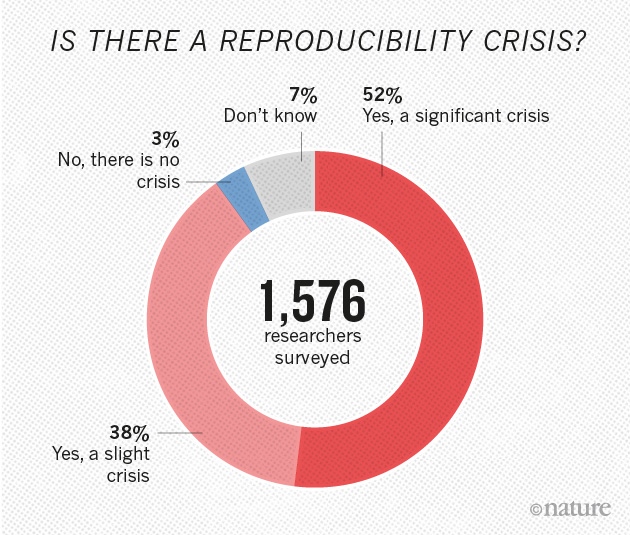
One common problem with research is its reproducibility, or lack of it. This is particularly severe in the case of psychology, but it is common in medicine too.
May 8, 2024
ESR on the shambolic response of the “elite” universities to the protests
ESR finds a silver lining to the storm clouds of all the ongoing pro-terrorist campus protests we’re seeing these days:
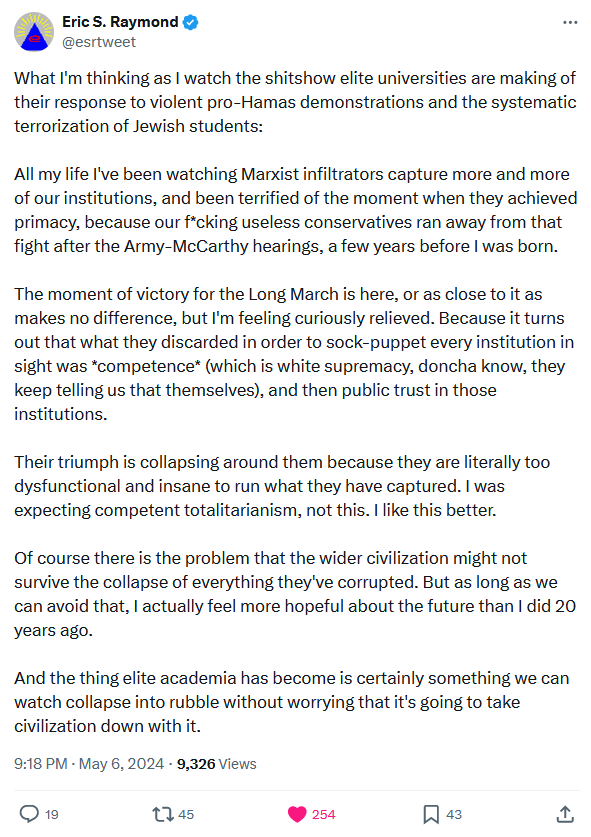
What I’m thinking as I watch the shitshow elite universities are making of their response to violent pro-Hamas demonstrations and the systematic terrorization of Jewish students:
All my life I’ve been watching Marxist infiltrators capture more and more of our institutions, and been terrified of the moment when they achieved primacy, because our f*cking useless conservatives ran away from that fight after the Army-McCarthy hearings, a few years before I was born.
The moment of victory for the Long March is here, or as close to it as makes no difference, but I’m feeling curiously relieved. Because it turns out that what they discarded in order to sock-puppet every institution in sight was *competence* (which is white supremacy, doncha know, they keep telling us that themselves), and then public trust in those institutions.
Their triumph is collapsing around them because they are literally too dysfunctional and insane to run what they have captured. I was expecting competent totalitarianism, not this. I like this better.
Of course there is the problem that the wider civilization might not survive the collapse of everything they’ve corrupted. But as long as we can avoid that, I actually feel more hopeful about the future than I did 20 years ago.
And the thing elite academia has become is certainly something we can watch collapse into rubble without worrying that it’s going to take civilization down with it.
May 5, 2024
The protests “will help Trump get an Electoral College landslide, just as the new left handily elected Nixon in 1968 and 1972”
Andrew Sullivan, the very model of a never-Trumper, sees the ongoing student protests feeding into a repeat of the 1968 and 1972 US Presidential elections:

“Patriotic students hung up an American Flag at George Washington University after pro-Palestine protesters trashed the campus, defaced the statue of George Washington, and removed an American Flag.”
Twitter image posted by Chaya Raichik – https://twitter.com/ChayaRaichik10/status/1786504098746958103/photo/1
As readers know, I’m deeply sympathetic to the argument that Israel has over-reached, over-bombed, and over-reacted in its near-unhinged overkill of Palestinian civilians, especially children, in the wake of 10/7’s horrors. It has been truly horrifying. I begrudge no one demonstrating passionately to protest this. But as I watch the rhetoric and tactics of many — but not all — of these students, I’m struck by how this humane concern is less prominent than the rank illiberalism and ideological extremism among many.
Preventing students from attending classes, taking exams, or even walking around their own campus freely is not a protest; it’s a crime. So is the destruction of property, and the use of physical intimidation and violence against dissenting students. The use of masks to conceal identity is reminiscent of the Klan, and antithetical to non-violent civil disobedience. It’s a way for outsiders to easily infiltrate and a way to escape responsibility for thuggishness. It’s menacing, ugly and cowardly.
It did not have to be this way. Imagine if students simply demonstrated peacefully for a cease-fire, placed the victims and hostages at the forefront of the narrative, and allowed themselves to be arrested proudly on camera and face legal consequences for their actions, as the civil rights movement did. Imagine if they were emphatically non-violent and always open to debate.
But they aren’t, because they are not the inheritors of the Christian, universalist civil rights movement but its illiberal, blood-and-soil nemesis, long curated in the Ivy League. The key group behind the protests, Students For Justice in Palestine, doesn’t mince words. It celebrated the explicitly genocidal murder of Jews on October 7:
National liberation is near — glory to our resistance, to our martyrs, and to our steadfast people! … Resistance comes in all forms — armed struggle, general strikes, and popular demonstrations. All of it is legitimate, and all of it is necessary.
The “our” is interesting. If you think these protests are only about Gaza — and not America — you’re missing the deeper context. Here’s a masked, keffiyeh-wearing spokeswoman for the UCLA protest:
Given the fact that the University of California is founded on colonialism, it’s inherently a violent institution. There needs to be an addressment of US imperialism and its ties to the UC system and how it perpetuates war and violence aboard — not only abroad, but also here, locally.
So violence is justified in response. Here’s a keffiyeh-clad spokesman at CUNY:
This revolution, which includes the mass demonstrations and encampments, are not just exclusively for students. It is for the masses. … It is for the free people of the world who are able to resist however you can — whether it be with a rock and other tools of liberation.
These are not fringe figures; they have been chosen to speak to the public. They believe in violence because there is nothing in their worldview that could prohibit it against certain “oppressor” races of people. As one of the “queer” leaders of the Columbia protest has said: “Zionists don’t deserve to live”, and “Be grateful that I’m not just going out and murdering Zionists”. He took his classes in decolonization seriously, even if he is now backtracking from their logical conclusion.
The illiberalism is deep and endemic. The civil rights movement was desperate for the press to show up; these thugs follow observers menacingly around, holding up barriers to prevent even fellow students from filming them. The civil rights movement ended physical borders between groups of human beings; these thugs create borders and police dissent. The civil rights movement asked America to live up to its ideals; the woke believe America is a source of evil in the world, and needs to be “decolonized”. “I love Osama [bin Laden]”, one pro-Palestinian demonstrator in New York City said. “I want to suck his dick”. That mix of evil and scatology is a woke trademark.
And these protests are clearly as much about the abolition of the Jewish state as they are the horror of Gaza. They are driven by the neoracist idea that “white-people-are-bad-but-black-and-brown-people-are-good”; they are about a blood-and-soil “anti-imperialism” that requires the abolition of any state not reflective of ancient indigenous populations. (The SJP refers to the US as “Turtle Island”, an allegedly indigenous name.) They are against “cultural appropriation” but prance around in keffiyehs. They glibly use the word “genocide” to trigger and re-traumatize Jews, while ignoring the genocidal goals of Hamas; and chants of “There Is Only One Solution: Intifada Revolution!” ring with echoes of Nazism.
And they will help Trump get an Electoral College landslide, just as the new left handily elected Nixon in 1968 and 1972.
It tells you something when even Al Sharpton is rattled by these violent fanatics. “How do the Democrats — how do all of us on that side — say January 6th was wrong if you can have the same pictures going on on college campuses?” he asked on MSNBC. It feels like 2020 again. Replacing Old Glory with the Palestinian flag or defacing a statue of George Washington (see above), is not how you win over the country. But the more you know about these fanatics the more you realize they don’t want to win over the country; they want to destroy it as mindlessly as the pro-Trump fringe. And they’d welcome the even deeper polarization he’d bring.
May 3, 2024
“Columbia Delenda Est“
From late last month, Robert Graboyes, who is an alumni of Columbia University, thought it appropriate to follow Cato the Elder’s prescription for Carthage in this case:

Low Memorial Library, Columbia University, 1921.
From Wikimedia. Textured and rendered as ruins by Robert Graboyes.
As an alumnus of Columbia University (MPhil and PhD), I recommend that every peaceful, legal means available be employed to destroy the reputation of my alma mater — an institution that has chosen to make itself Ground Zero for Jew-hatred in America. Paraphrasing Cato the Elder:
“Columbia Delenda Est” — “Columbia Must Be Destroyed.”
Cato’s entreaty — “Carthago Delenda Est” — was intended not only to punish the Carthaginians, but also to warn other states from behaving as Carthage had. Laying waste to Columbia’s prestige would send a chilling message to other institutions choosing to tolerate, appease, and celebrate threats and acts against Jews.
WHY COLUMBIA SPECIFICALLY?
America’s elite universities are awash in antisemitism. When Rep. Elise Stefanik repeatedly asked the presidents of Harvard, Pennsylvania, and MIT whether they would discipline students calling for the genocide of Jews, the feckless trio humiliated themselves before an international audience — though they seem unaware of that fact.
Recently, a Jewish student at Yale was stabbed in the eye by a protestor wielding a Palestinian flag. At Berkeley, students invited to the (Jewish) law school dean’s home decided that was an appropriate setting for a pro-Hamas demonstration and refused to desist or leave when asked. Encampments similar to Columbia’s are ongoing at Emerson College, MIT, NYU, Rutgers, the New School, Tufts, UMaryland, UMichigan, UNC-Chapel Hill, Vanderbilt, Washington U, and Yale. Thousands of antisemitic incidents have been recorded at hundreds of schools. The University of Southern California has surrendered to the mob by canceling this year’s commencement ceremony.
Use the wrong pronoun or wear a sombrero on Cinco de Mayo, and your university will consider bringing out the firehoses and German shepherds; but assault Jewish students and call for their extermination (along with the eradication of a sovereign nation), and the same university will defend your actions as representing the sacred right to free and open speech. Antisemitism has spread like ebola across American Academia. But there are at least three good reasons to single out Columbia.
FIRST: With antisemitism blooming at so many American universities, it is impractical to try attacking the phenomenon everywhere all at once. It is better to choose one prestigious university, inflict as much pain as possible on that lone institution, and let the stinking carcass of its reputation stand as a warning to other universities — leaving all of them to wonder which university is second on the list. This strategy reminds me of a passage from Hagakure: Way of the Samurai:
According to what one of the elders said, taking an enemy on the battlefield is like a hawk taking a bird. Even though it enters into the midst of a thousand of them, it gives no attention to any bird other than the one that it has first marked.
Or, more prosaically, as activist Saul Alinsky wrote in his Rules for Radicals:
Pick the target, freeze it, personalize it, and polarize it.
SECOND: Columbia is located in New York City — the world’s leading media market. No doubt, that geographic locale has contributed to the school’s outsized prominence in the current wave of on-campus pogroms. Any blowback falling on Columbia as a result of its moral collapse will also will attract blaring coverage by the press and/or by the denizens of social media. The school’s locale will guarantee maximum publicity as the school’s reputation crumbles, brick by brick.
THIRD: The offenses at Columbia have been especially egregious. Even by today’s standards, the number of offenses at Columbia (some violent and threatening, some merely hateful) are breathtaking. The examples reported on a single day (April 20) illustrate the lie that “anti-Zionism” is anything other than rebranded Jew-hatred:
- A protestor holding a sign saying “Al-Qasam’s [sic] next target” who stood in front of a group of Jewish students holding Israeli flags and singing
- A Jewish student wearing a yarmulke being shoved and screamed at by protestors, “you’ve got blood on your hands!” when he attempted to recover an Israeli flag stolen by a protestor, who then ran to a cheering crowd of anti-Israel protestors that attempted to burn the flag. (The student additionally claims a rock was thrown at his face and protestors screamed, “Kill the Zionist”)
- Protestors screaming “go back to Poland!” and “yehudim, yehudim [which translates to Jews, Jews]” at Jewish Columbia students trying to leave campus
- Protestors circling around the main gates and entrance to campus, with one stating, “I am Hamas”, which was documented in video
- Crowds screaming “tear down the gates” and various hateful chants in English and Arabic as individuals unaffiliated with the university climbed the University’s gates
- A Jewish Columbia student being splashed with water by a protestor
- Protestors chanting, “Al-Qassam you make us proud! Take another soldier out!”, “We say justice, you say how? Burn Tel Aviv to the ground!”, and “Hamas we love you. We support your rockets too!”
- A protestor delivering a speech on campus that exclaimed, “We are here today because on October 7 the Palestinian resistance in Gaza broke through the walls of their open air prison, shattering the illusion of the invincibility of their occupiers. [Cheers from the crowd.] By setting up this encampment in the heart of the Zionist stronghold of Columbia University, we intend to do the same”
- A protestor standing immediately outside Columbia’s gates leading a crowd in Arabic chants glorifying terrorism and encouraging students to become terrorist “martyrs” after which he explained in English that the chant translated to “mother of the shahid, mother of the martyr, I wish my mother was in your place”.
Columbia has allowed the mobs and tents to linger, rather than speedily removing them and restoring order and safety to campus. Professors have endorsed and participated in the encampment, as have legions of students. The university chose to shut down in-person classes rather than taking steps to assure the safety of Jewish students. Recognizing this, a rabbi associated with the university urged Jewish students to leave for the sake of their safety.
May 2, 2024
QotD: Fomenting inter-generational hatred
“You’re in a heap o’ trouble, boy.” Or girl. What follows are the reasons — or at least the big ones — why you’re so thoroughly screwed, along with some suggestions for self-help at the end.
You tend to loathe Boomers and Generation X, I know. I don’t actually blame you for that, at least not entirely. Some of you, though, the Millennials who lump all the above together, without exception, strike me as singularly stupid and ignorant.
Moreover, the reasons you have for loathing them are somewhat misplaced. You tend to think — not without some reason — that the Boomers, especially, robbed their future, which is to say you, personally, to pay for largesse for themselves in the present.
It’s true enough, but it is neither the really awful thing they did to you nor does the complaint portray you in any particularly favorable light. “Those damned Boomers; they took everything and now there’s nothing left for us.” Yeah … you know what that sounds like? It sounds like the whining of one group of thieves over the success of a better or, in this case, merely luckier group of thieves who got to the big haul first. Yes, it really does.
Sorry, but the damage the Boomers and Xers did to you wasn’t primarily fiscal. No, no, the damage they did – or allowed – was to you, as a person. That’s the real crime. They didn’t just rob you of some money in advance. They didn’t just vote for a series of politicians and political programs and giveaways that ran the economy into the ground.
No, they stole from you — or allowed others to steal from you — some key elements of personhood, especially the ability to engage in critical, logical thinking. That’s right, you were not educated, whether in kindergarten or in the kindergartenesque, safe space segregated, snowflake sanctuary schools we call colleges and universities. Yes, these institutions of miseducation were supposed to teach you how to think. Instead, they taught you what to think and stunted your native ability to think. If you ever start to spout bright green feathers? Yes, this is the reason why; your teachers demanded that you become a parrot.
Tom Kratman, “It’s Up to You, Millennials. Deflect or Be Doomed”, Milo, 2017-12-06.
April 26, 2024
Out – “GenZ”: In – “Waffen ZZ“
Peachy Keenan invites us to meet the new hotness, the Zoomerwaffen:
These crazy Zoomer kids are bringing back all the old trends: baggy jeans, the band Sublime, and casual, no-big-deal, fanatical anti-semitism. When I was in college, the only people who still hated Jews were Arabs and skinheads. In 2024, hating Jews is even cooler than having retarded pronouns!
“Never again” was the promise Jews made to themselves after the Holocaust and it held for almost 80 years, but it looks like we are in fact about to do it again. It’s starting, ironically, on the same elite college campuses that were the birthplaces of the “inclusion” movement of recent years. Our finest universities have spent the last 30-odd years “abolishing hate”, establishing “safe spaces”, and forcing tolerance down students’ throats until they gagged on it.
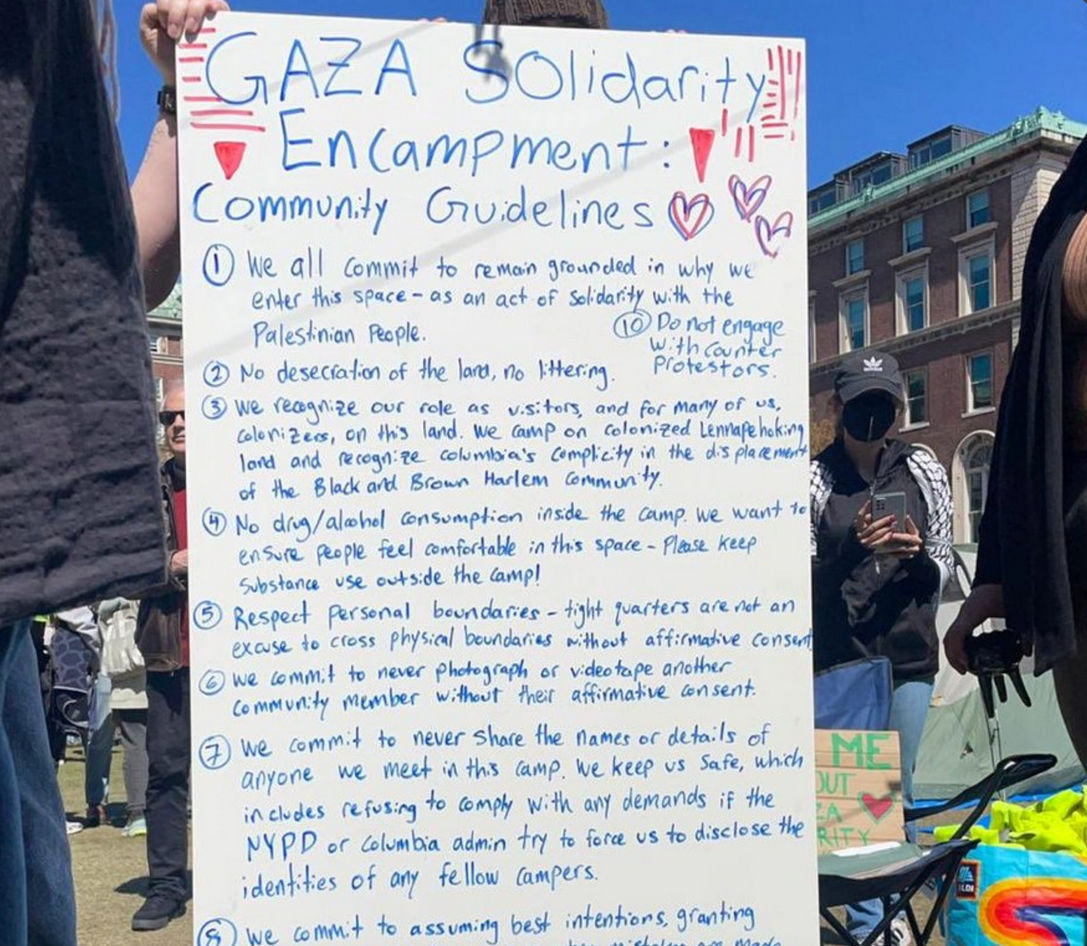
Columbia’s Hamas encampment is a safe space. Not for Jews, though.
But also we have to acknowledge that demands from Jewish students for special protections against hate speech, harassment, violence, and bigotry, while totally justified, tend to stick in the craw of other identity groups who have been the target of widespread vilification and hate on campus for years, right here in the United States.
The Zoomerwaffen are here and they are coming for the Jews — the same way their college came for the straight white males.
Zoomerwaffen SS officer Klaus Von Chad in his Amazon keffiyeh cheers as the American flag is taken down and burned.
Yes, some of the Zoomerwaffen even look like Nazis, apparently. These wild-eyed Ivy League coeds have taken a break from rizzing each other up and accidentally overdosing on fentanyl so they can goof around in keffiyahs, call for the slaughter of a persecuted religious minority, and ululate in their Lululemons as they are arrested for insurrection. (Insurrection is good now, Grandpa!).
I had to laugh when I saw Ilhan Omar’s unfortunate daughter arrested at Columbia for leading some anti-semitic protest. Bit on the nose, even for the Omar family, isn’t it? Ilhan’s little nepo meeskite got kicked out of her dorm and suspended from school, which means she can expect a job offer from MSNBC any minute now.
Since October 7th, Jews have been under attack everywhere and literally Hamas has replaced BLM as the coolest club in America for progressive, “love is love”, white kids.
Welcome to the Swiftie-to-Jihadi pipeline!

April 5, 2024
QotD: When the faculty lounge turned nasty over the electric vehicle charging stations
Not because academics are worried about anything so prole as hypocrisy — as we know, cognitive dissonance only affects the Dirt People — but because eggheads operate on a different scale of values. Bentleys etc. are what those people drive … so professors have to kick it bobo style. Thus the faculty lot is filled with Priuses (Prii?), Teslas, and so forth. Back when The Simpsons was funny, it had a throwaway joke about Ed Begley Jr. driving a car so eco-friendly, it was powered entirely by his own sense of self-regard. If they actually marketed those, every professor in America would have one … but since they don’t, the “eco-pimp my ride” competition continues unabated.
Which is hilarious for two reasons. First, there isn’t — there won’t be, there can’t be — sufficient infrastructure to support more than a token few electric vehicles (EVs). Flyover State is nothing if not eco-friendly, though, and so they fell all over themselves giving the faculty charging stations … but see above: All they could manage was one charging station per level, in one parking garage. Which naturally led to much agonizing in the Faculty Senate, not to mention the student newspaper, the town newspaper, and every boutique coffee place and head shop in College Town. How can charging station time be most equitably distributed? Does the Lesbian Negress outweigh (supply your own joke here, please) the White FTM tranny? What about the genderfluid hemophiliac Inuit? Where does the wingless golden-skinned dragonkin rank?
Severian, “Luxury Beliefs”, Rotten Chestnuts, 2021-06-03.
March 29, 2024
“TamponGate” at Vanderbilt
Suzy Weiss at The Free Press relates a story that’s just too weird not to share:

No one is ever going to let me guest-host this digest again, so I might as well tell you about some Vanderbilt girl’s tampon. This all started yesterday morning, when a wave of undergrad students rushed Kirkland Hall, where Vanderbilt’s chancellor’s office is located. Thus began their sit-in — a response to the college administration shutting down a student government vote over whether the school should divest funds from Israel.
The protesters remained there for nearly 21.5 hours — blowing Harvard’s 12-hour “hunger strike“, also known as a good night’s sleep — out of the water, before police began removing and arresting students, some of whom have since been suspended.
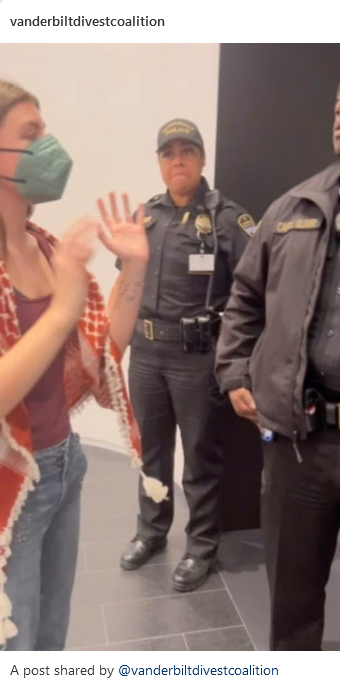
There are many dumbfounding moments from this latest campus frenzy — for example, when the students, arms linked, called the black police officers protecting the chancellor “puppets”. When food was brought in from Panera Bread by the administration for the officers but not the students, it was treated like a human-rights abuse.
But the tampon takes the cake. (Major props to Steve McGuire for compiling the best episode of the internet since yesterday.)
Here’s what went down: during one of those 21.5 hours of the protest, probably at an ungodly one, a few of the student demonstrators decided to call 911. That’s because their friend, who was part of the sit-in, had to change her tampon.
Specifically, she was “being denied the right to change her tampon that has been in for multiple hours, which leads to an increased risk of toxic shock syndrome.”
The frankly Zen-like 911 operator, who deserves a raise, was understandably confused. “Ma’am, do you have an emergency?”
Um, yes?! The student on the phone requests urgent medical assistance.
“You’re telling me your friend in Kirkland needs an ambulance. Is that what you’re telling me?”
Then in another video, one of the protesters—in a keffiyeh and a mask—approaches the police and an administrator, who was indeed in a sweater vest, demanding to know WHAT. WILL. HAPPEN. to her friend, should she leave the sit-in to change the tampon in question. The adults calmly explain that she won’t be arrested if she leaves the building. But can they confirm that she will never be arrested, ever?!
“She does not feel safe,” someone says off-screen, punctuating it with claps.
This whole thing makes the Nick Christakis Halloween costume struggle session look like a teachable moment. It must be seen to be believed. Watch all the videos in Steve’s thread here.
For starters, if having a tampon in for “multiple hours” is grounds to call for an ambulance, I should have been dead years ago. Second, this student was being denied no such right. All she had to do was get up, leave the protest, and find one of the hundreds of bathrooms that she had access to elsewhere on campus. Pro tip: wear a pad to the all-night protest. The First Amendment doesn’t come with a heating pad.
It’s all very Karen, to borrow a trope from 2020, especially when a protester demands the administrator find someone who can get them some answers. Just like middle-aged women who think dressing down the manager will somehow earn them a full refund, these students have convinced themselves that by linking arms and screaming “shame” at their college’s chancellor, they are stopping a war in the Middle East.
Don’t these authority figures realize they are standing in the way of a global intifada, which is also — obviously — a totally good thing?
We find out in a subsequent video that indeed the tampon was removed, though not in any bathroom. Reader, it came out at the sit-in, like so much urine in so many plastic water bottles. A woman on the microphone calls it “the most depraved shit I’ve seen in my entire life”.
Hard agree.
March 28, 2024
QotD: Honest scholarship … and whatever passes for scholarship these days
Equally distressing as these (and an increasing number of other) examples of scholarly utter shoddiness or execrable dishonesty is the complete incredulity of many people in accepting the “findings” of such “scholars”.
A perverted form of amusement can be had by imagining what sort of “scholarly” output you might offer to the world were you to operate according to the standards used by “scholars” such as Nancy MacLean. Free to present fiction as fact, you might, say, claim that because Dr. MacLean studied at the University of Wisconsin, and because Wisconsin was once home to the serial killer Jeffrey Dahmer – and because in her book Democracy in Chains she did not explicitly denounce serial killing – that Dr. MacLean’s work is a surreptitious attempt to justify serial killing.
Of course, any such conclusion would be both preposterous and inexcusably unethical. Anyone who (unlike me here) seriously offered such a wacky, detached-from-all-reality, ideologically motivated thesis to the public should lose not only any claim to scholarly respect, but any claim to respect of any sort. And yet the bases for the conclusions reached by “scholars” such as Dr. MacLean are no more realistic than are those in my previous, satirical paragraph.
Don Boudreaux, “The Wisdom of Bob Higgs”, Café Hayek, 2019-08-29.
March 15, 2024
Peter Turchin’s notion of the “overproduction of elites”
Severian is on a mini-vacation at the moment, but still managed to find time to share some thoughts about Turchin’s “overproduction of elites”:

University graduation – a large crowd of students at a graduation ceremony in Ottawa, Ontario. This was the thumbnail image used on the “Elite overproduction” Wikimedia page, which seemed quite appropriate.
Photo by Faustin Tuyambaze via Wikimedia Commons.
Let us consider “the overproduction of elites”. Those who love Peter Turchin’s work love this phrase, as it finally gives a name to a phenomenon we’ve all noticed: The creation, promotion, and indeed valorization of what would more properly be called social barnacles — they don’t move, can’t change, and eventually bring whatever they infest to a complete halt. Those who dislike his work often haven’t read it, so they object to the use of the word “elite” — again, these are social barnacles; what’s elite about them?
Which is precisely Turchin’s point — “elite” is a descriptor of their lifestyle, and most importantly their self-image; it is almost perfectly opposed to their actual utility. The modern Ed Biz is set up to do little else but produce these (pseudo) elites, and therefore a kind of Say’s Law takes hold. Say’s Law, you’ll recall, is vulgarly summarized as “Supply creates its own demand,” and that’s what we see with the (pseudo) elites churned out by every college in the land — they expect, indeed they demand, “jobs” commensurate with their “education”, and thus make-work “jobs” in the Apparat are brought into being.
They take out massive student loans to get the “jobs”; they “work” the “jobs” to service the debt, and so on.
But that’s true of most “white-collar” “jobs” these days. What separates the “elites”, in Turchin’s usage, from the rest of them is not their utility, or lack thereof — the economy, such as it is, would function just as well (or not) with far fewer lawyers, accountants, insurance adjusters, and so on. The difference, comrades, is what we must call Revolutionary Class Consciousness,
stealingnationalizingsocializingliberating a phrase from Lenin.An accountant, I’d wager, views his work as a technical specialty. They’re “rude mechanicals” (that’s Shakespeare, darlin’; evidently Mr. Ringo is an educated man). Maybe not so “rude” — accountants make good scratch; they’re middle to upper-middle class, economically — but basically technicians. Accounting is a highly-trained, well-compensated job, but that’s all it is: A job. Accounting is what an accountant does; it’s not what an accountant IS. Contrast that to the overproduced “elites”, in Turchin’s sense, and you see what Turchin’s sense really means: An “elite” really IS his job title.
Note the shift: His job title. As we all know, so many of the overproduced “elite” do no meaningful work. How could they? We could easily do this for most any “job” in the Apparat, but one example will suffice. Consider “Journalist”. Formerly called “Reporter”, and back then it required some actual productive output. Some “shoe leather”, as the phrase was. To find out what they were up to at City Hall, you actually had to physically go down to City Hall and follow the Mayor around. These days — the days when Reporters are now Journalists — it’s just stenography. And not even real stenography, Claudine Gay-style stenography — the Mayor’s press secretary (who probably went to college with you) emails you a press release; you change a word or two and then reprint it, basically verbatim, under your byline.
A monkey could be trained to do it. Hell, a chatbot could be trained to do it, and that’s probably a good quick-and-dirty definition of a Turchin-style overproduced “elite”: If whatever “work” he does could easily be replaced by a chatbot, with no appreciable drop-off in either productivity or quality. Because that’s the key to understanding these people: They know damn good and well, at some almost-but-not-quite conscious level, that they’re social barnacles. That is the “base” upon which the “superstructure” — again stealing terms from Onkel Karl — of their Revolutionary Class Consciousness is built.


