Quotulatiousness

November 22, 2018

This is why tax cuts are always criticized for benefitting the rich

Filed under: Economics, Government, Media — Tags: , , , — Nicholas @ 05:00

Rebecca Zeines and Jon Miltimore explain why newspaper headlines and TV anchors always seem to decry any tax cut as being disproportionally beneficial to the wealthy:

But crucial facts are often missing in these articles. As a recent Bloomberg piece explained, two key points tend to be overlooked in articles written by media outlets and progressive tax proponents:

  1. The top 1 percent paid a greater share of individual income taxes (37.3 percent) than the bottom 90 percent combined (30.5 percent).
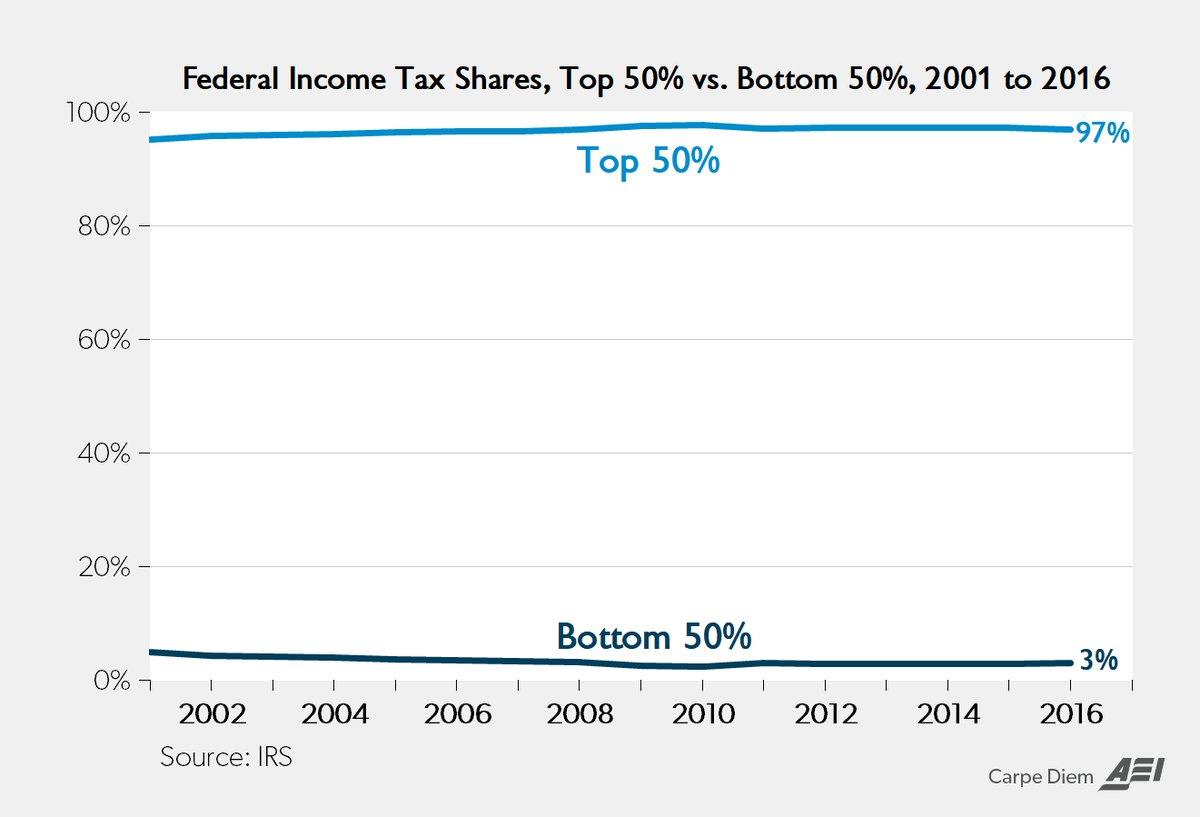
  2. The top 50 percent of all taxpayers paid 97 percent of total individual income taxes.

These numbers date back to 2016 but remain applicable in 2018.

These data show that the bottom 50 percent of US taxpayers paid just 3 percent of total income taxes in 2016, while the top 50 percent accounted for 97 percent.

Here is a wonderful visual representation of this dynamic, courtesy of Mark Perry of the American Enterprise Institute:

There is a clear correlation between economic freedom and prosperity, and tax climate is a key component of economic freedom.

Economist Dan Mitchell explains it best: Heavy taxation destroys entrepreneurship. The more money is taxed out of the private sector, the less is available for investment, development, and worker compensation (recall that after Trump’s tax bill was enacted, many businesses raised workers’ wages and offered bonuses).

Efforts to improve America’s tax climate are consistently and predictably derided as tax cuts for “the rich.” But, as the above diagram shows, it’s quite impossible to offer people a comparatively huge tax cut when they’re paying a comparatively tiny percentage of income taxes.

November 16, 2018

The political wrangles ahead over the federal carbon tax

Andrew Coyne — for once not beating the drum for electoral reform — discusses the challenge facing the federal government in the wake of provincial resistance to their carbon tax plans:

But the real test, of course, is yet to come. The provinces cannot stop the tax on their own. The court challenges are likely to fail. Provinces that refuse to implement carbon pricing will simply find the federal “backstop” tax imposed in its place. It is the election that will decide the issue, not duelling governments. Or so Conservatives hope.

Certainly there are abundant grounds to doubt the political wisdom of the Liberal plan. A tax, or anything that resembles it, would be a hard enough sell on its own. But a tax in aid of a vast international plan to save the earth from a scourge that remains imperceptible to most voters, to which Canada has contributed little and against which Canada can have little impact, while countries whose actions would be decisive remain inert? Good luck.

What seems clear is that voters’ support for carbon pricing is shallow and tentative. The Conservative strategist who chortled to the National Post that the Liberals are asking Canadians “to vote with their hearts, not their wallets” — an impossibility, he meant — was correctly cynical. Just because people want to save the planet doesn’t mean they want to pay for it.

The best way to read the public’s mood is in the positions of the political parties, who are in their various ways each trying to assure them that it won’t cost them a dime. The Liberal version of this is to promise to rebate the extra cost of the federal tax to consumers — indeed, they pledge, 70 per cent of households will make a profit on the exchange.

The Conservatives have been less forthcoming, but it would appear their plan is to hide the cost, substituting regulations, whose effects are largely invisible to consumers, for the all-too-visible tax at the pump. Here, too, I suspect they may have a better (i.e. more cynical) read on popular opinion. The public often prefer to have the costs of government hidden from them, even if they know they are paying them — even if they know they are paying more this way, as indeed they are in this case. Do what you want to us, they seem to say, just don’t rub our faces in it.

So I would be skeptical about polls showing majority support for the federal plan: 54 per cent, according to Angus Reid, while Abacus finds 75 per cent would either support or at least accept it (versus 24 per cent opposed). These were taken shortly after the announcement of the federal rebates. Yet it is far from evident the rebates will still register with people a year from now. Indeed, the Conservatives barely paused to acknowledge them as inadequate before going on to pretend they had never been mentioned.

November 15, 2018

Amazon’s HQ$2Bn decision

Filed under: Business, Economics, Government — Tags: , , , , , — Nicholas @ 03:00

If you had any doubt that the Amazon HQ2 competition was about anything other than trolling for economic bribes, this should banish the thought:

Amazon is getting some prime real estate.

In exchange for more than $2 billion in economic incentives, the online shopping giant will locate a pair of new corporate headquarters just across the Potomac River from Washington, D.C., and just across the East River from Manhattan. Tuesday’s much-anticipated announcement of the locations for Amazon’s “HQ2” also included details — which had previously been kept from the public — about the economic incentives that successfully lured the Seattle-based firm to the east coast’s political and economic hubs.

Amazon says it will invest $5 billion and create more than 50,000 jobs across the two new locations, with at least 25,000 employees at each of its new corporate campuses, to be located in Virginia’s Crystal City and New York’s Long Island City. Nashville wins a consolation prize: a new supply chain and logistics center that promises 5,000 jobs in exchange for $102 million in economic incentives.

In New York, Amazon will receive $1.2 billion in refundable tax credits through a state-level economic development program and a cash grant of $325 million that’s tied to the construction of new buildings at the Long Island City location over the next 10 years. In Virginia, the state is ponying up $573 million in tax breaks tied to the creation of 25,000 jobs, and the city of Arlington will provide a cash grant of $23 million over 15 years funded by an existing tax on hotel rooms.

Yes, the numbers are staggering — New York state’s pledge of $1.52 billion for 25,000 jobs works out to more than $60,000 in taxpayer support per new job created — but Amazon appears to have selected New York and the D.C. area based on more than just how many zeroes local officials agreed to put on the giant cardboard check.

After all, New Jersey offered Amazon $5 billion (with another $2 billion from Newark), and Maryland offered $8.5 billion. Yet Amazon passed them both over to pick their neighbors.

October 26, 2018

Economist Jack Mintz dis-claims credit for the Liberals’ carbon tax scheme

Filed under: Economics, Environment, Government — Tags: , , , , — Nicholas @ 05:00

Everybody likes to be recognized for their work, but Jack Mintz wants to delineate where his original plan and the actual carbon tax scheme implemented by the federal government diverge:

I continue to maintain, as I have all these years, that the best way to implement carbon taxes is to use the revenues to reduce harmful corporate and personal taxes (I’ve since added land-transfer taxes to the original list). This includes removing anti-competitive levies while also providing support for low-income households to cope with higher electricity, heating and transportation costs.

However, what was unveiled Tuesday by the federal Liberal government in its carbon-pricing plan fails to achieve what I would have argued to be an ideal carbon policy. What is being advertised as a climate plan for provinces that fail to follow Ottawa’s carbon-tax directives — currently New Brunswick, Ontario, Manitoba and Saskatchewan, but they’ll likely be joined by others — instead comes across as a grand redistribution scheme administered by an expanding government bureaucracy.

While the federal carbon tax is almost uniform (electricity is not yet included), it provides special exemptions for certain sectors such as farmers, fishers, aviation, power producers in the North and greenhouse operators, although not the ones growing recreational cannabis.

But the departure from uniformity is marginal and not nearly as concerning as the Trudeau government’s continuing commitment to existing and even new regulations and subsidies to promote “clean energy,” each with their implicit carbon price. While economists repeatedly argue for a carbon tax precisely because it means we can forgo these high-cost interventions, somehow that has all been lost. While plenty of the economists behind the carbon-tax lobby were cheering Prime Minister Justin Trudeau’s new plan yesterday, I somehow missed their demands that we now must eliminate clean fuel and renewable electricity standards, subsidies for electric vehicles and ethanol — all of which have carbon costs well in excess of the $50-a-tonne carbon tax planned for 2022.

Another failure of the federal plan is to pass on carbon taxes in the form of Justin Bucks — or, to use the more laborious official name for these tax rebates: Climate Action Incentive Payments. So, rather than include carbon taxation as part of a comprehensive tax reform to make the tax system simpler, less distorting and fair, these Justin Bucks will be paid to households, small businesses, municipalities, universities, colleges, hospitals, non-profit and Indigenous populations.

A fatal flaw in federal pricing plan is a major shift in taxes from individuals to businesses. The average per household rebate — $1,161 in Saskatchewan in 2022 for example — is more than the cost per household of $946 (not including GST or HST on any energy bills). Even though the document states that business taxes are fully shifted forward to households, something is amiss here. How can household rebates average more than costs?

October 25, 2018

It’s not a “bribe” … it’s an “incentive”!

Terence Corcoran explains why the federal government’s promised “incentive” isn’t in any way, shape, or form any kind of bribe:

Step right up, ladies and gentlemen. Welcome aboard the all-new Canadian Cynical Circular Carbon Circus, the amazing Liberal climate control spectacle that will send you on a great environmental ride into the future.

Come on in! We will pay you to not consume fossil fuels — as individuals and as industries. It’s an economic revolution that takes us beyond blockchain and cryptocurrencies and cannabis into a brave new universe in which money goes round and round and everybody wins. We will pay Canadians with their own money — more than $20 billion over five years in carbon taxes that will raise the price of gasoline by 11 cents a litre by 2022, and ever higher thereafter if not sooner. Everybody pays and everybody wins, except for those who don’t. And some people win more than they pay. It’s better than a lottery!

For the people of Ontario, Saskatchewan, Manitoba and New Brunswick, the federal carbon circus cash comes via a new “Climate Action Incentive Payment.” An Ontario family of four will receive $307 for this year, the amount to be claimed on 2018 income tax returns. A Saskatchewan family will get a Climate Action Incentive Payment of $609.

What’s the Climate Action Incentive Payment for? The Liberal plan unveiled by Prime Minister Justin Trudeau and Environment Minister Catherine McKenna Tuesday doesn’t specify. What are taxpayers in the four provinces being incented to do, exactly, with this new wad of free cash? There is only one explanation: Vote Liberal in 2019!

The payments are based on a 2019 carbon price of $20 a tonne, rising to $50 by 2022. As the carbon tax goes up, Ontario families will receive $718 in 2022 and Saskatchewan families $1,459. And there will be more to come, presumably, since the latest doomsday scenario from the UN Intergovernmental Panel on Climate Change — the font of all speculation and data manipulation on climate issues — warned that by 2030 (only 12 years from now) a carbon price of somewhere between $135 to $5,500 per tonne would be needed to keep global warming below 1.5 degrees Celsius.

October 21, 2018

This is why Keynesianism doesn’t work in practice – the politicians flub the hard part

Filed under: Economics, Government, Politics — Tags: , , — Nicholas @ 03:00

Tim Worstall explains the fatal flaw in Keynes’ economic theory … not so much in the theory part, but in the practical application by flesh-and-blood human beings:

We’re told that government borrowing is falling, the deficit closing. This therefore means that it’s possible to relax austerity, to start spending more upon sweeties for the voters. This being exactly and precisely why Keynesianism as a practical matter doesn’t work. For politicians will follow the fun bit and not the difficult part. Thus as an overall theory it simply is, to use a governmental phrase, no longer operative.

[…]

Think of what that basic Keynesian idea is. When the economy’s in the doldrums we should blow out the deficit in order to increase demand and thus boost the economy. But when we’re running at the resource limit then any such attempts will just turn up as inflation. So, we should stop doing that. Also, as Keynes himself pointed out, when the Sun shines is the time to repair the roof. Perhaps pay down some of that national debt so that the next time we need to blow that deficit out we’ve got space to do so.

Do note that this basic set up is also entirely consistent with modern monetary theory. When the economy is running at its limits then we should be taxing more of that created money back to prevent inflation. That is, running a smaller budget deficit, possibly even a surplus.

So, what happens to kill either theory in reality? Well, here we are. Unemployment at its lowest since the early 1970s. Employment to population ratio at its highest since then. And what are people talking about? Blowing out the deficit again to buy sweeties for voters. That is, the political imperatives just don’t militate in favour of anyone using these theories as they’re supposed to work.

In the meantime, of course, we’ve effectively changed the meaning of the word “austerity“:

Austerity is a political-economic term referring to policies that aim to reduce government budget deficits through spending cuts, tax increases, or a combination of both. Austerity measures are used by governments that find it difficult to pay their debts. The measures are meant to reduce the budget deficit by bringing government revenues closer to expenditures, which is assumed to make the payment of debt easier. Austerity measures also demonstrate a government’s fiscal discipline to creditors and credit rating agencies.

To a modern politician — or political activist — “austerity” now means something more like “only spending a bit more this year than you did last year”. British commentators have been accusing the government’s “austerity” measures for all kinds of negative effects, yet there have been no large scale austerity measures brought in.

September 25, 2018

QotD: The Laffer Curve

Filed under: Britain, Economics, Government, Quotations — Tags: , , — Nicholas @ 01:00

Around a certain sort of leftist mention of the Laffer Curve just brings a derisive snort. The sadness of that reaction being that it’s just an obvious mathematical truth. Tax rates of 0 % and 100 % bring in no revenue. Somewhere in between maximises the moolah. Note what isn’t being said, that all tax cuts always pay for themselves, nor even that lower tax rates are necessarily a good thing. Only that there’s some optimal level with regard to revenue collection.

All the arguments about the optimal level of government are over in the Wagner Curve and such others.

The Laffer Curve is also made up of two components, the income and substitution. Some people will work just to make their nut. Observational studies have shown that many taxi drivers do. So, increase their tax rates and they’ll work more. The substitution effect is, well, what’s that net wage worth to me? What’s the value of not working? When going fishing is worth more than working then people will go fishing. The curve as a whole is the interplay of these two effects.

Each tax in each society has its own such curve. A transactions tax of 0.01% can reduce revenue collection, as the EU’s study of a financial transactions tax shows us. Taxes upon income of 20% are below that Laffer Curve peak.

But where, exactly, is that peak for taxes upon income? The best study we’ve got, Saez and Diamond, says between 54% and 80% dependent upon other structures in the tax system. The Tory part of the UK Treasury says around 40 to 45% for income tax, plus national insurance, so at the bottom end of that S&D range. Many lefties want to say it’s higher so we can tax “the rich” more.

Tim Worstall, “How Lovely To Spot The Laffer Curve In The Wild – Doctors’ Pensions Edition”, Continental Telegraph, 2018-09-05.

September 7, 2018

QotD: Government distortion of the housing market

Filed under: Economics, Government, Quotations, USA — Tags: , , , — Nicholas @ 01:00

Behind the veneer of free-market governance is a deep expanse of government involvement in massive areas of the economy, such as the housing market and health care. People don’t make decisions on housing and health-care concerns every day, but when they do, they would benefit from the information that markets provide about whether they can afford a large house or whether a particular drug is worth the price. Government distortion of these key markets has scrambled these signals.

An annual congressional report, “Estimates of Federal Tax Expenditures,” gives insight into how Washington manipulates supply and demand in these sectors. Consider house prices. This year, Washington will pay homeowners $99 billion in forgone taxes to borrow money to purchase or refinance a house or to sell that house and reap the profit. Americans will buy or sell about $600 billion worth of houses this year. Government subsidy, then, represents nearly one-sixth of this market. The federal government also provides a guarantee for most mortgages, thanks to Fannie Mae and Freddie Mac, the two government-supported mortgage companies that benefited for decades from an implicit government guarantee before they got an explicit guarantee during the 2008 financial crisis.

These subsidies have fired the growth of the housing industry. Between 1975 and 1979, the U.S. Treasury paid out $102.6 billion in mortgage-interest breaks in today’s dollars. Between 2015 and 2019, the Treasury will pay out $419.8 billion in such tax favoritism — a more than fourfold rise, nearly ten times the population increase. The hike is particularly extraordinary, considering that in the late 1970s, the annual interest rate on a mortgage was 9 percent, twice what it is today. Taking today’s lower rates into account, Washington has increased the mortgage subsidy more than eightfold.

It’s no surprise that mortgage debt has soared, to $9.5 trillion, from $2.6 trillion in inflation-adjusted dollars in 1981. Back then, mortgage debt constituted 31 percent of our nation’s GDP. Today, it makes up nearly 53 percent. [Dierdre] McCloskey, who thinks that free markets are generally healthy, acknowledges that “there are examples of the price signal not coming through.” The mortgage-interest deduction is “a silly idea,” she says, yet “very hard to change.”

Indeed, government subsidy is a critical factor in whether families can afford to purchase a home, and what kind of home, how large, and in what zip code. The home-mortgage deduction, then, helps determine how people live — yet we barely notice. Few of us consider how the government shapes one of the biggest decisions we’ll ever make, or how the U.S. government’s presence in the housing market maintains the value of our homes.

Nicole Gelinas, “Fake Capitalism: It’s not free markets that have failed us but government distortion of them”, City Journal, 2016-11-06.

August 31, 2018

Farewell, buck-a-beer publicity stunt, we hardly knew ye

Filed under: Business, Cancon, Politics — Tags: , , , , — Nicholas @ 03:00

Chris Selley on the all-too-brief publicity stunt of cheaper beer for Ontario:

President’s Choice is ending its buck-a-beer promotion on Sept. 3, just days after it started: We get one week, one long weekend and then out of the pool, party’s over, back to class. PC-branded beer will rocket back up to $1.38 a bottle when you buy 24 at The Beer Store or $1.65 when you buy 12, which highlights just how steep — and presumably unsustainable — the discount really was. We shall see how long the two other participating breweries’ offers last, but they made it quite clear, as did PC, that this was a limited-time offer prompted by Doug Ford’s most shamelessly blunt populist pledge.

My goodness, though, what a commotion it will leave in its wake. Some brewers quite understandably took the opportunity to note the impact of aluminum tariffs on their bottom lines, to complain that Ford’s government was playing favourites by giving away expensive product placement in LCBO stores for $1 beer, and to note the government is actually raising taxes on beer.

Others, however, waxed utterly scandalized. “How about buck a pound of steak? Who would eat that?” asked one Toronto brewer who had perhaps not entirely thought through his rhetorical question. “We haven’t even given two thoughts about this,” Great Lakes Brewery’s communications manager, Troy Burtch, told the Toronto Star. “Why would anyone do this?” Burtch and Great Lakes have signalled their total uninterest by tweeting incessantly about it.

The Canadian Taxpayers’ Federation went after some of the affronted craft brewers for accepting taxpayer subsidies for their higher-end products. People on social media lined up for and against buck-a-beer, vowing to boycott the participants or those complaining about the program.

The whole thing was a dumb Ford Nation stunt, no question. But good grief. You can hardly blame the breweries, either for participating or for not: they were just trying to wring as much publicity as they could from the situation. No one is really any worse off, or at least not much. What we were really seeing among the chattering classes was a rerun-by-proxy of the June 6 election: to drink Ford’s swill was to vote Ford Nation; to boycott it was to stand bravely against their entire agenda.

August 10, 2018

The tough part of selling a national carbon tax … is the “tax” part

Filed under: Cancon, Economics, Environment — Tags: , , — Nicholas @ 05:00

As Colby Cosh points out, you can find all sorts of economists to explain why a properly constructed and applied carbon tax is the least harmful way to reduce carbon output, but Canadians typically focus on the “tax” part and not the claimed environmental efficiency benefits:

In yesterday’s Financial Post, the Calgary economist Jack Mintz asked the question “Why are carbon taxes so unpopular?”, pointing out that plenty of countries and jurisdictions have commitments to climate progress and energy efficiency but that few use this particular policy instrument. I guess Jack wouldn’t have had much of a column if he had just adopted the spirit of an auto mechanic explaining a breakdown to a naive car owner and jabbed directly at the problem. “See that word ‘taxes’? There’s your problem right there.”

And, truly, it is not quite as simple as that. But, as Mintz suggests, it is a big part of the difficulty. As a means of helping reduce carbon output, carbon taxes are competing with subsidies and regulations. Pervasive carbon taxes are, as a general principle, a less costly way of eliminating freely exhaled carbon, pound for pound or ton for ton.

If the tax is well designed, you are slapping a uniform unit price directly onto the thing you are trying to prevent; and you are leaving people and businesses to make decentralized judgments, based on their knowledge of their own circumstances, about whether to avoid the tax, and when, and how to do it. Even though the initial level of the tax must be something of a guess, you can adjust it by arbitrarily small increments until you have eliminated just as much carbon output as you wish to.

Economists will recognize that last paragraph as a grocery list of the relative advantages of carbon taxation. But voters are predisposed to hate taxes, and are very sensitive to their size and their side effects. They may not like government subsidies for windmills or carbon-capture schemes or certain species of light bulb either; but subsidies can usually be sold on the basis of local job creation or business incubation, and they can be — let’s face it, inevitably are — adjusted for maximum electoral benefit.

For my part, I don’t disbelieve the economists on the efficiency arguments … I just don’t trust the government to design and implement such a tax without rigging the system to benefit favoured corporations, regions, and donors.

July 26, 2018

The Trump tariffs are working exactly as designed

Filed under: Economics, Government, Politics, USA — Tags: , , , , — Nicholas @ 05:00

That is, they’re becoming a drag on the economy and will take away a lot of the economic activity that was stimulated by the tax cuts enacted earlier. Warren Meyer says that it’s time that congress reclaimed the tariff powers it has outsourced to the executive branch over the years:

I Know Congress Hates To Challenge A President of Its Own Party, But…

…Congress simply has to pare back the tariff authority it has delegated the President. It is simply insane that Trump can just unilaterally impose 20% tariffs on foreign automobiles, a $200 billion new tax on US consumers.

It is appalling to see Trump following the usual blue model of economic regulation, imposing one intervention after another, each meant to fix the unintended consequences of the last intervention. Steel tariffs increased costs to domestic auto makers, so Trump proposes tariffs on foreign autos. When tariffs result (inevitably) in counter-tariffs on US agricultural exports, Trump proposes more agricultural subsidies. People (not me) lament gridlock in government and want more fluid lawmaking — well here it is. And it sucks. It is mindless and reactive and emotional and totally ignorant of economics.

These tariffs, when combined with earlier actions, will result in tax increases on consumers that swamp the tax cuts Trump and the Republicans were so proud of last year.

Jon Gabriel on the most recent “fix” for one of those unintended consequences:

A few months back, President Trump declared that “trade wars are good, and easy to win.” Now, just as nearly every economist on the left and right predicted, Americans are being hurt.

The White House slapped tariffs on imported steel and aluminum. China retaliated with planned tariffs on soybeans, meats and various agricultural products. Mexico, Canada and the European Union also struck back at farm goods and other U.S. exports.

A smart leader would notice his mistake and end the destructive policy. Instead, Trump declared that “tariffs are the greatest” and created a multibillion-dollar federal program to mitigate a small part of the mess he created.

Since Agriculture Secretary Sonny Perdue estimated $11 billion in damage to the industry, he announced a $12 billion payoff to make up the difference.

The administration used emergency executive powers created during the Great Depression; that way Congress wouldn’t get to weigh in.

“This is obviously a short-term solution that will give President Trump time to work on a long-term trade policy and deal to benefit agriculture as well as all sectors of the American economy,” Perdue told reporters.

It’s certainly short-term, but hardly a solution. Trade deals and networks are disrupted, farmers can’t plan for the future, and non-agricultural industries are still losing money. Not to mention all the American consumers watching prices rise on all sorts of household goods.

But red states have a lot of farmers and the midterms are just three months away. Maybe borrowing a few billion dollars will hide enough economic pain to convince voters to keep Republicans in power for two more years.

July 18, 2018

QotD: Understanding how company profits can be used

Filed under: Australia, Business, Economics, Government, Quotations — Tags: , — Nicholas @ 01:00

In its fight against company tax cuts, [the Australian] Labor [Party] peddles the myth that company tax cuts are a windfall for big businesses and their shareholders, this week even launching ads suggesting [Australian PM] Malcolm Turnbull supports company tax cuts because he’ll personally benefit as an investor.

It’s a myth easily debunked. Think about it. What exactly can a company do with the extra money retained from paying less tax? It can only spend profits in two ways: paying dividends to shareholders or spending more on its operations.

Dividends are subject to tax, including withholding tax for foreign shareholders. Suggesting Turnbull or any other investor will get a windfall is a blatant lie.

In fact, many shareholders will pay more tax to make up the greater difference between the company tax rate and their own tax rate. That’s how dividend imputation works, as Labor well knows.

Alternatively, the company can spend more on things like technology, plant and equipment, funding research and development, expanding its sales force or opening new shopfronts or branches. In other words, more money paid in wages to workers and buying goods and services from suppliers.

All of that spending is also taxed. Workers pay income tax. GST [Goods and Services Tax] is collected on goods and services. Suppliers pay company tax or income tax themselves.

Lower company tax simply allows a business to use more of its money on something productive before the money is collected by government.

Nyunggai Warren Mundine, “Bill Shorten’s Labor would kill the reforms of Hawke and Keating”, Financial Review, 2018-06-26.

June 16, 2018

Who will think of the children Australian civil servants???

Filed under: Australia, Bureaucracy, Government, Humour — Tags: , , , — Nicholas @ 03:00

A tale from Catallaxy Files that’s sure to tug on your heartstrings:

In Canberra today, the Australian Greens announced a new tax fairness policy to remedy a design fault in the current system.

According to the Greens, it seems that it is only Australian public servants (local, state and Federal) who have been able to negotiate salary increases. As a consequence, because of their increased salaries, public servants are constantly pushed into higher tax brackets with the result that impost of bracket creep disproportionately falls on them.

Independent economic research has confirmed this phenomena. The Australia Institute economists have models showing that up to 80% of Commonwealth bracket creep tax receipts are paid by Australian public servants.

The Australian Greens believe that just because public servants earn more than private sector workers, they should not be required to pay more tax. Australian Greens’ Treasury spokesperson Adam Bandt said:

    Australian public servants should not be forced to carry the brunt of government spending, including spending on other public sector salaries. This is a role for the private sector. It is manifestly unfair that just because public servants have been able to extract additional salaries that they should be forced into higher tax brackets.

In response, the Australia Greens have announced the Tax Equalisation and Redistribution Designation (TERD). Under the TERD, full-time, part-time and casual public sector workers will be subject to a separate tax schedule with a flat 15% rate for income above $500,000. Public servant income below $500,000 will be tax free.

Of course, it would be even simpler for accounting purposes just to exempt the civil service from paying tax at all — we might expect that to be a Green Party policy plank in a year or two (or even our own NDP, who have a lot of support from our unionized civil service).

Reminder: Catallaxy Files is not a parody site … although this particular story is a parody. Not following Australian politics closely, I only twigged when they got to the acronym for the program…

June 5, 2018

Taxing Work

Filed under: Economics — Tags: , , , — Nicholas @ 02:00

Marginal Revolution University
Published on 22 Nov 2016

For most people in developed countries, retirement comes down to a choice: weighing the costs and benefits of continuing to work vs. leisure. An important factor influencing an individual’s decision is their government’s tax and retirement policies.

Most developed countries offer a government-run retirement system with benefits that kick-in at a certain age. That age varies from country to country, usually starting when a worker reaches their early sixties.

Of course, not everyone wants to retire simply because they can receive benefits. People that really love their work may choose not to retire. In some countries, though, that decision can be heavily penalized through lost retirement benefits.

Taxes on earnings plus penalties, like losing retirement benefits, gives us an implicit tax rate. Countries with higher implicit tax rates for older workers see a much lower labor force participation rate for people considered retirement age.

As you might imagine, these government policies on retirement can be extremely costly. Many European governments that penalize non-retirement have been working to reform these policies and reduce implicit tax rates for elderly workers.

In the Netherlands, which had one of the highest implicit tax rates in the 1990s, an older worker could have actually had to pay to work. Since the Netherlands reformed their policies surrounding retirement, they’ve seen an increase in the labor force participation rate for older workers.

In the next video, we’ll cover another big influence on female labor force participation: The Pill.

June 4, 2018

The economic damage of tariffs

Filed under: Economics, History, Politics, USA — Tags: , , , , — Nicholas @ 05:00

Tim Worstall fisks a recent Pat Buchanan brain fart article on the glories of erecting tariff walls against foreign trade:

Pat Buchanan has been going on for decades about how wondrous tariffs are and if only they were brought back then things would be just peachy. Sadly, this all seems to be based on his not understanding trade, tariffs, nor apparently even history. That’s not a good set of recommendations for a policy about trade and tariffs, one that has been tried many a time in history.

Now, it is entirely true that if we returned to a more Hamiltonian policy era then we’d all be richer. But that wouldn’t be because we had tariffs which paid for government rather than an income or corporate tax. It’s because government would be confiscating a very much smaller portion of what we all produce to pay for itself. If the Feds took 3% of everything we do instead of the current 18% or so then sure, we’d all be richer. But that’s true however that tax is raised.

[…]

His argument is that, protected from foreign competition, American business was able to develop and grow into being world beaters. No, I don’t think this is true – I insist that behind tariff barriers companies stagnate. Indeed it’s standard economics that the medium to long term effects of trade are that the competition from foreigners is what makes the domestic companies stronger and more productive. But put that argument to one side. Assume that Buchanan is correct.

For his conclusion to be correct then it must have been true that the total costs of trade were rising in that time period. Total costs being tariffs plus transport. Only if the total costs were rising was protection rising. The tariffs are only part of the story. And as it happens total protection was falling over this time period. The falls in the costs of transport – for the US externally primarily the steam ship – were greater than the rises in the tariffs. Thus the US was becoming more open to trade at this time when industry was booming and growing to world class levels.

That’s not an argument in favour of trade protection now, is it?

    The U.S. relied on tariffs to convert from an agricultural economy in 1800 to the mightiest manufacturing power on earth by 1900.

Well, it’s also true that what the US was inside those tariff barriers was the largest free trade area in the world. I’m the guy insisting that free trade makes places grow, Pat the opposite. And the place with more free trade among more people than anywhere else grows fastest? That’s a point in my favour, no, not Pat’s? Remember, the US Constitution expressly forbids the individual states from having tariffs between them…..that regulation is left to the Feds who have never imposed them.

    How have EU nations run up endless trade surpluses with America? By imposing a value-added tax, or VAT, on imports from the U.S., while rebating the VAT on exports to the USA. Works just like a tariff.

No, a VAT does not work like a tariff. In no manner at all does it do so in fact. As every economist keeps trying to point out. Within the EU all goods and services, no matter where they’re made, pay the exact same rate of VAT. Well, OK, ladies unmentionables pay a lower rate than motor cars, that’s true, but all unmentionables pay the same rate, all cars. There is no difference made between domestic and foreign production. It’s entirely unlike a tariff therefore, the crucial component of which is that distinction made between home and foreign production.

Stuff made in the EU and sold in the US pays no VAT. Stuff made in the US and sold in the US pays no VAT. Again, we’ve no distinction by source or origin, this is entirely and completely unlike a tariff.

« Newer PostsOlder Posts »

Powered by WordPress