Quotulatiousness

April 25, 2018

Ontario’s ongoing guaranteed annual income experiment

Filed under: Cancon, Economics, Government — Tags: , , , , — Nicholas @ 05:00

Finland may have given up on their guaranteed annual income pilot, but Ontario’s similar program is still getting positive reviews from GAI fans like Andrew Coyne at the National Post. Colby Cosh isn’t quite as impressed with the program or the chances of it being expanded beyond its current small scale:

The Ontario plan is giving randomly selected low-income working-age individuals $16,989 a year in free money. That’s the basic story, with the detail that couples are eligible for a combined $24,027. This amount replaces provincial welfare, employment insurance, or early Canada Pension Plan payments, dollar-for-dollar; Canada Child Benefit cheques are strictly separate, however, and if study members go out and earn some income, their payment is reduced by 50 cents for every dollar they make until the supplement hits zero.

This is the “negative income tax” model of guaranteed income, intellectually pioneered by the Austria-Mont Pelerin-Chicago strain of economic thought that is my personal heritage and Coyne’s alike. The conclusion of the PBO paper is that the total cost of such a program for the entire country, applied to this year’s economy, would come to about $76 billion.

[…]

Kevin Milligan, a UBC economist who is skeptical of GAI, often points out that GAI advocates face the challenge of reconciling three conflicting elements of such a program: we want it to have a reasonable overall cost, we want it to be generous enough to bother with, and we want it to impose a low “clawback” rate on earned income so as not to discourage that.

The “Ontario model” sort of resolves the “trilemma” by being soggy on all three fronts. The $17,000 basic amount was chosen specifically to come to 75 per cent of Statistics Canada’s “low-income measure”: it is a guaranteed not-even-low income. (At the same time, I notice that the basic personal exemption on federal income tax forms is just $11,809 this year. Before we hurl ourselves headlong at a new social program of a relatively untested nature, maybe we could explicitly just stop taxing the poor first?)

Three points of GST may seem like a reasonable overall cost, if it could be realized, but an entitlement such as this is bound to be a one-way street: by the time we decide we do not like the effects, it will have become the next thing to a sacrament. (Canada’s guaranteed federal income defines us as a country!) Meanwhile, the 50-per-cent clawback in the Ontario model is fairly dramatic, and, moreover, under the model, couples who begin cohabiting would stand to lose up to $10,000 a year of GAI payments between them.

April 12, 2018

Canadian Music Policy Coalition pushes to revive the idea of an “iPod tax”

Filed under: Cancon, Law, Media — Tags: , , , — Nicholas @ 05:00

Michael Geist on one particular rent-seeking submission to the federal government pushing for changes to Canadian copyright law:

The long-awaited Canadian copyright review is set to kick off hearings next week as a House of Commons committee embarks on a year-long process that will hear from a wide range of stakeholders. My Globe and Mail op-ed notes that according to documents obtained under the Access to Information Act, however, one stakeholder – the Canadian Music Policy Coalition, an umbrella group representing 17 music associations – got an early start on the review process last fall by quietly submitting a 30-page reform proposal to government officials.

The proposal, titled “Sounding Like a Broken Record: Principled Copyright Recommendations from the Music Industry”, calls for radical changes that would spark significant new consumer fees and Internet regulation. The plan features new levies on smartphones and tablets, Internet service provider tracking of subscribers and content blocking, longer copyright terms, and even the industry’s ability to cancel commercial agreements with Internet companies if the benefits from the deal become “disproportionate.”

The coalition, which includes the Canadian Council of Music Industry Associations, the Canadian Music Publishers Association, and copyright collectives such as SOCAN, asks the government to follow three main principles as part of its reform process: real-world applicability, forward-thinking rights, and consistent rules.

But the coalition proposal largely avoids discussing the current state of the industry, perhaps with the intent of leaving some with the impression that file sharing remains a significant problem. The reality is the music industry in Canada, led by the massive growth of authorized music streaming services, has enjoyed a remarkable string of successes since the last time copyright law was overhauled in 2012.

The Canadian music market is growing much faster than the world average, with Canada jumping past Australia last year to become the sixth largest music market in the world. Music collective SOCAN, a coalition member, has seen Internet streaming revenues balloon from $3.4 million in 2013 to a record-setting $49.3 million in 2017.

Moreover, data confirms that music piracy has diminished dramatically in Canada. Music Canada reports that Canada is below global averages for “stream ripping”, the process of downloading streamed versions of songs from services such as YouTube. Last month Sandvine reported that file sharing technology BitTorrent is responsible for only 1.6 per cent of Canadian Internet traffic, down from as much as 15 per cent in 2014.

Yet despite the success of Internet streaming services and the marginalization of file sharing activity, the coalition has crafted a reform proposal that would be more at home in 2008 than in 2018. For example, the industry is now calling for new fees to be set by the Copyright Board on all smartphones and tablets to compensate for personal copying. The revival of the so-called “iPod tax” would today go far further than just digital music players, as the coalition is asking the government to amend the Copyright Act to allow for fees to be imposed on all devices.

April 5, 2018

QotD: ESR’s “Iron Laws of Political Economics”

Filed under: Economics, Government, Politics, Quotations — Tags: , , , , , — Nicholas @ 01:00

Mancur Olson, in his book The Logic Of Collective Action, highlighted the central problem of politics in a democracy. The benefits of political market-rigging can be concentrated to benefit particular special interest groups, while the costs (in higher taxes, slower economic growth, and many other second-order effects) are diffused through the entire population.

The result is a scramble in which individual interest groups perpetually seek to corner more and more rent from the system, while the incremental costs of this behavior rise slowly enough that it is difficult to sustain broad political opposition to the overall system of political privilege and rent-seeking.

When you add to Olson’s model the fact that the professional political class is itself a special interest group which collects concentrated benefits from encouraging rent-seeking behavior in others, it becomes clear why, as Olson pointed out, “good government” is a public good subject to exactly the same underproduction problems as other public goods. Furthermore, as democracies evolve, government activity that might produce “good government” tends to be crowded out by coalitions of rent-seekers and their tribunes.

This general model has consequences. Here are some of them:

There is no form of market failure, however egregious, which is not eventually made worse by the political interventions intended to fix it.

Political demand for income transfers, entitlements and subsidies always rises faster than the economy can generate increased wealth to supply them from.

Although some taxes genuinely begin by being levied for the benefit of the taxed, all taxes end up being levied for the benefit of the political class.

The equilibrium state of a regulatory agency is to have been captured by the entities it is supposed to regulate.

The probability that the actual effects of a political agency or program will bear any relationship to the intentions under which it was designed falls exponentially with the amount of time since it was founded.

The only important class distinction in any advanced democracy is between those who are net producers of tax revenues and those who are net consumers of them.

Corruption is not the exceptional condition of politics, it is the normal one.

Eric S. Raymond, “Some Iron Laws of Political Economics”, Armed and Dangerous, 2009-05-27.

March 13, 2018

The economic argument for carbon taxes

Filed under: Economics, Environment, Government — Tags: , , , , — Nicholas @ 05:00

Tim Worstall explains what a carbon tax is supposed to do, as opposed to what many environmental activists want it to do:

The essential economic analysis is that carbon emissions are an “externality.” There are costs to third parties of the freely chosen activities of consenting adults. If there aren’t such third party costs then the adults get to consent – as long as your bedroom contains only those freely consenting adults then what goes on there is up to you. But if there are those third party costs – say, the noise from the enjoyments causes lost sleep among the neighbours – then some societal power to force an adjustment seems reasonable enough.

Again, economics analyses here by suggesting that we’ll get too much, or too many, of those third party costs if people aren’t paying for them. If we’ve not got to pay to soundproof the orgy then we’ll have more orgies than if we do. It’s fair that we insist upon such soundproofing perhaps. But sometimes we cannot insist upon such direct actions – then we’ve got to try and change the price system. Which is what the carbon tax does.

There are benefits to using fossil fuels – transport, heat, cooking and so on. Given current technological levels immediate banning would mean billions die – commonly thought to be a Bad Thing. But there are those costs imposed upon others as well in the climate change the emissions cause. The answer is that we look to that greatest good of the greatest number, the utilitarian answer. Where emissions produce more value than the damage they cause – including over time – then we want them to continue. Where they don’t then we want them to stop. That way we get the maximum possible value being created and thus all humans – over time – are as rich as we can be given current technologies.

Calculating what this number is, this tax rate, is also known as determining the social cost of carbon emissions. The Stern Review may or may not have exactly the right number but it’s a good enough starting point, $80 per tonne CO2. Say 50 cents or so per gallon of gas. Slap that tax on and we’ve corrected the price system. People who use gas are now paying the environmental costs of their use. So, anything they use it for must create greater value than the damage being caused. We’re copacetic at this point, we’ve the optimal level of emissions.

Note that this logic still works whatever you think of the rate. 1 cent or $100 a gallon, the logic is still the same, we’re only arguing over what is that social cost of carbon. Stick a tax on of whatever it is and we’re done.

Even if climate change isn’t a problem, or isn’t happening, we do still need some tax revenues somewhere. It’s also better to tax consumption than incomes or capital, better to tax things inelastic in demand with respect to price than those elastic. Fossil fuel consumption taxation is a consumption tax and the demand for fossil fuels is, in the short to medium term at least, inelastic. We’re fine with fuel taxation therefore.

For a quick backgrounder on the concept of externalities, MR University did a video on this a few years back. For reasons to worry that your government might not be quite as revenue-neutral in imposing a Pigouvian tax, Warren Meyer also has doubts.

January 27, 2018

Econ Duel: Rent or Buy?

Filed under: Economics — Tags: , , , — Nicholas @ 02:00

Marginal Revolution University
Published on 13 Sep 2016

Owning a home is a huge part of the American Dream. But is the dream of home ownership really all it’s cracked up to be?

In this new Econ Duel from Marginal Revolution University, Professors Tyler Cowen and Alex Tabarrok weigh in on the issue. Each representing a side of the home ownership debate, the two professors ask what’s smarter — to rent, or to buy?

On the “buy” side, Tyler Cowen shares the tax advantages of buying a home as well as the effect home ownership has on one’s stability and savings regimen. Does buying a home force us into better savings habits?

Against those arguments, we have Alex Tabarrok, coming down on the “rent” side of the equation.

Among other points, he talks about the real beneficiary of tax breaks (hint: It may not be you!). Along with that, Alex tackles the trials and tribulations of home-buying, in places like San Francisco, New York, or Boston, where a combination of scarce building permits and increased demand drive up home prices. Plus, doesn’t owning a home — and committing a 20% down payment — break the diversification rule of good investing?

All that said, though, here’s the real question that matters — which side are YOU on? Watch and let us know in the comments!

January 18, 2018

Live in Toronto? Feel undertaxed? Here’s your easy solution to give the city more of your money

Filed under: Cancon, Government — Tags: , , , — Nicholas @ 03:00

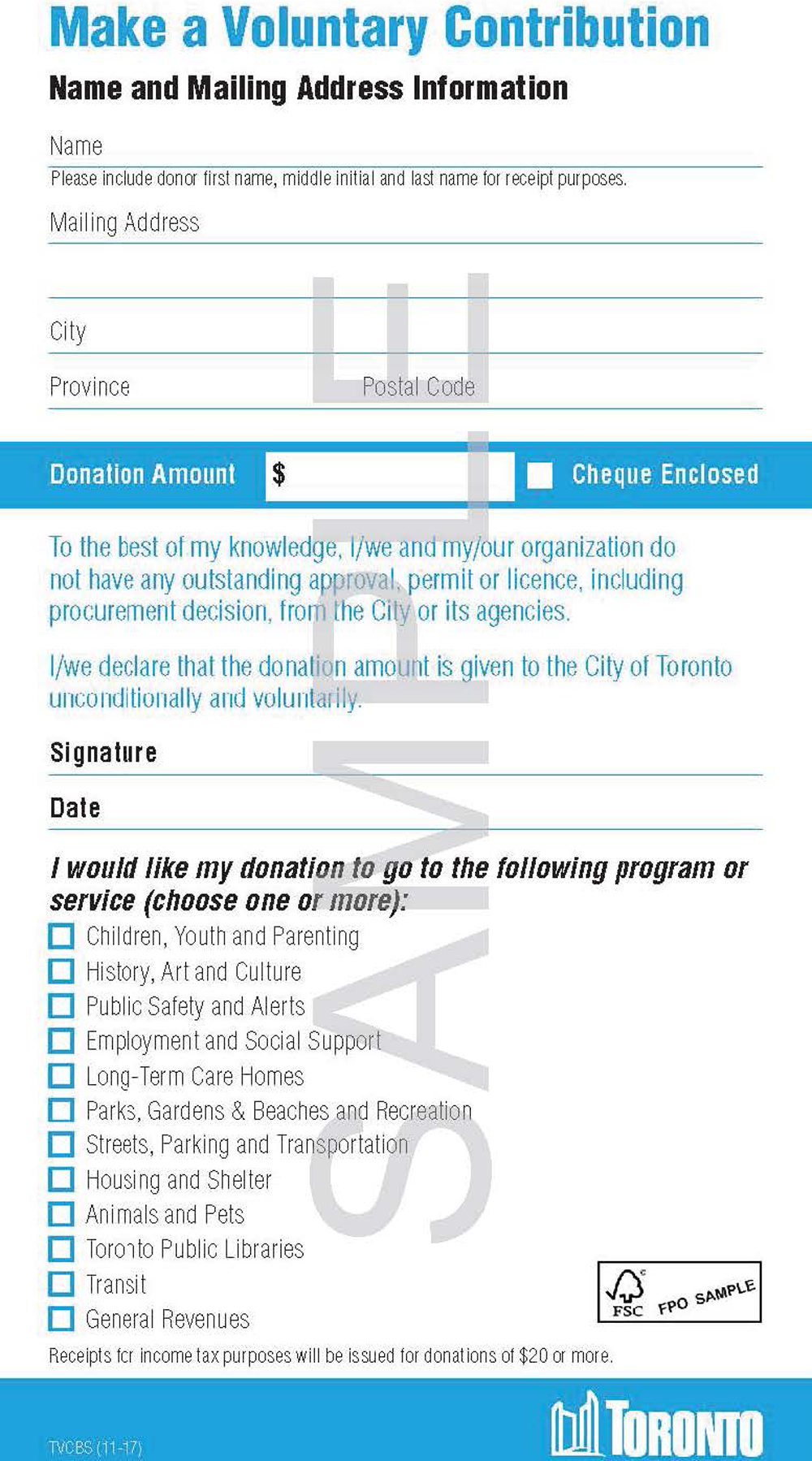
Chris Selley points out that in addition to your opportunity to pay more than your fare share of federal tax (Her Majesty, in right of Canada, is always happy to accept any amount you wish to donate), Toronto taxpayers are able to use a simple form to donate money to the city:

Click to see full-size image.

So here’s a proposal: Torontonians who consider themselves undertaxed should give the city the difference. Every time you get a property tax bill, you get a little blue insert inviting contributions of up to $50,000 to the program of your choice or just into general revenues. Say your house is worth $750,000. Your bill should be around $4,962, or 0.66%. If you think Mississauga’s rate (0.85 per cent) or Brampton’s rate (1.05) per cent is more appropriate, then just cut the city a cheque for the difference ($1,413 or $2,913, respectively), send it back in the envelope provided and watch for your tax receipt. There are a lot of progressive homeowners in this city. It wouldn’t take much before we were talking about real money.

Is this likely to happen? Certainly not. The inserts date from 2010, when council cancelled the vehicle registration tax. A parade of deputants to budget committee said they didn’t want the money back; council gave them an easy way to give it back; almost nobody did, and almost nobody does now. The grand total of voluntary contributions under the property tax envelope program in 2016 was $81,320.77, and one of those donations was for $50,000.

Total contributions to city programs are of course much larger. The Toronto Public Library (which I support, however modestly) issued tax receipts for $3.4 million in donations in 2016, the zoo for $1.1 million. But the city itself only issued $1.35 million in total tax receipts, even as many of us beg it to take more of our money and spend it on council-approved priorities.

It might not be fair to pay more than your neighbour. But when you tell pollsters you want to be taxed more, political strategists don’t believe you. And when Doug Ford can win 33 per cent of the vote after four years of his brother as mayor, it’s tough to say they’re misguided. You can wait for a critical mass of your fellow citizens to come around to your worldview, or you can nudge the process along with your pocketbooks. Your money is as good as anyone else’s.

January 7, 2018

QotD: The Whiskey Rebellion

Filed under: History, Liberty, Quotations, USA — Tags: , , , , , , — Nicholas @ 01:00

Ninescore and fifteen years ago, with the ink only just sanded on the United States Constitution, President George Washington and Treasury Secretary Alexander Hamilton decided it was time to try out their shiny brand-new powers of taxation.

Their first victims would be certain western Pennsylvania agricultural types long accustomed to converting their crops into a less perishable, more profitable high-octane liquid form. Unfortunately for the President and the Secretary, many of these rustics, especially near the frontier municipality of Pittsburgh, placed a slightly different emphasis than high school teachers do today on the Revolutionary slogan regarding “taxation without representation”. In their view, they’d fought the British in 1776 to abolish taxes and they weren’t interested in having representation imposed on them by that gaggle of fops in Philadelphia, the nation’s capital. They made this manifestly clear by tarring-and-feathering tax collectors, burning their homes to the ground, and filling the stills of those who willingly paid the hated tribute with large-caliber bullet holes.

Feeling their authority challenged, George and Alex dispatched westward a body of armed conscripts equal to half the population of America’s largest city (Philadelphia once again, later famous for air-dropping explosives on miscreants charged with disturbing the peace). Four hundred whiskey rebels, duly impressed by this army of fifteen thousand, subsided. The miraculous process by which the private act of thievery is transubstantiated into public virtue was firmly established in history. The results — chronic poverty and unemployment, endless foreign wars, and reruns on television — are with us even today.

L. Neil Smith, “Introduction: A Brief History of the North American Confederacy”, The Spirit of Exmas Sideways: a “novelito” by L. Neil Smith.

December 29, 2017

2017 wasn’t all doom and gloom and Trump tweet wars

Veronique de Rugy manages to find three things that 2017 produced that somehow didn’t kill millions of Americans (so far, as far as we know):

First, President Donald Trump just signed a historic reduction in the corporate income tax rate, from 35 percent — the highest of all industrialized nations — to 21 percent. And except for a one-time repatriation tax, the U.S. will no longer tax most profits made by businesses overseas.

Both changes should boost economic growth and American workers’ wages. Moreover, the reform removes many of the distortions that discourage companies from investing foreign-earned income in the United States and prompt them to use tax avoidance techniques.

Second, this was a very good year for deregulation. Cutting taxes isn’t the only way to boost growth and raise wages; innovation may matter even more. Getting rid of duplicative and outdated regulatory hurdles to innovation promises to have a real impact on our lives. That’s what the Trump administration, with the help of Congress, seems committed to doing.

When the president first got to the White House, for example, he froze many not-yet-implemented Obama-era regulations. These include the punishing overtime pay regulation, which would have increased the cost of employing workers and ultimately reduced their base compensation to offset the increase in overtime pay.

[…]

Last but not least are the sustained efforts by Sens. Pat Toomey, R-Pa., and Richard Shelby, R-Ala., to slow down the process that would restore the Export-Import Bank, a bastion of cronyism, to its full and former glory.

Appointing enough board members to give Ex-Im a full quorum would instantly restore the agency’s ability to sign off on deals above $10 million for the benefit of a handful of very large foreign and domestic corporations. By resisting, the two senators are fighting a lonely fight on behalf of the unseen victims of corporate welfare.

December 12, 2017

Kill the Mortgage Interest Deduction Now!

Filed under: Economics, Government, USA — Tags: , , , — Nicholas @ 04:00

ReasonTV
Published on 11 Dec 2017

Thankfully, one of the biggest scams in the American tax code is finally under attack in the House version of Republican tax reform.

It’s the mortgage-interest deduction, which lets homeowners deduct interest paid on mortgages of up to $1 million for two houses. Ever since owning a home has been a central tenet of the American Dream since the end of World War II and the rise of suburbia, it’s been a given that deducting mortgage interest from your taxes is as American as apple pie.
_____

The House plan would limit filers to deducting interest on the first $500,000 of a mortgage on just one house, sending a blind panic through wealthy home owners, realtors, and the building trades, all of whom are terrified that a government subsidy is being yanked away from them.

But the real problem with the House bill is that it doesn’t go far enough. We should scrap the mortgage-interest deduction altogether and let housing prices reflect real market values.

The mortgage-interest deduction is typically justified by claiming that it lets people—especially vaguely defined “middle-class” people–afford homes. But it also increases the price of housing by making it artificially cheap to borrow, meaning homebuyers are willing to pay more. England, Canada, and Australia don’t let their taxpayers deduct their mortgage interest and they all have higher rates of homeownership than the United States.

The mortgage-interest deduction disproportionately benefits the wealthiest Americans, who soak up almost all the $70 billion a year it costs in foregone revenue each year. Reason Foundation’s director of economic research, Anthony Randazzo calculates that only 20 percent of tax filers claim the mortgage-interest deduction. That group by and large are part of six-figure households in a country where the median household income is $57,000.

Killing the mortgage-interest deduction might cause a one-time 7 percent drop in real estate prices, according to one estimate, with wealthy homeowners feeling most of the pain.

As a homeowner, that seems like a small price to pay to end a policy that distorts the real estate market, complicates the tax code, and benefits mostly wealthier Americans on the false promise that it makes home-owning affordable for the middle class.

The mortgage-interest deduction is just special interest pandering wrapped in a gooey story that equates “the American Dream” with having a mortgage. The tax code should be designed to raise the revenue necessary to pay for essential services, not to nudge and prod us into spending money on something the government decides is good for us.

Produced by Todd Krainin. Written and narrated by Nick Gillespie.

December 10, 2017

Political hysteria as a tool of persuasion

Filed under: Media, Politics, USA — Tags: , , , — Nicholas @ 03:00

David Harsanyi on the way the Democrats are reacting to the apocalyptic news that the Republicans finally managed to pass a tax reform:

Whenever passable Republican legislation materializes — a rarity these days — Democrats quickly warn that thousands, or perhaps even millions, of lives are at stake. Tax reform? Health care? Bogus international treaties? Internet regulations that were only instituted last year? It really doesn’t matter. Longstanding conservative ideas are not only wrong; they portend the end of America as we know it.

Why are liberals so apocalyptic and bellicose about tax reform (a rare cut that is, according to the sometimes-reliable Washington Post fact-checkers, only the eighth largest in history)? Well, everyone in politics tends to dramatize the consequences of policy for effect. A modern Democratic Party drifting toward Bernie-ism, though, is far more likely to legitimately perceive any cuts in taxation as a limiting of state control, and thus, an attack on all decency and morality. Taxation, after all, is the finest tool of redistribution. So it’s understandable.

But that’s not all of it. With failure comes frustration, and with frustration there is a need to ratchet up the panic-stricken rhetoric. It’s no longer enough to hang nefarious personal motivations on your political opponents — although it certainly can’t hurt! Good political activists must now corrupt language and ideas to imbue their ham-fisted arguments with some kind of basic plausibility. Many liberal columnists, for example, will earnestly argue that Republicans — who at this moment control the Senate, the House of Representatives and the White House, thanks to our free and fair elections — are acting undemocratically when passing bills. As you know, democracy means raising taxes on the minority. What else could it mean?

December 8, 2017

Final hurdle for US tax reform efforts

Filed under: Law, Politics, USA — Tags: , , — Nicholas @ 03:00

Veronique de Rugy looks at the two differing tax bills passed by the Senate and the House of Representatives and what needs to be done to blend them into a single bill for the President to sign:

The House and Senate passed their own versions of a tax reform bill surprisingly fast. But now the hard work starts, as they need to turn those two bills into one. The trick is to produce a bill that can pass both chambers again, meaning a bill that appeases some powerful interest groups while still making the budget math work.

In some respects, this conference process may be easier than we think. Once lawmakers have come this far with such a big bill—when stakes are this high—it’s hard to imagine them not doing everything they can to cross the finish line. Helping in the process is the fact that their bills aren’t so vastly different in terms of philosophy and provisions that it makes reconciling differences impossible.

[…]

It’s worth considering some worst- and best-case scenarios resulting from this conference process. Worst-case scenario, the final bill would water down the investment provisions and entirely preserve many tax preferences currently targeted in both bills. It would also preserve the House version’s individual rates, including a 12 percent bubble rate for top income earners, which effectively would impose a marginal tax rate of 45.6 percent, as opposed to the current 39.6 percent.

It would expand the child tax credit value beyond the levels passed in the House ($1,600) and the Senate ($2,000). That change would remove a large number of taxpayers from the tax rolls, which would be problematic because Republicans also refuse to cut spending. This also would shift more burden to the top 10 percent (taxpayers making above $138,000), who already pay 70 percent of the total federal income tax. If members of Congress also were to expand the refundable part of the credit, it would dramatically increase government spending, too.

The cherry on a very unsavory tax cake would be if lawmakers adopted the House’s tax base erosion provisions, which include an idiotic excise tax that resembles the dreaded border adjustment tax, which was killed in recent months.

To finish on a positive note, allow me to dream a little. My best-case scenario would maintain the permanent 20 percent corporate tax rate. It would also delay the adoption of anti-tax avoidance provisions until lawmakers get to assess the full impact that cutting the corporate tax rate has on avoidance behaviors by companies. Congress would adopt the Senate version of the individual tax rates or even cut the top marginal rate further.

November 23, 2017

If you think your taxes are too low, you can easily give the government more of your money

Filed under: Government, USA — Tags: , , , , — Nicholas @ 05:00

As discussed fairly recently, the government requires you to pay taxes up to a certain point, but there’s nothing stopping you from paying more than they ask. For Canadian federal taxes, Her Majesty in right of Canada would be delighted to accept any additional money you wish to donate. I’m sure your provincial or territorial government has a similar mechanism set up. Equivalent schemes are definitely available in the UK and probably other Commonwealth countries.

In the US, the tax rates are in the news again and the usual (ultra-wealthy) suspects are lining up to demand that the government not lower their taxes:

There’s an amusing ritual that takes place in Washington every time there’s a big debate about tax policy. A bunch of rich leftists will sign a letter or hold a press conference to announce that they should be paying higher taxes rather than lower taxes.

I’ve debated some of these people in the past, pointing out that they are “neurotic” and “guilt-ridden.”

But they apparently didn’t take my criticisms seriously and go into therapy, They’re now back and the Washington Post provides very favorable coverage to their latest exercise in masochism.

    More than 400 American millionaires and billionaires are sending a letter to Congress this week urging Republican lawmakers not to cut their taxes. The wealthy Americans — including doctors, lawyers, entrepreneurs and chief executive — say the GOP is making a mistake by reducing taxes on the richest families… Instead of petitioning tax cuts for the wealthy, the letter tells Congress to raises taxes on rich people like them. …The letter was put together by Responsible Wealth, a group that advocates progressive causes. Signers include Ben & Jerry’s Ice Cream founders Ben Cohen and Jerry Greenfield, fashion designer Eileen Fisher, billionaire hedge fund manager George Soros… Most of the signers of the letter come from California, New York and Massachusetts.

Earlier in the month, I would have told these “limousine liberals” not to worry because I was pessimistic about the chances of a tax bill getting enacted. But then the Senate GOP unveiled a better-than-expected plan and I’m now semi-hopeful that something will make its way through the process.

That doesn’t mean, however, that these rich leftists should be despondent.

Because I’m a nice guy, today’s column is going to let them know that they don’t have to accept a tax cut. The Treasury Department has a website that they can use to voluntarily send extra money to Washington. It’s called “gifts to reduce the public debt,” and people like George Soros can have their accountants and lawyers calculate the value of any tax cut and then use this form to send that amount of money to D.C.

November 18, 2017

QotD: A key drawback of a cashless society

Filed under: Economics, Government, Liberty, Quotations — Tags: , , , , — Nicholas @ 01:00

When I was just starting out as a journalist, the State of New York swooped down and seized all the money out of one of my bank accounts. It turned out — much later, after a series of telephone calls — that they had lost my tax return for the year that I had resided in both Illinois and New York, discovered income on my federal tax return that had not appeared on my New York State tax return, sent some letters to that effect to an old address I hadn’t lived at for some time, and neatly lifted all the money out of my bank. It took months to get it back.

I didn’t starve, merely fretted. In our world of cash, friends and family can help out someone in a situation like that. In a cashless society, the government might intercept any transaction in which someone tried to lend money to the accused.

Unmonitored resources like cash create opportunities for criminals. But they also create a sort of cushion between ordinary people and a government with extraordinary powers. Removing that cushion leaves people who aren’t criminals vulnerable to intrusion into every remote corner of their lives.

We probably won’t notice how much this power grows every time we swipe a card instead of paying cash. The danger is that by the time we do notice, it will be too late. If we want to move toward a cashless society — and apparently we do — then we also need to think seriously about limiting the ability of the government to use the payments system as an instrument to control the behavior of its citizens.

Megan McArdle, “After Cash: All Fun and Games Until Somebody Loses a Bank Account”, Bloomberg View, 2016-03-15.

November 7, 2017

“Paying for” tax cuts

In the latest issue of the Libertarian Enterprise, L. Neil Smith explains why he isn’t a fan of the notion that tax cuts need to be “paid for”:

I am not an economist, nor do I play one on TV, but I know a hand-job when I see one. The mindless mutants who are mangling Donald Trump’s tax plans are dragging this nation and the world into a Da-Daesque vortex we may never get out of. (Only a “progressive” Democrat would stomp a man’s legs, break them in a dozen places, and then make fun of him because he can’t walk.) While lowering almost everybody’s taxes, they want a special bracket appended to the deal to punish people with a million dollars or more to “pay for” everybody else’s tax relief. My question, in an era when government takes too much away from us already, why the bloody hell should it be allowed to steal more?

Even from people who are supposedly hated by the “masses”? (I seriously doubt it. “The Democrat Party masses, more likely. Most right-wing masses — if there is such a thing — aspire to become millionaires, themselves.)

Half a century ago, when I was a shiny new Objectivist warrior, jousting with various statist orcs and trolls on the left, a major concern of theirs seemed to be the big, luxurious houses that rich people built for themselves or bought and lived in. Somehow, there was something evil or sinful in that — “conspicuous consumption” one famous comtard called it — and it needed to be stopped. It didn’t ever seem to have occurred to these feeble-minded pickpockets (who had likely never done an honest day’s work in their worthless lives) that the construction of a big, luxurious house (today, we call them McMansions) requires the skilled services of dozens, if not hundreds, of earth-movers, concrete-workers, framers, finish carpenters, glazers, roofers, plumbers, sheet-rock guys, landscapers, etc., most of whom have families to feed, clothe, and house, themselves.

They need rich people to build big, luxurious houses for.

In general, there are few, if any, ways the most malign “malefactor of great wealth” can spend his money without benefitting someone who needs a job. Even cocaine has to be cultivated and processed by somebody. This lesson was learned the hard way back in 1990 when Idiot-in-Chief George 41 Bush broke his “read my lips” promise and allowed a punitive “luxury tax” to be levied on yachts, big, expensive cars, and assorted other keen stuff like that. Hundreds of jobs were lost. Thousands suffered. One company went from 220 workers to 50 overnight. Within two years those who had stirred up class envy the most energetically were calling for repeal of this “hate the rich” tax. In the same way, millionaires’ money would fly overseas in an instant and vanish from our struggling economy.

October 24, 2017

QotD: Tax complexity

Filed under: Bureaucracy, Government, Quotations, USA — Tags: , , — Nicholas @ 01:00

What’s interesting about this [IRS] scam is that it’s a departure from classic confidence schemes. Think about something like the Nigerian e-mail scams, and how they draw their victims in: greed for a lucrative finder’s fee in exchange for doing something that sounds maybe a little bit shady, but maybe sort of noble too. The victim is then strung along by playing to the greed, and kept from talking to others who might point out the scam by because they think they are complicit in something legally questionable.

The IRS scam, on the other hand, works entirely by fear. It takes people who haven’t done anything wrong, and makes them afraid that they have. That’s a pretty hefty achievement. Imagine trying to extort money from someone by, say, claiming that they had murdered someone. You might elicit laughter, or bewilderment, but you’d rarely elicit much cash.

Which raises the obvious question: How did we get into a situation where it’s so easy for people to believe that the IRS is about to arrest them for a crime they weren’t even aware of having committed?

You guessed it: The IRS is incredibly powerful, and the tax code is incredibly opaque.

Like many journalists, my husband and I pay someone to do our taxes. We have to. The year we married, I realized that with two journalists who both had salary and non-salary income, home offices, various business expenses, and a new home purchase, our taxes had finally passed the point at which I was even marginally competent to do them. Before then, I had always done my taxes myself, and filed them with a sort of wistful hope that I had done them correctly. At this point it seems worth pausing to note that:

  1. I have an MBA.
  2. I write about tax policy for a living.

These things are surprisingly little help. Filling out your taxes is not a matter of being good at math, or accounting, or even knowing how various provisions of the tax code interact in revenue projections. It is entirely a matter of knowing what can be deducted, and how. And because our tax code is so complex, that doesn’t mean “read the statute”; it means “read the statute, and the case law, and develop a sense over long experience of how agents are likely to interpret this or that during an audit.” The only people who can do that are tax professionals; the rest of us are too busy earning a living in our own professions.

There’s no perfect measure of tax complexity, but consider one quick-and-dirty metric: the number of lines on a typical tax form, and the length of the accompanying tax booklet. Quartz did just that a while back, and found that the complexity had been steadily increasing.

Legal complexity does not accumulate linearly; it accumulates exponentially. When you have one law on the books, and you add a second, the new law may (or may not) have some unexpected interaction with the old law. This would be one complexity point for regulators to manage. But with each new law, the number of potential interactions grows quickly, until it passes the ability of any layman to grasp it (and eventually, surpasses the professionals as well, which is why they’re increasingly specialized in narrow areas). We are long past that point with the tax code.

Megan McArdle, “Why We Fear the IRS”, Bloomberg View, 2016-01-04.

« Newer PostsOlder Posts »

Powered by WordPress