Quotulatiousness

May 22, 2019

QotD: A “conservative” argument for regulating social media companies

There should be a high barrier for any company seeking to interfere with the marketplace of ideas in which the right of free correspondence is practiced.

Critics of regulating dot com monopolies have made valid points.

Regulating Google or Facebook as a public utility is dangerous. And their argument that giving government the power to control content on these platforms would backfire is sensible.

Any solution to the problem should not be based on expanding government control.

But there are two answers.

First, companies that engage in viewpoint discrimination in response to government pressure are acting as government agents. When a pattern of viewpoint discrimination manifests itself on the platform controlled by a monopoly, a civil rights investigation should examine what role government officials played in instigating the suppression of a particular point of view.

Liberals have abandoned the Public Forum Doctrine, once a popular ACLU theme, while embracing censorship. But if the Doctrine could apply to a shopping mall, it certainly applies to the internet.

In Packingham v. North Carolina, the Supreme Court’s decision found that, “A fundamental principle of the First Amendment is that all persons have access to places where they can speak and listen.”

The Packingham case dealt with government interference, but when monopolies silence conservatives on behalf of government actors, they are fulfilling the same role as an ISP that suspends a customer in response to a law.

When dot com monopolies get so big that being banned from their platforms effectively neutralizes political activity, press activity and political speech, then they’re public forums.

Second, rights are threatened by any sufficiently large organization or entity, not just government. Government has traditionally been the most powerful such organization, but the natural rights that our country was founded on are equally immune to every organization. Governments, as the Declaration of Independence asserts, exist as part of a social contract to secure these rights for its citizens.

Government secures these rights, first and foremost, against itself. (Our system effectively exists to answer the question of who watches the watchers.) But it also secures them against foreign powers, a crisis that the Declaration of Independence was written to meet, and against domestic organizations, criminal or political, whether it’s the Communist Party or ISIS, that seek to rob Americans of their rights.

A country in which freedom of speech effectively did not exist, even though it remained a technical right, would not be America. A government that allowed such a thing would have no right to exist.

Only a government whose citizens enjoy the rights of free men legally justifies is existence.

If a private company took control of all the roads and closed them to conservatives every Election Day, elections would become a mockery and the resulting government would be an illegitimate tyranny.

That’s the crisis that conservatives face with the internet.

Daniel Greenfield, “Americans Paid for the Internet, We Deserve Free Speech On It”, Sultan Knish, 2019-05-16.

May 12, 2019

A handy list for your next band name

Filed under: Humour, Media — Tags: , , — Nicholas @ 03:00

An amusing Twitter thread from a few days ago threw up some entertaining band name suggestions:


I’m pretty sure that Multiaxial System opened for Estrus Peak at the El Mocambo in ’94.

May 11, 2019

Jonathan Haidt – Social media has altered a fundamental constant of the universe

Filed under: Books, Media, Politics, USA — Tags: , , , , — Nicholas @ 05:00

Katie Herzog attended the first Heterodox Academy conference and reports on Haidt, the academy’s founder, and other attendees at the event:

Jonathan Haidt at the Miller Center of Public Affairs in Charlottesville, Virginia on 19 March, 2012.
Photo via Wikimedia Commons.

I told three people that Jonathan Haidt will be speaking in Seattle this week. One is a left-leaning university professor, another is an apolitical meditation teacher, and the last is a conservative talk radio host. Despite the chasm between their personal politics, they were all equally enthusiastic to hear Haidt speak. He seems to have that effect on people, and is one of the rare political thinkers who manages to both appeal to (and occasionally enrage) people across the political spectrum.

A professor of social psychology at NYU’s Stern School of Business, Haidt is also the author of best-selling book, The Coddling of the American Mind, which he published with First Amendment lawyer Greg Lukianoff last year. That book grew out of an article of the same name that the duo first published in the Atlantic in 2015. As anyone who was paying attention back then may recall, the article made quite a splash, and it brought some emerging trends at university campuses into the public consciousness, including the rise of trigger warnings, deplatforming speakers, and university administrators’ attempts to protect students from any perceived harm. The article, and the subsequent book, didn’t exactly make Haidt popular in some hyper-left circles, and Haidt is occasionally accused of being a conservative in disguise. What he actually is, is a centrist, which gives him a perspective outside the typically left/right binary, and much of his recent work is about tribalism and division in the U.S. It’s a trend he thinks is getting worse.

[…]

“If you are in a university that puts you into interaction with diverse ideas, that makes you smarter,” Haidt says. “You can solve more problems. You become a more critical thinker. The more you hang out with people who think like you, especially if they enforce orthodoxy, the lower your IQ gets.”

In other words, only engaging with ideas you already support can actually make you dumber. It can also damage your cause. As an example, Haidt sites student attempts to deplatform both outside speakers and faculty on campuses over the last few years. Video of protests at schools like Evergreen State were widely shared on conservative networks, and while the students may have seen themselves as warriors in the fight for social justice, those who don’t already support their ideals were more likely to see hysterical students screaming at befuddled adults. The backlash was inevitable. “The antics on campus did a lot, I think, to elect Donald Trump,” Haidt says. “Most people on the left have not seen those videos but most people on the right have seen them. And so even if you think it’s virtuous to always be fighting, in the long run, you are harming your own side.”

In an effort to reverse the trend of ideological homogeneity on campus, Haidt founded the Heterodox Academy, an organization that advocates for universities to embrace viewpoint diversity (even, yes, when those viewpoints are conservative). Last year, they hosted the first Heterodox Academy Open Minds Conference in New York, which I attended. (Full disclosure: I moderated a panel, for which I was compensated.)

The conference was remarkable: Everyone I spoke to seemed to have some story about what made them first see that the world isn’t cleanly broken up into good versus evil, from professors who’d been the subject of protests to journalists who’d been canceled. Still, this was a conference mostly made up of academics and writers, and I doubt there was a single stereotypical Trump voter or social justice warrior in attendance. For the sake of viewpoint diversity this is probably a failure, but the organization still managed to bring together a crowd that included conservatives like Bret Stephens and liberals like Alice Dreger and libertarians like Kmele Foster all in one space. There were heated discussions, to be sure, but no one called for anyone else to be fired. This, I am sure, would be appalling to a certain subset of leftist Twitter, but as Haidt reminded me, social media may be loud, but it’s not representative. “We have to distinguish between the average and the visible anecdote,” he said. “This is another thing social media has done to us: We used to have a sense of the mood in a room or the mood in our social network, and now we have no idea.”

Still, he’s not optimistic that we’ll work our way out of these divisions, at least without significant disruption in the process. “Things feel so strange to me,” he said. “It feels as though a fundamental constant of the universe has been altered. I think social media has done that.”

May 8, 2019

QotD: Those “my-kid-was-almost-sex-trafficked” hoaxes

Filed under: Law, Media, Quotations, Technology, USA — Tags: , , , , , — Nicholas @ 01:00

Perhaps you’re wondering why someone would make up such a preposterous story. I have an idea.

For the last few years, there has been a string of moms going on Facebook, breathlessly claiming that they were out at the mall (or Ikea, or Target), when suddenly they realized that they were being stalked by a kidnapper clearly planning to snatch their kids and sex-traffic them.

The evidence is usually something like, “I saw a guy staring at my baby.” Or, “I saw the couple in one aisle and then I went down a different aisle and there they were again,” or, “I looked outside and there was a van with its door open!”

Inevitably, the mom congratulates herself on having had the wherewithal to figure out what was going on just in time, and bravely thwart the heinous crime by, uh, staring the guys down. Then the mom usually says something like, “if it happened to me it could happen to you,” without reminding readers that in fact, nothing happened. No one grabbed a kid. No one was sex-trafficked. (The head of the Crimes Against Children Research Center, David Finkelhor, says he knows of zero cases of a child kidnapped from a parent in public and sex trafficked.) It’s all in the moms’ heads.

Yet they get thousands, sometimes tens of thousands, of approving shares and comments on social media.

Here’s one story. Here’s another, and another, and another. Here’s one that went mega-viral a few years back. You get the idea. It’s a panic, with a twist: adulation.

The mom ends up the hero of the non-event, basking in comments like thank you for sharing this, and so glad you are safe and, you are such a strong, conscientious mama.

If only this hoax story could go as viral as the my-kid-was-almost-sex-trafficked posts.

Lenore Skenazy, “Mom Charged With Falsely Accusing a Man of Trying to Kidnap Her 5-Year-Old at the Mall”, Reason, 2019-07-04.

May 4, 2019

Canadian privacy laws

Filed under: Cancon, Law, Liberty, Media — Tags: , , , — Nicholas @ 03:00

Michael Geist asks whether it matters that Canadian privacy laws provide more privacy protection if they can’t actually be enforced:

It has long been an article of faith among privacy watchers that Canada features better privacy protection than the United States. While the U.S. relies on binding enforcement of privacy policies alongside limited sector-specific rules for children and video rentals, Canada’s private sector privacy law (PIPEDA or the Personal Information Protection and Electronic Documents Act), which applies broadly to all commercial activities, has received the European Union’s stamp of approval, and has a privacy commissioner charged with investigating complaints.

Despite its strength on paper, my Globe and Mail op-ed notes the Canadian approach emphasizes rules over enforcement, which runs the risk of leaving the public woefully unprotected. PIPEDA establishes requirements to obtain consent for the collection, use and disclosure of personal information, but leaves the Privacy Commissioner of Canada with limited tools to actually enforce the law. In fact, the not-so-secret shortcoming of Canadian law is that the federal commissioner cannot order anyone to do much of anything. Instead, the office is limited to issuing non-binding findings and racing to the federal court if an organization refuses to comply with its recommendations.

The weakness of Canadian law became evident last week when the federal and British Columbia privacy commissioners released the results of their investigation into Facebook arising from the Cambridge Analytica scandal. The report details serious privacy violations and includes several recommendations for reform, including new measures to ensure “valid and meaningful consent”, greater transparency for users, and oversight by a third-party monitor for five years.

Facebook’s response? No thanks. The social media giant started by disputing whether the privacy commissioner even had jurisdiction over the matter. After a brief negotiation, the company simply refused to adopt the commissioners’ recommendations. As their report notes “Facebook disagreed with our findings and proposed alternative commitments, which reflected material amendments to our recommendations, in certain instances, altering the very nature of the recommendations themselves, undermining the objectives of our proposed remedies, or outright rejecting the proposed remedy.”

April 24, 2019

The west is being haunted by the spectre of the “far right”

Filed under: Media, Politics — Tags: , , , , , , — Nicholas @ 05:00

Back in my younger days, I attended a seminar — I think it was Marshall Fritz presenting — that discussed the need to “define, or be defined” as a political tool. If you allow your critics or opponents to set the terms of the debate, you’ve already lost. Arthur Chrenkoff knows this well:

It was not Orwell’s original idea that those who control the language control the society and determine its nature. In any case, the left hardly ever needed inspiration from critics on how to achieve their agenda. They are instinctively good at manipulating speech and cultural expression. Watch out, therefore, for the current pattern of marginalising and delegitimising mainstream ideas they are hostile to by associating them with political fringes.

[…] we increasingly live in a world where, if you believe the media, everywhere you turn there’s the “far right”. Mainstream centre-right ideas and concerns are now being redefined as being somehow associated with and tainted by extremism. If you are worried about the violence against and the persecution of Christians you might be far right. If you value the cultural and philosophical heritage of the Western civilisation you might be far right. If you don’t believe in an open borders immigration policy you might be far right. If you prefer local democracy to transnational institutions you might be far right. If you are defending your country from an armed invasion by another country you might be far right too. If these are all to be the indicators of far right extremism, then what exactly is the “normal” right right now?

This effort to use language as a cudgel has several sinister implications. It delegitimises perfectly normal political ideas through guilt by association. It also creates the impression that the (genuine) far right is much bigger, more influential and more threatening and dangerous than it actually is. This in turn is used to downplay and minimise the dangers of Islamist and far-left extremism and terrorism. But perhaps the scariest aspect of it all is that the left, by manufacturing the far right monster, are actually genuinely contributing to the growth of far-right extremism. The relentless flood of identity politics, grievance and victimhood, and shaming and guilting entire sections of population based on their skin colour and culture is genuinely radicalising some misfits into fascism, like the Christchurch terrorist, for example. For every action there is eventually an equal and opposite reaction. The left might think it’s courageously defanging the fascist dragon but instead it’s just sowing its teeth.

April 14, 2019

The repressive new intellectual orthodoxy

Filed under: Britain, China, Europe, Politics — Tags: , , , , , — Nicholas @ 03:00

Roger Scruton discusses the interview he gave to the New Statesman:

I recently gave an interview to the New Statesman, on the assumption that, as the magazine’s former wine critic I would be treated with respect, and that the journalist, George Eaton, was sincere in wanting to talk to me about my intellectual life. Not for the first time I am forced to acknowledge what a mistake it is to address young leftists as though they were responsible human beings. Here is my brief response to an unscrupulous collection of out of context remarks, some of them merely words designed to accuse me of thought-crimes, and to persuade the government that I am not fit to be chairman of the commission recently entrusted to me.

[…]

In retrospect I could have chosen the words more carefully. But my purpose was to point out that anti-Semitism has become an issue in Hungary, and an obstacle to a shared national identity. As for the Soros Empire, I am the only person I know who has actually tried to persuade Viktor Orbán to accept its presence, and that of the Central European University in particular, in Hungary. I did not succeed, but that is another matter. I should add that I am neither a friend nor an enemy of Orbán, but know him from the days when I helped him and his colleagues to set up a free university under the communists. What Orbán did then was the first step towards the liberation of his country, and George Soros was one of those who helped him too. It is sad for Hungary that the two have fallen out, and that the old spectre of anti-Semitism has been reborn from their clash. Given their two aggressive personalities, however, it is hardly surprising.

[…]

Finally, my comments on China: I was describing the attempt of the Chinese Communist Party to achieve conformity of behaviour in everything that might threaten its comprehensive political control, and I think it is fair to describe this as an attempt to robotise the Chinese people. The Communist Party expects each person to replicate the behavioural code, not questioning its authority and finding safety in imitation. Many people see the threat of this in the attitude of Beijing towards Hong Kong. Far more important, to my mind, is the internment of a million or more Uighur Muslims, in order to clean their minds of the dangerous God idea and re-programme them with the Party idea instead. If we are not allowed to criticise this as the robotising of the victims, then what are we allowed to criticise and how?

We in Britain are entering a dangerous social condition in which the direct expression of opinions that conflict – or merely seem to conflict – with a narrow set of orthodoxies is instantly punished by a band of self-appointed vigilantes. We are being cowed into abject conformity around a dubious set of official doctrines and told to adopt a world view that we cannot examine for fear of being publicly humiliated by the censors. This world view might lead to a new and liberated social order; or it might lead to the social and spiritual destruction of our country. How shall we know, if we are too afraid to discuss it?

QotD: Sun Tzu isn’t your life coach and Confucius never said that

Filed under: Books, China, Media, Quotations — Tags: , , — Nicholas @ 01:00

Popular uses of East Asian philosophies often tend this way: toward making the circumscribed expansive, toward making small wisdoms carry water for all the wisdom. This is how the ancient military theorist Sun Tzu might end up guiding your retirement savings, coaching your kid’s football team, improving your marriage, or even raising your kids. Sun Tzu’s Art of War has been leveraged into self-help advice on all of these subjects and more. Superficially, and also for trained scholars of early Chinese military history, it might seem that Sun Tzu is in fact only really interested in managing violent conflict well. But at a deeper level – which is to say, at the level of what might be marketed to gullible Western consumers – he is actually addressing all of life’s mysteries. What reads like straightforward instruction on wartime espionage might yet have something to teach us about our children. To access this deeper meaning, we need to assume that ‘oriental’ wisdom is never about this or that, but always about everything. And importantly, at root, it is reassuring.

Worse than the bizarre uses of Sun Tzu are the seemingly endless heartwarming and encouraging things that Confucius is claimed to have said. Blandly inspirational Confucius memes are now so numerous and so detached from reality that they have spawned a meta-meme, one that reads: ‘Confucius: I never said all that shit.’ Most of the memes detailing what Confucius ‘said’ say little that is compelling or even mildly interesting. But that is exactly why it’s so important to append ‘Confucius said’ to them. Without this addendum, bracing us to receive a bit of ‘Eastern wisdom’, we might believe them to be yet more dull mini-homilies. Which, to be clear, they are. Poor old Confucius features in these memes as a mystical oriental kitten, telling us all to hang in there!

Amy Olberding, “Tidying up is not joyful but another misuse of Eastern ideas”, Aeon, 2019-02-18.

April 4, 2019

Of course Facebook is now in favour of government regulation … it’ll keep out their competition

The recent calls for the government to regulate social media got support from Mark Zuckerberg, which seems to have surprised some in the media. It’s not at all uncommon for established firms to not only welcome government oversight but to actively support it — because it’s a highly effective strategy to strangle smaller competitors and keep new competitors from entering the field:

On Saturday, Mark Zuckerberg appealed to the government for increased regulation of the internet including his company Facebook. According to Zuckerberg, increased government action is needed to protect society from harmful content, ensure election integrity, protect people’s privacy, and to guarantee data portability. If enacted, the government would possess a wide range of control over internet businesses. For Zuckerberg, this is for the public’s best interest.

But make no mistake about it, Zuckerberg’s cries for regulation is not an appeal to his humanitarianism. On the other hand, it solves glaring issues that Facebook has faced since the 2016 election.

[…]

With increased government oversight, Facebook’s leadership will finally be able to pass the buck to someone else. The government will provide them with a clear set of rules that they will be accountable for. Any negative press coverage that occurs outside of those guidelines, will not be attributable to their company but to the rule-making body of the government. This will allow Facebook’s leadership to regain credibility within a clearly definable framework that they are not responsible for creating.

But perhaps Zuckerberg’s appeal for regulation is even more cunning. Government regulation will undoubtedly be met with higher costs. Internet companies will have to spend more on staffing to be in compliance with the increased burdens implemented by the rule-making body. We saw this play out in the banking industry after the Great Recession. A study conducted last year found that since 2009, banks have been fined a total of $345 billion dollars in penalties and noncompliance costs. Further, another study found that in 2016 banks spent $100 billion dollars on regulatory compliance alone.

Large internet companies like Facebook and Google will easily absorb the strain of increased regulatory costs. It is the smaller businesses that will feel the financial squeeze. With increased regulatory compliance spending, smaller startups will face an even bigger hill to climb to compete with the likes of Facebook.

Another “feature” of government regulation is what is known as “regulatory capture”, as the regulating body and the regulated organizations, after an initial period of ostentatious “conflict”, settle down into a cosy symbiotic relationship … in only a few years, many of the regulatory staff will find themselves working for one of the regulated organizations, and vice-versa. The regulatory body will — like all bureaucracies — start to care more about keeping itself alive and growing than about the original reason it was set up. Small organizations will stall or go extinct, and only the existing dinosaurs will carry on, protected from competition by their regulator’s powers.

March 8, 2019

Wokescolds, rejoice! Titania McGrath has been unmasked!

Filed under: Britain, Humour, Media, Politics — Tags: , , , , — Nicholas @ 05:00

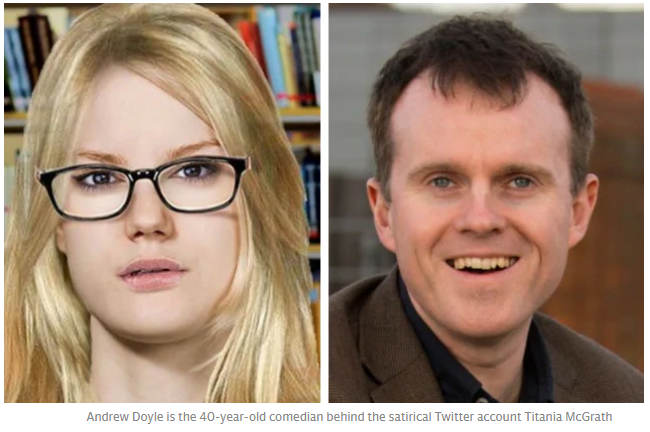
After the woke wolfpack finally dragged down and destroyed the great Twitter troll Godfrey Elfwick (RIP), the satirical void was eventually filled by the ultra-woke poet Titania McGrath. All good things must come to an end, apparently, because we recently discovered that noble Titania is actually — gasp! — just another Twitter troll:

When a former Oxford University postgraduate student set up a satirical Twitter account in April 2018 under the name of Titania McGrath, he had no idea of the social media storm that was to follow.

Aiming to poke fun at the “identitarian left” who use “vicious tactics to push identity politics above all else”, the parody account quickly amassed over 180,000 social media followers.

After months of speculation, the individual behind it can finally be revealed – as a 40-year-old former private school teacher with a doctorate in Early Renaissance Poetry from Wadham College, Oxford.

Dr Andrew Doyle created the account to mock today’s “woke culture” that is obsessed with gender fluidity, identity politics and hates freedom of speech.

Describing Titania McGrath as “a militant vegan who thinks she is a better poet than William Shakespeare”, Mr Doyle told The Telegraph: “Woke is the concept that everything must be inclusive, inoffensive, that you always use the correct language and that you must be hyper aware of other people’s sensitivities.

“This social justice movement is full of people who are arrogant, narcissistic and very certain in themselves. The very idea that they could be wrong doesn’t even cross their mind. That to me is incredibly funny. I thought Titania could embody all of that.

“The majority of people are desperate for this culture to be mocked. The account has become so popular because people are sick of feeling that they can’t say what they want. It used to be the case that if someone spoke out of turn, you would say that’s a bit much, apologise and everyone would move on. Now you post a screenshot on Twitter and try to get someone fired.

“Titania is staying the stuff that most people want to say.”

March 4, 2019

Twitter’s vast latifundia of techno-serfs

Filed under: Business, Media, Technology — Tags: , , , — Nicholas @ 03:00

In Quillette, Alec Cameron Orrell debunks the notion that the average Twitter user derives much benefit from time spent on the site:

Researchers of social media both in the Academy and in Silicon Valley have apprehended for a long time that social media prey on the dopamine rewards system of the brain. Some have used this knowledge to exploit users; others have used it to warn the public of a digital narcotic epidemic. The frisson of delightfully outraged purpose that courses through a user’s nerves as he reads or responds to a post arises from the same brain system that rewards a human being for consuming a healthy meal or organizing his sock drawer. The Hollywood actors who have done mighty work to support the Bolivian cocaine trade in the past can’t put Twitter down now, and that’s no accident.

Digital abolitionists grow more and more strident and numerous these days. Many — including early Facebook investor McNamee — hail from inside Silicon Valley. A raft of articles over the last few years have documented the wave of Silicon Valley techno-elites who, like savvy drug cartel bosses, forbid their own children from using the devices and social media platforms they build, while they encourage their employees to spend frequent periods “unplugged.” They know social media and mobile devices create users, and some have been brave enough to lobby the public for a shift in consciousness.

The slave reaps no substantial or real-world payment for his labor. Chemical slaves to drugs get nothing but misery and poverty in the end. Social media users subsist in an analogous trap, subtle and harder to spot. When it comes to social media, 99.9 percent of users will never see any substantial return on what stacks up to be an enormous longterm investment of time. Users will experience some fleeting stimulant sensations and a smattering of poorly organized — or incorrect—information. “I find out what’s happening on Twitter!” or “I get to promote myself on Twitter!” amounts to self-delusion on par with the vile Antebellum plantation saw that “Slaves get paid in the satisfaction of a hard day’s work and some are even taught how to read!” Such apologetics leverage false but presentable ends to cover horribly exploitive means — means the real ends of which are too embarrassing to admit. The average Twitter user might make the odd connection or get some attention for his business on Twitter, if he keeps at it day after day. In contrast, Jack Dorsey always gets paid handsomely for the user’s time on-site month after month by advertisers. The users work the platform with their attention, and Master Jack goes home with the check.

Unless already famous, the chances of reaping substantial reward from Twitter — such as income or significant growth of attention from others — roughly equal the chances of winning the lottery. And like the lottery, millions of average users chip in and hope, while just a few luck out and get a payout. Those few average users who get a mediocre reward — and even fewer who get famous with a lucky tweet or some such — keep the millions of average users coming back to try their luck every day. The little blue bird runs on the principle of the one-armed bandit and Powerball.

Virtually all users end up losing in the long-term. Most lose hours and hours scrolling through quips and posting burns, sifting through nonsense to find the odd bit of useful information, but mostly for distraction. Like their casino cousins cursed by fate with a gambling addiction, an unlucky minority of Twitter users lose everything on the platform without meaning to. A particularly ill-considered tweet brings down on their heads digital lynching, infamy, disgrace, loss of employment, loss of a spouse, libel lawsuits, and in some countries, criminal indictment for hate speech or threatening behavior. Uncounted thousands of users have operated their mobile devices under the influence of Twitter on the information superhighway, only to wind up with a digital DUI or in an online 25-car pileup.

February 28, 2019

ProTip – Never, ever, ever read the comments

Filed under: Liberty, Media, Politics, Technology — Tags: , , — Nicholas @ 05:00

Scott Alexander explains why he had to ask the moderators to shut down the r/slatestarcodex subreddit’s Culture War thread:

This post is called “RIP Culture War Thread”, so you may have already guessed things went south. What happened? The short version is: a bunch of people harassed and threatened me for my role in hosting it, I had a nervous breakdown, and I asked the moderators to get rid of it.

I’ll get to the long version eventually, but first I want to stress that this isn’t just my story. It’s the story of everyone who’s tried to host a space for political discussion on the Internet. Take the New York Times, in particular their article Why No Comments? It’s A Matter Of Resources. Translated from corporate-speak, it basically says that unmoderated comment sections had too many “trolls”, so they decided to switch to moderated comment sections only, but they don’t have enough resources to moderate any controversial articles, so commenting on controversial articles is banned.

And it’s not just the New York Times. In the past five years, CNN, NPR, The Atlantic, Vice, Bloomberg, Motherboard, and almost every other major news source has closed their comments – usually accompanied by weird corporate-speak about how “because we really value conversations, we are closing our comment section forever effective immediately”. People have written articles like The Comments Apocalypse, A Brief History Of The End Of The Comments, and Is The Era Of Reader Comments On News Websites Fading? This raises a lot of questions.

Like: I was able to find half a dozen great people to do a great job moderating the Culture War Thread 100% for free without even trying. How come some of the richest and most important news sources in the world can’t find or afford a moderator?

Or: can’t they just hide the comments behind a content warning saying “These comments are unmoderated, read at your own risk, click to expand”?

This confused me until I had my own experience with the Culture War thread.

The fact is, it’s very easy to moderate comment sections. It’s very easy to remove spam, bots, racial slurs, low-effort trolls, and abuse. I do it single-handedly on this blog’s 2000+ weekly comments. r/slatestarcodex’s volunteer team of six moderators did it every day on the CW Thread, and you can scroll through week after week of multiple-thousand-post culture war thread and see how thorough a job they did.

But once you remove all those things, you’re left with people honestly and civilly arguing for their opinions. And that’s the scariest thing of all.

Some people think society should tolerate pedophilia, are obsessed with this, and can rattle off a laundry list of studies that they say justify their opinion. Some people think police officers are enforcers of oppression and this makes them valid targets for violence. Some people think immigrants are destroying the cultural cohesion necessary for a free and prosperous country. Some people think transwomen are a tool of the patriarchy trying to appropriate female spaces. Some people think Charles Murray and The Bell Curve were right about everything. Some people think Islam represents an existential threat to the West. Some people think women are biologically less likely to be good at or interested in technology. Some people think men are biologically more violent and dangerous to children. Some people just really worry a lot about the Freemasons.

Each of these views has adherents who are, no offense, smarter than you are. Each of these views has, at times, won over entire cultures so completely that disagreeing with them then was as unthinkable as agreeing with them is today. I disagree with most of them but don’t want to be too harsh on any of them. Reasoning correctly about these things is excruciatingly hard, trusting consensus opinion would have led you horrifyingly wrong throughout most of the past, and other options, if they exist, are obscure and full of pitfalls. I tend to go with philosophers from Voltaire to Mill to Popper who say the only solution is to let everybody have their say and then try to figure it out in the marketplace of ideas.

But none of those luminaries had to deal with online comment sections.

The thing about an online comment section is that the guy who really likes pedophilia is going to start posting on every thread about sexual minorities “I’m glad those sexual minorities have their rights! Now it’s time to start arguing for pedophile rights!” followed by a ten thousand word manifesto. This person won’t use any racial slurs, won’t be a bot, and can probably reach the same standards of politeness and reasonable-soundingness as anyone else. Any fair moderation policy won’t provide the moderator with any excuse to delete him. But it will be very embarrassing for to New York Times to have anybody who visits their website see pro-pedophilia manifestos a bunch of the time.

“So they should deal with it! That’s the bargain they made when deciding to host the national conversation!”

No, you don’t understand. It’s not just the predictable and natural reputational consequences of having some embarrassing material in a branded space. It’s enemy action.

Every Twitter influencer who wants to profit off of outrage culture is going to be posting 24-7 about how the New York Times endorses pedophilia. Breitbart or some other group that doesn’t like the Times for some reason will publish article after article on New York Times‘ secret pro-pedophile agenda. Allowing any aspect of your brand to come anywhere near something unpopular and taboo is like a giant Christmas present for people who hate you, people who hate everybody and will take whatever targets of opportunity present themselves, and a thousand self-appointed moral crusaders and protectors of the public virtue. It doesn’t matter if taboo material makes up 1% of your comment section; it will inevitably make up 100% of what people hear about your comment section and then of what people think is in your comment section. Finally, it will make up 100% of what people associate with you and your brand. The Chinese Robber Fallacy is a harsh master; all you need is a tiny number of cringeworthy comments, and your political enemies, power-hungry opportunists, and 4channers just in it for the lulz can convince everyone that your entire brand is about being pro-pedophile, catering to the pedophilia demographic, and providing a platform for pedophile supporters. And if you ban the pedophiles, they’ll do the same thing for the next-most-offensive opinion in your comments, and then the next-most-offensive, until you’ve censored everything except “Our benevolent leadership really is doing a great job today, aren’t they?” and the comment section becomes a mockery of its original goal.

I’ll allow one exception to the rule I provided in the headline: the comments at David Thompson’s blog are always worth reading, but I have to assume that David or countless unpaid minions must work very hard indeed to maintain the quality of comments that get posted. I’ve never actively encouraged commenting here at Quotulatiousness, and I don’t spend a lot of time on the various social media sites as I have a low tolerance for the kinds of “conversation” you tend to find there.

February 20, 2019

What to do when you’re suddenly the star of the latest online witch-hunt

Filed under: Business, Liberty, Media, Technology — Tags: , , , , , — Nicholas @ 03:00

At Reason, Nancy Rommelmann gives a handy guide to what you need to know when a social media witch-smeller points at you and the masses start baying for your blood:

I am a pro-choice, aqua-haired, middle-aged liberal living in Portland, Oregon. I probably disagree with Nicholas Sandmann on every major issue. But we have something in common. In the last month we have both endured what is fast becoming an American ritual: our 15 minutes of hate.

Sandmann’s crime was a smirk while wearing a MAGA hat. Mine was a YouTube series I launched in December with another journalist in which we discussed the excesses of the #MeToo movement. This and the show’s name, #MeNeither, inspired an ex-employee of my husband’s coffee company to send an email to staff, characterizing the series as “vile, dangerous and extremely misguided” and adding that it “throws into question the safety of Ristretto Roasters as a workplace.”

She also sent an email to the media.

Within days, a quarter of the Ristretto staff quit and the company lost major accounts. I was repeatedly called a c*nt and was challenged to at least one fist fight. My husband was told to leave his wife or lose his business.

As someone who covers this stuff, I thought I knew how rough it might be to get dragged in public. It’s different when it’s tearing up your life.

If you do not think this can happen to you, you have not been paying attention. Here’s a guide for how to survive it…

February 5, 2019

The looming threat of agents plotting to influence the next federal election

Filed under: Cancon, Politics — Tags: , , , — Nicholas @ 05:00

Andrew Coyne has the details:

I have an urgent warning for the people of Canada. Even now, certain agents are plotting to influence the result of the next election campaign by means of stealth and deception.

Posing as ordinary Canadians, they plan to use social media to spread falsehoods designed to inflame public opinion, using the latest micro-targeting technologies to tailor their messages to the reader’s particular fears and prejudices.

These agents are better known as the political parties.

One of the problems with the Liberal government’s recently announced plan to “defend Canadian democracy” from foreign interference, notably in the form of “fake news,” is the basic premise: that the principal threat to the integrity of the Canadian electoral process is posed by outsiders, third parties and foreign agents, rather than the participants.

If there is something ominous about the government involving itself, however indirectly, in deciding what is and is not fake news, there is something quite ludicrous about a political party raising the alarm over the spreading of falsehoods during an election campaign. Indeed, a good short definition of an election campaign would be “a sustained, intense, all-party burst of falsehood, slander and misrepresentation.”

There isn’t a lot else. A modern campaign consists mostly in what is gently termed “defining” opposing party leaders, in a way calculated to make them unrecognizable to their own mothers. The rest is devoted to deliberately misrepresenting the other parties’ positions, while making false or exaggerated claims about their own.

There remains a gentlemanly expectation that these falsehoods should not be obviously detectable as such — that is, that the lie should itself be artfully concealed, disguised as an elision, half-truth or what a Liberal MP recently called “rhetorical advantage,” rather than rubbed in the public’s faces in the manner pioneered by Donald Trump.

February 1, 2019

Severian explains why he quit teaching

Filed under: Education — Tags: , , , , , — Nicholas @ 03:00

Spoiler: it wasn’t fun anymore. As to why it wasn’t fun, it was (say it together with me) the youth of today:

It’s not that kids today are mal-educated, woefully ignorant, and wouldn’t know serious academic work if it bit them on the ass. Those are all true, of course, but that’s the way it has always been — I have no doubt Plato said the same thing about Aristotle (and Socrates no doubt said it about Plato). In my experience, the rueful phrase “back when I was in college” first escapes your lips approximately 36 hours into graduate school.

It’s not the quantity of ignorance, then, but the quality. Generation Snowflake really are New Soviet Men. If you’ve read about life under Stalin, especially, you’ll know what I’m talking about — at once invincibly self-righteous and cringingly subservient, modern students come across like junior volunteer commissars. If they don’t already know it, it’s by definition not worth knowing… and you’re an asshole — to be avoided, undermined, ignored, or (very, very grudgingly) tolerated, as the situation dictates — for trying to make them “learn” something new.

They’re not sociopaths, exactly, but that’s close enough to what they are that we’ll go with it. For instance: They have no problem asking you to move due dates, even for big things like midterm exams, if it inconveniences them. And just them — the rest of the class should still have to take the exam on Friday; it’s just that she, Suzy Snowflake, has a big sorority function that weekend that she really needs to prepare for, so she should be allowed to take it Monday. Nor do they have a problem with lying on spec, just to see if you’ll bite. Tell Suzy no, she still has to take the exam on Friday like everyone else, and there’s a decent chance you’ll be getting a “dead Grandma” email from her over the weekend — my Grandma died suddenly this Friday, I had to go home for the funeral, I’m so broken up, I’m free to take the makeup exam on Monday.

No, I’m not joking, and yes, you can check Suzy Snowflake’s social media and find pictures of her downing shots at the big sorority do Saturday night. And yes, she knows those pictures are out there; Generation Snowflake regards the concept of “online privacy” like your cat thinks about calculus. It’s just that hey, maybe you won’t check. Worth a shot, right? If anyone should be upset it’s her, for making her feel bad by doubting her story. She’ll saunter into class on Monday like nothing happened…. because to her, nothing did. She threw a Hail Mary, it got intercepted, oh well, what’s new in the Netflix queue?

Faced with that, any attempt at education is like King Canute ordering back the tides. It’s excruciatingly pointless, and that’s why I quit. Life’s too short to spend raging against the inevitable.

« Newer PostsOlder Posts »

Powered by WordPress