Quotulatiousness

June 27, 2020

Andrew Sullivan on revolution in the current year

Filed under: History, Politics, USA — Tags: , , , , , , — Nicholas @ 05:00

The people involved in the protests — some of them would-be revolutionaries — may not know about prior revolutionary movements, and if they succeed then they’ll ensure that nobody will be able to remember what life was like before their longed-for Year Zero moment:

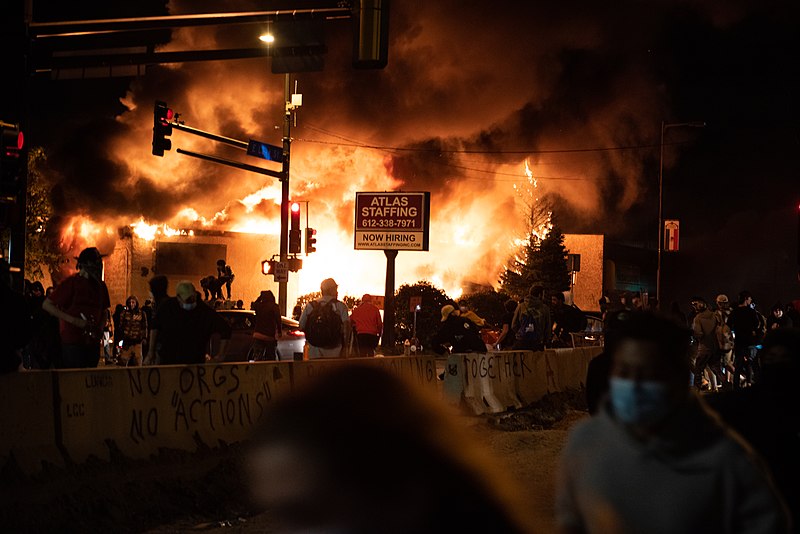
A building burning in Minneapolis following the death of George Floyd.
Photo by Hungryogrephotos via Wikipedia.

Revolutions also encourage individuals to take matters in their own hands. The distinguished liberal philosopher Michael Walzer recently noted how mutual social policing has a long and not-so-lovely history — particularly in post–Reformation Europe, in what he has called “the revolution of the saints.” “The ‘saints’ were very strong on the work of neighborhood committees. In Calvin’s Geneva, law and order were maintained through ‘mutual surveillance.’ Church members (ideally all Genevans were church members) ‘watched, investigated, and chastised’ each other.” Imagine what these Puritans could have done with cell phones and Twitter histories.

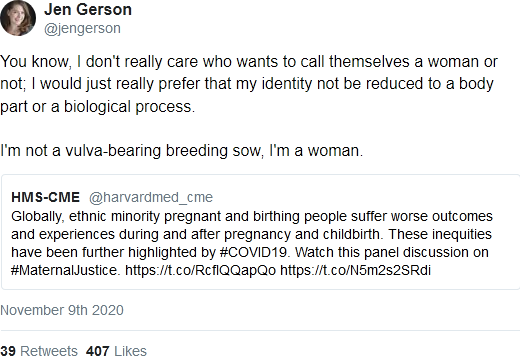
Revolutionaries also create new forms of language to dismantle the existing order. Under Mao, “linguistic engineering” was integral to identifying counterrevolutionaries, and so it is today. The use of the term “white supremacy” to mean not the KKK or the antebellum South but American society as a whole in the 21st century has become routine on the left, as if it were now beyond dispute. The word “women,” J.K. Rowling had the temerity to point out, is now being replaced by “people who menstruate.” The word “oppression” now includes not only being herded into Uighur reeducation camps but also feeling awkward as a sophomore in an Ivy League school. The word “racist,” which was widely understood quite recently to be prejudicial treatment of an individual based on the color of their skin, now requires no intent to be racist in the former sense, just acquiescence in something called “structural racism,” which can mean any difference in outcomes among racial groupings. Being color-blind is therefore now being racist.

And there is no escaping this. The woke shift their language all the time, so that words that were one day fine are now utterly reprehensible. You can’t keep up — which is the point. (A good resource for understanding this new constantly changing language of ideology is Translations From the Wokish.) The result is an exercise of cultural power through linguistic distortion.

So, yes, this is an Orwellian moment. It’s not a moment of reform but of a revolutionary break, sustained in part by much of the liberal Establishment. Even good and important causes, like exposing and stopping police brutality, can morph very easily from an exercise in overdue reform into a revolutionary spasm. There has been much good done by the demonstrations forcing us all to understand better how our fellow citizens are mistreated by the agents of the state or worn down by the residue of past and present inequality. But the zeal and certainty of its more revolutionary features threaten to undo a great deal of that goodwill.

The movement’s destruction of even abolitionist statues, its vandalism of monuments to even George Washington, its crude demonization of figures like Jefferson, its coerced public confessions, its pitiless wreckage of people’s lives and livelihoods, its crude ideological Manichaeanism, its struggle sessions and mandated anti-racism courses, its purging of cultural institutions of dissidents, its abandonment of objective tests in higher education (replacing them with quotas and a commitment to ideology), and its desire to upend a country’s sustained meaning and practices are deeply reminiscent of some very ugly predecessors.

But the erasure of the past means a tyranny of the present. In the words of Orwell, a truly successful ideological revolution means that “every record has been destroyed or falsified, every book rewritten, every picture has been repainted, every statue and street building has been renamed, every date has been altered. And the process is continuing day by day and minute by minute. History has stopped. Nothing exists except an endless present in which the Party is always right.” We are not there yet. But unless we recognize the illiberal malignancy of some of what we face, and stand up to it with courage and candor, we soon will be.

June 26, 2020

The rise of the Karenfinder General

Filed under: Media, Politics, USA — Tags: , , , , — Nicholas @ 05:00

Brendan O’Neill on the recent phenomena of the Karens and the anti-Karens:

The most important thing here is the question of where the Karenfinder Generals derive their power from. It comes from the insatiable appetite among identitarian reactionaries for mis-speakers or wrongthinkers they can ritualistically denounce and destroy. It is this warped social-media appetite for spectacles of shaming, for being part of a virtual mob that takes to task an allegedly evil person, that bolsters and empowers people like Karlos Dillard. It is reported that he has a strange obsession with Karens and he is even selling anti-Karen t-shirts through his Instagram page. This speaks to the extent to which Karen-shaming has become a kind of industry. There are memes, there is branded clothing, and there are of course the videos of exposed and shattered Karens which are watched and shared millions of times. Dillard was able to reduce Leah to a weeping wreck desperately trying to remain anonymous because of this broader, entrenched and increasingly misogynistic culture of seeking out white women to revile and tear down.

One of the great ironies of the witch-hunting of Karens is that the people doing the filming and public shaming are far more Karen-like than the women they humiliate. The Karen prejudice is built on a view of certain middle-class, often middle-aged, white women as uncouth and arrogant and given to complaining. They always want to “speak with the manager”. But no one wants to “speak with the manager” as gleefully as the Karenfinder Generals. Their entire mission is to report on “problematic” people to the managers of acceptable thought, to the bosses of correct-think: the new PC elites. Their thirst for tearing people down for doing or saying something wrong utterly overshadows the instinct to complain that any middle-class white woman might have.

Consider the recent Central Park incident in which a woman called Amy Cooper called the cops on a black man called Christian Cooper (no relation) and claimed that he was harassing her when in truth he was reprimanding her for letting her dog off its leash in a part of the park where you’re not meant to do that. Amy behaved badly in this incident. But as Robert A George argued in the New York Daily News: “[Christian] is the ‘Karen’ in this encounter, deciding to enforce park rules unilaterally and to punish ‘intransigence’ ruthlessly.” Amy Cooper’s life has been shattered by this Karen-shaming incident: she lost her job and her dog.

Or consider the case of Lisa Alexander, the CEO of a San Francisco-based cosmetics company who was recently filmed by a Filipino man after she asked him why he was writing “Black Lives Matter” on the wall outside a private residential property. Alexander may have been wrong to presume that this Filipino man couldn’t possibly live in one of these plush private residences, but she is polite, patient and not remotely racist during their encounter. At one point the man even suggests that she call the police and she looks shocked and says: “I don’t want to call the police.” And yet she was put online, shamed across the world, lost business as a result, and then issued a self-denouncing confession in which she accepts, essentially, that she is a witch. “I did not realise at the time that my actions were racist”, she said. “I am taking a hard look at the meaning behind white privilege and am committed to growing from this experience.”

It all gets more Salem-like by the day. Just as accused witches of old could never deny the accusations against them – denial often carried a greater penalty than confession – so Karens today must immediately confess to the sin of racism if they want any hope of at least partially saving their reputations and their futures. As in earlier outbreaks of witch-hunting, Karen-hunting puts women into a bind. If they deny the charge of racism, that is held up as proof of just how racist they are. If they confess to the charge of racism, that is of course also proof of their foul, evil minds, of their possession by the demon of race-hatred. Lisa Alexander’s confession of wickedness and promise to re-educate herself on the evils of white privilege sums up how religious the identitarian outlook has become. She is in essence on her knees begging for salvation, pleading for redemption, offering to do the intellectual penance of learning the horrible truth about her “white privilege” – that is, her sinful state, her fallen nature.

June 21, 2020

Paul Wells – “Everyone agrees!” [on the need to fully investigate the Nova Scotia massacre] … “But so far there is no inquiry”

Filed under: Cancon, Law — Tags: , , , , , , — Nicholas @ 05:00

Paul Wells in Maclean’s:

We are faced, perhaps only temporarily, with a familiar Canadian paradox: everyone says they want something to happen, but it isn’t happening.

The “something” is a rigorous public inquiry into a horrible shooting spree that spanned two days and killed 22 people in Nova Scotia in mid-April. It was the worst mass murder in Canadian history. It was lurid in its weirdness. The gunman, Gabriel Wortman, spent two days driving around in a convincing replica RCMP vehicle, shooting at whim, while the force he was imitating and dodging failed to send out a more comprehensive emergency alert than their Twitter warnings, one that might have saved more lives. In the midst of the carnage, two actual RCMP officers apparently fired their weapons into the walls of a firehall in Onslow for reasons that remain unknown.

New reporting for Maclean’s by Shannon Gormley, Stephen Maher and Paul Palango raises troubling new questions about Wortman’s possible ties to organized crime and, especially, to the RCMP itself. This reporting is attracting a lot of attention and, here and there, vigorous online debate. This Twitter thread, for instance, asks hard questions about our latest story.

The questions raised by our investigative team including Paul Palango, author of three best-selling books (here, here and here) about the troubling history of the RCMP, are backed by a solid and growing network of well-informed sources. But past a certain point, even superb reporting can’t provide authoritative answers. That work is properly left to duly mandated public authorities, usually wearing judges’ robes. Some people, reading the most recent Maclean’s reporting, have said the RCMP has a lot of questions to answer. Unfortunately there is no reason to take any answer from the RCMP on faith. It’s time for a full judicial inquiry.

Everyone agrees! From Nova Scotia premier Stephen McNeil to the latest embattled RCMP commissioner to three Trudeau-appointed Nova Scotia senators to anguished families of the murdered to, I mean sort of, the Prime Minister. But so far there is no inquiry.

Jagmeet Singh’s social media moment in the sun

Filed under: Cancon, Media, Politics — Tags: , , , , — Nicholas @ 03:00

Most Canadians seem to have forgotten about federal NDP leader Jagmeet Singh, so this parliamentary kerfuffle — perfectly timed for maximum social media attention — is a great boost to his political visibility.

Federal NDP leader Jagmeet Singh taking part in a Pride Parade in June 2017 (during the leadership campaign).
Photo via Wikimedia.

In this woebegotten year of 2020, blessed is the politician who can stumble into a scandal perfectly tailored to the tyranny of Twitter.

As protests, riots, and rage make their mark across the world in the wake of the murder of George Floyd, NDP leader Jagmeet Singh got himself ejected from the House of Commons for calling Bloc MP Alain Therrien a “racist.”

It was an act of civil disobedience, well suited to the passions of the moment, that generated overwhelming support for Singh.

“Only in a racist country does a brown man get ejected from parliament for insisting that the denial of systemic racism is racist,” was a fairly typical, and popular, example on Twitter.

I’m not interested in disputing the point, but rather deconstructing it. So let’s start, for a moment, with the prim prohibitions on unparliamentary language.

In keeping with the long-standing “tradition of respect for the integrity of all Members,” elected officials are barred from using personal attacks, obscenities and insults while in the House of Commons.

And, yes, I’m mentioning this point mostly for the joy of listing off some of the language that has been deemed “unparliamentary” in the past, including, my favourite; “Honourable only by courtesy” (ruled against in 1880), “Coming into the world by accident,” (1886) and “The political sewer pipe from Carleton County” (1917).

Whatever else we can say about the state of our political culture, the quality of our insults has declined alarmingly.

There are a few examples in the parliamentary record of the term “racist” being used in the House. In several instances, the record can’t identify who said it. Or the subject of the insult failed to call a point of order on the matter.

June 12, 2020

J.K. Rowling on her most recent “cancellation”

I know a lot of Harry Potter fans are upset with their formerly favourite author for her stance on transgenderism … or what they’ve heard about her stance … or what their friends have said about her stance … so J.K. Rowling has posted an essay on her own site explaining what happened and how she has been coping with being “cancelled” so many times:

… as a much-banned author, I’m interested in freedom of speech and have publicly defended it, even unto Donald Trump.

The fourth is where things start to get truly personal. I’m concerned about the huge explosion in young women wishing to transition and also about the increasing numbers who seem to be detransitioning (returning to their original sex), because they regret taking steps that have, in some cases, altered their bodies irrevocably, and taken away their fertility. Some say they decided to transition after realising they were same-sex attracted, and that transitioning was partly driven by homophobia, either in society or in their families.

Most people probably aren’t aware – I certainly wasn’t, until I started researching this issue properly – that ten years ago, the majority of people wanting to transition to the opposite sex were male. That ratio has now reversed. The UK has experienced a 4400% increase in girls being referred for transitioning treatment. Autistic girls are hugely overrepresented in their numbers.

The same phenomenon has been seen in the US. In 2018, American physician and researcher Lisa Littman set out to explore it. In an interview, she said:

“Parents online were describing a very unusual pattern of transgender-identification where multiple friends and even entire friend groups became transgender-identified at the same time. I would have been remiss had I not considered social contagion and peer influences as potential factors.”

Littman mentioned Tumblr, Reddit, Instagram and YouTube as contributing factors to Rapid Onset Gender Dysphoria, where she believes that in the realm of transgender identification “youth have created particularly insular echo chambers.”

Her paper caused a furore. She was accused of bias and of spreading misinformation about transgender people, subjected to a tsunami of abuse and a concerted campaign to discredit both her and her work. The journal took the paper offline and re-reviewed it before republishing it. However, her career took a similar hit to that suffered by Maya Forstater. Lisa Littman had dared challenge one of the central tenets of trans activism, which is that a person’s gender identity is innate, like sexual orientation. Nobody, the activists insisted, could ever be persuaded into being trans.

The argument of many current trans activists is that if you don’t let a gender dysphoric teenager transition, they will kill themselves. In an article explaining why he resigned from the Tavistock (an NHS gender clinic in England) psychiatrist Marcus Evans stated that claims that children will kill themselves if not permitted to transition do not “align substantially with any robust data or studies in this area. Nor do they align with the cases I have encountered over decades as a psychotherapist.”

The writings of young trans men reveal a group of notably sensitive and clever people. The more of their accounts of gender dysphoria I’ve read, with their insightful descriptions of anxiety, dissociation, eating disorders, self-harm and self-hatred, the more I’ve wondered whether, if I’d been born 30 years later, I too might have tried to transition. The allure of escaping womanhood would have been huge. I struggled with severe OCD as a teenager. If I’d found community and sympathy online that I couldn’t find in my immediate environment, I believe I could have been persuaded to turn myself into the son my father had openly said he’d have preferred.

When I read about the theory of gender identity, I remember how mentally sexless I felt in youth. I remember Colette’s description of herself as a “mental hermaphrodite” and Simone de Beauvoir’s words: “It is perfectly natural for the future woman to feel indignant at the limitations posed upon her by her sex. The real question is not why she should reject them: the problem is rather to understand why she accepts them.”

As I didn’t have a realistic possibility of becoming a man back in the 1980s, it had to be books and music that got me through both my mental health issues and the sexualised scrutiny and judgement that sets so many girls to war against their bodies in their teens. Fortunately for me, I found my own sense of otherness, and my ambivalence about being a woman, reflected in the work of female writers and musicians who reassured me that, in spite of everything a sexist world tries to throw at the female-bodied, it’s fine not to feel pink, frilly and compliant inside your own head; it’s OK to feel confused, dark, both sexual and non-sexual, unsure of what or who you are.

I want to be very clear here: I know transition will be a solution for some gender dysphoric people, although I’m also aware through extensive research that studies have consistently shown that between 60-90% of gender dysphoric teens will grow out of their dysphoria. Again and again I’ve been told to “just meet some trans people.” I have: in addition to a few younger people, who were all adorable, I happen to know a self-described transsexual woman who’s older than I am and wonderful. Although she’s open about her past as a gay man, I’ve always found it hard to think of her as anything other than a woman, and I believe (and certainly hope) she’s completely happy to have transitioned. Being older, though, she went through a long and rigorous process of evaluation, psychotherapy and staged transformation. The current explosion of trans activism is urging a removal of almost all the robust systems through which candidates for sex reassignment were once required to pass. A man who intends to have no surgery and take no hormones may now secure himself a Gender Recognition Certificate and be a woman in the sight of the law. Many people aren’t aware of this.

June 11, 2020

In 1929, the warning sign was getting stock tips from shoeshine boys and elevator operators

Filed under: Business, Economics, History — Tags: , , , , — Nicholas @ 05:00

In 2020, as Jay Currie suggests, the warning sign might be robinhood.com:

“Jay Gould’s Private Bowling Alley.” Financier and stock speculator Jay Gould is depicted on Wall Street, using bowling balls titled “trickery,” “false reports,” “private press” and “general unscrupulousness” to knock down bowling pins labeled as “operator,” “broker,” “banker,” “inexperienced investor,” etc. A slate shows Gould’s controlling holdings in various corporations, including Western Union, Missouri Pacific Railroad, and the Wabash Railroad.
From the cover of Puck magazine Vol. XI, No 264 via Wikimedia Commons.

In the winter of 1928 Joe Kennedy, father of JFK and major stock market player, stopped to get his shoes shined. The shoeshine boy leaned in and said, “Buy Hindenburg”. Kennedy began unwinding his positions saying, “You know it’s time to sell when shoeshine boys give you stock tips. This bull market is over.”

I had a similar experience in late 1999 when a friend took out a mortgage on her condo to buy shares in the billion dollar online copy paper empire. She had a perfectly good job in retail garden supplies. Remembering Kennedy, I advised another friend that her Nortel was looking a bit overbought. As it happened she sold quite near the peak.

The 2020 equivalent of the shoeshine boy is the perfect storm is the free trading platform, robinhood.com. This is a nicely designed site where you can trade shares on your computer or phone. It has become very, very popular with younger, new investors. My late 1990’s day trading pals would have killed for this sort of interface and no brokers fees. It has spawned a whole host of reddit chats, twitter streams and countless YouTube videos on the excitement of swing trading. (One fun spot to watch Robinhood is the https://robintrack.net/leaderboard which shows which stocks the people on Robinhood are buying. It is a bit slow and buggy but a great front row seat.)

What is striking about the robinhood.com world is that it revolves around trading rather than any sort of “investing”. You hop into APPL in the morning, see if you can make a couple of bucks by noon and move onto the next thing. And Apple is a real, solvent, company.

Robinhood has been in the news recently because the herd has charged into the shares of a number of companies which are either in or near bankruptcy. Hertz Rent-a-Car dropped from $20 to $0.50 in three months as the market realized that with no travelers there would be no car rentals. Interestingly, we learn from robintrack.net that at $20 there were a little over 1000 users holding, as Hertz crashed the Robinhood users piled in, at $0.55 there were 44,000 and there are now 158,000. And many will have made money, lots of money, trading the gyrating price from $0.50 to back up to $5.00.

In the run up to the crash of October 1929, long after Joe Kennedy had pulled his money from the market, retail traders were coining it trading the “swings” on margin accounts. It didn’t matter what the company actually did, it was going up. The same “irrational exuberance” was a big feature in the dot com bubble.

The “Fearless Girl” statue faces the Arturo Di Modica “Charging Bull” on Wall Street (Wikipedia)

The lessons of the 1929 crash and the 2000 dot com bust were simple – get out early and be in no hurry to get back in. Right now the dinosaurs like Buffet and Ichan are sitting on stacks of cash. Just like Joe Kennedy was when Wall Street swan dived in October 1929. They got that cash by selling their shares to shoeshine boys and the bright lights at Robinhood.

May 29, 2020

The contagion of fear and the progressive loss of perspective in the modern world

Filed under: Britain, Government, Health, Media — Tags: , , , , , — Nicholas @ 03:00

In the Hector Drummond Magazine, Dan C. discusses what he calls the “comfort of fear”:

Not actually the official symbol of Britain’s National Health Services … probably.

This is the sort of glib response (akin to “so you WANT people to die then?”) that has essentially hijacked all conversation and debate since the start of the Coronavirus outbreak. I didn’t respond, partly because I didn’t have the energy for an argument with a friend (at least Twitter rows tend to be anonymous) and quite frankly, what does one say to this? That we shouldn’t send out children back to school ever again in case one child happens to pass away from any illness or disease? That we should continue in lockdown until we cure death itself?

My concern is that this bizarre way of thinking is commonplace right now for many parents. Locked inside their houses for weeks on end, soaking up an endless stream of Netflix programs, mawkish Instagram feeds and daily Government briefings, convinced that Black Death Mk II has landed outside their front door, paid by the state to stop working and lapping up every rainbow-based hashtag that emerges from “our NHS”, all sense of balance and perspective has vanished. With such an unprecedented paradigm shift, this new state of heightened safety has led many to consider their view on illness and risk for the very first time in their lives and unfortunately the concept of critical thinking has been found lacking. Real life, which has been slowly eroded for many decades, has suddenly been switched off completely overnight and the worst of it is that most people don’t seem to care.

The scary part of all of this is that if the adults in the room have suddenly lost their desire to engage in the outside world, to have meaningful human interaction, to take risks (don’t get me started on the definition of “risk”) and to live their lives in the fullest possible way then what chance do children stand? After all, you can’t miss what you’ve never had.

Historians will look back in bewilderment at this period, noting that it took no more than a month during the spring of 2020 for fearlessness to completely evaporate in society. In its place is a comfortable sense of fear.

May 24, 2020

Zuby on why Joe Biden’s “you ain’t black” comment is one of the most racist things said by any US politician recently

Filed under: Media, Politics, USA — Tags: , , , , , — Nicholas @ 05:00

I’d embed all the tweets here, but the page loading speed would be monumentally slow, so here’s the initial tweet and I’ve scraped the text from the rest and put it in blockquotes:

Every black person is aware of the power and pain of being considered an ‘outsider’ within one’s own ‘race’.

This happens everywhere, but it is a common phenomenon particularly amongst Black Americans, due to history and culture. (2/14)

You are probably familiar with terms like ‘Uncle Tom’, ‘coon’, ‘house n*gga’, ‘coconut’, ‘Bounty’ and ‘race traitor’.

These slurs are used to demean black people by stripping them of their ‘Blackness’. (3/14)

ALL black conservatives, libertarians, centrists, or even moderate liberals have been on the receiving end of at least one of these slurs.

Usually levied by another black person, but occasionally by a particularly bold ‘woke white progressive’ type. (4/14)

This form of ostracisation is particularly painful for Black Americans. Who are largely disconnected from their African roots due to the horrors of slavery.

As a substitute, many cling to a fuzzy concept of ‘Blackness’. For the sake of identity and community. (5/14)

So, to be considered ‘not black’ is like being an outcast of a community that often already feels alienated… (6/14)

I am not American and I do not speak on behalf of anybody but myself. These are my own thoughts.

My name is Nzubechukwu and my heritage is of the Igbo tribe in Anambra state in Nigeria 🇳🇬

So NOBODY can take my ‘Blackness’ from me! They will look foolish trying! (7/14)

Most Black Americans don’t have this SOLID sense of heritage.

People (of all colours) know this and weaponise it against them to prevent individuals from stepping out of the ‘groupthink’.

Anyone who is perceived to go ‘against’ ‘The Black Community’ must be punished. (8/14)

Left-wing politicians, activists and professional race hustlers have used this psychological warfare to keep black people ‘in check’ and voting for them for many decades.

It’s demeaning, discriminatory, and it strips black people of our agency. (9/14)

So, when Biden suggested that ‘you ain’t Black’ if you consider voting for Trump instead of him, he exposed a much deeper form of racism.

The sense of ‘ownership’ of Black people. Unearned allegiance and entitlement.

It was a vile statement… (10/14)

But it was also honest. Because that’s how a lot of these politicians and ‘progressives’ really feel about black people.

Like they own us. (11/14)

If you were born black, then you will die black. There is no such thing as being ‘politically black’. This is nonsense designed to CONTROL you and keep you needy.

NOBODY can take away your ‘Blackness’. Your ‘Black Card’ is your birthright. Regardless of who you vote for. (12/14)

I would never dream of telling anyone who they must vote for, based on their skin colour nor genitalia.

That would be extremely arrogant, condescending and discriminatory.

Be VERY suspicious of anybody who talks like that. They want to control your mind. (13/14)

That is all. I hope you enjoyed my TED talk.

Much love. 👊🏾

Zuby
#ImStillBlack

H/T to Darleen for posting the link to David Thompson’s blog.

May 6, 2020

What’s on your bookshelf?

Filed under: Books, Britain, Media, Politics — Tags: , , , — Nicholas @ 05:00

The self-appointed censors of righteousness demand to know!

Plenty of people like to be filmed against the backdrop of their bookshelves to convey the message or at least create the impression that they are smart. This has become even more common during the current extraordinary conditions of self-isolation, where virtually all the media interviews are conducted from home rather than in studio. Ditto for all the Zoom and other teleconferences. This, in turn, has given some people the opportunity to nose around and check out just what exactly others have on their shelves – presumably having read it and not just for decoration. It should be a fun exercise, but these days of perpetual outrage no fun goes unpunished.

By contrast, the picture of a bookshelf belonging to a Tory minister Michael Gove and his wife Sarah Vine was unsolicited, which probably adds to the regret right about now.

[…]

Books, like other human artifacts, are historical records and documents of our past. You might not like the course that the history took, but it’s important to know it and remember it.

And hypocrisy, because of the double standards.

Sure, Nazis, Nazi sympathisers, Holocaust deniers and assorted other apologists are mad, bad and dangerous to know. But what about communists? How many of those having a go at Gove and his wife for owning an Irving book have on their own shelves works by Marx, if not Lenin, Mao, Che and numerous related others? Those who have been inspired by and followed Marx’s idea (whether you think correctly or not) have been responsible for some 100 million premature deaths in the 20th century and other untold misery and devastation. Mao, the author of the little Red Book, accounts for up to 60 million of those (I happen to have a copy; does that make me a Maoist and a genocide fan?). But socialism is cool and you can’t blame Marx because to do so would be to delegitimise the whole socialist project. And of course the socialist ideals are all beautiful – equality! solidarity! community! dignity! – and, in any case, everyone has had good intentions. So all good, guys.

Read and own whatever the damn you like – and don’t let the fascists of any kind dictate your bookshelf. Except for 50 Shades of Grey. We’ll all judge you for that.

The main picture: some of my shelves – feel free to judge me.

I thought to take a picture of my own shelves, but Arthur Chrenkoff appears to have a broadly similar selection of books (more heavily weighted to British politics than mine), so I just nicked his photo to save the effort. (Thanks, Arthur! Hope you don’t mind!)

May 5, 2020

QotD: Social media encourages autistic behaviour

Nothing like that happens today, as far as I can tell, and I spent a lot of time in a wide variety of ivy-covered halls. Part of it, of course, is the general, catastrophic decline in reading comprehension among today’s student body — Lenin was a wonderfully effective polemicist in his day, but for the modern kid it might as well still be in Russian — but a lot of it isn’t. A much bigger part of it is that modern kids can’t overcome the genetic fallacy, and a large part of that, I argue, is the autism spectrum-like effect of social media.

The genetic fallacy, you’ll recall, is the inability to separate the idea from the speaker. Or, if you’re under age 40, it’s simply “communication,” as our public discourse nowadays proceeds in very little other than genetic fallacies. Try it for yourself. We all know what kind of reaction you’ll get in respectable circles if you say “You know, Donald Trump has a point about …”, but you can do it on “our side” of the fence, too. Watch: Obama was right about Race to the Top. No, really: Compared to W’s No Child Left Behind bullshit, pretty much anything short of letting kids be raised by wolves would’ve been better (and hey, even being raised by wolves worked out ok for Romulus and Remus). Even with the qualifier attached, almost everyone on “our side” instinctively bristles — we’ve been so conditioned by the words “Obama” and “race,” especially in close proximity, that we can’t help ourselves. Even I do it.

It’s especially bad for the younger generations who, as I keep arguing, have been effectively autismized (it’s a word) by social media. Twitter, especially, is so constructed that “replies” can come in hours, days, months, years later. Blogs too for that matter — one of the reasons we close the comments here after a few weeks is to prevent drive-by commenters clogging things up trying to re-litigate something from years ago. Modern “communication” must take place in discrete, contextless utterances. That being the case, understanding a statement in context is impossible — I repeat, impossible. So Lenin (or Hitler, or Mao, or William F. Buckley, or the Stay-Puft Marshmallow Man) didn’t have a point about ___; because that requires understanding how his point fit into the larger context of his thought, his times, his culture, his world. None of that shit fits into a tweet, so we’re trained to respond to the name — Lenin (etc.) is either a good guy or a bad guy, full stop, so anything he says about anything must be good or bad, automatically.

I hardly need to elaborate on the effect this has on our public culture. If Our Thing really wants to get serious, the first thing any “organization,” no matter how loose, must do is: Ban social media.

Severian, “Education, the Genetic Fallacy, and the Spectrum”, Rotten Chestnuts, 2020-01-27.

May 2, 2020

QotD: Today’s psychological epidemic

Filed under: Health, Media, Quotations — Tags: , , , , , , — Nicholas @ 01:00

I think that one of the things the web has done is enable people who have personality disorders to validate their particular pathology, because they find all sorts of people who are like them.

There’s an epidemic of self-diagnosis among young people, there’s a race to multiply pathology, there’s a glorification of disorders like borderline personality disorder, which is rare. When being the most oppressed victim gives you the highest status, then it’s a race to the bottom.

We’re not helping young people figure out a noble and difficult pathway forward, where they bear responsibility and march forthrightly into adulthood. Quite the contrary. We’re saying, “Well, the system is corrupt and there’s no point in taking part in it. You’re going to be victimized no matter what you do.” And so the race is on for who gets to play the victim card with the highest degree of status. And it’s really bad, it’s especially bad for adolescents because they’re trying to sort their identity out, they’re already a mess.

Jordan Peterson, “Christie Blatchford Sits Down With ‘Warrior For Common Sense’ Jordan Peterson”, National Post, 2018-02-07.

March 31, 2020

QotD: How the old “mainstream media” fell for fake news

Filed under: Economics, Media, Quotations, Technology — Tags: , , , — Nicholas @ 01:00

One of the important side effects of the communications revolution is the proliferation of grifters, con men and hustlers. Things that were impossible thirty years ago, like e-mail scams, remain a constant problem. The internet has made it easy for even the crudest hustlers to reach a broad audience. As a result, the number of hustlers has increased and the types of hustles have also increased. The twitter troll, for example, is an entirely new type of hustle, made possible by the internet.

One reason for this is that the internet has turned into a big stage where anyone can try out their act on the public. In the old days, a carny bimbo would have been confined to a traveling carnival, Hollywood, New York or community theater. Maybe she would have ended up in pornography. It was not an easy way to make a living. Today, she can have a twitter account where she flashes photo-shopped pics of herself. Thirsty losers send her money through PayPal or super chats on her YouTube channel.

The low barrier to entry means every female with a desire for the carny life can get on stage from the privacy of her studio apartment. It’s not just females working the new rackets. In a prior age, Mike Cernovich would have been traveling from town to town selling his monkey mind juice to gullible townies at state fairs. Alex Jones would have been mailing people his mimeographed newsletter, where he explained how space aliens control the Federal Reserve Bank.

Most likely, it is the communications revolution that has caused the news media to commit suicide. In the old days, when the audience was fixed, the focus was on maintaining the facade of objectivity. No one was under any illusions about growing the audience, so they focused on keeping the audience. The internet promised a global market and unlimited market share. A relentless drive for eyeballs gave rise to the clickbait journalists turning the media into fake news.

The Z Man, “Carny Town”, The Z Blog, 2019-12-29.

March 27, 2020

The Wuhan Coronavirus sucks, our data on it sucks … but our media suck most of all

Filed under: China, Government, Health, Media, USA — Tags: , , , , , — Nicholas @ 05:00

The all-hysteria, all the time media will have much to regret once the worst of the Wuhan Coronavirus epidemic has run its course:

  • The data we have sucks, and thus any conclusions we are drawing mostly suck too. The data is worse than just being incomplete or bad — if it was randomly distributed, we could live with that. But the lack of test kits and how we have deployed the few we have means that the data is severely biased. We are only testing people who are strongly symptomatic. If there is a normal distribution of outcomes from this disease, we are only testing on the right side of the distribution. We have no idea where the median is or how long the tail is to the left side of asymptomatic outcomes. The only thing we absolutely know about the disease is its not as deadly as the media is portraying as we are missing hundreds of thousands of cases in the denominator of the mortality rates. The media has also been terrible about reporting on risk factors of those who died. When a bunch of people died suddenly in Seattle, one had to read down 5 paragraphs into the story to find that they were all over 70 in an old-age home. Or when prime-of-life people die, facts such as their being type 1 diabetics — a known severe risk factor for this virus (and one that makes it different from the flu) are left out.
  • The media is constantly confusing changes in measurement technique and intensity with changes in the underlying progress of the virus itself. Changes in case numbers have as much to do with testing patterns and availability than they do with the real spread of the disease.
  • While COVID-19 is likely worse than the normal flu, our perceptions of how much worse are strongly affected by observer bias. Frankly, if every news broadcast every night spent 15 minutes reciting flu deaths each day, we would all be hiding in our homes away from flu. They present a healthy man in his thirties dying clearly as the tragedy it is, but the spoken or unspoken subtext is, “this is abnormal so this thing is much worse.” But it seems abnormal because we do not report on the very real stories of healthy young people who die of the flu. My nephew who was 25 years old and totally healthy with no pre-existing conditions died of the flu last month — and no one featured this tragedy on the national news.
  • The data we are getting sucks worse because the media has decided, as one big group, that for our own good they are going to limit all facts about the virus to only the bad ones. There is a strong sense — you see it on Twitter both in Twitter’s policies as well as Twitter group attacks — that saying anything that might in any way reduce one’s fear of the disease should be banned for our own good. One of the more prominent examples was Medium removing an article NOT because it was proven wrong but because it took one side of a very open question and it was obviously decided it was “unsafe” to allow that side to even be aired.

March 3, 2020

The bottled water and toilet paper hoarders of 2020

Filed under: Economics, Health, Media — Tags: , , — Nicholas @ 03:00

Arthur Chrenkoff on one of the oddest features of the current infectious disease panic:

“sold out of bottled water?” by Klara Kim is licensed under CC BY-NC-SA 2.0

This is happening alright, and it’s not some isolated incidents; on my Facebook news feed, at least half a dozen posts from friends in Sydney and Brisbane display photos of Venezuela-style empty shelves at their local supermarkets. The fear is real, and so is the hoarding.

OK, I can understand face masks and hand sanitisers walking off the shelves, as these are the crucial tools in containing the spread of the pandemic. Most face masks – as with so many other products in our shops – are made in China and in the current crisis conditions any new and additional supplies won’t make it out of the country, so whatever is already here is it. And it isn’t, as masks have been the first item to disappear from retail outlets from your local pharmacy to a Bunnings store.

I can also understand the non-perishable food supplies. Even though Australia could be quite self-sufficient if need be (minus the out of season imported fruit and veg), possibly people are stocking up not so much in fear the food will run out but out of reluctance to go out in the public in a few weeks’ time should the situation really turn into a zombie apocalypse. In any case, there is nothing wrong with having a well stocked pantry.

Where I start to no longer understand the consumers is bottled water. We are fortunate to live in a developed country where one can safely drink from a tap. There won’t be shortages of drinkable water under any circumstances – except for a complete societal collapse – and coronavirus is not a water-borne pathogen like those causing cholera or typhoid. If you are still paranoid, you can boil your water before ingesting (just make sure you cool it down).

But it’s the toilet paper that really gets me. Trust me, if things go really belly up, toilet paper is the least of your worries. Humanity has survived for tens of millennia without sanitary tissues, and in their absence any paper or rag or even running water will substitute nicely. Food, water, medicines, electricity, to name just four, are much more crucial in a time of crisis or emergency. Again, it’s true that a lot of toilet paper is manufactured in China or generally overseas and so potentially susceptible to shortages if manufacturing and international transport are affected as they are already. But how much toilet paper does your household require to function? Are you expecting you might need the iron rations of your favourite rolls to last for at least a few months? And if you think that you might not be able to restock on toilet paper until later this year, then – let me repeat myself – don’t you think you will have much bigger problems with ensuring your continuing survival to worry about?

As Norman Lewis points out, the worst hysterics are among the “elites”, not us lumpenproles:

Last week, the world stock markets suffered their worst week since the financial crisis in 2008, with $6 trillion wiped from shares and, in some markets, a sell-off at a rate not seen since the Great Depression almost a century ago. Why? Because global investors are in a panic about the potential economic fallout from the coronavirus epidemic.

Many commentators are making the point that this is mad. Ross Clark argues convincingly in the Spectator that the “most dangerous thing about coronavirus is the hysteria”. Philip Aldrick, economics editor of The Times, agrees. He says it is the “panic we should fear more than the virus itself”.

Our appetite for doom and fear of the unknown are offered as explanations for this behaviour. Risk culture and a predisposition to overreacting to threats are also certainly components of what is happening. But there is another equally important element linked to these that is not being raised – that this madness is not being driven by the “low-information”, knuckle-dragging, gullible ignorant masses, but by the information-rich, university-educated and refined global business and government elites.

The contrast between the responses to coronavirus from the elites and ordinary people has been stark. Even as the level of panic in the mainstream reporting around coronavirus has risen, ordinary people have just gotten on with their lives. The supposedly well-informed elites, who often accuse the “dumb” masses of being vulnerable to hysteria and “fake news”, have themselves been prodded into panic. Meanwhile, where they are not in lockdowns, ordinary people are still going to work, commuting, going to bars … They’re simply getting on with their lives, while taking note of the potential risks.

The elites are in free-falling panic; like a herd of wildebeest, panicked by the sight of a predator and rushing blindly across crocodile-infested waters, they have sparked a potential global economic meltdown. Meanwhile, we see stoic common sense, simple but profound wisdom, on the part of the “great unwashed”.

February 23, 2020

Benjamin Griveaux discovers that “privacy” is an outdated 20th century concept

Filed under: France, Government, Media, Politics, Technology — Tags: , , , , , — Nicholas @ 06:00

At The Register, Alistair Dabbs describes the descent of formerly ascendent French politician Benjamin Griveaux:

Previously a key spokesman for president Emmanuel Macron, he was flying high in the polls to be elected mayor of Paris next month … until the electorate got a good look at his knob.

Benjamin Griveaux on 11 October 2018.
Photo by Jacques Paquier via Wikimedia Commons.

In a case of political revenge porn that is gripping the French nation almost as tightly as Griveaux was gripping himself, videos of him buffing the aubergine appeared on a short-lived satirical website apparently focusing on “political pornography” (don’t bother asking) and promptly went viral.

These were private, first-person videos he’d taken himself spiralising the old courgette and sent to the object of his amour who, unfortunately for his wife, was not his wife. Predictably, neither woman was impressed with the, er, outcome.

Cue an embarrassed press conference with lots of deliberately posed shots of him looking downwards and contrite, during which he announced he would stand down from the imminent elections and pass the, er, baton to someone else. Taking their example from Griveaux himself, Macron’s party La République en Marche (since redubbed “La République en Main“) did a bit of frenzied reshuffling to find a replacement.

Put aside the political, moral and human issues: these are being thoroughly argued out in the media as you read this. As for nudey selfies, come on, most of us have tried it for a laugh – albeit most probably when we were students. What I want to know is how an intelligent, well-connected and tech-savvy party executive like this could allow his personal instruction video on the subject of unclothed self-taming to get into the wild in the first place.

Griveaux’s official statement to the police claims that he sent the video person-to-person via a certain private messenging system – press reports do not name which one, unfortunately – that would delete the video after one minute. If this is true, it strengthens his case for “invasion of personal privacy”, which has massive punitive outcomes in France thanks to Jacques Chirac who as president beefed up the privacy laws to protect his illegal financial dealings from media scrutiny.

What messaging app was he using? And is he being all that tech-savvy in his belief that his video would self-destruct after 60 seconds, like in some ’70s episode of Mission Impossible? Even in WhatsApp, you have to remember to delete it yourself.

Perhaps he was using a business-focused porn-selfie messenger: a kind of doing-the-business sharing app. It’s the innovative new way of engaging with your contacts. Norbert Spankmoney wants to connect with you! Yes, I bet he does.

Come on, Ben, surely you know that for every ultra-secure, ultra-private, ultra-personal video messaging app, there are a dozen freebie video-grabbing utilities out there. Even if you code it up to prevent screen capture, someone could always video your video, just like they can photograph an onscreen secret document.

Give it up. Nothing is private any more.

« Newer PostsOlder Posts »

Powered by WordPress