Quotulatiousness

October 1, 2020

Far from being in trouble, Canadian film and TV investment has nearly doubled in the last 10 years

Filed under: Business, Cancon, Government, Media — Tags: , , , , , , , — Nicholas @ 03:00

The Canadian government — particularly Canadian Heritage minister Steven Guilbeault — is eager to pass legislation to “get money from the web giants” and their primary justification is the claim that Canadian TV and movie funding has been shrinking. As Michael Geist explains, that’s a pants-on-fire lie:

CMPA Profile – Financing, Sources: CMPA Profile 2019, 2016, 2013

Canadian Heritage Minister Steven Guilbeault has said that his top legislative priority is to “get money from web giants.” While much of the attention has focused on his ill-advised plan to require Facebook to obtain licences for linking to news articles, his first legislative step is likely to target Internet streamers such as Netflix, Amazon and Disney with new requirements to fund Canadian content and to increase its “discoverability” by making it more prominent for subscribers. Based on his comments at several town halls, Guilbeault is likely to also create new incentives for supporting indigenous and persons of colour in the sector with a bonus for those investments (potentially treating $1 of investment as $1.50 for the purposes of meeting Cancon spending requirements). Much of the actual implementation will fall to the CRTC, which will be granted significant new regulatory powers and targeted with a policy direction.

Guilbeault’s case for establishing new mandated payments is premised on the claim that support for the film and television sector is declining due to the emergence of Internet streaming services, which have resulted in decreased revenues for the conventional broadcast sector and therefore lower contributions to Cancon creation. In fact, Guilbeault recently told Le Devoir that without taking action there would be a billion dollar deficit in support in the next three years. He says that his objective is to actually generate a few hundred million more per year in local production by the Internet streamers. In other words, he’s expecting roughly $2 billion in new investment over three years in Cancon from U.S. entities due to his planned regulations (moving from a billion dollar deficit to a billion dollars in extra spending).

While Guilbeault frames these regulatory requirements as a matter of fairness and “rebalancing”, industry data over the past decade tell a much different story. Indeed, there has been record setting film and television production in recent years, much of it supported by companies such as Netflix. CRTC chair Ian Scott last year said that Netflix is “probably the biggest single contributor to the [Canadian] production sector today.” While that is not entirely true – the data suggests that Canadian taxpayers are the biggest contributor with federal and provincial tax credits consistently the largest source of financing – the claim that there is a billion dollar deficit coming or that foreign streamers do not contribute to film and television production in Canada without a regulatory requirement is simply false.

September 23, 2020

Federal minister admits the Libranos’ plan is a shakedown to “get money from web giants”

Filed under: Cancon, Government, Media, Politics, Technology — Tags: , , , , — Nicholas @ 03:00

Michael Geist on a rare moment of honesty from Canadian Heritage Minister Steven Guilbeault on the federal government’s atrocity of an internet regulation plan:

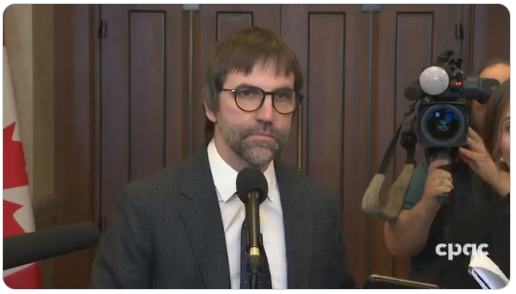
Canadian Heritage Minister Steven Guilbeault, 3 February 2020.
Screencapture from CPAC video.

As Canadian Heritage Minister Steven Guilbeault prepares an Internet regulation plan that features the prospect of licences for linking, undermining net neutrality, and trade sanctions, he has typically argued that “it’s about fairness”, suggesting that foreign companies unfairly benefit from the Canadian market at the expense of domestic companies. Yet when Guilbeault appeared at a production sector town hall last week, he was far more candid. Guilbeault told the sector that in a minority government situation, his department had to choose between a massive bill changing “everything under the sun” or to slice it up into smaller pieces. Having chosen the piecemeal approach, Guilbeault pointed to his top priority: get money from the foreign Internet companies (his exact words at 47:58 were “the most pressing thing we needed to do was to get oxygen into the system, which is money. And go and get that money where that money is. Which is web giants.”)

In certain respects, the acknowledgement that this amounts to little more than a shakedown makes sense. CRTC Chair Ian Scott has said that Netflix is now probably the largest contributor to film and television production in Canada and the sector enjoyed record production numbers pre-COVID-19, so the data simply does not support claims that the streamers are hurting the industry. As for the news sector, the Minister has failed to deliver millions in promised tax credits and seemingly now wants an alternative that involves creating a licensing regime for linking to content.

Yet if the goal is simply a matter of wanting more money from Internet companies that can be used to support Canadian cultural policies, it is not clear why this is a matter for the Heritage Minister. Everyone wants more money from the Internet companies and countries around the world have a credible argument that the huge global Internet revenues should be more equitably apportioned among them. In other words, the way to “get money from web giants” is for Finance Minister Chrystia Freeland to tax them on their revenues. Those tax revenues would go into general tax revenues and can be spent in an transparent manner without the need for specialized subsidy programs. This isn’t easy. The U.S. unsurprisingly objects to a potential reduction in its tax revenues, which means that Canada must find allies with other countries in seeking global solutions on tax. Further, Guilbeault candidly recently told a publisher town hall that changes to the tax code is far more difficult than direct program spending.

The problem with Guilbeault’s preference for direct program spending subsidized by Internet companies is that it raises a host of complications and negative effects. For example, mandated Canadian content spending for companies such as Netflix could require the companies to pay into a fund that supports Canadian content production. However, the current rules make it challenging for those same companies to access those funds for their own productions. That leads to either a trade challenge (and the possibility of tariffs against key Canadian sectors such as dairy and steel) for being forced to pay into a system that is inaccessible to foreign providers or a reform to the system that would open things up to foreign providers and in the process undermine the competitiveness of domestic producers and broadcasters who are more reliant on tax credits and funding programs.

September 20, 2020

Andrew Sullivan on the politically deranging effects of social media addiction

Filed under: Media, Politics, Technology, USA — Tags: , , , , , — Nicholas @ 03:00

In his latest Weekly Dish installment, Andrew Sullivan decries the extreme polarization of the US electorate and points an accusing finger at social media for making things much worse:

An Electoral College victory for Trump, if he loses the popular vote again, would, in this new elite consensus, prove beyond doubt the centuries’ long grip of “white supremacy”. Some are already calling such a victory illegitimate, even though it would be completely constitutional, under the rules everyone has agreed to. The sickening street violence that the far left has downplayed, and permitted to run riot in major cities could be a mere taste of what is to come — along with ever-stronger white nationalist gangs instigating or responding in kind. (Trump’s toleration of this dangerous right-extremism in the past four years is as unforgivable as the left’s excuses for murderous violence.) But the upshot is the same: we will be lucky if the country doesn’t erupt in large-scale civil violence by the end of all this.

And the reason this dystopian scenario is so credible is not just the fault of these political actors. It’s ours too — thanks to the impact of social media. I think we’ve under-estimated just how deep the psychological damage has been in the Trump era — rewiring the minds of everyone, including your faithful correspondent, in ways that make democratic discourse harder and harder and harder to model. The new Netflix documentary, The Social Dilemma, is, for that reason, a true must-watch. It doesn’t say anything shockingly new, but it persuasively weaves together a whole bunch of points to reveal just how deeply and thoroughly fucked we are. Seriously, take a look.

The doc effectively shows how the information system necessary for democratic deliberation has, in effect, been jerry-rigged in the last decade to prevent any reasoning at all. It’s all about the feels, and the irrationality, and the moment, which is why Trump is so perfectly attuned to his time. And what’s smart about the documentary is that it shows no evil genius behind this unspooling, no sinister plot deliberately to destroy our system of government. One of the more basic motives in American life — making money — is all you now need, the documentary shows, to detonate American democracy at its foundation.

For Facebook and Google and Instagram and Twitter, the business goal quickly became maximizing and monetizing human attention via addictive dopamine hits. Attention, they meticulously found, is correlated with emotional intensity, outrage, shock and provocation. Give artificial intelligence this simple knowledge about what distracts and compels humans, let the algorithms do their work, and the profits snowball. The cumulative effect — and it’s always in the same incendiary direction — is mass detachment from reality, and immersion in tribal fever.

With each passing second online, news stories, graphic videos, incendiary quotes, and outrages demonstrate their stunning utility to advertisers as attention seizers, are endlessly tweaked and finessed by AI to be even more effective, and thereby prime our brains for more of the same. They literally restructure our minds. They pickle us in propaganda. They use sophisticated psychological models to trap, beguile, outrage, and prompt us to seek more of the same.

[…]

And online is increasingly where people live. My average screen time this past week was close to ten hours a day. Yes, a lot of that is work-related. But the idea that I have any real conscious life outside this virtual portal is delusional. And if you live in such a madhouse all the time, you will become mad. You don’t go down a rabbit-hole; your mind increasingly is the rabbit hole — rewired that way by algorithmic practice. And you cannot get out, unless you fight the algorithms to a draw, or manage to exert superhuman discipline and end social media use altogether.

But the thing about algorithms and artificial intelligence is that they don’t rest, they have no human flaws, they exploit every weakness we have, and have already taken over. This is not a future dystopia in which some kind of AI robot takes power and kills us all. It is a dystopia already here — burrowed into our minds, literally disabling the basic mental tools required for democracy to work at all.

If you watch video after video of excessive police force against suspects, for example, and your viewing habits are then reinforced by algorithms so you see no countervailing examples, your view about the prevalence of such excessive force will change, regardless of objective reality. A new study shows how this happens. Watching the videos, even more than reading text about them, raises the percentage of white liberals who believe the cops frequently or always use excessive force by around 20 percentage points. The actual data are irrelevant. The BLM movement this summer was less a racial reckoning, as we’re constantly lectured, than a moment of web-induced mass hysteria.

September 19, 2020

Andrew Heaton attempts to talk to people about politics

Filed under: Humour, Media, Politics, USA — Tags: , , — Nicholas @ 05:00

In his latest missive from deeply singed California, Andrew Heaton expresses some concerns about the American body politic in the late stages of utter emotional breakdown (that is, the last couple of months of the election):

I’m going to go out on a limb here and say that the political climate is going to “heat up.” Although the heat comes from a different fault line than you might think. The real division in America isn’t between conservatives and progressives. It’s between people who read stuff, and people who TYPE IN ALL CAPS ON TWITTER.

I’m pretty firmly in the “read stuff” camp. Which makes me poorly situated for our current period, as I am a quarter Vulcan on my father’s side, and it’s overwhelmingly in vogue to be emotionally incontinent. Emotionally incontinent people don’t care for us pseudo-Vulcans. Perhaps you can relate?

This is a normal conversation for me:

    Friend: Trump is an evil fascist meat goblin!

    Me: Yeah, I can’t stand that guy. I’m not a big Biden fan, but I definitely prefer him over Trump.

    Friend: But Trump is a racist lunatic!

    Me: Sure. I certainly don’t think he has an ideological core or respect for constitutional rule of law. I have serious misgivings about his leadership. Also he’s horrible on trade.

    Friend: HE’S LOCKING CHILDREN IN CAGES! THE WORLD IS ON FIRE!!! DON’T YOU SEE THAT TRUMP IS THE DEATH OF THIS AND ALL WORLDS!?!?

If you read the above conversation carefully, you might notice that I’m not actually disagreeing with my hysterical friend. In fact we’re broadly in agreement, at least on the 2020 election outcome. So why are they flipping out, like the electoral version of Kermit the Frog flailing his arms in a Muppets sketch?

Here’s why: in political conversations the People Who Read Stuff are interested in exchanging ideas and policies. The ALL CAPS ON TWITTER crowd wants to exchange feelings.

If your hysterical conservative friend is laying eggs about Antifa ushering in the Night of the Long Knives, or your progressive friend is freaking out about Trump ushering in The Night of the Long Knives, what you say or think is immaterial — they are looking for you to match their emotional state. If you don’t, it means you’re probably making a buck selling knives.

This is a problem in my social life. I have learned that my feelings are fickle and easy to manipulate, and so distrust them. I take pride in my Vulcan heritage. When confronted with a big, scary problem, I believe the best response is to get calm and thoughtful. In Vulcan culture we call this “acting like an adult.”

Unfortunately equanimity is not popular on this planet. It’s trendy to experience feelings so hard that neurochemicals seep out of your pores, the way alcoholics sweat vodka.

You can subscribe to the newsletter here.

September 17, 2020

Book burning’s back on the menu, boys!

Filed under: Books, Britain, Politics — Tags: , , , , , , — Nicholas @ 05:00

Brendan O’Neill on the latest fad for the ultrawoke celebrities — book burning.

J.K. Rowling

So it turns out that Jedward, with their quiffed Aryan hair and strangely intense mannerisms, don’t only look like a couple of members of Hitler Youth who’ve been on a shopping spree at TK Maxx. They sound like it too. Yesterday, ever keen to jump on a bandwagon, even if it’s a bandwagon of misogynistic hate, the Shining twins of Irish pop suggested to their Twitter followers that they should burn JK Rowling’s next novel when it is published. “Does anyone need firewood this winter!”, they tweeted. “JK’s new book is perfect to burn next to a Romantic fire. Aww get all cozy and comfy can’t wait.”

Let’s leave to one side the industrial levels of gall it must require for two blokes who don’t know the difference between an exclamation mark and a question mark to have a pop at the most successful British author of all time. The more striking thing about Jedward’s tweet is that it suggests book-burning is back. Their tween-fascist cry for the burning of Rowling’s forthcoming novel was retweeted and liked thousands of times, by armies of so-called trans allies who now look upon Rowling as a real-life Voldemort: a despicable, evil figure whose works should be tossed on to raging bonfires as the woke mob yelps with delight.

The hatred for JK Rowling is out of control. It goes far beyond the everyday attempted cancellations and screeching Twittermob assaults on anyone who dares to deviate from the correct-think of the PC elites. The hatred for Rowling is far more raw, far more intense, far more irrational.

Her intellectual sin, her speechcrime, is of course that she believes in biological sex. She thinks there are differences between men and women. She thinks biological males should bugger off out of women’s changing rooms, sporting tournaments, prisons, rape-crisis centres, and so on. Many of us agree with her. And for this, she is frequently bombarded with rape threats and death threats. “Suck my cock!”, sexist pigs tweet at her. They invite her to die in a fire. They send her explicit pornography. This week #RIPJKRowling trended on Twitter. These people are insane. When your “activism” involves tirelessly insulting and sexually harassing a woman for having a thought that is different to your own, you need to have a serious word with yourself.

The deranged Rowling hate intensified this week after it was reported that her next Strike novel – the detective series she writes under the name Robert Galbraith – will involve a backstory about a man who dresses as a woman and then goes around murdering women. “Transphobia!”, the woke Twitterati predictably yelled. Not for the first time the sexist fury with Rowling for having the temerity to be a woman who thinks for herself was in large part inflamed by Pink News, the online gay magazine that has done more than most to depict women who are sceptical of certain aspects of transgenderism as “TERFs” – that is, witches, bitches, uppity broads who really ought to do what the editors at Pink News tell them to.

September 16, 2020

The Canadian echo chamber on American political issues

Filed under: Cancon, Media, Politics, USA, Weapons — Tags: , , , , , — Nicholas @ 05:00

Ben Woodfinden’s latest for The Dominion looks at the weird effects political passions in the United States have on political stances in Canada:

Restricted and prohibited weapons seized by Toronto police in a 2012 operation. None of the people from whom these weapons were taken was legally allowed to possess them.
Screen capture from a CTV News report.

Participatory media increasingly defines and shapes our discourse. It submerges us in a broader reality but only does so by filtering it into a digital reality that offers a distorted reflection rather than picture of the real world. This has been going on for at least a decade now, but the pandemic has accelerated this transformation of our discourse and politics. By locking us in our homes the pandemic forces us to view the world through a digital lens even more than we already did, and in a world where we’re all viewing everything through our screens that digital reality becomes closer and closer to our primary reality.

One of the specific, and most pernicious effects of this, as I lamented in The Critic is that it turns us all into online Americans participating in their politics through the digital medium, rendering us virtual participants and not just foreign observers. I won’t repeat myself too much, I’d recommend just reading the piece [link], but the online realm is American, and what digital politics does is make politics everywhere more American. We participate in it as a game and a form of entertainment. This bleeds back into our own politics.

Americanized Discourse

Gun politics is one particular political issue where Americanized discourse is most pronounced. It captures perfectly how Americanization plays out. Every time there is some sort of tragic shooting or discussion of gun violence in Canada the debates play out in depressingly predictable ways. Progressives and Liberals paint a picture in which Canada suffers from the kind of rampant gun violence and mass proliferation of firearms as in America. This is the framing used to justify often highly symbolic or ineffective new gun laws and restrictions that, while often not all that effective, make the Liberals and progressives seem like the party for gun control in the face of this rampant violence. But only if you pretend we live in America.

And it’s not just the Liberals and progressives who play this game. Listen to some of the more vocal advocates of “gun rights” in Canada and you’d think we have a second amendment in the Charter. One side wants to make it seem like Canadians are walking around with and easily able to acquire assault weapons, the other side wishes it were so! The reality of course lies somewhere in between. Gun possession is heavily regulated, but lawful citizens can still buy firearms if they want to, and there is no explicit right in the Charter that prevents the government from regulating and restricting firearms. Talking about gun “rights” in Canada is itself quite a foreign and imported concept. At the same time we don’t have an epidemic of gun violence, and while we have experienced some horrific mass shootings, like the recent Nova Scotia tragedy, gun violence in Canada pales in comparison to the United States.

But because both sides are essentially happy to help paint a phantasmic picture of gun violence and/or gun regulations in Canada, we end up with a surreal politics around guns. Sensible debates around guns are made harder by this because debates take place on top of a framing and narrative that draws explicitly on American political culture more than it does Canada’s. Both sides want to take on American roles and are happy to contribute to this framing.

Gun politics is just one example, and there are so many others. Our discourse is so often built around framings that make it seem as if the issues and political cleavages here are indistinguishable from American ones, but it only happens because we import American framing and narratives into our own discourse and then build are arguments around these phantasms. We, like many other countries around the world, are in the middle of a moment of racial reckoning, or whatever you want to call it, because of something that happened in Minneapolis, not in Canada.

Racism is a real thing in Canada, no honest person should deny this, because there is racism in absolutely every country and society. But in the wake of George Floyd’s killing we ended up having a conversation about racism that reflected the particular ways racism works in America.

September 11, 2020

Canadian government heading toward “the worst of all worlds on Internet regulation”

Filed under: Business, Cancon, Government, Media — Tags: , , , , — Nicholas @ 05:00

Michael Geist on the bull-headed determination of the Canadian federal government — and specifically Heritage Minister Steven Guilbeault — to “solve” a problem by introducing savagely anti-consumer internet regulations:

Canadian Heritage Minister Steven Guilbeault, 3 February 2020.
Screencapure from CPAC video.

The harm that will come from these policy choices is difficult to overstate. By focusing the tax burden on sales taxes rather than technology company revenues, consumer costs will go up and the company profits will be left untouched. The CRTC powers will lead to years of hearings and follow-on litigation, yielding few tangible benefits for creators. The mandated Cancon contributions will spark trade wars and make Canada a less attractive market for new services leading to fewer choices and less competition, while the link licensing requirement will result in blocked sharing of news articles on social media sites that hurts both Canadians and media organizations. All the while, the issues that really matter – privacy, anti-competitive behaviour, online hate, misinformation, a fair share of tech corporate profits – are left largely untouched.

How did the government end up with the worst of all worlds on Internet regulation?

The starting point was the 2015 election in which it committed to no new Netflix taxes (prompted by a Conservative pledge on the issue) and subsequent consultations on everything from copyright to digital cultural policy. The result was then-Heritage Minister Melanie Joly struggling to honour the no-tax commitment, while satisfying increasingly vocal demands from some stakeholders for one. Those calls increased after the results of her cultural policy consultation were released, which largely focused on a rejection of new Internet taxes and support for net neutrality.

In the aftermath of the Cambridge Analytica scandal, worries about Russian election interference, and Christchurch massacre broadcast live online, the policy winds shifted and the government was clearly looking to become more active on the Internet regulation file. That led to Election Act provisions that were generally viewed as successful. It also paved the way for a 2019 election platform that was far aggressive on social media and the Internet, with commitments to address everything from privacy to hate speech online.

[…]

If the government were to address the real concerns, there would be long-overdue privacy reforms, a more aggressive approach on competition issues, measures to address online hate and misinformation, and pursuit of a global agreement on fair taxation of technology company revenues. If it wants to support increased film production from indigenous groups or help the news sector, it can make those policy choices and use general tax revenues without creating a massive regulatory infrastructure.

Instead, it is turning to the harmful policies noted above that raise consumer costs (digital sales taxes), regulate online Cancon with mandated spending requirements (even though the industry has record production led by Netflix), dispense with any pretense of maintaining net neutrality, lead to blocked sharing of news articles (mandated licence for social media sites merely for linking to news content), and result in services avoiding the Canadian market (market interference in payments from services such as Spotify). Much of this will be overseen by the newly empowered CRTC, leading to lengthy hearings that primarily benefit lawyers. After having badly mishandled Canadian digital policy, the government now seems content to take a pass on the important issues and leave the controversial non-issues to the regulator and the courts.

September 5, 2020

Kareem Shaheen on the shame of mask-shaming

In The Line, Kareem Shaheen — who is a mask-wearer and was one before they were made mandatory — explains why shaming anti-maskers is a terrible way to encourage compliance, but a great way to virtue-signal:

“Covid 19 Masks” by baldeaglebluff is licensed under CC BY-SA 2.0

The mask shaming mirrors the way social media has warped our culture. The Twitter and ‘gram “in crowd” flaunt its mask use to demonstrate an ostensibly superior grasp of morals and science — and to bully those who don’t follow its cues. Those who perceive themselves to be on the outside of this circle can’t help but cringe at the manipulation and grandstanding behind these seemingly well-intentioned gestures.

Mask resistance, then, becomes a virtue signal of its own.

And, of course, Twitter itself has been a cesspool of counter-productive shame. Back in July, the hashtag #NoMasks trended, which gave the illusion of a groundswell of opposition against mandatory masking laws. But an analysis by First Draft, a nonprofit based in the United Kingdom, examined 8,000 Twitter accounts that used the hashtag. It found that the majority of people who tweeted #NoMasks were actually pro-mask. Their condemnation of the supposed anti-mask contingent actually boosted #NoMasks, bringing more people in contact with related conspiracy theories and arguments against wearing masks.

The moralizing is all the more galling because our own governments were forced to do an embarrassing about-face on their efficacy.

In the early weeks of the pandemic, health agencies in Canada and the United States recommended against wearing masks because there was insufficient evidence that they could prevent the spread of the virus, remember? They said that masks would provide a sense of false security, and suggested that we were all too dumb to know how to wear them properly.

This despite widespread use of masks in Asia, and while there was a growing consensus in hard-hit parts of Europe that they were effective and necessary.

With so much confused messaging, it’s no mystery that so many people are now skeptical about wearing masks. Sure, some of the most ardent mask-haters are also Q-Anon-spouting, anti-vaxxer crystal-healing masks-are-fascism conspiracy theorist kooks. But not all them fit that description.

And the problem with all of this is that if you’re actually trying to convince people to wear masks — as opposed to merely demonstrating your own superior morality via the veil — shame is one of the least effective methods of persuasion.

September 2, 2020

Trust – the limiting factor on Chinese tech firms’ growth

Filed under: Business, China, Government, India, Media, Technology, USA — Tags: , , , , — Nicholas @ 05:00

Henrik Tiemroth on the “glass ceiling” that Chinese technology companies are struggling with:

The rise of Chinese technology firms has been one of the major developments of the last decade. As some of those companies expand their operations overseas, some observers see China laying the groundwork for a broader imperial project, using their growing digital might to project power and influence. By 2030, will we all be sending messages on WeChat, searching on Baidu, and shopping on Alibaba?

Probably not. As China’s major tech firms attempt to expand to global markets, they are running into a glass ceiling of their government’s own making: people don’t trust them. The recent ban on ByteDance’s popular social media app TikTok in the United States demonstrates the extent – and the limits – of China’s digital ambitions.

TikTok was the first Chinese internet product to have a mass following in the United States. As of 2020, the app has 100 million active users in the US – about a third of the population. But the popular and seemingly innocuous app for making, viewing and sharing quippy homemade music videos has been declared a national security threat.

In August, President Trump signed an executive order effectively banning the app, along with WeChat, unless their US operations are taken over by a domestic company. Given the close links between Chinese companies like ByteDance and the government, they argue, the data collected on American users of the app could be used by the Chinese state for espionage or other nefarious purposes.

The Trump administration is not the first government to take this step. In July, India banned TikTok, along with 59 other Chinese apps, amid rising tensions with China. The government cited similar concerns about the potential for mining and misuse of private data. Indonesia temporarily banned the platform in 2018, and Japan is reportedly considering following the US’s lead.

Across the world, people are becoming warier of who uses their data and how. Lawmakers are perking up, as the implications of data for national security are becoming more clear. In 2018, the European Union implemented landmark data privacy laws. In the US, tech CEOs are regularly dragged before congressional committees and a bipartisan movement for regulation is building.

Chinese internet companies face those same concerns and then some. It’s one thing to have your personal data used to promote conspicuous consumption. It’s another entirely to have it weaponized by a sophisticated digital surveillance state at the cutting edge of data-driven totalitarianism.

August 25, 2020

QotD: Collective punishment

We used to take calls for collective punishment much more seriously. In the 1949 Geneva Convention it was determined that: “No protected person may be punished for an offense he or she has not personally committed.” Collective punishment was seen as a tactic designed to intimidate and subdue an entire population. The drafters of the Geneva Convention clearly had in mind the atrocities committed in WWI and WWII where entire villages and communities suffered mass retribution for the resistance activities of a few. In their commentary on the outlawing of collective punishment the International Red Cross stated: “A great step forward has been taken. Responsibility is personal and it will no longer be possible to inflict penalties on persons who have themselves not committed the acts complained of.”

In times of peace, collective punishment may come in the form of social media dust-ups over sombrero hats or Chinese dresses. Gradual softening on the taboo of collective punishment does not bode well for the health of liberal democracies. Which is also why it is important for us all to remember that social-justice activists who complain about cultural appropriation only represent themselves, and not the minority groups to which they belong.

Claire Lehmann, “The Evils of Cultural Appropriation”, Tablet, 2018-06-11.

August 20, 2020

The attractive nuisance of conspiracy theories

Filed under: Politics, USA — Tags: , , , , — Nicholas @ 03:00

In The Critic, Michael Coren pours scorn on the fans of QAnon and other conspiracy theories:

QAnon alleged clues about the NYC bombing, 10 December 2017.
Wikimedia Commons.

For those outside of the increasingly bizarre and surreal loop, something called QAnon is a pretty big thing in the United States, with increasing influence internationally. It’s a far-right conspiracy theory claiming that a secret deep state plot is at work against Donald Trump, who is the only person capable of smashing the power of a Satan-worshipping cabal of pedophiles composed of liberal and Democrat politicians, Hollywood celebrities, and high-profile mainstream media figures. There, nothing at all odd or bonkers about that. It goes on to allege that a planned coup by Hilary Clinton, Barack Obama, and – as always – George Soros was only prevented when President Trump hired former FBI director Robert Mueller to investigate.

The people who embrace all of this, and there are a large and increasing number of them, roar all sorts of quasi-religious language in their tweets and posts, speak of “The Storm” and “The Great Awakening” and are convinced that once they’re victorious, thousands of their enemies will be detained, incarcerated, likely sent to Guantanamo Bay, and the military will the take over the nation. Everyone loves a happy ending.

There’s plenty more involved, and every conspiracy theory one can imagine generally comes into play. Dive into social media and you’ll find the Q zealots, but look around a Trump campaign event and their posters and slogans will be just as common. Indeed, Republican candidate Marjorie Taylor Greene, a proud believer in QAnon, recently won the congressional nomination in Georgia’s 14th district. In that this area gave its last Republican candidate 76% of the vote it’s virtually impossible that Greene will not be a member of Congress. Many in her party were appalled but Donald Trump tweeted, “Congratulations to future Republican Star Marjorie Taylor Greene on a big Congressional primary win in Georgia against a very tough and smart opponent. Marjorie is strong on everything and never gives up — a real WINNER!” In other words, this is a serious concern.

Outside of democratic politics, the so-called Pizzagate scandal was part of the QAnon maze of lunacy. False claims were made that hacked personal e-mail accounts had revealed the existence of a child-sex ring involving several leading Democrat politicians. The whole thing was, it was alleged, based in a pizzeria in Washington DC. A North Carolina conspiracy believer then travelled to DC and opened fire in the restaurant with a high-powered weapon.

It’s likely that the people behind the entire Q madness are making a great deal of money and it could be that they’re not even directly politically motivated. Whatever their motives, it’s all gone well beyond its origins and was pushed into high gear when the apparently genuine case of the Jeffrey Epstein scandal came to light. His alleged links to senior lawyers, Democrats, and a member of the royal family, plus a bewildering suicide, were meat and drink to every conspiracy theorist with a mum’s basement worth the name.

Wikipedia says:

QAnon[a] (/kjuːəˈnɒn/) is a far-right conspiracy theory detailing a supposed secret plot by an alleged “deep state” against President Donald Trump and his supporters. The theory began with an October 2017 post on the anonymous imageboard 4chan by “Q”, who was presumably an American individual, but probably became a group of people. Q claimed to have access to classified information involving the Trump administration and its opponents in the United States. NBC News found that three people took the original Q post and expanded it across multiple media platforms to build internet followings for profit. QAnon was preceded by several similar anonymous 4chan posters, such as FBIAnon, HLIAnon (High-Level Insider), CIAAnon, and WH Insider Anon.

Q has accused many liberal Hollywood actors, Democratic politicians, and high-ranking officials of being members of an international child sex trafficking ring. Q also claimed that Trump feigned collusion with Russians to enlist Robert Mueller to join him in exposing the ring and preventing a coup d’état by Barack Obama, Hillary Clinton, and George Soros. “Q” is a reference to the Q clearance used by the U.S. Department of Energy. QAnon believers commonly tag their social media posts with the hashtag #WWG1WGA, signifying the motto “Where We Go One, We Go All”.

July 27, 2020

QotD: People on social media are the worst!

Filed under: Media, Quotations, Technology — Tags: , , , — Nicholas @ 01:00

This article asked many internet pioneers about how they think it’s all turned out. They’re not happy.

No one asked me, he said with a petulant sniff. I think it’s turned out well for those who regard it as a personal publishing platform, and don’t regard social media as an equivalent or replacement for the real world. It is a shadow realm full of tricksters and devils and angels and blokes and sheilas. It’s Second Life except it seems real because it contains Kardashians, who are the most important and fascinating people on earth.

Anyway, it’s mostly lamented now because A) Trump, and B) People are jerks.

    Rich Kyanka: Social media was supposed to be about, “Hey, Grandma. How are you?” Now it’s like, “Oh my God, did you see what she wore yesterday? What a f**ing cow that bitch is.” Everything is toxic — and that has to do with the internet itself. It was founded to connect people all over the world. But now you can meet people all over the world and then murder them in virtual reality and rape their pets.

Everything is toxic — and that has to do with the internet itself. I don’t think so. I think it has to do with people on the internet. People who otherwise wouldn’t say boo to you as you passed on the street, but feel as if it is their duty to yell at everything on Twitter, because there are no consequences. If you got into the elevator at work every day and acted rude to everyone in the car, eventually it would have consequences. The Internet is a hellish version of an elevator car — everyone is looking at everyone else and talking at the same time about everyone else and themselves.

James Lileks, The Bleat, 2018-05-02.

July 3, 2020

Back to the Future Middle Ages

At Spiked, Dominic Frisby takes us back to a time when today’s progressive temper tantrums would fit in perfectly with accepted behaviours of the age … the Middle Ages:

A social media heretic faces trial

How much of what went on in the Middle Ages and early-modern periods do we look back on with abhorrence and a certain amount of perplexity? Burning witches at the stake, lynch mobs, self-flagellation – what possessed people to do such things, we wonder.

But take a step back, look about and you see many of these practices are still flourishing today, though they go by different names.

Here are just some of them.

Let’s start with excommunication. Excommunication meant so much more than being banned from taking communion. It involved you being shunned, shamed, spiritually condemned, even banished. Only through some kind of heavy penance – often a very public, lengthy and humiliating contrition – could you and your reputation be redeemed.

Excommunication became a powerful political weapon. It was dished out to enemies of the faith to destroy their legitimacy. Often it was used as a punishment for sins as minor as uttering the wrong opinion.

What are No Platforming and cancel culture if not a modern form of excommunication? Qualified, competent professionals are hounded out of their jobs and publicly shamed just for uttering the wrong opinion, often simply for a misjudged choice of words. Even just the wrong pronouns.

As often as not, their employer wants a quiet life, so he bows to activist pressure and sacks the target of the witch hunt. Cancel culture is excommunication.

Today’s religions, however, are not the many sects of Christianity that once perforated Europe, but climate change, education, the NHS, gay rights, trans rights, the European Union and multiculturalism. Even coronavirus and the lockdown have become sacrosanct.

Intellectuals of the right and left, from Polly Toynbee to Nigel Lawson, have described the NHS as Britain’s religion. It has replaced the Virgin Mary as the divine matriarch. Why this worship? I suggest it goes back to the late 19th and early 20th centuries, when the state began to replace the church as the main provider of education, welfare and healthcare. After 1945, it was just a matter of time before the welfare state achieved altar status.

July 1, 2020

Parler, pro and con

Filed under: Business, Liberty, Media, Politics, Technology, USA — Tags: , , , — Nicholas @ 05:00

The latest social media challenger to Twitter has been getting a fair bit of attention over the last couple of weeks, as many British and American conservative Twitter users have announced they’ll be relocating to the newer service due to their concerns over Twitter’s progressive bias and very uneven-handed moderation. In The Critic, David Scullion points out that Parler may not be the dream social network for the unwoke:

The avowedly “unbiased” social media site based in Nevada has been around for two years but has rapidly gained traction amongst Trump supporters in the US, Brexit and Conservative supporters in the UK, and pro-monarchists in Saudi Arabia. (Yes really).

The raison d’être is free speech and in its “Declaration of Independence” Parler outlined the injustices, as they see it, of the existing big tech firms:

    They manipulate their platform to hide information. They shadow ban, trick and deceive. They have become enablers, and often leaders, of the vicious cancel-culture mob who goose-step through our online communities and scream down those who dare to disagree.

The document ends by calling on users to “#Twexit to Parler” – i.e. leave Twitter and join them.

But will they succeed?

[…]

It seems like Parler’s popularity is a symptom of censorship in big tech, but building a rival “free speech” network has its own problems.

For a start, Parler will throw you to the wolves if they get sued over your posts.

Parler requires users to “agree to defend and indemnify Parler, as well as any of its officers, directors, employees, and agents, from and against any and all claims, actions, damages, obligations, losses, liabilities, costs or debt, and expenses (including but not limited to all attorneys fees) arising from or relating to your access to and use of the Services.”

And in order to use Parler, individuals must also forfeit their right to sue it in court or join a class-action claim. Instead they must settle disputes in arbitration.

It’s also worth pointing out that Twitter once branded itself as “the free speech wing of the free speech party” and said it took a “neutral” view of tweets posted by users because of the company’s founding principles. Those principles are now gone, gradually removed in response to a need to protect their bottom line.

June 30, 2020

“It all counts for nothing, because the Conservatives themselves are useless”

Most Canadians, reading that headline, will assume that Sean Gabb is talking about the Conservative Party of Canada (and he’d be 100% correct in that case), but he’s actually talking about Britain’s equally useless equivalent under Boris Johnson:

Prime Minister Boris Johnson at his first Cabinet meeting in Downing Street, 25 July 2019.
Official photograph via Wikimedia Commons.

According to The Daily Mail, Madeline Odent is the Curator of the Royston Museum in Hertfordshire. This museum is funded by Royston Council. In the past few days, Mrs Odent has taken to Twitter, giving expert advice on how to use household chemicals to cause irreparable harm to statues she dislikes.

It is, she says, “extremely difficult” to remove the chemicals once they have been applied. She adds that “it can be done, but the chemical needed is super carcinogenic, so it rarely is.” Again, she says: “We haven’t found a way to restore artefacts that this happens to.” Her last reported tweet features a picture of Winton Churchill’s defaced statue in Parliament Square, and says: “Stay tuned for our next edition, where we’ll be talking about marble memorials of racists.”

The newspaper and various people are calling for the woman to be sacked. It is, I allow, surprising for someone to hold a job that involves conserving the past, and then to advise an insurrectionary mob on how to destroy the past. This being said, and assuming the story is substantially true, Mrs Odent is less to be blamed for giving her advice than those who employed her as an expert on conservation and its opposite.

We have had a Conservative Government since 2010. We have had a Conservative Government with a working majority since 2015. For the past six months, we have had a Conservative Government with a crushing majority. It all counts for nothing, because the Conservatives themselves are useless.

Political power is not purely, nor mainly, a matter of being able to make laws. It is far more a matter of choosing reliable servants. Before 1997, we could suppose, within reason, that these servants were politically neutral. They often had their own agenda. They could use their status as experts to influence, and sometimes to frustrate, laws and policies with which they disagreed. But there were not self-consciously an order of people devoted to a transformative revolution. The Blair Government broke with convention by stuffing the public sector with its own creatures, loyal only to itself. This is to be deplored. On the other hand, the Blair Government did have a mandate for sweeping change, and it is reasonable that it should have given preference to employing those who could be trusted to further both the letter and spirit of this mandate. The Conservatives have had enough time to make the public sector into at least an obedient servant of those the people keep electing. Instead of this, they have spent this time employing and promoting people whom Tony Blair would have sacked on the spot as malicious lunatics.

« Newer PostsOlder Posts »

Powered by WordPress