Quotulatiousness

October 4, 2022

“… apparently the future of science is BAJEDI (Belonging Accessibility Justice Equity Diversity and Inclusion), which is quite a bit cooler than mere DEI”

Filed under: Bureaucracy, Government, Politics, Science, USA — Tags: , , , — Nicholas @ 03:00

And you thought the stuffy old National Science Foundation was only supporting pale, stale, cisgendered white male research? Think again!

I’ve written many times about the National Science Foundation and its increasingly politicized conception of “science”. As an independent federal agency with a nearly $9 billion budget, the NSF is a behemoth in the world of academic science, shaping research agendas and the future of the professoriate. And apparently the future of science is BAJEDI (Belonging Accessibility Justice Equity Diversity and Inclusion), which is quite a bit cooler than mere DEI. Here’s a current funding opportunity for scientists:

The federal agency that funds research projects like “Probing Nucleation and Growth Dynamics of Lithium Dendrites in Solid Electrolytes” is moving hard into the business of social justice, with career-making grants that will focus STEM researchers on the problem of racial grievances. Here’s how much money is available for that racial equity program:

The premise underlying this turn toward equity-focused science projects is that “science scholars who are underrepresented in STEM produce higher rates of scientific novelty”. Innovation is grounded in race and ethnicity; the more gloriously intersectional you are, the more creative you become. Imagine the boldness of a transgendered Asian Pacific Islander astrophysics, and how much newer and fresher our conception of the universe is when it doesn’t come from straight white males.

And so the NSF wants to fund “diversity champions” who will freshen up our science with BIPOC innovation — which means adding more sociologists to the team of geophysicists: “When developing proposals, the PI team should acknowledge the need for increased engagement from social and behavioral science experts to address issues related to BAJEDI in the geosciences and include these best practices and experts in proposed projects.” […]

It’s a real cultural revolution in the world of academic science.

September 9, 2022

The Velvet Glove and Sparrow II missiles; A Beginners Guide To Post-War Bomber Interception Tactics

Filed under: Cancon, History, Military, Technology, USA, Weapons — Tags: , , , , , — Nicholas @ 02:00

Polyus Studios
Published 14 Jul 2018

The Velvet Glove was a semi-active guided missile system developed by the Canadian Armament Research and Development Establishment. Its successor, the Sparrow II, was developed by Canadair in association with the US Air Force. This is the story of the development of the missiles in the context of contemporary weapons systems.
(more…)

August 29, 2022

“Follow the science!”, “No, not like that!”

Filed under: Government, Health, Media, Science, USA — Tags: , , , , , — Nicholas @ 05:00

Chris Bray recounts his experiences when he “followed the science” over the Wuhan Coronavirus:

It’s happening again, and so is the response. It’s becoming our one persistent cultural cycle.

During the first availability of the Covid-19 “vaccines” — which don’t prevent transmission or infection, but we changed the meaning of that word, so shut up shut up shut up — I did what I usually do: I thought about the past to try to make sense of the present. If we’ve instantly produced safe and effective vaccines for SARS-CoV-2, I wondered, why didn’t we do the same for SARS-CoV-1? It took less than five minutes to answer that question:

So scientists did come up with a vaccine for SARS-CoV-1, but when they gave it to animals, it made the animals extremely susceptible to severe illness when they were “challenged” with the virus again — “suggesting hypersensitivity to SARS-CoV components was induced”. And so, the authors of that 2012 paper argued, “Caution in proceeding to application of a SARS-CoV vaccine in humans is indicated.”

Because I believe in science, I followed that advice, and I told my doctor that I was following that advice — and that I wasn’t terribly concerned about Covid-19 anyway, so whatever. I would be cautious about injecting a novel medical product into my body: I would wait, calmly. She assured me that there was no scientific shortcutting at all in the development of the vaccines for SARS-CoV-2, which were absolutely known to be 100% safe and effective, but she also agreed that there was nothing wrong with watching and waiting for a few months.

I meant it. At that point, I hadn’t refused the vaccines — I had just decided that I would wait for a bit to see how they played out once they’d been injected into a few billion human lab rats.

And then the shaming started. I was uninvited from a family event, and ordered to stay away — and then, after a short pause, repeatedly shamed by email as a disgusting selfish pig who made the family sick with my ignorance and selfishness. (Distant family, thankfully.) The public sphere came alive with this message, and Joe Biden let me know that his patience was wearing thin for my kind. Social media was a daily fear bath, and consumed with shaming rituals.

It was exactly that message that turned my skepticism, my preference for watching and waiting, into a flat and permanent refusal. People said they were talking about science — in a vicious flood of hyperemotional shaming language, the hysterical tone and substance of which made it clear that they weren’t talking about science at all. They were talking about their fearfulness and their weakness; they were talking about their cowardice, and about the shame they felt at finding their fear of the air wasn’t shared. The shaming made me contemptuous; it secured my commitment to resist.

So now comes a new flood of shaming messages, assuring people that mere political disagreement is a sure sign of monstrous cruelty and hate.

June 27, 2022

High Altitude Research Project and the Martlet Launch Vehicles; Gerald Bull’s dream of a space gun

Filed under: Cancon, History, Military, Space, Technology, USA, Weapons — Tags: , , , , , , , — Nicholas @ 04:00

Polyus Studios
Published 26 Jun 2022

Support me on Patreon – https://www.patreon.com/polyusstudios

In 1968, 7 countries were operating satellites in orbit, while only 3 countries had the ability to launch one themselves. But they were on the verge of being joined by a Canadian university. Starting in the early 1960s, Montreal, Quebec based McGill University developed and began testing an ambitious concept to place small satellites into orbit. It was the culmination of decades of pioneering work across multiple fields. It was the High Altitude Research Project and the Martlet orbital launch vehicle.

Music:
Denmark – Portland Cello Project
Your Suggestions – Unicorn Heads

Chapters:
0:00 Introduction
0:28 Bull’s early career
3:00 Birth of the Program
7:47 Getting HARP off the ground
10:52 Martlet 1
13:26 Early Martlet 2
15:41 Martlet 3
18:05 Enhanced Martlet 2s
21:40 Other HARP Guns
24:19 Quest for an Orbital Capability, the 2G-1
27:53 Satellite Delivery Model, Martlet 4
30:27 Advanced gun research
31:30 Hard times for HARP
32:30 Bull’s Ambition Gets The Best Of Him
35:28 Legacy of the HARP Project

June 18, 2022

“Fusion is 30 years away and always will be” … how much progress have we made toward practical fusion energy?

Filed under: Books, History, Science, Technology, USA — Tags: , , , — Nicholas @ 05:00

One of the readers of Scott Alexander’s Astral Codex Ten has contributed a review of The Future of Fusion Energy by Jason Parisi and Justin Ball. This is one of perhaps a dozen or so anonymous reviews that Scott publishes every year with the readers voting for the best review and the names of the contributors withheld until after the voting is finished:

Fusion is the power which lights the stars. It is the source of all elements heavier than hydrogen in the universe. Wouldn’t it be great if we could use and control this power here on Earth?

I predict that we will get fusion before 2035 (80%) or 2040 (90%). I am a professional plasma physicist, a fusioneer if you will, so I probably know more about this subject than you, but am likely to overemphasize its importance.

The Future of Fusion Energy is the best introduction to fusion that I know. I can confirm that the information it contains is common knowledge among plasma physicists. My parents, who are not physicists, can confirm that it is accessible and interesting to read.

Things are changing fast in fusion right now, and The Future of Fusion Energy is already out of date in some important ways. I will summarize our quest for fusion as it is portrayed in the book, describe what has happened in the field since 2018, and make some predictions about where we go from here. The predictions are my own and do not reflect the opinions of Parisi or Ball.


Why Don’t We Have Fusion Already?

There is an old joke:

    Fusion is 30 years away and always will be.

What happened? Why has fusion failed to deliver on its promise in the past?

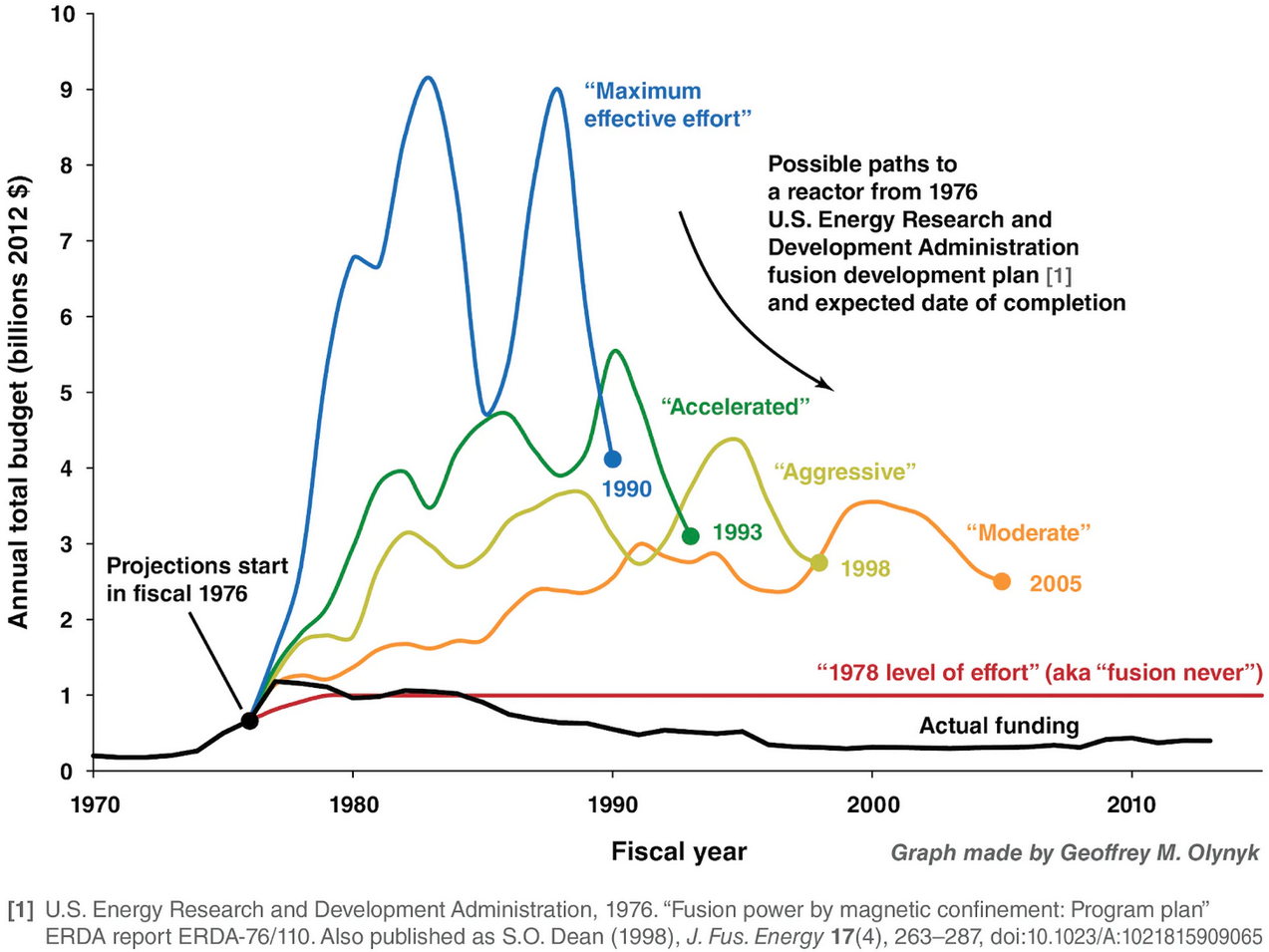
By the 1970s, it was apparent that making fusion power work is possible, but very hard. Fusion would require Big Science with Significant Support. The total cost would be less than the Apollo Program, similar to the International Space Station, and more than the Large Hadron Collider at CERN. The Department of Energy put together a request for funding. They proposed several different plans. Depending on how much funding was available, we could get fusion in 15-30 years.

How did that work out?

Along with the plans for fusion in 15-30 years, there was also a reference: “fusion never”. This plan would maintain America’s plasma physics facilities, but not try to build anything new.

Actual funding for fusion in the US has been less than the “fusion never” plan.

The reason we don’t have fusion already is because we, as a civilization, never decided that it was a priority. Fusion funding is literally peanuts: In 2016, the US spent twice as much on peanut subsidies as on fusion research.

May 22, 2022

HMCS Bras D’Or; The world’s fastest warship and the pinnacle of hydrofoil development in Canada

Filed under: Cancon, History, Military, Technology — Tags: , , , , , , , — Nicholas @ 02:00

Polyus Studios
Published 3 Feb 2022

Don’t forget to like the video and subscribe to my channel!
Support me on Patreon – https://www.patreon.com/polyusstudios

HMCS Bras D’Or was the pinnacle of over 100 years of hydrofoil development in Canada. Starting with Alexander Graham Bell and ending with the Proteus, hydrofoils held the promise of faster travel over the waves. Unfortunately the technology never found a comfortable fit in either military or civil fleets. It was designed to be an ASW hunter but by the time she was ready, the Navy was settled on using the now familiar Destroyer/Helicopter combos.

0:00 Introduction
0:29 Alexander Graham Bell and Casey Baldwin
2:28 The R-100 Massawippi
5:46 The R-103 Baddeck
7:15 The Rx
8:48 Anti-submarine warfare hydrofoil concept
12:24 FHE-400 Bras D’Or
17:23 Testing and refinement
19:25 Cancellation
20:18 Proteus
20:45 Conclusion

Music:
“Denmark” – Portland Cello Project
“Your Suggestions” – Unicorn Heads

#BrasDor #CanadianAerospace #PolyusStudios

April 28, 2022

Why yeast extract is in tons of foods (and why it’s delicious)

Filed under: Britain, Food, Health — Tags: , — Nicholas @ 02:00

Adam Ragusea
Published 13 Dec 2021

2008 paper in which Turkish scientists found 50ºC for 24 hours is the best time and temp for yeast autolysis: https://www.researchgate.net/publicat…

1916 paper in which American scientists found that yeast extract cured beriberi in pigeons fed only white rice, because B vitamins: https://www.google.com/books/edition/…

1995 book chapter covering Justus Von Liebig’s experiments with yeast extract: https://www.google.com/books/edition/…

2002 press release from the Marmite company covering their history (much more thorough than what’s currently on their website): http://webarchive.loc.gov/all/2002111…

Vegemite. There, I said it.

February 4, 2022

Proposed Advanced Variants of the Avro Canada CF-100 Canuck

Filed under: Cancon, History, Military, Weapons — Tags: , , , , , — Nicholas @ 02:00

Polyus Studios
Published 20 Nov 2018

Don’t forget to like the video and subscribe to my channel!
Support me on Patreon – https://www.patreon.com/polyusstudios

This video covers some of the advanced variants that were proposed for to enhance the capabilities of the CF-100 Canuck. It covers both weapon systems and a few airframe redesigns.

0:00 Introduction
0:55 Velvet Glove and Sparrow 2 missiles
1:36 Falcon and Sidewinder missiles
2:22 Eagle missile
2:53 Genie nuclear rocket
3:18 Engine testing
3:50 Canuck Mk10
4:40 VTOL Canuck
6:03 Conclusion

Music:
Denmark – Portland Cello Project

#CF100 #CanadianAerospace #PolyusStudios

January 9, 2022

QotD: Secrets in plain sight

Filed under: Business, Quotations, Science, Technology — Tags: , , — Nicholas @ 02:00

One such trend – which Thiel approaches in a lot of different equivalent ways – is the loss of belief in secrets. People no longer believe that there are important things that they don’t know, but which they could discover if they tried a little harder.

Past scientific discoveries came from a belief in secrets. Isaac Newton wondered why apples fell, thought “Maybe if I work really hard on this problem, I can discover something nobody has ever learned before”, and then set out to do it. Modern people aren’t just less likely to think this way. They’re actively discouraged from it by a culture which mocks the story of Newton as “the myth of the lone genius”, and tells young people that even thinking about this risks promoting a regressive political agenda. Nowadays people get told that if they think they’ve figured out something about gravity, they’re probably a crackpot. Instead, they should wait for very large government-funded programs full of well-credentialled people to make incremental advances.

Good startups require a belief in secrets, where “secret” is equivalent to “violation of the efficient market hypothesis”. You believe you’ve discovered something that nobody else has: for example, that if you set up an online bookstore in such-and-such a way today, in thirty years you’ll be richer than God. This is an outrageously arrogant claim: that you have spotted a hundred-billion-dollar bill lying on the sidewalk that everyone else has missed. But only people who believe something like it can noncoincidentally found great companies. You must believe there are lucrative secrets hidden in plain sight.

Scott Alexander, “Book Review: Zero to One”, Slate Star Codex, 2019-01-31.

December 19, 2021

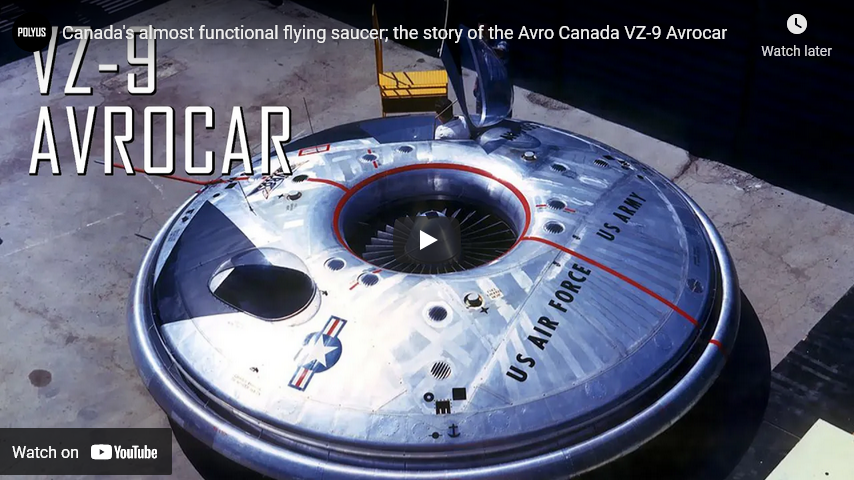
Canada’s almost functional flying saucer; the story of the Avro Canada VZ-9 Avrocar

Filed under: Cancon, History, Military, Technology, USA — Tags: , , , , — Nicholas @ 02:00

Polyus Studios
Published 14 Jul 2018

Support me on Patreon – https://www.patreon.com/polyusstudios

The Avro Canada VZ-9AV Avrocar: Canada’s first attempt at vertical take off and landing aircraft. Although the concept ultimately turned out to be a dead-end, the engineers and designers at Avro experimented with bold new ideas. Their concepts would push the limits of the imagination and reflected the extreme technological optimism of its time.

Music:
Denmark – Portland Cello Project

Research Sources:
“Declassified: America’s Secret Flying Saucer” – https://www.popularmechanics.com/mili…
Avro Canada VZ-9 Avrocar – https://www.aviationsmilitaires.net/v…
Avrocar: Canada’s Flying Saucer: The Story of Avro Canada’s Secret Projects by Bill Zuk (2001)
How to Build a FLYING SAUCER – https://declassification.blogs.archiv…
LaesieWorks – AVROCAR VZ-9AV – http://www.laesieworks.com/ifo/lib/AV…
The Living Moon – Project Silverbug – The Avrocar – http://www.thelivingmoon.com/49ufo_fi…

Footage Sources:
Avrocar I Progress Report 01/02/1958 – 05/1959 – US National Archives (~1959)
Disc Flight Development, Avrocar I Progress Report, 05/02/1959 – 04/12/1960 – US National Archives (~1960)
Avrocar Continuation Test Program and Terrain Test Program, 06/01/1960 – 06/14/1961 – US National Archives (~1959)
Tiltwing Versatility – San Diego Air and Space Museum (~1971)

Aircraft mentioned:
Project Y
Project Y-2
Project PV 704
Project 1794
Project Silverbug
Weapon System 606A
VZ-9AV Avrocar
CL-84 Dynavert

#Avrocar #CanadianAerospace #Polyus

December 17, 2021

Scott Alexander on the risk of ancient plagues returning

Filed under: Environment, Health, History — Tags: , , , , , , , — Nicholas @ 03:00

The other day, Scott Alexander responded to a hair-on-fire New York Magazine piece of hysteria-mongering about climate change warming up arctic zones that may still harbour ancient plagues that can return:

I’m a little nervous talking about this, because I am not a microbiologist. But I haven’t seen the proper experts address this properly, so I’ll try, and if I’m wrong you guys can shout me down.

(Also, the real microbiologists are apparently “self-injecting [3.5 million year old bacteria] just out of curiosity” and we should probably stay away from them for now)

I think we probably don’t have to worry very much about ancient diseases from millions of years ago.

Animal diseases can’t trivially become contagious among humans. Sometimes an animal disease jumps from beast to man, like COVID or HIV, but these are rare and epochal events. Usually they happen when the disease is very common in some population of animals that lives very close to humans for a long time. It’s not “one guy digs up a reindeer and then boom”.

If a plague is so ancient that it’s from before humans evolved, it’s probably not that dangerous. In theory, it could be dangerous for whatever animal it originally evolved for — a rabbit plague infecting rabbits, or an elephant plague infecting elephants. And then maybe after many rabbits are infected, some human might eat an infected rabbit and get unlucky, and the plague might mutate to affect humans. But I don’t think this is any more likely than any of the zillion plagues that already infect rabbits jumping to humans, and nobody is worrying about those.

The story about anthrax is a distraction. The fact that someone got anthrax from a corpse frozen in permafrost is irrelevant; there is anthrax now, and you could get it from a perfectly fresh corpse or living animal if you wanted. It’s adapted to animals and it can’t spread from person to person. Just because you got an irrelevant-to-humans modern animal disease when you dug up a modern animal, doesn’t mean you’re going to get a dangerous-to-humans disease from an ancient animals.

But I’m more concerned about recent human plagues coming back.

Not bubonic plague; that one is another distraction. The reason we don’t get more Black Deaths isn’t because yersinia pestis died off or mellowed out. It’s because we have good sanitation and pest control.

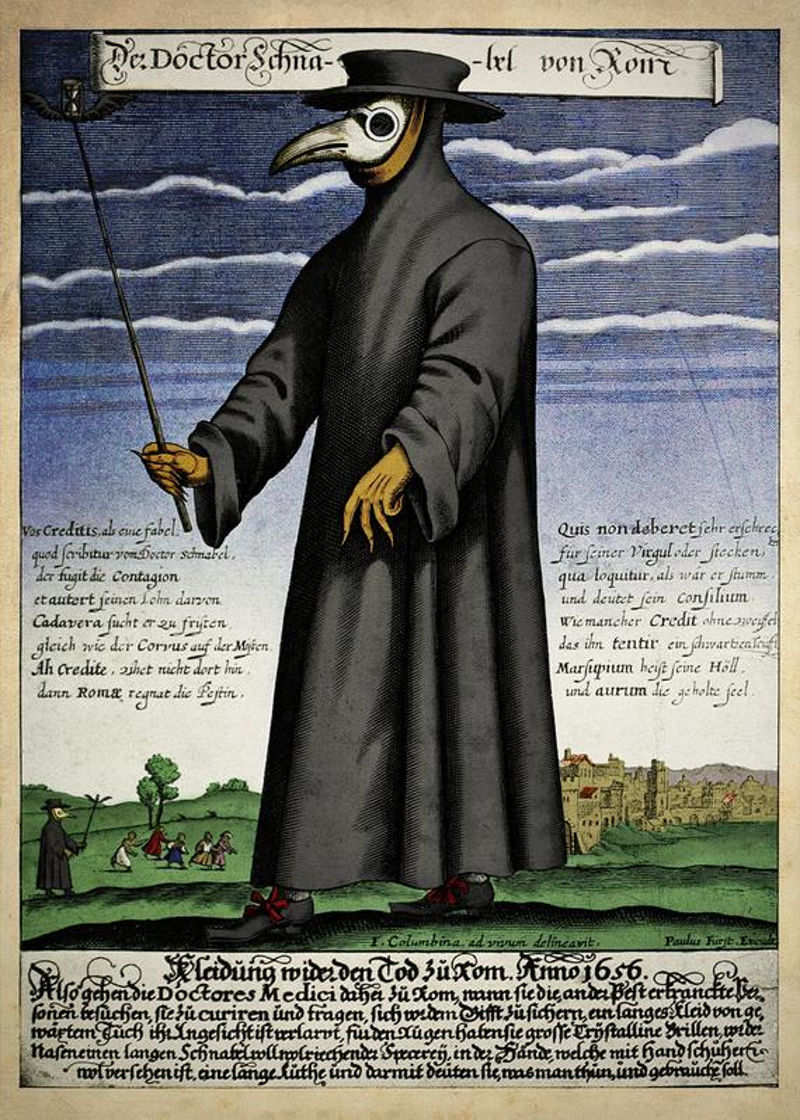
And doctors whose knowledge of medicine doesn’t begin and end with “look like a creepy bird”

But the 1918 Spanish flu has, as far as I know, legitimately died out. Lots of people like saying that in a sense it’s still with us. This NEJM paper (with a celebrity author!) points out that it’s the ancestor of all existing flu strains. But most of these flu strains are less infectious than it was. This didn’t make sense to me the first, second, or third time I asked about it: why would a flu evolve into an inferior flu? Sure, it might evolve into a less deadly flu because it’s perfectly happy being more infectious but less deadly. But I think the Spanish flu was also especially infectious; so why would it evolve away from that?

December 16, 2021

Supersonic Firsts

Filed under: Britain, Cancon, History, Military, Technology, USA — Tags: , , , , , — Nicholas @ 02:00

The History Guy: History Deserves to Be Remembered
Published 20 Aug 2021

On August 20, 1955, United States Air Force Colonel Horace A Hanes set the world’s first supersonic world speed record in a North American Aviation F-100C Super Sabre. Although we are well into the supersonic age, aircraft that can exceed the speed of sound are still rare machines, and marvels of engineering and pilot prowess. The early aviation pioneers who tested the terrifying sound barrier have helped scientists better understand the dynamics of superfast speeds.

This is original content based on research by The History Guy. Images in the Public Domain are carefully selected and provide illustration. As very few images of the actual event are available in the Public Domain, images of similar objects and events are used for illustration.

You can purchase the bow tie worn in this episode at The Tie Bar:
https://www.thetiebar.com/?utm_campai…

All events are portrayed in historical context and for educational purposes. No images or content are primarily intended to shock and disgust. Those who do not learn from history are doomed to repeat it. Non censuram.

Find The History Guy at:

Patreon: https://www.patreon.com/TheHistoryGuy
Please send suggestions for future episodes: Suggestions@TheHistoryGuy.net

The History Guy: History Deserves to Be Remembered is the place to find short snippets of forgotten history from five to fifteen minutes long. If you like history too, this is the channel for you.

Awesome The History Guy merchandise is available at:
teespring.com/stores/the-history-guy

Script by THG

#history #thehistoryguy #airforce

November 30, 2021

The Surprising and Forgotten History of Helium

Filed under: Britain, History, Science, Technology, USA — Tags: , , , , , — Nicholas @ 02:00

The History Guy: History Deserves to Be Remembered
Published 28 Jun 2019

Humanity didn’t recognize the second most abundant element in the known universe until the nineteenth century. A significant source on earth wasn’t discovered until 1903. The discovery and understanding of the element helium played a central role in some of the most important scientific discoveries of the modern era, and helium continues to change the world today.

This is original content based on research by The History Guy. Images in the Public Domain are carefully selected and provide illustration. As images of actual events are sometimes not available, images of similar objects and events are used for illustration.

All events are portrayed in historical context and for educational purposes. No images or content are primarily intended to shock and disgust. Those who do not learn from history are doomed to repeat it. Non censuram.

Find The History Guy at:

Patreon: https://www.patreon.com/TheHistoryGuy

The History Guy: History Deserves to Be Remembered is the place to find short snippets of forgotten history from five to fifteen minutes long. If you like history too, this is the channel for you.

Awesome The History Guy merchandise is available at:
teespring.com/stores/the-history-guy

Script by THG

#thehistoryguy #helium #science

October 27, 2021

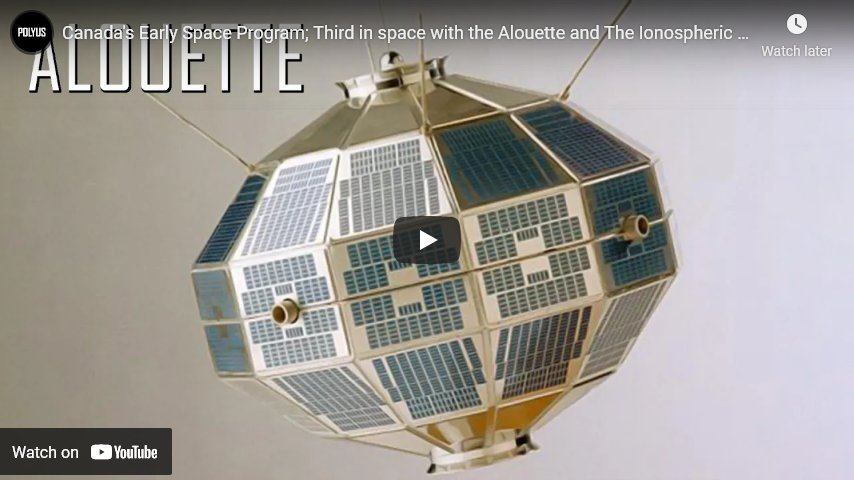
Alouette and The Ionospheric Satellites; A Beginners Guide To The Early Canadian Space Program

Filed under: Cancon, History, Space, Technology, USA — Tags: , , , , — Nicholas @ 02:00

Polyus Studios
Published 22 Aug 2109

Don’t forget to like the video and subscribe to my channel!
Support me on Patreon – https://www.patreon.com/polyusstudios

In the early 1960s Canada was among the early pioneers of space technology and research. Scientists and engineers took advantage of then cutting edge technologies like the transistor and solar panels, to produce the Alouette and ISIS series of satellites. It was an immense engineering challenge that represented the high water mark of a tradition of ionospheric research that began back before the establishment of Canada as a nation. The Alouette and ISIS series of satellites produced more than 1200 research papers exploring all aspects of the Earth’s ionosphere, the aurora, and other phenomena. They also demonstrated to the world that Canada was a world leader in peaceful space technology.

0:00 Intro
0:29 Arctic exploration and early magnetic field research
2:40 New technologies promote new questions
5:35 Birth of the Canadian Space Program
9:25 Testing and Launch of Alouette
13:04 ISIS series of satellites
17:12 Legacy and Conclusion

Music:
“Denmark” – Portland Cello Project

Research sources:
https://nssdc.gsfc.nasa.gov/nmc/space…
https://space.skyrocket.de/doc_sdat/i…
http://www.friendsofcrc.ca/Projects/I…
https://www.ieee.ca/millennium/alouet…
https://www.ieee.ca/millennium/isis/i…
http://www.asc-csa.gc.ca/eng/satellit…
http://friendsofcrc.ca/Projects/ISIS/…
https://nssdc.gsfc.nasa.gov/nmc/space…
http://acuriousguy.blogspot.com/2017/…
https://photostories.ca/explore/photo…
http://www.ieee.dreamhosters.com/digl…
https://www.ieee.ca/millennium/alouet…

#Spacecraft #PolyusStudios #CanadianAerospace

October 6, 2021

Did Penicillin Win World War Two? – WW2 Special

Filed under: Britain, Health, History, Military, Science, USA, WW2 — Tags: , , , , — Nicholas @ 04:00

World War Two
Published 5 Oct 2021

We all know that penicillin is a wonder drug, it shortened the war, and assured Allied victory. Or did it, is that just a myth? The Allies are certainly much further ahead than the Axis, but even with accelerated wartime development, will it come into service quick enough to make a difference?
(more…)

« Newer PostsOlder Posts »

Powered by WordPress