Forgotten Weapons
Published 18 May 2021http://www.patreon.com/ForgottenWeapons
https://www.floatplane.com/channel/Fo…
Cool Forgotten Weapons merch! http://shop.forgottenweapons.com
Only days ahead of the French Army in April 1945, Ott-Helmuth von Lossnitzer and about 250 Mauser engineers and technicians fled Oberndorf with the core of Mauser’s new projects. They had the drawings, components, and gages for guns like the new StG-45 assault rifle, MK214 aircraft cannon, and Volkspistol and they were headed for an impregnable series of tunnels in the Austrian Alps to carry on the war. In a story that is absolutely worthy of film adaptation they scrounged a series of locomotives, dodged P47 Thunderbolt attacks, and went careening through the Alps with about 2 dozen boxcars of the most important prototype guns in the German arsenal.
Of course, the idea of continued resistance was a complete fantasy. When it did finally arrive in Ötztal, the Mauser refugees found all the tunnels already occupied by other groups with the very same idea. So they basically made camp and waited for American forces to arrive. The train was found by a British-American CIOS (Combined Intelligence Objective Subcommittee) party, the engineers were all questioned, and the train contents packed up for shipment to the UK and US. Ott-Helmuth von Lossnitzer himself emigrated to the US as part of Operation Paperclip, where he worked for Springfield Arsenal for many years until retiring in 1968 and then living in Wisconsin until his passing in 1989.
For anyone interested in this story, I highly recommend Lossnitzer’s oral recollections compiled into book form by Leslie Field and Bas Martens – ISBN 9789081737807. It is out of print now, but you may be able to find it on the secondary market.
Much more accessible is the reprinting of the original CIOS report on Mauser published by Peter Dallhammer (whom you may recall from his Textbook of Pistol Technology and Design). This is a 360-page treasure trove of details on Mauser’s ongoing R&D in 1945, and it is available on Amazon:
https://amzn.to/2RrnNgTContact:
Forgotten Weapons
6281 N. Oracle 36270
Tucson, AZ 85740
September 4, 2021
The Mauser Train: High Adventure in the Last Days of WWII
August 16, 2021
QotD: Biotechnology
Along with rethinking cities, environmentalists will need to rethink biotechnology. One area of biotech with huge promise and some drawbacks is genetic engineering, so far violently rejected by the environmental movement. That rejection is, I think, a mistake. Why was water fluoridization rejected by the political right and “frankenfood” by the political left? The answer, I suspect, is that fluoridization came from government and genetically modified (GM) crops from corporations. If the origins had been reversed — as they could have been — the positions would be reversed, too.
Ignore the origin and look at the technology on its own terms. (This will be easier with the emergence of “open source” genetic engineering, which could work around restrictive corporate patents.) What is its net effect on the environment? GM crops are more efficient, giving higher yield on less land with less use of pesticides and herbicides. That’s why the Amish, the most technology-suspicious group in America (and the best farmers), have enthusiastically adopted GM crops.
There has yet to be a public debate among environmentalists about genetic engineering. Most of the scare stories that go around (Monarch caterpillars harmed by GM pollen!) have as much substance as urban legends about toxic rat urine on Coke can lids. Solid research is seldom reported widely, partly because no news is not news. A number of leading biologists in the U.S. are also leading environmentalists. I’ve asked them how worried they are about genetically engineered organisms. Their answer is “Not much,” because they know from their own work how robust wild ecologies are in defending against new genes, no matter how exotic. They don’t say so in public because they feel that entering the GM debate would strain relations with allies and would distract from their main focus, which is to research and defend biodiversity.
Stewart Brand, “Environmental Heresies”, Technology Review, 2005-05
July 31, 2021
English sea-borne trade in the early 17th century
In the latest Age of Invention newsletter, Anton Howes reviews a book on English trade … a very old book:
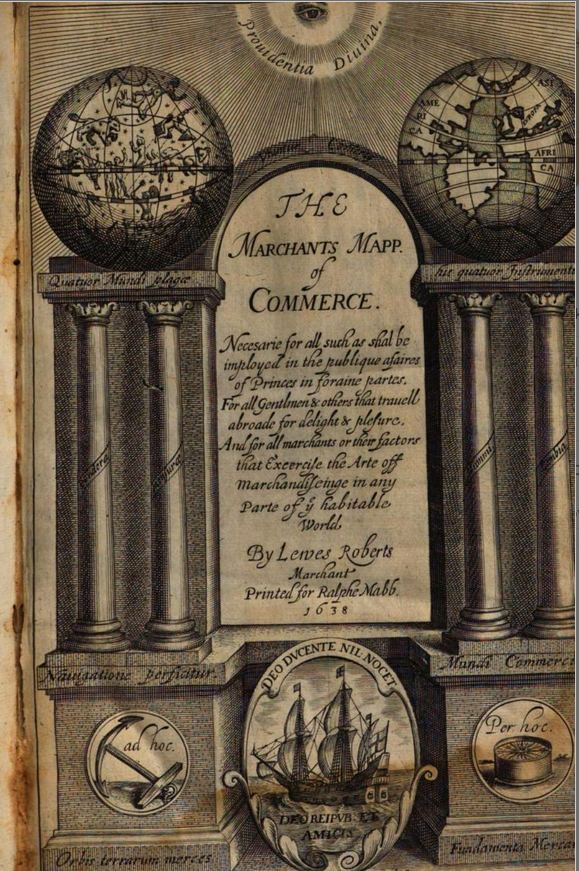
I’ve become engrossed this week by a book written in 1638 by the merchant Lewes Roberts — The Marchant’s Mappe of Commerce. It is, in effect, a guide to how to be a merchant, and an extremely comprehensive one too. For every trading centre he could gather information about, Roberts noted the coins that were current, their exchange rates, and the precise weights and measures in use. He set down the various customs duties, down even to the precise bribes you’d be expected to pay to various officials. In Smyrna, for example, Roberts recommended you offer the local qadi some cloth and coney-skins for a vest, the qadi‘s servant some English-made cloth, and their janissary guard a few gold coins.
Unusually for so many books of the period, Roberts was also careful to be accurate. He often noted whether his information came from personal experience, giving the dates of his time in a place, or whether it came second-hand. When he was unsure of details, he recommended consulting with better experts. And myths — like the rumour he heard that the Prophet Muhammad’s remains at Mecca were in an iron casket suspended from the ceiling by a gigantic diamond-like magnet called an adamant — were thoroughly busted. Given his accuracy and care, it’s no wonder that the book, in various revised editions, was in print for almost sixty years after his death. (He died just three years after publication.)
What’s most interesting about it to me, however, is Roberts’s single-minded view of English commerce. The entire world is viewed through the lens of opportunities for trade, taking note of the commodities and manufactures of every region, as well as their principal ports and emporia. A place’s antiquarian or religious tourist sites, which generally make up the bulk of so many other geographical works, are given (mercifully) short shrift. Indeed, because the book was not written with an international audience in mind, it also passes over many trades with which the English were not involved, or from which they were even excluded. It thus provides a remarkably detailed snapshot of what exactly English merchants were interested in and up to on the eve of civil war; and right at the tail end of a century of unprecedented growth in London’s population, itself seemingly led by its expansion of English commerce.
So, what did English merchants consider important? It’s especially illuminating about England’s trade in the Atlantic — or rather, the lack thereof.
Roberts spends remarkably little time on the Americas, which he refers to as the continents of Mexicana (North America) and Peruana (South America). Most of his mentions of English involvement are about which privateers had once raided which Spanish-owned colonies, and he gives especial attention to the seasonal fishing for cod off the coast of Newfoundland — a major export trade to the Mediterranean, and a source of employment to many English West Country farmers, who he refers to as being like otters for spending half their lives on land and the other half on sea.
But as for the recently-established English colonies on the mainland, which Roberts refers to collectively as Virginia, he writes barely a few sentences. Although he reproduces some of the propaganda about what is to be found there — no mention yet of tobacco by the way, with the list consisting largely of foodstuffs, forest products, tar, pitch, and a few ores — the entirety of New England is summarised only as a place “said to be” resorted to by religious dissenters. The island colonies on Barbados and Bermuda were also either too small or too recently established to merit much attention. To the worldly London merchant then, the New World was still peripheral — barely an afterthought, with the two continents meriting a mere 11 pages, versus Africa’s 45, Asia’s 108, and Europe’s 262.
The reason for this was that the English were excluded from trading directly with the New World by the Spanish. It was, as Roberts jealously put it, “shut up from the eyes of all strangers”. The Spanish were not only profiting from the continent’s mines of gold and silver, but he also complained of their monopoly over the export of European manufactures to its colonies there. It’s a striking foreshadowing of what was, in the eighteenth century, to become one of the most important features of the Atlantic economy — the market that the growing colonies would one day provide for British goods. Indeed, Roberts’s most common condemnation of the Spanish was for having killed so many natives, thereby extinguishing the major market that had already been there: “had not the sword of these bloodsuckers ended so many millions of lives in so short a time, trade might have seen a larger harvest”. The genocide had, in Roberts’s view, not only been horrific, but impoverished Europe too (he was similarly upset that the Spanish had slaughtered so many of the natives of the Bahamas, known for the “matchless beauty of their women”).

July 3, 2021
HMS Victory – In Her True Colours
Maritime Foundation
Published 25 Oct 2015HMS Victory – In Her True Colours
Painting HMS Victory – Repainted in the true colours Nelson would have known.
Produced by Maritime Films UK (www.maritimefilmsuk.tv) for the National Museum of the Royal Navy.
June 25, 2021
The Birth of the Manhattan Project – WW2 Special
World War Two
Published 24 Jun 2021When nuclear fission was discovered, scientists theorized it could be used in an atomic bomb. Thus, the American Army sets up one of the biggest research projects in history: The Manhattan Project.
(more…)
May 29, 2021
Justin Trudeau is clearly not concerned about China or Chinese involvement in Canadian affairs
In The Line, Jen Gerson outlines the PM’s latest display of insouciance in regard to anything involving China, their ruling Communist party, or the Chinese military:
The Globe and Mail reported last week that Canada’s top infectious disease research centre, the National Microbiology Laboratory in Winnipeg, had hosted and otherwise collaborated with guest researchers and scientists from China — including some with links to that country’s military or government. O’Toole asked about this in the House, and Trudeau gave a very routine Trudeauvian non-answer. O’Toole and other Tories kept up the questioning, Trudeau eventually responded with this (as per Hansard): “Mr. Speaker, we have always and will always take this threat seriously. Public safety officials have met with more than 34 universities to help them keep their research safe. In 2020, CSIS engaged more than 225 different organizations, including universities, to ensure that they were aware of foreign threats. I also want to mention that we are seeing a disturbing rise in anti-Asian racism. I hope that my Conservative Party colleagues are not raising fears about Asian Canadians.”
Sigh. Where do we begin?
First of all, though this may shock our readers, the Sun papers, and its columnists, have been known to exaggerate their criticisms of the PM. The PM gave a more substantive answer than Lilley gave him credit for. You can disagree with the PM — see below! — without getting cute with what he actually said. The racism line was dumb, and shitty. It was beneath the PM and unfair to the legitimate questions that were being asked. Trudeau shouldn’t have said it, and he was right to get called out for it.
So yes, a dick move by the PM — in a hundred years, maybe one of his descendants can apologize for it. But let’s not take our eye off the ball.
Trudeau’s answers were more than Lilley suggested, but they’re still not good enough. O’Toole and the Conservatives are onto something. China’s ruling regime is aggressive, brutal, and thuggish. They’re a threat to security abroad, they’re committing outright crimes against humanity against their own religious minorities, they’ve crushed Hong Kong underfoot, and they’re actively hostile to Canada. None of this is racist to note.
And yet our federal Liberals remain alarmingly unable to admit any of this. We don’t buy that it’s just a matter of political expediency, an awkward but necessary consequence of the ongoing detention of the two Michaels. Hell, we wish that the Liberals were just being publicly cautious with their real views on Beijing while remaining clear-eyed about the threat behind closed doors. The evidence continues to suggest that the federal Liberals, from Trudeau on down, remain hopelessly naïve about the nature of Beijing’s rulers, even as more and more of our allies are getting real about what the next generation or two of geopolitics is gonna look like for the Western alliance. (Which Canada remains a part of, whether Trudeau likes it or not.)
The growing tensions with a rising China are a big deal. It is only going to become a bigger deal. The Liberals need to get with the program. We hope to see more on this across the Canadian media — and hopefully it’s a bit more useful and productive than what the Sun ran with this week. The Liberals look terrible on this file already for entirely legitimate, serious reasons. We don’t need to pop our aging joints as we stretch and contort ourselves to make it seem so.
April 8, 2021
Vladimir Lenin and the Communist War On Religion | B2W: ZEITGEIST! I E.15 – Spring 1922
TimeGhost History
Published 7 Apr 2021Vladimir Lenin founded the Bolshevik Party, orchestrated the October Revolution, and led the world’s first communist state to victory in the Russian Civil War. He is now gravely ill and close to death, but he still has one more enemy he wants to crush.
Join us on Patreon: https://www.patreon.com/TimeGhostHistory
Hosted by: Indy Neidell
Written by: Francis van Berkel
Director: Astrid Deinhard
Producers: Astrid Deinhard and Spartacus Olsson
Executive Producers: Astrid Deinhard, Indy Neidell, Spartacus Olsson, Bodo Rittenauer
Creative Producer: Maria Kyhle
Post-Production Director: Wieke Kapteijns
Research by: Francis van Berkel and Lewis Braithwaite
Image Research by: Daniel Weiss
Edited by: Daniel Weiss
Sound design: Marek KamińskiColorizations:
Daniel Weiss – https://www.facebook.com/TheYankeeCol…Sources:
Painting of Tikhon by Moskvitin Philip
Photos from Color by Klimbim
Bundesarchiv_Bild – 183-R14433 (Vertrag von Rapallo)Soundtracks from Epidemic Sound
– “One More for the Road” – Golden Age Radio
– “Not Safe Yet” – Gunnar Johnsen
– “Dark Shadow” – Etienne Roussel
– “Explaining Gravity” – Silver Maple
– “Far Far Far” – Hector Posser
– “Dawn Of Civilization” – Jo Wandrini
– “Ominous” – Philip Ayers
– “Walk With Legends” – Bonnie Grace
– “What Now” – Golden Age Radio
– “Weapon of Choice” – Fabien TellArchive by Screenocean/Reuters https://www.screenocean.com.
A TimeGhost chronological documentary produced by OnLion Entertainment GmbH.
From the comments:
TimeGhost History
2 days ago (edited)
The Russian Orthodox Church was once an all-mighty institution throughout what was the Russian Empire. But now in a matter of years, it has been completely swept aside by the new Soviet government in the name of progress and reason. This is just one — particularly violent — example of what has been a common theme of this era: the conflict between religion and modernity.It has already come a few times in the series and will continue to do so, but it’s not always a story of retreating faith like it is in this episode. As you will see in later episodes, organized religion often fights back against modernity and even sometimes tries to accommodate it. You’ll have to stay tuned to find out exactly why.
March 6, 2021
Vaccinations and Communist Famine | B2W: ZEITGEIST! I E.12 – Summer1921
TimeGhost History
Published 5 Mar 2021This season there is a major breakthrough in combatting one of humanity’s oldest diseases, but a deadly famine also strikes Soviet Russia. Will the international community come to the fledgling state’s aid?
Join us on Patreon: https://www.patreon.com/TimeGhostHistory
Hosted by: Indy Neidell
Written by: Francis van Berkel
Director: Astrid Deinhard
Producers: Astrid Deinhard and Spartacus Olsson
Executive Producers: Astrid Deinhard, Indy Neidell, Spartacus Olsson, Bodo Rittenauer
Creative Producer: Maria Kyhle
Post-Production Director: Wieke Kapteijns
Research by: Francis van Berkel
Image Research by: Daniel Weiss
Edited by: Daniel Weiss
Sound design: Marek KamińskiColorizations:
– Daniel Weiss – https://www.facebook.com/TheYankeeCol…Sources:
Some images from the Library of Congress
Albert Calmette. Photograph, 1930. Credit: Wellcome Collection
World health : the magazine of the World Health Organization Credit: Wellcome Collection Hannokarlhuber https://www.hanno-karlhuber.at/galeri…
https://wellcomeimages.org/indexplus/…
art of Atlit-Yam from Hanay
Photo by J P Davidson https://flickr.com/photos/50616401@N0…From the Noun Project:
– people by Gregor Cresnar
– Earth by RF_Design
– sick By Adrien Coquet, FR
– Man by Milinda CoureySoundtracks from Epidemic Sound and ODJB
– “One More for the Road” – Golden Age Radio
– “Not Safe Yet” – Gunnar Johnsen
– “The Inspector 4” – Johannes Bornlöf
– “Guilty Shadows 4” – Andreas Jamsheree
– “Dark Shadow” – Etienne Roussel
– “Brighter Days Will Come” – Oakwood Station
– “Just Like Old Times” – Jackie MartinArchive by Screenocean/Reuters https://www.screenocean.com.
A TimeGhost chronological documentary produced by OnLion Entertainment GmbH.
From the comments:
TimeGhost History
3 days ago
As usual this episode sees the balance of dark and light that is so typical of the interwar period. Famine in Russia and the first fast-food chain in America; the turning of the tide against TB and tragic Hollywood scandal.So a mixture of serious and fun. Regular viewers will know that our comment section is the same, running from intense debate to long-running memes. In this episode Indy mentions the first ice-cream candy bar, so to encourage things to stay on the light-hearted side why don’t you comment below telling us what’s your favourite candy bar or fast-food joint?
February 8, 2021
Why Everybody Disagrees on the Efficacy of the English Longbow – A Video Essay
SandRhoman History
Published 7 Feb 2021Everybody quarrels over the efficacy of the English longbow. Many historians, reenactors and history enthusiasts alike hold the view that arrows piercing armor is a myth. Some base this view on testing as was done for example by Tod from Tod’s workshop. Together with his team, he provided an invaluable data point for this debate. Others, such as traditionalist historians are often open to the possibility of arrows piercing armor, even though they are aware of actual testing of the longbow. In general, the efficacy of a weapon is much more complicated than its mere armor penetration value. So, in this video we’d like to shed light on the whole debate and explain why it is so hard to find common ground on this issue. This is why everybody disagrees on the efficacy of the English longbow.
Patreon: https://www.patreon.com/sandrhomanhis…
Twitter: https://twitter.com/Sandrhoman
Tod’s Video: ARROWS vs ARMOUR – Medieval Myth Busting https://youtu.be/DBxdTkddHaE
Tod’s playlist: MEDIEVAL MYTH BUSTING https://youtube.com/playlist?list=PLI…
Bibliography:
Rogers, C.J., The Efficacy of the English Longbow, 1998.
Devries, K., Medieval Military Technology, 1994.
Bane, M., “English Longbow Testing against various armor circa 1400”, 2006.
Soar, H., Gibbs, J., Jury, C., Stretton, M., Secrets of the English War Bow. Westholme, 2010, pp. 127–151.
Magier, Mariusz; Nowak, Adrian; et al., “Numerical Analysis of English Bows used in Battle of Crécy”. Problemy Techniki Uzbrojenia. 142 (2), 2017, 69–85.
February 6, 2021
From an improbable 1930s “death ray” to the radar network that helped defeat the Blitz
In a story from a few years back, Tim Harford outlines how a British Air Ministry prize for developing a “death ray” to use against enemy aircraft eventually helped kick off the discovery of radar:
… sometimes inventions need other inventions to unlock their full potential.
For the aviation industry, that story starts with the invention of the death ray, or at least an attempt to design a death ray, back in 1935.
Officials in the British Air Ministry were worried about falling behind Nazi Germany in the technological arms race.
The death ray idea intrigued them: they had been offering a £1,000 prize for anyone who could zap a sheep at a hundred paces. So far, nobody had claimed it.
But should they fund more active research? Was a death ray even possible?
Unofficially, they sounded out Robert Watson Watt, of the Radio Research Station.
And he posed an abstract maths question to his colleague Skip Wilkins.
“Suppose, just suppose,” said Watson Watt to Wilkins, “that you had eight pints of water, 1km [3,000ft] above the ground.
“And suppose that water was at 98F [37C], and you wanted to heat it to 105F.
“How much radio frequency power would you require, from a distance of 5km?”
Skip Wilkins was no fool.
He knew that eight pints was the amount of blood in an adult human, 98F was normal body temperature and 105F was warm enough to kill you, or at least make you pass out, which — if you’re behind the controls of an aeroplane — amounts to much the same thing.
So Wilkins and Watson Watt understood each other, and they quickly agreed the death ray was hopeless: it would take too much power.
But they also saw an opportunity.
Clearly, the ministry had some cash to spend on research. Perhaps Watson Watt and Wilkins could propose some alternative way for them to spend it?
Wilkins pondered. It might be possible, he suggested, to transmit radio waves and detect — from the echoes — the location of oncoming aircraft long before they could be seen.
Watson Watt dashed off a memo to the Air Ministry’s newly formed Committee for the Scientific Survey of Air Defence. Would they be interested in pursuing such an idea? They would indeed.
What Skip Wilkins was describing became known as radar.
February 4, 2021
QotD: The (as-yet-unfulfilled) promise of “personalized medicine”
A more useful lesson might be skepticism about personalized medicine. Personalized medicine – the idea that I can read your genome and your blood test results and whatever and tell you what antidepressant (or supplement, or form of therapy) is right for you has been a big idea over the past decade. And so far it’s mostly failed. A massively polycausal model would explain why. The average personalized medicine company gives you recommendations based on at most a few things – zinc levels, gut flora balance, etc. If there are dozens or hundreds of things, then you need the full massively polycausal model – which as mentioned before is computationally intractable at least without a lot more work.
(You can still have some personalized medicine. We don’t have to know the causes of depression to treat it. You might be depressed because your grandfather died, but Prozac can still make you feel better. So it’s possible that there’s a simple personalized monocausal way to check who eg responds better to Prozac vs. Lexapro, though the latest evidence isn’t really bullish about this. But this seems different from a true personalized medicine where we determine the root cause of your depression and fix it in a principled way.)
Even if we can’t get much out of this, I think it can be helpful just to ask which factors and sciences are oligocausal vs. massively polycausal. For example, what percent of variability in firm success are economists able to determine? Does most of the variability come from a few big things, like talented CEOs? Or does most of it come from a million tiny unmeasurable causes, like “how often does Lisa in Marketing get her reports in on time”?
Maybe this is really stupid – I’m neither a geneticist or a statistician – but I imagine an alien society where science is centered around polycausal scores. Instead of publishing a paper claiming that lead causes crime, they publish a paper giving the latest polycausal score for predicting crime, and demonstrating that they can make it much more accurate by including lead as a variable. I don’t think you can do this in real life – you would need bigger Big Data than anybody wants to deal with. But like falsifiability and compressability, I think it’s a useful thought experiment to keep in mind when imagining what science should be like.
Scott Alexander, “The Omnigenic Model As Metaphor For Life”, Slate Star Codex, 2018-09-13.
January 24, 2021
The Great Wine Blight
The History Guy: History Deserves to Be Remembered
Published 9 Sep 2020In the 19th century, the Great Wine Blight threatened the very existence of grapes. But the pestilence brought into Europe by American vines was eradicated by the use of those very same vines. The History Guy recalls how American indigenous vines saved the wine industry, and how you can help to preserve its future.
This is original content based on research by The History Guy. Images in the Public Domain are carefully selected and provide illustration. As very few images of the actual event are available in the Public Domain, images of similar objects and events are used for illustration.
Special thanks to Stone Hill Winery, Hermann, Missouri:
https://stonehillwinery.comYou can purchase the bow tie worn in this episode at The Tie Bar:
All events are portrayed in historical context and for educational purposes. No images or content are primarily intended to shock and disgust. Those who do not learn from history are doomed to repeat it. Non censuram.
Find The History Guy at:
Patreon: https://www.patreon.com/TheHistoryGuyThe History Guy: History Deserves to Be Remembered is the place to find short snippets of forgotten history from five to fifteen minutes long. If you like history too, this is the channel for you.
Awesome The History Guy merchandise is available at:
teespring.com/stores/the-history-guy
Script by CDH
#history #thehistoryguy #wine
January 23, 2021
QotD: “Genetics is interesting as an example of a science that overcame a diseased paradigm”
This side of the veil, instead of looking for the “gene for intelligence”, we try to find “polygenic scores”. Given a person’s entire genome, what function best predicts their intelligence? The most recent such effort uses over a thousand genes and is able to predict 10% of variability in educational attainment. This isn’t much, but it’s a heck of a lot better than anyone was able to do under the old “dozen genes” model, and it’s getting better every year in the way healthy paradigms are supposed to.
Genetics is interesting as an example of a science that overcame a diseased paradigm. For years, basically all candidate gene studies were fake. “How come we can’t find genes for anything?” was never as popular as “where’s my flying car?” as a symbol of how science never advances in the way we optimistically feel like it should. But it could have been.
And now it works. What lessons can we draw from this, for domains that still seem disappointing and intractable?
Turn-of-the-millennium behavioral genetics was intractable because it was more polycausal than anyone expected. Everything interesting was an excruciating interaction of a thousand different things. You had to know all those things to predict anything at all, so nobody predicted anything and all apparent predictions were fake.
Modern genetics is healthy and functional because it turns out that although genetics isn’t easy, it is simple. Yes, there are three billion base pairs in the human genome. But each of those base pairs is a nice, clean, discrete unit with one of four values. In a way, saying “everything has three billion possible causes” is a mercy; it’s placing an upper bound on how terrible genetics can be. The “secret” of genetics was that there was no “secret”. You just had to drop the optimistic assumption that there was any shortcut other than measuring all three billion different things, and get busy doing the measuring. The field was maximally perverse, but with enough advances in sequencing and computing, even the maximum possible level of perversity turned out to be within the limits of modern computing.
(This is an oversimplification: if it were really maximally perverse, chaos theory would be involved somehow. Maybe a better claim is that it hits the maximum perversity bound in one specific dimension)
Scott Alexander, “The Omnigenic Model As Metaphor For Life”, Slate Star Codex, 2018-09-13.
January 4, 2021
QotD: Repressing the facts in genetic research
Now, in 2010, cleared-eyed observers are imagining a near-term future scenario that looks like this: (1) we will shortly have genomic-sequence information on hundreds of thousands of human beings from all over the planet, enough to build a detailed map of human genetic variation and a science of behavioral genetics. (2) We will confirm that variant alleles correlate strongly with significant measures of human ability and character, beginning with IQ and quite possibly continuing to distribution of time preference, sociability, docility, and other important traits. (3) We will discover that these same alleles correlate significantly with traditional indicia of race.
In fact, given the state of our present knowledge, I judge all three of these outcomes are near certain. I have previously written about some of the evidence in Racism and Group Differences. The truth is out there; well known to psychometricians, population geneticists and anyone who cares to look, but surrounded by layers of denial. The cant has become thick enough to, for example, create an entire secondary mythology about IQ (e.g., that it’s a meaningless number or the tests for it are racially/culturally biased). It also damages our politics; many people, for example, avert their eyes from the danger posed by Islamism because they fear being tagged as racists. All this repression has been firmly held in place by the justified fear of truly hideous evils – from the color bar through compulsory sterilization of the “inferior” clear up to the smoking chimneys at Treblinka and Dachau. But … if the repressed is about to inevitably return on us, how do we cope?
It’s not going to be easy. I saw this coming in the mid-1990s, and I’m expecting the readjustment to be among the most traumatic issues in 21st-century politics. The problem with repression, on both individual and cultural levels, is that when it breaks down it tends to produce explosions of poorly-controlled emotional energy; the release products are frequently ugly. It takes little imagination to visualize a future 15 or 20 years hence in which the results of behavioral genetics are seized on as effective propaganda by neo-Nazis and other racist demagogues, with the authority of science being bent towards truly appalling consequences.
Eric S. Raymond, “A Specter is Haunting Genetics”, Armed and Dangerous, 2010-06-19.
December 31, 2020
The limiting factor that holds back the green dream of electric cars everywhere
I’m not actually against the spread of electric vehicles — where appropriate — but we’re a long way technically speaking from an all-electric future on the roads. Alongside the vast increase in our electric generation and distribution infrastructure such a change would require, there’s also the practical limitation of what is currently possible in battery technology, and hoped-for improvements will require significant breakthroughs which seem more than just a step beyond our current capabilities:
“There are liars, damned liars, and battery guys” – or some variation thereof – is an aphorism commonly attributed to US electro-whizz Thomas Edison.
Edison’s anecdotal frustrations remain valid today because scarcely a month goes by without a promised battery revolution, and scarcely a month goes by without that revolution arriving.
In October, for example, The Register encountered Jagdeep Singh, CEO of QuantumScape, a battery startup that boasted a new type of battery that could double the range of electric vehicles, charge in 15 minutes, and is safer than the lithium-ion that dominates the rechargeable market.
“Ten years ago, we embarked on an ambitious goal that most thought was impossible,” Singh said in a canned statement. “Through tireless work, we have developed a new battery technology that is unlike anything else in the world.”
Singh might disprove Edison’s aphorism and deliver the better batteries the world will so clearly appreciate. But to do so he’ll have to buck a 30-year trend that has seen lithium-ion reign supreme.
Why has the industry stalled? The short answer is that chemistry hasn’t found a way to build a better battery.
“The basic concept of what a battery is hasn’t shifted since the 18th century,” says Professor Thomas Maschmeyer, a chemist at the University of Sydney and founding chairman of Gelion Technology, a battery developer. All batteries, Maschmeyer explains, consist of three main building blocks: a positive electrode, called a cathode; a negative electrode, called an anode; and an electrolyte that acts as a catalyst between the two sides. “These three elements cannot change. So, if you want a breakthrough, it must come from a fundamental change in the chemistry,” Maschmeyer says.
Better living through chemistry
Battery boffins have proposed a periodic table’s worth of alternative compounds that could surpass lithium-ion batteries.These largely fall into two categories. First, batteries that are trying to surpass the energy densities that lithium offers, such as solid-state batteries, lithium-sulphur, and lithium-air. The other is batteries comprised of more abundant materials such as sodium-ion batteries, aluminium-ion, and magnesium-ion batteries.
But changing the chemistry of batteries is easier said than done, says Professor Jacek Jasieniak, a professor of material sciences and engineering at Monash University. He compares changing one element in a battery to changing a chemical in a pharmaceutical. “Often solving one problem exacerbates another,” he says.