
A specter is haunting genetics; the shadow of racialist slavery, eugenics, and Naziism. Western civilization since 1945, traumatized by the horror of the Holocaust, has elevated anti-racism into an unquestionable secular piety. Much good has been accomplished thereby, but like all pieties the worthy results have been accompanied by a great deal of willed repression, denial, and cant. Evidence that racial genetic differences do matter is not actually hard to find; Murray & Herrnstein’s The Bell Curve (1994) included a brave and excellent summation of the science on this point. Consequently, the bien-pensant reaction to that book was hysterical vilification, anathematization of heresy in full cry. Even at the time the lurking fear beneath the hysteria was easy to spot – that the authors might, after all, be right, and must be damned even more intensely because they might be.
Eric S. Raymond, “A Specter is Haunting Genetics”, Armed and Dangerous, 2010-06-19.
December 30, 2020
QotD: The sting in the tail of genetic research
December 27, 2020
Moderna’s Wuhan Coronavirus vaccine was developed nearly a year ago
Philip Steele explains why Moderna’s vaccine was not made available until very recently, despite having been developed only days after the genetic code for the virus was published:

Few people realize that the Moderna vaccine against COVID-19 — which the FDA has finally declared “highly effective,” and which is now being distributed to Americans — has actually been available for nearly a year.
But the government wouldn’t let you take it.
The vaccine, a triumph of medical science known as mRNA-1273, was designed in a single weekend, just two days after Chinese researchers published the virus’s genetic code on January 11, 2020.
For the entire duration of the pandemic, while hundreds of thousands died and the world economy was decimated by lockdowns, this highly effective vaccine has been available.
But you, and all the people who died, were prohibited by the government from taking it.
There are some who claim that the FDA “saves lives” by putting the brakes on medical innovation with their requirements for years-long, and often decades-long, billion-dollar medical trial procedures.
Missing here is the obvious counterpoint — How many lives did the FDA sacrifice to disease in the meantime?
In the case of COVID-19 we know the answer: more than 300,000 deaths so far in the United States and counting.
November 27, 2020
“The Attack of the Dead Men” Pt.2 – Gas! Gas! Gas! – Sabaton History 095 [Official]
Sabaton History
Published 26 Nov 2020On 22. April 1915, a wall of greenish-yellow fog, up to 2m high, was slowly creeping towards the Allied lines on the Ypres salient. A sweetish-chloric smell preceded the horrific effects of the deadly gas. Coughing, spitting, and retching, men were abandoning their trenches, hurrying to the rear, or falling to the ground, clutching their throats. It was the same desperate, gruesome scenery, the Russian soldiers at Osowiec Fortress had to fight through. From then on, a scientific race to counter and protect against those deadly chemicals began.
Support Sabaton History on Patreon: https://www.patreon.com/sabatonhistory
Listen to “Attack of the Dead Men” on the album The Great War: https://music.sabaton.net/TheGreatWar
Watch the Official Lyric Video of “Attack of the Dead Men” here: https://www.youtube.com/watch?v=-AFdw…
Listen to Sabaton on Spotify: http://smarturl.it/SabatonSpotify
Official Sabaton Merchandise Shop: http://bit.ly/SabatonOfficialShopHosted by: Indy Neidell
Written by: Markus Linke and Indy Neidell
Directed by: Astrid Deinhard and Wieke Kapteijns
Produced by: Pär Sundström, Astrid Deinhard and Spartacus Olsson
Creative Producer: Maria Kyhle
Executive Producers: Pär Sundström, Joakim Brodén, Tomas Sunmo, Indy Neidell, Astrid Deinhard, and Spartacus Olsson
Community Manager: Maria Kyhle
Post-Production Director: Wieke Kapteijns
Editor: Karolina Dołęga
Sound Editor: Marek Kamiński
Maps by: Eastory – https://www.youtube.com/c/eastory
Archive: Reuters/Screenocean – https://www.screenocean.comColorizations by:
Adrien Fillon – https://www.instagram.com/adrien.colo…Sources:
– National Archives NARA
– Library of Congress
– Bundesarchiv
– Imperial War Museums: IWM Q 56546, HU67224, Q 60344
– Canadian War Museum
– Auckland Museum
– Wellcome Images
– Icons form The Noun Project: Arrow by 4B Icons, gas bomb by Mete Eraydın, Gas by Andrejs Kirma, Skull by Muhamad Ulum, smoke grenade by 1516All music by: Sabaton
An OnLion Entertainment GmbH and Raging Beaver Publishing AB co-Production.
© Raging Beaver Publishing AB, 2019 – all rights reserved.

November 4, 2020
The replication crisis in all fields is worse than you imagine
It may sound like a trivial issue, but it absolutely is not: scientific studies that can’t be replicated are worthless, yet our lives are often impacted by these failed studies, especially when politicans are guided by junk science results:
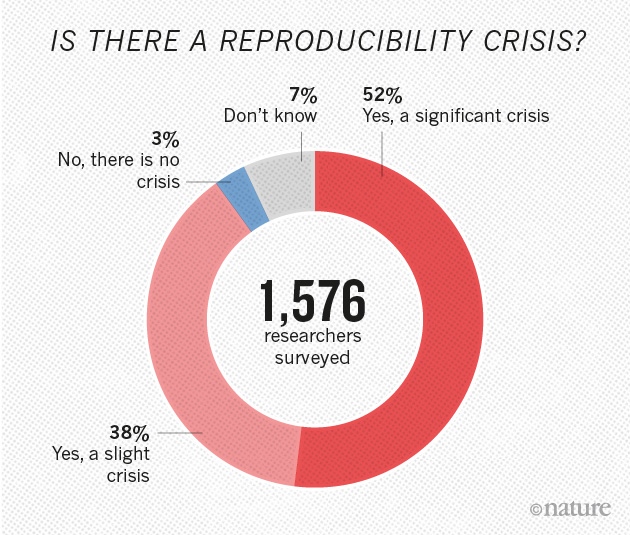
More than 70% of researchers have tried and failed to reproduce another scientist’s experiments, and more than half have failed to reproduce their own experiments. Those are some of the telling figures that emerged from Nature‘s survey of 1,576 researchers who took a brief online questionnaire on reproducibility in research.
The data reveal sometimes-contradictory attitudes towards reproducibility. Although 52% of those surveyed agree that there is a significant ‘crisis’ of reproducibility, less than 31% think that failure to reproduce published results means that the result is probably wrong, and most say that they still trust the published literature.
Data on how much of the scientific literature is reproducible are rare and generally bleak. The best-known analyses, from psychology and cancer biology, found rates of around 40% and 10%, respectively. Our survey respondents were more optimistic: 73% said that they think that at least half of the papers in their field can be trusted, with physicists and chemists generally showing the most confidence.
The results capture a confusing snapshot of attitudes around these issues, says Arturo Casadevall, a microbiologist at the Johns Hopkins Bloomberg School of Public Health in Baltimore, Maryland. “At the current time there is no consensus on what reproducibility is or should be.” But just recognizing that is a step forward, he says. “The next step may be identifying what is the problem and to get a consensus.”
Failing to reproduce results is a rite of passage, says Marcus Munafo, a biological psychologist at the University of Bristol, UK, who has a long-standing interest in scientific reproducibility. When he was a student, he says, “I tried to replicate what looked simple from the literature, and wasn’t able to. Then I had a crisis of confidence, and then I learned that my experience wasn’t uncommon.”
The challenge is not to eliminate problems with reproducibility in published work. Being at the cutting edge of science means that sometimes results will not be robust, says Munafo. “We want to be discovering new things but not generating too many false leads.”
September 18, 2020
Was the Wuhan Coronavirus (aka Covid-19) created in a Chinese lab?
Rowan Jacobsen profiles the scientist who believes, based on her own research, that the Wuhan Coronavirus was not a naturally occurring mutation and was instead deliberately created in a Chinese government lab:
It wasn’t long before she came across an article about the remarkable stability of the virus, whose genome had barely changed from the earliest human cases, despite trillions of replications. This perplexed Chan. Like many emerging infectious diseases, COVID-19 was thought to be zoonotic — it originated in animals, then somehow found its way into people. At the time, the Chinese government and most scientists insisted the jump had happened at Wuhan’s seafood market, but that didn’t make sense to Chan. If the virus had leapt from animals to humans in the market, it should have immediately started evolving to life inside its new human hosts. But it hadn’t.
On a hunch, she decided to look at the literature on the 2003 SARS virus, which had jumped from civets to people. Bingo. A few papers mentioned its rapid evolution in its first months of existence. Chan felt the familiar surge of puzzle endorphins. The new virus really wasn’t behaving like it should. Chan knew that delving further into this puzzle would require some deep genetic analysis, and she knew just the person for the task. She opened Google Chat and fired off a message to Shing Hei Zhan. He was an old friend from her days at the University of British Columbia and, more important, he was a computational god.
“Do you want to partner on a very unusual paper?” she wrote.
Sure, he replied.
One thing Chan noticed about the original SARS was that the virus in the first human cases was subtly different — a few dozen letters of genetic code — from the one in the civets. That meant it had immediately morphed. She asked Zhan to pull up the genomes for the coronaviruses that had been found on surfaces in the Wuhan seafood market. Were they at all different from the earliest documented cases in humans?
Zhan ran the analysis. Nope, they were 100 percent the same. Definitely from humans, not animals. The seafood-market theory, which Chinese health officials and the World Health Organization espoused in the early days of the pandemic, was wrong. Chan’s puzzle detectors pulsed again. “Shing,” she messaged Zhan, “this paper is going to be insane.”
In the coming weeks, as the spring sun chased shadows across her kitchen floor, Chan stood at her counter and pounded out her paper, barely pausing to eat or sleep. It was clear that the first SARS evolved rapidly during its first three months of existence, constantly fine-tuning its ability to infect humans, and settling down only during the later stages of the epidemic. In contrast, the new virus looked a lot more like late-stage SARS. “It’s almost as if we’re missing the early phase,” Chan marveled to Zhan. Or, as she put it in their paper, as if “it was already well adapted for human transmission.”
That was a profoundly provocative line. Chan was implying that the virus was already familiar with human physiology when it had its coming-out party in Wuhan in late 2019. If so, there were three possible explanations.
For the record, my strong suspicion is that she is correct about the origins of the virus, but I don’t think it was deliberately released by the Chinese government. I think if it had been deliberate, it would have been much more directly “weaponized” in both delivery mechanism and targeting.
June 27, 2020
QotD: The cost of military equipment
So why does this cause so much confusion? Well, it all has to do with what gets reported. Someone who is trying to make the case that some program is outrageously expensive and should be cancelled is going to lump together development and procurement, divide by the number of systems involved, and then publish the resulting number. But, particularly when we’re discussing the cost of a system about to enter production, that’s very different from the actual numbers. To give a well-known example, the B-2 is generally reputed to have cost about $2 billion/plane in the 90s. However, this is the total program cost divided by the 21 airframes. If we’d decided to buy 22 B-2s instead of the 21 we did buy, the extra plane would have cost only $700 million or so. Admittedly, the B-2 is a rather extreme case, and usually the share of R&D cost is less than the procurement (flyaway) cost, but it’s illustrative of the power of this kind of framing.
“bean”, “Military Procurement – Pricing”, Naval Gazing, 2018-03-09.
June 23, 2020
QotD: Scientific discoveries despite “research” and “planning”
For from the “planning” point of view, the little nerd has endangered billions of dollars in funding, and thus the livelihoods of innumerable bureaucratic drudges. That is, after all, why they retain the China Wall of lawyers: to prevent unplanned events from happening. But glory glory, sometimes they happen anyway.
David Warren, “That’s funny”, Essays in Idleness, 2018-03-08.
June 11, 2020
Black Death Mystery Solved – Not Bubonic Plague – Pandemic History 02
TimeGhost History
Published 10 Jun 2020From the day the Black Death starts to ravage humanity in 1347, there will be speculation about what it is. It will take until 2017 for science to give us a conclusive answer to the riddle how so many people could die so fast all over Europe, Africa, and Asia in only five years.
Join us on Patreon: https://www.patreon.com/TimeGhostHistory
Hosted by: Indy Neidell and Spartacus Olsson
Written by: Indy Neidell and Spartacus Olsson
Directed by: Astrid Deinhard
Executive Producers: Astrid Deinhard, Indy Neidell, Spartacus Olsson, Bodo Rittenauer
Creative Producer: Joram Appel
Post-Production Director: Wieke Kapteijns
Research by: Spartacus Olsson, Indy Neidell, and James Currie
Edited by: Karolina Dołęga
Sound Engineer: Marek Kamiński
Graphic Design: Ryan WeatherbyVisual Sources:
Welcome Images
Mark and Delwen from Flickr: https://www.flickr.com/photos/markand…
Smarteeee from Wiki CommonsIcons from The Noun Project by: arif fajar yulianto, James, Maxim Kulikov, Jejen Juliansyah Nur Agung, Gan Khoon Lay, Alfonso Melolonta Urbán
Laymik, parkjisun, Eucalyp, Adrien Coquet & Mahmure Alp.Music:
“Barrel” – Christian Andersen
“Symphony of the Cold-Blooded” – Christian Andersen
“Potential Redemption” – Max Anson
“Moving to Disturbia” – Experia
“Superior” – Silver Maple
“Please Hear Me Out” – Philip Ayers
“Guilty Shadows 4” – Andreas Jamsheree
“Deadline” – Marten Moses
“Endlessness” – Flouw
“Moving to Disturbia” – ExperiaArchive by Screenocean/Reuters https://www.screenocean.com.
Research Sources:
Quinto Tiberio Angelerio and New Measures for Controlling Plague in 16th-Century Alghero, Sardinia, Raffaella Bianucci, Ole Jørgen Benedictow, Gino Fornaciari, and Valentina Giuffra
“The Path to Pistoia: Urban Hygiene Before the Black Death”, G. Geltner, Past & Present, Volume 246, Issue 1, February 2020, Pages 3–33
Encyclopedia of the Black Death, Joseph Patrick Byrne
“Epidemiological characteristics of an urban plague epidemic in Madagascar, August–November, 2017: an outbreak report”, The Lancet, Rindra Randremanana, PhD *Voahangy Andrianaivoarimanana, PhD Birgit Nikolay, PhD Beza Ramasindrazana, PhD Juliette Paireau, PhD, Quirine Astrid ten Bosch, PhD et al
“Yersinia pestis, the cause of plague, is a recently emerged clone of Yersinia pseudotuberculosis” Mark Achtman, Kerstin Zurth, Giovanna Morelli, Gabriela Torrea, Annie Guiyoule, and Elisabeth Carniel
“Insights into the evolution of Yersinia pestis through whole-genome comparison with Yersinia pseudotuberculosis“, P.S.G. Chain, E. Carniel, F.W. Larimer, J. Lamerdin, P.O. Stoutland, W.M. Regala, A.M. Georgescu, L.M. Vergez, M.L. Land, V.L. Motin, R.R. Brubaker, J. Fowler, J. Hinnebusch, M. Marceau, C. Medigue, M. Simonet, V. Chenal-Francisque, B. Souza, D. Dacheux, J.M. Elliott, A. Derbise, L.J. Hauser, and E. Garcia
“Distinct Clones of Yersinia pestis Caused the Black Death”, Stephanie Haensch, Raffaella Bianucci, Michel Signoli, Minoarisoa Rajerison, Michael Schultz, Sacha Kacki, Marco Vermunt, Darlene A. Weston, Derek Hurst, Mark Achtman, Elisabeth Carniel, Barbara BramantiA TimeGhost chronological documentary produced by OnLion Entertainment GmbH.
From the comments:
TimeGhost History
2 days ago
There is much we can learn from history and as you will see in the next two episodes of our impromptu pandemics series it takes a long time for us to make these learnings. Many of the mistakes made during the outbreak of the Black Death are still an issue as we respond to COVID-19 almost 700 years later. This episode was also a very personal learning experience for us, Indy and Spartacus. Both of us read and studied a lot about the plague when we were younger in the 1980s, Indy even did his BA paper in history on the plague. Back then there was a lot of speculation about what the Black Death actually was (although the general consensus was that it must have been bubonic plague based on the findings made in the 20th century, after the discovery of the Yersinia Pestis bacteria). But that conclusion was a bit problematic — the Black Death was too lethal, spread too fast, and killed people too quickly for bubonic plague. Until we started researching these episodes we hadn’t spent much thought on the topic, so imagine our surprise when we discovered that bacteriologists, epidemiologists, and archeologists had come together to solve the mystery after two chance occurrences of unusual plague outbreaks in 2014 and 2017. To paraphrase Lord Marlborough: if you want to truly learn something about a topic, there’s no better way than to make a video about it.

April 29, 2020
QotD: “Ethical” ways to prevent scientific progress
The hobbling of research is not just a symptom of bureaucratic mission creep. It is actually rationalized by many bioethicists. These theoreticians think up reasons that informed and consenting adults should be forbidden to take part in treatments that help them and others while harming no one. They use nebulous rubrics like “dignity,” “sacredness,” and “social justice.” They try to sow panic about advances in biomedical research with far-fetched analogies to nuclear weapons and Nazi atrocities, science-fiction dystopias like Brave New World and Gattaca, and freak-show scenarios like armies of cloned Hitlers, people selling their eyeballs on eBay, and warehouses of zombies to supply people with spare organs. The University of Oxford philosopher Julian Savulescu has exposed the low standards of reasoning behind these arguments and has pointed out why “bioethical” obstructionism can be unethical: “To delay by 1 year the development of a treatment that cures a lethal disease that kills 100,000 people per year is to be responsible for the deaths of those 100,000 people, even if you never see them.”
Steven Pinker, “The Intellectual War on Science”, Chronicle of Higher Education, 2018-02-13.
November 16, 2019
History of Space Travel – Kill Devil to V-2 – Extra History – #3
Extra Credits
Published 14 Nov 2019Start your Warframe journey now and prepare to face your personal nemesis, the Kuva Lich — an enemy that only grows stronger with every defeat. Take down this deadly foe, then get ready to take flight in Empyrean! Coming soon! http://bit.ly/EHWarframe
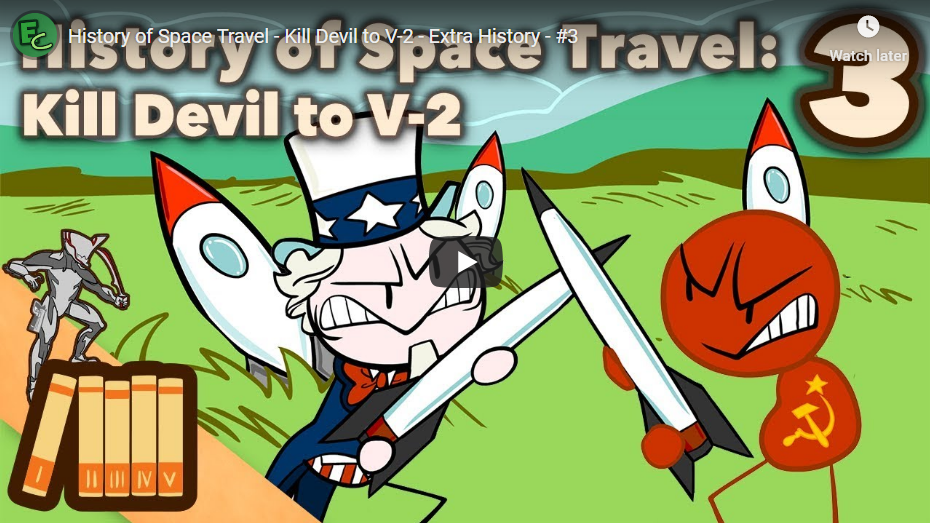
Early flight started as a utopian dream but quickly became the military’s top priority: first as reconnaissance vehicles, and then as weapons in their own right. After WW1, the threat of German aircraft led to the Treaty of Versailles banning Germany from having an airforce at all. But the Germans also found a loophole: rockets didn’t count as an airforce. Enter Werner Von Braun & the V-2 rockets.
September 19, 2019
Ancient technology: Saxon glass-working experiment
Lindybeige
Published on 9 Aug 2019Many thanks to Victoria Lucas for inviting me along to see her experiments in medieval glass-working. Fire! Craft! Mud!
Support me on Patreon: https://www.patreon.com/LindybeigePicture credits:
Natron deposit image
By Stefan Thüngen – Own work, Public Domain, https://commons.wikimedia.org/w/index…Glass slab of BETH SHE’ARIM
Hanay [CC BY-SA 4.0 (https://creativecommons.org/licenses/…)]Palm cup
Reptonix free Creative Commons licensed photos [CC BY 3.0 (https://creativecommons.org/licenses/…)]Lindybeige: a channel of archaeology, ancient and medieval warfare, rants, swing dance, travelogues, evolution, and whatever else occurs to me to make.
▼ Follow me…
Twitter: https://twitter.com/Lindybeige I may have some drivel to contribute to the Twittersphere, plus you get notice of uploads.
websites:
http://www.Lindybeige.uk
http://www.LloydianAspects.co.uk

July 21, 2019
The humble egg – wonder food or deadly poison?
If you’ve paid any attention to popular reporting on nutrition studies over the years, you’ll have noticed how just about any advice on food has not only changed, but has often been completely the opposite of advice offered just a few years earlier. During my teenage years, the egg was pushed (thanks in part to the “Egg Marketing Board”, one of Canada’s supply management bureaucracies) as “the perfect food”. During the next decade, as newer nutrition studies were published, suddenly the wonderful, nutritious egg was now a huge risk to your cardiovascular health and even one egg per week might be enough to kill you. Rinse and repeat for so many other foods and you either stop eating altogether or, more sensibly, stop paying any attention at all to mainstream media interpretations of nutrition studies.

It’s been a tortuous path for the humble egg. For much of our history, it was a staple of the American breakfast — as in, bacon and eggs. Then, starting in the late 1970s and early 1980s, it began to be disparaged as a dangerous source of artery-clogging cholesterol, a probable culprit behind Americans’ exceptionally high rates of heart attack and stroke. Then, in the past few years, the chicken egg was redeemed and once again touted as an excellent source of protein, unique antioxidants like lutein and zeaxanthin, and many vitamins and minerals, including riboflavin and selenium, all in a fairly low-calorie package.
This March, a study published in JAMA put the egg back on the hot seat. It found that the amount of cholesterol in a bit less than two large eggs a day was associated with an increase in a person’s risk of cardiovascular disease and death by 17 percent and 18 percent, respectively. The risks grow with every additional half egg. It was a really large study, too — with nearly 30,000 participants — which suggests it should be fairly reliable.
So which is it? Is the egg good or bad? And, while we are on the subject, when so much of what we are told about diet, health, and weight loss is inconsistent and contradictory, can we believe any of it?
Quite frankly, probably not. Nutrition research tends to be unreliable because nearly all of it is based on observational studies, which are imprecise, have no controls, and don’t follow an experimental method. As nutrition-research critics Edward Archer and Carl Lavie have put it, “‘Nutrition’ is now a degenerating research paradigm in which scientifically illiterate methods, meaningless data, and consensus-driven censorship dominate the empirical landscape.”
Other nutrition research critics, such as John Ioannidis of Stanford University, have been similarly scathing in their commentary. They point out that observational nutrition studies are essentially just surveys: Researchers ask a group of study participants — a cohort — what they eat and how often, then they track the cohort over time to see what, if any, health conditions the study participants develop.
H/T to Marina Fontaine for the link.
July 14, 2019
The Dictator of France – WW2 – 046 – July 13 1940
World War Two
Published on 13 Jul 2019The Germans and the French in Vichy consolidate their newly acquired power as the British deal with the remnants of the French navy. The Battle of Britain begins with fighting above the English Channel, a battle with great consequences for the future of Europe.
Join us on Patreon: https://www.patreon.com/TimeGhostHistory
Or join The TimeGhost Army directly at: https://timeghost.tvFollow WW2 day by day on Instagram @World_war_two_realtime https://www.instagram.com/world_war_t…
Join our Discord Server: https://discord.gg/D6D2aYN.
Between 2 Wars: https://www.youtube.com/playlist?list…
Source list: http://bit.ly/WW2sourcesWritten and Hosted by: Indy Neidell
Produced and Directed by: Spartacus Olsson and Astrid Deinhard
Executive Producers: Bodo Rittenauer, Astrid Deinhard, Indy Neidell, Spartacus Olsson
Creative Producer: Joram Appel
Research by: Indy Neidell
Edited by: Iryna Dulka
Map animations: EastoryColorisations by Norman Stewart and Julius Jääskeläinen https://www.facebook.com/JJcolorization/
Eastory’s channel: https://www.youtube.com/channel/UCEly…
Archive by Screenocean/Reuters https://www.screenocean.com.Sources:
– IWM: HU 25966, D 734, HU 104721, D 735,
A 18492, HU 52333, Q 69694, A 18284, AMY 450, MH 4560
– Collection of Adolph B. Miller/COLL1068, USMC Archives & Special Collections
– Lloyd W. Williams Collection (COLL/77), USMC Archives & Special CollectionsA TimeGhost chronological documentary produced by OnLion Entertainment GmbH.
From the comments:
World War Two
3 days ago (edited)
“You either die a hero or live long enough to see yourself become the villain,” could very well describe the life of Philippe Pétain. Or at least, thats what many generally agree on in hindsight. For the people living in France in 1940, it wasn’t that black or white. “Saving France” didn’t necessarily mean fighting from exile, and establishing a French state with approval of the German victors might have seemed like the best option to protect French interests, people and identity. It’s hard to place yourself in the shoes of people who lived through hard times and had to make tough decisions. Thats why we try to report and describe what happened as unbiased as we can. Keep that in mind when commenting, as well as our rules and guidelines.

June 6, 2019
New paper on minimum wage effects is bound to be mis-used
In the Washington Examiner, Tim Worstall explains why a new well-researched paper on the minimum wage will be misunderstood and then used to “prove” things it doesn’t actually say:
None of this changes the standard intuition that when there’s a heavy such bite then there will be ill effects. What it does do is then lead us to trying to calculate what is a wage that does have that snarl, that bite? What is a minimum wage that is “too high” in the sense of having an excess of those ill effects upon employment? This is where I predict — no, not fear, not posit, nor surmise, but predict — this paper will be misused.
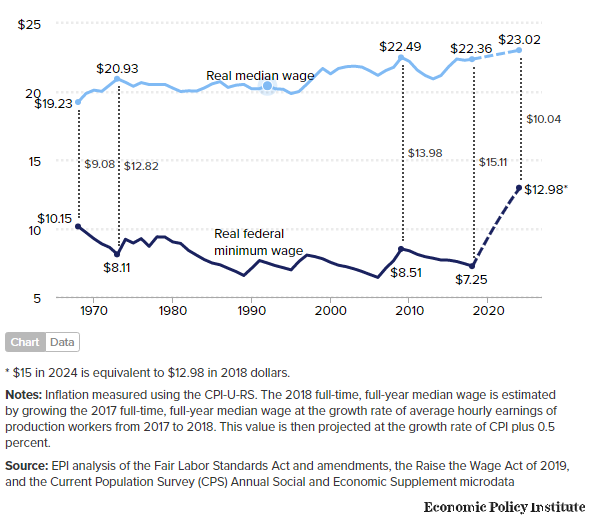
Our thinking is that the effects come from the relationship between the minimum and median wages. If we insist that wages cannot be lower than more than we already pay half the people, then we really are going to have problems. A minimum wage of 100% of the median wage isn’t going to work, that is. That ratio is called the Kaitz Index. This paper shows us that there are few to no such bad things happening up to 0.59 on that Kaitz measure. We can have the minimum wage at 59% of the median wage and know that we’ll have the good effects and only trivial amounts, at worst, of the bad.
You can see what’s going to happen next, can’t you? The Economic Policy Institute tells us that the median wage is about $22 this year, and 59% of that is $13. A bit of rounding and some aspiration, and why not go for a $15 minimum wage?
Except there are two median wages. Part-time and seasonal wages tend to be lower than full-year and full-time ones. The Economic Policy Institute is using that higher full-time one. The one for all jobs is quite a bit lower, $18.58 per hour. Take 59% of that and you get a rather lower level of $10.95 an hour. That’s around and about what McDonald’s, Walmart, and similar establishments pay as entry-level wages, which does seem about right, doesn’t it?
So, the new research paper, from esteemed researchers, published in the world’s top English language economics journal, tells us that minimum wages up to a certain level cause few to no problems. They’ve shown this for up to 59% of median wages. But which median do they mean? Dube himself told me they mean that lower one — specifically, the “median wage of all workers, not just for full time.”
But we all know how this is going to be used, don’t we? As proof that $15 an hour won’t cause any problems — which isn’t what the paper shows at all. Rather, it says that a $10.95 an hour minimum wage shouldn’t cause any problems of note.
The new paper is good empirical work. The fault is in what people will argue it says, not what it does.
April 22, 2019
QotD: Antoine-Laurent de Lavoisier
It was surprising how much I did not know about Lavoisier; and of how little importance it was. He is Saint George killing the dragon of Phlogiston in this account. Father of modern chemistry, &c. Student of heat and respiration; improver of gunpowder; hyper-efficient tax collector in the bureaucracy of the French Old Regime; academician; weekend geologist; dreamer in agriculture and economics; aristocratic gardener whose works around his Château de Frechines might plausibly be described as an experimental farm; social climber and assiduous self-promoter, whose fame could not hide him from the glinting blades of Robespierre.
A very clever man was our Lavoisier, the more charming the farther one got away from him (often I read between the lines); whose pleasure, once he took offices in the Arsenal at Paris, with a budget to do largely as he pleased, was to conduct violent experiments on anything that was lying around. His revolution in chemistry consisted of quantifying it all.
When a child, I had the evil of Phlogiston brought to my attention. It was, not from the Dark Ages as popularly supposed, but only from the end of the seventeenth century, the prevailing “settled science” on the combustible principle in the air, and other substances. It was pure theory, and surprisingly easy to kick over with a few methodical tests; notwithstanding the scientific establishment of the day kicked, screamed, and desperately resisted every attempt to displace it. Lavoisier (and Priestley in England) burnt or blew up one thing and another until Lavoisier had discovered and named Oxygen.
And so we advanced from Phlogiston to Oxygen, and incidentally to ascending in hot air balloons. Good show!
David Warren, “Phlogiston”, Essays in Idleness, 2016-05-31.


