Quotulatiousness

September 25, 2023

Something, something “sins of the fathers”, something, something Elon Musk

Chris Bray provides an example of how “mainstream psychosis” has become the new normal, at least among academics and our so-called “elites”:

My argument is not “the news media lies”, or “there’s a lot of misleading discourse”. My argument is that whole overlapping layers of high-status America — in academia, in media, and in politics — are psychotic, fully detached from reality and living in their own bizarre mental construction of a fake world. I don’t mean this figuratively, or as colorful hyperbole. I mean that the top layers of our most important institutions are actually, literally populated by people who are insane, who have cultivated a complete mental descent through the looking glass.

So: Jill Lepore.

Lepore is as high-status as it’s possible to be. She holds an endowed chair at Harvard, she has a Bancroft, and she’s been on the masthead at the New Yorker for almost two decades. She has about as much institutional validation as an academic historian can get. And she just published an essay that wouldn’t be out of place in foot-high crayon letters on the wall of a mental institution.

“What happened to antisemitic rants before social media”, is the actual subhed. You see, before Twitter, people who said that Jews were bad were very marginal, and no one ever listened to them. At the risk of giving away too much personal information, I’m writing this in a bar, and the bartender is giving me some fairly aggressive side-eye over the burst of nervous laughter that I just dropped. Musk’s grandfather was named J.N. Haldeman, and he wrote a lot about how much he didn’t like Jews, and here’s what Lepore has to say about that:

    But Haldeman’s legacy casts light on what social media does: the reason that most people don’t know about Musk’s grandfather’s political writings is that in his lifetime social media did not exist, and the writings of people like him were not, therefore, amplified by it. Indeed, they were very unlikely to circulate widely, and are now quite rare.

Jill Lepore has a PhD in history, and she thinks that antisemitic speech was quite rare before social media. Here’s a link to a non-paywalled version of the essay, and I encourage you to go read it. Otherwise you’re going to struggle to believe me. See for yourself, and then come back and I’ll talk about it.

How, if you want to argue that negative statements about Jews had little reach before social media, do you explain … Jewish history? Why didn’t they have time for the bread to rise, Jill? Before Twitter, screeds against Jews “were very unlikely to circulate widely,” except for, I don’t know, Mein Kampf? We dip the parsley in the salt water to remember the bitter tears of our ancestors, who never faced any antisemitism because it was very marginal and never allowed to circulate widely.

It gets better, though, because Haldeman was born in Minnesota, then raised in Canada, and then moved to South Africa two years after the formal implementation of apartheid. He wrote white supremacist tracts in apartheid South Africa, and Lepore maintains that the reach of his racist literature was sharply limited by the absence of social media. See, it was very rare to be able to read racist views in apartheid South Africa.

September 19, 2023

QotD: Logical consistency isn’t their jam

Filed under: Government, Liberty, Politics, Quotations, USA, Weapons — Tags: , , , , — Nicholas @ 01:00

The same people who last week were screeching about the government having concentration camps now want me to give my AR15s to that same government.

The same people who last month were hyperventilating about the government slaughtering black people now expect me to surrender my guns to that same government.

The same people who last year were setting stuff on fire and yipping about the government rounding up the gays and Muslims for liquidation now think it’s a good idea for me to just hand over my rifles to that same government.

You chuckleheads need to make up your damned minds.

Lawdog, “You know what I find …”, The Lawdog Files, 2019-08-07.

August 29, 2023

The Souls of Black Folk by W.E.B. Du Bois “runs so fantastically counter to the entire ideology of ‘decolonise'”

Filed under: Books, Britain, Education, History, Liberty, USA — Tags: , , , , — Nicholas @ 09:10

In Spiked, Brendan O’Neill finds himself surprised at the inclusion of a very unusual book on a list demanded by those pushing for “decolonization” of university curricula:

W.E.B. Du Bois by James E. Purdy, 1907, gelatin silver print, from the National Portrait Gallery which has explicitly released this digital image under the CC0 license.
Wikimedia Commons.

“Decolonise the curriculum” is a movement that wants university courses to focus less on dead white European males and more on writers of colour. Its argument is that black students need texts that speak directly to them. They need books by authors who look like them. They need books about experiences and ideas they can more readily relate to than they can the stuff written about in “high white culture”. Black students must be able to recognise themselves in what they study, we’re told, or else they’ll feel cheated and demeaned.

I was surprised to find that one of the leading decolonise movements, at the University of Edinburgh, was arguing for WEB Du Bois’ 1903 book, The Souls of Black Folk, to be included on the English curriculum. The activists said it was unreasonable to expect black students to engage with so many white authors. They also need to engage with people like Du Bois, in whose work they might “recognise themselves”. I was surprised, not because I think The Souls of Black Folk shouldn’t be on more university courses – absolutely it should. No, it’s because The Souls of Black Folk runs so fantastically counter to the entire ideology of “decolonise”. It made me wonder if these activists have even read it. Du Bois’ book contains some of the finest arguments you will ever read against the idea that high culture is a white thing that others cannot connect with.

One of my favourite passages in the book, from the chapter on what kind of education black men are fit for, touches on this very question. Here Du Bois makes his critique of those in his own time who were arguing that blacks only require basic education and industrial training. He describes his own experience of higher learning, writing:

    I sit with Shakespeare and he winces not. Across the colour line I move arm in arm with Balzac and Dumas … From out the caves of evening that swing between the strong-limbed earth and the tracery of the stars, I summon Aristotle and Aurelius and they come all graciously with no scorn or condescension.

That passage, Du Bois’ moving belief that Shakespeare does not wince at him, captures a central thread of his writing: universalism. Du Bois agitates against accommodating to segregation or low expectations, and argues for the rights of “black folk” to assimilate into the spoils of civilisation; to become, as he puts it, “co-workers in the kingdom of culture”. To those in the late 1800s and early 1900s who argued that black people needed a targeted form of culture, one specific to their needs and capacities, Du Bois said: “We daily hear that an education that encourages aspiration, that sets the loftiest of ideals and seeks as an end culture and character rather than breadwinning, is the privilege of white men, and the danger and delusion of black men.”

Du Bois insisted that it is only through assimilation into the “kingdom of culture” that self-knowledge and self-improvement can truly occur. As he wrote: “Wed with Truth, I dwell above the veil.” The veil he’s referring to is the veil of colour, the one that separated blacks from whites in post-slavery America. For Du Bois, that veil was best lifted via assimilation into the American republic’s political universe and its realm of culture.

Du Bois’ critique of the notion that high culture was for white men, and would prove mystifying to black men, has sadly been superseded by an “anti-racism” with an entirely different outlook. Now, the supposedly radical stance is to believe that high culture is disorientating for black people, and possibly even damaging to their self-esteem, and therefore they require something more targeted. In short, they need release from the kingdom of culture. That, in essence, is what the decolonise movement desires: the “liberation” of non-white peoples from the cultural gains of Western civilisation. Behold the crisis of universalist belief.

July 25, 2023

Chris Rufo, enemy of the [legacy media] people

Filed under: Books, Education, Government, Media, Politics, USA — Tags: , , , , — Nicholas @ 03:00

Last week, Richard Hanania posted this review of Chris Rufo’s new book America’s Cultural Revolution: How the Radical Left Conquered Everything:

Some facts are so shocking that you don’t want to believe them. And if you do believe them, there’s a tendency to forget, downgrade their importance, and often have to be reminded of them again. Here’s one fact that falls into this category: The American education system, or at least the field of education itself, was taken over by literal communists. Those entrusted to teach children and young adults have as their greatest intellectual inspirations lunatics who would clearly have massacred their fellow Americans if they had the chance.

We know this because during the Cold War, some of the leading lights of modern academia were openly in favor of distant regimes that were engaging in mass killings in the name of equality. Some of them, like members of the Weather Underground and Angela Davis, personally participated in violent acts themselves. Instead of locking these people up and throwing away the key, we made them into tenured professors, and some of the most highly cited scholars in the world. They now are major intellectual figures in education schools, which train future teachers and administrators and ultimately control what kids learn, along with the DEI bureaucracies that exert so much control from within our most powerful institutions.

What does one do with these facts? Chris Rufo’s work over the last several years has been about taking them seriously. Tomorrow, he is publishing his first book, America’s Cultural Revolution: How the Radical Left Conquered Everything, which explains the history behind and intellectual foundations of modern wokeness. It serves as a wakeup call as to how bad things are. Many of the facts presented may be familiar to the reader, but taken together, they tell a story that serves as a searing indictment of the American establishment.

Rufo’s book is built around intellectual biographies of four activist-scholars: Herbert Marcuse, Angela Davis, Paulo Freire, and Derrick Bell. He traces their influence through political organizing and propaganda efforts. Marcuse was the intellectual godfather of the New Left. Davis’ Black Panther movement can be considered the precursor to BLM. Freire’s Pedagogy of the Oppressed “became the bible of teachers colleges throughout the United States and created a cottage industry in academic publishing,” with the author’s research having garnered about half a million citations. Finally, Derrick Bell was the force behind Critical Race Theory, a movement that seems to have been resisted and laughed at by most of the academic legal establishment before it wore its opponents down and gained a foothold in top law schools.

I can’t help but feeling a certain parallelism between Rufo’s work and my own. We both started becoming well known for writing about wokeness in the last few years. We both make extensive use of Twitter and longform writing to communicate to the world, and we both have books coming out two months apart with the same publisher trying to explain the origins of the radical ideas and concepts that have taken over American institutions. He’s exactly one year and two days older than me, so we’ve lived through the same formative political and cultural experiences, watching “white” become an epithet and homosexuals go from being a leper class when we were in high school to individuals having a preference that seems almost quaint in the era of public celebration of trans and the alphabet people.

Of course, an important difference is that Rufo has maintained a laser-like focus on wokeness and avoided alienating natural allies as he’s built a broad coalition within the conservative movement to take on the enemy. And his accomplishments have been quite impressive. Rufo was almost single-handedly responsible for Trump banning Critical Race Theory in the federal government, as he’s also developed close working relationships with Ron DeSantis and other politicians. Today, when Republican-controlled states ban gender transitions for minors, forbid the discussion of Critical Race Theory in schools, or abolish DEI offices in public universities, Rufo is serving as an intellectual inspiration to decision makers when he’s not directly involved in the policy process himself. If wokeness is ever defeated, one can imagine a leftist in thirty years writing a book on the career and activities of Rufo the way he writes about Marcuse and others today.

July 18, 2023

Life lessons from Thomas Sowell’s memoir

Filed under: Books, Economics, History, Military, USA — Tags: , , , , , — Nicholas @ 05:00

Rob Henderson took a lot away from his recent reading of Thomas Sowell’s A Personal Odyssey, including some fascinating lessons from Sowell’s time in the US Marine Corps:

Trust people who value being honest more than being nice.

As the Korean War intensified, Sowell was drafted into the Marine Corps. He notes that color did not matter, as all new recruits were treated with equal disdain. Sowell describes his life in the Marine barracks in Pensacola. There were two non-commissioned officers permanently stationed to oversee the young marines. One was Sergeant Gordon, “a genial, wisecracking guy who took a somewhat relaxed view of life”. The other was Sergeant Pachuki, “a disciplinarian who spoke in a cutting and ominous way” and was always “impeccably dressed”.

Sowell and his peers preferred Sergeant Gordon, as he was more easygoing. Sowell had to go into town to pick up a package. Sowell asked his Chief Petty Officer if he could leave the base to retrieve his package. Sowell received permission.

Later, while Sowell was not on base, he was marked as absent and was accused of being AWOL (absent without leave), a serious offense. Sowell knew Sergeant Gordon, the nice one, had overheard him asking for permission to leave the base. Gordon denied having heard anything, and told Sowell, “You’re just going to have to take your punishment like a man”. Gordon fretted that if he crossed the higher-ups, he would be reassigned to fight in Korea.

But unasked, Sergeant Pachuki came forward and spoke with the colonel, explaining the situation. As a result, Sowell was exonerated and returned back to his duties.

Referring to Gordon, the “nice” sergeant who betrayed him, Sowell writes, “People who are everybody’s friend usually means they are nobody’s friend”.

A “free good” is a costless good that is not scarce, and is available without limit.

Sowell would regularly needle Sergeant Grover, another member who outranked him.

Here’s the excerpt:

    Some were surprised that I dared to give Sergeant Grover a hard time, on this and other occasions, especially since he was a nasty character to deal with. Unfortunately for him, I knew that he was going to give me as hard a time as he could, regardless of what I did. That meant it didn’t really cost me anything to give him as hard a time as I could. Though I didn’t realize it at the time, I was already thinking like an economist. Giving Sergeant Grover a hard time was, in effect, a free good and at a zero price my demand for it was considerable.

Sowell learned he could receive something he enjoyed (pleasure at provoking Grover) in exchange for nothing.

    Much of what you see has been carefully curated with an agenda in mind.

One of Sowell’s assignments in the Marine Corps was as a Duty Photographer on base. One day after submitting some of his photos, Sowell had the following exchange with the public information office sergeant:

    “They are good pictures, he said. “But they do not convey the image that the public information office wants conveyed.”

    “What’s wrong with them?” I asked.

    “Well, take that picture of the reservists walking across the little wooden bridge carrying their duffle bags.”

    “Yeah. What’s wrong with it?”

    “The men in that picture are perspiring. You can see the damp spots on their uniforms.”

    “Well, if you carry a duffle bag on a 90-degree day, you are going to sweat.”

    “Marines do not sweat in public information photographs.”

    “Okay, what was wrong with the picture of the reservists picking up shell casings after they had finished firing? That was one of my favorites.”

    “Marines do not perform menial chores like that, in our public relations image.”

    “But all these photos showed a very true picture of the reservists’ summer here.”

    “We’re not here to tell the truth, Sowell,” he said impatiently. “We are here to perpetuate the big lie. Now, the sooner you understand that, the better it will be for all of us.”

When I visited the Air Force recruiter in high school, I saw the brochures with images of well-groomed airmen in their dress blues graduating from basic training. I had no knowledge that much of that training would involve mind-numbing minutia. I suppose this is true for other career fields too. You see radiant coverage of academic research in legacy media outlets, or fun twitter threads outlining interesting research findings. You see the brand new hardcover book with all the glowing blurbs and reviews. You don’t see all the drudgery of research or writing behind the scenes.

Sometimes, it doesn’t pay to have too big a reputation.

Sowell and his fellow marines would sometimes have impromptu boxing matches around the barracks on base. One day Sowell was up against another guy and threw a sloppy right hand. The guy stumbled back, tripped, and fell to the ground. Although Sowell had swung and missed, witnesses thought he had knocked the other guy out.

Later, Sowell went up against another guy named Douglas. Douglas relentlessly came at Sowell and gave him a serious beating. Douglas told Sowell afterwards that the reason he was so aggressive was that he feared Sowell’s “one punch” could turn the fight around at any time. “Sometimes,” Sowell writes, “it doesn’t pay to have too big a reputation.”

July 6, 2023

“Too many complaints? That’s racism. Too few complaints? Well, that’s racism, too.”

Filed under: Bureaucracy, Cancon, Health — Tags: , , , , — Nicholas @ 04:00

Amy Eileen Hamm reports on how the British Columbia College of Nurses and Midwives (BCCNM) acted on its concern that not enough complaints against their members were being lodged by First Nations people:

As regular readers of Quillette will know, many Canadian institutions have fervently adopted the cause of “decolonization” — a vaguely defined term that one university describes as the dismantling of “assumed Euro-western disciplinary constructs and traditions”. This can mean anything from abolishing musical scales (which “perpetuate and solidify the hegemony of [the] Euro-American repertoire”); to reimagining our scientific understanding of sunlight, so as to correct “the reproduction of colonialism” that has infected “physics and higher physics education”; to assailing the gender binary through a “decolonizing act of resistance”.

That’s the theory, anyway. In practice, institutional efforts at “decolonization” generally translate into affirmative-action hiring programs and policies to mandate symbolic (generally empty) gestures such as land acknowledgements. They’ve also created a cash cow for “specialist” administrators and third-party consultants in what is now known as the “equity, diversity, inclusion, and decolonization” sector. The premise is that decolonization is so difficult and complex that it can only be overseen by said (highly paid) professionals.

My own professional sector, nursing, provides a useful case study. In British Columbia, where I live and work, nurses are licenced by the British Columbia College of Nurses & Midwives (BCCNM), whose offices are located “on unceded Coast Salish territory, represented today by the Musquea?m, Squamish and Tsleil-Waututh Nations.” In other words, Vancouver.

If a patient feels that he or she has experienced “incompetent, unethical, or impaired nursing or midwifery practice”, he or she can complain to the BCCNM through its complaints portal. It’s not a complicated process. You send an email describing what the nurse allegedly did, when the incident occurred, and whether there were any witnesses. If you’ve already complained to someone else, you’re supposed to note that as well, along with your suggestions for resolving the complaint. That’s it.

But apparently, this process is just too onerous — and even dangerous — for Indigenous people. And so the BCCNM has paid C$97,000 to a self-described “boutique business process management firm” called Novatone, which has duly produced a lengthy report on how to “make the BCCNM complaints process safer for Indigenous Peoples.” The same title — mantra might be a better word — appears at the top of all 50 pages: Looking Back to Look Forward: How Indigenous ways of being, knowing, and doing must inform the BCCNM feedback process and reflect the principles of cultural safety, cultural humility, and anti-racism.

(For the benefit of those outside Canada, the mystical-sounding phrase, “ways of knowing”, along with its “being” and “doing” variants, has now entered the official idiom as a means to signify the unfalsifiable shaman-like intuitions that supposedly guide the consciousness of Indigenous people throughout every facet of their existence — including, apparently, complaining about the care they receive from nurses.)

Juxtaposed images from the Novatone report, Looking Back to Look Forward, contrast the “colonial, western, linear” nature of existing BCCNM processes with a “wholistic, relational, culturally informed process” that would supposedly align with Indigenous values.

July 5, 2023

QotD: The role of merchants in pre-modern societies

Filed under: Business, History, Quotations — Tags: , , , , , — Nicholas @ 01:00

Merchants are a bit of a break from the people we have so far discussed in that they, by definition, live in the realm of the market (in the economic sense, although often also in a physical sense). […] so much of the world of our farmers and even our millers and bakers was governed by non-market interactions: horizontal and vertical social ties that carried expectations that weren’t quite transactional and certainly not monetized. By contrast, merchants work with transactions and tend to be the first group in any society to attempt to monetize their operations once money becomes available. I find students are often quick to feel identity with the merchant class, because these folks are more likely to travel, more likely to use money, more likely to employ or be employed in wage-labor; they feel more like modern people.

It thus tends to come as something of a surprise that with stunning consistency, the merchant class tended to be at best cordially disliked and at worst despised by the broader community (although not typically to the point of suffering legal disability, as did some other jobs; see S. Bond, Trade and Taboo: Disreputable Professions in the Roman Mediterranean (2016) for this in Rome). This often strikes students as strange, both because we tend to think rather better of our own modern merchants but also because the image they have of the merchant class certainly looks elite.

For the farmers who need to sell their crops (for reasons we will get to in a moment) and purchase the things they need that they cannot produce, the merchant feels like an adversary: always pushing his prices to his best advantage. We expect this, but remember that our pre-modern farmers are just not that exposed to market interactions; most of their relationships are reciprocal, not transactional – the horizontal relationships we discussed before. The merchant’s “money-grubbing” feels like a betrayal of trust in a society where you banquet your neighbors in the good years so they’ll help you in the bad years. The necessary function of a merchant is to transgress the “rules” of village interactions which – and this resounds from the sources – the farmers tend to understand as being “cheated”.

At the same time, while most merchant types are humble, the high-risk and potentially high-reward involved in trade meant that some merchants (again, a small number) could become very rich. That, as you might imagine, did not go over well for the traditionally wealthy in these societies, the large landholders. Again, the values here often strike modern readers as topsy-turvy compared to our own, but to the elite large landholders (who dominate the literary and political culture of their societies), the morally correct way to earn great wealth is to inherit it (or capture it in war). The morally correct way to hold that wealth is with large landed estates. Anything else is morally suspect, and so the idea that a successful merchant could – by a process that again, strikes the large landholder, just like the small farmer, as “cheating” – leap-frog the social pyramid and skip to the top, without putting in the work at either having distinguished wealthy ancestors or tremendous military success was an open insult to elite values. Often laws were put in place to limit the ability of wealthy non-aristocrats (likely merchants or successful artisans) from displaying their wealth (sumptuary laws) so as to keep them from competing with the aristocrats; at Rome, senators were forbidden from owning ships with much the same logic (Roman senators being clever, they still invested in trade through proxies while at the same time disapproving of the activity in public politics).

[…] As far as elites were concerned, merchants didn’t seem to produce anything (the theory of comparative advantage which explains how merchants produce value without producing things by moving things to where they are most valued would have to wait until 1776 to be mentioned and the early 1800s to be properly explained) and so the only explanation for their wealth was that they made it by deception and trickery, distorting the “real” value of things (this faulty assumption that the “real value” of things is inherent in them, or a product of their production, rather than their use value to an end user or consumer, does not go away in the modern period).

Merchants also – almost by definition being foreigners in their communities – often suffered as members of “middleman minorities“, where certain tasks, particularly banking, commerce and tax collection are – for the reasons just discussed above – outsourced to foreigners or ethnic minorities who then tend to face violence and discrimination because of the power and prominence those tasks give them in society. Disdain for merchants was thus often packaged with ethnic hatred or racism – anyone exposed to the tropes of European or Near Eastern antisemitism (or more precisely, anti-Jewish sentiment) is familiar with this toxic brew, but the same tropes were applied to other middlemen minorities engaged in trade – Chinese people in much of South East Asia, Armenians in Turkey, Parsis in India and on and on. Violence against these groups was always self-destructive (in addition to being abhorrent on its face) – the economic services they provided were valuable to the broader society in ways that the broader society did not understand.

Bret Devereaux, “Collections: Bread, How Did They Make It? Part IV: Markets, Merchants and the Tax Man”, A Collection of Unmitigated Pedantry, 2020-08-21.

June 24, 2023

Official mythmaking about the Empire Windrush in 1948

Filed under: Americas, Britain, History — Tags: , , , , , , — Nicholas @ 05:00

The Armchair General unpacks some of the story-spinning being conducted by the British government and various charities to mark the 75th anniversary of the voyage of the Empire Windrush from Jamaica to Britain:

“The National Windrush Monument” by amandabhslater is licensed under CC BY-SA 2.0 .

The Armchair General notes that there is much excitement about the 75th anniversary of the arrival of the ship called the Empire Windrush — which arrived on 22 June 1948 — and the contribution of the so-called Windrush Generation.

The myth currently being constructed is that those coming from Jamaica on the ship were invited, in order to rebuild a Britain struggling to recover from Word War II; we are told that, with so many young men killed in the fighting, Britain needed menial workers to selflessly come and rebuild our economy. Indeed, this view of events has been cemented in a much-lauded poem by Professor Laura Serrant.

    Remember … you called.
    Remember … you called
    YOU. Called.
    Remember, it was us, who came.

Like almost any story constructed by governments and charities over at least the last thirty years, this narrative is dodgy at best and downright dishonest at worst. The simple fact is that the ship’s operator had expected to leave Jamaica under capacity and so offered passage at half price: many local men (and it was all men) took the opportunity.

Writing in The Spectator, in an article well worth reading in full, Ed West points out that the British government certainly did not encourage these immigrants at all.

    Far from calling them, the British government was alarmed by the news. A Privy Council memo sent to the Colonial Office on 15 June stated that the government should not help the migrants: “Otherwise there might be a real danger that successful efforts to secure adequate conditions of these men on arrival might actually encourage a further influx.”

    Colonial Secretary Arthur Creech Jones replied: “These people have British passports and they must be allowed to land.” But, he added confidently: “They won’t last one winter in England.” Indeed, Britain had recently endured some very harsh winters.

    The Ministry of Labour was also unhappy about the arrival of the Jamaican men, minister George Isaacs warning that if they attempted to find work in areas of serious unemployment “there will be trouble eventually”. He said: “The arrival of these substantial numbers of men under no organised arrangement is bound to result in considerable difficulty and disappointment. I hope no encouragement will be given to others to follow their example.”

Nor was it the solely the evil Tories who were concerned:

    Soon afterwards, 11 concerned Labour MPs wrote to Prime Minister Clement Attlee stating that the government should “by legislation if necessary, control immigration in the political, social, economic and fiscal interests of our people … In our opinion such legislation or administration action would be almost universally approved by our people.” The letter was sent on 22 June; that same day the Windrush arrived at Tilbury.

One can hardly be surprised: after all, 75 years ago, the Labour Party at least strove to represent the working class of Britain and the simple fact is that there was, at the time, massive unemployment — so much so that the government was heavily subsidising tickets to Australia (at £10) in order to encourage British people to emigrate (over 2 million British people left between 1948 and 1960).

    There is a certain amount of well-intentioned inclusive myth-making in this story, and from a historical point of view the idea that “diversity built Britain”, the birthplace of the Industrial Revolution, is bizarre. Until 1952 Britain was the richest country in Europe, after which we massively fell behind our continental rivals – so if diversity did “build” the country, it didn’t do a great job.

One can argue, I think, that the Windrush Generation made a great many contributions, in common with many immigrants; and if their contribution was not, in reality, as large as is claimed, then they share that with the EEC/EU’s Common Market which, again (and despite all the claims), brought no discernible benefit to the UK.

H/T to Tim Worstall for the link.

June 14, 2023

QotD: In hindsight, calling it “Operation HONOUR” was quite ironic

Filed under: Cancon, Military, Quotations — Tags: , , , , , , — Nicholas @ 01:00

I spent my subaltern years in the light of Operation HONOUR, the signature project of then-Chief of Defence Staff General Jonathan Vance. Operation HONOUR was a massive culture change effort intended to address the findings of the Deschamps Report, which had exposed the “underlying sexualized culture in the CAF that is hostile to women and LGTBQ members, and conducive to more serious incidents of sexual harassment and assault”. General Vance went to great lengths to emphasize that Operation HONOUR was, in fact, a military operation and not a mere policy. Slicing out the tumour of sexualized culture was our mission and the General’s words were our orders. During my first ever round of quarterly performance evaluations, I reported to the company commander that one of my NCOs was non-compliant with the principles of Operation HONOUR.

Loyalty up, remember?

As a young soldier, I had actually worked for this particular NCO. He was an artifact of the Old Army and had a reputation as a hardman. He liked to brag about picking Friday night fights in Native bars out on the Prairies (he wore weighted gloves for extra knock-out power). He described to us in detail what he would do to his wife after a training weekend. He told us she would never say no, followed up with a chuckle and “like she has a choice”. If you were weak in his eyes, he’d belittle you publicly as a “queer” or a “faggot”. The funny thing was that this guy was overweight and never showed up for ruck marches or PT tests. His annual conduct-after-capture briefing was basically forty minutes of “you’re gonna get raped but that doesn’t make you gay”. One of his favourite war stories was about stray dog duty in Bosnia. He’d lure in the strays with peanut butter on the end of shotgun then blow their brains out. Riveting stuff.

Overnight I had gone from from being this man’s subordinate to being his superior, so when the General said we had a duty to report, I did my duty. The next week I was in front of the Regimental Sergeant-Major being asked why I was interfering with a strong NCO’s career prospects. That’s when I learned that loyalty up meant loyalty to the Regiment, and that sensitive matters such as this were handled internally and off the record. That one-way conversation was a major push towards putting in my application for the Regular Force. I didn’t want to be around that type of nonsense (“oh my sweet summer child” says the peanut gallery). Not long after I left, my former supervisor sexually assaulted the mess steward.

[…]

In February 2021, an investigation was opened into General Jonathan Vance, who had just finished his tenure as Chief of Defence Staff. Major Kellie Brennan, a subordinate of Vance at various times, accused him of a preventing her from disclosing their long-running affair. Since their relationship began in 2001, Vance had been married twice. DNA testing confirmed that Vance was the father of one of Brennan’s children, but he had never acknowledged or taken responsibility for the child. Vance plead guilty to obstruction of justice in March 2022 and received a conditional discharge with twelve months of probation.

The heat and light generated by an investigation of the outgoing Chief of Defence Staff led to an unprecedente level of scrutiny on the CAF’s senior leadership. In 2021 alone, the Governor General of Canada, the Minister of National Defence, the incoming Chief of Defence Staff, the Vice Chief of Defence Staff, Commander Canadian Special Operations Command, and Commander Military Personnel Command, amongst others, would resign, retire, or be re-assigned amidst allegations of impropriety. Since 2021, recruiting and retention levels have continued to free fall and the federal government has set aside $900 million in class-action lawsuit compensation for current and former CAF members who experienced sexual harassment, assualt, or discrimination. The social trap has been sprung.

“Shady Maples”, “A Question of Loyalty”, The Powder Horn, 2023-03-12.

June 3, 2023

What are you going to believe? The official Narrative™ or your lyin’ eyes?

Filed under: Media, Politics, USA — Tags: , , , , , — Nicholas @ 05:00

Jeff Goldstein rounds up just a few incidents that gained media notoriety for their racist overtones, only to be quietly dropped and ignored once the truth came out:

A screenshot from a video showing Nick Sandmann confronted by activist Nathan Phillips at the steps of the Lincoln Memorial in Washington DC, 18 January, 2019.
Wikimedia Commons.

Covington Catholic High School’s Nick Sandmann never tried to stare down a phony Native American activist. Smugly or otherwise. And we all should have known it.

Morgan Bettinger never threatened to run over BLM protesters, nor did she make any of the supposedly racist remarks Zyahna Bryant claimed she did. Bryant — a “social justice” activist and Marxian race hustler — can perhaps be trusted to review a new Applebee’s dessert pie, but on all other subjects, the wise move would be to adopt a skeptical pose when engaging with her, if not simply dismiss out of hand anything spilling from her mouth save maybe a tasty fruit filling.

Michael Brown never said “hands up, don’t shoot!” Jacob Blake is not a hero or a civil rights icon — nor should be George Floyd or Trayvon Martin.

Christian Cooper did indeed threaten to take Amy Cooper’s dog. Justin Neely was a crazed homeless man and career criminal who absolutely threatened people on a subway train. Daniel Penny has never been a white supremacist.

Time and time again, the left creates its own mythology, then repeats it until the rest of us just kind of accept it as at least somewhat fairly described. And that’s a fatal mistake, both intellectually and practically.

Physician’s assistant Sarah Comrie, six-months pregnant and coming off of a twelve hour shift in Bellevue Hospital’s neonatal ward, never approached a group of five black teenagers, all of them males, and tried to steal a bike they’d rented — though the mental image of five black teenagers pressed ridiculously together groin to ass on a rented bike peddling down a New York City street on their way to, what? — church? A Hamilton matinée? — I have to admit amuses me enormously.

Similarly, the five male teens who laid claim to the bike never acted “admirably,” as yet another race hustler attempted to frame the interaction; in fact, during the 90-second viral video clip, the men can be seen and heard hectoring the pregnant woman, taunting her, cursing at her, putting hands on her several times, and intentionally creating a “Karen” narrative in real time. Nevertheless, we’re told that if we believe our own eyes — and identify thuggish behavior as belonging to those who act thuggishly, and with what it appears is thuggish relish — then what we’re doing is “using thug as a synonym for the n-word”.

— And yet, the person making that claim is naturally the one who is interested in drawing that connection — in a rhetorical maneuver that has become so trite and boring that I wish I could stop pointing it out: the gambit is meant to forestall any pushback on the preferred and implied racial narrative the grifters are hoping to shape and add to their civic mythologies, while also and simultaneously deterring people from honestly assessing what they’ve witnessed — however out of context and fraught that may be — for fear of being labeled “racist” and publicly scapegoated as a symbol for venal “whiteness” that is now central to the leftist’s “anti-racism” and CRT projects.

May 13, 2023

The original cargo cults

Filed under: History, Pacific, Politics — Tags: , , , — Nicholas @ 03:00

Theophilus Chilton on the origins of the term “cargo cult” and how it mirrors the thinking of so many progressives about “white privilege”:

Ceremonial cross of John Frum cargo cult, Tanna island, New Hebrides (now Vanuatu), 1967.
Photo by Tim Ross via Wikimedia Commons.

Many of us are familiar with the metaphor of the “cargo cult”. The term itself was coined by the famous physicist Richard Feynman (who, ironically, didn’t actually use the term the way he had described it) in a speech he gave about transparency and integrity in science. Briefly, the phenomenon of the cargo cult was observed in the South Pacific during World War II. Pacific Islanders would observe the Americans building runways and control towers, and soon after airplanes full of supplies would land and disgorge their contents of goodies. The islanders would build their own bamboo mockups – runways, towers, even bamboo headsets for the “controllers” – expecting that planes full of food and medicines would come to them as well. Of course, none ever did.

Ultimately, cargo cults rested on a form of magical thinking, on the failure to understand the fundamental reasons for why a phenomenon was taking place. This led to a miscomprehension about how one could obtained the desired benefits. It’s essentially a crude form of philosophical nominalism, where the form and appearance exist without grasping any of the underlying fundamental reality.

This misunderstanding is almost predictable when dealing with a culture that practices some form of primitive polytheism. In most cultures, the ritual — the outward performance of gesture/action/song to petition the gods — must be done exactly the same way as the last time … or the magic doesn’t work. For the islanders whose lives were thrown into utter chaos by the arrival of allied troops on their island, because they could see for themselves that the foreigners’ rituals worked: the food, clothing, trade goods, unfamiliar artifacts just poured on to the island once the ritual airfield was constructed. This is a vastly powerful magic that the islanders would be willing — and were willing — to devote vast efforts to learn for themselves. I quoted Bret Devereaux at length on this point.

In many ways, the current progressive obsession with “white privilege” is essentially the same kind of thinking. For progs and professional PoCs, white “privilege” – access to the benefits of high civilisation obtained through high trust civil society, philosophy, science, technology, and all the rest – is just something that happened, something which white people lucked into without any merit or ability on their part. It could just as easily have happened to anyone else, hence it’s “unfair” that whites get all the benefits of what their ancestors laboured to build.

The cargo cult aspect is essentially what the leftist appropriation of Western history and the invasion of our societies is about – because anyone could have done the West, anyone can keep the West going. White, western Europeans and Anglos aren’t really necessary and since people (like runways and bamboo control towers) seem superficially similar, they can be considered interchangeable so that more pliable replacement populations can be brought in to keep the lights on while yet going along with the globalist program.

The plight of Africa in post-colonial times was discussed here.

May 12, 2023

Dispatch from the front lines of the Imperial History Wars

Filed under: Africa, Britain, History — Tags: , , , , , , — Nicholas @ 04:00

In Quillette, Nigel Biggar recounts how he was conscripted into the Imperial History Wars:

It was December 2017, and my wife and I were at Heathrow airport, waiting to board a flight to Germany. Just before setting off for the departure gate, I could not resist checking my email one last time. My attention sharpened when I saw a message in my inbox from the University of Oxford’s Public Affairs Directorate. What I found was a notification that my “Ethics and Empire” project, organized under the auspices of Oxford’s McDonald Centre for Theology, Ethics & Public Life, had become the target of an online denunciation by a group of students; followed by reassurance from the university that it had risen to defend my right to run such a thing.

So began a weeks-long public row that raged over the project, which had “gathered colleagues from Classics, Oriental Studies, History, Political Thought, and Theology in a series of annual workshops to measure apologias and critiques of empire against historical data from antiquity to modernity across the globe.” Four days after I flew, the eminent imperial historian who had conceived the project with me abruptly resigned. Within a week of the first online denunciation, two further ones appeared, this time manned by professional academics, the first comprising 58 colleagues at Oxford, the second, about 200 academics from around the world. For over a fortnight, my name was in the press every day.

What had I done to deserve all this unexpected attention? Three things. In late 2015 and early 2016, I had offered a partial defence of the late-19th-century imperialist Cecil Rhodes during the Rhodes Must Fall campaign in Oxford. Then, in late November 2017, I published a column in the Times, in which I referred approvingly to Bruce Gilley’s controversial article “The Case for Colonialism”, and argued that the British (along with Canadians, Australians, and New Zealanders) have reason to feel pride as well as shame about their imperial past. Note: pride, as well as shame. And a few days later, third, I finally got around to publishing an online account of the “Ethics and Empire” project, whose first conference had in fact been held the previous July.

Contrary to what the critics seemed to think, the Ethics and Empire project is not designed to defend the British Empire, or even empire in general. Rather, it aims to select and analyse evaluations of empire from ancient China to the modern period, in order to understand and reflect on the ethical terms in which empires have been viewed historically. A classic instance of such an evaluation is St Augustine’s The City of God, the early-fifth-century AD defence of Christianity, which involves a generally critical reading of the Roman Empire. Nonetheless, Ethics and Empire was conceived with awareness that the imperial form of political organisation was common across the world and throughout history until 1945; and so does not assume that empire is always and everywhere wicked; and does assume that the history of empires should inform — positively, as well as negatively — the foreign policy of Western states today.

The territories that were at one time or another part of the British Empire. The United Kingdom and its accompanying British Overseas Territories are underlined in red.
Composed by “The Red Hat of Pat Ferrick” via Wikimedia Commons.

Thus did I stumble, blindly, into the Imperial History Wars. Had I been a professional historian, I would have known what to expect, but being a mere ethicist, I did not. Still, naivety has its advantages, bringing fresh eyes to see sharply what weary ones have learned to live with.

One surprising thing I have seen is that many of my critics are really not interested in the complicated, morally ambiguous truth about the past. For example, in the autumn of 2015, some students began to agitate to have an obscure statue of Cecil Rhodes removed from its plinth overlooking Oxford’s High Street. The case against Rhodes was that he was South Africa’s equivalent of Hitler, and the supporting evidence was encapsulated in this damning statement: “I prefer land to n—ers … the natives are like children. They are just emerging from barbarism … one should kill as many n—ers as possible.” As it turns out, however, initial research discovered that the Rhodes Must Fall campaigners had lifted this quotation verbatim from a book review by Adekeye Adebajo, a former Rhodes Scholar who is now director of the Institute for Pan-African Thought and Conversation at the University of Johannesburg. Further digging revealed that the “quotation” was, in fact, made up from three different elements drawn from three different sources. The first had been lifted from a novel. The other two had been misleadingly torn out of their proper contexts. And part of the third appears to have been made up.

There is no doubt that the real Rhodes was a moral mixture, but he was no Hitler. Far from being racist, he showed consistent sympathy for individual black Africans throughout his life. And in an 1894 speech, he made plain his view: “I do not believe that they are different from ourselves.” Nor did he attempt genocide against the southern African Ndebele people in 1896 — as might be suggested by the fact that the Ndebele tended his grave from 1902 for decades. And he had nothing at all to do with General Kitchener’s concentration camps during the Second Boer War of 1899–1902 (which themselves had nothing morally in common with Auschwitz). Moreover, Rhodes did support a franchise in Cape Colony that gave black Africans the vote on the same terms as whites; he helped to finance a black African newspaper; and he established his famous scholarship scheme, which was explicitly colour-blind and whose first black (American) beneficiary was selected within five years of his death.

April 17, 2023

“… capitalism is a ‘virus’ composed of ‘systems that oppress’ …”

Filed under: Cancon, Government, Politics — Tags: , , , , — Nicholas @ 05:00

In Quillette, Jonathan Kay tells the story of a civil servant in British Columbia who objected to the content of a “Gender Workshop”:

If you’re a white-collar Canadian, chances are good that you’ve received workplace lectures on the subject of “decolonization” — a vaguely defined project aimed at “deconstructing colonial ideologies of the superiority and privilege of Western thought”. It’s a decidedly cultish pedagogical genre that I’ve come to know well, because exasperated workers often send me screenshots and recordings from their training sessions. Since raising complaints about these materials internally would risk career-threatening accusations of “white fragility” and such, leaking them to journalists is seen by many employees as the only viable option.

One notable specimen I received last year was a 136-page module titled Introduction to Decolonization, which had been presented earlier that year by the Hummingbirds Rising consultancy to staff at British Columbia’s Office of the Ombudsperson (an entity self-described as “B.C.’s independent voice for fairness and accountability, [working] to make sure public sector organizations are treating people fairly and following the rules”). The roughly 100 attendees were told by the trainers that this would be a “brave space”, in which those who had concerns about decolonization could “be bold and brave [with their] questions and comments”. (According to a Deputy Ombudsperson, attendance at the organization’s all-staff Diversity & Inclusion events is typically listed as optional. In practice, staff told me, almost everyone feels that they are expected to attend.)

Much of the historical material presented in that session was perfectly accurate — including descriptions of the injustices associated with Canada’s system of Indigenous reserves. But as the presentation wore on, the content began to raise eyebrows. A section on economics declared flatly that capitalism is a “virus” composed of “systems that oppress”. A capsule lesson on spirituality presented Western values as inherently narcissistic, in contradistinction to Indigenous peoples’ quest for universal harmony. An array of listed terms that the presenters evidently associate with “white supremacy” included “being on time”, “manners”, and “perfectionism”. Most scandalously (as it would turn out), one slide indicated that the Nazi slaughter of six million European Jews had been directly inspired by the Canadian Constitution. Even more bizarrely, the slide was illustrated with a screen grab from an episode of Mr. Bean, a madcap 1990s-era British comedy show.

(When asked about the presentation, the Office of the Ombudsperson’s Communications Lead told Quillette that Hummingbirds Rising had been listed on the BC Public Service’s public pre-qualified supply list, and that prior vetting of the presentation had not been conducted by office staff. The Communications Lead added that the training was part of the Office’s “commitment to reconciliation with Indigenous people. Staff knowledge of cultural safety and the impacts of colonization on Indigenous people is an important component of the office’s Indigenous Communities Services Plan. We recognize that there may be some people who find some of the content of the Hummingbirds presentation controversial. We want to underscore, however, the value for our staff to fully understand the plurality of Indigenous perspectives in our province.”)

Slides from Introduction to Decolonization

After sharing these images on Twitter, I was contacted by the Vancouver office of a prominent Jewish organization, whose leadership (understandably) found the Mr. Bean/Holocaust slide to be in extremely poor taste. Thanks to their efforts, the issue was reportedly taken up internally by BC’s provincial government. And in the months that followed, I later learned, managers at the Office of the Ombudsperson took pains to find out who’d leaked the materials.

If the goal was to prevent more leaks, it didn’t work: Earlier this year, I received more documents pertaining to the Office of the Ombudsperson, the most interesting of which involved another over-the-top all-staff Diversity and Inclusion (D&I) workshop—this one on the topic of “challenges facing transgender and gender non-conforming people.” The presenter, Vancouver lawyer Adrienne Smith, is a well-known activist in this area, having helped lead the campaign to strip public funding from a local women’s shelter on the basis of its refusal to let biological males work as rape-crisis counsellors.

April 11, 2023

Canada’s colonial past

Filed under: Books, Britain, Cancon, Education, History — Tags: , , , — Nicholas @ 05:00

Peter Shawn Taylor talks to Nigel Biggar, author of the recent book Colonialism: A Moral Reckoning:

C2C Journal: Explain what you mean by a “moral reckoning” for colonialism – and how does that differ from the now-standard historians’ view that it was a shameful era characterized by exploitation, racism and violence?

Nigel Biggar: My first degree from Oxford is in history but professionally I am a theologian and ethicist. An ethicist is in the business of thinking about rights and wrongs and complicated moral issues. As I have previously written about the morality of war, I wanted to bring that ethical expertise to the very complicated historical phenomenon of empire.

And while my critics claim I am not an historian, they are not ethicists. My book is not a chronology. Each chapter deals with a different moral issue: motives, violence, racism, slavery, et cetera. Then I try to bring it to a conclusion with an overall view of the record of British imperialism, morally speaking. There are the evils of the British Empire, and there are its benefits as well.

[…]

C2C: One of your chapters takes a close look at Canada’s Indian Residential Schools. Take us through an ethicist’s view of a topic that has come to be considered this country’s greatest sin.

NB: The motivation for establishing residential schools was basically humanitarian. That is, they were meant to enable pupils to survive in a world that was changing radically. Notwithstanding any abuses and deficiencies that may have come later, we have to deal with the fact that native Canadians were asking for these schools in the beginning. They lobbied for them in treaties. And this was because they recognized that for their people to survive, they needed to adapt. They wanted their young people to learn English or French and how to farm. They recognized that the old ways could not be sustained any longer.

A lot of people today have a hard time coming to grips with the fact that the past was a very different place. For most people, the 19th century was pretty damn brutal. When we consider the conditions in residential schools today, we are horrified. But what is horrifying are the conditions in which most people of that time had to live. It is true mortality among native kids in these schools was generally higher and conditions were poorer. Sexual abuse was also a problem, but mostly by fellow pupils. I don’t want to sweep any of that under the table. Maybe the Canadian government should have spent more money on residential schools. But to make that case you need to identify what the government of the day should have spent less on. And I haven’t seen that argument made anywhere.

The Truth and Reconciliation Commission has many lurid tales about kids being seized from their parents. No doubt that, after education became compulsory in the 1920s, some children were distressed at being taken away. But this too has to be understood in light of the fact that the idea all children must have a certain level of education was gaining tremendous traction in Canada, Britain and throughout Europe at this time. So compulsory education for native children must be considered in that regard. And what might people say today if the Government of Canada had refused to educate Indigenous children?

Again, I don’t want to downplay the defects of residential schools. But we need to provide context in order to understand these things in proportion. It must also be considered significant that since the early 1990s, Canadian media have declined to give voice to many natives who want to offer positive expressions of residential schools, as J.R. Miller points out in his authoritative history of the residential school system, Shingwauk’s Vision. According to Miller, the verdict for the schools must be given in “muted and equivocal terms”. The wholesale damnation of residential schools is overwrought and unfair.

April 4, 2023

“We can at least appreciate the irony of an Indian and Pakistani coming to blows over the issue of partitioning Britain”

Filed under: Britain, Europe, Politics — Tags: , , , , , — Nicholas @ 03:00

Ed West on the historical oddity of the three leaders of Eire, Scotland, and the United Kingdom all being of south Asian descent:

Irish Taoiseach Leo Varadkar and British Prime Minister Rishi Sunak
Composite image from extra.ie

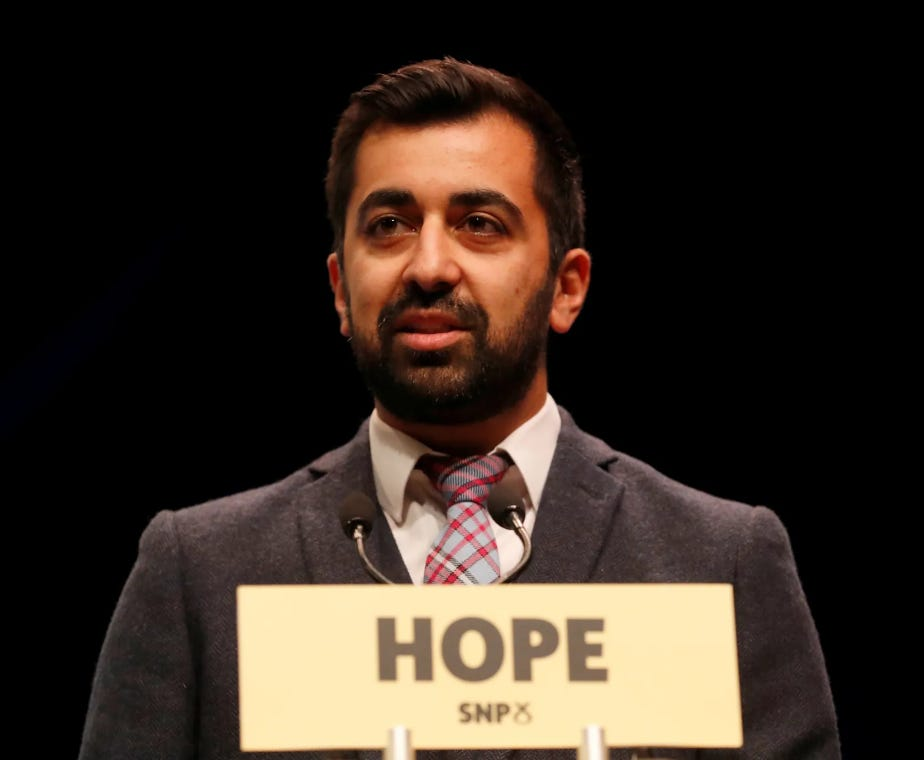
There’s a joke going around Irish WhatsApp that goes like this: “An Irishman, Englishman and Scotsman sit down for a historic summit regarding their ancient grievances.” The image shows the Taoiseach Leo Varadkar, British Prime Minister Rishi Sunak and Humza Yousaf, newly elected First Minister of Scotland.

That three men of South Asian ancestry now lead those three nations is something which even ten years ago would have seemed implausible; a generation further back simply bizarre. And that doesn’t take into account Britain’s most senior directly elected politician, London Mayor Sadiq Khan.

What makes it stranger is that Mr Yousaf, of Pakistani origin, and Sunak, of Indian descent – although both via British East Africa – will be engaged in deciding the future of the Union. As one wit put it, “We can at least appreciate the irony of an Indian and Pakistani coming to blows over the issue of partitioning Britain.”

Yet although both Scotland and England are now led by men with roots in the subcontinent, that is where the comparisons between the two countries end. Yousaf might like to mimic American race talking points, but he presides over a country which is overwhelmingly white and will remain so (although we’re still awaiting the latest census results); the southern kingdom is in contrast now very multiracial, and projected to get more so – a process accelerated by the Tory Government.

Britain has undergone a demographic revolution since the Second World War, a transformation into a multicultural society. Out of the ashes of the British Empire the country’s rules ended up creating a new empire at home, one where this time they could be the good guys. Just like the first British Empire, this one might be called Anglo-Indian, with the two leading parties partly aligning along old divisions between Hindu and Muslim. Like the first empire, this new diverse rainbow of nations entails strict new blasphemy codes, even if now dressed up as hate speech.

Yet this great change has hardly affected Scotland. The two countries have diverged along different paths, and this is perhaps one reason why it may prove hard to hold our multicultural empire together, although it’s a cause liberal defenders of Britishness are loath to admit. Where once the countries were brought together by Protestantism, the English language and empire, now the new “good” British Empire drives them apart, while the English language is a global source of division.

« Newer PostsOlder Posts »

Powered by WordPress