
This is what I was saying above: everything in music criticism and music culture has changed, except music poptimist perceptions of music criticism and music culture. That is what refuses to mutate. And I think it’s ugly and toxic and has left us in this bizarre place where people who write about music for large audiences think their sacred duty is to affirm the legitimacy of what the audience already likes, instead of championing something entirely new and totally different. But then, that’s what happens when you tell a lot of mostly white and mostly male taste makers that a particular set of tastes is inherently sexist and racist — they sprint in the opposite direction as fast as they can. Because aging white men are almost as afraid of being called racist and sexist as they are of being old.
Freddie deBoer, “A Few Indisputable Points About Poptimism and Then I Give Up”, Freddie deBoer, 2024-07-22.
October 25, 2024
QotD: The treason of the music critics
October 20, 2024
Nazi Conspiracies Everywhere – Rise of Hitler, April 1930
World War Two
Published 19 Oct 2024Join us for the May 1930 edition of the Weimar Wire, where we cover violent communist Youth Day demonstrations, a tough first month for new German chancellor Bruning, crazy Nazi conspiracy theories, and a whole lot more.
(more…)
October 6, 2024
QotD: Putting the past on trial
Historical context is all very well. When it comes to Woolf, perhaps a few details about her novels To the Lighthouse or Mrs Dalloway would be appreciated, or some information about her relationship with Vita Sackville-West. But no, instead we are to be hectored about her “challenging, offensive comments and descriptions of race, class and ability which would find unacceptable today”. One wonders what the person responsible for these judgmental remarks has ever accomplished, if anything at all. These petty moralists are like the crabs in the bucket, pulling down the most accomplished out of envy and spite.
The best approach to writers of genius is humility, but this quality seems to be on the decline. We see evidence of this in the self-importance of those who have rewritten books by P.G. Wodehouse, Ian Fleming, Agatha Christie and Roald Dahl. It should go without saying that Wodehouse’s prose cannot be improved, least of all by know-nothing activists who have inveigled their way into the publishing industry.
I recently bought the complete set of Fleming’s James Bond books, but I had to seek out second-hand copies to ensure that they had not been sanitised by talentless “sensitivity readers”. Yes of course, these books include sentiments that are unacceptable by today’s standards. But what’s so wrong with that? “All women love semi-rape” is a shocking sentence – in this case, it’s by the female narrator of The Spy Who Loved Me (1962) – but what purpose does censoring the passage actually serve?
The rewriting of books and the creation of cautionary QR codes are symptoms of our current strain of puritanism. These are the descendants of those religious zealots who shut the theatres in 1642 out of fear that the masses might be corrupted. And while I concede that Ian Fleming’s views on relationships between the sexes may not have been progressive, I don’t feel the need to be berated about it before enjoying the adventures of James Bond.
It’s not as though Bond is even meant to be a likeable character; the man has a licence to kill, for heaven’s sake. This isn’t someone you’d wish to invite to a dinner party. In that regard he’s reminiscent of the hero of George MacDonald Fraser’s Flashman series, a character based on the bully from Tom Brown’s School Days by Thomas Hughes. He’s a violent boorish rapist, but the novels are still entertaining because most of us aren’t reading them for moral instruction.
In exploring the gamut of human experience, writers will often feel compelled to recreate the grotesque, the uncomfortable, the outrageous, even the downright evil. Who ever supposed that works of fiction should restrict themselves to rose-tinted idealisations of human existence? Imagine Macbeth without the regicide, or King Lear without the eye-gouging, or Titus Andronicus without the cannibalism. Would Dante’s Divine Comedy retain its power if some “sensitivity reader” excised the Inferno?
Andrew Doyle, “Putting the past on trial”, Andrew Doyle, 2024-07-04.
September 25, 2024
Freddie deBoer on “deference politics”
In the first of a series of articles, Freddie deBoer discusses the phenomenon of “deference politics” practiced by many (most?) progressives in the United States (and equally in Canada):
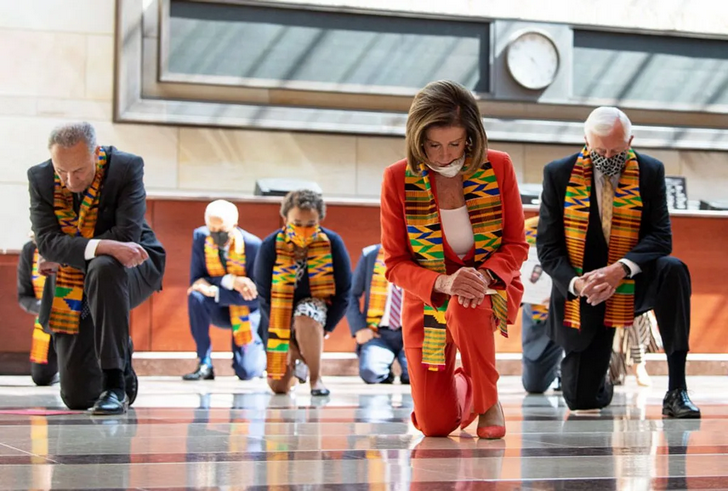
When I talk about deference politics, I’m referring to the tendency of left-leaning people to substitute interpersonal obsequiousness towards “marginalized groups” for the actual material change those groups demand.
If you’ve lived in any left-aligned spaces in the past decade, you’ve encountered deference politics many times. A white person in a humanities seminar, an organizing meeting, an industry convention, a workplace gathering, etc., who makes the conscious decision to avoid engaging or to engage from a position of proactive apology towards various identity groups is engaged in deference politics. Someone who insists that members of “dominant groups” should censor themselves or speak softly or avoid speaking too much or defer to or otherwise “make space” for members of minority identities is advocating for deference politics; someone from a dominant group who tells others in that group that they should defer is practicing (self-aggrandizing) deference politics. “Maybe men should just shut up for awhile,” voiced by a man, is quintessential deference politics. “I sat my white ass down and listened” is deference politics. “Teach me how not to oppress you,” spoken at an academic conference by a straight person to LGBTQ people on a panel, is deference politics. Avoiding sharing a challenging opinion on an issue of controversy for fear of running afoul of the wrong kind of identity accusation is deference politics.
The infamous image above, of Democratic leaders wrapped in kente cloth and taking a knee in memory of George Floyd, actually preceded a meaningful attempt at material change, the George Floyd Justice in Policing Act. While that bill would not have been a sufficient overhaul of America’s criminal justice system — it’s hard to use the federal government to reform policing, which tends to be governed by state policies and influenced by local conditions — it would have been a good start. The Democrats, sadly, were not able to pass the bill in two tries, though perhaps it could still be revived. That the party simply didn’t have the votes to make the bill law isn’t something that we should be particularly hard on the Democrats about, but the contrast between its failure and the theatrics that attended its announcement is deference politics in its essential form: at a moment of mass discontent over the state of race and policing, Black Americans got the absurd performance from Congressional leaders but not the substance of better policy. And this is core to the critique of deference politics; the point is not that the good intentions of the people who practice them are worthless but that the people who practice deference politics never seem to recognize that all of the deferring never makes positive action more likely. Like many great political crimes, deference politics privileges the communicative and the emotional over the material and the actual.
It’s important to point out that many Black activists and writers recoiled at the deference politics practiced after George Floyd’s death and pointed out that they had never asked for such theatrics.
Is “deference politics” just a way to say “woke”?
No. Deference politics could conceivably be practice or demanded in any given political context and by members of any given political tendency. Conservatives do occasionally advocate for deference politics, such as when they insist that only veterans should comment on issues of war and peace. Nor do woke people assertively practice deference politics all the time; in fact, for various demographic reasons most people practicing social justice politics are themselves members of dominant groups, and they have a tendency to assert their own superior right to speak rather than to defer to others. The term “deference politics” should likewise not be used to refer to all cringey elements of “allyship”, which involves a diverse suite of questionable tactics and attitudes, but certainly deference politics are core to the behavior of the modern ally. The practice epitomizes the modern liberal obsession with defining politics as a matter of interpersonal niceties rather than as the systems through which human values are expressed in material terms in the real world.
September 11, 2024
QotD: The preposterous tactics of George R.R. Martin’s Dothraki nomads
As a description, it is hard for this to be very much wrong because it is so very vague, but the attentive reader will note that Jorah’s assertion that there are “so many” must be wrong for either Eurasian Steppe Nomads or Great Plains Native Americans, both of whom were routinely outnumbered by settled enemies, often dramatically so. Let’s put a pin in that, though, because of course while Martin gives only vague description of Dothraki warfare, the show, Game of Thrones, shows it to us on screen quite vividly.
We see a bit of Dothraki warfare in S6E9 when Daenerys’ Dothraki charge down the Sons of the Harpy at Mereen, but the really sustained look at how they fight has to wait for S7E4 and the Loot Train Battle and S8E3 and the Battle of Winterfell, both of which, happily, we have already discussed! In all three cases, the Dothraki do exactly the same thing. They charge, in a pell-mell rush, while giving high-pitched war-calls. While some of the Dothraki may fire arrows on the approach (they have them stand up to do this, which is not how actual Mongols or Native Americans fired from horseback; it looks cool and is stupid, like most of Game of Thrones season 7 and 8), they otherwise charge directly into contact and begin fighting from horseback with their arakhs as the primary weapon.
This is not how horse-borne nomads fought.
As we’ve discussed repeatedly before, the key weapon for Steppe nomads was the bow, shot from horseback at high speed (on this, note May, “The Training of an Inner Asian Nomad Army” JMH 70 (2006) and Mongol Art of War (2007)). Thus the crucial maneuver was the caracole, where the rider approaches the target at high speed, firing arrows as he goes, before making an abrupt turn (it is actually the turn that is technically called a caracole, but the whole tactic goes by this name) and retreating, before trying again. Pulling this tactic off en masse required a great deal of both individual skill at horsemanship and archery, but also quite a lot of group cohesion and coordination, since a collision of horses at speed is very likely to be fatal for everyone – humans and horses – involved.
This tactic can then be repeated – charge and retreat, charge and retreat – until the psychological toll on the defender becomes too great and they either break and retreat or else charge out to try to catch “retreating” nomads. In either case, it was at that moment when the Steppe nomads could press home and destroy the disorganized enemy. These tactics were brutally effective, but they were also a necessary casualty control measure. Shock combat – that is massed melee combat in close quarters – is simply far too lethal for low-population nomadic societies to sustain in the long-term on the regular (a hoplite battle might result normally in c. 10% casualties for instance (but note this discussion of that figure) – think of what that would mean in a society where 100% of adult males participate in each battle – you’d run out of men pretty quickly!).
And fascinatingly, we can actually see that calculus play out in North America, where the arrival of firearms, which suddenly make pitched “missile exchange” battles (especially on foot) as lethal as shock combat (it seems notable that the introduction of musketry into Old World warfare did not come with a significant increase or decrease in battlefield lethality, at least until the rifled musket – on that, see B. Gibbs, The Destroying Angel (2019), but also note E.J. Hess, The Rifle Musket in Civil War Combat: Reality and Myth (2008)), the pitched battle vanishes. It was simply too lethal to be a viable option in the long term for societies with low population density and very high military participation rates.
Instead, the raid came to dominate warfare on the Great Plains, with mass-casualty events generally being restricted to situations where a raiding party caught an enemy group unawares (McGinnis, op. cit., 45-6, 57-9). To be clear, that’s not to say the Great Plains Native Americans were peaceful, after all the goal of all of this raiding was to cause one of those rare mass-casualty surprise attacks and – as McGinnis notes again and again, warfare was part of the Plains Native American way of life, as the social status of males was directly and powerfully tied to success in war.
In short, the need to keep lethality relatively low is one of the most important factors which shaped nomadic horse-borne warfare, both on the Steppe and on the Great Plains. And here is where I think that even Martin’s description – which could, if read with friendly eyes, be taken as a description of the Steppe caracole described above – falls short: the Dothraki are dangerous because they are so many. But actual nomadic warfare was fundamentally conditioned by the shortage of men created by the low population density of the Steppe or the Great Plains. This weakness could be somewhat made up for by making every male into a warrior, but only if casualty rates remained low. A war of attrition with settled peoples would wear the nomads out quickly, which is why such attritional warfare was avoided (unless you are the Mongols, who use the sedentary armies of conquered states, notably using the armies of Northern China to conquer Southern China; that said, Drogo is clearly not Chinggis Khan or any such sort of Khal-of-Khals)
So where does this model of warfare come from? Well, when it comes to the show, we needn’t actually look far, because the creators tell us. The director of the episode, Matt Shakman, noted in an interview that his primary reference for the Dothraki charge was John Ford’s Apache attack in his 1939 film Stagecoach (you can see the scene he means here). And in the S7 special feature, “Anatomy of a Scene: The Loot Train Attack”, David Benioff notes that the charge “definitely got a bit of that western feel” while VFX producer Steve Kullback says, of the battle, it’s “sort of like Cowboys and Indians”.
In Stagecoach (1939), the Apache aren’t a real humanized culture, but an elemental force of destruction. Their charge at the titular stagecoach is essentially mad and heedless of all losses (in the same featurette, Camilla Naprous, Game of Thrones‘ horse master, describes the Dothraki as “they’re just these absolute mad men on horses”, in case you thought that connection was only subtext). The position of “Indians” as particularly “rapey” is also explicit in Stagecoach, where the one of the white male defenders of the coach saves his last bullet to spare the one woman, Mrs. Mallory, from being captured and raped by the approaching cavalry [NR: I think Dr. Devereaux means “Indians” here, but given the historic reputation of the cavalry …] (the concern about white women being raped by non-white men being a paramount fixation of early American film; see also The Birth of a Nation (1915); or, you know, don’t.) And the tactics (or lack thereof) of the Dothraki, charging madly forward with no order or concern for safety, also map neatly on to Stagecoach‘s Apache attack (and not on to actual Apache attacks).
I don’t think this lazy use of old Western tropes is limited to merely the show, however. Having written this far, I find myself convinced that there is a longer article or perhaps a video-essay waiting to be written by a different sort of scholar than myself – that is, a film historian – on how Martin’s depiction of the Dothraki and their world is fundamentally rooted in the racist tropes of the Hollywood Western and its portrayal of Native Americans in a frontier environment where, as Sergio Leone put it, “life has no value“. Quite a lot of parallels with Martin’s Dothraki emerge after even a brief overview of the representation of Native Americans in film. The emphasis on taking captives (especially white women) to no apparent purpose besides sexual violence, the distinctive “screaming” of Dothraki warfare (which, yes, Native Americans used a range of intimidating war cries, but so did basically everyone else in the pre-modern world, so why are the Dothraki the only ones who do it in Westeros?), its lack of tactics or order, and – as we’ve discussed already – the grossly simplified form of dress all seem to have their roots in racist Hollywood depictions of Native Americans. The Dothraki Sea is, essentially a “Cavalry and Indian Story” with the cavalry removed.
That is not a pure creation of Benioff and Weiss. The show simply takes that subtext and makes it text.
Bret Devereaux, “Collections: That Dothraki Horde, Part IV: Screamers and Howlers”, A Collection of Unmitigated Pedantry, 2021-01-08.
August 30, 2024
Two-Tier Keir’s “mask off” moment(s)
Millennial Woes presents a disturbingly long summary of British Prime Minister Keir Starmer’s responses to popular non-violent protests:

The situation in Britain now is so perverse that, if you could convey it to people from a century ago, I think they, after getting over the disbelief and astonishment and accepting that this really was true, would assume it could not possibly have come about by chance. Whatever their complaints about the Britain of 1900, they wouldn’t have believed it capable — on its own — of the degeneration we have seen. They would insist that it must have been wickedly subverted, every failsafe removed, and entire systems of governance, culture and morality repurposed, made to achieve the opposite of their purported function.
I hardly need list the symptoms of this, but for the sake of posterity …
- The control nexus (of which the government is merely one node) ships massive numbers of unassimilable foreigners into the country against the repeatedly expressed wishes of the natives, and in clear violation of their best interests.
- Natives who complain about this are hounded, doxed, demonised, made unemployable, and often imprisoned.
- Their children are systematically indoctrinated by fiction media to accept their dispossession. They are encouraged to despise the “bigoted” attitudes of their parents and grandparents, and to loathe their nation’s history. The boys are encouraged to idolise non-native men. The girls are encouraged to race-mix with them.
- Teachers deliver the same indoctrination in the classroom — in every classroom. You won’t be allowed to become a teacher unless you voice enthusiasm for such things. Alternative views have been eradicated from the classroom and the lecture hall.
- Natives are systematically disadvantaged in numerous sectors of education and employment.
- Natives are demonised in fiction and news media while non-natives are made to look wonderful.
- The mass sexual abuse of native children by non-natives is systematically down-played by news media, who shift discussion to false “equivalents”.
- Natives’ history is systematically distorted in education and fiction media.
- The very existence of the natives, as a group, and their ownership of their homeland, are systematically denied by education, fiction media, news media, and phoney “science”.
- The police do whatever they are told to do, kneeling for the participants in one riot, hunting down the participants in a different riot.
- Judges pass obviously outrageous prison sentences upon certain people, for blatantly political reasons. These people are denied bail and pressured to plead guilty for fear of sentences even more outrageous. All of this is to send a message to other people: “don’t dare complain or the same will happen to you”.
- The media rushes to concoct fake narratives about events, to keep the public misinformed.
- A so-called “charity”, which is heavily linked to the government and the civil service, seeks to indoctrinate the young and ruin the lives of “troublemakers”, and actively aids the government in concocting fake narratives in order to control public thought and direct events.
- Fake news from such Establishment agents is forgiven, fake news from the Establishment’s enemies is answered with threats of prosecution.
- The media “memory hole” stories of appalling violence by non-natives, explain away such incidents with talk of mental illness, tell natives “don’t look back in anger”, and at all costs defend the suicidal ideologies that make such incidents possible.
- The prisons are emptied of rapists, child molesters and murderers so that troublesome natives can be assigned their cells. They are placed alongside non-natives who might well be violent to them, and journalists gloat about it.
- The slaughtering of three little girls by a non-native is dismissed by the Prime Minister, who says “it doesn’t matter” that the rioting was a response to this outrageous crime, which was enabled by the outrageous government policies that the natives have been complaining about for decades. Their shock, their trauma, their resentment, their dignity, their pain… “doesn’t matter”. This is in stark contrast with how he reacted to Black people rioting several years before.
- The natives’ freedom of speech is continually undermined, one government after another actively seeking to erode it further.
- Not one single organisation is fighting for the wellbeing, rights or interests of the natives.
- Any political party that would do anything about any of this is refused the right to stand in elections, debanked, demonised and, in most cases, destroyed.
Any one of these examples would, in itself, be cause for great alarm. The whole lot together indicate a society that is not just largely, not just fundamentally, but wholly opposed to the continued existence of its native population. To underline: British society is actively perpetrating the destruction of the native British people.
It has been said that the ruthless authoritarian response of the fledgling Starmer government to this summer’s (White) riots is a “mask off” moment for the Labour Party. Others have called it a “mask off” moment for the British Establishment, which transcends the particular party in office. Indeed, things that didn’t happen under the Conservatives have suddenly happened under Labour; things that one would more neatly associate with the former have instead happened under the latter. That can only mean either that the Labour Party has utterly lost its sense of itself, or that the particular party in office simply doesn’t matter, because the Establishment abides.
I think, in fact, all of these statements are true. It has been a “mask off” moment for the Labour Party, and for Keir Starmer himself, and for the Establishment which enables and directs them. The Labour Party has lost its sense of itself — or, to put it less romantically, has been completely repurposed. And the Establishment does abide; no matter which party is in office, things only ever evolve in one direction. And after all, while Starmer’s behaviour casts a bad light on him, he is only Prime Minister in the first place because the Establishment wanted him, not someone who might have reacted to these riots in a different manner. (Boris Johnson is good at stoking war abroad, but not so willing to stoke it at home.)
But in the end it doesn’t really matter. We don’t need to pin the blame on Starmer, Labour, the British Establishment or Davos; they are all one and the same miasma. Yes, the Conservative Party might have reacted differently to the riots, so to some extent we can blame Labour’s ideology or Starmer’s personality, but the pendulum is kept swinging for a reason. One empty suit is shifted out, another is shifted in. Each one might be enthusiastically on-board with the agenda or compelled to go along with it, this being the only variance. And thus the Establishment abides, always getting what it wants against the wishes of the natives, and always degrading and dispossessing them.
August 25, 2024
Woke libraries
Frank Furedi on the already well-advanced plan to turn public libraries into safe spaces for progressive indoctrination:



In recent times, the Library has become the target of what I characterise in my new book, as The War Against The Past. The current project of dispossessing Western society of its historical legacy has gained a powerful influence over the institutions of culture. That is why the Library – a repository of the knowledge and wisdom gained through the past – has become the target of cultural vandalism.
The promoters of the culture war in the Library often justify their action on the ground that their target is not so much the past – but the “racist past”. This is the argument used by the Government backed supporters of a campaign in Wales who wish to reorganise libraries along the lines of anti-racist principles. These racially obsessed cultural warriors insist that Libraries throughout Wales must embrace the goal of becoming anti-racists if the devolved Labour government’s pledge to “eradicate” systemic racism by 2030 would be realised. To ensure that libraries and the “racist” buildings holding their collection are cleansed of the sin of “whiteness”, a £130,000 project designed to indoctrinate local librarians in “critical whiteness studies” has been devised.
The project of racial indoctrination pursued in Wales warns that staff training sessions will be necessary to ensure that libraries align with anti-racist principles. However, it insists that such training sessions should not take place in buildings with a “racist past”. From the standpoint of the authors of the document proposing “critical whiteness studies”, many buildings housing libraries must be avoided because they serve as symbols of racism. Do they presume that the buildings in question can contaminate members of the public with the racist plague? Or are they merely interested in tearing down the walls of racist buildings in order to rebuild them as temples to the doctrine of decolonization?
In a world, where the racialisation of every dimension of life has acquired its own imperative, it was only a matter of time before buildings became demonised as racist. There is now a veritable literature authored by academic racial entrepreneurs who insist that buildings can be racist. One enthusiastic social scientist supporting this thesis offers numerous “examples of buildings being racist”. The racialisation of building and the material properties used in their construction has acquired the character of a veritable fetish. “Concrete, steel and glass buildings are ‘racist'” is the title of one contribution on this subject.
The Welsh Government appears to be consumed by the quest of ridding its nations of racist buildings. As far back as 2021 it published an audit of all such buildings as well as, schools, streets, statues and pubs that it regarded as the product of Wales’ racist past. In effect almost any building, street name or pub whose name was linked with a historical figure was by definition racist. Gone are the days when a pub is allowed to call itself Admiral Nelson or the Duke of Wellington.
The policy of renaming a building, street or a statue is bad enough. What is far worse is when a library is forced to subordinate its book collection to the imperative of racialization. In the name of ridding the book shelves of their “whiteness” and “racist past”, a library becomes a target of officially sanctioned cultural vandalism.
Throughout the Anglosphere. Cultural vandalism is justified on the ground of settling scores with colonialism, racism or white supremacy. For example, school libraries in Australia have removed “outdated and offensive books on colonialism” from their collection[v]. The purge of a school library in Melbourne was guided by Dr Al Fricker, a Dja Dja Wurrung man and expert in Indigenous education with Deakin University. In the course of auditing all 7000 titles on its library shelves. Fricker showed little nostalgia towards the collection. He stated that some of the books removed were almost 50-year-old and were “simply gathering dust anyway”. He stated that “we wouldn’t accept science books being that old in the library, so why do we accept other non-fiction books to be that old, because nothing is static”.
There is something truly disturbing about the idea that a library ought to rid itself of old non-fiction books. In my discipline of sociology that would mean ridding libraries of the 19th century pioneers of the field. In effect the call to reject old non-fiction books constitutes the annihilation of the intellectual legacy of the social sciences and the humanities.
August 13, 2024
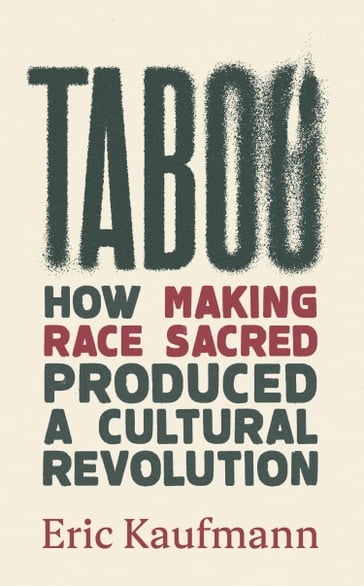
Taboo by Eric Kaufmann
In Quillette, John Lloyd reviews Eric Kaufmann’s Taboo:How Making Race Sacred Produced a Cultural Revolution:
Earlier this year, Eric Kaufmann, a Canadian professor of political science, left Birkbeck College in the University of London where he had taught for twenty years. He was also head of the political science department there, and already had a number of deeply researched books behind him. But neither long service, departmental prominence, nor publishing success offered much of a defence against three separate attempts to cancel him. Indeed, his 2018 book Whiteshift told against him, since it argued, inter alia, that white majorities should have as much right to protect their identity and culture as minorities, a position now perceived by some as evidence of racism. “Repressing white identity as racist”, he wrote, “and demonising the white past, adds insult to the injury of this group’s demographic decline. This way lies growing populist discontent, or even terrorism.”
During the first part of his career, Kaufmann mostly kept his conservative views to himself, and with good reason. When he revealed them in Whiteshift, he became a marked man and spent several years fending off persistent efforts to strip him of his job and livelihood. His academic colleagues were generally unsupportive, and some of them participated in the campaign against him. So, he left Birkbeck for the University of Buckingham, the first of a small clutch of private universities created since the 1970s with the enthusiastic backing of Prime Minister Margaret Thatcher. Buckingham takes pride in rejecting leftist monoculture in favour of an approach that privileges open debate without the risk of career obliteration.
These days, Kaufmann is — as the Scots saying goes — a “bonnie hater” (or what others might call a “happy warrior”). With his new book, he joins the best of those (disproportionately American) writers, journalists, and politicians alarmed by the activities of ideologically motivated individuals and organisations operating under the vague umbrella term “wokeism”. This inchoate movement, Kaufmann maintains, is deeply destructive of freedom (and of freedom of speech in particular), learning, virtue, public morality, patriotism, and emotional continence. It is, Kaufman recently told the Daily Mail, an “Orwellian threat to the [E]nlightenment — free speech, equal treatment, due process, objective scientific truth. I believe this new woke ideology threatens the foundations of our civilisation.”
Wearying of the years of harassment he received for his views (none of which, he stresses, was ever physical), Kaufmann moved to Buckingham. He wanted to take advantage of the opportunity to establish a Centre for Heterodox Sociology where progressive doctrines could be studied, dissected, and debated, a pursuit he believes would be impossible anywhere else. Buckingham received first prize for free speech in last year’s National Student Survey. It will now be required to live up to that distinction, since Kaufman’s approach — after many years spent avoiding conflict — has become direct and uncompromising. Any determined left-leaning student or scholar would find this an intolerable provocation — a display of prejudice and bigotry meriting expulsion from the scholarly body lest it spread to innocent souls insufficiently prepared to counter it.
The list of progressive doctrines Kaufmann has compiled to define “wokeism” is probably the most comprehensive assembled to date. Much of what concerns him most relates to education. He believes that higher education, in particular, has become a place of inflexible dogmas on race, gender, emotional fragility, and anti-white bias rather than a home of serious study, reflection, and discussion. But he does not believe—as many other critics of contemporary progressivism do—that this is a kind of warmed-over Marxism, in which the fragile student has taken the place of the exploited proletarian. Instead, progressivism’s concern for the outnumbered, the vulnerable, and the frail can be traced back to Christ’s teachings, and especially to his Sermon on the Mount reported in Matthew 5:5: “Blessed are the meek, for they shall inherit the earth.” This injunction is now marshalled into a secular hallowing of blacks (above all), Muslims, women, and LGBT individuals.
Kaufmann calls the upshot of this genealogy “cultural socialism” — a movement that privileges equality, but equality of outcome not merely opportunity. He points to a speech that US president Lyndon Johnson delivered to students at the historically black Howard University in 1965, in which Johnson claimed that “we seek not just equality as a right and a theory, but equality as a fact and equality as a result”. Suddenly, Kaufmann remarks, “the door was open to restricting liberty and equal treatment in the name of achieving ‘equality of result’.” Such a regime, he points out, will inevitably disincentivise effort and excellence. Why forgo pleasure to work hard when the dedicated and indolent alike will all be made equal in the end? It’s worth remarking, however, that socialism does not necessarily provide the low road to unequal equality. Kaufmann quotes the historian Eric Hobsbawm — an unapologetic communist until he died in 2012 — who insisted that privileging one group over another will destroy society by breaking it into mutually hostile communities.
August 5, 2024
QotD: George R.R. Martin’s Dothraki rank with the lazy racial sterotypes of Hollywood’s “Golden Age” westerns
The Dothraki were actually fashioned as an amalgam of a number of steppe and plains cultures … Mongols and Huns, certainly, but also Alans, Sioux, Cheyenne, and various other Amerindian tribes … seasoned with a dash of pure fantasy.
We may, I think, now safely dismiss this statement as false. What we have found is that the Dothraki do not meaningfully mirror either Steppe or Plains cultures. They do not mirror them in dress, nor in systems of subsistence, nor in diet, nor in housing, nor in music, nor in art, nor in social structures, nor in leadership structures, nor in family structures, nor in demographics, nor in economics, nor in trade practices, nor in laws, nor in marriage customs, nor in attitudes towards violence, nor in weapons, nor in armor, nor in strategic way of war, nor in battle tactics.
We might say he has added “dashes” of pure fantasy until the “dash” is the entire soup, but the truth is clearly the reverse: Martin has sprinkled a little bit of water on a barrel of salt and called it just a dash of salt. There is no historical root source here, but instead pure fantasy which – because racist stereotypes sometimes connect, in thin and useless ways, to actual history – occasionally, in broken-clock fashion, manages to resemble the real thing.
It seems as though the best we might say of what Martin has right is that these are people who are nomads that ride horses and occasionally shoot bows. The rest – which as you can see from the list above there, is the overwhelming majority – has functionally no connection to the actual historical people. And stunningly, somehow, the show – despite its absolutely massive budget, despite the legions of scrutiny and oversight such a massive venture brings – somehow is even worse, while being just as explicit in tying its bald collection of 1930s racist stereotypes to real people who really exist today.
Instead, the primary inspiration for George R.R. Martin’s Dothraki seems to come from deeply flawed Hollywood depictions of nomadic peoples, rather than any real knowledge about the peoples themselves. The Dothraki are not an amalgam of the Sioux or the Mongols, but rather an amalgam of Stagecoach (1939) and The Conqueror (1956). When it comes to the major attributes of the Dothraki – their singular focus on violent, especially sexual violence, their lack of art or expression, their position as a culture we primarily see “from the outside” as almost uniformly brutal (and in need of literally the whitest of all women to tame and reform it) – what we see is not reflected in the historical people at all but is absolutely of a piece with this Hollywood legacy.
But Martin has done more damage than simply watching The Mongols (1961) would today. He has taken those old, inaccurate, racially tinged stereotypes and repackaged them, with an extra dash of contemporary cynicism to lend them the feeling of “reality” and then used his reputation as a writer of more historically grounded fantasy (a reputation, I think we may say at this point, which ought to be discarded; Martin is an engaging writer but a poor historian) to give those old stereotypes the air of “real history” and how things “really were”. And so, just as Westeros became the vision of the Middle Ages that inhabits the mind of so many people (including quite a few of my students), the Dothraki become the mental model for the Generic Nomad: brutal, sexually violent, uncreative, unartistic, uncivilized.
And as I noted at the beginning of this series, Martin’s fans have understood that framing perfectly well. The argument given by both the creators themselves, often parroted by fans and even repeated by journalists is that A Song of Ice and Fire‘s historical basis is both a strike in favor of the book because they present a “more real” vision of the past but also a flawless defense against any qualms anyone might have over the way that the fiction presents violence (especially its voyeuristic take on sexual violence) or its cultures. No doubt part of you are tired of seeing that same “amalgam” quote over and over again at the beginning of every single one of these essays, but I did that for a reason, because it was essential to note that this assertion is not merely part of the subtext of how Martin presents his work (although it is that too), but part of the actual text of his promotion of his work.
And it is a lie. And I want to be clear here, it is not a misunderstanding. It is not a regrettable implication. It is not an unfortunate blind-spot of ignorance. It is a lie, made repeatedly, now by many people in both the promotion of the books and the show who ought to have known better. And it is a lie that has been believed by millions of fans.
One thing that I hope is clear from this treatment is just how trivial the amount of research I’ve done here was. Certainly, it helped that I was familiar with Steppe nomads already and that I knew who to ask to be pointed in the direction of information. Nevertheless, everything I’ve cited here is available in English and it is all relatively affordable (I actually own all of the books cited here; thanks to my Patrons for making that possible, especially since getting materials from the library is slower in the days of COVID-19; nevertheless, the point here is that they are not obscure tomes). Much of it – Ratchnevsky on Chinggis Khan, Secoy and McGinnis on Great Plains warfare – were already available well before the 1996 publication of A Game of Thrones. 1996 was not some wasteland of ignorance that might have made it impossible for Martin to get good information! For an easy sense of what a dedicated amateur with film connections might have learned in 1996, you could simply watch Ken Burns’ The West, which came out the same year. I am not asking Martin to become a historian (though I am asking him to stop representing himself as something like one), I am asking him to read a historian.
Instead of doing that basic amount of research, or simply saying that the peoples of Essos were made up cultures unconnected with the real thing, Martin and the vast promotional apparatus at HBO opted to lie about some real cultures and then to put hundreds of millions of dollars into promoting that lie.
And I want to be clear, these are real people! I know, depending on where you live, “Mongols” and “Sioux” and “Cheyenne” may feel as distant and fanciful as “Rohirrim” or “Hobbits” or else they may feel like “long-lost” peoples. But these were real people, whose real descendants are alive today. And almost all of them face discrimination and abuse, sometimes informally, sometimes through state action, often as a result of these very lingering racist stereotypes.
In that context, declaring that the Dothraki really do reflect the real world (I cannot stress that enough) cultures of the Plains Native Americans or Eurasian Steppe Nomads is not merely a lie, but it is an irresponsible lie that can do real harm to real people in the real world. And that irresponsible lie has been accepted by Martin’s fans; he has done a grave disservice to his own fans by lying to them in this way. And of course the worst of it is that the lie – backed by the vast apparatus that is HBO prestige television – will have more reach and more enduring influence than this or any number of historical “debunking” essays. It will befuddle the valiant efforts of teachers in their classrooms (and yes, I frequently encounter students hindered by bad pop-pseudo-history they believe to be true; it is often devilishly hard to get students to leave those preconceptions behind), it will plague efforts to educate the public about these cultures of their histories. And it will probably, in the long run, hurt the real descendants of nomads.
But this is exactly why I think it is important for historians to engage with the culture and to engage with depictions like this. Because these lies have consequences and someone ought to at least try to tell the truth. With luck, even with my only rudimentary knowledge, I have done some of that here, by presenting a bit more of the richness and variety of historical (and in some cases, present-day) horse-borne nomadic life, in both North America and Eurasia.
Because there is and was a lot more to nomads than just “that Dothraki horde”.
Bret Devereaux, “Collections: That Dothraki Horde, Part IV: Screamers and Howlers”, A Collection of Unmitigated Pedantry, 2021-01-08.
August 3, 2024
“Multiculturalism is when yummy food”
Fortissax pours scorn on the defenders of multiculturalism-at-all-costs for one of the most common arguments in favour:
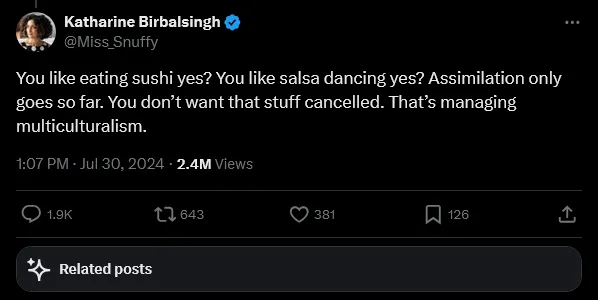
“Multiculturalism is when yummy food” is a real position people take. If you ask them what benefits of multiculturalism are, they’re going to say food and nothing else. Westerners don’t watch Bollywood films, they don’t listen to Desi music, they don’t watch cartoonishly bad Latin American dramas, usually for Hispanic abuelas still living in Mexico where every actor is suspiciously fairer-featured than everyone in their whole family. People can’t say “I love the food, the music, the culture” because they don’t engage in any of this. Salsa isn’t even popular; it hit its peak at the end of the 1990s because white boomer Americans approached an intensely Anglicised, sanitised form of Latin-American culture as introduced to them through the likes of Enrique Iglesias and other English-speaking Latin pop artists.
I don’t believe all leftists say this out of sincerity. It’s a knee-jerk reaction to any criticism of multiculturalism. They don’t put a lot of thought into it. The justification is usually related to how “bad” that “white people food” is. This follows the same thread of accusations that “white people can’t dance”, “white people can’t jump”, “white people can’t fight”, and “white people can’t fuck”. It’s another lib-coded tract to bash English-speaking white Americans over the head with, to justify demographic displacement by portraying them as boring, ugly, weird, or uncool. On some level, they probably know food isn’t worth human lives, but they have to reinforce their moral view or the whole thing collapses, and they have to admit fault for doing things and promoting ideas that are so destructive that people would want to unalive them. If they give up now, it’s over. It’s sunk cost fallacy.
For the rest who’re wholly sincere: it’s just straight up bullshit. Foreign restaurants serve you a Westernized version of their slop. Their bulk food suppliers are Western, the ingredients are Western-derived, but they sell it as “authentic” when it isn’t. That crab rangoon you just spent $40 on Doordash was bulk bought at Costco during a last ditch grocery run. They’re selling you the experience. A sampling of the real thing, deliberately fitted to your people’s general dietary preferences. All of these “ethnic”, “exotic” restaurants do this. Everyone knows about “secret menus” at Chinese or Indian restaurants. Anybody who works in culinary, hell, anybody whose watched the UK version of Hell’s Kitchen where Gordan Ramsay tries to rescue failing restaurants owned by small business owners can tell you most of these people aren’t using fresh or original ingredients. You go to any “Japanese” restaurant in North America, the staff are a random assortment of Asian, or sometimes Korean or Chinese, or maybe even Filipino but it doesn’t matter because they look Asian enough to boomers, correctly guessing people can’t tell the difference at a passing glance.
July 18, 2024
An elite luxury belief – “Diversity Is Our Strength”
In a guest-post at Postcards from Barsoom, Spaceman Spiff lists some of the cargo cult notions that have captured the imagination of many “elites” in western nations, like “Diversity Is Our Strength“:

Multiculturalism is pursued in Western countries with a religious mania. It is difficult to imagine anything closer to a belief system for today’s upwardly mobile professional than advocating for diversity and inclusion.
Most of the world views ethnic and cultural mixing as a dangerous, civilization ending activity. A threat to be guarded against, not an opportunity to be embraced. This has been the conventional view throughout history in almost every society.
The modern Western formulation has challenged this. Mixing cultures, especially those hostile to assimilation, is not just to be tolerated but encouraged. Alien peoples must be sought out and imported to increase the ethnic and cultural mix. We must extend every courtesy to those fundamentally incompatible with us in customs and manners. The ultimate expression of this ambition is open borders, a concept viewed with deep hostility by almost all non-Western countries.
Whatever the origins of such policies, the implementers of these ideas are everywhere. They work in corporations, public sector bodies, and NGOs. We find them in Starbucks and Walmart. Diversity is everywhere even though it makes little sense as an end in itself.
How do we explain the enthusiasm with which middle managers and HR workers have embraced such a destructive idea, including its corporate version of job and education quotas?
Competency itself can be hard to find even in ideal conditions, so why hobble your chances like this? Why intentionally seek to create brittle heterogeneous environments that reduce productivity and increase strife?
The simple answer is that sophisticates don’t succumb to primitive notions like preferring their own. These are urges to be resisted, like hunger while dieting. Racism is old hat and any noticing of differences is racism. After all, our elites do not behave like this, so the goal is to be observably anti-racist, just like them.
Some look at our globalist elites and see them mixing with an international set. As they hobnob around the world they certainly socialize with foreigners. Indian elites, Arab elites, and Chinese elites all mix with their Western equivalents. We see them at events like Davos or the global climate change meetings. A multicoloured constellation of traitors from every country, all getting along with each other because they are nothing like their fellow countrymen, and everything like each other.
What the dullards in the corporate HR world miss is that this is not a celebration of diversity. Most of those elites are nearly identical. Many attended the same universities. All speak English, the international language. They have similar views, including contempt for their respective compatriots.
There is no diversity at the very top, just an elitist outlook most of them share, and contempt for the peasants who surround them. White, brown, or black, we all look the same from the cultural stratosphere. Cannon fodder for their Olympian ideas, but nothing more. The elite view of mass migration is indifference, not enthusiasm.
The street-level version takes the superficial aspects of this phenomenon and worships it as the end goal since the underlying homogeneity of the elites is largely absent. Their goal is not to seek out that which we have in common with others but the less sophisticated observation of what makes us different, what makes us more “diverse.”
The midrange talent in the West have therefore convinced themselves celebrating overt differences in the form of multiculturalism is modernity. It is the future promised by Star Trek and other communist dreams. Colour won’t matter, just like Martin Luther King promised, so long as we overlook the long predicted consequences of their dream, the lowered wages, the erosion of trust and the eventual polarization of competing groups within our own nations we once kept at bay with more considered immigration policies.
July 5, 2024
QotD: South Africa after Apartheid
Speaking with hindsight, however, it would be charitable to suggest […] that apartheid was “simply a logical adaptation to the presence of a population that simply cannot support or sustain a First World standard of living, done by people who very much valued the First World society they had created”. While that statement is undoubtedly true, up to a point, and it could be argued that apartheid was a pragmatic solution to the chaos evident throughout the rest of Africa, it cannot be used as an excuse. Indeed, such a labeling would give, and has given rise to the notion that First World systems are inherently unjust, and a different label “colonialism” — which would include apartheid — can be applied to the entirety of Western Civilization.
The fact of the matter is that when it comes to Africa, there is no good way. First World — i.e. Western European — principles only work in a socio-political milieu in which principles such as the rule of law, free trade, non-violent transfer of political power and the Enlightenment are both understood and respected. They aren’t, anywhere in Africa, except where such adherence can be worked to temporary local advantage. Remember, in the African mindset there is no long-term thinking or consideration of consequence — which is why, for example, since White government (not just South African) has disappeared in Africa, the infrastructure continues to crumble and fail because of a systemic and one might say almost genetic indifference to its maintenance. When a government is faced with a population of which 90% is living in dire poverty and in imminent danger of starvation, that government must try to address that first, or face the prospect of violent revolution. It’s not an excusable policy, but it is understandable.
That said, there is no gain in rethinking apartheid’s malevolence […] because apartheid was never going to last anyway, and its malevolence was bound to engender a similar counter-malevolence once it disappeared. Which is the main point to my thinking on Africa: nothing works. Africa is simply a train-smash continent, where good intentions come to nought, where successful systems and ideas fail eventually, and where unsuccessful systems (e.g. Marxism) also fail, just fail more quickly.
Kim du Toit, “Tough Question, Simple Answer”, Splendid Isolation, 2019-12-05.
July 4, 2024
“Over twenty years ago now, we declared war on terror; a generation later, we are ruled by terror”
At Postcards From Barsoom, John Carter discusses the prevalence of fear in modern western culture:
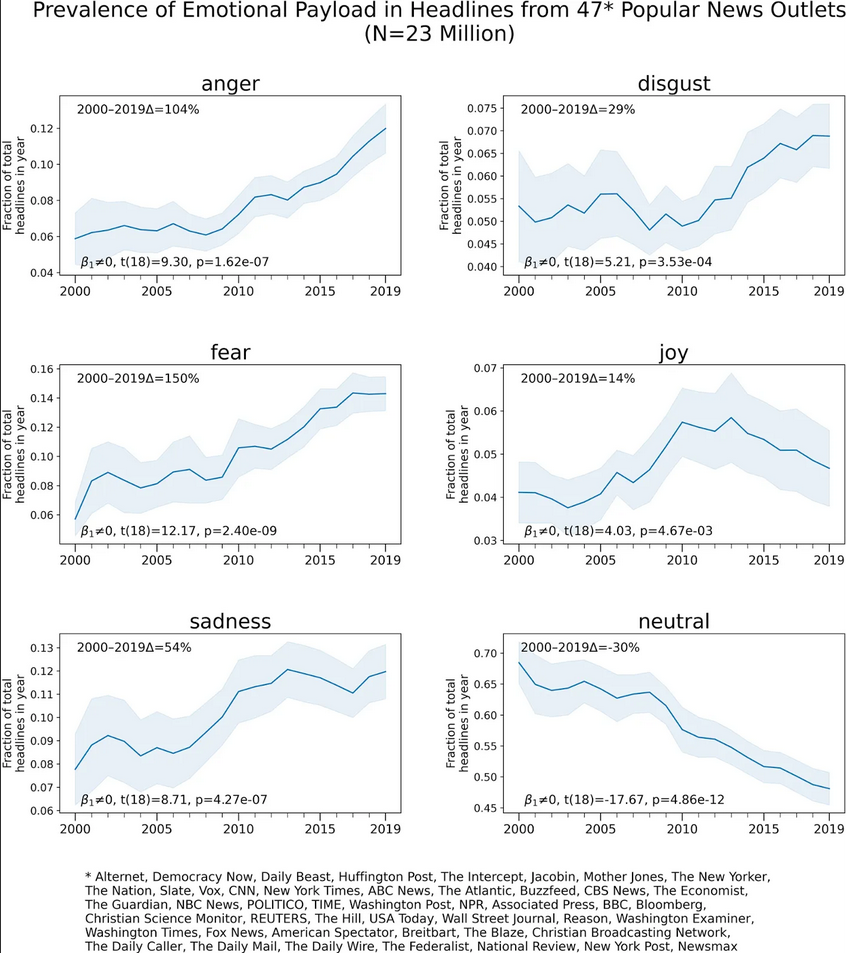
Over twenty years ago now, we declared war on terror; a generation later, we are ruled by terror. The public discourse revolves around peoples’ fears, most of them imagined. Many spend their lives petrified at the prospect of normal social interaction. Women are scared that men will rape them, and men are scared that women will rape them in the courts. Both leftists and rightists are terrified that the other, if given free rein, will drag the world into a dark age, though only one of them is right. All of our great public efforts are either to mitigate this future catastrophe or that dire present threat, or they are about furiously not acknowledging some insoluble and therefore inevitable future disaster, while studiously ignoring some entirely soluble ongoing emergency which those who could solve delude themselves they can profit from.
It shouldn’t be surprising that the war on terror ended up making us chronically terrified. That’s the track record for these things. Even back in the 1990s we knew that. The war on poverty generated an obscenely inflated welfare underclass while systematically slowing economic growth, thereby generating poverty twice over. The war on drugs led to a society of drug addicts, in which every fifth person is on at least one kind of pill, and most of the rest are self-medicating in other ways. Instead of weed (legal now, in any case), we have fentanyl and meth. Victory!
When Washington declares war on something, it invariably produces more of it. This seems perverse until you realize that wars on abstractions are simply how managerial bureaucracies extend their bases of power. A war that can never be won is a war with job security. A war that gets worse the longer and harder you fight it is even better, because this generates growth.
Washington’s current wars seem to be on racism, baseline human sexual normalcy, men, and multipolarity; the latter is really just a fancy word for the growing tendency for other countries to not do what Washington tells them to because, in general, they prefer being racist to being erased, they think the butt stuff is weird, they don’t want to be castrated, and since they are not castrated, they are still capable of not liking to be told what to do. Sure enough, all of these wars, whether cultural or geopolitical, are steadily generating the very things that they’re trying to stamp out. Racism stocks have reached prices they haven’t seen in generations, thanks to sustained decade of all-out full sector push by the media, corporate, educational, and public sectors, all doing their part to push that line up, up, up. Meanwhile, the war on multipolarity seems in general to be doing a fantastic job of generating more multipolarity.
The longer Washington wages its cowardly war against Russia, China, Iran, and I guess now North Korea, the more Washington’s standing in the world is reduced. I say “cowardly” of course because the war is not waged openly: formally, no war has been declared by Washington or any of its core NATO allies against any of the obvious belligerents. It’s all done through proxies which Washington pays to train and arm and die on its behalf, funding it all with a money printer whose brrrring has gotten defeaning. Or it’s done through sabotage; let’s not forget Nordstream, which kicked the legs out from under Germany’s, and therefore Europe’s economy, in perhaps the most breathtakingly cynical act of strategic sabotage against a supposed ally that one might imagine. Washington doomed Europe in order to ensure that Europe would stay attached to Washington. The whole world sees what Washington is doing of course, and is frightened lest it happen to them, but also disgusted that it happens at all; the latter emotion is becoming increasingly dominant, however, because Washington is becoming less frightening every day.
Washington could not even coordinate an orderly retreat from Afghanistan; its wunderwaffen have made little impact on the Ukrainian battlefront; even combined with its vassals, it cannot match levels of armament production that come effortlessly to its adversaries; its pier in Gaza fell apart uselessly; its mighty navy has so far been utterly powerless to stop a blockade imposed by some obscure tribe of desert Arabs. Then there’s the big fail, Washington’s attempt to nuke the Russian economy by locking it out of the SWIFT system. The Russian economy is doing fine, in fact better than fine, but SWIFT on the other hand is swiftly becoming irrelevant. The dollar’s global reserve status is on borrowed time, and everyone knows it.
I don’t think anyone’s more terrified right now than Western elites. They know they’ve fumbled the ball, that they’ve lost their footing, and they’re flailing around weightlessly as they try to catch it without faceplanting. None of their plans are really working. None of their usual levers of control are as effective as they used to be; some, such as the media, have almost stopped responding altogether. Their people are turning against them for a dozen different reasons, all of them excellent. Their great economic machine is sluggish, its components grinding together and seizing up. Their enemies abroad are on the march, or mobilizing. It’s all coming for them at once, and they don’t appear to have any idea what to do. You’re seeing that deer in the headlights look a lot now from prime ministers and presidents, and it isn’t always because of dementia. They’re in over their heads. Children, playing a game that became all too real when they weren’t paying attention.
July 2, 2024
Jonathan Kay on real Canadian history
Canadians have never really been encouraged to learn much about our own history. When I was in school, the history content skewed as far away from anything that might be stirring or exciting as it possibly could (we skipped over all the wars, for example), so that they could emphasize the legislative assemblies, the treaties and conferences, and the mix-and-match bearded and mustachioed “great and the good” of the time. If nothing else, you could catch up on your sleep for an hour. (I exaggerate a bit, but history in the primary grades at least covered the initial discovery and exploration of what would become Canada by French and English fur traders, adventurers, and scoundrels (some were all three). We even got a relatively unbiased (for the time) introduction to some of the First Nations, mostly in Ontario and Quebec.) These days, of course, kids learn that Canada is a genocidal colonialist white supremacist horror show that has no right to exist … hardly the kind of improvement one would hope for.
In the National Post Jonathan Kay suggests the only way to really understand Canadian history is to utterly ignore the politicians (and the bureaucrats) and learn it for yourself:
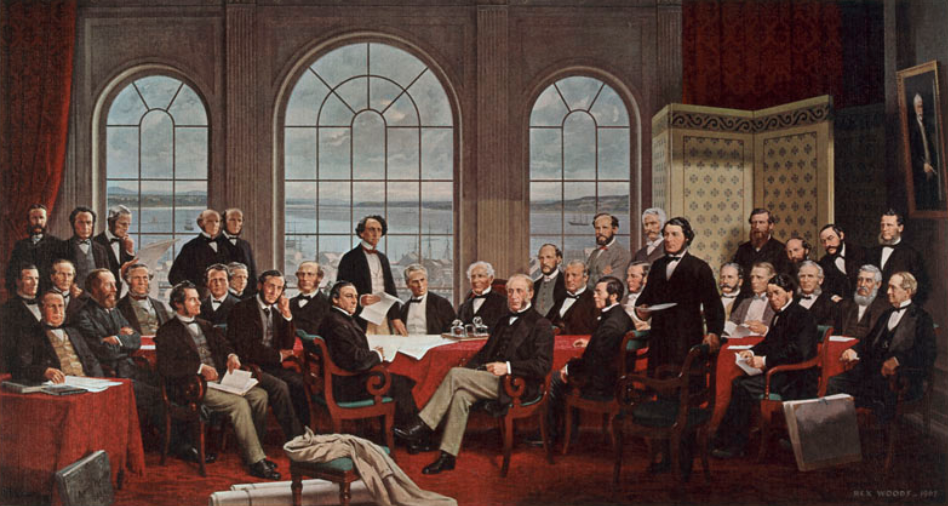
These guys are important, no question, but you need to go back a long way before them to really understand Canadian history. The nation didn’t burst fully formed from Sir John A.’s forehead, Athena-style.
Libraries and Archives Canada item ID number 3013194.
The surest way to make me treasure something is to take it away. So it was with Canada Day, whose annual appearance I’d once greeted with scarcely more excitement than the Ontario Civic Holiday and Aromantic Spectrum Awareness Week. Then came 2021, when the high priests of social justice demanded that we cancel Canada’s birthday celebrations, so that we might spend July 1 in morbid contemplation of our original sin. Not being one for rituals of confession and penitence, I instead began to think harder about why I love this country, despite its flaws — even if expressing such sentiments in public was now viewed as hate speech.
“This country was built on genocide”, ran one major-newspaper headline, amid the national meltdown following reports that hundreds of unmarked children’s graves had been found at former residential schools. Calgary dropped its fireworks program on the basis that (among other reasons) such scenes of celebration might hamper “truth and reconciliation”. Justin Trudeau, who’d come into office urging Canadians to “celebrate this amazing place we call home”, now took Canada Day as an occasion to instruct us that “the horrific findings of the remains of hundreds of children at the sites of former residential schools in British Columbia and Saskatchewan have rightfully pressed us to reflect on our country’s historical failures”.
The prime minister’s suggestion that children’s corpses were being plucked from the ground en masse turned out to be a reckless falsehood. Even the Tk̓emlúps te Secwépemc Nation, whose chief once claimed that “the remains of 215 children” had been found in Kamloops, now seems to be acknowledging that her original statements were wrong. While Canada has much to answer for when it comes to the legacy of residential schools, no graves or bodies were found at these locations in 2021. And none have been found since.
[…]
The unfortunate truth about Canada’s 19th-century origin story is that our country’s initial contours were sketched out by a group of middle-aged binge drinkers whose focus was less on life, liberty and the pursuit of happiness than on the mundane task of diffusing the high capital costs associated with rail construction and defending northern rivers and ports from rampaging Americans and Irishmen. (Yes, Irishmen: Visitors to Charlottetown’s Victoria Park will find a trio of ocean-facing nine-pounder guns that were installed in 1865 to guard against the Fenian Brotherhood, whose troops, many residents feared, were set to invade and conquer the island. But faith and begorrah, I do digress.) In this project, the Fathers of Confederation were successful. But the ensuing separation from Britain was a slow, bureaucratic affair that makes for dull reading (and duller television). I wish it were otherwise, fellow patriots. But alas, these are the facts.
Which is to say that if we’re looking to develop a compelling, historically accurate and, dare I say, inclusive, understanding of Canada’s national story, the story has to begin earlier. Specifically: the early 1600s — two and a half centuries before John A. Macdonald and his fellow Fathers of Confederation were knocking back the giggle juice in Charlottetown Harbour. As you might imagine, this means giving a starring role to Indigenous peoples — though not as the sacred martyrs and magical forest pixies of modern progressive imagination, but rather as the true-to-life diplomats, traders, craftsmen, hunters and soldiers that the first waves of Europeans knew them to be.
[…]
Toronto-born Greg Koabel spent most of his early academic career studying James I’s England (with a particular focus on the 1641 treason trial of the Earl of Strafford). And so, crucially, he approached the history of Canada laterally, through the prism of English and (primarily) French geopolitics. In telling the story of the first sustained European settlements in North America, he pays Indigenous populations the respect of examining them through this same geopolitical lens.
The resulting narrative, told in his brilliant Nations of Canada podcast, is so fascinating that you’ll have to keep reminding yourself he’s talking about Canada. This past week, Koabel hit a major milestone, releasing his 200th episode. And with his permission, I’ve been adapting his long-form audio chronology to written publication at Quillette. So far, we’ve published more than 100,000 words, and Samuel de Champlain hasn’t even left the stage yet.
I’m not much of a podcast listener, aside from The Rest is History and some Minnesota Vikings-specific sports podcasts, but the Quillette serializations of Koabel’s podcast episodes really are excellent and more than repay the effort to read them.
July 1, 2024
The Anglosphere “imported American racial progressivism, and then commenced to import American-style racial problems. Thanks, America.”
At Postcards From Barsoom, John Carter discusses meritocratic racial quotas in employment and higher education as a “Universally Disagreeable Compromise”:
Graphic for Rhode Island College’s Office of Diversity, Equity and Inclusion.
The race question has been a fault line in American society from its inception. In the aftermath of the hypermigration of the early twenty-first century, it has only become more complicated and divisive, not only in America, but throughout the Anglospheric world. The rest of us imported American racial progressivism, and then commenced to import American-style racial problems. Thanks, America.
The question seems to ultimately revolve around who shall receive the economic spoils. The “equity” that is endlessly referenced by diversity commissars is literally the home equity held by the white middle class, which the diverse and their champions openly intend to expropriate and redistribute.
The most contentious battlegrounds are in academic admissions and corporate hiring, in which the imperative is to minimize the number of White men, and maximize everything that isn’t White men. How the everything else is maximized is of no particular account. A team composed entirely of black men is just as “diverse” as a team which also features Black lesbians, Arab homosexuals, and Thai ladyboys. It is the presence of White men that makes organizations less diverse: a team composed entirely of Black men, with the exception of a solitary White male token, is less diverse than the all-Black team.
For generations now we have suffered under the affirmative action regulations imposed under the banner of Civil Rights. For proponents, Civil Rights are a civic religion, and they guard the advantages won by adherence to their faith jealously. For the victims of affirmative action – which includes both those rejected from employment or university, as well as those subjected to the incompetency of affirmative action admits and hires – affirmative action is a hateful absurdity.
The underlying problem, which to this day only Internet edgelords will openly discuss, is human biodiversity. The various ancestral groups are, in fact, different, in ways that go beyond the merely cosmetic, to include general levels of cognitive aptitude, along with specific behavioural proclivities. To a certain degree this is due to upbringing, but only to a certain degree; upbringing can bring a child as close to his genetic potential as possible, but cannot push him beyond it. The best that nurture can do is to allow nature to flower; it cannot change nature. The natural outcome of this is that, under a purely race-blind, meritocratic dispensation, there will be noticeable and ineradicable differences in the representation of various races within any given profession.
Whether or not one supports a purely meritocratic approach to admissions and hiring then tends to depend a lot on whether one belongs to a group that is likely to do well, or poorly, under such a system. East Asians tend to support a more meritocratic approach, because their high test scores, good study habits, and strong work ethic mean that they will be extremely competitive. Blacks, on the other extreme, are far more skeptical of meritocracy, intuiting that a ruthlessly meritocratic approach would tend to see them pushed out of the professions at the expense [or rather, to the benefit] of Whites, Asians, and Indians.
The current system is practically the worst possible system. The official narrative is built upon the foundational lie that we are all the same under the skin, and that any difference in group-level socioeconomic outcome can only be the result of bigotry, racism, systemic racism, implicit bias, and the historical consequences of slavery or colonialism. This lie has driven our society quite insane, leading in particular to the demonization of Whites – a large fraction of whom buy into the narrative of ethnomasochistic guilt with religious zeal, and another large fraction of whom reject this framing of their racial character as sick and ugly. To a large degree the culture wars are driven by this very division. In the American context, this division maps quite closely to Constitutionalists vs Civil Rights adherents, i.e. it is a holy war between the two dominant civic religions. It is not accidental that this also maps to Republican (i.e. those who wish to preserve the Old Republic built by the Constitution) vs Democrat (i.e. those who wish to complete the transformation of the Republic into something [like] the Our Democracy they’ve been growing in the soil of Civil Rights).
As William M Briggs has pointed out ad nauseum, the prohibition of “disparate impact” and “discrimination” under the Civil Rights regime is an absolute nightmare for corporate America. On the one hand, to discriminate on the basis of race (or any other identity) is plainly illegal; on the other, to not discriminate is invariably to open oneself to charges of discrimination, as the various statistical differences between racial groups work themselves out in aptitude tests, SATs, grade point averages, or job performance. This places employers in the Kafkaesque position of being required to discriminate without being seen to discriminate. They must put their thumbs on the scale to ensure equal outcomes, without being caught doing so.
For Whites especially, this has been a very bad deal. Because no organization will ever be sued for taking on too many officially victimized minorities, there is no upper limit to the number of diversity hires; but if the student body or corporate org chart falls below a given group’s fraction of the population, lawsuits are almost guaranteed. This then produces an inevitable ratchet effect which systematically excludes White people from their own society, with corrosive effects on competence, morale, and confidence in institutions. It doesn’t help that, because we are still officially meritocratic, the leadership classes subject us all to constant gaslighting: we are discriminated against openly by people who brag about discriminating against us while insisting in the same breath that there is no discrimination. It is not surprising that many of us are ready to burn these people at the stake.


